Wednesday, September 14, 2022

George Mackay Brown - Greenvoe

* Spoilers*

George Mackay Brown (1921-1996) was Orkney's foremost poet and novelist. By the time he published Greenvoe, his first novel, he was well known for poetry and short stories. Living relatively reclusively in Stromness his novel is soaked through with a sense of Orkney. His fictional community of Greenvoe is on the fictional island of Hellya, it stands in for a myriad of island and remoter communities. 

Greenvoe is a small fishing community. It is shot through with the class differences that are usually ignored when novelists write about Scotland. This is not an idyllic village, rather its one where rich and poor live cheek by jowl, jealousies, adulteries and disagreements fester and those higher up the wealth ladder sneer down at those below. At the top of the food chain is the laird in the "big house", his beautiful daughter visits from the Scottish mainland, triggering lust and jealousies. But there are other visitors - including the Asian travelling clothing salesman, who is met with interest, custom and poverty - while offering his own sharp commentary on Greenvoe's inhabitants. 

Much of the book deals with these characters in passing, the hard-drinking Tommy who beachcombs for a living, the ferryman Ivan Westray, described as a "ladies man" in the book's blurb but who is much nastier than that, and most interestingly Skarf, a Marxist and failed fisher who is writing a history of the island and whose prose entertains the drinkers in the hotel bar. Skarf is fascinating because through him Brown links the deep history of Orkney with contemporary events. There's continuity between the too. 

Despite Skarf's politics, I was most interested by the elderly Mrs Mckee, who is only on the island because of the irresponsible behaviour of her alcoholic son Simon, the local minister. Mrs McKee is drowned in anxiety and sorrows, reliving her past life immersed in her own petty guilts. Through her we learn of the tragic backstory to her son, but her own life - restrained by the limitations of class and wealth.

But these intricately drawn lives, woven together so skilfully by Brown, are town apart in barely a week as the secret "Black Star" project arrives on the island. Like so many Scottish people before them, the community is broken apart and scattered, for the interests of a small minority. 

Greenvoe's greatness lies in the portrait of a town in tension with itself, pulled back and forth by the petty ruptures and interests of different individuals, and their own histories, lies and prejudices. Brown demonstrates a clever eye for moralistic shopkeepers and cheating publicans. But none of his characters are innocent, they're all flawed. Their tragedy is that they're victims of circumstances not of their choosing. Skarf understands that.

Tuesday, September 06, 2022

James Hawes - The Shortest History of Germany

James Hawes' The Shortest History of Germany is a bestseller. This shouldn't be a surprise. The historical trajectory of the twentieth century was fundamentally shaped by events in Germany and today the country remains a powerhouse in terms of the European economy, central to events in the wider region. German history remains of interest to the casual reader as much as the academic historian. Hawes' book promises to explain it all in short, accessible bites to the reader. Unfortunately I think the book is utterly inadequate and its conclusions leave the reader open to dangerous conclusions about what happened and why in the mid-twentieth century and beyond.

In short, Hawes argues that to understand modern German history we have to look into the distant past, and sees the fault lines of Germany society arising out of fundamental divisions that go back to the era of the Roman Empire and Charlemagne. He concludes that "Germany is the sole hope for Europe... it must now be embraced, as what it was always meant to be: a mighty land at the very heart of the West". 

Germany, Hawes argues, has always faced two ways: West and East. The western looking side has had a progressive, modern outward looking world view and the East has been the source of chaos and danger. Take the question of Hitler's victory. Hawes rightly points out that Hitler failed to get a majority of votes, but he argues that the key determining factor of this was the religious background that people had, and that was shaped by the historical development of Germany. He then argues that this is rooted in the ancient past:

In many areas within the Roman limes [borders] of 100Ad, Hitler fails to break 35%... The average here overall is well under 40%. Even with the whole state apparatus behind him... Hitler has failed to take the west and south of Germany. In fact, only two constituencies within the bounds of Otto the Great's Empire of 940AD. give Hitler a majority - and they both lie right at its eastern limits, on the western banks of the Elbe.

Correlation is, of course famously not causation. The problem with this argument however, is it basically implies that everyone east of the Elbe is always going to be right-wing. Such geographical explanations are inadequate, but Hawes dishes them out with gusto. Of East Germany he writes, it "didn't become different because of the Russian occupation of 1945-1989; the Russian occupied the place because it had always been different". Surely most readers here would pause and point out that the Russian's occupied Eastern Germany because they arrived from the East.

What Hawes fails to offer the interested reader is any explanation for events. History is, to paraphrase, "just one thing after the other". For Hawes, the Nazis arose because Hitler was able to manipulate people to accept him in the chaos that followed the first World War. But Hitler was able to do this because the chaos had been caused by the left. The new German government after World War On had "no reliable forces of its own" so it had to turn to the "Free Corps" to crush the "red rioters". Yet the revolutionary period that followed World War One was one of mass mobilisations by German working people fighting for jobs, equality and freedom - not a few rioters. Time and again Hawes blames the Communists for wanting to overthrow the "new democracy" despite that new democracy being vicious towards ordinary people as it tried to save capitalism from itself.

Hawes argues that Hitler was successful because the Nazis deliberately copied "the street fighting style and the modern-seeming politicking of the new, Lenin-inspired left". In fact, at times, it seems that Hawes' real targets are the left. Completely incorrectly he writes that "Hitler's ideas were closer to Lenin's than to any traditional European conservatism", neatly ignoring the rabid antisemitism and racism at the core of Hitler's ideas and his stated counter-revolutionary agenda. Hawes doesn't mention how the first victims of the Nazis were the left, and especially the Communist left, despite them allegedly being so "close" in ideas. In fact Hawes' characterisation of the left and the far-right is shockingly incorrect:

Both Lenin and Hitler appealed to perverted versions of that great 19th-century liberal ideology (as seen in Hegel, Marx and Darwin): the idea of progress-through-struggle-to-utopia.

Hawes' argument that Marxists believe in "progress-through-struggle-to-utopia" doesn't stand up to scrutiny, whether in the work of Marx, Lenin or German socialist thinkers like Rosa Luxemburg. It is, of course a feature of Stalinism and Second International Marxism, though Hawes only sees continuity from Lenin's era to Stalin when he should see a break and seems to celebrate the entirely pro-war Second International. But Hawes' generalisations are also worrying. He presents Hegel as "the root of all evil?" but neglects to discuss some very dangerous thinkers who were real influences on the far right - figures like Schopenhauer, Nietzsche and Spengler. 

This might all be of historical curiosity, but this approach mars Hawes' discussions of post-war politics. The problem is that Hawes' instinctive conservatism cannot really explain the dynamics of German history. He doesn't really offer any explanation of why the German economy tanked in the 1920s, and he seems to have no sympathy with the ordinary Germans that rebelled in vast numbers against the capitalist destruction of their jobs and livelihoods. Because he sees the Russian Revolution as a bad thing, he cannot understand its influence on a generation of radicals, even after the Stalinist counter-revolution. Indeed he can only see continuity and similarity between the right wing in German and the interests of Stalin's Soviet Union.

A book of this length is always going to take some short cuts. But Hawes fails to offer any real in-depth explanation of key events, relying on superficial generalisations. His concluding remarks about the AfD, UKIP, Brexit and Britain and Germany, feel like a crude attempt to shoehorn contemporary political prejudices into a book length framework that doesn't really work. His hope that Germany and Europe will get a "vision of a land treated as, and working  as, the very heart of the West" is misplaced precisely because it ignores the real economic and political forces that shape the terrain that German politics takes place on. The current economic crisis will place new strains and stresses on the German people, and progressives will need more nuanced historical accounts and clearer politics if they are to avoid history repeating itself.

Related Reviews

Kershaw - To Hell and Back: Europe 1914-1949
Browning - The Origins of the Final Solution
Paxton - The Anatomy of Fascism
Mazower - Hitler's Empire

Charles Platt - Garbage World

Garbage World is very much a novel of two parts. First published in 1967 around the time when ecological awareness was beginning to become a mainstream political concept, the book deals with a solar system wide society that has a rubbish problem. The waste and rubbish of human production is dumped on an asteroid which is inhabited by humans who were originally there to manage the waste, but have evolved into an autonomous group of humans who view other "clean" humans with distaste. These villagers scavenge the rubbish as its dumped on their asteroid, eating thrown away food and collecting the best bits of the rubbish. Those who get the best collections of rubbish rise higher in the ranks of their society. Its a sort of cargo cult of humans living on garbage.

But the asteroid is becoming unstable and needs to be managed. A survey team arrives to warn the inhabitants but there are hidden motives. Gaylord, a younger, more impressionable anthropologist on the survey becomes pulled into Garbage World's society. Despite his almost pathological hatred of dirt he gradually gets pulled into life, including beginning a relationship with the daughter of the village head. Gaylord, to use more modern parlance, goes rogue and joins in with an act of rebellion against the outsiders.

The first half of the book works relatively well. Its a fairly amusing commentary on the attitudes of a throwaway society, perhaps mostly targeted at the consumer rich society in the United States of the 1950s and 1960s. Platt is rather humorous, though much of the humour is rather scatological. We are encouraged to laugh at the student people who revel in dirt and rubbish, as well as the overly clean, prim and proper Earthers. Of course this is spoof, so it shouldn't be taken too literarily, but I did wonder whether there was an element of the author trying to portray less technological advanced people as behaving like this.

The second half of the novel is less satisfying. It becomes a rather tame adventure story where Gaylord, his new partner and the villagers try to escape the destruction of their society. At the end everyone engages in an orgy of dirt and sex. So the book begins with a interesting premise but abandons it to engage in a rather putrid adventure. No doubt there are some that were titillated by this odd combination of dirt and sex but it did little for me. Garbage World is an interesting footnote of 1960s science fiction, but it's not a classic.

Thursday, September 01, 2022

Corinne Fowler - Green Unpleasant Land

In July 2021 a coincidence of time and space meant that I was able to join a Stand Up to Racism protest outside the massive estate of Richard Drax. The estate was built with a fortune made from slavery. As Corinne Fowler points out in Green Unpleasant Land, the Drax family made vast amounts of cash from sugar plantations in Barbados and used it to transform the very landscape of Dorset. They built "England's longest wall" around their estate, a wall that remains - keeping out anyone who might want to enjoy the land, or peer at the consequences of such wealth. 

For her unflinching portrayal of the reality of the English countryside, Fowler has received plenty of criticism. In a hostile article the Daily Mail quoted the former, right-wing, Tory cabinet minister Peter Lilley as saying, "Arguably, it is she who has insulted her country by her book whose very title — Green Unpleasant Land — tells us what she thinks of her fellow citizens." Typically the Daily Mail headline claims that "gardening has its roots in racial injustice". It is a click-bait title designed to trigger the sort of apoplectic rage that the Mail's core readership excel in. It is also grossly unfair for Fowler's book is nuanced and detailed about the reality of the English countryside, gardening and its portrayal in literature. In fact Green Unpleasant Land is a remarkably interesting study of the English countryside, its history and the forces that shaped (and continue to shape) the landscape many of us, including Fowler, continue to enjoy. 

The Drax wall is a useful entry point to Fowler's argument. She notes that it "provides a fitting metaphor for the link between empire overseas and enclosure at home". Far from being a idyllic place, the countryside, Fowler argues, was (is) a space of intense struggle over ownership and access. She notes the various class struggles against enclosure or for economic improvements and points out that this continues today. But despite this history, the image of a beautiful pastoral idyll continues. She says:

Industrialised farming and escalating environmental destruction ought to have made naïve visions of the countryside hard to sustain. Yet they have been sustained, and a succession of social histories, personal memoirs and political manifestos have criticised the continuing pastoral view.

In contrast she points to a whole number of books and studies that have demonstrated the exact opposite (including, full disclosure, one of my own books). In particular she looks at the close links between colonialism, racism and the countryside - which manifest both through economic issues such as land ownership and exclusion, to more overt racism directed to Black visitors. She argues that there has been a "collective amnesia about the role of empire", highlighting, for example W.G.Hoskins' classic work The Making of the English Landscape, which "makes no mention of empire".

Fowler dismisses "common misapprehensions about rural England: firstly, that it has nothing to do with colonialism and, secondly, that Black British and Asian British authors are disconnected from English rurality." She systematically examines the way that writers who have written about the countryside, or set novels within it, consider questions of colonialism and racism. There are some fascinating examples. In Walter Scott's 1814 novel Waverley, the Highlands are seen as populated by people compared by Scott to "natives of Africa and America, India and the Orient". Charlotte Brontë repeatedly hints at the "colonial connotations of Wuthering Heights". Descriptions of the moors frequently link the dirty, poverty stricken people to black faced "savages". 

Yet the colonial linkage to the countryside is not just in fiction. Fowler shows how the nature of Empire shaped the countryside too. Drax's wall is one example. The profits from slavery allowed a new landowning bourgeoise to transform the landscape. The enclosures of land and the destruction of common rights, leading to the forcible destruction of the peasantry are part of a process where the primitive accumulation of wealth overseas helped kick start the evolution of capitalism back home. That's the economic context, but there were other examples. Slaves were brought back to England from overseas, sometimes to be black servants, a particularly appalling fashion. There were also black workers, traders, gardeners and escaped slaves in the countryside. The history opf the English countryside is far blacker than the Daily Mail would like.

The global transportation of plants as transformed gardens and farms in Europe. Fowler points out the role of slaves themselves in helping select and transport these plants for botanists, farmers and gardeners to enjoy. The knowledge and labour of enslaved black people and indigenous communities was essential to choosing the plants as well as providing the food to continue with slavery. Gardening may not have had its original roots in racial injustice as the Daily Mail claims Fowler says, but it was fundamentally shaped by slavery, colonialism and imperialism.

Fowler's book is subtitled Creative Responses to Rural England's Colonial Connections. These creative responses include the poetry, novels and essays of black writers whom Fowler examines in depth. The breadth of her coverage of these is remarkable and I found it impossible not to add to my list of books to read as a result. But Fowler also adds her own creativity to the discussion by responding to the themes and arguments in the book with a short story and some poetry of her own. I found these particularly insightful, and it the fact the book brings together the non-fiction and fictional form was both unusual and thought-provoking. I particularly enjoyed the poem about Kings Heath park in Birmingham which I know well. Her poem Green Unpleasant Land is about the response to Danny Boyle's London 2012 Olympic opening ceremony. In the opening chapter of the book Fowler examines the knee-jerk response to Boyle's placing of black people in the countryside and in the poem she has a raging commentator declare:

If you're still listening, here's my message:
to all you pc hand-wringers out there:
Jerusalem will never get built
if you corrupt our heritage

The erroneous belief that the English countryside is untainted by corruption, violence, racism, colonialism or class struggle is a deep-seated one. As Fowler points out, "they" have to keep reinventing it. Why? I think it serves two purposes. By removing the real history of the countryside, it becomes a continuous reservoir that the ruling class can draw upon to challenge progressive ideas. But it also offers something to individuals - escapism, hope, a challenge to the alienation of work and urban areas. We're sold a dream of Jerusalem outside the city, because without that dream, the reality is overcrowded housing, lack of jobs, poverty and polluted streets. Corinne Fowler's Green Unpleasant Land is a challenge to that narrative. It is readable, entertaining and honest, and deserves a wide readership if we are to really build Jerusalem.

Related Reviews

Howkins - The Death of Rural England
Groves - Sharpen the Sickle
Rackham - The History of the Countryside
Poskett - Horizons: A Global History of Science
Horn - Joseph Arch

Wednesday, August 31, 2022

David G. Hartwell & Patrick N. Hayden - 21st Century Science Fiction

After several recent dives into the early history of written science-fiction (see here and here, for instance) I decided to look into more contemporary works. One of the motivations for that was to explore how modern SF considered subjects that were rarely discussed in some of the classics of the genre. Issues such as race, colonialism, class and gender. 

This collection of short stories and novellas is based, with a single exception, on authors who came to prominence in the 21st century. As such its contents are frequently far in time, and subject, from predecessors of the 1960s and 1970s. However thematically in some cases that distance is not so far. There are 34 stories in the collection, and it is gratifying to see that many of these authors are not white, male and North American or European. The genre is much more diverse than it was, though there is still progress to be made. 

In terms of subjects I found my appetite for something different sated quickly with the first story in the book Vandana Singh's Infinities which follows a Muslim mathematician on the quest to understand the infinite. Set in India at at time of pogrom and inter-religious strife it carefully links these issues with wider subjects such as love and solidarity. It was clever, moving and an excellent opening chapter. A similar, post-colonial tale was Tobias S. Buckell's Toy Planes, a brilliantly tight story of a few thousand words that deals with the first trip to space by a Caribbean spaceplane. The final words spoken by the black astronaut, "We're coming up to" felt like a declaration of intent by the author as much as the character. The story itself felt very much like a statement against the dominant forms of the genre.

Some of these themes are touched on in another interesting story by David Moles, Finisterra. Here the main characters deal with poachers hunting massive animals in the atmosphere of a gas giant, yet killing the largest of these threatens a poor community of "Savages. Refugees. Drug farmers". The themes of hunting, poaching and extinction are close to the surface, even if the story turns into a fairly standard, albeit very well written and paced, adventure story.

Several of the stories, including the aforementioned Toy Planes are very short, sometimes less than 1000 words. Several much longer novellas are included like Finisterra. These tended to not be as good as the others. I'm not a great fan of Peter Watt's novels, and while his novella The Island here was more accessible, it lacked a certain clarity on what was happening. Some of the other stories, such as Charles Stross' Rogue Farm, which deals with what happens when robotic AIs become autonomous, felt like call backs to an earlier generation of novels. That's not to say it wasn't fun - I've always liked Stross' writing. But their themes felt liked updated Asimov ideas - though far better written. Another example of this was the fascinating The Calculus Plague by Marissa Lingen which looks at how ideas might be spread virus like. People might be taught maths through contact with others, but how would capitalism actually use such technology. Lingen's story is a sobering and humorous take on that question. John Scalzi's Tale of the Wicked is a classic Asimov robot story, though the characters are more human.

There are well over thirty stories in this fine collection, all of a fine standard and my personal predilections are unlikely to be the same as other readers. Several of the stories, including Vandana Singh's were very good indeed and I particularly liked Cory Doctorow's Chicken Little an updating and riffing on a classic novel Space Merchants. David D. Levine's Tk'tk'tk stood out too - the account of a human salesman trapped on an alien planet, desperate for that last big sale to enable him to go home. Paolo Bacigalupi's Windup Girl made waves recently for a post-climate crisis world dominated by massive corporations profiteering from genetic information. His story The Gambler collected here is a fine return to similar themes. For sheer flamboyance I loved Paul Cornell's One of Our Bastards is Missing. Its a great style that reminded me of George MacDonald Fraser though Cornell's hero is no coward. I also enjoyed and was moved by Mary Rickert's Bread and Bombs, which rang true as we watch the war in Ukraine and remember the wars in Iraq and Afghanistan and the treatment of those fleeing conflict.

However my favourite in the whole collection was Jo Walton's Escape to Other Worlds with Science Fiction, which takes the trope of a world where the Nazis won, and twists it around. It is very reminiscent of a certain book by Phillip K. Dick, but done with style and a new little twist. 

Many of these stories take up the question of artificial intelligence and what it means to be human / alive. I felt this preoccupation reflects less the technological advances of our era, and more a feeling of anxiety at the state of the world. Science fiction hasn't always been the best at dealing with such issues - preferring to offer escapism rather than explanation. This fine collection shows that this is changing and that the future of the genre is in safe hands. If you love science fiction, and particularly the short story form, I'd recommend this.

Related Reviews

Nevala-Lee - Astounding: John W. Campbell, Isaac Asimov, Robert Heinlein, L Ron Hubbard & the Golden Age of Science Fiction

Wednesday, August 24, 2022

Brian Aldiss - The Interpreter

This is an interesting early attempt to grapple with colonialism through science fiction. First published in 1960 it turns some of the tropes of science fiction on their heard by making Earth the victim, rather than the centre of a galaxy spanning civilisation. Earth, and its people, are simply another star system putting resources and wealth into the alien civilisation that has "civilised" them. In his author's note Brian Aldiss comments that the book came because he had seen "at first hand the uneasy relationship existing between 'imperialists' and subject races in India and Indonesia". Sixty years after its first publication author's would no doubt use different language, but there's no doubt that Aldiss is trying to address big questions in a progressive way.

The Interpreter of the title is Gary Towler, the lead interpreter to the alien commander. The aliens refuse to learn Earth's language, considering the art, science and language of humanity simplistic, ugly and stupid. They laugh at Earth's art, condemn its people and strip it of resources. They've also found a layer of people to be their go between, people like Towler whose favoured positions grant them some benefits over the mass of the population, but tie them to the alien's interests.

Word of the ill treatment and corruption on Earth has reached the alien's capital and an inspector heads to the planet. The distance gives the alien commanders on the ground time to set up a better story, using a war with Earth's rebels to justify their behaviour and hiding their corrupt practices. The story focuses on Towler's attempt to convince the visiting liberal dignitary of the reality of their rule, but very little goes to plan.

It's tempting to read a great deal of anti-colonial politics into the story - there's an interesting theme about armed resistance versus passive acceptance of rule in return for improvements for instance- but I'm not sure how much Aldiss draws on real struggles against the British Empire. The ending is far to easy, bloodless and simple, though there is quite a twist. The biggest weakness is the ending which wraps things up too quickly, and leaves some of the plot unfulfilled.

Fans of early science fiction who are of a liberal bent will probably enjoy this book, because it demonstrates that mid-twentieth century science fiction had at least a few authors who were trying out big ideas and radical politics within their novels - unlike writers like Isaac Asimov who were content to pretend Empire would always be benevolent. At the very least Aldiss celebrates anti-colonial rebellion, even if the language and politics feel somewhat dated today.

Related Reviews

Aldiss - Billion Year Spree
Aldiss - Greybeard
Aldiss - Non-Stop

Monday, August 22, 2022

V. Gordon Childe - Man Makes Himself

Gordon Childe was one of the foremost popular left intellectuals of the 20th century. He was a prolific author, and his books aimed at a popular audience sold in their millions. He is perhaps best known for his archaeological work, excavating Skara Brae in Orkney and his television appearances helped cement him as a public intellectual. But Childe was also a radical. As Terry Irving has recently shown, Childe's politics were fundamental to his life, and never far from the surface. He has been described as the first Marxist archaeologist, and in Man Makes Himself, perhaps his finest popular work, he applies his understanding of Marxism to prehistoric history. First published in 1936 it was enormously, and deservedly, popular. 

Today the book is, of course, dated. Even with the changes made for later editions there have been enormous strides taken in science that have shown some of Childe's ideas to be incomplete or incorrect. In particular the advent of carbon-dating and genetic science have transformed our understanding of humanity's early past as well as helping to fix dates on events and objects that Childe could not have imagined. Why then read this book? The first reason is that Childe tries to great a grand historical narrative that shows how the history of different regions fitted into a wider development of technology and ideas in prehistoric times. As Nature wrote when Man Makes Himself was first published:
Childe has a sense of perspective in time, which has been developed to a degree exceptional even among archaeologists, who juggle with millennia; and he is little more restricted in space, for he ranges from the north of Scotland to the Valley of the Indus with a familiarity which few may emulate. He is, therefore, in a position to recommend with confidence the study of archaeology as an antidote to those modern pessimists, who are disposed to doubt the soundness of the foundations upon which the belief in ‘progress', inherited from the late nineteenth century, takes its stand. Neither ‘age’, nor century, he argues, and equally no single area marked out by geographical or national limitations, can afford material adequate for such a judgment. The impartial inquirer must survey all time, and take the whole world as his province, before he ventures to pronounce upon the trend of events in present-day civilization.
This brief comment in Nature does not mention the central ideological theme to Childe's book. He argues that humanity "progresses" through a process of revolution. Two particular revolutions form the core of prehistory - the Neolithic, agricultural revolution and the urban revolution. Childe argues that such revolutions manifest themselves as "an upward kink in the population curve" whereby economic and social revolution transforms the human economy is such away that population growth can dramatically expand. Thus dialectical change, a qualitative change leading to a quantitative change, is central to Childe's theory of history. In turn, such economic changes allow for the development of new ideas, technology and social organisation. 

The second reason that it is worthwhile reading Man Makes Himself today is Childe's approach to historical change. Here he relies on a Marxist approach that places humanity within a wider natural world. Humanity acts on the world, changes it, and is in turn changed itself. However dated the book might be on occasion, Childe's approach remains useful and instructive. Here Childe demonstrates his approach in commenting on the discovery of fire:
But in mastery of fire man was controlling a mighty physical force and a conspicuous chemical change. For the first time in history a creature of Nature was directing one of the great forces of Nature. And the exercise of power must react upon the controller. The sight of the bright flame bursting forth when a dry bough was thrust into glowing embers, the transformation of the bough into fine ashes and smoke, must have stimulated man's rudimentary brain. What these phenomena suggested to him is unknowable. But in feeding and damping down the fire, in transporting and using it, an made a revolutionary departure from the behaviours of other animals. He was asserting his humanity and making himself.
Here it is perhaps worth digressing and noting the use of gendered language. It is very notable in this quote, and the very title of the book, that Childe substituted "man" for the whole of humanity. Childe however makes it clear that he does refer to men and women when writing. Unusually for popular writers of the time, Childe is concerned with the different economic roles of women. Though, on occasion, he does make comments that are somewhat dated. For instance, in discussing the development of pottery, he writes, that "pots were generally made by women and for women, and women are particularly suspicious of radical innovations". But contrast this misogynist comment with Childe's later point:
In our hypothetical Neolithic stage there would be no specialisation of labour - at most a division of work between the sexes. And that system can still be seen at work today. Among hoe-cultivators the women generally till the fields, build up and fire the pots, spin and weave; men look after animals, hunt and fish, clear the plots for cultivation and act as carpenters, preparing their own tools and weapons. But, of course, to such a generalisation there are many exceptions: among the Yoruba, for instance, weaving is in the hands of men.
Childe is notably sympathetic to indigenous communities and women, in a way that many writings of the 1930s were not. While describing some contemporary societies as "savages" he is using language of his time, but is actually remarkably clear that their societies are not backward, but ones that have taken particular historical paths. He is extremely wary of readers seeing such societies as being modern day examples of the "stone age". Rather, he argues, they have taken a path of development that works for them.

However its the question of change itself that I wanted to draw out here. Childe's book is excellent at demonstrating how economic changes can lead to social changes. He explains how agriculture allows the creation of a food surplus which in turn allows groups of non-food producers (priests, soldiers, artists, magicians) to function. It also allows for the stratification of society into classes. This is, of course, a complex process. Childe suggests that hierarchical society arises first because a group of people (priests, magicians) exist who appear to be able to ensure that food is bountiful - their magic means the Nile floods, or crops don't fail etc. 

Childe then argues that societies become resistant to change because these superstitions make innovation difficult. He writes:
When a group are enjoying a sufficiency of food in simple comfort with spells of rest, why should they change their behaviour? They have painfully learned the tricks and dodges, the arts and crafts necessary to coax this modicum of prosperity out of Nature; why do more? Indeed, change may be dangerous... the established economy is reinforced by an appropriate ideology.
There is certainly some truth to this. Not all societies do develop - famously some hunter-gatherer communities refused to make the transition to agriculture because they understood it might mean harder, and more, work. Richard B. Lee's work with the !Kung San in the Kalahari desert has demonstrated this very well. But Childe doesn't also show how the ruling class society can itself be a barrier to development. What I mean by this, is that economic innovation and change can, because it alters the structure of society, can threaten the ruling order. Which in turn means that ruling classes will resist changes - social, political, economic and even technological - if they find that their wealth or existence is threatened.

Thus, the barriers to development are not simply because of superstitions, though the ruling class may well use religious or magical justifications, but they are also because the development of class society leads to entrenched economic interests. This is why the Marxist theory of the state remains so important, but unfortunately Childe doesn't treat it here. It also leads to another problem with Childe's book - the resultant class struggle is absent. Exploitation is mentioned as a source of surplus, and Childe points out that social development often did not benefit the mass of the producers who "formerly so fertile in invention, were reduced to the position of 'lower classes.'

Despite Childe's emphasis on material roots to society he ends up being remarkably idealistic in his understanding of historical change. Of the Egyptian ruling class, he comments, the pharaoh "may have started as a magician.. it is hardly to be expected that ruling classes with such affiliations should be patrons of rational science; they were too deeply implicated in the encouragement of hopes which experience was repeatedly showing to be illusory, but which still deterred men from pursuing the harder road of sustained and intense thinking."

Later he writes:
The superstitions man devised and the fictitious entities he imagined were presumably necessary to make him feel at home in his environment and to make life bearable. Nevertheless the pursuit of the vain hopes and illusory short-cuts suggested by magic and religious repeatedly deterred man from the harder road to the control of Nature by understanding. Magic seemed easier than science, just as torture is less trouble than the collection of evidence.
Why does this matter? Firstly it matters because there is a danger the reader will transpose such arguments to modern times. The reason that capitalism is a fetter on the further development of human society is not because of superstitions and backward ideas, but because the capitalist state and the ruling class block the transformative change we need. Secondly it is problematic because it removes human agency from the equation - people can, and did, challenge ideas and come up with new ones. And latter revolutions - the development of feudal society, or the transition from feudalism to bourgeois society, are closely linked with a development of new ideas about the world and the tensions in the economic base. Reading Irving's book recently I was struck that Childe didn't really grasp the Marxist concept of the state, and that was not just a problem in terms of his contemporary left politics (and practice) but also in his understanding of historical change.

I have dwelt here on some of the problems with Childe's book. So I want to reemphasise at the end that this is a remarkably interesting read. It is remarkably rare to find a contemporary work about prehistory that has the global span that Childe aims for. Even rarer is it for such a book to really have any sense of how historical change takes place. I have, for instance, noted that Francis Pryor's books often suffer from a complete misunderstanding of "revolution" as a process. Childe's work is exemplary on what such economic and social transformation meant. 

Childe's book also covers much ground - from developments in pottery, to the way that mathematics evolved out of the economic needs of different societies. Though some readers might find Childe's explanations of how the Egyptians and Babylonians multiplied a bit opaque!

But the greatest strength of Man Makes Himself is the authors' sense that humanity deserves to progress and that the masses will make that happen. In the conclusion he writes that the word "race" has hardly appeared. This is, he explains, because you cannot explain global developments in terms of race, otherwise you end up with preposterous arguments such as Sumerians were genetically inclined towards mathematics. Instead,
we have tried to show how certain societies in the process of adjusting themselves to their environments were led to create States and mathematical sciences by applying distinctively human faculties, common to all men... at the same time, the achievements we have sought to explain were not automatic responses to an environment, not adjustments imposed indiscriminately on all societies by forces outside of them. All the adjustments we have considered in detail were made by specific societies, each with its own distinctive history.
Such an approach is a profoundly human one, and because it is at the heart of V Gordon Childe's Man Makes Himself, it makes the book remarkably insightful and enjoyable.

Related Reviews

Saturday, August 20, 2022

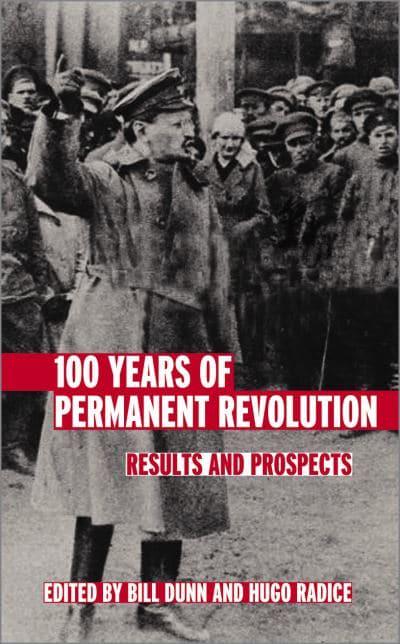
Bill Dunn & Hugo Radice (eds) - 100 Years of Permanent Revolution: Results & Prospects

In 1906 Leon Trotsky published Results and Prospects. The article was written in the aftermath of the 1905 Russian Revolution and summarised his concept of permanent revolution. This idea was perhaps Trotsky's most important theoretical contribution to revolutionary socialism in the period running up to the 1917 Revolution. This collection of essays was published on the centenary of Trotsky's first article and contains studies of the ongoing relevance of the theory. The editors Bill Dunn and Hugo Radice summarise Trotsky's insights thus:

Trotsky rejected a 'stage's theory of revolution - that Russia would have to wait until capitalism was fully developed before socialism could be put on the agenda. Any Russian revolution had to be understood not in isolation, but as a world event both in its causes and consequences. Despite its absolute 'backwardness', competition with the West, and penetration of capital from the West, produced vast concentrations of workers capable of challenging Tsarist power. Russia alone lacked the material basis for establishing socialism, but the seizure of power by a workers' government could lead an international revolutionary process. On a world scale, the development of capitalism already provided ample economic foundations for socialism.

Reading Trotsky's theory today, the editors say, "one is struck by his potential relevance". The theory itself however, was a fundamental break from the general conception of revolutionary Marxism at the time. Even Lenin, a thinker fully capable of breaking out of the constraints of existing revolutionary theory, would not make the leap that Trotsky did in 1906 until the actuality of revolution in 1917. In his essay, Michael Löwy asks, "how was it possible for Trotsky to cut the Gordian knot of Second International Marxism"? He explains, "a careful study of the roots of Trotsky's political boldness, and of the whole theory of permanent revolution, reveals that his views were informed by a specific understanding of Marxism, an interpretation of the dialectical materialist method." Löwy argues that Trotsky's insights arose because he refused to reduce "social, political and ideological contradictions to the economic infrastructure". It clearly was a major break with Second International Marxism, though I think Löwy  goes to far in suggesting that Lenin didn't make the same leap because he did not "discover dialectics" until 1914. What I think is missing from these insights by Löwy is a sense of the way that the experience of Soviet power in 1917 shaped Lenin's views, as well as the failure of Second International Marxism when tested by the First World War.

Trotsky's theory was not widely read at the time he first wrote it, and in the aftermath of his defeat by Stalin, it was side-lined even further. One of the reasons for it, is that it is a direct challenge to the Stalinism nonsense of "socialism in one country". Daniel Bensaid's article quotes Trotsky saying that Marxism, "takes its point of departure from world economy, not as a sum of national parts but asa mighty and independent reality which has been created by the international division of labour and the world market". Elsewhere Trotsky wrote (in 1927) that "The completion of the socialist revolution within national limits is unthinkable. One of the basic reasons for the crisis in bourgeois society is the fact that the productive forces created by it can no longer be reconciled with the framework of the nation state".

Several essays look at how Trotsky's theory can be applied to specific eras and regions. A fascinating study of the Iranian Constitutional Revolution of 1906-1911 sees Kamran Matin apply the theory in really useful ways. He writes that the Constitutional Revolution

can be better understood as a 'revolution of backwardness;... that is to say, as the outcome of the process whereby the revolutionary moments in the developmental trajectory of a non-capitalist society, situated within and under constant impingement of, an increasingly capitalism-dominated international space, assume a particular character underivable from the backward society's internal dynamism alone.

He argues that a failure to understand this sort of approach has been "catastrophic" for the Iranian left. He concludes, as most other authors do, that Trotsky's theory is indispensable for Marxist praxis today. Others aren't as clear and some essays suffer from theoretical weaknesses. Neil Smith's piece argues that the central position of the nation state is being challenged in their role as the "building blocks of a global social and political economy" by institutions such as the IMF, UN and World Bank. Such arguments, common in the early 2000s, are clearly erroneous today. Again, Trotsky's understanding of the dialectical integration of nation states into a global economy is much more useful in understanding global politics and the process of international revolution.

Since this book was published in 2006 we saw the way that economic integration in the Middle East helped spread revolution through the region. We also saw the relevance of a theory of permanent revolution that could encourage workers and peasants to fight for more than simply the replacement of dictatorship with bourgeois democracy - for real economic and political control from below. This is why the conclusion of Micahel Hanagan's piece on Permanent Revolution and Ireland is disappointing as he finishes by saying that "100 years [later] Trotsky's work is still capable of suggesting research agendas and inspiring debates". 

As the revolutionary process in Sudan continues to raise challenges and arguments for those taking part, I'd argue that the importance of Trotsky's work goes far beyond the academic debate and research, but holds out a key insight into how revolution can be victorious. In an era when we face "socialism or extinction" that's the real point. Luckily the vast majority of the essays in this book understand this, and while some of the chapters seem dated in the face of more recent experience, all of them give insights into how Trotsky's Permanent Revolution may well be the revolutionary politics of the 21st century.

Related Reviews

Trotsky - The History of the Russian Revolution
Trotsky - On Britain
Trotsky - Lessons of October
Trotsky - 1905
Trotsky - An Appeal to the Toiling, Oppressed and Exhausted Peoples of Europe


Saturday, August 13, 2022

David Kerr Cameron - Willie Gavin, Crofter Man: Portrait of a Vanished Lifestyle

Willie Gavin, Crofter Man, is the second of David Kerr Cameron's trilogy about history and social life in the Scottish countryside. In this volume he looks at Croft farming, through the life of Willie Gavin, a anonymised croft owner from the early 20th century. Willie's life is recreated by Cameron through archival information, tombstones and the reminiscences of children and grandchildren.

Willie was an expert stonemason who became a crofter on his father's croft. Crofting was extremely hard and unrewarding, Cameron is at pains not to romanticise the lifestyle, or portray the life as some sort of rural idyll. Indeed he criticises those who see such farming as romantic in words that might be applied to those who retreat to the countryside imaging an easy rural life:

Of that rage for improvement, the birth of crofting was maybe the greatest betrayal of all; it deluded men, then trampled on their dreams. Folk took on crofts for the independence they thought they gave and doomed themselves to long disappointment. They believed they were perhaps putting a tentative first foot on the farming ladder and found instead that their position was untenably ambiguous in that new countryside and in a restructured society; they were neither masters nor hired men. Sometimes the croft's appeal lay in the deep-seated desire for a house that would be a home, settled and secure, in that new farming landscape of the tied house and the wandering cottar; the occupants found soon enough that the laird was sometimes as hard to please, and always to pay.

Gavin, perhaps, had less illusions, having seen his father's hard work. Though clearly Willie also believed things would be better. Each year the dreamed that the harvest would be his best, enough to break out of the cycle of poverty and debt. Each year it wasn't. In fact his wife was only able to break from the croft with her husband's death and the selling of his last harvest and all their possessions.

Mention of Willie's marriage brings up his wife, Jess MacKendrick. Her life is told by Cameron, alongside that of Willie. It is poignant - for Jess's life was hard - on her fell the twin burden of child rearing and home management, alongside agricultural work. She married Gavin after they met while she was working as a housemaid, and Cameron has dug out the shopping bill she had as, before their marriage, she purchased what would be needed for their home together. It's a moving list of the minutiae of daily life and the prices the merchant charged.

The twentieth century saw crofting life change - machinery for instance. Though Gavin was old fashioned and refused to use such equipment, relying on his own labour until the stroke that nearly killed him at 75 taking in the harvest in his fields. Cameron notes that this was likely Gavin's most successful harvest as he'd finally switched to a modern seed, though too late to make a real difference. 

As with Cameron's other books, he blends archival and oral history with music, poetry and song. He notes how the stories that Jess tells her children provided a continuity, and their telling "knit the generations" and passed down the "Lore of the Gavins and the MacKendricks... imprinting identity". There is a real sense of the crofting life being locked to the past, but challenged by the new. That said, the family were realtively mobile, visiting town, travelling to see relatives and so on. It would be wrong to see them as being so poor they were trapped at the croft, on the other hand the croft demanded attention constantly. 

The problems of this come out on the Sunday. As observant folk, the Gavins would not work on the Sabbath, despite the havoc this played at key moments in the agricultural calendar. Willie might, if Jess was not watching, make an adjustment to a rope - but little else.

As with all of Cameron's work, Willie Gavin, is an accomplished work of social history that will fill in gaps for those visiting Scotland, and perhaps staying in an old croft. There is no sanitisation here - we are constantly reminded that the modern Scottish landscape was made through hard work, poverty and endless labour by people like Willie Gavin and Jess MacKendrick. It is worth reading this book to remind ourselves of this.

Related Reviews

Cameron - The Ballad and the Plough: A Portrait of the Life of the Old Scottish Farmtouns

Tuesday, August 09, 2022

Caroline Wickham-Jones - Orkney: A Historical Guide

This updated classic historical guide to Orkney is the perfect book to read if you are lucky enough to visit the islands. Caroline Wickham-Jones was a renowned expert historian and archaeologist who lived in Orkney, and there's a real sense of personal touch to the historical summaries and guides: "Bring a torch" she encourages the reader on occasions. 

The book is divided by time period, a short historical overview in chapters dedicated to Mesolithic, Neolithic, Bronze and Iron Age Orkney followed by the Picts, Norse and Earl eras and then 18th, 19th and contemporary history. The book covers a lot because there's a lot to see in Orkney, a place where recent history is often closely linked to ancient eras. It also means that there is a constantly stream of new things to examine in the islands, so the book benefits from a new chapter on "recent archaeological discoveries", which includes, among other things, Norse burial sites in Papa Westray and the hugely important Ness of Brodgar.

On occasion I found the book a little too compartmentalised. The fantastic Neolithic tomb of Maeshowe is described in detail, and Wickham-Jones mentions the Viking graffiti in it, but doesn't offer translations or information until the section on Norse history. A casual reader using the book as a guide book might easily miss these links. I was also surprised to see little or no discussion of enclosure, displacement or clearances relating to the sites mentioned or the history of Orkney. Given the role this played in the transformation of Orkney's farming landscape I was surprised by this.

Nonetheless this is an extremely useful book that every visitor to the islands ought to read as an introduction to the history and landscape of Orkney.

Related Reviews

Irving - The Fatal Lure of Politics: The life and thought of Vere Gordon Childe
Devine - The Scottish Clearances: A History of the Dispossessed
Richards - The Highland Clearances
Pryor - Britain BC

Sunday, August 07, 2022

Brian Manning - 1649: The Crisis of the English Revolution

Brian Manning's 1649 is about a seminal year in world history, the year of the English Revolution. It was a year that began with the execution of Charles I, and ended with the consolidation of the Cromwellian regime. As such its a fascinating work that brims with the insights that only a Marxist historian could develop. It is also a work that takes seriously issues such as the role of women, or the poor in the revolution. Manning begins with a clear statement of fact about the revolution itself:
What occurred in 1648-9 was a military coup d'etat... there was no conspiracy and no secrecy, the army debated and prepared in full public view and gave notice of its intentions - but its actions were decisive and its success swift, and executed by the high command and officer corps without direct popular or mass participation... The events of December-January 1648-9 did lead to significant changes in political institutions and so fall into the category of a revolutionary coup.
Having described this as a coup, Manning is at pains to explain the participation and involvement of various forces. He argues that the "men who made the revolution", where "generally they did not come from the old ruling class or elites but predominantly from the 'middle sort of people', from which sprang the most dynamic and radical force in the parliamentarian party during the civil war.

He explores the radical ideas that were swirling around in this fantastic year, describing the flowering of discontent and thought, and the people who participated in it. A Leveller manifesto from September 1648 demanded, among other things, that 
a just government be set up, wherein all men may be equally bound, and that all publike Officers throughout the Land be chosen freely every year, or oftner if need be; for usually all or most men turn Tyrants if they be in Publike Office above one year.
These ideas may have been pushed by a minority, but Manning points out they were "not so small a minority as is usually assumed", and it is notable "there was so little overt opposition or resistance" to the coup. Manning draws a very important conclusion, "That changes so profound as the transition from a monarchy to a republic caused so little disturbance or disorder implied not only acquiescence, but some willingness to give active support to the new regime.

This arises, Manning explains because of the class nature of the struggle. He says:
Class is a matter of relationships between social groups. The outcome of the revolution was determined by the widening of the gap between 'middle sort' and 'the poor' and the narrowing of the gap between the 'middle sort' and the gentry, which inhibited the 'middle sort' from appealing to the masses. The interests of the 'middle sort' lay increasingly in the extension of enclosure and wage labour. But most of them were not able to take advantage of this: some prospered but many were proletarianized, and the middle class emerged as 'a radical reordering of the social relations within the 'middling sort'. The social context of the revolution was an evolving middle class and working class.
In other words class determined the outcome of the revolution, but was a consequence of the changing economic situation within England. It was this that the old aristocracy was unable to reform itself to deal with, and thus lost out to the interests of a growing minority of the bourgeois order. 

But the nature of the Revolution did not lead to mass transformation in consciousness. Manning notes, for instance, that the "mass" of women did not question their inferior social position. That said they did engage in mass politics, such as demonstrations, preaching and presentations of petitions to Parliament. In this sense, Manning says "there was a revolt against the degree of subjection that confined them to domestic and private affairs and denied them a public and collective voice in the great matters of religion and politics."

But if 1649 saw a great revolution, and huge transformations the agent of that change - the army - itself underwent a transformation afterward. If, as Manning says, it was a revolutionary force in the late 1640s, by the next decade it was a force for "order and stability".

Manning's book is an insightful account of a crucial year of revolutionary history. For those with some knowledge of key events and social dynamics of the English Revolution as well as some knowledge of other left works on the period, it is an indispensable addition to the library.

Related Reviews

Thursday, August 04, 2022

Lyndsie Bourgon - Tree Thieves: Crime & Survival in the Woods

Forests are one of the world's most important biological reserves. They suck about a third of humanity's carbon emissions out of the atmosphere each year. According to the United Nations, forests also "contain 60,000 different tree species, 80 percent of amphibian species, 75 percent of bird species, and 68 percent of the world's mammal species." Despite this importance, tree cover is being lost at an alarming rate, and as Lyndsie Bourgon's new book details, significant damage to our forests comes from the illegal trade in wood, driven by the poaching of trees.

This illegal trade is big business. Bourgon tells us that according to the World Bank, "the global scale of illegal logging generates something between $51 billion and $157 billion annually". Staggeringly, "thirty percent of the world's wood trade is illegal". There's a very good chance that some of the wood in your house comes from trees that were illegally chopped down, very often from protected areas or endangered species.

Bourgon's book is a study of this trade and the fight against the poachers. But what makes her book so important is that she starts from the poachers themselves. She does this by asking two related questions - "how can a tree be stolen?" and "why would someone steal one?" The first question sets up the second. Trees can only be stolen when forests are commodified. 

With the development of capitalism, there was a transformation of how humanity related to the natural world. As Karl Marx put it in his notes now known as the Grundrisse:

for the first time, nature becomes purely an object for humankind, purely a matter of utility; ceases to be recognized as a power for itself; and the theoretical discovery of its autonomous laws appears merely as a ruse so as to subjugate it under human needs, whether as an object of consumption or as a means of production.

Capital transforms nature, and over time, seeks to destroy those societies that retain a different approach to the natural world. The first settlers in the Americas often wrote home extolling the virtues of the landscape in terms that appear to us as a shopping list, which in effect they were. A celebration of the natural wealth of the new continent for those at home that could profit from it. Here is Martin Pring writing in 1603 about Martha's Vineyard:

As for Trees the Country yeeldeth Sassafras a plant of sovereigne vertue for the French Pox, and as    some of late have learnedly written good against the Plague and many other Maladies; Vines, Cedars, Okes, Ashes, Beeches, birch trees, Cherie trees bearing fruit whereof we did eat; Hasels, Witchhasels, the best wood of all other to make Sope-ashes withall; walnut trees, Maples, holy to make Bird lime with and a kinde of tree bearing a fruit like a small red Peare-plum.

Bourgon's book shows how trees were a particular part of this process. A tree can only be stolen once it has been accorded a value and turned into a commodity, but it also can only be stolen when there is a need to steal it. The invention of poaching as a crime made the natural usage of trees (or their fallen branches and fruits) illegal. It was a process contested by those that relied on these benefits - as Marx himself saw when he campaigned against the criminality of wood theft in 1842.

Bourgon agrees. She writes that "People have 'taken' wood for centuries, but wood has also been taken from us". But she adds an important insight, crucial to understanding what is taking place today:

Why might someone steal a tree? For money, yes. But also for a sense of control, for family, for ownership, for products that you and I have in our homes, for drugs. I have begun to see the act of timber poaching as not simply a dramatic environmental crime, but something deeper - an act to reclaim one's place in a rapidly changing world, a deed of necessity.

Her focus is on the forests of massive Redwoods in North Western America and Canada. Here she looks at the development of a huge industry based on the destruction of forests to create timber. A massively profitable industry which saw the development of wealthy lumber towns. The industry itself was based on the dispossession of the original indigenous forest communities - and one that was promethean in its approach. One joke made at the time was that there were always more trees over the hill to cut down. 

That is, of course, not true and alongside the deforestation there grew a movement to protect the trees. Bourgon makes the point that this movement itself was relatively reactionary, basing itself on the notion that "pristine" nature needed to be protected, and erasing the pre-European communities from history. But the movement was successful, creating areas of space that had to be protected and could not be used by its inhabitants in ways that had become customary. It was a process that eerily echoed the enclosure and privatisation of land in Europe, a process whereby, "hunting became poaching. Foraging and grazing became trespassing. Logging became timber theft." As Bourgon points out, many families could now only survive by breaking the law, and so, the act of protecting forests turn the trees themselves into sites for class struggle.

Bourgon explores her thesis by examining the history of Orick, a former lumber town in California. Here she interviews poachers and discusses their history. How their fathers and grandfathers worked in the lumber industry, with highly skilled jobs that were taken from them as the industry shut down. The environmental movement played no small part in this process as the creation of National Parks drove the industry elsewhere. But for some, poaching remains a way of living, and fighting the establishment. Bourgon shows how the tourist wood industry is closely linked to the illegal economy and she discusses the battle by the authorities to stop the poaching, but of greatest interest are the poachers themselves.

These were men who were told that the end of the lumber industry would lead to them having jobs in tourism. These jobs never materialised. But nor did the sort of struggle that could have won them compensation and decent jobs as well as the confidence in themselves as people. Bourgon notes the lack of "class politics" by the environmental movement which meant that they cut themselves off from the workers who could have been their allies. She quotes labour historian Erik Lommis who notes that the process of struggle "undermined potential allegiances" between activists and workers.

It is a crucial lesson for the environmental movement today. We might say "leave the oil in the ground" but unless we can articulate a viable alternative for the workers, they'll may well end up our enemies. Something the oil industry, like the Californian lumber industry, understood all too well. 

Thus the poaching of wood is far more than a way of getting some cash, though it is that. It is a way of fighting the system that decimated your community and forgot you and your family. The destruction of the logging industry saw communities lose "the central meaning of their lives". Bourgon points out that this means for Orick and other towns, "the result is a form of community trauma deeply felt in many rural areas: intergenerational poverty, long-term unemployment, degraded environments, disconnected social relationships and destructive social norms."

Poaching then, is an act of desperation combined with one of undirected rage against a system that has failed the person who is committing the theft. It has its historical parallels with those English rural activists that maimed animals in revenge against those who had dispossessed them from their lands, or those that burnt hay ricks in protest at lost jobs. While we can understand the motivations, we also have to recognise that there is an element of nihilism too. As one poacher says, "they won't have any trees left... I got a saw over there that'll cut down any trees they got".

Bourgon's book then is an insight into the poaching industry from the bottom up. We shouldn't celebrate the poachers though as modern day Robin Hoods, but we can understand them as victims of a system who were failed by the environmental and trade union movements. 

Having taken this approach, Bourgon doesn't neglect the wider economies and politics of poaching, in several chapters she looks at wood theft and the industry globally, seeking to generalise from the California experience. We see how the investigative processes developed in North America have led to remarkable technologies that can help prosecute and identify the illegal timber trade. But it is clear that this is not enough to stop a business that is remarkably lucrative, and begins with small groups of poachers far from urban areas that are impossible to police. But there is another problem - the timber business is so profitable and destructive to the environment precisely because it arises in a system of generalised commodity production, where nature itself has become part of the profit machine. Saving the trees means challenging that system and that means bringing together the environmental and workers' movement.

Lyndsie Bourgon's book then is a remarkable insight into an aspect of environmental politics that few activists even know exists. It is particularly insightful because it begins with those at the bottom of the system, who have been failed by a system that puts profits before people and planet. As such its extremely informative and enlightening. It is also an excellent read that I highly recommend.

Related Reviews

Jackson - The Thief at the End of the World, Rubber, Empire and the obsessions of Henry Wickham
Dawson - Extinction: A Radical History

Archer - 'By a Flash and a Scare': Arson, Animal Maiming & Poaching in East Anglia: 1815-1870
Reed & Wells – Class, Conflict & Protest in the English Countryside 1700-1880
Hay, Linebaugh, Rule, Thompson & Winslow - Albion's Fatal Tree: Crime and Society in Eighteenth Century England
Horn - Life and Labour in Rural England 1760-1850
Rackham - Trees and Woodland in the British Landscape

Tuesday, August 02, 2022

Alec Nevala-Lee - Astounding: John W. Campbell, Isaac Asimov, Robert Heinlein, L Ron Hubbard & the Golden Age of Science Fiction

John W. Campbell's editorship of Astounding magazine from 1938 till the end of the Second World War marks the Golden Age of Science Fiction. It was an era when science fiction became, if not mainstream, at least popular with millions of people, particularly in the United States. Many of the greatest names in science fiction writing such as Asimov, Heinlein, Vogt, Pohl, Bradbury and Bester and many others had their career breakthrough in this period. Alec Nevala-Lee's book details the history of Astounding, and in particular the editor and three great authors of its subtitle who are most associated with the magazine - Campbell, Asimov, Heinlein and Hubbard.

While the book might seem a niche history, its importance is much greater. Astounding magazine was enormously important to many writers, those that had their immediate breaks with the magazine and others who came to the scene later, like George R.R. Martin. As Nevala-Lee points out, "public figures of all political persuasions from Paul Krugman to Elon Musk to Newt Gingrich - have confessed to being influenced by its stories". (We can argue how different their political persuasions are another time!) The magazine was also influential like science fiction more generally in encouraging a generation of young people to become scientists, something crucially important to the development of the US nuclear weapons and space programmes during and after the Second World War.

Astounding's most important editor was John W. Campbell, who saw the magazine as precisely a tool for developing such technical skills for America. He was evangelical in believing Science Fiction would help develop humanity, through the US economy, towards its future. As Nevala-Lee points out, "Campbell and his writers were creating nothing less than a shared vision of the future". But it was a very particular vision of the science and technology that would shape the future. As Nevala-Lee points out, "When we propose technological fixes for climate change, or place our hopes in the good intentions of a few visionary billionaires, we unconsciously endorse a view of the world straight out of the pages of Astounding."

Much of Astounding's output under Campbell confirmed to a relatively restricted framework. Stories tended to focus on heroic individuals whose technological adeptness meant they were able to save the world. Plenty of heroic figures, and few, if any, stories interrogated wider society. Campbell moulded his writers, coming up with plot lines, encouraging and shaping them. Their was a comfortable unanimity to Astounding in this period. Its readers knew what they would get, and Campbell provided it for them, issue after issue, turning the magazine into one of the most popular pulp magazines ever.

The author who best epitomises this was Isaac Asimov. When I was a young teen, convinced that scientific rigour and clarity was all that was needed in order to improve society, Asimov spoke to me. His stories had a logic, structure and clarity that spoke to me. Asimov himself was careful not to muddy the water with complexities like relationships, women or, god forbid, sex. According to Nevala-Lee, Campbell joked that Asimov's books would be ordered by librarians unseen, but those of Heinlein had to be checked first. But Asimov's writings, certainly in his early years, are decidedly conservative - though he would become the most progressive of all of the four. The matched, and indeed were shaped, by Campbell's ideas and while they are readable today, they are remarkably dated. Heinlein didn't match Campbell's conservative politics, though he was enormously popular but it was perhaps Hubbard who Campbell most identified with.

This is not to say that all of these stories are rubbish. Some of the great classics of the genre were published by Astounding - Asimov's Nightfall for instance. Campbell shaped authors, but he had an eye for talent too, though he could also dismiss brilliant writers like Ray Bradbury.

Today Hubbard is known as the founder of Scientology, but less well known is the role played by Campbell in the earlier years of Hubbard's search for a new pseudo-science. Campbell fell for Hubbard's ideas hook, line and sinker. But it is also fair to say that Astounding's editor was looking for such ideas. Hubbard's cranky metaphysical fake psychiatry fitted Campbell's belief in that some humans had greater powers and could utilise them in the quest for a better future. It fitted well with his focus on superhumans in the stories he liked to publish.

Nevala-Lee traces the story of Astounding and these four figures. It's a fantastic, if alarming read. None of these individuals were nice. Campbell himself held appalling racist ideas, and all of them were misogynist. Asimov was a serial adulterer, who was renowned for groping and sexually assaulting women, particularly young female fans. Oddly Asimov was the only individual who remained fairly progressive in opposing nuclear weapons and the war in Vietnam. Though his behaviour towards women is quite shocking. I put the book down slightly sickened by how these writers behaved and thought - and how influential they had become.

Reading Nevala-Lee I was struck that all of the writers in the early years, lacked any real link to wider society. Issues such as race, class, gender etc failed to have any real impact. Their writing tended to exist in a vacuum, which saw humanity as essentially malleable, capable of being shaped by the intellectual elite. Campbell himself clearly saw Astounding as a vehicle for shaping and developing that elite.

Nevala-Lee's Astounding then is a disquieting read. It is a window on a particular part of US culture around the Second World War which became surprisingly important. It is less a history of science fiction in the era and more about how key individuals in the science fiction community came to dominate and how their views of people and society in turn became the bedrock of contemporary science fiction. Luckily there were other writers out there and the later half of the 20th century saw a "new wave" of writers who frequently broke with the formulaic writings of Astounding - something that Campbell could never quite understand.

For those interested in the development of science fiction as a genre Alec Nevala-Lee's book is a must read. But it should also be read by those interested in wider historical and cultural post-war developments in US society - not least Scientology. By turns it is entertaining, interesting, shocking and unpleasant - but its always readable.

Related Reviews

Saturday, July 30, 2022

Harry Harrison - Make Room! Make Room!

Harry Harrison's 1966 novel Make Room! Make Room! is perhaps best known for the Hollywood film Soylent Green that was loosely based on it. The book itself is a political tract dressed up as a science fiction novel, but it is a decent novel - even if the underlying politics are wrong, and the there's a constant tension throughout between Harrison's liberal politics and the right-wing Malthusian agenda underlying the book.

Make Room! Make Room! is a pastiche of a noir detective novel set in New York in 1999. In this future the world is massively overcrowded. New York itself is home to 35 million people and its essential infrastructure cracks under the strain. We hear horrific reports of what is happening elsewhere in the world - Russia and China are in perpetual war in order to keep down numbers for instance. In New York, impoverished people queue for hours for water and soylent steaks [Soy Lentil], unless the water fails because farmers have blown up the pipes. The city is never far from a riot, and life has little value if murder can bring a welfare card or access to other resources.

The book begins with corruption - a wealthy gangster is killed by an impoverished youth. The city fathers think its another mafioso trying to muscle in on their own territory so they pressure the police to find the killer. Andy Rusch is the policeman first on the scene he quickly falls for Shirl, the dead gangsters lover. Together they get a brief glimpse of a better life as they enjoy the remaining fruits of the gangster's wealth, before they move back to Andy's tiny apartment which he shares with the elderly veteran Sol. 

In the narrative Sol plays the role of political commentator - the sort that Robert Heinlein loved to place in his own works. Sol, with the benefit of age, extols on how life was, until people wouldn't stop having children. Medicine, he argues, lead to death control which meant that the world population grew and grew, until the overcrowded planet collapsed. No-one, he tells Shirl, can have any other explanation, neatly ignoring all those economists, political theorists and activists who have argued that there is another explanation. Sol (presumably Harrison's alter-ego) joins a demonstration defending a government bill designed to limit population, at a protest between opposing camps he is injured and dies. In the aftermath of this Shirl leaves Andy, unable to cope with the arrival of a new family taking up the room, and Andy finds the killer, only to find that his seniors in the police ignore this achievement as it's no longer important.

The book does not end as the movie famously does. Though it does finish on a note of despair - Shirl at least has temporarily improved her position, but for the rest life will continue to be very grim. As the new millennium dawns the world population is growing uncontrollably. It's a dire warning, and Harrison opens the book hoping for his two (remember population replacement levels are considered to be about 1.6 children per woman) children's sake that the book proves to be a "work of fiction".

It is of course a "work of fiction" because the predictions inside did not come true. It is also fictional because it is based on incorrect economics. I have written elsewhere on why Malthusian arguments linking population and environmental disasters are incorrect. I hope readers will look at that article before filling up the comment box below with feverish typing. In short, I argue that there are (and were when Harrison was writing) two basic problems with Malthusian politics. Firstly, the driving force of hunger, unemployment and ecological collapse is the capitalist system of production - because it is based on uncontrolled accumulation for profit. The second reason is that the predictions have never matched reality. World population is now reaching a plateau and will likely level off, and then decline in the coming decades. Population growth cannot be directly linked to ecological disaster, as it is mostly happening in countries that have the least population. 

But, in another sense, Harrison's book is prophetic, because the world he depicts is happening. Food and water shortages, unemployment, low pay, poverty are a reality, and enormous numbers of people are suffering and coming into conflict with the system. The cause of that is not overpopulation, but capitalism. We only need look at the way the environmental crisis is dovetailing with economic and social fractures in society to threaten enormous horror. In this sense the book is fascinating, because what Harrison does well is to give his detective novel the backdrop of a society going through a massive social crisis. In Make Room! Make Room! the politicians have no solutions, and live isolated lives of plenty while they use the forces of the state to repress the masses. The people, on the other hand, face a choice - either a personal struggle for existence through crime, or mass revolt. Riots and protests do, as a result, make for key plot points.

The problem is that while Harrison had liberal politics, and indeed the book does demonstrate a certain amount of what we might call class politics - there's a humorous aside where Sol describes the "last Tory" in England being shot trying to stop his grouse woods being ploughed under for food - the basis for the book is utterly reactionary. This is given away by Harrison's "suggestions for reading" at the end of the book (something unusual in a work of science fiction) which includes writings by reactionary overpopulation theorists like William Vogt and Robert Malthus.

Despite the reactionary politics behind it Make Room! Make Room! is an interesting read. Its origins lie in the growing concern over environmental degradation in the 1960s, yet its starting point is a politics that utterly fails to grasp the real problem with society. Nonetheless Harrison writes a good story, and there is far more to the novel than the film it spawned would suggest. It's just a shame that Harrison didn't find any more radical works to read.

Related Reviews

Harry Harrison Novels


Reviews related to population theory