Showing posts with label crime fiction. Show all posts

Monday, May 25, 2026

Lis Angus - That Other Family

How would you react if suddenly, out of the blue, you discovered that everything you were certain about your parents was untrue? This is what happens to Julie Walker in Lis Angus' latest thriller. Julie lives a happy life as the mother of three teenage kids, happily maried to husband Matt, with a decent job at Ottawa's main public library. One day she meets Frances Boyle at work. Frances brings with her some photos of her family and there in the middle, unmistakably is Julie's father. It turns out that Julie's beloved father had two entirely separate families.

For most people this would be a shattering revelation. Frances wants to meet Julie's mother - to her, she's the other woman. With Julie's and Frances' father dead, only her mother can offer an explanation to both women. Before Frances can meet her though, Julie heads out to talk to her mum. To her surprise, when she tries to gently break the news, Julie's mum knows all about the other family. Shock piles on shock for Julie. How could these secrets have been kept quiet for so long. Then her mum spills the beans. The other family is no ordinary family. They're part of a major criminal gang. The sort of criminals bound by honour and committed to revenge. Had they known of the other family the lives of Julie's mum and dad would have been worthless.

Despite some waryness from Julie, Frances bonds with her and her family. Julie's worries seem to disappear. Then, one early morning while Julie's family is out, their house explodes.

So begins Julie's quest for the truth. She's desperate to protect her family. But every turn she's met with official disbelief - even Matt isn't sure things are real. As the threats get closer again, Julie's faced with betrayal and violence from an unknown enemy. Why are the Walkers' being targetted? More importantly, who is targetting them?

Lis Angus is a thriller writer based in Ontario. That Other Family is her second novel, and it is full of delightful twists and turns, tension and a genuinely original plot. The novel is set in an area that Lis knows well. Her acknowledgements include a thanks to an Ottawan librarian for showing her around the library which features in the book! But the landscape and the small towns and villages around the city are clearly drawn from personal knowledge. It makes for an even more realistic story.

That Other Family is a tight piece of writing that lovers of thrillers will enjoy. But there is no morose detective solving the crime, no muscley heroes despatching the bad guys. Instead there's a mother fighting for her family and that's the best sort of hero.

Related Reviews

Macleod - No Great Mischief
Hammett - The Thin Man
Matsumoto - Tokyo Express
Burnet - His Bloody Project: Documents relating to the case of Roderick Macrae

Sunday, April 26, 2026

Dashiell Hammett - The Thin Man

It is New York, Christmas ,1932. Prohibition is almost over and so most people are drinking quite heavily. There is a lot of cigarette smoke, quite a few late night parties, many visits to not very pleasant speakeasys and murder hangs over the whole town. Nick Charles is in town with his wife Nora. Nick is a former detective. Now he looks after his father in law's businesses and is doing very well for himself. His wife Nora is a socialite who drifts between parties and is wary of her husband's drinking. Neither of them get up early.

While hanging about drinking in a speakeasy Nick is approached by Dorothy Wynan. She's the daughter of a former client of Nick's called Clyde. Clyde hasn't been seen in a long time and Dorothy is worried. She's also flirtatious. Everyone is flirtatious, and one of the entertaining things about Dashiell Hammett's The Thin Man is the banter and flitrtation between Nora and Nick. "How about that red-head you wandered off with at the Quinn's last night" she asks him early on in the novel. "She just wanted to show me some French etchings" answers Nick.

Once Clyde's former secretary and mistress, Julia Wolf, is found dead, the plot gets going. Nick finds himself surrounded by a mystery that he has no interest in being part of. Nora is fascinated and he somewhat enjoys himself by showing her the detective ropes. He is further drawn in by being shot at by a gangster who was Julia's lover, and flirted at by Mimi, Clyde's former wife who is now down on her luck as her cash is running out. The police are keen for Nick to be involved and, to make it even more complicated, Clyde's lawyer is a former comrade of Nick's from the army. He's a hopeless shot - Nick saved his life at least once.

Like all decent detective stories, and Hammett's in particular there is a complex plot which throws in loose ends and new characters every few pages. At various points in the novel I suspected every single one of the people above to be guilty, including Nora (for no apparent reason). Classically there's also a thin line between state investigation and private detectives. The cops simply take Nick along with them to key investigations. 

The Thin Man was Hammett's last novel. Its themes are the hypocrisy and drunkenness of America in the 1920s and 1930s and the lazy, wasteful lives of a section of the monied classes. Few of the characters are working. Fewer still get up before 8am or are in bed before midnight. Its a dark, seedy world. Hammett would develop the characters into a series of films. Though some of the scripts remained unfilmed, The Thin Man is dedicated to Lillian Hellman, the blacklisted playwright whom Hammett was romantically linked to for many years. 

The Thin Man's conclusion is not particularly surprising, though its executed with typical flair. But the novel itself feels darker and deeper than many others of its genre. A classic.

Related Reviews

Hammett - Red Harvest
Hammett - The Maltese Falcon
Chandler - Trouble is my Business

Saturday, November 29, 2025

Seishi Yokomizo - The Little Sparrow Murders

In Japan a Temari Song is sung by children as they bounce balls and play together. The titular Little Sparrows Temari song tells the story of three young women, from different backgrounds, who are all "sent away". In other words they are murdered. In the song the women are from different families, whose surname, "locksmith" for instance, tells the listener who they are and what their family does. Such names are common in small rural towns, but this is post-War Japan and a society is going through rapid changes. The song is a link to the past, but it has a shocking echo during the period of the novel as three young women are, indeed, murdered.

The novel is set in Onikobe where the "famous" private detective Kosuke Kindaichi has travelled on holiday. Two decades previously it had been the scene of an intriguing and unsolved murder. But Kindaichi is not drawn there to solve a crime, but to find rest and recuperation. Nonetheless there are connections to the past and early into his holiday the village Chief disappears, leaving traces of blood and poison. An intriguing letter shows that an old lover from the past has reappeared. Has the chieftain been killed for something that happened twenty years before?

As Kindaichi's stay unfolds murder follows murder. The reader will be distracted however by the descriptions of rural Japan, and the fascinating characters. The arrival of a famous singer and actor who grew up in the village further complicates matters, as does the discovery that one of the villagers was an esteemed "silent film narrator" (a role that was peculiar to Japan and makes for a fascinating diversion). The murders are horrific and seem to follow the Temari Song. But I was a little overwhelmed by the number of characters and the convoluted plot. As such I tended to read it more for the atmosphere and aesthetic. Nonetheless I did draw some comparisons with other media - the two rival village families offered some similarities with the setting of the classic Kurosawa film Yojimbo, though perhaps its fairer to say that the context is that of many rural times with families growing rich, or loosing their once esteemed position. In fact there are some intriguing class contexts here but they aren't really fleshed out.

The Little Sparrow Murders was not my favourite Kosuke Kindaichi mystery, but it does have its merits. Readers should start with the earlier books.

Related Reviews

Yokomizo - Death on Gokumon Island
Yokomizo - The Inugami Curse
Yokomizo - The Honjin Murders

Saturday, October 11, 2025

Seichō Matsumoto - Tokyo Express

Traditionally Tokyo Express is described as a novel that opens with the discovery of two bodies on a grim, rocky beach in Japan. They are apparently a couple, who've died by suicide. But actually the novel really opens with the women who work in a small restaurant where one of the dead couple is a waitress.

It's worth noting this slight difference, because central to this classic detective novel are small details of ordinary life. The women who work at the restaurant, whose clients are often wealthy (and corrupt) business men, play an important role in the novel as observers. They are led to see things by the characters, and its how and what they saw which makes the detectives who think there's something odd about the suicide, reevaluate.

Tokyo Express was first published in 1958. It is very much a novel about post-war Japanese society. A society in transition from the stifled, imperial, past to one of open capitalism. While tradition remains important, businessmen are corrupt and easily led. Government officials are lining their own pockets and covering up shady dealings and ministers are under investigation. It's a society in transition, but also on edge. Almost everyone, with the exception of the disheveled detectives, is out to grab what they can.

One other difference is worth noting. The new Penguin edition is a new English translation. The original English title wsa Points and Lines. That, in my opinion, is a far better title. It captures the essence of the novel which hinges on the detectives working out exact timings, connections and travel on timetables. One of the characters (and I avoid too many spoilers here) is unable to leave their sick bed. In doing so, they've become obsessed with the Japanese railway timetable. A similar detailed study by a detective helps break things through. This is a novel that hinges on times and travel, because its all about who could be where and how. And, if they were somewhere specific, then Japanese formality meant that they would leave their name to be trapped by bureacratic paperwork.

This then is a novel that could not have worked in the same way in England. Timetables here might have constructed the context, but the bureaucratic record would have not matched the detective's thoroughness. Tokyo Express then is a tightly written crime novel relying on superb levels of detail. But it's depth depends on close attention to culture and society.

Related Reviews

Yokomizo - The Honjin Murders
Yokomizo - Death on Gokumon Island
Yokomizo - The Inugami Curse

Wednesday, August 06, 2025

James Ellroy - Perfida

James Ellroy is perhaps best known for his two works Black Dahlia and LA Confidential. I recently read, and enjoyed, his American Tabloid and The Cold Six Thousand, set among conspirators, CIA agents, murders and racists around the time of the Kennedy assassination. When I reviewed American Tabloid I described it as being set in "the dark underbelly of the American dream".

Perfida is a very different book to the sprawling conspiracies of American Tabloid and its sequels. However it is also a very dark encounter with US history. Set in the immediate aftermath of Pearl Harbour, the book looks at a horrible episode in US history - the internment of thousands of Japanese Americans for alleged threats to national security. This infamous event was the culmination of racism, imperialism and an opportunity for people to steal the assets and land off those arrested and interned. 

Ellroy explores this episode through the investigation by Los Angeles Police of the murder of a Japanese family. Two rival detectives, both of whom feature in other Ellroy novels set later, are here as is Hideo Ashida, an intriguing character - a Japanese forensic specialist cop. As they police investigate they unravel a conspiracy that brings together Fifth Columnists, asset strippers and many other lowly types, that threatens to spill over the bring down corrupt politicians, policeman and other nasty types.

Its a fat book. Ellroy's clipped style is taken to many an extreme here. "He snagged his car and laid tracks. He took the 1st Street bridge to Broadway. He took Broadway to the parkway. He popped two bennies and hit Avenue 45". It is not hard to believe that 790 pages could have been 350. Sadly Ellroy's probably too big an author to have that level of editing these days. 

But lack of brevity is not the problem. Nor, indeed, is the violence. For me the convoluted plot took too long to bring to a conclusion and I had mostly lost interest by the time it was wrapped up. But if that was one issue the other was the characters who are too one-dimensional. There's  Kay Lake a young woman with radical ideas desperate for adventure whose endless stream of lovers just happens to include almost every other major character. Her radicalism is quickly brought off by a policeman lover who happens to want her to destroy a group of leftists. The leftists in this book, including the awfully cliched radical filmmaker Claire De Haven (who has apparently read Marx and various religious tracts and concluded Marx got it wrong on religion and there is a god) are bad parodies but, I suspect, they reflect what Ellroy thinks about leftists of all stripes.

If the left in Perfida are corrupt, the right are appalling. But it is the right, the fascists and the racists, who get all the airtime to spot off their views and engage in their nefarious plots. There's plenty of random deaths, beatings and racist attacks here. But no one (even the leftists) seems to care. As I thought when I read LA Confidential, one of the problems is that there are no good, or kind, or even normal people in Ellroy's world. This is the underbelly of the US, but there's no nice side. No solidarity, friendship or kindness. 

After finishing Perfida I realised that I had the option to read the rest of the trilogy. But I also realised I didn't care enough - about the characters, about what James Ellroy was trying to say, or about his distorted view of the world.

Related Reviews

Ellroy - L.A.Confidential
Ellroy - American Tabloid
Ellroy - The Cold Six Thousand

Friday, June 06, 2025

Graeme Macrae Burnet - His Bloody Project: Documents relating to the case of Roderick Macrae

His Bloody Project tells the story of a horrific murder in 19th century rural Scotland. It purports to tell a true story based on found documents and archives. While these aren't real, they have been meticulously constructed by Graeme Macrae Burnet and, having read a number of histories of the crofting communities they certainly feel genuine.

The first substantial document is the account of the murderer himself. Supposedly written by Roderick Macrae in his prison cell before the trial, it is a story of his family's life in the small village of Culduie. The village is remote from the big cities and immersed in traditional practices and social relations. Superficially it is more feudal than anything else, Macrae's family use their land on sufferance from the landowner, and mediated through the control of the local authority figure - the constable Lachlan Broad. While Roddy's account is not necessarily truthful, it is shot through with the slights and abuses that these social relations engender. Roddies' father is abused and put upon by the all powerful constable. Following the death of Roddy's mother, their land is reduced and other attacks - such as refusing to allow the family to gather seaweed without permission are symbols of oppression - and Broad's personal victimisation.

Roddy's account is also a coming of age story - as he enters adolescene he is learning about the wider world, relations and sex. Broad is having sex with Roddy's sister, and clearly its a coercive relationship. Roddy's father steadfastly ignores this violence.

Roddy tells all this matter of factly, including the story of how he falls for, and then is rejected by Broad's own daughter. But he then also tells the story of how he murders Broad, and his two children, including the girl who rejected him in order to stop the oppression of his family. Its violent, unpleasant and Roddy is unrepentent. The reader will be torn between the satisfaction of the violent settling of debts with Broad, and simulatneously horrified by the wider killing.

But. Is Roddy telling the reader everything? The documents that follow cast a different light on the story, and Roddy's motivations. The transcript of the trial details the prosecutions desire to portray Roddy as a violent criminal, and the defenses' attempt to paint him as mentally distressed at the time of the killing - distress caused by the oppression and the shock at his mother's death.

Mixed in with this are other stories, including the pompous and unpleasant account of the doctor sent to study Roddy, and the village, in order to better prepare a defence. The doctor, immersed in the latest anthropological studies, sees savagery, stupidity and ignorance everywhere, except among the wealthy and the landowners. Similarly the media reporting of the trial sees the anger by Roddy's family and the wider community at losing land as due to their fondness for outdated and inefficient farming - rather than the despair at the threat to their livelihoods.

Burnet has done a magnificent job of using the "documents" to tell both a story and make a comment on the horrors and difficulties of croft life in a rigid and violent class society. I was pleased, but not surprised, to see that the books he used as source material included works by the wonderful historian James Hunter who has documented similar cases in his own work. 

Ultimately however, this is a novel about truth. Who is telling the truth? What are the real facts? Was Roddy right to kill Broad? Or was he actually commiting a different crime? And can someone take the law into their hands when the law is clearly geared towards protecting the wealthy and powerful. A very good, if painful read.

Sunday, May 18, 2025

Eric Ambler - Journey into Fear

In 1940, during the "phoney" years of the Second World War, the conflict looked very different. Bombs had yet to fall on British or Germany cities. France was still uninvaded, and undefeated, and most people thought the war would probably end up like the First - bogged down in trenches. This entertaining spy thriller written during that period, thus lacks the knowledge of what would come next, and it makes for a surprisingly low key, if tense novel that lays the foundations of thrillers to come.

Eric Ambler's Journey into Fear features Graham - an unassuming military engineer who is in Turkey to sell weapons to a country that many hoped would become an early ally of Britain and France against Germany. (Spoiler: It didn't). As such these arms sales are vital to British interests, and the Turkish government. Graham survives two assassination attempts and the authorities put him on a ship as the train to France and on to England is too dangerous. Graham quickly realises that the assassins are with him on the ship. The crew think him paranoid, and he has only a nightclub dancer and an assortment of eccentric travellers to assist him. 

Its an unusual combination of espinoage thriller and locked room mystery. Who is exactly who is as important as the build up to the action packed ending. There's little here of the military details and sex that bedevils those who came after. But there's some brilliant period background and an exciting plot. You can see shades of Len Deighton, John le Carre and others here. Entertaining and nostalgic. I'm delighted to discover it was made into a Orson Welles' film in 1943.

Related Reviews

Ambler - The Mask of Dimitrios

Tuesday, February 18, 2025

John le Carré - Call for the Dead

Call for the Dead is the first appearance of John le Carré's recurring character, the British intelligence officer George Smiley. Its a very short and puncy novel, dealing with the aftermath of a relatively regular interview that Smiley has with a civil servant Samuel Fennan. Fennan had been in the Communist Party in the 1930s, but that was long ago, and now he's a loyal worker with a decent income and a relatively nice house in the London suburbs. But the following day he is found dead, a suicide note nearby, and Smiley is being blamed for scaring Fennan so much that he felt compelled to kill himself.

But Smiley's recollections of the interview were much more positive. He found Fennan amicable and enjoyed their time together. As he begins to ask questions of Fennan's wife, the local police and probe a bit deeper he finds evidence of a much darker conspiracy. 

Call for the Dead is interesting in a number of ways. Truthfully its more of a detective story, and as Carré's first novel, this and the second, A Murder of Quality, suggest that the author was working out his position in the various genres. The book is also of interest because it gives a lot of background to Smiley himself, that really illuminates some of the later stories. 

But its a great read. The seediness of suburban life and the grimness of post-war Britain really come out well. Smiley himself, and his collaborators in this book, are part of the grey charm. But it's also a reminder that great thrillers do not always need to be 350 pages in length. 

Related Reviews

Carré - A Small Town in Germany
Carré - The Looking Glass War
Carré - A Murder of Quality
Carré - A Legacy of Spies
Carré - The Spy Who Came in from the Cold


Friday, February 07, 2025

Jane Harper - Force of Nature

This entertaining, if unsatisfying, detective story is the second of Jane Harper's novels featuring the detective Aaron Falk. Unfortunately I haven't read the first, but this did not seem to effect my reading of the book at all. Force of Nature follows the aftermath of a corporate team building exercise gone wrong. Two groups of men and women are sent into the hills outside of Melbourne and expected to make their way to the end point. Despite it being a well managed event by organised guides, when the group of women finally make their way out, one person is missing and others have mysterious injuries.

The story is efficiently told, with Harper jumping back and forth between the investigation led by Falk and the account of the women's trip. She handles the points of view well, and the story of the disintegration of the lost party as personal rivalries undermine the team. There's a real tension with the missing woman Alice Russell, as its not clear whether she is alive or dead. 

Unfortunately I struggled to care for any of the corporate types and their motivations felt unlikely. The detectives felt a little one-dimensional at times, and the back story felt squeezed in. All in all its a quick, tense read that lacked the dynamism and pull of Jane Harper's The Lost Man. A good light read but one I fear I will forget rather quickly.

Related Reviews 

Harper - The Lost Man
Høeg - Miss Smilla's Feeling for Snow

Tuesday, October 08, 2024

Len Deighton - The Ipcress File

Len Deighton's The Ipcress File came out in 1962, the first in a series about an anonymous spy who was to be christened Harry Palmer in the films made of the books. Palmer is an interesting character, a direct reposte to James Bond. Spycraft in these novels is not glamorous or sexy, its dirty, dull and bureaucratic. Deighton's version of the British spy system is stuffed full of upper-class ex-servicemen who are well out of their depth, fighting paperwork battles for funding and obsessing over expenditure. His anonymous hero is a working class former soldier who invades their world, delights in insubordination, and has a "to hell with it" attitude to spying and paperwork. It makes for a fun mix.

Expectations of Deighton's book might depend on whether or not you have seen the film. If you have, then it is difficult to shake off Michael Caine's role. If you haven't then you are treated to a first person view of a Cold War London that is emerging from its era of rationing and austerity. The Dockers are always on strike. The coffee is always cold and inadequate and everything is glum and a bit seedy. It is the depiction of this that makes the film of Ipcress File so entertaining. But the book lays it on much harder.

If I have one criticism it is that the first person structure of the novel makes it quite hard to follow an intricate plot. Despite it's relatively short length, this is not a novel to rush through. The sparcity of prose means that missing a line means plot points can be lost quite quickly. Rather like some of Raymond Chandler's work, I am still a little unsure of the fate of one of the characters!

The Ipcress File is a fantastic 1960s story full of double-crosses, betrayal and international machinations. Combined with frustrations about spies who haven't filled in their expense forms. Highly enjoyable!

Related Reviews

Deighton - Winter: A Berlin Family 1899-1945

Tuesday, July 30, 2024

Peter Høeg - Miss Smilla's Feeling for Snow

The novel opened with an extremely gripping atmosphere of early Nordic noir. Set in Copenhagen it follows events after Smilla discovers the body of a young boy who lives in her complex, that it turns out, she has befriended. Smilla is not particularly outgoing, she's a stranger to Denmark, having grown up in colonial Greenland and she views the world through the eyes of a Greenlander, ignoring many European conventions, thinking differently and having an ear to closer to nature. It is perhaps this that leads her to suspect that her young friend has been murdered, and gradually, with the help of another person from the apartment, she begins to unpack a complex conspiracy.

The first half is gripping stuff. Peter Høeg blends the crime story with wider themes of Danish imperialism, colonial history and indigenous ideas and politics. It's well written and fun, and it was good to see the way that Høeg allows the reader to learn more about Smilla as the story progresses through flashback and the like. But, and it's a big but, the story comes apart quickly in the second half as the crime novel moves deeper into conspiracy and then a sea voyage to Greenland.

One of the delights of a good crime novel is that it came frame events around a seemingly minor event - the death of a person for instance. Then construct a believable world and wider conspiracy around this. Høeg constructs the context brilliantly, but the criminal story is just inadequate to the original crime and Smilla's investigation. The story grows off in random directions, characters come and go, and it all feels to unreal. This is exacerbated by the unsatisfactory ending.

This simply didn't work for me. The ending felt like an attempt to turn a crime story into an existential novel. It was so very disappointing. The book also has the single worst sex scene in the literature.

Sunday, March 17, 2024

Seishi Yokomizo - Death on Gokumon Island

Seishi Yokomizo's Death on Gokumon Island is the second outing for his famous detective Kosuke Kindaichi (though oddly in the English translations its the fourth book published). Kosuke is returning from his military service during World War Two in the Japanese army when his friend Chimata Kito dies on the repatriation ship. Chimata entrusts Kosuke to return to bring the news to his wealthy family on Gokumon Island, and with his final breath warns Chimata that his sisters will be murdered unless Kindaichi can stop it.

Arriving on the island, the horrific news shocks the family, and the detective is quickly introduced to the complex social and economic relationships centred on the fishing industry of which the Kito's are heads. Rather fascinatingly there's an excellent explanation of the Labour Theory of Value among fishers here, as Kosuke learns how families like the Kito's get their wealth from other people's labour. Gokumon island itself is a strange place, linked to a long history of piracy, and isolated from the mainland. There's a repeated implication that everyone on the island is different, and strange things are expected.

One by one, the three women are murdered. Kosuke proves unable to stop the sequence, indeed at one point he's suspected of the crime. The bizarre murderes, a series of red herrings and the strange behaviour of many of the inhabitants make it tough for Kosuke to find the killer. But, it should be said, this is not a crime novel were readers will work it out for themselves. The clues aren't all there, and I felt it a little contrived.

Yokomizo was clearly building a brand with his second book. There are plenty of call backs to the first book, The Honjin Murders, and at least one recurring character. It gives the reader a comfortable reassurance, and while the book is not as strong there's still much here about Japanese society, the aftermath of World War Two and a fascinatingly complex series of crimes to solve. The dishevelled, scruffy and dandruff covered Kosuke Kindaichi is certainly a worthy detective to follow into all the sequels. 

Related Reviews

Yokomizo - The Honjin Murders
Yokomizo - The Inugami Curse

Friday, January 19, 2024

Lee Child - Killing Floor

A recent bout of sickness left me temporarily unable to concentrate on books, so I watched the first Reacher series. I chose it precisely because what it seemed to offer was what my brain needed - a strong story line, simple plot and plenty of bad guys being punched by the good guys. Having watched it, I decided to read the book it is based on, the first Jack Reacher novel by Lee Child, Killing Floor.

Reading Killing Floor directly after watching the televised version is an interesting experience. Like the series, the book propels the reader along. There's plenty of action - every few pages a new plot device keeps the reader interested - which creates this feeling in the reader that they need to keep reading. Killing Floor is set in the fictional Georgia (US) town of Margrave. Reacher gets off the bus in order to visit the site of the death of a favoured Blue Singer. His brother has told him about the town, which is the plot device that drags Reacher into the action.

The setup is rather good. Margrave is an extremely pretty, clean and unfeasible wealthy place. Reacher is quickly arrested, framed for the town's first murder in thirty years, and then released. Because of the place of his brother in this weird setup, Reacher essentially gets dragged into the police investigation to find the killer. Quickly more bodies pile up, and there are some very dubious events.

It is all highly improbable. But the reader keeps reading, and Reacher keeps finding out new information. No surprise that Margrave isn't the idyllic location it looks like at first glance. Instead it turns out to be a hot bed of international crime.

Reacher punches, kicks and shoots his way to retribution. Everything is neatly completed and packaged up by the end of the book. Its very like the series - if you enjoyed one while ill with the flu, you'll like the other. I was slightly surprised by the first person format. Perhaps that changes. Either way, its a good thriller that does what it says on the tin.

Sunday, December 31, 2023

Seishi Yokomizo - The Inugami Curse

Seishi Yokomizo published seventy-seven detective novels featuring his Japanese detective Kosuke Kindaichi. This is the second to be translated into English, though it is the fourth in the original order, Kindaichi is disheveled and slouching - more Colombo than Poirot. But like all great literaru detectives he saves up all the information in his head until one final piece clicks into place.

The Inugami Curse deals with rivals for the inheritence of the Ingumai corporation, a massively wealthy institution who accured enormous profits in the run up to WOrld War Two. The head of the clan, Sahei Inugami, dies just after the war ends, and his complex web of misterisses and children find themselves competeing for the vast ammount of money to be inherited. Sahei creates an incredibly complex Will, in order to ensure that his favoured person, Tamayo, the daughter of the couple who adopted and looked after him, gets all. To do this, and to protect her from assassination, Sahei insists that to receive the cash she must marry one of his other three children.

Realistically the only reason this Will exists is to create the sort of complex antagonism that can lead to various family members being picked off. The murderer must be one who stands to gain from the crimes. And the killer or killers realise that they can also use the murders to wipe out Tamayo's claims.

Its convoluted, and readers will be pleased with the family tree for reference. The ending is satisfactory, even if you are able to work out some of it, the denouncement fits it together incredibly satisfactorily. This is the second of Yokomizo's books I've read. They've both been unique and of a high standard. How did he keep it up for the other seventy-five!

Related Reviews

Yokomizo - The Honjin Murders

Tuesday, December 26, 2023

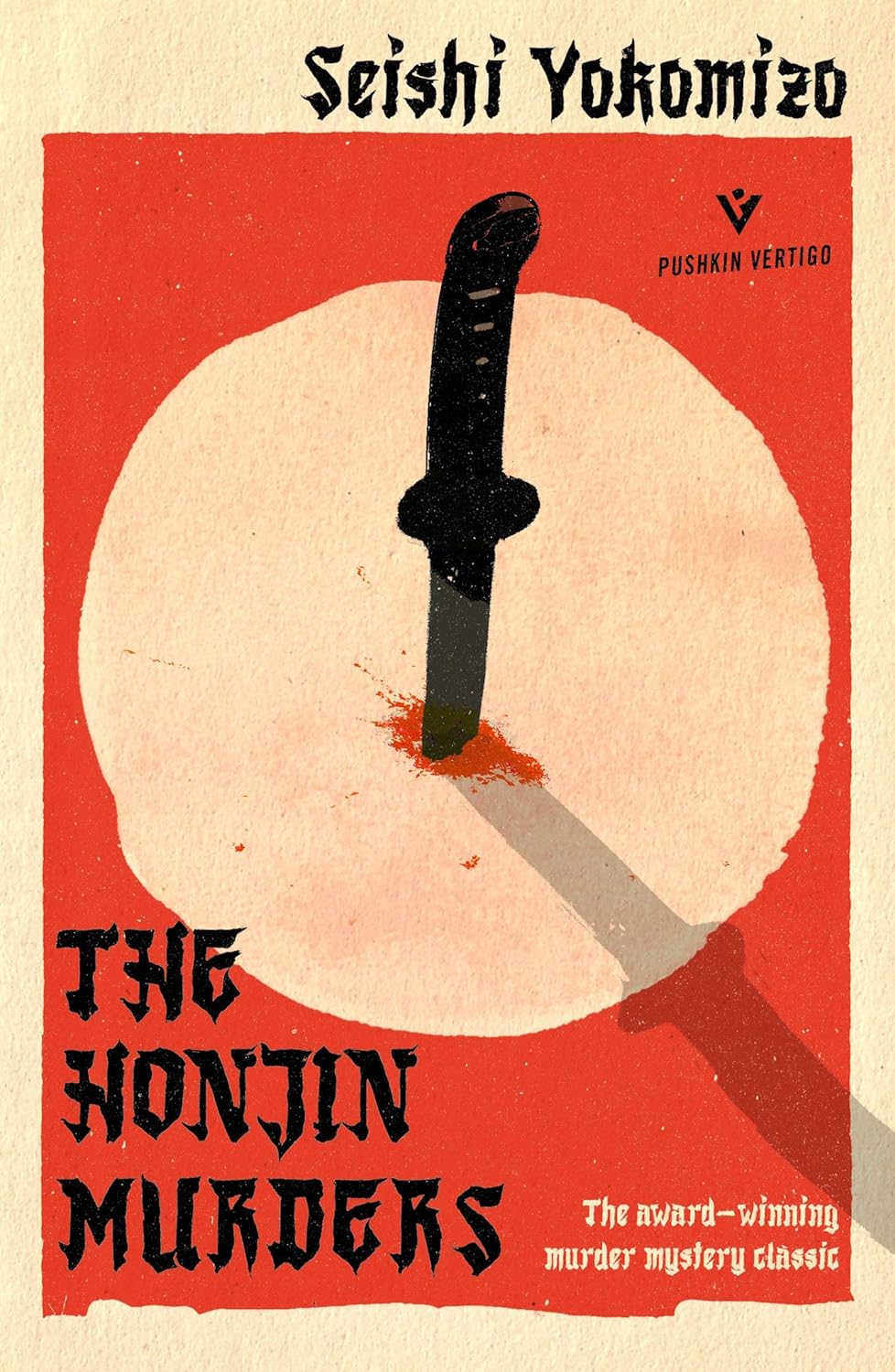
Seishi Yokomizo - The Honjin Murders

Seishi Yokomizo was one of the most prolific of Japanese mystery writers, yet is almost unknown outside of his country. Thankfully the first English translations of the novels featuring his detective Kosuke Kindaichi are now available, of which this, The Honjin Murders, is the first. 

Set in the winter of 1937, but told by its narrator in the last year of the Second World War, the story is consequently framed by what we know happened in that conflict. So it depicts a pre-war rural order that was to be broken apart. The novel actually uses the story of a murder, and its resolution, as a way to frame this change - the old order literally disappears and decays.

The wealthy and upper-class Ichiyanagi family are celebrating the marriage of one of their sons, but after the celebrations, deep in the night, horrible screams are heard - and the music of a Koto playing. On investigation the bride and groom are found murdered, but there are no footsteps too and from the locked room and their seems to be no explanation as to why the murders took place. Suspicion immediately falls on a three-fingered man (a Koto is played with three fingers) seen in the area, until the dishevelled Kosuke arrives.

Yokomizo constructs a very clever plot, and soaks it in the ideas and atmosphere of the some detective writers - Arthur Conan Doyle, Agatha Christie, John Dickson Carr and Gaston Leroux. In fact characters refer to these repeatedly as they reference the "locked room" nature of the killings.

But perhaps of greater interest than the detective mystery itself is the cultural background. The cause of the murder is in fact the misogynist nature of upper-class Japanese society, and while this is skipped over somewhat in the conclusion, the modern reader should perhaps dwell on this a little. 

An excellent read and I look forward to the further adventures of Yokomizo's Kosuke Kindaichi. Louise Heal Kawai's great translation also deserves acknowledgement and praise.

Related Reviews

Carr - Hag's Nook
Carr - The Hollow Man
St John Sprigg - Death of an Airman

Tuesday, July 04, 2023

John Dickson Carr - The Eight of Swords

The Eight of Swords is the third of the Dr. Fell series of detective stories written by John Dickson Carr beginning in the 1930s. It begins with Fell returning from America and immediately becoming sucked into representing the Metropolitan Police at an investigation into a Country House murder. His investigation is hampered by an overly enthusiastic, and eccentric, bishop who is convinced he is an expert detective. The murder victim is an oddly named, Septimus Depping who turns out to be anything but the wealthy owner of the country house.

Unfortunately the book suffers from far too many supporting characters and an overly complicated investigation. As is his want, and tradition dictates, Fell does not reveal his insights until the end (though on occasion he does try, only to be interrupted). The story has a secret passage, midnight shootings, a tense scene in a village pub and a red herring tarot card. All these things ought to make for a cracking read, but I found myself bored and confused by the meandering story and unsatisfied by the outcomes. Why did the bishop slide down the bannisters? One for the fans.

Related Reviews

Carr - Hag's Nook
Carr - The Mad Hatter Mystery

Carr - The Hollow Man

Saturday, April 15, 2023

Chester Himes - All Shot Up

In A Rage in Harlem we were introduced to two of the most memorable police detectives in fiction, Coffin Ed Johnson and Gravedigger Jones. All Shot Up is their second outing and is run through with many of the same themes that makes Rage such a fantastic novel. There is corruption, racism and grifting as Harlem's black community try to survive the terrible housing, police racism and poverty by looking for their big break.

Snow has hit Harlem, as a speeding, fancy Cadillac knocks over an old lady. She survives, but is them immediately, and gruesomely, killed by another car bring driven by three cops. The cops stop the first car, rob the passengers and steal the Cadillac and go on to get involved in a nasty shootout outside a Gay bar. Johnson and Jones have to pick up the mess, and start by assuming everyone is guilty of something - even if its just not admitting to seeing anything. Their roughing up of the drinkers in the bar has nothing to do with homophobia - the two cops seem to dislike everyone equally - and everything to their violent methods of chasing down the guilty. Knocking over a few witnesses publicly helps them get their lead, and we follow them through the dirty, snowy streets into an extremely complex plot.

One of the interesting things about All Shot Up, is that like A Rage in Harlem, several characters are transgender and there are some quite subtle comments on LGBT issues. Several of the gay men in the book lead double, but relatively public, lives. So while the book says nothing about Civil Rights struggles, there is a tacit bringing together of LGBT and racial subjects. This said, there is little or nothing about women's liberation in this - most of the female characters are sexualised and treated misogynistically by male characters. 

But the novel is driven by Jones and Johnson as they bully their way across the Harlem landscape, freezing in their beat up car, drinking spirits to keep going and absolutely happy to open up with their big handguns as often as they can. Chester Himes' novels revel in the chaos and complexity of a detective novel set in a place were everyone is grifting because no one really has anything. The reader is very much along for the ride.

Friday, February 24, 2023

James M. Cain - Serenade

James M. Cain is best known for his two short novels The Postman Always Rings Twice and Double Indemnity. Both of these are brilliant, tightly written novels that delve deep into the underbelly of American society, so I was pleased to get this lesser known work for Christmas. 

Serenade is a very different novel. For a start it is longer than his better known works. Secondly it is much looser in terms of dialogue. Postman and Indemnity felt like the written was squeezing meaning out of every word. In Serenade there are extended discussions about music. The main character is a washed up opera singer, and this allows Cain to wax lyrical about composers, musical styles and musicians. It was a favourite subject of Cain's, and he clearly knew his material. It also helps us understand John Sharp, the washed up singer who gets a lucky break back into fame and fortune via a meeting with a Mexican-Indian prostitute.

We know Sharp because he is a man completely convinced of his own greatness, willing to take any opportunity to get back into the limelight, who falls heavily for Juana. Cain sets her up as the fall guy, the reader expects a moral lesson - where Sharp gets together with an unsuitable, non-white woman, and losses everything. That does, in a way happen, but the great surprise is that it is not Sharp's love for Juana that undoes him, but his previous love for a rich musical lover who happens to be male. 

Serenade is remarkable for a novel of its era in having gay sex, and romance, as a key plot point. It is true that the homosexual aspect is effectively used in a negative way. Sharp loses everything because he has to flee his past, and his personal narrative, and tragedy, rests on him breaking with his homosexuality and accepting his straight self. In many ways though it is Juana who is the real heroine here - standing up to the blackmailers and bullies and fighting for Sharp - though breaking from him when she has to.

Its a strange book, and readers will find some of it very difficult to stomach. There's a lot of racism and  some sexual violence - Sharp, in fact, rapes Juana early in their relationship - though he makes sure to tell himself throughout the book that it wasn't really rape as she wanted it. it makes for an unusual read, that won't be too everyone's taste and perhaps, tells us more about the times than the story itself. Cain does however write some excellent set pieces, particularly the scene when Sharp and Juana are trapped in a Mexican church in a violent thunderstorm - though there's no surprise that this was not made into a movie by Hollywood.

Related Reviews

Cain - The Postman Always Rings Twice
Cain - Double Indemnity

Tuesday, February 07, 2023

John Dickson Carr - The Mad Hatter Mystery

I have been reading John Dickson Carr's Doctor Fell novels following my discovery of the later book The Hollow Man last year. That is considered one of the greatest "locked room" mysteries, and Carr's other works tend to work on a similar principle - a ludicrous or impossible situation is worked out by Fell who improbably refuses to divulge any information on his method until he has worked it all out. I suspect any genuine police officers who worked with Fell would have arrested him for "obstructing the course of justice" or some such misdemeanour.

Of course for the reader this is excellent as it allows them to concoct their own theories only for them to inevitably be destroyed by Fell's own explanation. The Mad Hatter Mystery is the second volume of Fell's stories, and follows this pattern closely. In fact, despite the blurb saying that the books can be "enjoyed in any order", this book does follow on relatively soon after the first story. It is better to read it in order in my opinion. Two seemingly separate sets of events are brought together in a murder. One is the repeated, and public, stealing of hats and their placements in public places. The second is the discovery and then loss, of a priceless and unknown short story by Edgar Allan Poe. 

The details of what takes place matter little, and their divulgence here might spoil the story for future readers. But I found the story incredibly complicated. There were a plethora of characters, many of whom appear to only exist to complicate the main story. The real joy in the book is the setting and the depiction of the police investigation for the murder takes place in the Tower of London and the police search takes our heroes across 1920s or 30s London. We get quite a few insights into drinkers' culture and the lives and loves of our upper-middle class characters. 

But I did not get any satisfaction from the ending. I had little invested in the characters and the central mystery of the Hats was disappointing. A few hours after reading I am not sure I can tell you what and why the murder actually took place. That might be stretching the truth a little, but the book lacked the dark overtones of the other Fell novels. 

Related Reviews

Carr - Hag's Nook
Carr - The Hollow Man

Friday, January 20, 2023

Christopher St John Sprigg - Death of an Airman

There are several remarkable things about Christopher St John Sprigg's Death of an Airman. The first one is that despite its popularity when first published in the early 1930s, it has been out of print for many decades and has only republished by the British Library's imprint.

The story is an unusual whodunnit, set around a small airbase in the south of England in the early 1930s. Flying has taken off as a hobby for wealthy young people who delight in the thrills and dangers, and the reader is introduced to an excellent selection of unusual characters who form the basis for the mystery. The reader arrives on the scene with the Bishop of Cootamundra, an Australian bishop, "on leave" in England who wants to learn to fly so he can better visit his scattered outback flock.

On the first day of his instruction the Bishop witnesses a crash and determines that there is something odd about the death, concluding that murder has occurred. Here's were the book gets a more unusual and interesting. One thing is the aerodrome's characters - most of these are women, including the young woman, Sally Sackbut, who manages the business - Sprigg clearly did not baulk at giving women characters key roles. Another thing is the motive behind the murder which is related to drugs trafficking. Drugs are an unusual plot device for a mainstream murder mystery in the 1930s and it leads our detectives into an international hunt for the killer. There are some fascinating period aspects to this, at one point a policeman expresses surprise at a murder being linked to drug trafficking, "We don’t often get that mixed up with drugs. Have you brought the stuff you found?" he says! Aircraft from the continent stop for customs checks in Kent!

Another interesting part to the book is the detailed descriptions of aircraft and flying. The author was a expert pilot himself, and in fact the most interesting thing about Death of an Airman is the author. Christopher St John Sprigg is better known to history by his pseudonym, Christopher Caudwell. In 1934, the year Death of an Airman was published, Caudwell was starting on a very intense engagement with Marxism and a few years later would publish his first Marxist book of literary criticism about poetry. Caudwell was also an accomplished poet and critic, whose life and work was cut short when he died fighting for the Republican cause in the Spanish Civil War. He died firing a machine gun to cover the escape of his comrades in February 1937, having joined the British Communist Party in 1935. 

Reading Death of an Airman to find hints of Caudwell's emerging Marxism is a pointless task, though his inclusion of numerous female characters points to an individual who didn't accept at least some of the most common fictional stereotypes. In fact while Death of an Airman is an unusual novel, its not a brilliant detective one. The cast of characters, the unusual setting and the period details make it a worthwhile read, but the overall dramatic story was a little disappointing.

Related Reviews

Carr - The Hollow Man
Leonard - Maximum Bob
Cain - The Postman Always Rings Twice