Showing posts with label ancient history. Show all posts

Friday, December 26, 2025

Francis Pryor - Paths to the Past: Encounters with Britain's hidden landscapes

Francis Pryor's books have been some of the most accessible and popular guides to British landscape history. Works such as Britain BC have helped us understand how monuments like Stonehenge are actually part of a human landscape shaped by thousands of years of labour. Pryor's work with Time Team and his pioneering work as a farmer, archaeologist and historian have offered unique perspectives on history, land and society. 

Paths to the Past is a short collection of very brief essays, twenty-four in all, that are Pryor's highly personal engagement with a variety of unusual and sometimes spectacular  sites and buildings. These range from very large areas - such as Orkney's neolithic landscape - to the very small: Cromwell's Bridge in Lancashire. In each place Pryor explores the buildings, the human landscape and the natural world. Pryor's aim with the book is to encourage the reader to visit these places, and he certainly did provide a number of places for me to go in the future.

Unfortunately I found that while all of the essays are interesting, they tend to be interesting because of the places that Pryor is describing rather than his particular insights. I was constantly underwhelmed. Each of the essays left me feeling that Pryor was going to give us some great insight, but I was left wanting. Sometimes its no more than saying he felt the presence of the past. After a visit to the Great Orme Bronze Age mines in North Wales Pryor writes that he was "standing in their space, listening to their sounds".

On a number of occasions I also felt that Pryor's approach to history was to separate humanity from the landscape. More problematically there is no sense of struggle in Pryor's work. There's hard labour, such as that of the Bronze Age miners squeezing through dangerous passages, but there's no struggle. Enclosure is simply described as a process of landscape change made by landowners, rather than the centuries long battle over land, space and political rights that resulted in the great defeat of the English peasantry. That's a far more interesting story and one that surely has resonnances to today.

These are interesting places and Pryor writes about them very well (few authors can make a reader want to visit a shopping centre in Peterborough). But it felt removed from the engaging (and pathbreaking) work that Pryor has produced previously and which I have celebrated. See links below.

Related Reviews

Pryor - Britain BC
Pryor - Britain in the Middle Ages, An Archaeological History
Pryor - Farmers in Prehistoric Britain
Pryor - Seahenge: A Quest for Life and Death in Bronze Age Britain
Pryor - Britain AD: A Quest for Arthur, England and the Anglo-Saxons
Pryor - Flag Fen: Life and Death of a Prehistoric Landscape
Pryor - The Birth of Modern Britain
Pryor - The Making of the British Landscape

Monday, December 22, 2025

Chris Harman - Spartacus and the Slave Revolt that Shook the Roman Empire

Redwords have been bringing out a series of books with transcripts of talks by leading Marxists with new introductions. This little book is based on a talk by Chris Harman at Marxism 1998 in London as part of a course on battles that changed the world. In the talk Harman jokes that the reading wasn't to difficult as there are only two sources for the Spartacus rebellion, and these amount to five pages or so. But what we do know tells us a great deal about Ancient Rome and the position of slaves within it. Harman's historical materialist approach places the battles of the Third Servile War in the wider context of the development of Rome and the limits of the Roman Empire.

Give the short nature of the text Harman only touches on some subjects. Indeed, as Christian Høgsbjerg notes in his extremely useful introduction, at one point in the talk Harman realises he is running out of time and has to summarise a lot of material. It is useful then that Høgsbjerg has access to Harman's original notes as he is able to construct and include material that Harman couldn't include on the day of the talk. But two aspects of the talk remain vitaly important. The first is Harman's summary of the class nature of Roman society and how the army was an essential part of this:

Essentially, what happened was the victory of the Roman armies led to two sorts of immense wealth flooding to Rome. One was the immense wealth coming from the territoties which were conquered by Rome.. the second form of wealth ... was the massive enslavement of populations.

Harman continues:

The Roman rich had these vast sums of wealth... [which] enabled them to buy the slaves off the Roman state, and they systematically then established a situation in which they began tilling their estates with slave. And their calculation was quite simply this. 'The Roman army is invincible. Every year, we conquer more people. Every time we conquer more people, we enslave more people, there's an endless supply of slaves'.

This leads us to the second point of Harman's argument. This model was unsustainable and sections of Roman society understood this. The contradiction was that the cost of fighting the wars became prohibitive, and to try to resolve things the Roman ruling class tried to change society, by setting up forms of serfdom. But the centrality of slavery (and war) to the Roman economy made this impossible. 

This then places the activity of Spartacus and his rebels into context. Because the taking of Rome by the rebels would have meant them implementing the very regime they were rebelling against (they were, after all, former slaves). Harman's conclusion was that the revolt was heroic, but "history hadn't advanced to such a point in which it's possible for an oppressed class to see overthrowing the empire and estabishing itself as a new ruling class upon a higher, better form of organisation of society". In other words, rather like the peasants of the German Peasants' War, their victory could never be permanent, even if they could never overcome the ruling class's forces.

While it's a short pamphlet and, to be honest, Harman's speaking style doesn't readily translate into an easy reading text, there's a great deal in this talk. Once again Chris Harman's historical materialist approach gives us far more insights that we might expect from just five pages of original source material. Christian Høgsbjerg's excellent editing, introduction and footnotes flesh out the material and make this a fine quick read.

Related Reviews

Harman - Zombie Capitalism: Global Crisis & The Relevance of Marx
Harman - Selected Writings
Harman - The Fire Last Time: 1968 and After
Harman - Revolution in the 21st Century
Beard - Emperor of Rome
Parenti - The Assassination of Julius Caesar
Rees - The Far Edges of the Known World: A new history of the ancient past
Tacitus - The Agricola and the Germania

Thursday, October 16, 2025

Owen Rees - The Far Edges of the Known World: A new history of the ancient past

The premise of The Far Edges of the Known World is demonstrated best with the quote that opens the book. The Greek hero Jason (of the Argonauts fame) says to his wife (whom he has taken on his voyages from far away, that "all the greeks consider you to be wise, and you are held in high regard. But if you still lived at the far edges of the world, there would be no talk of you". The Greeks knew that there were placesbeyond the borders of their own lands, but they held them in low regard. They were places of fear, monsters, cannibals and chaos. Home was culture, stability and religon.

The book then is a study of how ancient cultures dealt with the fringes of their influence, and how the places and people of the periphery influenced wider Empires. For most ancient people,"the further away you were from the core of that society, the further away you were from civilisation itself". But the reality was that those people did not see themselves in that way, and their own place was the centre of their universe.

Owen Rees looks at a number of examples of this. Olbia in modern Ukraine was a Greek city on the Black Sea. This was, says Rees, the "outermost reach of the Greek world". Nonetheless the Greek world did reach there. But it was an outpost of Greece among the legendary and violent Scythian nomads who fought on horseback and who might turn themselves into wolves. The city itself "almost absorbed that muthical mustique, that sense of unknown truths, rumours and misunderstandings". But the city wasn't a tiny outpost. It was a thriving city, an economic powerhouse and the centre of trading for a whole region. The people of Olbia, trading salted fish,

which could be transported throughout the Greek world as a luxury item. But they also exported leather, salt, grain and enslaged people, possiblity supplied by the surrounding Scythian communities... Olbia imported wine, olive oil and fine pottery from further south... as far afield as Egypt.

The Greeks believed that the Scythian's rejected their culture but in reality Olbia represents the coming together of culture and the exchange of ideas, as well as trade goods. The Greek myths of Olbia were just that. The city was not a "carbon copy" of other Greek places, but had a "flair all of its own". The edges of Greek influence were ragged and merging elsewhere.

We see the same elsewhere, in multiple examples. The blending and merging of cultures and ideas at the fringes of ancient empires but ones were sometimes the blurring goes much further in to the heart of that culture. Perhaps the most unexpected, and fascinating example, is one from Bais, in Madhya Pradesh, northern India. Here a monument commerates the Greek ambassador who came there and met with Bhagavata, the son of Dion, from Taxila (in modern Pakistan). Rees explores this remarkable and unexpected event - an ancient Greek ambassador in India. Not just that, but one who appears to have gone native. It demonstrates, says Rees, that Taxila was:

a city filled with learning and cultural exchange, where religious innovation and novelty was embraced and given space to thrive. It was a place where no one language superseded another, but where different languages sat side by side.

This might, perhaps, not seem to controversial. But Rees is tackling a problem whereby we tend to see history through the prism of a few, local, examples. Ancient Greece and Rome are the societies by which others are judged, and allegedly form the bedrock for modern culture and politics. Instead, Rees points out, they are also assimilations of other cultures, influenced, shaped and changed by much wider and less well known civilisations. Rees says, "by focusing out minds on the narrow, traditional narratives of history we do not appreciate just how many stories, innovations and shared histories we inadvertantly eradicate". 

I enjoyed Owen Rees' book, but at times I found his central argument was lost in overwhelming detail. At times I also felt it was obscured and needed drawing out more. But the central idea - that cultures are not monolithic and are shaped by interaction and exchange, is one that we could do well to remember today.

Related Reviews

Beard - Emperor of Rome
Al-Rashid - Between Two Rivers: Ancient Mesopotamia and the Birth of History
Balter - The Goddess & the Bull: Çatalhöyük An Archaeological Journey to the Dawn of Civilisation

Wednesday, July 16, 2025

Mary Beard - Emperor of Rome

Emperor of Rome is Mary Beard's latest book aimed at a popular audience about Ancient Rome. As with her others this is accessible, entertaining and readable. This book looks at the Emperors, though as she makes clear this is no easy task. The Imperial period covered a long period of time, and there were numerous Emperors, some of whom lasted a very brief time and several of whom we know little or nothing about. Beard avoids a chronological approach, which is good because it means she avoids having to tell the same story over and again. Instead what she tries to do is to give the reader a general impression of the role, perception and activities of the man who was the pinnacial of the highly rigid, violent society that was Rome.

One of the advantages of this approach is that the Emperor is understood in context. We avoid the "1066 and all that narrative" of good and bad men, and begin to see the men as mor than "benevolent elder statesmen or juvenile tyrants". These are there, and Beard cannot but avoid give us some of the salacious gossip and slander. But she also can conclude that these stories are ones that arise in context - as attempts to discredit, or boost, an Emperor during or after their lifetimes. The Emperors were the top of the ruling class, but they were also important figures in terms of continuinty. As Beard points out, "the magnifying lens of these stories helps us to see clearly the anxieties that surrounded imperial rule at Rome".

It also means that Beard doesn't try to separate the Emperors from those below them. The Emperor cannot exist without military guards and networks of patronage. But he also, being at the top of a slave society, cannot exist without the labour of thousands of slaves. It is the casual commodification of the slaves that highlight the first example of this interaction, as Beard recounts how the Emperor Domitian once held a dinner were everything, including the food dishes, was coloured black. The slaves were painted back, and guest's dinner places were marked with pretend tombstones. The sombre atmoshpere would have terrified the diners: were they about to be executed? At the end, upon returning home, the guests were met by tone of the slaves, carrying a fake tombstone and the washed slave dressed up as a gift. 

There's much in this example - the Emperor's casual references to death as a symbol of power. The even more casual giving of the slave as a gift which, Beard points out, is what will stand out to modern readers. And the use of dinners as places where the Emperor would network and distribute gifts. But we also have to ask "Did it happen"? Was the story, recounted centruies later by the Roman writer Dio, even true. Its a good example of how what we think about Emperors as individuals as well as the role, might be distorted - even if the story reveals much about wealth, power and the nature of Roman slave society.

There's a lot here, and I enjoyed the book as an exploration of the nature of class rule in Rome. Surprisingly for a book focused on individuals it also shed a lot of light on some of the ruins in Italy, particular those in Rome and made me eager to visit again. For other visitors this would be a good book to pack in your holiday suitcase.

Related Reviews

Beard - SPQR: A History of Ancient Rome
Beard - The Roman Triumph
Beard - Pompeii: The Life of A Roman Town
Beard & Crawford - Rome in the Late Republic
Hopkins & Beard - The Colosseum

Wednesday, May 07, 2025

Moudhy Al-Rashid - Between Two Rivers: Ancient Mesopotamia and the Birth of History

Ancient Mesopotamia, the "land between the rivers", sits between the Tigris and Euphrates. An incredibly fertile region, its agricultural food surplus permitted an amazing civilisation to flourish with associated art, military power, royal luxury and monumental buildings. In the 1920s archaeologists excavating a palace building in the pyramid of Ur found a remarkable room filled with items from Mesopotamia's history. The odd thing was that these seemed to be in a place that was built much more recently. In other words these older objects had been moved to a newer room. The headline grabbing speculation was this was an ancient museum.

The pyramid of Ur is old and survived for thousands of years. Its most recent inhabitants, far in our own past, would also have been aware of their own history stretching back thousands of years. In fact, as Moudhy Al-Rashid says:

History, memory and antiquity were important in ancient Mesopotamia and it was not unusual - or even problematic - to blend history and myth. The older a thing or person or event was, the more important it was. Kings regularly sought to root their royal activities and even identities in bygone ages. The Sumerian King List, as a record stretching into a past so distant no sources even survive to corrobaorate it, allowed later kings to associate themselves with such a long list of greatness. The people who wrote the list were attempting the very same thign I am in this book - a history of their ancient past.

The centrality of history, and myth to the Mesopotamian view of themselves is what makes the idea of an ancient musuem so intriguing. So in her exploration of ancient Mesopotamia, Al-Rashid takes the objects found in the "museum" and discusses them in detail to interogate both the ancient history and what history means to us. Its an entertaining exploration of a part of history that I knew little about. 

Part of what makes this point in history so fascinating is that it is so well documented. This is, in no small part, due to the myriad of clay tablets inscribed with cuneiform writing. These tablets document everything from orders by shopkeepers to instructions to the king's personnel. There are also letters between sisters, tables of school children who are practising their letters, together with sketches of their teachers. With these, sometimes very dull and sometimes very moving, documents we see both how the people of the region organised their economies and the things they were interested in. Al-Rashid's expertise is these cuneiform tablets and her enthusiasm shines through. Sadly there are no pictures of the tablets she discuses, so its hard to imagine them. But Al-Rashid's descriptions of the tablets, and crucially, the evolution of the writing form is detailed. This is how we begin to see these objects as parts of an evolving history that has shaped our own.

But in describing the objects and tablets Al-Rashid gives us further insights. The history of the past, as the "king lists" suggest is often the history of a wealthy few. But Al-Rashid digs through this to try and draw out more about who made up the majority of society, and how they lived and worked. She writes:

Some of the earliest cuneiform texts from two of the oldest Mesopotamian cities, Uruk and Jemdet Nasr, record lists of workers whose sexes were labelled in the same way as those of cattle using signs that resembled genitalia. They were counted and accounted for like animals.... Other qualifications also appeared alongside people's names, including the combinations of the signs for 'head' and 'rope' to refer to a person led by a noose, and one sign that simply means 'yoke'.

The wealth of places like Ur and its palaces rested on the hard, and often forced, labour of tens of thousands of workers. As Al-Rashid says these people are barely recorded and remembered apart from a few passing cuneiform references. The rich however are memorialised, and "took their stories into death, along with their many privileges, proppsed up by an economic system that concentrated wealth, for the most part, in the hands of palaces and temples for partial redistribution to a wider population of dependents."

Indeed for those at the bottom of Mesopotamian society somethings were horrific. Some cuneiform records record how parents were forced to sell their own children, even babes in arms, into slavery. Al-Rashid is careful to explore the way the ancient texts demonstrate the reality of the past's class societies:

Cuneiform preserves the stories of people whose work in many ways made life in ancient Mesopotamia possible. The agricultural labrouers who harveted grain, factory workers who made textiles, and the runaway slaves (and perhaps even their bounty hunters) live on in the tiny triangles from ancient Mesopotamia and provide a glimpse of what life might have been life for those whose stories were wtitten down by and for others. 

It is unusual to find a book about the ancient past that takes serious questions of class, gender and power. Mesopotamia was a system that produced great wealth, but we rarely hear about those who created it. As Brecht wrote so memorably:

Who built Thebes of the 7 gates?
In the books you will read the names of kings.
Did the kings haul up the lumps of rock?
And Babylon, many times demolished,
Who raised it up so many times?
In what houses of gold glittering Lima did its builders live?
Where, the evening that the Great Wall of China was finished, did the masons go?


Al-Rashid's book does its best to rescue those forgotten lives and place them in the context of their wider world. Its a great book whose only fault in my view is that it lacks a map and any illustrations. A few pictures of the objects described, and a few images of cuneiform tables and their translations would have made all the difference. But don't let this stop you getting a copy and devouring it.

Related Reviews

Scott - Against the Grain: A Deep History of the Earliest States
Mithen - Thirst: Water & Power in the Ancient World
McAnany & Yoffee - Questioning Collapse: Human Resilience, Ecological Vulnerability, and the Aftermath of Empire

Tuesday, October 29, 2024

Michael Balter - The Goddess & the Bull: Çatalhöyük An Archaeological Journey to the Dawn of Civilisation

Çatalhöyük is perhaps one of the most remarkable neolithic archaeological sites in the world. Situated in  Anatolia, Turkey, it is one of the earliest "cities" known. First discovered by James Mellaart in the 1950s, it was partially excavated several times by him. and numerous artificats, human remains and art works were found. It has been further explored in the 1990s and through the 2000s. It is, without a shadow of a doubt, one of the most important places for understanding early human history. 

Michael Balter's book is one of the few modern, and accessible, accounts of Çatalhöyük. It is simultaneously a book about the history of the site, as well as being an account of the history of the exploration of Çatalhöyük and also a social history of the modern dig. Balter was present for multiple digging seasons - initially because he was writing about Çatalhöyük as a journalist, and then to study the people and the dig itself. It makes for a remarkable account. As one of the archaeologists notes, if you want to understand what has been found, you also need to understand the person doing the dig.

The story starts in the 1950s with Mellaart's discovery of the site, and then his initial excavations. Mellaart looms large over Çatalhöyük, firstly as the finder and excavator, and then as a more controversial figure. Mellaart's own studies were rooted in the prevailing ideas of the time, and several were dated. His own excavations were less rigorous than contemporary digs, but they still yielded important information and insights. Mellaart became a world authority, skilful at public outreach that made him, and the site, famous. But Mellaart was also controversial. Permission for his archaeological exploration was abruptly withdrawn by the Turkish authorities and he was banned from the country after the scandal known as the Dorak affair. In this Mellaart was accused of smuggling treasurers out of the country. The book was published during Mellaart's lifetime, and finishes with him visiting the contemporary dig. But after his death a few years later, it became clear that he had engaged in forgery, blemishing his authority about the site.

Mellaart's legacy and work hung over the dig at the time of its reexcavation in the 1990s. This was led by a British archeologist Ian Hodder, a pioneer of what became known as post-processual archaeology. Balter's book explores the development of archaeological theory, showing how the 1960s led to the emergence of a "New Archaeology" that argued archaeology was primarily concerned with human cultural change. In constrast, Hodder and others argued in the 1980s onward, that what was needed was an approach that "would combine the New Archaeology's emphasis on studying the processes of social change with the concerns of an earlier generation of archaeologists such as V. Gordon Childe and Glyn Daniel, who had viewed archaeology primiarly 'as a historical discipline' and artifacts as 'expressions of culturally framed ideas.'"

This meant that for his excavation of Çatalhöyük, Hodder developed a radically different approach to excavation. He assembled a broad and large team of experts who could look at multiple different aspects of the site - from the remains of plants to the location of bodies - and offer insights. Digging the site must have been a heady experience at times, as the team of archaeologists bounced ideas off each other and explored different approaches. The new approachs to archaeology that emerged in the second half of the 20th century, were heavily influenced by radical movements - from Marxism to Feminism. It is interesting to see the importance of these approaches explored by Balter's book, and indeed how they actively shaped the work and interpretations of the archeaological workers. 

What Balter does in this book then, is quite remarkable. His exploration of the history of Catalhöyük takes place on multiple levels. First their is his account of early human history - the ideas, activity and lives that made up the neolithic culture there. But through his discussion of these he also explores the nature of modern archaeology and its own shaping through contemporary culture. Finally, and inseparable from the previous two, he looks at the workers on the site. Exploring how their own lives, ideas and cultures shape their understanding of the neolithic. 

Lacking an academic grounding in archaeology but an enthusiasm for the distant past, I was expecting to mostly enjoy the bits about ancient Catalhöyük society. I actually found myself fascinating by Michael Blater's exploration of archaeology itself, and the people who make and shape it. A recommended read.

Related Reviews

Irving - The Fatal Lure of Politics: The life and thought of Vere Gordon Childe
Reader - Cities
Childe - Man Makes Himself
Lewis-Williams - The Mind in the Cave
Mithen - After the Ice – A Global Human History 20,000 – 5,000 BC

Tuesday, December 12, 2023

Shlomo Sand - The Invention of the Jewish People

Shlomo Sand's The Invention of the Jewish People was a best seller when it was originally published in Hebrew in Israel. As a result it was published more widely with an English edition arriving in 2009. In his 2010 review of the book Jewish socialist John Rose argued that the book would "accelerate the disintegration of the Zionist enterprise... its ideological credibility, already severely shaken, will now shatter more quickly." Reading Invention in the midst of Israel's renewed assault on the Palestinians, which some have called a second Nakhba, it is hard to think that this happened to any extent. Nonetheless Rose makes an important point. Zionism, and the myths that it rests upon, have taken an intellectual beating from Sand's book. This makes it crucialy important.

A second point made by Rose is equally important. Because this book attempts to explore the real early Jewish history, and celebrates that with "elan and gusto", it makes Sand "immune to any accusation of anti-Semitism". This is, as recent movements have shown, the book even more important.

Sand's starting point is that nation states needs an ideological basis:

The birth of the nation is undoubtedly a real historical development, but it is not a purely spontaneous one. To reinforce an abstract group loyalty, the nation, like the preceding religious community, needed rituals, festivals, cermonies and myths. To forge itself in a single, firm entity, it had to engage in continual poublic cultural activites and to invent a unifying collective memory. Such a novel system of accessible norms and practices was also needed ofr the overarching consciousness, an amalgamating ideological consciousness: namely, nationalism.

Zionist ideas, and thus the Israeli state, rest on a number of such myths that seek to justify the existence and presence of the Zionist state in the Middle East. Much of Sand's book is a demolition of the Biblical basis for these myths, based on a close study of archaeological investigations, primary sources and other historical material. In particular Sand notes that the struggle of the Palestinians themselves helped force a recognition that the foundation myths of Israel were not based in reality:

Young archaeologists began to have misgivings and escaped to earlier eras. More resarchers encountered unresolved contradictions. But it was only after the outbreak of the First Intifada in 1987, and the advent of greater critical openness in the Israeli public arena, that the excavators began to speak up, their voices hoarse from having so long been muffled by sacred soil.

The biggest "myth" that Sand challenges based on this work is the idea of a Jewish expulsion from their historic homeland and their exile. Zionists argue that this expulsion gives the basis for the right for Jews to return to Palestine, and for the establishment of the Israeli state. In painstaking detail Sand explains why this did not happen. Instead Sand concludes, "the myth of the uprooting and exile was fostered by the Christian tradition, from which it flowed into Jewish tradition and grew to be the truth engraved in history, both the general and the national."

Another myth to be demolished was the existence of a "united national kingdom of David and Solomon". All future political models def on this paragon of the biblical past and drew from it imagery, thinking and intellectual exhilaration." But nothing was ever found, "no vetige was ever found of monumental structures, walls or grand palaces, and the pottery found... was scanty and quite simple". Later he adds, "no trace has been found of the existence of that legendary king, whose wealth is described in the Bible as almost matching that of the mighty imperial rulers of Babylonia or Persia". There is, of course, plenty of evidence for these latter two states.

In exploring the history, Sand has to also confront those thinkers of the Zionist tradition who argued for Zionism on the basis of these and other pseudo-scientific myths. These sections are charateristically detailed, and Sand's demolition of these writers and activists is very important as they undermine many of those academics and thinkers who continue to justify Zionism today. In addition we learn that many contemporary myths are also untrue. Jews and Muslims cannot live together, we are told, because they never have. Yet Sand shows the opposite is true. In fact, in the past, people amicably lived and worshipped side-by-side.

Finally Sand critiques the idea that there is a seamless thread from the original Jewish people in the Middle East historically to Jewish people today. Again, Sand shows that this is untrue, taking up the way that communities regularly did convert to Judaism, for religious and occasionally economic reasons. 

History is always written in the context of contemporary debates. The whole thrust of Sand's book is to demonstrate that the myths that form the basis for Zionism, are exactly that - myths. But the Israeli state and its apologists have, over decades, carefully constructed and managed an alternative history. This forms the basis of justification of today's violent repression of the Palestinian people. As Sand says:

Although most of the professional historians knew there had never been a forcible uprooting of the Jewish people, they permitted the Christian muth that had been taken up by the Jewish tradition to be paraded freely in the public and educational venues of the national memory making o attempt to rebut it. They even encouraged it indirectly, knowing that only this myth would provide moral legitimacy to the settlement of the 'exiled nation; in a land inhabited by others.

Today the Israeli State exists as part of a wider set of imperialist relations in the Middle East. Its current assault on Gaza has everything to do with strengthen its hand and protecting its interests. But as Palestinian resistance is rocking that military confidence, and Sand's honest account of Jewish history and the uses (and misuses) it has been put to, is an extremely important expose of the nature of Zionism. In the context of contemporay events it deserves wide readership again.

Related Reviews

Rose - The Myths of Zionism
Fanon - The Wretched of the Earth
Pappe - Ten Myths About Israel

Monday, May 22, 2023

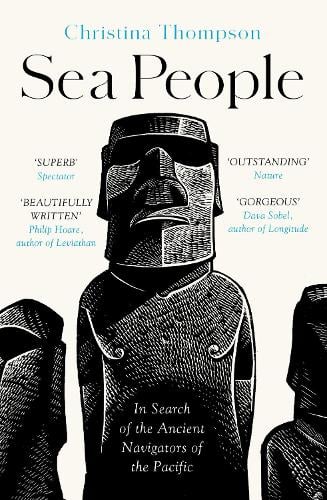
Christina Thompson - Sea People

The Pacific Ocean is the largest body of water on Earth. It huge area is larger than the planet's entire landmass, and its possible to look at the Pacific on a globe and almost imagine a planet completely devoid of land. Yet zooming in from such a view, it quickly becomes apparent that this massive area of water has land, tiny volcanic islands that poke out of the water, sometimes separated by thousands of kilometres. When Europeans first arrived at these islands they were amazed to find most of them inhabited. To the European's this seemed amazing. The islanders had what seemed to be very rudimentary boats. How could this have taken place? 

Christina Thompson's book is a history of the "Polynesian Triangle", an

area of ten million square miles in the middle of the Pacific Ocean defined by the three points of Hawai'i, New Zealand and Easter Island. All the islands inside this triangle were originally settled by a clearly identifiable group of voyagers: a people with a single language and set of customs, a particular body of myths, a distinctive arsenal of tools and skills, and a "portmanteau biota" of plants and animals that they carried with them wherever they went. 

Without compasses, sextants or maps, they colonized the Ocean and did so in a remarkably short period of time., creating what was "until the modern era, the largest single culture area in the world".

The Europeans, of course, could not believe the Polynesian's did this on their own, and a significant part of the book is the story of how Europeans misunderstood the history of the Pacific. Believing that navigation over such distances was impossible without European technology, those that came after Captain Cook, came up with a variety of ideas about what happened. These ranged from the racist - that the Polynesians were actually descendants of white tribes, to the improbable - the Polynesians were actually South American. Much discussion took place about how the navigation took place - whether it was accidental (as most people believed until very recently) or planned.

In exploring the European approach to the Polynesians, Thompson draws out the real story - which is an incredible account of brilliant exploration, genius navigation and completely different ways of understanding the world. She shows how different understanding of the relations between currents, waves, land and water, allowed the first navigators to move around the Ocean with incredible accuracy, and how this was proved by some startlingly brilliant experimental voyages in the 1970s and 1980s. These trips both proved the impossible possible and gave new renewed identities to the Polynesians themselves, rescuing their own history from the condescending ideas of many European scientists. There are fascinating accounts of archaeology, navigation and oral history - and I was particularly struck by Thompson's brilliant account of Cook's relationship to the Tahitian Tupaia who produced a famous chart. Thompson shows how this is actually an incredible accurate map of the Pacific, but one almost incomprehensible to a 17th century European sailor.

I picked up Sea People on a whim in a bookshop and I am very glad I did. It seems like it might be a specialist topic, but its a brilliant exploration of the different "ways of seeing" that different human cultures develop, and how such knowledge has been lost because of the way European colonialism remade everything in its own image. I highly recommend it. As Thompson points out, there are still questions about the origin of the Polynesians, it is "unlikely that we will ever know how some of the remotest archipelagos were initially discovered or how many canoes were lost in the course of this long and arduous colonising process", but

To the extent that this history has been disentangled... it has been thanks to input of radically different kinds. At one end of the spectrum are the mathematical models: the computer simulations, chemical analyses, statistical inferences - science with all its promise of objectivity and its period lapses into error. At the other, the stories and songs passed from memory to memory: the layered, subtle, difficult oral traditions, endlessly open to interpretation, but unique in their capacity to speak to us, more or less directly, out of a pre-contact Polynesian past.

Related Reviews

Poskett - Horizons: A Global History of Science
Cushman - Guano and the Opening of the Pacific World: A Global Ecological History
Moorehead - The Fatal Impact
Hunt & Lipo - The Statues that Walked: Unravelling the Mystery of Easter Island

Sunday, April 02, 2023

Peter Frankopan - The Earth Transformed: An Untold History

The breadth of Peter Frankopan's historical analysis, and his dialectical approach to the environmental and societal interaction does not match up to his lacklustre and cynical analysis of the contemporary ecological crisis. Read it for the excellent historical backdrop to modern society, less for his analysis of the modern world.

I reviewed The Earth Transformed for Socialist Worker Long Reads. You can read it here.

Monday, August 22, 2022

V. Gordon Childe - Man Makes Himself

Gordon Childe was one of the foremost popular left intellectuals of the 20th century. He was a prolific author, and his books aimed at a popular audience sold in their millions. He is perhaps best known for his archaeological work, excavating Skara Brae in Orkney and his television appearances helped cement him as a public intellectual. But Childe was also a radical. As Terry Irving has recently shown, Childe's politics were fundamental to his life, and never far from the surface. He has been described as the first Marxist archaeologist, and in Man Makes Himself, perhaps his finest popular work, he applies his understanding of Marxism to prehistoric history. First published in 1936 it was enormously, and deservedly, popular. 

Today the book is, of course, dated. Even with the changes made for later editions there have been enormous strides taken in science that have shown some of Childe's ideas to be incomplete or incorrect. In particular the advent of carbon-dating and genetic science have transformed our understanding of humanity's early past as well as helping to fix dates on events and objects that Childe could not have imagined. Why then read this book? The first reason is that Childe tries to great a grand historical narrative that shows how the history of different regions fitted into a wider development of technology and ideas in prehistoric times. As Nature wrote when Man Makes Himself was first published:
Childe has a sense of perspective in time, which has been developed to a degree exceptional even among archaeologists, who juggle with millennia; and he is little more restricted in space, for he ranges from the north of Scotland to the Valley of the Indus with a familiarity which few may emulate. He is, therefore, in a position to recommend with confidence the study of archaeology as an antidote to those modern pessimists, who are disposed to doubt the soundness of the foundations upon which the belief in ‘progress', inherited from the late nineteenth century, takes its stand. Neither ‘age’, nor century, he argues, and equally no single area marked out by geographical or national limitations, can afford material adequate for such a judgment. The impartial inquirer must survey all time, and take the whole world as his province, before he ventures to pronounce upon the trend of events in present-day civilization.
This brief comment in Nature does not mention the central ideological theme to Childe's book. He argues that humanity "progresses" through a process of revolution. Two particular revolutions form the core of prehistory - the Neolithic, agricultural revolution and the urban revolution. Childe argues that such revolutions manifest themselves as "an upward kink in the population curve" whereby economic and social revolution transforms the human economy is such away that population growth can dramatically expand. Thus dialectical change, a qualitative change leading to a quantitative change, is central to Childe's theory of history. In turn, such economic changes allow for the development of new ideas, technology and social organisation. 

The second reason that it is worthwhile reading Man Makes Himself today is Childe's approach to historical change. Here he relies on a Marxist approach that places humanity within a wider natural world. Humanity acts on the world, changes it, and is in turn changed itself. However dated the book might be on occasion, Childe's approach remains useful and instructive. Here Childe demonstrates his approach in commenting on the discovery of fire:
But in mastery of fire man was controlling a mighty physical force and a conspicuous chemical change. For the first time in history a creature of Nature was directing one of the great forces of Nature. And the exercise of power must react upon the controller. The sight of the bright flame bursting forth when a dry bough was thrust into glowing embers, the transformation of the bough into fine ashes and smoke, must have stimulated man's rudimentary brain. What these phenomena suggested to him is unknowable. But in feeding and damping down the fire, in transporting and using it, an made a revolutionary departure from the behaviours of other animals. He was asserting his humanity and making himself.
Here it is perhaps worth digressing and noting the use of gendered language. It is very notable in this quote, and the very title of the book, that Childe substituted "man" for the whole of humanity. Childe however makes it clear that he does refer to men and women when writing. Unusually for popular writers of the time, Childe is concerned with the different economic roles of women. Though, on occasion, he does make comments that are somewhat dated. For instance, in discussing the development of pottery, he writes, that "pots were generally made by women and for women, and women are particularly suspicious of radical innovations". But contrast this misogynist comment with Childe's later point:
In our hypothetical Neolithic stage there would be no specialisation of labour - at most a division of work between the sexes. And that system can still be seen at work today. Among hoe-cultivators the women generally till the fields, build up and fire the pots, spin and weave; men look after animals, hunt and fish, clear the plots for cultivation and act as carpenters, preparing their own tools and weapons. But, of course, to such a generalisation there are many exceptions: among the Yoruba, for instance, weaving is in the hands of men.
Childe is notably sympathetic to indigenous communities and women, in a way that many writings of the 1930s were not. While describing some contemporary societies as "savages" he is using language of his time, but is actually remarkably clear that their societies are not backward, but ones that have taken particular historical paths. He is extremely wary of readers seeing such societies as being modern day examples of the "stone age". Rather, he argues, they have taken a path of development that works for them.

However its the question of change itself that I wanted to draw out here. Childe's book is excellent at demonstrating how economic changes can lead to social changes. He explains how agriculture allows the creation of a food surplus which in turn allows groups of non-food producers (priests, soldiers, artists, magicians) to function. It also allows for the stratification of society into classes. This is, of course, a complex process. Childe suggests that hierarchical society arises first because a group of people (priests, magicians) exist who appear to be able to ensure that food is bountiful - their magic means the Nile floods, or crops don't fail etc. 

Childe then argues that societies become resistant to change because these superstitions make innovation difficult. He writes:
When a group are enjoying a sufficiency of food in simple comfort with spells of rest, why should they change their behaviour? They have painfully learned the tricks and dodges, the arts and crafts necessary to coax this modicum of prosperity out of Nature; why do more? Indeed, change may be dangerous... the established economy is reinforced by an appropriate ideology.
There is certainly some truth to this. Not all societies do develop - famously some hunter-gatherer communities refused to make the transition to agriculture because they understood it might mean harder, and more, work. Richard B. Lee's work with the !Kung San in the Kalahari desert has demonstrated this very well. But Childe doesn't also show how the ruling class society can itself be a barrier to development. What I mean by this, is that economic innovation and change can, because it alters the structure of society, can threaten the ruling order. Which in turn means that ruling classes will resist changes - social, political, economic and even technological - if they find that their wealth or existence is threatened.

Thus, the barriers to development are not simply because of superstitions, though the ruling class may well use religious or magical justifications, but they are also because the development of class society leads to entrenched economic interests. This is why the Marxist theory of the state remains so important, but unfortunately Childe doesn't treat it here. It also leads to another problem with Childe's book - the resultant class struggle is absent. Exploitation is mentioned as a source of surplus, and Childe points out that social development often did not benefit the mass of the producers who "formerly so fertile in invention, were reduced to the position of 'lower classes.'

Despite Childe's emphasis on material roots to society he ends up being remarkably idealistic in his understanding of historical change. Of the Egyptian ruling class, he comments, the pharaoh "may have started as a magician.. it is hardly to be expected that ruling classes with such affiliations should be patrons of rational science; they were too deeply implicated in the encouragement of hopes which experience was repeatedly showing to be illusory, but which still deterred men from pursuing the harder road of sustained and intense thinking."

Later he writes:
The superstitions man devised and the fictitious entities he imagined were presumably necessary to make him feel at home in his environment and to make life bearable. Nevertheless the pursuit of the vain hopes and illusory short-cuts suggested by magic and religious repeatedly deterred man from the harder road to the control of Nature by understanding. Magic seemed easier than science, just as torture is less trouble than the collection of evidence.
Why does this matter? Firstly it matters because there is a danger the reader will transpose such arguments to modern times. The reason that capitalism is a fetter on the further development of human society is not because of superstitions and backward ideas, but because the capitalist state and the ruling class block the transformative change we need. Secondly it is problematic because it removes human agency from the equation - people can, and did, challenge ideas and come up with new ones. And latter revolutions - the development of feudal society, or the transition from feudalism to bourgeois society, are closely linked with a development of new ideas about the world and the tensions in the economic base. Reading Irving's book recently I was struck that Childe didn't really grasp the Marxist concept of the state, and that was not just a problem in terms of his contemporary left politics (and practice) but also in his understanding of historical change.

I have dwelt here on some of the problems with Childe's book. So I want to reemphasise at the end that this is a remarkably interesting read. It is remarkably rare to find a contemporary work about prehistory that has the global span that Childe aims for. Even rarer is it for such a book to really have any sense of how historical change takes place. I have, for instance, noted that Francis Pryor's books often suffer from a complete misunderstanding of "revolution" as a process. Childe's work is exemplary on what such economic and social transformation meant. 

Childe's book also covers much ground - from developments in pottery, to the way that mathematics evolved out of the economic needs of different societies. Though some readers might find Childe's explanations of how the Egyptians and Babylonians multiplied a bit opaque!

But the greatest strength of Man Makes Himself is the authors' sense that humanity deserves to progress and that the masses will make that happen. In the conclusion he writes that the word "race" has hardly appeared. This is, he explains, because you cannot explain global developments in terms of race, otherwise you end up with preposterous arguments such as Sumerians were genetically inclined towards mathematics. Instead,
we have tried to show how certain societies in the process of adjusting themselves to their environments were led to create States and mathematical sciences by applying distinctively human faculties, common to all men... at the same time, the achievements we have sought to explain were not automatic responses to an environment, not adjustments imposed indiscriminately on all societies by forces outside of them. All the adjustments we have considered in detail were made by specific societies, each with its own distinctive history.
Such an approach is a profoundly human one, and because it is at the heart of V Gordon Childe's Man Makes Himself, it makes the book remarkably insightful and enjoyable.

Related Reviews

Tuesday, August 09, 2022

Caroline Wickham-Jones - Orkney: A Historical Guide

This updated classic historical guide to Orkney is the perfect book to read if you are lucky enough to visit the islands. Caroline Wickham-Jones was a renowned expert historian and archaeologist who lived in Orkney, and there's a real sense of personal touch to the historical summaries and guides: "Bring a torch" she encourages the reader on occasions. 

The book is divided by time period, a short historical overview in chapters dedicated to Mesolithic, Neolithic, Bronze and Iron Age Orkney followed by the Picts, Norse and Earl eras and then 18th, 19th and contemporary history. The book covers a lot because there's a lot to see in Orkney, a place where recent history is often closely linked to ancient eras. It also means that there is a constantly stream of new things to examine in the islands, so the book benefits from a new chapter on "recent archaeological discoveries", which includes, among other things, Norse burial sites in Papa Westray and the hugely important Ness of Brodgar.

On occasion I found the book a little too compartmentalised. The fantastic Neolithic tomb of Maeshowe is described in detail, and Wickham-Jones mentions the Viking graffiti in it, but doesn't offer translations or information until the section on Norse history. A casual reader using the book as a guide book might easily miss these links. I was also surprised to see little or no discussion of enclosure, displacement or clearances relating to the sites mentioned or the history of Orkney. Given the role this played in the transformation of Orkney's farming landscape I was surprised by this.

Nonetheless this is an extremely useful book that every visitor to the islands ought to read as an introduction to the history and landscape of Orkney.

Related Reviews

Irving - The Fatal Lure of Politics: The life and thought of Vere Gordon Childe
Devine - The Scottish Clearances: A History of the Dispossessed
Richards - The Highland Clearances
Pryor - Britain BC

Wednesday, October 07, 2020

Marshall Sahlins - Stone Age Economics

First published in 1974, Marshall Sahlins' Stone Age Economics remains a touchstone for modern anthropology. While in places it is dated - Sahlins uses language like "primitive" to refer to pre-class societies in history and in contemporary times - and sections of it are very difficult for the non-expert, I still found the book interesting and relevant.

Sahlins book tackles an argument that remains common-place today. The standard view of hunter and gatherer societies is that they were hard and difficult. As the author explains:

Almost universally committed to the proposition that life was hard in the palaeolithic, our textbooks compete to convey a sense of impending doom, leaving one to wonder not only how hunters managed to live, but whether, after all, this was living? The spectre of starvation stalks the stalker through these pages. His technical incompetence is said to enjoin continuous work just to survive, affording him neither respite nor surplus, hence not even the "leisure" to "build culture". 

It's an argument that is rooted in the view that only modern, capitalist economies, can provide the commodities and lifestyles to give people happy, decent, long lives. It is also, as Stone Age Economics is dedicated to showing, entirely false. As Sahlins explains:

A good case can be made that hunters and gatherers work less than we do; and, rather than a continuous travail, the food quest is intermittent, leisure abundant, and there is a greater amount of sleep in the daytime per capita per year than in any other condition of society. 

For workers who are working harder and longer than they were 10, 20 or 30 years ago, some of the accounts in Stone Age Economics might bring a wry smile. Take one study of aboriginal people in Arnhem Land, Australia. The average length of time each person put into the finding and preparation of food was four or five hours a day. Sahlins notes (about the Bushmen of southern Africa) that their food collecting was "more efficient [in ratio of provider to supported population] than French farming in the period up to World War II). In summary, Sahlins writes that "hunters and gatherers of the ethnological present... suggest a mean of three to five hours per adult worker per day in food production". Notably, he points out, less than unionised industrial workers at the time - bankers hours as he jokingly summarises. These figures are even more favourable than early agriculturalists.

But it is not just in terms of time "working" that these studies are interesting. Sahlins' overview of dozens of studies of hunter-gatherer communities around the world shows that they often could have produced more food than they did. In other words, motivation is not about getting a surplus, or controlling it. Rather people were driven by the desire to feed family and community - not obtain resources, food or commodities for the sake of it. 

In an interesting critique of those who argue that communities will ruthlessly exploit natural resources for personal gain, to the disadvantage of all, Sahlins quotes anthropologist Joseph Spencer [1966] on early shifting agriculture:

Light areal density patterns of population are naturally associated with many groups following shifting cultivation because of their intrinsic social system... This cultural tradition cannot be interpreted in terms of the carrying capacity of the land, so that the social phenomenon, rather than the literal carrying capacity of the land itself has assumed the dynamic role of controlling population density.

Indeed Sahlins emphasises (49) that "archaic economies" do not have a tendency towards overpopulation, and it is society itself that shapes things like population size. 

This is not to say that all these societies are perfect. Sahlins' summary of anthropological surveys shows that at times of stress (natural disaster, famine) the social relations that prevent theft or encourage sharing and gift giving  can break down. But these are the exceptions and the studies indicate that it is on the rare occasion of external shock that this happens and that communities tend to organise to avoid such outcomes where they can. Nor is everyone necessarily equal in how they provide for the wider group. Some people can hunt, others aren't very good. Some have other talents. What matters is that the system evens itself out. There is fascinating material here on the division of labour between men and women in pre-class hunter-gatherer and early agricultural societies. Women's oppression is not a thing in these societies.

Readers will be fascinated by the glimpses of other social organisation that are so different to our working lives under capitalism. In particular I liked the emphasis on rest as part of life. But what Sahlins emphasises time and again is how social relations are utterly different. We cannot understand hunter-gatherer communities by looking at them through the lens of contemporary economic thought. For instance, take Sahlins focus on the "Domestic Mode of Production". Here he concludes:

For the domestic groups of primitive society have not yet suffered demotion to a mere consumption statues, their labour power detached from the familial circle and, employed in an external realm, made subject to an alien organisation and purpose. The household is as such charged with production, with the deployment and use of labour power, with the determination of the economic objective. Its own inner relations as between husband and wife, parent and child, are the principal relations of production in society.... How labour is to be expended, the terms and products of its activity, are in the main domestic decisions. And these decisions are taken primarily with a view toward domestic contentment. Production is geared to the family's customary requirements. Production is for the benefit of the producers. 

The latter half of the book tries to unpick some of the realities of how such societies work - the question of obligations that arise out of gift giving is a big issue. Sahlins breaks down how trade between groups, which have gift giving at their heart, leads to the establishment of what we might call rates of exchange. A pot for two spears. These might vary from place to place (more pots for spears, closer to their centre of production). But the rate gets established on the basis (Sahlins argues) that people offer more than their worth. Trade in these contexts was not about profit, but creating relations that benefit all.

Sahlins says you cannot understand exchange "in its material terms apart from its social terms." A Bushman put it better, "The worse thing is not giving presents. If people do not like each other but one gives a gift and the other must accept, this brings a peace between them. We give what we have. That is the way we live together".

This was even true of the rise of early social differences. Big men might be chiefs. But they did not garner vast wealth for themselves. Gifts from their people enabled the display of largesse, or the building of public works, or support for those without. "To be stingy is to sink in public esteem" said one scientist of the Manus. "Meanness, indeed, is the most despised vice, and the only thing about which the natives have strong moral views" said another of the Trobriand.

Such relations are alien to the capitalist mindset. Or rather the mindset that develops under capitalism. But they are also alien to the way that society organises and individuals relate to each other under capitalism too. For instance the way that people share without grumble, help each other and donate to the common pot in order that everyone can benefit simply does not happen in a society were we are atomised and forced to compete at every level. Those who claim that human nature means we cannot work collectively for the common good are proved wrong by Sahlins' work which proves that for most of humanity's history (and indeed for communities that continued into contemporary times) the opposite was true. 

While in places this book is difficult and readers without detailed knowledge of the source material might find his references unclear, this remains both a classic work of anthropology and a deeply important book about ourselves.

Related Reviews

Lee - The !Kung San: Men, Women & Work in a Foraging Society
Leacock - Myths of Male Dominance

Bellwood - The First Farmers
Martin - The Death of Big Men and the Rise of the Big Shots
Flannery and Marcus - The Creation of Inequality
McAnany and Yoffee - Questioning Collapse
Scott - Against the Grain

Monday, March 09, 2020

Tacitus - The Agricola and the Germania

These two short works by Tacitus, both written about 98CE, are two of the most accessible works by ancient authors and will be of particularly interest to European readers because they deal with Britain and Germany at the time of Imperial Rome. The first book, Agricola, is a biography of Tacitus' father in law. Written after Agricola's death it tells mostly of the five years when he governed Britain and was the general in charge of suppressing resistance to Roman rule. Sadly there's little detail about Britain and indeed the book is not particularly clear on details even of the Roman occupation. It is remarkably insightful into strategies of occupational forces though, noting that pure violence is seldom enough to maintain power:
And so the population was gradually led into the demoralising temptations of arcades, baths and sumptuous banquets. The unsuspecting Britons spoke of such novelties as 'civilisation', when in fact they were only a feature of their enslavement.
The Agricola is also the source of a famous quote that has oft been used by the anti-war movement to describe the consequences of contemporary imperialism.
They are the only people on earth to whose covetousness both riches and poverty are equally tempting. To robbery, butchery, and rapine, they give the lying name of 'government'; they create a desolation and call it peace.
Interestingly the quote originates in a speech that Tacitus puts into the mouth of a leader of the Briton's Calgacus. Victims of British colonialism over the following centuries would know what he meant.

The Agricola is a deliberate attempt to make sure that the life and successes of Agricola are passed on to history. The general's success meant he was ostracised at court because the Emperor Domitian felt threatened by others' popularity. Tacitus hints that Domitian had Agricola poisoned, having an unusually close interest in the progress of his health, but scholars suggest that this was unlikely.

The Germania is an early form of anthropological writing - a close description of the communities and customs of the people of what we now call Germany. Tacitus is keen to demonstrate how, despite these peoples' backwardness compared to Rome - their moral attitudes are an improvement. There's no adultery in Germany for instance he claims, somewhat unbelievably. Despite sometimes lacking evidence (he asks the reader to believe what they feel they can) there's quite a lot of interesting material hinting at social organisation of the local tribes. Complete support for the chief for instance, with traditions that mean it is considered cowardly to survive if your leader died, or to throw away your shield. We also get a sense of communities relying heavily on networks of obligation and present giving. The final part is a round up of the differences of each tribe - here Tacitus seems on much less firm ground, but it's an entertaining read - not least because it helps give us a sense of how the Romans saw the rest of the world.

In fact this is a key point. Tacitus is to a certain extent bemoaning the state of contemporary Imperial Rome and celebrating the simplicity, and moral heights of those tribes opposed to Rome itself. Writing of the Chauci, he notes that their "reputation stands as high in peace as in war". It's clear Tacitius thinks that Rome ought to be seen like that, but no longer is.

Related Reviews

Tacitus – The Annals of Imperial Rome
Tacitus - The Histories
Suetonius - The Twelve Caesars
Caesar - The Conquest of Gaul

Wednesday, February 26, 2020

Bill Gammage - The Biggest Estate on Earth: How Aborigines Made Australia

In The German Ideology Marx and Engels write "nature, the nature that preceded human history...is nature which today no longer exists anywhere (except perhaps on a few Australian coral-islands of recent origin)". They were arguing that the natural world is transformed by humans, constantly recreated and rebuilt. It is an insight that kept returning to me as I read Bill Gammage's excellent book The Biggest Estate on Earth. Gammage's contention is that the Australian landscape as seen by European colonial explorers, settlers and convicts post-1788 (the date of first arrival of the British first fleet) was not natural, pristine or untouched and certainly not terra nullius. Rather as the author says, "there was no wilderness". The Australian landscape was shaped by thousands of years of careful, planned human labour.

But this is not what those arriving from Europe saw. Instead they tended to interpret the landscape as a natural collection of park-like spaces. As Gammage explains "Almost all thought no land in Australia private, and parks natural. To think otherwise required them to see Aborigines as gentry, not shiftless wanderers. That seemed preposterous."

The reference here to gentry relates to the fact that hundreds of European accounts (Gammage quotes dozens and dozens of examples) describe the landscape as often being "park like". Park, at this time, referred to the type of landscapes created by wealthy British landowners. They were rich enough to leave landscapes laid out for pleasure - not to produce food, or generate wealth. It is, as Gammage suggests, peculiarly myopic to see these perceived landscapes and equate them with parkland in Europe, and conclude that they cannot have been artificial. It is also a view imbued with racism and class.

Much of the book looks at exactly how and why the aboriginal people shaped the land. There is a brilliantly illustrated section (in full colour) that uses paintings and old photographs as well as contemporary images to show how the landscape changed after 1788 when the land wasn't burnt back. Burning was the key way that land was cleared and the clearance allowed food to be grown or helped with the hunting of animals like kangaroo. The changes also meant that the destruction of aboriginal communities was also written into the landscape. Take this picture Mills' Plains by John Glover (circa 1832-1834).


Gammage writes:
Glover shows Tasmanians. They were not there in 1832, for in 1828-30 they were shot or rounded up by bounty hunters like Glover's neighbour John Batman. Glover knew this. He captioned his [painting] Batman's Lookout, Ben Lomond (1835) 'on account of Mr Batman frequenting this spot to entrap the Natives'. Yet he depicts not only their presence, but their absence. His Mills' Plains foreground shows young gums, wattles and casuarinas which all regenerate quickly after fire. They are young because Tasmanians burnt the old; they are there because Tasmanian burning was stopped. They are the first generation for decades not to get burnt, so their height measures the end of Tasmanian dominion.
Ironically the lack of burning also meant that some flora and fauna went extinct. The burning encouraged particular growth, or created ecological niches that were needed by certain animals. The end of burning led, for instance, "to the extinction or decline of over a third of small desert animals species."

The recent extreme bushfires in Australia have reawakened debate about how a return to regular backburning could help prevent future catastrophic fires. Gammage certainly provides ample evidence that this is true. But he also makes it clear that it wouldn't be easy. The Aboriginal people had thousands of years of experience and even sympathetic attempts to recreate this have failed: "They knew which fire regime worked" he writes. That said, the effects could be dramatic. As Gammage explains, Aboriginal people rarely had to deal with enormous fires because they rarely happened - because "people had to prevent it, or die". Gammage recounts a story from the 1870s:
When a fire menaced the station while its men were away, an [Aboriginal] elder studied the flames, then organised women and children to light spot fires in five staggered rows across the advancing front. This broke up the fire and it was put out."
But these skills with fire arose from long experience and a particular understanding of the natural ecology. I don't have space to cover Gammage's explanation of Aboriginal understanding of their relationship to history and space. But the "Law" he describes is an obligation on everyone to manage and protect the land as it was and is.
All must care for the and and its creatures, all must be regenerated by care and ceremony, no soul must be extinguished, no totem put at risk, no habitat too much reduced. That mandate, not the theology, made land care purposeful, universal and predictable. This is true of very part, even what might seem untouched wilderness, and even where ecologists today can't see why. The parks and puzzles Europeans saw in 1788 were no accident.
Thus the shaping of landscape was not technological, it was something that arose out of the very understanding that Aboriginal people had of the land and their place in it. There's a tragic story that demonstrates this, told by Gammage, of a small band of Tasmanian people, decimated by the colonial powers, who continued to fire the landscape, doing the work of ten times their number, to try and maintain the land - even though the smoke would betray their existence.

This approach can be contrasted with the settlers who saw the land with very different eyes. It is summed by a quote from 1864 by a surveyor WCB Wilson who wrote:
heavy showers fell which had a wonderful effect upon the hitherto parched up ground innumerable bulbous roots shooting up their long green stems in every direction and clothing the earth with a profusion of flowers.... It is very delightful to contemplate Nature in her holiday garbs, but unfortunately both the flowers and the coarse green grass are intrinsically worthless.
Gammage comments that Wilson "didn't value anything much". But here, summarised, is the new capitalist approach to land as a source of value. The landscapes that the Aboriginal people created where particularly prized by settlers, not simply for the clear areas, but also for the management of water courses, or the holding back of particular plants. But once they had control the Settlers couldn't maintain these landscapes and massive bush-fires are just one ecological consequence. Before 1788 Australia was very different, but so were the societies that lived there. Gammage concludes:
'Man' made such country home for at least 20,000 years. People civilised all the land, without fences, making farm and wilderness one. In the Great Sandy Desert women replanted yam tops and scattered millet on soft sand, then watched the seasons: millet crops a year after its first rain. This is farming, but not being a farmer. Doing more would have driven them out of the desert. Mobility let them stay. It imposed a strict and rigid society, but it was an immense gain. It gave people abundant food and leisure, and it made Australia a single estate. Instead of dividing Aborigines into gentry and peasantry, it made them a free people.
Marx and Engels pointed out that examining the economic basis to a society enabled you to understand its structures and social relations. Aboriginal society was based on a different relationship to the land and that enabled a much more equitable and sustainable world. Capitalism is the negation of that. Replacing capitalism with a sustainable world will not mean a return to the aboriginal communities from before 1788. But it will mean learning from their relationship with the land to ensure that future generations can enjoy it.

Bill Gammage's excellent and book is a powerful exploration of how we can understand non-capitalist social relations. He shows how modern Australia arose out of the destruction of a way of life, and consequently a landscape. He challenges racist myths about Australia's indigenous people and reminds us that things do not have to be like they are.

Related Reviews

Pascoe - Dark Emu: Aboriginal Australia and the Birth of Agriculture

Thursday, February 13, 2020

David Miles - The Tale of the Axe: How the Neolithic Revolution Transformed Britain

I've been looking forward to reading The Tale of the Axe for some time as there is a lack of popular studies of the stone age tools that our ancestors used for much of human history. As the subtitle of David Miles' book suggests, these tools were fundamental to the transformation of human society from nomadic hunter-gathering to sedentary farming communities.

Disappointingly, however, stone age technology is not really the subject of the book. In fact the title is a bit of a misnomer, as there is no real tale of the axe here. Instead this is a decent over-view of how our understanding of ancient human history has developed and a summary of contemporary understanding, which particularly focuses on the British Isles.

Unfortunately the book suffers from trying to do too much, and becomes a bit of a mish-mash of ideas and subjects. There is quite a bit of skipping back and forth, and at times I was frustrated because I didn't really get what the author was arguing. It is refreshing to see someone engaging critically with the work of Gordon Childe and the ideas of Engels in the context of archaeology, but I didn't really find out whether he found them useful or not. Instead Miles appears to take bits and pieces of what he finds useful and apply them to particular situations without really giving me a sense of his actual framework.

While there is actually much of interest here (and some absolutely stunning photos and illustrations) I was quite frustrated by the book and the author's style. His tendency to throw in random facts and contemporary quotations was deeply distracting and left me annoyed rather than illuminated.

These criticisms aside, David Miles' book does have some interesting details and he draws on his long career as an archaeologist to illuminate specific sites and periods. But ultimately I was disappointed.

Related Reviews

Pryor - Britain BC
Bellwood - First Farmers: The Origins of Agricultural Societies
Mazoyer & Roudart - A History of World Agriculture from the Neolithic Age to the Current Crisis
Lewis-Williams - The Mind in the Cave
Mithen - To the Islands
Green - A Landscape Revealed: 10,000 Years on a Chalkland Farm
Reynolds - Ancient Farming
Flannery & Marcus - The Creation of Inequality

Thursday, January 02, 2020

Nick Ashton-Jones - Landscape, Wealth & Dispossession Part 2: Feudalism

Part two of Nick Ashton-Jones projected six volume study of the British Landscape and the way it has been shaped and used by various human societies. This book looks at Feudalism and the emergence of capitalism.

I've reviewed this, and the previous volume, for the Agricultural History Review, see here.

Saturday, December 28, 2019

Bruce Pascoe - Dark Emu: Aboriginal Australia and the Birth of Agriculture

Dark Emu is a remarkable book that deserves to be widely read and discussed. Firstly it is a fascinating discussion of the history and culture of Australia's Aboriginal people before European colonial arrival. But it is also a brilliant, and very readable, account of how that history was distorted, covered-up and forgotten in order for the colonial powers to develop their own political and economic structures that benefited a new capitalist order.

I suspect that most people who pick up Dark Emu might believe, at best naively, that Aboriginal people were hunter-gatherers before the arrival of Europeans. Using primary and secondary sources Bruce Pascoe shows that this is completely erroneous and, Pascoe argues, prevents us developing a clearer understanding of both historical Aboriginal society and how that relates to contemporary political, environmental and social politics:
Arguing over whether the Aboriginal economy was a hunter-gather system or one of burgeoning agriculture is not the central issue. The crucial point is that we have never discussed it as a nation. The belief that Aboriginal people were 'mere' hunter-gatherers has been used as a political tool to justify dispossession. Every Land Rights application hinges on the idea that Aboriginal and Torres Strait Islander people did nothing more than collect available resources and therefore had no managed interaction with the land... If we look at the evidence... and explain to our children that Aboriginal people did build houses, did build dams, did sow, irrigate and till the land, did alter the course of rivers, did sew their closes and did construct a system of pan-continental government that generated peace and prosperity it is likely we will admire and love our land all the more.
Contrary to perceived wisdom, Aboriginal, pre-contact society was not just one of nomadic hunter-gatherers, though, as Pascoe points out that does not mean there were no communities like this.
It may be that not all Aboriginal peoples were involved in these practices, but if the testament of explorers and first witnesses is to be believed, mos Aboriginal Australians were, at the very least, in the early states of an agricultural society, and, it could be argued, ahead of many other parts of the world.
But the crucial thing is that Aboriginal societies were dynamic - they changed and evolved. And in most areas, by the time of European arrival, Aboriginal communities had developed complex systems of agriculture, aquaculture and villages.  For instance, Pascoe describes the work of archaeologist Heather Builth who shows how a complex system of fish traps at Brewarrina, in NW New South Wales, supported a community of about 10,000 people in a "more or less sedentary life in this town". With such a large population, people would have needed to store food and Builth shows how food was smoked and stored and "formed the basis of trade with regions in New South Wlaes, South Australia and other parts of Victoria".

The evidence for complex human society (particularly agriculture) from archaeological sources as well as records of early European colonists and explorers is incredible. What is even more shocking is the way that this evidence is dismissed, ignored and hidden. Part of the reason for this is the racism of the European eyewitnesses. There is an incredible example of this from the accounts of James Kirby who , in 1843, explored an area which not not yet seen European colonisation. He describes (using racist language) an ingenious fishing device whereby people fished with an rod in tension that when triggered by a fish, "threw the fish over the head of the black [the Aboriginal fisher], who would then in a most lazy manner reach back his hand, undo the fish, and set the loop again". Kirby interprets this in the most racist way. Rather than be amazed at the semi-automated fishing system, he says he has "often heard of the indolence of the blacks and soon came to the conclusion after watching a blackfellow fish in such a lazy way, that what I had heard was perfectly true".

All human societies transform the landscape they inhabit. This is not usually recognised about the Aboriginal people because of the inherent racist assumption that they were savages who existed simply through an negative relationship with their environment. Again, the opposite is true. In one of the most fascinating sections of the book, a section that has particular resonance given the recent horrific wildfires in Australia, Pascoe shows how Aboriginal agriculture frequently relied on regular firing of the bush to encourage conditions for improved farming. Europeans, on arrival, feared fire and so they didn't use it to clear land. Ironically this encourages the conditions for more power fires, and undermined the fertility of the land itself: "Changing the timing and intensity of fires radically changed the nature of the country, so that what had been productive agricultural land became scrub within a decade." Fire was "part of a planned program of cropping or". This has implications for how we understand the Australian landscape. Pascoe quotes archaeologist Rhys Jones:
What do we want to conserve, the environment as it was in 1788 or do we yearn for an environment without mas, as it might have been 30,000 or more years ago? If the former then we must do what the Aborigines did and burn at regular intervals under controlled conditions. 
But this also has implications for continued agricultural practices that, driven by the desire to maximise profits, encourage environmental degradation and make fires more likely.

Pascoe doesn't pretend that Aboriginal societies were without conflict. Though he does point out that judging Aboriginal society by standards of European "civilisation" means that you miss the democratic, sustainable, non-hierarchical society that was able to provide for the needs of thousands of people for centuries. Nonetheless I think Pascoe is guilty of some naivety when it comes to understanding why, for instance, European societies were brutal and exploitative, and Aboriginal societies were not. It is clear, for instance, that class society had not developed in Aboriginal communities - historical development elsewhere in the world demonstrates that the invention of agricultural allows the creation of a surplus which can (I emphasise can) lead to the development of class society. When European colonialists arrived and smashed up Aboriginal society any further development was ended. What Pascoe makes clear is that had this development not been prevented, the peoples of Australia may well have begun the long historical road to further evolution of society - the had clearly already begun to develop complex agricultural based societies. But it is not inevitable that any future development would have retained social mores that made Aboriginal society so different to that which supplanted it.

Pascoe's use of source material shows what had long been hidden. Aboriginal societies, prior to the arrival of Europeans, were complex and extensive. But I am not sure how unique this is. Pascoe makes some reference to other pre-capitalist, indigenous societies. This could have been developed more and I think would have illuminated the way that capitalism has only succeeded through the destruction of other modes of production. Unfortunately for the limited analysis of this aspect of his argument Pascoe relies on the work of Gavin Menzies, whose work has been discredited.

However this does not discredit the arguments that Pascoe is making. In fact, I'd suggest that Dark Emu is one of the most important contributions to understanding the Aboriginal history that has been hidden and forgotten. It is also a powerful critique of contemporary Australian society - a society where the very land burns because profit is more important than people.

Related Reviews

Estes - Our History is the Future
Tully - Crooked Deals and Broken Treaties
Cronon - Changes in the Land
McMillan & Yellowhorn - First Peoples in Canada
Leacock - Myths of Male Dominance