Monday, July 25, 2022

Terry Irving - The Fatal Lure of Politics: The life and thought of Vere Gordon Childe

If you spend much time in the history sections of secondhand bookshops, two books frequently appear - Vere Gordon Childe's Man Makes Himself and his What Happened in History. Both books were enormous bestsellers. In them Childe gives a materialist account of human history, culture and social change. As Terry Irving explains, Childe "was an intellectual who had committed himself to the idea of historical progress and the role of revolutions in history". Childe's books were a popularisation of his ideas, and were extremely popular among non-specialists. But Childe was also committed to the idea of revolutionary social change in his own lifetime. Irving's biography is the first substantial attempt to link Childe's revolutionary socialist and radical politics to his life in the world of archaeology.

Chile was born in 1892. His early life was marked by a world on the brink of imperialist war and growing class struggle, a "pivotal period in Australian politics". While he was at university in Sydney in 1913 a major strike broke out. The strike itself ended quickly, but it shaped Childe's lifelong political thinking. In 1923 he published a book called How Labour Governs, a study of the limitations of Australian Labour in government. In it he would refer to Labor's Premier, Jim McGowen, a lifelong trade unionist calling on the public to "scab" on the 1913 strike. This contrast between the class struggle and parliamentary politics deeply affected Childe, who was by now involved in all the campus radicalism. Childe went to Oxford University in Britain where, despite the conservative nature of the university, its staff and student body, Childe was shaped by a radical milieu. While few Oxford students were Marxists, there was certainly much discussion of Hegel and radicalism, pacifist politics and debates about freedom, democracy and idealism. Childe returned to Australia a more convinced socialist even if he was not yet clear what that meant. 

One of the great strengths of Irving's book is that he places Childe's politics in the context of wider political events. He remarks, "when Childe returned to Sydney he was philosophically a Marxist and therefore a revolutionary. Revolution, however, when applied to Marxist political practice in the early twentieth century, was a capacious term". Irving notes how Marxist (and socialist politics generally) in the period were pulled by different political trends - the reformist ideas of German social democracy and the revolutionary politics as exemplified by Lenin's Bolsheviks. But while Childe was scornful of the "parliamentary road", he was simultaneously unconvinced by Leninism. As Irving writes:
Childe dismissed the orthodox Marxist and anarcho-syndicalist understanding of revolution as 'alluringly vague as far as its initial stages are concerned. But what was the alternative? While he was in Australia he was not impressed by the Bolshevik example. Rather, as he was drawn into the anti-war movement, he discovered the militancy of the industrial unionists, and Labor's experience of government. He was no longer in Britain where everything to him seemed so bloody because of the Labour Party's 'loyalty' to parliament and constitutionalism. In Australia, the militancy of the 'industrialists' had swept many thousands of workers into a mass strike. Was it possible that forming the Labor party might provide a non-violent but still revolutionary transition to socialism?
These were questions that would shape Childe's politics intellectually and practically. Reading Irving it becomes clear that in fact Childe never succeeded in squaring the circle of his rejection of Bolshevik style revolutionary practice and his understanding of the limitations of parliamentarianism. In part this comes from Childe's own lack of surety about his own role as an intellectual. Irving quotes an interesting letter written by Childe in 1918:
When in England I was I'm afraid inclined to be impatient with a certain vacillation of the intellectual liberals. Now I can appreciate the enormous service such a class renders when I see the deplorable results of its absence. In many ways I am delighted with the growing radicalism of the Labor Party and the Trade Union Movement here [in Australia], but I would infinitely prefer reconciliation and compromise to revolution. If the latter is forced upon the Labor Movement it will be entirely due to the unscrupulousness and bigotry of the professional and educated classes.
From this one gets a sense that Childe saw "revolution" at that time as a failure, the consequence of enlightened intellectuals being unable to direct the radical movement to a peaceful transition. But it also reflects a naive understanding of how radical change could be won. This I think reflects Childe's reading of Marxism, from which he failed to gain an understanding of the capitalist state. He was unable to grasp that a "non-violent" transition to socialism was not possible because of the state and thus failed to see the importance of Bolshevik strategy. This limitation also made it through to his theories of historical change, and I'll return to that shortly.

Firstly however it is important to explain that Irving wasn't rejecting class struggle, or militant politics. Indeed, as Irving emphasises, quite the opposite. On arriving back in Sydney Childe "welcomes the growing radicalism of the working class" and is shocked by the violence of the capitalists in return. It is a moment of personal development where, as Irving says, Childe "imagines middle-class socialists and pacifists as missionaries to the ruling class, explaining the inevitable victory of the 'world of labour'." The role of the intellectual as a "mediator" in the class struggle is clearly significant to Childe. Childe himself tried to play such a role during struggles, writing to the press to protest the treatment of political prisoners and the violence of government repression in the aftermath of the September 1918 red flag riots.

But it is clear that Childe was taking an idealistic position on the class struggle. While understanding the limits of parliamentarianism, Childe's rejection of revolution essentially forces him into a reformist position. It is notable, for instance, that Childe didn't attend the 1919 celebrations of the anniversary of the Russian Revolution. He never joined the Communist Party in Australia or later in England, but such nuances were lost on his critics and political opponents (and the Secret Services) who denounced him as a Communist revolutionary. 

In Childe's How Labor Governs he sets out to examine the limitations of reformism. It focuses, as Irving says, on "the likelihood of a labour party governing in the interest of the working class". He started from "an understanding of capitalism's class dynamics and their expression in the system of liberal representative government". As such How Labor Governs was one of the first attempts by a Marxist to grapple with the nature of reformism through studying the reality of Labour in government. Rosa Luxembourg had explored the economic basis of reformism in her book Reform or Revolution, but few other Marxists had the experience to develop these ideas. The lack of parliamentary politics and legal trade unionism in Russia prior to the Revolution of 1917 meant that the Communist International didn't really comprehend the political problems associated with parliamentarianism and trade union bureaucracy. As such Childe's book was of great importance. 

Childe shows how a reformist strategy cannot work, and how the workers' representatives can end up sucked into the system itself, more interested in "keeping his seat and scoring political points than of carrying out the idea that he was sent in to give effect to". But Childe is ambiguous on the political consequences of his own insights. In fact, Childe focuses on a syndicalist approach that sees industrial trade unionism as leading towards social change. Irving explains the "practical nature" of Childe's socialism in a revealing section:
One of the themes of [Childe's] intervention in the debate about the One Big Union was to caution the industrialists against relying on alluring but vague ideas about revolution. Instead he insisted on the value of practising collective self-management in state enterprises, even if it were only in the quarries at Bombo, a hamlet one the South Coast of New South Wales. Now we can grasp his idea of progress. This politics of revolutionary practice entailed an idea of progress that was not evolutionary, something emerging out of the preceding history of liberal self-government, as it was to the intellectuals of official labour. The idea of progress had to be taken away from them and reimagined as the creation of new values by a self-acting workers' movement, as a revolutionary and history making 'alteration in the social structure'. This was the view of progress that his four years in the Australian socialist movement reinforced, and which in time underlay his archaeological theorising.
Here we can see how Childe has broken with Labourism as a strategy, has a clear belief and desire for an "alteration in the social structure" but has no real clarity on what this means other than workers' making their own democracy and the nationalisation of industry. Childe clearly saw the class struggle as a vehicle for this change, but failed to see that class struggle on its own will not bring revolutionary change. The movement will have to defeat the state itself. Essentially Childe was hoping for peaceful change, even though he could clearly see that would not happen through parliament. Indeed Childe could be damning about this: "the Labour platform can give the workers no real improvement in position under capitalism, it offers them no escape from capitalism".

Irving argues that the framework outlined in the quote above is echoed in Childe's first breakthrough work on prehistory that appeared at a similar time, The Dawn of European Civilisation. In this work Childe argued for a "materialist concept of progress, and of history as a story of progress, a process created by practical activity, by human labour". 

When I first read Childe's What Happened in History I was enthused by this materialist approach, but dismayed by his framing. He essentially says that human history was, and would be, a process of gradual upward development. But because Childe cannot grasp the role of the state as an instrument of class rule that arises out of the unavoidable struggle between exploiter and exploited he fails to see that positive historical progress is not inevitable. The state is a break on progress, and can - as Childe must have seen in the archaeological record - lead to civilisations stagnating or disappearing. In the capitalist epoch it is a barrier to the development of socialism which must be "smashed". Childe, however, sees the state as neutral in this struggle. He was very much the "neo Hegelian" he described himself as. It is an ambiguity that Childe was never able to shake off. As Irving says about Childe's vision of socialist democracy:
For Childe, proletarian democracy described something elemental: the desire for self-government of the working class. In this respect Childe was not at odds with Lenin. His framing idea, however, did not have the Leninist aim of protecting and extending the proletarian revolution. Rather... Childe frames the problem of proletarian democracy as one of developing a form of representation that would protect its integrity within the existing bourgeois parliament.
Irving cautions that despite the limitations in Childe's approach we shouldn't see Lenin as a "bold revolutionary and Childe as a cautious dabbler in working-class politics". He argues that Childe had "a growing affinity with Lenin's revolutionary perspective". This is probably fair, but Childe did not take the next step which would have been to become an open partisan for revolutionary politics inside the fledgling Communist Parties of the 1920s. 

That said it is important to defend Childe. He was an intellectual dedicated to a vision of socialism and trying to understand the type of organisation and movements needed to achieve a socialist society. Despite his later success as a populariser of archaeology and Marxist history, his career was badly damaged by the principled positions he took, and there is no doubt he understood the consequences of his sacrifices. It is sad then that the recognition he has today is mostly around his historical work, which is sanitised and divorced from his politics - the very thing that he devoted his life to.

Terry Irving's book is then a very important contribution for several reasons. He rescues Childe the revolutionary and ties this to Childe the archaeologist. He also takes the reader on a journey through the political and intellectual milieu that shaped Childe, in particular the class struggle of the early 20th century. By placing Childe's near forgotten book How Labor Governs at the heart of the story Irving will also show a new generation of intellectuals and activists the limitations of parliamentary politics and that there are radically different ways of approaching the question of social transformation. 

On a personal note I was privileged to finish reading The Fatal Lure of Politics the day before a visit to Skara Brae, a neolithic site in Orkney where Childe made some of his most important excavations. While the museum there makes no comment on Childe's politics it was personally moving to see his work and put it in the context of his hope for a better, socialist, future. It is very much in this spirit that Terry Irving has written this political biography and I hope many socialists and archaeologists pick it up.

Related Reviews

Sunday, July 24, 2022

Peter E. Hamilton - Pandora's Star

There really ought to be warnings on these books. 1144 pages long and it turns out it's only part one! Despite the disappointment at the lack of closure (I had hoped this would be a nice holiday read) I quite enjoyed Pandora's Star. The book is set in the Commonwealth, a centralised capitalist economy spread over dozens of stars, with Earth at its centre. The Commonwealth is linked by wormholes, and spaceships have pretty much become outdated technology, until an astronomer sees a double star wink out. The speed of the disappearance is unusual - as though the star has been turned off. It's enough of a mystery, and implies a highly developed technology unknown to the Commonwealth, that a spaceship is built to visit. 

Turns out the stars have been enclosed in a massive force field. When it's penetrated humanity encounters a highly expansive and extremely dangerous alien race.

Most of the book deals with the build up to the arrival at the double stars and the interplay between various factions in the Commonwealth. There are various forces - the capitalists who want to protect their interests, the radicals who think that capitalism must be overthrown and there is a faction that believes there's an alien influencing humanity to open up Pandora's Star.

Most interesting, for this reader, were the revolutionaries. At least one of whom tells a brilliant story about how the capitalist food companies dump excess food into the wormholes to keep up the price. A story I've heard a few times in socialist meetings myself - though with the wormholes replaced by grain ships on the ocean.

It's all rather fun. But it is about 500 pages too long. Hamilton is given to extended descriptions of locations and a large number of minor characters, many of whom could have been dispensed with to make the novel tighter. Perhaps the target audience wants 1000 page blockbusters though. Hamilton can, however, do character development. I was struck by one character, Mellanie, who goes from being a minor character who is the sex interest of a major corporate boss, to being central to the plot at the end. He also writes decent female lead characters, even if there are slightly too many instances of sexy women using their sexuality to manipulate others. But Pandora's Star is cleverer than the average space opera, and I'll probably read the sequel for closure. Though I hear it is over 1200 pages!

Thursday, July 21, 2022

Eric Newby - The Last Grain Race

In 1938 the four-masted sailing ship Moshulu left Belfast to sail to Australia. Early the next year it returned home to England, its cargo holds full, the first of half a dozen ships racing in the Last Grain Race. For decades sailing ships had travelled between England and Australia, racing to bring their cargo home before anyone else to commander the best prices. But 1938/1939 would see the end of an era, as World War Two and oil powered cargo craft transformed the terrain of trade on the sea.

Moshulu's voyage would now be a footnote in the history of capitalist trade had it not been that one of its crew was the 18 year old Eric Newby, who would go on to have a famous career as a author and travel-writer. Nearly twenty years later Newby reconstructed the voyage from his diary and photographs and the result is this classic book.

Newby arrives on board the ship a complete newbee. His knowledge of sailing is limited to the exaggerated stories told to him by family friends and novels. The bullying mate sends him to the very top of the main mast on his first day onboard in Belfast docks to test his capability. Newby survives, but the experience at the dock side is very different to the reality he'll experience 20 metres in the sky during a gale. 

The next challenge is the crew. The sailors mostly hail from Sweden and Finland, bitter rivals and the atmosphere of the 1930s is dominated by nationalistic sentiment. The crew argue, fight and drink together, though they're all committed to the voyage. Newby has to prove himself - as a drinker, as a fighter as a seaman before he is accepted by the majority of the others. Some of them never to accept this "Englander", though they all seem to tolerate him - not least because they can get the youngest to do the dirty jobs.

Life above decks is often dangerous. Below decks is dangerous, dirty and violent. The sailors are obsessed with food, food which is barely edible on occasion. The bedbugs, dirt and smells combine to make Newby regret his life choices. And yet, as with any group of workers in difficult conditions, relying on each other in perilous circumstances, the sailors knit together as their collective experiences solidify them into a crew that Newby himself is part of. By the return trip Newby is better prepared, experienced and almost as tough as the others. Leaving the ship in England is a poignant moment. He won't return - the outbreak of war sees to that. But he will never forget the experience. This classic of social history is much more than the "true adventure" story it is now marketed as, its a funny and insightful account of the hardships of those who crewed sailing ships - very badly paid for a very dangerous job.

Related Reviews

Newby - Love and War in the Apennines
Slocum - Sailing Alone Around the World
Philbrick - The Heart of the Sea

Wednesday, July 13, 2022

Anne Alexander - 'Revolution is the Choice of the People': Crisis & Revolt in the Middle East & North Africa

Anne Alexander has been analysing and writing on the Middle East and North Africa (MENA) for many years. As a socialist and trade unionist she has been instrumental in building solidarity with the revolutions that swept the region from 2011 and, more recently, with uprisings in Tunisia, Algeria and the Sudanese Revolution. As such she is uniquely placed to analyse the rebellions, and I've been looking forward to this book for some time.

'Revolution is the Choice of the People' is simultaneously a study of the underlying causes of rebellion in the MENA regions and a celebration of those revolutions. Some of the most inspiring sections are those were Alexander discusses the events of the revolutions, particularly that of Egypt in 2011. But this book is far more than a historical account. It is an unparalleled contemporary Marxist discussion of revolution in the modern world and deserves to be widely read by radicals. 

Alexander summarises the importance of the revolutions:

The revolutionary wave which swept the Middle East in 2011 showed the potential for a region united horizontally through the ties of social class which connected the fates of the impoverished majority with each other and pitted them against the kings, generals and big businessmen who rule. It demonstrated the possibility of a future where ordinary people could liberate themselves from all kids of oppression, whether on grounds of gender or religious belief. This promise was both explicitly written into the demands of popular protests and strikes, which raised anti-sectarian slogans and implicit in the mass participation of women and oppressed religious groups.

She emphasises the role of the organised working class, showing that where they were central to revolutions in 2011, the revolutionary process went furthest. This is also true of the more recent "second wave" rebellions in countries like Algeria and Sudan where strike action has proved decisive at key points. 

The revolutions of 2011 had contemporary triggers, but some of the most valuable sections of  Alexander's book are where she locates the revolutions in the context of the regions' history. Both the colonial past, and the imperialist present - which means that in addition to the impact of European colonialism, US and Soviet imperialism, Alexander also discusses the regional forces that shape economic and political context. Her sections on the role of Israel in the context of US Imperialism and how this shapes the Palestinian resistance are particularly insightful.

The more recent economic context centres on the "neoliberal turn" in the region, which say, she argues, a shift in the role of the state "towards a focus on its role as facilitation and organisation of capital accumulation and a relative reduction in direct production or provision of services". This helped create the conditions of revolt by undermining the support structures of the masses and forcing groups of workers into confrontation with the state and employers. The close links between the state, big business and the military in many countries helped this process - and framed the ruling class response to rebellion.

The direct impact of this is obvious in Egypt and Sudan where, following the initial successes of the revolution in removing dictators, the military quickly moved to position itself as a key part of the state in a "transitionary" period. In both countries the military waited to consolidate its position, before trying to enact a counter-revolution. In Egypt that process has been bloody success for the Generals, but in Sudan it has been partially blocked by the revolution - though as I write this the situation is in flux. Alexander underlines the "Faustian bargain between civilian opposition leaders and the military." She continues:

Despite the difference in their political ideologies, Islamists in Egypt and the heterogenous mixture of "technocrats", representatives of "traditional" Islamic Parties and reformist movements making up the civilian FFC [Forces, Freedom and Change] component of the Sudanese Transitional Government found themselves facing versions of the same problem. The generals had no intention of relinquishing their dominant role in the state.

The question of the State then becomes of supreme importance. Alexander explores how even radical reformist movements in the MENA region have failed to understand the role of the state and thus led movements into traps placed by the counter-revolutionaries. She shows how theories of change based on "non violence", including those argued by Western academics like Erica Chenoweth, fail in their aim of bringing democratic change because they do not aim to defeat the state machine. 

Returning to the classical Marxist tradition Alexander shows how the ideas developed by Marx and Engels and then developed by Lenin, Trotsky and other revolutionaries, are directly applicable to the MENA revolutions. This is not to say that the ideas of those thinkers can simply be transferred without development. Alexander points out, for instance, that in the MENA region military institutions have "acted as direct agents of capital accumulation" with an enormous involvement of military officers in capitalist enterprises. She explains that this is distinct, but complementary to the "classic role played by military institutions in capitalist states as indirect agents of capital accumulation, as mapped out by Frederick Engels, Vladimir Lenin and Karl Liebknecht". A great strength of Alexander's book is how she develops classical Marxism to understand contemporary capitalism in the region.

In addition to her writing on the contemporary revolutionary struggle, there is much in this book of wider interest. In addition to the aforementioned sections on Palestine, the sections on Syria are also important, as part of a fascinating discussion about "workers' power". Alexander contrasts the different revolutions, showing how self-organisation of workers - organisation that poses the potential to become the basis for an alternative workers' state to the capitalist state - developed, or didn't develop. There were small beginnings of this process in Egypt, and the revolution in Sudan has thrown up thousands of Resistance Committees. In Syria the process was limited by the military response of the regime, which transformed the revolution into open warfare, as well as the self imposed limitations of areas which were often run through cross-class organisation, rather than being based on workers' control.

Here we return to the question of workers. In her discussion on neoliberalism, Alexander makes a point which is frequently forgotten. Neoliberalism is "still capitalism" and "capitalism needs workers". The fact that the MENA region has a huge and powerful working class meant that workers' revolt was always a possibility. The Egyptian revolution in particular went furthest in 2011 because its workers' had seen a succession of major revolts over the preceding decades that had created networks of activists who understood how to organise. The centrality of workers to capitalist production gives them enormous strategic power. As Alexander concludes:

As we have seen, the presence of organised workers engaged in mass strikes often proved decisive in shaking loose the grip of authoritarianism enough to open a period of political reforms or at least creating conditions for ordinary people to take some of their democratic rights to assemble and organise by storm. Conversely, the absence of the organised working class from the field of battle with the regimes generally correlated with the early militarisation of the counter-revolution and a rapid descent into civil war.

In too many cases, workers were used as a stage army to win concessions at particular moments of struggle. Instead, Marxists see workers' as the force for change, a force that can create the basis for a new state based on workers' control. Crucial to victory, however, will be the presence of organised revolutionaries. As Alexander shows, even small numbers of revolutionaries can make a difference. Yet their forces were too small to be decisive in 2011. Socialists in Sudan today are having similar arguments. This book is, in no small part, a contribution to developing socialist organisation today.

As I finished reading 'Revolution is the Choice of the People' rebellion exploded in Sri Lanka. Hundreds of thousands of impoverished working people stormed the presidential palace and overthrew the President. Even in the few days since it has become clear that the analysis that Alexander makes in her book is of crucial importance for millions of people around the world today. Capitalism can only offer economic crisis, ecological disaster and war. Anne Alexander's marvellous book is an inspirational look at how we have fought in the past, and how we can win today. Every socialist should read it.

Related Reviews

Alexander & Bassiouny - Bread, Freedom, Social Justice: Workers & the Egyptian Revolution
Ayeb & Bush - Food Insecurity & Revolution in the Middle East & North Africa
Shenker - The Egyptians: A Radical Story
El-Mahdi & Marfleet - Egypt: The Moment of Change
Gonzalez & Barekat - Arms and the People: Popular Movements and the Military from the Paris Commune to the Arab Spring
Berridge, Lynch, Makawi & De Waal - Sudan's Unfinished Democracy: The Promise & Betrayal of a People's Revolution

Tuesday, July 12, 2022

Brian Aldiss - Billion Year Spree

Brian Aldiss' Billion Year Spree was one of the first popular histories of science fiction written by a science fiction writer. It was later updated and renamed Trillion Year Spree, but due to a strange youthful compulsion to read all the Corgi SF Collector's Library editions I'm reviewing the earlier edition here.

Aldiss' begins his book with an original insight, crediting Mary Shelley as the first SF writer for her classic work Frankenstein. Unusual, and remarkably progressive, for the early 1970s when Aldiss first wrote this, the effect is slightly spoiled by the author failing to even give Mary Shelley her name in the introduction, referring to her only as the poet's wife. He recovers from this slip, and credits Frankenstein as being the first SF novel, defined in Aldiss words as "the search for a definition of man and his status in the universe which will stand in our advanced but confused state of knowledge (science) and s characteristically cast in the Gothic or post-Gothic mould." I remain unsure of the importance of the Gothic to the genre, but the "search for a definition of humanity" works well as a working definition of SF. It also gives Shelley her due credit.

Aldiss then takes us on a quick journey through early works of "SF" and their influences, including Poe, H.G. Wells and a number of Victorian fantasists. These summaries are interesting and insightful, though I often felt that Aldiss skirted interesting digressions. For instance nothing is mentioned of H.P. Lovecraft's racism which would surely have given an interesting context. Despite the inclusion of Mary Shelley early on, there are few references to female writers until the 20th century, and then with a few honourable exceptions (especially Ursula Le Guin) they are given only cursory reference.

I also felt that there wasn't enough due regard given to none European and North American writers. No mention of the Soviet Union's Arkady and Boris Strugatsky and only passing mention of Stanisław Lem. I would have liked an account of  Alexander Bogdanov though I do note it wasn't published in English until 1984. Part of the reason for highlighting these omissions is that the whole book feels dominated by a European narrative. Indeed Aldiss himself notes this when he points out that there are clear parallels in Victorian fiction and that of the early 20th century when travellers eye the world (or the universe) in distinctly colonial ways. John Carter's adventures on Mars being a classic example of this.

Which brings me to other omissions. I was disappointed that Aldiss failed to address wider social and political context. What about SF's discussions of questions like war, gender, sexuality, LGBT+ issues and so on? Books that talk about some of these issues are mentioned, but not the subjects themselves. Aldiss tends to see the 1960s in terms of music and culture, rather than rebellion and war. He also tends to focus on the big names - Heinlein, Asimov etc. Perhaps this is all made good in the updated version. As a result I found this book disappointing, though it's well written and relatively authoritative. It did leave me with plenty of "further reading" though.


Sunday, July 10, 2022

Minnie Vaid - Those Magnificent Women and their Flying Machines

In September 2014 the Indian space programme successfully put a spacecraft in Mars orbit. It was an amazing achievement, and there were two principle reactions. Firstly the cost. Putting Mangalyaan in orbit was priced at $74 million USD. While this figure was far cheaper than a similar US mission there were those that argued it was too costly for a country with such levels of poverty. Defenders of the mission pointed out that the cost was less than the $100 million USD spent on the Gravity film staring George Clooney and Sandra Bullock. Few commentators also called for the Indian government to check its spending on weapons, or pointed out the high levels of poverty in the United States. Nonetheless the cost were enormous. But the scientific and technological benefits were demonstrated by the second response which was to celebrate the role of female engineers within the Indian programme and their centrality to the Mars mission.

Globally women "make up on 28.8 per cent of those employed in scientific research and development" and "there are only 12 per cent female members in sixty-nine science academies worldwide". Such gender disparities make the centrality of women to the Mangalyaan mission even more remarkable. Minnie Vaid's new book explores the paths those women took to reach their position, the roles that they play as scientists and the barriers they experience towards advancement. All the women interviewed clearly see themselves as crucial in terms of expanding the profile of women in science and encouraging young people, and particularly young women, to take up sciences. 

Vaid notes the barriers. Women are expected to take up the "lion's share" of domestic work, bringing up children etc, and as a result "many women scientists limit themselves to less challenging positions, stopping short of jockeying for higher posts". There are hints at other barriers, including sexism and harassment at work and the prejudices of male workers and managers. Clearly however many barriers are being broken down, though I was struck how many of the women still took on the "double burden" at home of the lions share of domestic and childrearing work. That's not to say that their partners did not cook or care for children - far from it - but that their was a pressure on these women to be seen as good parents as well as brilliant scientists in a way that was clearly not true for their male counterparts. 

There remains however, a long way to go. "There are two Indias" explains Vaid:
In the first we rank 131 out of 188 in the Human Development Index and 108 out of 144 in the Global Gender Gap Index. That is a women in India earns less than a quarter of the annual income earned by a man, while her share of unpaid household work and child care is 66 per cent - to the 12 per cent share of a man... in the second India, girls want to become space scientists, fly on a rocket to Mars and participate in human space programmes. In a recent survey... a whopping 70 per cent girls said they wanted to pursue higher studies and had a specific career in mind.
What struck me about many of the scientists quoted, and indeed their wider families, is that they frame their involvement in the programme in very nationalistic terms. It is notable, for instance, the pride with which the scientists are seen by within India. This is often directed in terms of taking India forward - several women interviewed remarked that wider family took on domestic and childcare tasks  for the good of the national space programme and India's national image. This celebration of the national achievement smacked of the nationalism around the US and Soviet space programmes and the "race" to beat the other, rather than a collective achievement. In the context of Modi's nationalistic politics it was notable that there was only one Muslim and one Christian female scientist interviewed. Also notable was that all the scientists clearly practiced their religion. This meant that while the book had some fascinating insights into wider Indian culture and politics, they aren't explored in great depth. 

Nor were questions of gender equality explored further. It was interesting to see that several women had to, on occasion, bring young children to work - and this was facilitated by the organisation. It would have been interesting and exciting to hear that women were demanding free workplace creches and other reforms as a result. The women often worked extraordinarily long hours, with no extra pay, especially at times of launch or critical mission moments. I was disappointed to see that no one challenged these sacrifices and demanding more compensation - working in a prestigious institution should never mean allowing exploitation to go unchallenged - no matter how often managers make the tea. The fascinating insights into women in the Indian space programme posed many questions, but sadly the opportunity became mostly an opportunity to celebrate achievements rather than highlight further economic and political improvements that might be gained.

India's space programme is clearly going places and will be worth watching. This book offers a fascinating account of its most prominent aspect - the central role of women scientists. Readers will gain a new appreciation of the hard work and gains to be achieved from such science, but might feel that there could have been further exploration of the barriers and limitations.

Related Reviews

Monday, July 04, 2022

John McNeill - Something New Under the Sun: An Environmental history of the Twentieth Century

John McNeill begins his environmental history of the twentieth century by pointing out that environmental change is "as old as the planet itself", and that humans have always altered the world around us, but that "there has never been anything like the twentieth century". He is absolutely right. In the pages that follow he explores in detail how every aspect of the world's biosphere, from its atmosphere to the ocean depths saw massive change as a result of human activity through the last century. Unusually for an environmental history, he also considers things like urban sprawl, road building and other constructions that have also had an impact - not just the "natural" world. 

The book describes well the environmental situation in the late 1990s. With a growth in ecological problems being stored up and growing concerns for the future. It is historically interesting to note that the author seemed far less concerned with climate change than we might expect. Even though the situation is far worse now than McNeill imagines, the book has a huge power to shock. There are appalling, and amazing, figures about how bad things were in the early 20th century, especially when discussing the shocking impact of deaths from air pollution and smog in cities.

However the flaw in McNeill's book is often his failure to explore how economic differences shaped changes. Take this passage about how soil erosion took place with the "frontier expansion of Europe [into the Americas] and the integration of world agricultural markets". McNeil says that "most of those who arrived in the Americas, "were peasants" from Northern Europe who had a specific approach to farming, incompatible with American soils that were not so resistant to erosion as those in Europe. He concludes, "had the conquerors and colonizers of the modern world come from a different environment, one that did not invite negligence of soil conservation, then this second pulse would have been faint".

But this is to ignore the context of European agriculture and how, and why, it was transposed to the Americas. What drives the 20th century's systematic soil erosion in the Americas was farming for profit, not the origin of the European settlers. Their practices might have initially been unsustainable, but the longer term problem was the reason for the agriculture itself.

While McNeill's book suffers from such approaches at times, he's not always this simplistic. A few pages later he writes about southern Africa where
accelerated soil erosion derived from a complex mix of social forces, not least the politics of settler societies. White settlement, culture and inappropriate technique played a role: plows and furrows invited erosion far more than cultivation by hoe had done. In Basutoland at least, successful missionaries converted Africans from their animist beliefs and inadvertently removed cultural constraints on tree cutting, promoting deforestation and erosion. Moreover, the incentives and pressures of cash cropping mattered. 
This is a much clearer explanation, though I still feel it tends to downplay the economic in favour of a cultural explanation. Why did deforestation become needed - it wasn't a cultural requirement, it was an economic imperative.

McNeill lacks a clear framework on what drives ecological destruction in the twentieth century. On occasion he blames the economic system, or "a rogue mammal's economic activity". Often falls back on the old canard of population growth as the driving factor. Lacking a clear explanation that sites environmental damage in the context of economic production, and changing economic systems, he reaches odd, and unpleasant, conclusions. For instance:
death from air pollution and death from war, while ultimately perhaps equivalent, are from the social and economic point of view quite different matters. In the twentieth century, war killed people mainly in the prime of life; air pollution killed the sick, the elderly, and the very young. If one esteems all individuals equally, then the toll from air pollution may be reckoned as equivalent to the toll from the world wars. But if one considers instead that the elderly have already made what contribution to society they are likely to make, and that the very young - having had little invested in them - are very easily replaced, the calculus changes.
Of this shocking paragraph McNeill footnotes "I prefer the latter calculus intellectually, although I am offended by its heartlessness". McNeill tends to see economic activity more in terms of individual consumption: "When groups of consumers, through the magic of markets, were presented with the opportunity to buy something hitherto unavailable, they often did so." That said, McNeill does describe the way that economic integration (by which he means the attachment of ecologies to global markets) lead to the destruction of the environment and local communities. But he doesn't really explain why this happens.

More useful I think is the framework that Ian Angus has outlined in his book Facing the Anthropocene, which locates a "great acceleration" in ecological damage post World War Two, related to the way that US capitalism, dominated by fossil fuel interests enforced a particular economic model on the globe. McNeill's book fails to come close even though he describes the morbid consequences of the processes extremely well. What is missing from McNeill's book is any understanding of capitalism. He understands economic "activity" is a problem, especially the energy system, but without framing this within capitalism's drive to accumulate he pulls his punches and goes all over the place in his argument.

I suspect that if I had read Something New Under the Sun when it was first published in 2000, I would have found it more interesting and useful. In the light of the growth of left ecological writing since then it felt outdated. Nonetheless careful readers will material of interest even if the book is somewhat dated.

Related Reviews

Tuesday, June 28, 2022

Louise Erdrich - The Sentence

On May 25 2020, George Floyd, a forty-six year old black man was killed by Minneapolis police. His death sparked a resurgence in the Black Lives Matter movement, provoking huge demonstrations around the world and likely seeing the largest wave of protest in US history. Floyd's murder was a pivotal moment and Louise Erdrich's novel The Sentence revolves around the killing, and events that followed in the context of the Covid pandemic.

Her central character, Tookie, is a indigenous woman released from a disproportionality long incarceration. In prison Tookie found solace in books sent to her by a former teacher. Outside she finds solace working in a bookshop and the characters she meets there. One of them, Flora, dies on All Souls' Day 2019, and begins to haunt the shop. Tookie struggles to understand why Flora's spirit has done this - she was the shops "most annoying" customer, someone who desperately wanted to associate herself with being Native American, but was also fiercely loyal.

As the pandemic grows and bookshops become essential places of work, Tookie's shop becomes the focus of a narrowing world - a lifeline to other times and places for its customers. Their stock of books about indigenous culture is highly in demand, reflecting the transformation in political ideas that Black Lives Matter sparks. Through Tookie's search to understand Flora's death and haunting, Erdrich explores the meaning of literature, bookshops and books. Readers are perhaps meant to ask themselves what these things mean to us, in a world buffeted by violence and chaos.

The problem is that it doesn't work. One can only assume that Tookie's constant referencing of books and authors, and the associated reading list at the end is designed to blur the lives between fiction and reality. But to me it came across as smug and preachy. Black Lives Matter feels like a backdrop for a plot point, not a transformative social experience that shifted politics in the US - though the descriptions of the chaos of anger of the demonstrations feels accurate. 

The book left me unsatisfied. Perhaps I was trying to hard to work out what it all meant rather than going along for the ride. But it felt like an opportunity to discuss the deep seated racism at the heart of US society - racism that rose on the back of the genocide against Native Americans and slavery - was lost in a story that didn't quite work for this reader.

Friday, June 24, 2022

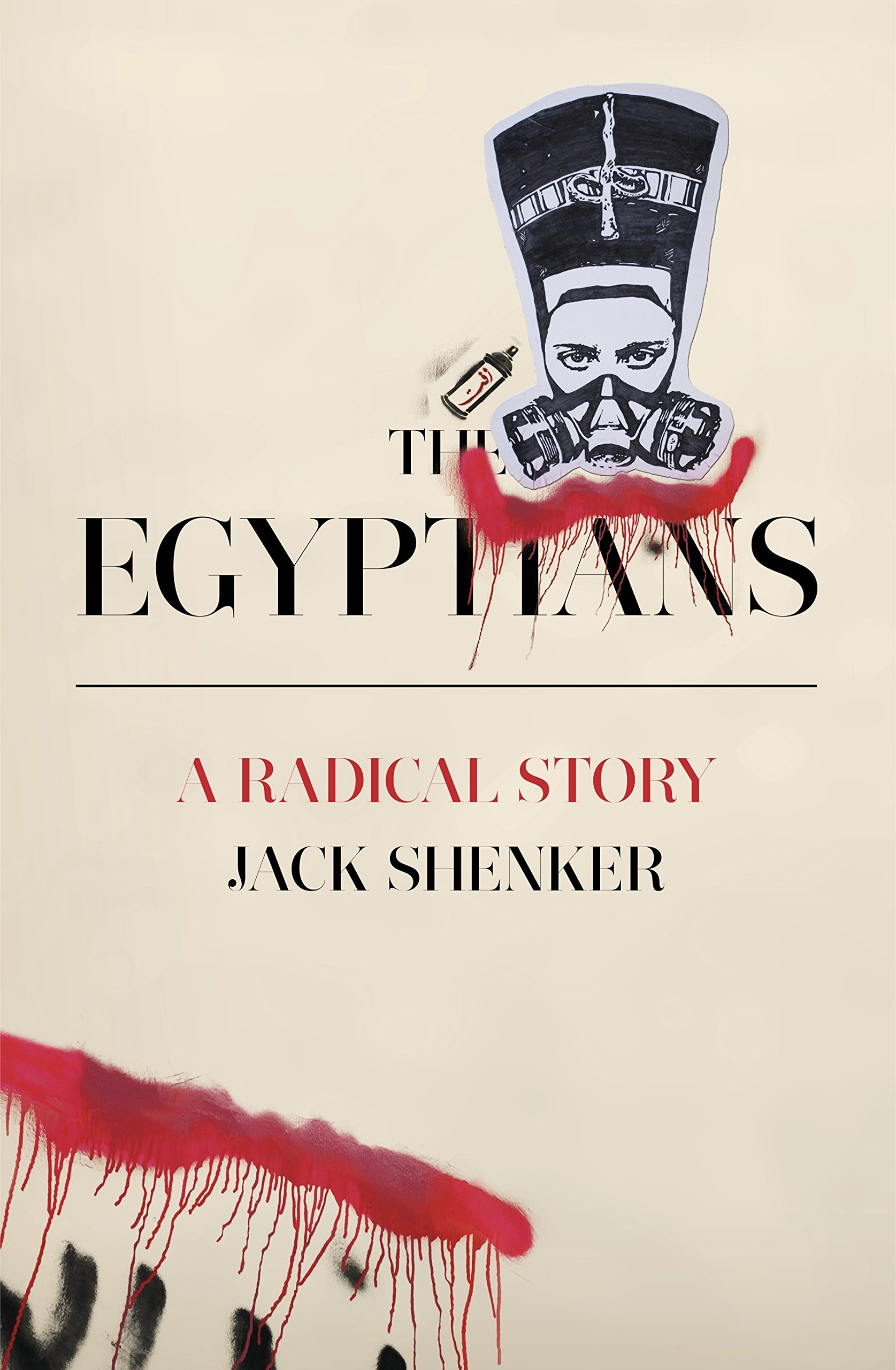
Jack Shenker - The Egyptians: A Radical Story

In early 2011 millions of people around the world were captivated by the Egyptian Revolution. I remember rushing out of meetings to the pub so we could watch the latest news from Cairo - had Mubarak gone or not? For the first time, mainstream and social media gave millions a ring side seat in a revolution. The Egyptian Revolution was part of the wider rebellions often labelled as the "Arab Spring". Rightly, Jack Shenker argues that the term is part of sanitising the revolutions of their radical content, remoulding them as pro-Western struggles whose participants were more interested in creating the sort of neoliberal society favourable to the Whitehouse and the European Union.

Shenker's book shows that the reality was very different. The Egyptian Revolution was the most thoroughgoing of the Middle Eastern risings and it was characterised very much by a desire to build a radically different sort of society. The moment when the Egyptian military finally decided that Mubarak had to go coincided with a massive explosion of workers' strikes. Once the working class began to move, the situation threatened far deeper changes than simply toppling a few politicians and military leaders.

Search for images of the Egyptian Revolution today and you will almost certainly find pictures of the massive crowds that occupied Tahrir Square. This occupation became symbolic of the revolution itself and inspired countless attempts to mimic it around the world. The idea that a free space where alternative ideas and organisation could flourish with existing society was incredibly attractive and dovetailed with the ideas of a fair few radical thinkers. It was if by sheer weight of the imagination, politicians and states could be overthrown. The scale of the occupation, the regime's attack on Tahrir, the fight by its participants to defend the space nonetheless did give the space an important place in the revolution. But we must be wary of placing to much utopian hope on such occupations. As Shenker cautions:

there is a danger in projecting too much of the revolution on to this single square, and thus confining the revolution in space and time… Focusing too closely on Tahrir ignores a panoply of revolutionary  struggles, and it leaves the factories and farms and schools and alleyways and minds in which revolution is raging dangling far off the edge of the page, alongside the dozens of other city squares across Egypt where battles were won and occupations mounted.

More recent commentators on the Sudanese revolution have, in my opinion, fallen into a similar trap to those who abstracted Tahrir from wider revolutionary context. But Shenker does celebrate what happened in that crowded square and how Tahrir symbolised wider aspirations: 

it embodied something more fundamental about the revolution—an action of creation, one that has coloured Egypt’s politics irrevocably ever since. In Tahrir, Egyptians built something different from Mubarak Country: a different set of borders, a different set of social relations, a different narrative about  who they were and what they could do.

Tahrir did not come from nowhere. In fact the site was the location of numerous smaller protests, many of which had been brutally suppressed by the Egyptian state. Shenker describes the deep roots of discontent in Egypt; struggles by local communities over their environment, their housing and their agriculture; small, brave and important democracy protest movements which fed the atmosphere that would eventually explode in 2011 and the economic struggles of workers and peasants. Shenker emphasises that "the first strand, and arguably the most critical, was the fight-back by workers against the structural violence and redistribution from poor to rich that accompanied neoliberalism." He explains:

By the twenty-first century, economic liberalisation under the tutelage of the international financial institutions had eroded that alliance, and workers increasingly saw the state itself as a the facilitator of colonialism of a different order. In the final years of Mubarak's reign, workers'; embroiled virtually every category of workplace you can think of in confrontation. By 2011, they would play a critical role in toppling the president altogether.

The role of workers in the Egyptian revolution is a neglected part of many accounts of 2011. Thankfully this is rectified in Shenker's book, where some of the most inspiring passages describe workplaces were workers are in control and have kicked out corrupt managers, or have won massive concessions. Likewise some of the most tragic are the way that the post-Mubarak regime and the Muslim Brotherhood quickly moved to demobilise the strikes and workers' action.

Shenker himself was close to much of the action, reporting from Egypt over many years and being at the heart of events during key moments before and after the revolution. His breathless excitement comes through as the January 25th protests are suddenly so much more than the small democracy protests he's witnessed over the years. At the other extreme we feel his terror as he is trapped in a police van, possibly heading for a beating or worse and his desperation as the people's gains are crushed by Sisi's counter-revolution. It is brilliant writing, exhilarating, personal but most of all giving ordinary Egyptians - from farmers and labourers to revolutionary socialists and feminist activists - their voice. There are also some joyous (and fascinating) accounts of talks with bosses and politicians who've been shrunk by the revolution.

It is also a remarkable work of historical research. Shenker shows how Egypt's history has been shaped by colonial and imperialist forces right till the present day. The neoliberalism that Mubarak and his predecessors imposed arising out of the position that Egypt has as a regional power and international state, especially during and immediately after the Cold War. 

Because Shenker takes the long view, which sees the Egyptian Revolution not as a sudden outburst of anger, but as a working class reaction to deep seated inequalities and oppression, it is hard not to conclude that the Egyptian Revolution will rise again in the future. While we must be wary of historical parallels, perhaps 2011 was Egypt's 1905? At the moment though, the counter-revolution has triumphed and tens of thousands of activists remain in jail. 

But at some point the contradictions of Egyptian society will bring people out onto the streets again. A renewal of the revolution will mean overcoming many real obstacles, but the objective circumstances will force people into conflict with the Egyptian state. As Shenker concludes:

Ultimately, Mubarak Country is built on an assumption of fear and dependency; pre-revolution and now, it relies not on a stable system of governance, but on the perpetuation of mental shackles, on a belief that nothing more is possible. The problem with mental shackles is that poverty and exclusion tend to rust them, and they are hard to maintain when new generations, new minds, keep bursting on to the scene. Perhaps this is why Sisi... has been particularly determined to oppress the very youngest... These are not the actions of a state that is confident in its own survival; they are the actions of a state which knows its authority has been irreparably damaged, and that Revolution Country clings on amid the fissures.

Jack Shenker's book is a masterful account of a particular revolution, an insight into the revolutionary process itself. It reminds us that workers' revolution is not something of the past, but a reality for capitalism today. Reading this book I was reminded of the excitement of 2011, the sense that the world was changing and how we all got a brief glimpse of a different social order. In that sense The Egyptians is far more than a historical account, its a lesson for radicals everywhere.

Related Reviews

Ayeb & Bush - Food Insecurity & Revolution in the Middle East & North Africa
El-Mahdi & Marfleet - Egypt: The Moment of Change
Alexander & Bassiouny - Bread, Freedom, Social Justice: Workers & the Egyptian Revolution
Gonzalez & Barekat - Arms and the People: Popular Movements and the Military from the Paris Commune to the Arab Spring
Berridge, Lynch, Makawi & De Waal - Sudan's Unfinished Democracy: The Promise & Betrayal of a People's Revolution

Monday, June 20, 2022

Darcus Howe - From Bobby to Babylon: Blacks & the British Police

Darcus Howe was one of the most important radical anti-racist activists in post-war Britain. As part of the collective that produced Race Today which he edited, he was a significant figure in developing and organising radical, anti-racist black movements. He was part of the "Mangrove Nine" a group of activists who were arrested for protesting against the repeated police raids and harassment of the Mangrove Caribbean restaurant in West London. To my generation he was perhaps best known as a broadcaster who regularly put the establishment, the police and the media in the spotlight for racism. 

Many of the issues that Howe campaigned over have returned to the spotlight in recent years as a result of Black Lives Matter. This short book is a classic work produced by Race Today in 1988 in the aftermath of the uprisings that shook Britain in 1981. Those "inner city" rebellions against Thatcher's policies and police racism shook the country and were almost universally condemned. Howe shows how they arose out of systematic racism, poverty, unemployment and rage against the police. 

Howe argues that the British government had managed to create an apparent consensus of policing, the British bobby that was fair and solved crime - but this was not the case, the police were systematically racist and used their power and violence to oppress working class people in general and black people in particular. In the 1970s and 1980s a new generation of young black people grew up who were not migrants and were not thinking of returning home, but rather saw Britain as home - and they were not prepared to stand for this treatment. As Howe says, "the development of young blacks inside British capitalism rendered them incompatible with the social arrangements they had inherited". 

The rebellions of 1981 saw "a section of the British working class, distinguishable by the colour of our skins, had declared open rebellion against the British state. And the British state reacted in the same manner as it had done to generations of Irish, Scottish, Welsh and English workers".

The great strength of Howe's work is that he places state (and police) racism and violence in the context of class rule and class struggle. This means he sees, and argues for, unity between black and white workers. Powerful statistics and examples show how the police powers were used systematically against black people, and in a way that encouraged division between workers through racism.

Howe also puts a personal twist on these stories. There's an account of the racism he experienced from a police officer who followed him and his friend as they shopped for shoes in central London, an experience that leads to Howe's arrest and then release. There's also an account of how the Notting Hill Carnival sees the police ramp up tension and hostility until they are able to attack the carnival and blame black people for the violence. The way that the media and police colluded in portraying black immigrants as criminals, drunks and prostitutes is quite shocking, and there are so many parallels with the way that racist myths are used today against Muslims.

This short book has been recently republished by Bookmarks, and includes a couple of extra essays by Howe and two excellent framing articles by socialist Brian Richardson and the campaigning lawyer Gareth Pierce. As new generations fight police violence and racism, and challenge a racism state, this short book is a brilliant call to arms that pays reading. Sadly Darcus Howe died in 2017 but he his words continue to resonant. I highly recommend this book.

Related Reviews

Richardson (ed) - Say It Loud! Marxism and the Fight Against Racism
Fryer - Staying Power: The History of Black People in Britain
Aspden - The Hounding of David Oluwale
Hirsch - In the Shadow of Enoch Powell

Thursday, June 16, 2022

Holly Black - Book of Night

Back in the 1990s we were told that the internet would allow us to communicate with people around the world, sharing ideas, learning from each other and making friends. New communities of like-minded internet users would construct virtual spaces in an atmosphere sharing and friendship. To be honest it sounded like bollocks back then, and it has turned out like that today. However the internet did allow certain groups of people to find each other - conspiracy theorists for one. In Holly Black's universe though, magical users learnt that they were not unique and they could share ideas and information and suddenly, the world had magic.

That's the fantastic premise to Black's first adult novel. Her YA work has been well received and certainly this story demonstrates her talents. I was immediately drawn into a world were much is the same, except that the magical users are greedy and jealous and people like protagonist Charlie Hall are hired to steal secrets.

In this world, even your shadow can be stolen and then magically grafted onto another. But some people have much more dangerous skills and will do everything to protect them and extend them. Others dream of the powers they could have if only someone like Charlie can steal the right thing.

While I enjoyed the world Black has made, I did at times find it overly complicated and I'm not quite sure I really got to the bottom of what she intended readers to understand about how magic functioned. I was much more enamoured by Charlie's exploits, her somewhat dysfunctional life and the confidence tricks the criminal underworld got up to. That said I was gripped hard by the story, and barely let up until I'd got to the end. I imagine there'll be a sequel and I look forward to seeing how Holly Black builds on this solid foundation.

Sunday, June 12, 2022

Imbolo Mbue - How Beautiful We Were

*** Spoiler Alert ***

This is a brilliant, but painful book. But I must warn you. As an environmental and socialist activist I do not think that I can review it, or even discuss it, without talking about the ending. If you don't want to have that spoiled I suggest that you go away and read it, without continuing.

Still here? Let's talk about Imbolo Mbue's amazing book. I came across this after learning that it was being banned by some school boards in the United States and I was puzzled, because it didn't seem to fit the normal pattern of banned books. It is set in the (fictional) African village of Kosawa. Rather like a theatre play Kosawa forms the backdrop to everything which happens, even though events might take place thousands of miles away. It is Kosawa that feels the impact of global changes and it is the village from where the characters experience and judge events. Kosawa is threatened by Pexton a US oil multinational which has discovered oil beneath the village land. At first the villagers are keen to embrace the small amount of wealth that comes their way, though Pexton's representatives lie and trick the villagers about what they will receive. 

But the relationship quickly sours as Kosawa's children begin to die. The pollution from the oil refinery and the leaks from the pipes poison the land and water, and the villagers are powerless to stop the leaks. Appeals to government make no difference, Kosawa is a dictatorship and the ruling class is closely linked to Pexton's oil revenue. The country's dictator has made Pexton's actions legal. Repeated meetings with Pexton's representatives bring no change, boring the villagers, until one day the villagers kidnap Pexton's men and demand action.

Imbolo Mbue skilfully weaves events through the eyes of Kosawa's inhabitants, in particular the children and women, something that emphasises who the victims of the pollution are. In doing so she shows how the villagers frame their experiences through their own understanding of the world - spiritual and ecological. The villagers cannot help but believe they've done something wrong, and are being punished by their Spirit. They cannot, at least initially, comprehend the ruthless nature of a oil company compelled to maximise profits at the expense of people and the land they live in. They can, however, comprehend the viciousness of a state that will do everything to protect the interests of the wealthy and powerful, and Kosawa quickly feels that violence.

The people of Kosawa attempt to appeal to the government. Their delegates go missing. Those who go to find them, in turn, face violence and suppression but catch the ear of an investigative journalist who kicks up a stink in the US press. Here, in my opinion, is where Mbue's novel becomes an extremely powerful and clever work. The US press reports galvanise a solidarity movement that puts pressure on Pexton, and in turn brings NGO assistance to Kosawa. I feared the novel would peter out in a story of Western NGO salvation. Instead, Mbue shows how the NGO sector desperately tries to hold back the villagers, promising them salvation through the US legal system and discouraging "rocking the boat". The villagers wait, and some die, and the urge to action grows stronger.

Some of the younger generation launch an armed struggle. Burning Pexton's property, assassinating its workers' and harassing the government. Its powerful, but invites retribution. At the same time, one of their number, Thula, makes it to a US university on a Pexton funded NGO organised scholarship. Their Thula reads Franz Fanon, Marx and Engels and Paulo Freire and becomes an activist. Shocked to see that in the US there is poverty, inequality and injustice, she is arrested and inspired to learn more about social movements. Her return to Africa sees her try to launch a revolution, and there's a powerful tension between her and those who remained behind - a tension between those that see the armed struggle as the way forward, those who see mass pacifist movements as the only moral way forward and those that would rather not struggle at all.

I have my own views on what sort of movement might bring social and climate justice. This review is not the place for them. The point that Mbue makes powerfully, is that the none of the movements that Kosawa inspires succeeds. The village is defeated, its people dispersed and its struggle forgotten except by a few survivors. I think this is the genius of the novel - we expect fairy tail endings. We're seduced to believe that a peaceful revolution will win at Thula become President, or the NGOs win justice or the right person is assassinated. Instead there is no victory, and we are left to dwell on what might have been. Ultimately this is a novel that is about the importance of struggle. Because without struggle there can be no hope, but struggle itself doesn't always win. 

It is a poignant, and powerful novel - a book that fits with the Black Lives Matter and the Climate Justice movements. It's a book that places agency into the hands of ordinary people in Africa, and shows that the enemy is a capitalist system and its representatives - whether they are US oil companies or ruthless African states. It is a wonderful work that offers the reader no easy answers.

Thursday, June 09, 2022

Hal Draper & E. Haberkern - Karl Marx's Theory of Revolution Volume 5: War & Revolution

This last volume of Hal Draper's monumental study of Karl Marx's thought is a very different work to the earlier ones. In part this is because it was mostly completed by Draper's collaborator Ernie Haberkern,  and thus has a difference in style to the earlier volumes. Haberkern worked from extensive notes but these were of course incomplete on Draper's death. Nonetheless the book provides a useful continuation of the earlier volumes and while it is clearly not the book that Draper would have produced on his own, it is very much a work of Marxist scholarship that should be read with the earlier volumes.

The title is on War and Revolution and the authors explain that earlier in their political careers, Marx and Engels saw a close link between the two - arguing, essentially, that war provoked revolution. The later drew back from such an explicit linkage, but they always looked at the way that war exacerbated tensions and created conditions for radical politics to push through. In the years after the death of Engels, Marxists built on their ideas to develop a theory of Imperialism which linked war directly to the accumulation of capital and the nation state. Engels, towards the end of his life, came close to such arguments, but it was later socialists who solidified them. But the positions that Marx and Engels took were often used to justify both pro and anti-war positions by later socialists. The transference of Marx and Engels arguments to the situation in the 20th century was, essentially, a bastardisation of their revolutionary work but it is sometimes based on real political positions that they took. 

Nonetheless, in the introduction Haberkern argues that contrary to the debates during the First World War, "neither Kautsky, nor Potresov, nor Lenin, nor, as far as I have been able to determine, any other socialists during World War I, cited the two wars after 1848 in which Marx and Engels unambiguously took a prowar stand in support of a bourgeois government." The authors unpick the reasons for Marx and Engels' position and implicitly explain why these weren't applicable to the global situation in 1914 (and one might add, still aren't applicable today).

One key question for Engels was the linkage between war and national liberation. Writing of the 1848 revolution, the authors say that Engels stressed that "in Hungary too social revolution and national liberation are inextriably linked." Here they point out that confusion for many about Marx and Engels' attitude to national liberation stems from a misreading of there arguments. The authors point out that in the Communist Manifesto the words "The workers have no country" are a mistranslation, and it should say "Vaterland" meaning that "the answer of the Manifesto is that the workers' have no Vaterland because they do not have political power anywhere". Draper and Haberkern continue:

The internationalism of the Manifesto lies in its assertion that he success of the coming revolution requires the victory of the working class in at least several of the leading European nations. A national victory was the first step in a European revolution. That first step could not be taken without taking into account the  immediate issues facing specific national movements. It was just as obvious to Marx and Engels that a national movement that restricted itself to the first step was doomed to fail.

Exploring these ideas takes Draper and Haberkern onto an extended discussion of Marx's and, particularly, Engels' positions on a number of specific cases of national liberation. One key discussion here, and one that I will no doubt return to, is the authors' exploration of the meaning behind Engels' infamous phrase "non-historic peoples" to describe "peoples who are incapable of forming viable national states." The authors point out that neither Marx nor Engels ever supported "the suppression of the national rights of any national group on the ground that it was 'non-historic' or 'non-viable' when said nation actually proved its viability, its 'historicity' by asserting its rights." Draper and Haberkern explain the position taken by Engels:

The problem is Engels was just beginning to sort through his own ideas... it is enough to note that Engels' thinking at this time was dominated by two propositions. The first was that the triumph of the bourgeoisie over the remnants of pre-bourgeois society was progressive, desirable, and represented the victory of civilisation over barbarism. It was also the necessary prelude to the rise of a workers' movement. The second proposition was that this process required the creation of large, culturally unified states and the consequent destruction of the patchwork of small, backward remnants of medieval politics that covered central and Eastern Europe.

The events of 1848, and the cowardly role of the bourgeoise, led Marx and Engels to change their attitudes to these revolutionary processes. But the authors also note that Engels himself did not adhere too closely to this position:

In every case where Engels is called upon in 1848 to describe a real political struggle between 'pure and simple nationalism and a socially revolutionary national movement, whether that case be Hungary, Poland or Bohemia, the 'historical nations' line disappears. For good reason. This idealist concept was of no use in analysing a real movement. It appears only after the fact in a cases where the democratic movement has been defeated or... never really got off the ground. And then it is only a simple description of fact dressed up in Hegelian phraseology.

The fact that Marx and Engels developed their politics over time has been a central theme of all of Draper's works and emphasises the limitations of an approach that plucks quotes from their private letters or out of context. It is also particularly true of their approach to different wars. Firstly though, it must be emphasised that Marx and Engels were not abstract political commentators, their statements were linked to concrete circumstance. A point that Draper and Haberkern emphasise:

Despite the confusion, in reality and in Engels' head, one major difference between his 1848 position and his post 1870 stands out. In 1848, Marx, Engels and radicals of all political shades looked forward to a war by revolutionary Germany, under the leadership of Bourgeois democratic revolutionaries against Tsarist Russia. Marx and Engels, after 1870, did not desire a war with Russia. They feared it. And they were adamant that they would not support any of the governments in such a war. They were for using the crisis of war to replace the governments in all countries be they republics or monarchies.

It was this internationalist revolutionary position that was abandoned by most of the Second International in 1914 and which Lenin, Rosa Luxemburg and a handful of revolutionaries stuck with. By the late 19th century Engels was developing an approach to imperialism that would be closer to Lenin's position in Imperialism. But he was still holding on to politics that originated in an earlier period. 

These arguments were important for Engels who was fighting a battle against the emergence of reformist politics within the German Social Democratic Party and the International. Draper and Haberkern explore the way that Engels fought this, because his hesitation and fear of splitting organisations meant that he pulled his political punches on occasion. It is this that led to Engels being accused, incorrectly, of becoming reformist towards the end of his life. Engels, the authors argue, was ahead of the curve in understanding the world had changed post 1870, but "never sat down to think through what this meant". 

Readers of this volume will find that a significant difference with earlier books is that there is much more of an engagement in with how Marx and Engels' ideas have been used since their death. In part that's because of the material and how subsequent pro-war and anti-imperialist socialists have quoted Marx. But it's also because some of this material comes from the imperialist epoch itself. As such the debates and discussions around national liberation movements and imperialism are indispensable and make this book worth reading. 

However, there are qualifications. This book is not as good as the earlier volumes for reasons already stated and the edition I have, the volume most easily obtainable at the moment, is peppered with typos, spelling mistakes and proofing errors. References are incomplete and words misspelled. It is a disappointment given the extremely exacting standards of the earlier works and perhaps a new, freshly edited volume, ought to be produced.

Related Reviews

Draper - Karl Marx's Theory of Revolution Volume 1: State & Bureaucracy
Draper - Karl Marx's Theory of Revolution Volume 2: The Politics of Social Classes
Draper - Karl Marx's Theory of Revolution Volume 3: The 'Dictatorship of the Proletariat'
Draper - Karl Marx's Theory of Revolution Volume 4: Critique of Other Socialisms 


Wednesday, June 08, 2022

Cecil Woodham-Smith - The Reason Why

This is a cracking history read. Cecil Woodham-Smith mined the archives, unpublished memoirs and long forgotten correspondence to retell the story of the Charge of the Light Brigade. What she brings to the story is context - and by this I don't mean the grand historical narrative of the clash of nation states and nineteenth century empires, but the context of the aristocratic world within which the Crimean War was fought and the Charge took place. It is a startlingly strange world. One where unbelievably wealthy aristocrats can do know wrong and bear no criticism. One where personal feuds are far more important than military success and Generals can lead their men to doom, but not fight with them. 

The Charge has often been discussed, and its principle figures are well known. All of them are odious, and all of them were terrible soldiers. Lord Cardigan, who commanded the Brigade and led the Charge is perhaps the most odious - that's certainly how Woodham-Smith portrays him. Vain, mean and prejudiced, its actually hard not to wish he had died under the Russian guns, or at least shot in a dark tent by his own men. But the latter would not have happened as Cardigan spent much of the War in luxury on his private yacht, missing important battles because of over-sleeping. 

Lord Lucan and Lord Raglan, are perhaps slightly less odious, though only just. Woodham-Smith would write an excellent history of the Irish Famine, but this earlier book also gives a brief account, not least because during Lucan's role as Lord Lieutenant of Mayo he evicted thousands of people during the Famine, surly condemning most of them to death. Lucan and Raglan are only slightly less awful than Cardigan, but they were also incompetent as were many of those in their class around them during the Crimea. Woodham-Smith's focus is on the Charge and the individuals in command, I'd have liked more on the British Army leadership's collective incompetence towards the whole force during the War, though perhaps Woodham-Smith's earlier book on Florence Nightingale rectifies this.

Woodham-Smith strongly implies that the communication failures that led to the Charge lie primarily in the personal hatreds at the heart of the aristocratic leadership. With her portrayal of Lord Cardigan as an incompetent buffoon she perhaps leads the reader to overly blame him as an individual for the disaster. Had the British Army got rid of Cardigan when they should have it is likely the disastrous Charge would not have taken place and we'd have all been spared that terrible patriotic poem. But the wider failures of the Army would likely still have happened, not least the failure to follow up the successes at Alma. 

That said, this is not really a book about the Crimean War, but the personalities and events that led to the Charge. As such there's surprisingly little about the ordinary soldier here. They usually appear as a victim of Cardigan's bullying and it would be interesting to read more on the War from their angle. Woodham-Smith also makes no attempt to explore the imperialist context of the war, or its consequences. But that was not her ambition. That said, this is great read - no matter how much you dislike the aristocracy and the ruling class they represented, you'll be shocked by Woodham-Smith's expose of their lives and behaviour here. Given the sort of people who ran the British Army, its seems unbelievable that the British ever had an Empire at all. As such this is an entertaining and infuriating read. But if you're looking for a deeper analysis you will have to go elsewhere.

Related Reviews

Woodham-Smith - The Great Hunger, Ireland 1845-9

James Poskett - Horizons: A Global History of Science

This is a remarkable book which turns much of what you thought you knew about scientific history on its head. It is a classic example of how social movements such as Black Lives Matter can transform how historians, scientists and academics approach questions and how readers engage with them. I will say this is likely to be one of my reading highlights of 2022.

I reviewed Horizons for SWP Long Reads you can read it here.

Monday, June 06, 2022

Barbara Kingsolver - Prodigal Summer

I was given Barbara Kingsolver's Prodigal Summer as a present nearly twenty years ago, and for some reason it remained unread. Picking it up recently however I was reminded that books have their moments,. The backdrop to the book deals with ecology and rural America, and perhaps I got more out of it in 2022 then if I'd read it when I was first gifted it. In Prodigal Summer Kingsolver weaves three, loosely connected stories together, centred on the rural communities of southern Appalachia in the United States. Here small farms struggle to make ends meet producing tobacco alongside a few animals. The beautiful forested mountains are home to an impressive ecological system that invites study, and leisure and the communities themselves, tightknit towns of extended families invite gossip, political disagreement and loneliness in equal measure.

Up in the forests, ranger and ecologist Deanna Wolfe studies a family of newly arrived Coyotes, musing on how they're connected to wider ecological systems, yet invite hunting for their perceived threat to farm animals. Her solitary life is disturbed by a handsome young hunter who finds her and they become unlikely lovers, to Wolfe's great embarrassment. Down among the farms a pair of grouchy retired neighbours bicker about god, farms - chemicals versus organic - and different outlooks on life. On a farm that has become outsider Lusa Landowski's through widowhood, she wonders whether its possible to break free of tradition and family farming and sees the landscape through completely different eyes to those of her deceased husband's family.

The three stories weave together through the ties that bind rural communities - of debts incurred and assistance needed. They are all shaped by ecological realities, and Kingsolver gives a skilful lesson in nature and ecological webs, through the eyes of her protagonists. But all this is to the backdrop of a sweltering summer that threatens economic and ecological woes, while everyone is enticed with romance and sex. 

I enjoyed this immensely, much as I recall being enthralled by Kingsolver's Poisonwood Bible. The author's knowledge and attachment to the area comes through beautifully, as does her love of nature itself. It's tempting to see the author in all three of her main characters, though perhaps she's present in several others too. Beautifully written, deeply moving and warm throughout, these are stories that don't really end - just continue onward.

Related Reviews

Kingsolver - Demon Copperhead