Wednesday, May 24, 2023

Suzanne Heywood - Wavewalker: Breaking Free

In 1975, when Suzanne Heywood was six, her parents announced that they were going to follow in the path of Captain Cook's third voyage and travel around the world by sailing boat. To Suzanne and her younger brother this was a bolt from the blue. It would be, her father said, a three year trip. The youngsters thought it was a tremendous adventure. The idea of a young family making such an epic journey captured the minds of many. Journalists and camera crews followed preparations, and the ship, Wavewalker, was sent off by an appropriately large group of the great and the good, and many curious onlookers.

The youngsters found it thrilling, but quickly things began to be a lot more confused. In the eyes of Suzanne, her father was a brilliant explorer, a worthy person to follow Captain Cook. But problems began to develop. Inevitably, the trips was not as easy as expected. Tensions developed among those on board, and as days, became weeks and then months, things were not quite so clear.

Wavewalker is a fascinating book, because it uses the medium of Heywood's memoires to explore something far beyond the voyage itself. The three years, became four, then five. Eventually Wavewalker and Heywood's family spent a decade sailing 47,000 miles. The reminiscences are often what you might expect from such a voyage. Suzanne remembers whales, adventure and exotic ports. But when, in the Indian ocean in the midst of an enormous storm, a giant wave smashed into Wavewalker and badly injured Suzanne, we begin to see the real tensions in the project.

For this book is not really about Wavewalker's voyage. It is really about how the obsessions of adults impact upon their children. Suzanne's father could not see beyond the voyage. Her mother, despite her professed hatred of sailing, could not break from him. Suzanne has recreated the experiences from her own diaries, recollections and interviews with the crew that come and go. She also has her father's logbooks and own writings, that paint a different picture - one of family unity and enjoyment. But, Suzanne increasingly, and desperately, wants to return home, but her parents won't allow anything to get in the way of their dreams. They see the voyage as a the best education young children could have. The intergenerational tensions become simmering hatred.  

The readers follow Suzanne as she becomes forced increasingly to rely on her own devices. Self reliant and wary of forming friendships because these are only ever temporary - it is not hard to see that Suzanne is actually depressed, and suffering enormously. She is desperate to learn, yet her parents see education as a irrelevant to the voyage. Her mother, in particular, blocks Suzanne - playing loud music while the girl studies, mocking her and only supporting her father's goals. 

This leads to some shocking moments. When Suzanne is having emergency surgery on a remote island for injuries sustained in the storm, her mother can barely be with her. Eventually, as a teenager, Suzanne is left in charge of her brother, while her parents voyage onward. Later we learn that her mother has told her father, that either Suzanne leaves the ship or she does. Suzanne is left to fend for herself, in a situation that frankly is shocking. Eventually she phones Childline, the counsellor telling her "None of this is your fault... You’re coping with far more than is fair."

What is shocking about Suzanne's account is her parent's seeming lack on interest in their children's own needs. They seemed to see them as extensions of their own selves - sharing interests, beliefs and so on. Suzanne is expected to take on the traditional female roles of kitchen work, while her brother works on deck. When she asks questions about religion, beginning to develop her own ideas about the world, her father mocks her as the "token Christian" rather than engaging with her and encouraging her to think. 

Suzanne shines through however as a independent, brave and clever girl. As she grows older on the endless voyage, she fights for space to learn and educate. In the most deplorable of circumstances she passes exams via correspondence courses, having to beg her parents to make sure she gets to the exams. While she never gets the dress she craves - her parents essentially take her money - she does eventually break free and get to university.

This book is very unlike those I would normally read, and this review is not easy to write. I got it after reading Suzanne Heywood's article in the Guardian, a selection of extracts, because the book spoke to me about relationships and family. While I cannot claim to have shared her experiences, I felt that Suzanne spoke to me about some of what I have experienced in my own life. Reading Wavewalker was then a deeply moving personal experience as well as a sad insight into another's life. 

When her family learn that Suzanne is writing this book, they react with shock and anger. It is clear that the tensions and fissures within the family that were created in the 1970s and 1980s are never resolved, because her parents can never admit their failure. Wavewalker then, is a on one level a tragic tail of parental failure. But on the other it is a tremendous story of a young woman who refused to give up on her dream, and overcame incredible odds to do that. My heart was with her on every page, though my mind was often elsewhere. 

Monday, May 22, 2023

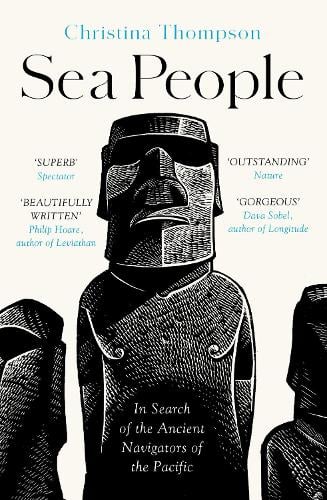
Christina Thompson - Sea People

The Pacific Ocean is the largest body of water on Earth. It huge area is larger than the planet's entire landmass, and its possible to look at the Pacific on a globe and almost imagine a planet completely devoid of land. Yet zooming in from such a view, it quickly becomes apparent that this massive area of water has land, tiny volcanic islands that poke out of the water, sometimes separated by thousands of kilometres. When Europeans first arrived at these islands they were amazed to find most of them inhabited. To the European's this seemed amazing. The islanders had what seemed to be very rudimentary boats. How could this have taken place? 

Christina Thompson's book is a history of the "Polynesian Triangle", an

area of ten million square miles in the middle of the Pacific Ocean defined by the three points of Hawai'i, New Zealand and Easter Island. All the islands inside this triangle were originally settled by a clearly identifiable group of voyagers: a people with a single language and set of customs, a particular body of myths, a distinctive arsenal of tools and skills, and a "portmanteau biota" of plants and animals that they carried with them wherever they went. 

Without compasses, sextants or maps, they colonized the Ocean and did so in a remarkably short period of time., creating what was "until the modern era, the largest single culture area in the world".

The Europeans, of course, could not believe the Polynesian's did this on their own, and a significant part of the book is the story of how Europeans misunderstood the history of the Pacific. Believing that navigation over such distances was impossible without European technology, those that came after Captain Cook, came up with a variety of ideas about what happened. These ranged from the racist - that the Polynesians were actually descendants of white tribes, to the improbable - the Polynesians were actually South American. Much discussion took place about how the navigation took place - whether it was accidental (as most people believed until very recently) or planned.

In exploring the European approach to the Polynesians, Thompson draws out the real story - which is an incredible account of brilliant exploration, genius navigation and completely different ways of understanding the world. She shows how different understanding of the relations between currents, waves, land and water, allowed the first navigators to move around the Ocean with incredible accuracy, and how this was proved by some startlingly brilliant experimental voyages in the 1970s and 1980s. These trips both proved the impossible possible and gave new renewed identities to the Polynesians themselves, rescuing their own history from the condescending ideas of many European scientists. There are fascinating accounts of archaeology, navigation and oral history - and I was particularly struck by Thompson's brilliant account of Cook's relationship to the Tahitian Tupaia who produced a famous chart. Thompson shows how this is actually an incredible accurate map of the Pacific, but one almost incomprehensible to a 17th century European sailor.

I picked up Sea People on a whim in a bookshop and I am very glad I did. It seems like it might be a specialist topic, but its a brilliant exploration of the different "ways of seeing" that different human cultures develop, and how such knowledge has been lost because of the way European colonialism remade everything in its own image. I highly recommend it. As Thompson points out, there are still questions about the origin of the Polynesians, it is "unlikely that we will ever know how some of the remotest archipelagos were initially discovered or how many canoes were lost in the course of this long and arduous colonising process", but

To the extent that this history has been disentangled... it has been thanks to input of radically different kinds. At one end of the spectrum are the mathematical models: the computer simulations, chemical analyses, statistical inferences - science with all its promise of objectivity and its period lapses into error. At the other, the stories and songs passed from memory to memory: the layered, subtle, difficult oral traditions, endlessly open to interpretation, but unique in their capacity to speak to us, more or less directly, out of a pre-contact Polynesian past.

Related Reviews

Poskett - Horizons: A Global History of Science
Cushman - Guano and the Opening of the Pacific World: A Global Ecological History
Moorehead - The Fatal Impact
Hunt & Lipo - The Statues that Walked: Unravelling the Mystery of Easter Island

Friday, May 19, 2023

N.K.Jemisin - The Fifth Season

This innovative fantasy novel is far from the "high fantasy" and world-building of the Tolkien clones that proliferate in this genre. It is set on a highly active geological planet, where humans live constantly in fear of the end of their age, as giant earth movements wreck their civilisations. Knowledge, passed down from eons before, warns them of their history and urges them to prepare for the end of a season, when things go to hell and everyone is left to fend for themselves, particularly those outside the Communes. The orogenes however, are hated humans who can control the earth, using its energy to move, change and direct power. Their ability to use this power, and lack of control unless highly trained, makes them feared by other humans - but their powers to stop tremors makes them necessary.

The Fifth Season takes some getting into, but once the reader gets their head around the non-linear plot and the various seasons and reference points, there's a lot here. The central story, of an orogene struggling to find and hide themselves in a hateful and dangerous world, is well plotted to show off the author's worldbuilding. Looking forward to the second volume.

Monday, May 15, 2023

Ian Angus - The War Against the Commons: Dispossession and Resistance in the Making of Capitalism

In his latest book, Ian Angus answers a question that apologists for the capitalist system would like to pretend does not exist. How is it that humans came to live in a world were a tiny minority own and control huge amounts of wealth, and the vast majority of us have to work for them? Angus writes that "even sharp critics of injustice and inequality rarely question the division between owners and workers, employers and employees". Yet almost every aspect of our world is defined by such inequality. About 50 percent of England is owned by one percent of the population. A staggering inequality for a country supposedly defined by its "green and pleasant land". Indeed it is England were Angus' history is mostly focused, for here it was that the process went "furthest" according to Marx. But the transformation of society that saw the total destruction of "the traditional economy" was neither automatic nor benign. Rather:

wage-labour has only become universal in the past few hundred years - and the change was forced on us by 'the most merciless barbarism, and under the stimulus of the most infamous, the most sordid, the most petty and the most odious of passions'.

The quote here comes from Marx, and Angus skilfully uses Marx's theoretical framework to explore the development of capitalism's system of unrestrained accumulation based on exploitation. Marx was well aware that pre-capitalist society took a myriad of different forms, and Angus shows how England (and indeed the British Isles in general) saw a number of different ways of organising agricultural production. The peasantry, under the respective lords, farmed land in ways that were much more communal and depended, in significant part, on the use of communal land. These commons were used according to democratic and egalitarian principles, sharing fields and carefully managing access to essential resources.

The developing capitalist interests however saw the commons as a barrier to further profit. The destruction of the commons, the key theme of this book, took place not out of individual malice, but out of the logic of capital. The need, by the capitalists to expand into every available space and to transform the very world into their own image. Land, animals, wood, forests and space itself was converted into a commodity that could be bought and sold. Fields were engrossed, land was enclosed, commons were privatised. The peasants who lived from the land, were expelled or turned into wage labourers - their old traditions and histories erased. As Angus says, "The twin transformations of original expropriation - stolen land becoming capital and landless producers becoming wage workers - were well underway". These people became a new social group:

A new class of wage-labourers was born in England when 'great masses of men [were] suddenly and forcibly torn from their means of subsistence, and hurled onto the labour-market as free, unprotected and right-less proletarians.'

The quote is, again, from Marx, whose book Capital is filled with rage at what happened to the peasantry. Angus continues by highlighting the sweep of this process:

It was sudden for those who lost their land, but the social transformation took centuries. In the early 1700s, two hundred years after Thomas More condemned enclosures and depopulation in Utopia, about a third of England and almost all of Scotland was still unenclosed, and most people still lived and worked on the land. it took another great wave of assaults on commons and commoners, after 1750, to complete the transition to industrial capitalism... Looking back, that transition appears inevitable but it did not seem so to commoners at the time... some argued eloquently for a commons-based alternative to both feudalism and capitalism.

Contrary to what some followers of Marx tell us, he did not believe that this process was inevitable or indeed desirable. Marx took inspiration from contemporary movements to protect the commons in his own time, but he was also aware of historic struggles. A great strength of Angus' book is his celebration of these forgotten struggles. One key event is Kett's Rebellion of 1549, about which I have written elsewhere. But Angus also notes other struggles, such as the great battles between poachers and gamekeepers - representing resistance to the idea that game should be a commodity, private property for the sole use of the local landowner. A significant chapter also looks at the work of Gerrard Winstanley whose writings during the English Revolution raised the possibility of a new way of ordering society - though interestingly Angus frames' Winstanley's vision not as a future Utopia, but as a transitional society to it.

Angus' conclusions about the laws introduced to protect private property make an important point:

The very existence of the Bloody Code refutes the common claim that capitalism triumphed because it better reflected the dictates of human nature than previous social orders. The poor were not easily reconciled to a system that expelled them from the land. England's ruling class tried to terrorise them into submission.

This terror and the process of destruction of the commons was not limited to England. Angus demonstrates how the colonial project for English capitalism arose directly from the processes begun in the English countryside. The slave trade, the destruction of commons in the Americas, Africa and Asia were part of a process that subverted the world into the interests of English capital. These sections are among the book's most insightful and moving, dealing as they do with the destruction of entire peoples and their worlds. 

Angus also gives several important theoretical insights. He notes, for instance, how apologists for capitalism can argue that the process was painful and violent, but it was necessary. They suggest that enclosure was important because it was only in this way that crop yields could rise to the levels needed to support industrial capitalism. Angus shows the wealth of evidence that this is incorrect and that yields were not significantly improved. But he also makes an important point that peasants themselves were innovative and clever - far from the dumb backward looking yokels of legend. Common field farming was not "inherently conservative" it was actually dynamic and incredibly successful. But such propaganda was important to the landowning class who wanted theoretical justification for their actions. It is notable that similar points are frequently made today. We are told that large scale industrial farming is the only way to feed the world. But such farming invariably has lower yields, is more polluting and highly vulnerable to environmental disaster. Then, as now, the "claim that peasants resisted improved methods reflects anti-peasant prejudice, not the real activity of working farmers".

The skilful linking of historical processes to contemporary political and ecological struggles is a great strength of Angus' book. This is not specifically a work of history, but rather a framing of the current ecological crisis within the wider historic development of capitalism and the destruction of the commons. For Angus it is capitalism's transformation of the commons that is emblematic of the system's method of operation. But looking backward can only tell us so much, the alternative has to be a new way of organising society based on the creation of a new society with the idea of common, democratic ownership at its heart. As Angus writes, "Today's movements of the oppressed and dispossessed to steal back the commons offer real hope that capitalism's five-century war against the commons can be defeated and reversed in our time." It is an inspiring vision and Ian Angus' War Against the Commons is a brilliant account that ought to be read by every activist who wants to see an end to capitalism and "another world".

I am looking forward to speaking with Ian Angus via Zoom for the London launch of The War Against the Commons at Marxism 2023. More information on the whole event here.

Related Reviews

Angus - A Redder Shade of Green: Intersections of Science and Socialism
Angus - Facing the Anthropocene
Angus & Butler - Too Many People? Population, Immigration & the Environmental Crisis

Yerby - The English Revolution and the Roots of Environmental Change
Wood - The 1549 Rebellions and the Making of Early Modern England
Wood - Riot, Rebellion and Popular Politics in Early Modern England
Thompson - The Making of the English Working Class
Thompson - Customs in Common
Linebaugh - Stop Thief!
Sharpe - In Contempt of All Authority
Hill - Liberty Against the Law

Sunday, May 14, 2023

Daniel Kehlmann - Tyll

The medieval German legend of the eponymous trickster Till Eulenspiegel features a jester whose adventures see him trick everyone, often in a scatological way, and escape with the skin of his teeth. In David Kehlmann's retelling, Tyll in brought forward to the Thirty Years war and sees the titular character take part in a series of episodic escapes through Germany, as society degenerates, the economy collapses and giant armies ravage people and land.

We begin with Tyll's background, his formative time as a child, when his thoughtful father, a man who loves books and knowledge, is accused of witchcraft. Tyll flees with his friend Nele, becoming an accomplished performer and trickster. Tyll's story, and that of his companions, is woven around the complex interlocking account of the Thirty Years War, in particular that of the King and Queen of Bohemia. Elizabeth Stuart, the daughter of James IV and I of England and Scotland, is seeking to regain her, and her husband's lost position. Tyll's position as court jester allows him to tell the truth to power, before fleeing the chaos.

Tyll is a fascinating, well written book. But I don't think it works as a novel. The narrative jumps back and forth, and events are contextualised enough. It is not always clear why Tyll finds himself in particular situations. It also requires a passing acquaintance with the dynamics of the Thirty Years War, and the bizarre (it really is bizarre) story of Elizabeth Stuart. That said the book is funny and well written - but not the straightforward novel I was expecting.

Tuesday, May 09, 2023

Alex Callinicos - The New Age of Catastrophe

The title of Alex Callinicos' book The New Age of Catastrophe echoes Eric Hobsbawm who described the years between 1914 to 1950, containing as they did two world wars, economic crisis and the Holocaust, as the "Age of Catastrophe". Callinicos argues that we are in a comparable period, which confronts us "with a crisis of civilisation" where "the forms of living that were made possible by the development of industrial capitalism... and that became increasingly generalised in the twentieth century are no longer viable". In fact they are "hurtling us towards societal collapse."

This capitalist drive towards collapse has a number of different manifestations - economic, imperialist, environmental and disease - each of which is rooted in the system and all of them linked together. Indeed, what makes Callinicos' book so useful is that he shows how these apparently singular disasters are woven into the fabric of the system, and simultaneously how the nature of the system itself amplifies and extenuates the disaster. For instance, writing about Covid, Callinicos says:

The pandemic thus has seen a brutal struggle between life and profits. So the chances of dying from a virus that emerged in the context of the globalisation of industrial capitalism are shaped by the prevailing class structures. Capitalism features on both sides of the equation. Humankind stands before the rest of nature fractured by social antagonism. And, as we have seen in the grossly unequal allocation of vaccines, this is even more true on a global scale than it is within individual societies.

Callinicos deploys this analysis in three excellent sections looking at the economic, military and environmental crises. In these he draws on a lifetime of Marxist theoretical work and revolutionary activity, and demonstrates an enviable ability to summarise the subjects. The chapter on environmental crises focuses mostly on climate change, and Callinicos draws on the theoretical work of writers like John Bellamy Foster, Mike Davis and Andreas Malm. But he shows how this crisis, arising out of the specific development of capitalism develops along similar lines to that of the Covid example above. In locating the climate crisis as a systemic one Callinicos also makes it clear that solutions are, essentially non-solutions if they do not challenge the system that drives the problem. His conclusion is thus that a strategy to deal with climate change that relies on market mechanisms or technological deployment is "purest folly". This conclusion is echoed by a point he makes about Covid:

By offering an individualised solution, the vaccination programmes shift our attention from the need to transform our relationship with nature and to invest in better transport and healthcare; and in this way, paradoxically, they feed the anti-vax campaigns of the far right.

Mention here of the far right brings me to another key insight of The New Age of Catastrophe - Callinicos' analysis of the fascist and far-right movements. These sections are incredibly insightful, and develop an excellent earlier article on the global far right. But it is the section on the United States that I found most illuminating (and frightening). Here Callinicos describes a far-right which has largely been successful in "directing the anger generated by the ills of the neoliberal era, at least in certain sections of the population... onto a cosmopolitan elite and... onto migrants and refugees." He shows how fascist movements have grown within and from right populist movements. Often, as in the case of the United States with Trump, or Brazil with Bolsanaro, there is a interaction between the fascists movements and the populist leaderships. In the United States this has gone furthest, with the storming of the Capitol being emblematic of this (though there was a similar event in Brazil recently, presumably after the book had gone to print). Perhaps controversially, Callinicos argues that the United States is the "weak link" where fundamental social, economic and political fractures have created a cauldron for the growth of far-right policies and were most of the left has become subordinate to the Democratic Party machine. It is, Callinicos argues, possible to imagine a "violent implosion" of US society.

In the face of these threats, and the very real way that war, climate change and economic crisis will heighten the possibility of social crisis, Callinicos argues a revolutionary strategy. Here he puts a classical Marxist position of the working class as the agent of revolutionary change, and the potential for the creation out of this of a society based on the common ownership of the means of production, where production itself is planned through mass participatory democracy. But Callinicos argues this through a discussion of two "terrains of struggle" that do not immediately call to mind the organised working class - gender and race. Here he says that the contestations over these could "contribute to the formation of a new working-class subject of emancipation". These sections are excellent, and Callinicos provides an excellent summary of the movements for trans rights, Black Lives Matter and women's rights. He concludes, in a section worth quoting at length, that the convergence between movements against oppression and exploitation could lead to a "new kind of workers movement" which goes beyond narrow economic issues:

Given its nature in the twenty-first century, the working class would have to give the different oppressions that weigh down on people - especially those arising from gender, 'race', sexual orientation, and disability - a strategic importance that they have lacked in the past... This would be not merely a moral stand but a matter of self-interest, of practical necessity. This necessity is underlined by the way in which the development of globalised production networks creates an interdependence between workers in the South and in the North... In unexpected ways, the world working class, which Marx and Engels address at the end of the Communist Manifesto, could thus begin to emerge as a collective agent in this age of catastrophe.

It is a hopeful outlook as it does not offer readers any illusion that the system will fix itself, or that far-right movements will simply collapse. Instead Callinicos shows how existing movements can become the part of the revolutionary process that might create a new socialist society. But at the same time, Callinicos makes it clear - there are no shortcuts to building those movements, and there are perils and divisions. Readers however will find The New Age of Catastrophe an indispensable aid to navigate the terrain of reaction and revolution. I highly recommend it.

Related Reviews

Callinicos - An Anti-Capitalist Manifesto
Callinicos - Imperialism and Global Political Economy
Callinicos - Making History
Callinicos and Simons: The Great Strike: The Miners' Strike of 1984-5 and its Lessons
McGarr & Callinicos - Marxism and the Great French Revolution
Callinicos, Kouvelakis, Pradella (eds) - Routledge Handbook of Marxism and Post-Marxism


Sunday, May 07, 2023

Martin Treu - Katherine von Bora: Luther's Wife

Short biographies of Martin Luther are other famous Reformation figures are ubiquitous in the museums and shops of Lutherstadt-Wittenberg. Martin Treu's brief biography of Katherine von Bora is the only one of Martin Luther's wife and felt worth a read. It is unfortunate that I have to refer to Katherine as Martin Luther's wife, but as the author points out in the introduction we know almost nothing about her except through her role in Luther's life. In fact he points out that we know much more about her, and indeed have several portraits of her, simply because of her marriage. This is not, for instance true, of Katherine Melanchthon or Walburga Bugenhagen, the wives of Luther's contemporary Reformers. Treu goes further an cautions that we have to also be careful that we do not assume that because we know something about von Bora, her life was "typical of a woman's role at the beginning of the 16th century". 

We do know the basic outline of von Bora's early life. She was in a convent from an early age, but then fled this alongside several other nuns when they got information about the Reformation. Martin Luther married von Bora latish in his life, and it seems their life together was loving and close. Luther took care to try and protect von Bora and his children after his death, though his attempt to leave all his possessions to his wife was illegal at the time.

During their time together we know that von Bora was an energetic and careful manager of the household. She actively attempted to extend the families financial security by buying land and property and renting out rooms to students. From Luther's famous "Table Talks" we occasionally hear her voice, and it seems she "participated to a considerable extent" in Luther's theological work. Luther clearly kept her informed when away on progress on issues through regular, loving, letters. Repeated denials from Luther that Katherine was involved in sermons and writings, imply many "suspected the opposite". But scant as evidence is for von Bora's life, the biography tends to fill in gaps from Luther's own life. For instance we read how Luther treated the children - I would be interested to know how many similar Luther biographies include this information. 

Perhaps most interesting is Treu's argument that the relationship between Luther and von Bora reflected the Biblical role of women as outlined by the story of Martha and Mary in the gospel of St. Luke. In this story, Jesus visits the two women and Martha "saw her responsibility only in making the external circumstances pleasant" for Jesus, while Mary sat quietly "at the feet of the master and listening attentively". Treu argues that both aspects "are bound together in Katherine's life". He argues that it was in these roles that Luther predominately understood and saw his wife. Nevertheless von Bora was clearly a strong, independent and active participant in public life. It is also clear that she was centrally involved in ensuring that her family grew into one of the wealthiest in the town.

Luther's death was a massive blow to this. Von Bora and her children suffered greatly in the chaos of the Thirty Years Wars and the loss of their powerful and wealthy backers. They were forced to flew Wittenberg twice, and von Bora latter years were marked by infirmity and ill health following the trials of the period. Treu remarks that the fates of her and her children were representatives of the convulsions that shook Europe following the Reformation era.

This short biography is an interesting read, particular as a guide to the family's life in Wittenberg. It suffers from the lack of evidence and source material, a problem that is not that of the author. 

Related Reviews

Stanford - Martin Luther: Catholic Dissident
Roper - Martin Luther: Renegade and Prophet

Friday, May 05, 2023

Roy Pascal - The Social Basis of the German Reformation

The Social Basis of the German Reformation was Roy Pascal's first book as he embarked on a significant career as a historian of Germany. 1933 was a good time to become a historian of that country, and Pascal followed up this work with a number of other books on Modern Germany and the Nazi dictatorship. Pascal is, perhaps, best known to the left because he was the first translator into English of Marx and Engels' German Ideology. Pascal was a follower, at the time, of the Communist Party, and the Social Basis was an attempt to study the Reformation from a Marxist point of view. As such Pascal places much importance on the economic context to the changes, though the book is also essentially a political biography of Martin Luther.

Pascal opens with the religious context for Martin Luther's life, and argues that:

In the final form of his theology… Luther identified the certainty of salvation with faith. Both were sheer gifts of God, unconnected with any mental faculties. Thus, while in the first stage of his thought he humbled man to the most despairing helplessness, he now exalted the individual far higher than former theologians had done, making him free of outward observance and intellectual discipline.

Pascal captures both the development of Luther's ideas and the difference to how others had understood Christianity. But the context was important. Pascal argues that Luther was reflecting the ideology and interests of a new class of people - the petty bourgeois. Thus his ideas were the “most profound expression” of the breakdown and reforming of the “mediaeval” political system. Pascal continues:

By asserting that grace was an irrational quality, which could not be reduced to intellectual terms and whose presence could be detected by the recipient alone, he broke down the medieval relationship between the individual and the Church. But at the same time his doctrine of the evilness of man's will bound the individual irrevocably within the existing social order. 

This theme of humans trapped by their social order becomes a theme for Pascal, who argues that there were two consequences. By isolating the religious experience in the individual, Luther took away the raison d’etre of the Church, and so made the breakdown of the Church possible. But crucially, Luther, as a representative of a new class, feared the movements that he had unleashed. Luther’s “first step backward” from this “revolutionary programme” [over child baptism] because he “feared the class of men who advanced this theory… feared the two consequent application of his theories because it would lead to the destruction of any system”.

Luther thus, as many writers have noted, saw obedience to the social order as the other side of the coin of his programme to reform the Church. His apparent about turn as he condemned the Peasants' War and urged the ruling class to massacre the revolting peasants is the direct consequence of this. Pascal argues that Luther was not a "conscious agent of the petty bourgeoisie" and instead was motivated primarily by spiritual interests. But that "he was intellectually identified with the outlook of his class, considered its values as absolute and final, and was ready to sacrifice everything to them, in the present and in the future".  There was, for Luther, what Pascal calls a "consistency of class interests". 

Is this accurate? Firstly it is refreshing to note the approach Pascal takes. Too many biographers separate Luther and the Reformation from class and economic considerations. Even where they do note political and economic context, there's a tendency to ignore class. So Pascal is worth reading because he bends the stick in the other direction. However I do think that Pascal has a tendency towards economic determinism here which fits with the cruder politics of the Communist Party in the 1930s - even though Pascal himself denies this in the last pages. Nonetheless, Pascal does identify the way the "peculiar structure of the Empire" shaped a particular type of struggle that linked the interests of the Princes and the "middle class" towards "re-moulding" society. But I think he goes too far, not least because he tends to identify classes/groups in 16th century Germany with their 20th century counterparts. Can one really talk of an "urban proletariat" in the 1520s? What does "middle class" mean in this context?

Nonetheless, given the failure of too many historians of the Reformation to try and grapple with class, it is refreshing to read Pascal. In conclusion he hopes that the book does provide "a clue to the meaning of the immense fermentation which was the Reformation". I would suggest that it offers much more than this, even if there are problems with his analysis.

Related Reviews

Stanford - Martin Luther: Catholic Dissident
Roper - Martin Luther: Renegade and Prophet
MacCulloch - Reformation: Europe's House Divided 1490-1700

Saturday, April 29, 2023

Peter Stanford - Martin Luther: Catholic Dissident

Reading Peter Stanford's biography of Martin Luther in Wittenberg itself was a very stimulating experience. Stanford's book is the first one about Luther that I've read from an explicitly Catholic point of view, though it must be said that the author themselves is perhaps a very liberal member of his church. 

Stanford places Luther in the context of a broken and corrupt church, in a "very specific time and in a very specific set of circumstances". Like many other of Luther's biographers Stanford argues that the formative aspects to Luther's character came from his youth - in particular his father and specific experiences. These created someone with an "inflexible, troubled personality". But Stanford is not so reductionist as to simply believe that relations between parent and child led directly to the Reformation. Indeed Stanford argues that Luther was driven by, "his insights into God's justice that challenged the orthodoxy of the day, but also an array of external factors around politics, dynasties and the exercise of power in the Catholic Church."

So it is the political situation that forms the context for Luther's growing discontent with the Church and his (alleged) posting of the 95 theses on the door of the Schlosskirche in Wittenberg. For those fascinated with these things, and those visitors to the church itself, Stanford tends to suggest that the "nailing" of the theses on the door did not actually happen. Though, as he points out, this is hardly the point. The publication of these theses set in train a process that did lead to the Reformation and the break in the Church. Though as the author explains, in part this was due to mistakes by the Church hierarchy itself.

Standford shows how Luther closely linked his critique of the church with the political and economic context. For instance, Luther writes: "Before long, all the churches, palaces, walls and bridges of Rome will be built of our money. First of all we should rear living temples, next local churches and only last of all Saint Peter's." This link between religious reform and economic conditions creates the context for the mass rebellion of the Peasants War in 1525, eight years after Luther's publishes his theses.

Stanford's book opens with his own experiences in the town and this travelogue aspect to the book shapes much of the narrative.  Reading the book in Wittenberg I was struck several times by the way the official marking of key Reformation events in the city, removes the mass context. For instance Stanford describes the mass invasion of the Schlosskirche by angry townspeople who break images and protest. Something that Luther was enormously fearful of, yet which isn't recorded in the official histories on the site. Nor are similar mass participations in the attacks on monasteries. Instead there is a tendency to portray the Reformation as a passive event were ordinary people took part by attending church and reading books. Stanford, instead, describes a mass Reformation, driven by discontent theologically and economically. We see this in the fears of the ruling class when the Church orders the burning of Luther's works:

Albrecht summoned up his courage and ordered a public bonfire of Luther's books in Mainz, only to see it halted by just the sort of popular insurrection he had feared. The official charged with lighting the flames was so worried about the reaction of the crowd that had gathered in protest that he sought their consent before starting the fire. They refused, he reported back to the archbishop, on the grounds that Luther's works had not been lawfully condemned. He did not proceed.

This is most notable with his account of the Peasants' War. Stanford rightly argues that the "Church did not exist in a vacuum from the society around it. There was... no dividing line between religion and what might be broadly be called politics, economics or society". And for one group of Germans, the peasantry, this lead to outright rebellion. James M. Stayer has written that the Peasants' War was the "expression of the Reformation in the countryside", and Stanford's book supports this. Stanford writes

By the language of the street that he used, the ecclesiastical corruption and incompetence that he highlighted, and even his own relatively humble beginnings, Luther had a strong appeal for the lower orders... As he took his stand against the two great powers of the age - the Pope and the emperor - he excited an anticipation of more to come as his reform programme easily... became conflated with the prospect of better circumstances in daily lives, where economic woes would be addressed and that widespread sense of being excluded finally tackled. In the minds of his hearers , the religious and the political were one.

This made it even more shocking to the Peasants when Luther sided with the authorities and called for the rebels to be murdered. In explaining this aspect Stanford tends to argue that Luther's ideas of transformation focused on the ideological and this meant that he could not countenance the idea of radical change. But I don't think this is enough, and I think there is a deeper explanation. The problem I think is that Stanford locates Luther's Reformation in the context of the politics of the era, without trying too look deeper at the economic changes taking place. Beyond the conflicts between powers and the sense of a changing urban economy, I don't think that Stanford adequately shows how these political conflicts arose out of the gradual birth of a new capitalist order. Luther, as I think many left historians have shown, aligned his interests with the new urban merchant petty-bourgeois class. This meant he sided with the authorities against the masses. Herein lies the answer to the conundrum of Luther's behaviour during (and after) the Peasants' War, not just because he needed to "find a way of working with, rather than against, the secular authorities" to construct a new church. Though it would be similarly wrong to ignore completely this aspect.

Does this undermine the book? In my opinion not much. Stanford's sympathies are in the right place - he sees the vacillation of Luther, and understands the anger of the masses at the bottom of 16th century German society. If he doesn't adequately explain the situation, he does describe it brilliantly. 

When I first opened Peter Stanford's book on the way to Wittenberg I was expecting to be frustrated by the framing of the work through the authors' own beliefs. Instead I found myself presently surprised by a nuanced explanation of this turning point in European history. While Lyndal Roper's book is probably a better (and more detailed) biography of Luther, Stanford's is the more accessible read and it is certainly the book to read if you are in Wittenberg for four days!


Related Reviews

Roper - Martin Luther: Renegade and Prophet
Pettegree - Brand Luther
MacCulloch - Reformation: Europe's House Divided 1490-1700
Stayer - The German Peasants' War and the Anabaptist Community of Goods

Thursday, April 27, 2023

Frank Norris - The Octopus

Frank Norris was an American journalist and novelist active in the last few decades of the 19th century. Today he is relatively unknown, though this novel, The Octopus, is an interesting read. I picked it up without knowing anything about the author, and Norris' more unpleasant ideas did not become immediately obvious.

The Octopus is a social realist novel set in rural California in the 19th century. It deals with the battle between wheat farmers and the railroad capitalists, whose interests are interdependent, but also clash. The book is populated by a number of fascinating characters and Norris tells the story by using varying viewpoints. While Norris is relatively progressive in his sympathies (I'll return to his ideas shortly) the book is not really a radical leftist novel. In fact most of the leading characters in the book are unsympathetic in the sense that they are wealthy landowners or capitalists competing for more money. As Norris describes the Californian farmer, "there's your Western farmer,... Get the guts out of your land; work it to death; never give it a rest. Never alternate your crop, and then when your soil is exhausted, sit down and roar about hard times."

The poor and downtrodden exist in this world - they work on the farms and on the railroad and they are frequently treated shoddily. The novel opens in the aftermath of a railroad strike, and one key small farmer is a character who scabbed on that strike, sets up a farm and is then ruined by the dynamics of the market. 

The context of the novel is the battle between agriculture and railroad - the rail capitalists wanted to fully control the land they lease to the farmers - but the main character is the land itself, or rather the wheat. This is grown in a "new order", on

a ranch bounded only by the horizons, where, as far as one could see, to the north, to the east, to the south and to the west, was all one holding a principality ruled with iron and steam, bullied into a yield of three hundred and fifty thousand bushels, where even when the land was resting, unploughed, unharrowed and unsown, the wheat came up.

This is far from the small producing, self sufficient farms of American folklore. In fact these massive agricultural pursuits are tied to an international market, with the big landowners desperate to use international politics to push their produce onto a hungry world. The limit to this are the costs paid to the middle-men, for transport, handling and processing. It is this that sets up the battle between the rail and land.

When I read The Octopus I did not really grasp the violence at the heart of US social relations. Reading Chad Pearson's recent book Capital's Terrorists, which deals with the battles between labour and bosses in a similar period at the same time, I got an appreciation for the centrality of violence. While this is not a conflict between boss and worker, the dispute easily explodes into murderous conflict. The aftermath allows Norris to briefly discuss more radical social change, though the speeches along these lines he places in the mouth of one of his main characters makes little impact. Presley, who plays the main role of observer in the book, a stand in for the reader to key events, fears that the Railroad (i.e. big Capital) will prevail everywhere, and all that can happen is that those opposing it, their struggles, are like a "fleck of grit in the wheels, perhaps a grain of sand in the cogs". 

He refers to alternative "schemes of society", but sees these as being impractical because of the all consuming power of capital to destroy ordinary people, and all obstacles in its way. Norris doesn't like the way the growth of capital smashes and destroys, but he sees it as an unfortunate necessity, in an economic Darwinian struggle for existence. 

The Octopus is thus a radical novel, but not one that is set among oppressed and exploited people. Nonetheless it sees the way that capitalism turns everything into a mirror of itself. In this sense it is probably reflective of a strand of US radicalism that celebrates the small producer, businessman and middle-class, over the proletarian and their struggles. Which brings me to Frank Norris himself. One of the problems with Norris, though not so much with this book, is his racist attitudes. Norris was very much influenced by 19th century Scientific Racism, and was an antisemite. It is notable that many scholars have seen Norris depiction of the main Railroad manager S. Behrman as an stereotypical Jewish figure, greedy for money.

This racism and antisemitism will put off many readers and helps explain how the author is relatively unknown today. Nonetheless the book is interesting, and has clearly influenced many writers such as Jack London, Upton Sinclair or John Steinbeck. 

Monday, April 24, 2023

Karen Maitland - The Plague Charmer

In 1361, just thirteen years after the Black Death decimated the population, another pandemic swept the British Isles. This time the disease seemed to kill men, leaving women and children the main survivors. Coming so soon after the previous plague, the shock to the population must have been enormous.

Karen Maitland's The Plague Charmer is set in a small fishing village in western Somerset, and she skilfully draws a picture of a community in shock and the second appearance of the plague. Characteristically she creates a foreboding atmosphere - the characters in her novels retain a belief in magic, spirits and demons, as well as a adherance to Christian belief. The rescue of a woman from the sea in a great storm however shakes the community's faith in their Christian god, not least after the local priest runs away at the first sign of plague. Nearby, the great and the good are gathering at the manor house, where they seal themselves in at the first sign of disease.

Maitland carefully brings the two stories set in these locations together, characters having links that are gradually revealed through the book. Again, characteristically, many of Maitland's characters are unpleasant - liars and thieves, though they all show their own particular morality. The best part of the story is that which shows the breakdown in community solidarity with the arrival of the plague, and Maitland combines this with the story of what happens to the children of the other hero Sara, who are outside the home when their families are locked in by villagers trying to stop the spread of the disease. One character that links the two locations is Will, a dwarf who has performed for his master at the Manor, but is now banished for some, as yet, unknown crime. Will is a thief and is frequently blamed by the more pious villagers for various happenings. Yet it is his character whose personal redemption carries the village to its own redemption, as he alongside Sara, fights to stop the witch who has cursed them.

Maitland's stories are often very dark and draw on myths and legends that mean there is an interesting, though sometimes discombulating involvement of fantasy. I like to think this realistically shows the medieval mindset, in a world where nature seemed to behave irrationally and unpredictably. Fans of Maitland's work will enjoy this novel and its recommend as a decent introduction to her style.

Related Reviews

Maitland - Company of Liars
Maitland - The Owl Killers

Monday, April 17, 2023

Chad E. Pearson - Capital's Terrorists: Klansmen, Lawmen & Employers in the Long Nineteenth Century

In Summer 1901 some 100 men broke into the homes of thirteen trade unionists in the city of Tampa, Florida in the United States. The union activists were mostly Black and of Cuban and Italian heritage. They were put onto a boat and taken to an island off Honduras were they were marooned. The activists were part of a major cigar workers' strike - a key industry in Tampa - which had successfully closed down production. The kidnapping was designed to undermine the strike, break union organisation and give the initiative back to the bosses. In this it was successful. The 100 anti-union activists were marshalled together by a conglomeration of Tampa's "elite" - business owners and politicians who were "labor's most passionate enemies".

Reading Chad E. Pearson's book Capital's Terrorists it is hard not to be shocked by the stories of repression he records. The Tampa kidnapping of 1901 is unusual because it did not lead to the murder or injury of workers or their union organisers. There are many other tragic examples of lynching, shooting, torture and imprisonment however through the period covered. Pearson highlights the uniqueness of this violence with comparable economies:
Nationally, between 1872 and 1914, anti-labor union forces killed between 500 and 800 workers in direct conflicts. This amount is considerably larger than the number of strike-related deaths in other countries during this period. In Germany... the number of protesters killed during the same period was sixteen. In France... nineteen laborers were killed between 1906 and 1909.
This violence was a consequence of the history of the United States. The kidnapping of Tampa's union activists was inspired by the forced displacement of Florida's Native American population. Systematic and murderous violence against black workers' flowed directly from the politics and organisation of the bosses during the Slavery and Reconstruction eras. The violence that had founded the United States became part of the DNA of class relations. This is not to say that other countries "elites" did not commit murder or kidnapping. The British state's treatment of the Tolpuddle Martyrs, the protesters at Peterloo or other rebels gives the lie to that. The point that Pearson makes is that the scale and nature of the violence in the US used against workers' was unprecedented.

W. E. B. Du Bois said that the decade after Reconstruction saw the "counter-revolution of property", a period when Pearson tells us:
Thanks partially to elites' vigilantism, which involved various forms of coercion, intimidation and violence meant to keep African Americans on worksites, and away from polling booths, schools and political formations - the 1880s saw major increase in the production of corn, cotton, rice and sugar. Klansmen and other vigilantes helps to ensure that the South's coercive labor regimes produced enough commodities to meet global demand.
The employers' organisations which drove such counter-labour activities saw their actions as maintaining their power, influence and the status quo - and ensuring huge profits. As such paramilitary groups like the KKK should be understood was more than just racist organisations. They were "multilocational and decentralized association[s] that used terrorism to... promote the interests of society's most privileged members. In short, vigilante groups like the Klan served the class interests of those at the top of society". These groups had the twin goals of "labour control and the reinstatement of 'law and order'."

That is not to say that racism was unimportant. In fact, racism against Black people, immigrants and indigenous people runs through each chapter. The bosses organising against strikers in mines, the cigar industry, streetcars or wherever, used racism as a tactic to divide and rule, as well as being an ideological that they subscribed personally too. Racism was also, clearly a motivating factor for the individuals in groups like the KKK or other organisations discussed by Pearson.

But Pearson argues that class is the crucial tool for understanding these groups and the conflicts they engaged in. The violence used by the elite classes against workers, and the organisations they created to do this, was part of the cementing of comradeship between the bosses and those who identified with them. It helped isolate workers (and their organisations) from other groups in society, such as middle class shop owners and newspaper editors. It also explains the overlap and support given by the regional and national state to the local bosses. Time and again Pearson describes how vigilantes are "let off" or exonerated by the legal system as judges and Presidential appointees identify not with law and order, but with their class interests. Indeed there was an understanding for some trade union activists that "Uncle Sam is against us", in other words - that the US state was their enemy as much as the bosses. The reality of such disputes was, as Pearson points out, that "some relatively moderate union leaders [were transformed] into rather confident quasi-revolutionaries".

Anti trade unionism overlapped very much with anti-socialism. The "elites" themselves developed their own ruling class ideology to justify and encourage their actions. Quite a lot of Pearson's work focuses on J. West Goodwin, an active figure in the setting up of Citizens Alliances where he drew on his own, violent, experiences in stopping strikes. These Alliances, often involving hundreds or thousands of ruling class figures, actively countered workers organisations. Justifying this saw their spokespersons emphasising the importance of the "open shop" - a workplace where workers were not compelled to join unions. In Colorado, the Citizens' Alliance declared "The 'open shop' is the foundation of this organisation". Another Alliance activist in St Louis declared the closed shop "the worst curse that ever befell this country", worse than "wars, pestilence, cyclones, floods, earthquakes, fires" and so on. 

A core ideology of the capitalist system is the illusion that workers' are competing on a level playing field in the labour market. When workers' organise to build a trade union, it challenges the fundamentals of how the system works. So for capitalists like Goodwin, the vocal opposition to the closed shop was linked to their belief in a system that would be free to maximise their profits. The close association in the bosses minds' between a system free from workers' organisation and their personal role was summed up by a motto of the Idaho Springs Citizens' Protective League: "They Who Furnish the Capital Should Conduct the Business. Law and Order First - Politics, Creeds and Unions Afterwards". However the problem for the bosses, as always, was that the capital came from workers' labour and workers' would organise to try and get a bigger share of the fruits of their work.

Why does this matter? In his epilogue, Pearson draws a clear line between Capital's Terrorists in the founding period of US capitalism and the Terrorist attack on the Capitol, in January 2021. At "minimum", "both sets of actors had political agendas that they believed could be achieved by using brute force". But also "it is a safe bet... that most of the terrorists in the Capitol, especially the business owners, opposed labor organisations with the same level of intensity". But as Pearson points out, there are limitations to this analysis. Nonetheless, the key thing is that the history of US capitalism is one that has legitimised vigilante violence against workers, the left and the Black community.

Readers like myself who found themselves surprised by the overt violence used against trade unions as described in Pearson's book, will have a better understanding of the centrality of violence to the US political system itself. In this regard alone, Chad E. Pearson's Capital's Terrorists is a tremendous contribution. But there is one further point. The reader will emerge better equipped to understand the threat that US workers' faced to their organising in the past and today. In an era when we are often told that American workers are part of the problem, reminding ourselves of the brave struggles and appalling sacrifices that they have made in the past is both inspiring and important.

Related Reviews

Saturday, April 15, 2023

Chester Himes - All Shot Up

In A Rage in Harlem we were introduced to two of the most memorable police detectives in fiction, Coffin Ed Johnson and Gravedigger Jones. All Shot Up is their second outing and is run through with many of the same themes that makes Rage such a fantastic novel. There is corruption, racism and grifting as Harlem's black community try to survive the terrible housing, police racism and poverty by looking for their big break.

Snow has hit Harlem, as a speeding, fancy Cadillac knocks over an old lady. She survives, but is them immediately, and gruesomely, killed by another car bring driven by three cops. The cops stop the first car, rob the passengers and steal the Cadillac and go on to get involved in a nasty shootout outside a Gay bar. Johnson and Jones have to pick up the mess, and start by assuming everyone is guilty of something - even if its just not admitting to seeing anything. Their roughing up of the drinkers in the bar has nothing to do with homophobia - the two cops seem to dislike everyone equally - and everything to their violent methods of chasing down the guilty. Knocking over a few witnesses publicly helps them get their lead, and we follow them through the dirty, snowy streets into an extremely complex plot.

One of the interesting things about All Shot Up, is that like A Rage in Harlem, several characters are transgender and there are some quite subtle comments on LGBT issues. Several of the gay men in the book lead double, but relatively public, lives. So while the book says nothing about Civil Rights struggles, there is a tacit bringing together of LGBT and racial subjects. This said, there is little or nothing about women's liberation in this - most of the female characters are sexualised and treated misogynistically by male characters. 

But the novel is driven by Jones and Johnson as they bully their way across the Harlem landscape, freezing in their beat up car, drinking spirits to keep going and absolutely happy to open up with their big handguns as often as they can. Chester Himes' novels revel in the chaos and complexity of a detective novel set in a place were everyone is grifting because no one really has anything. The reader is very much along for the ride.

Friday, April 14, 2023

Penelope Houston - Went the Day Well?

A recent viewing of the Ealing Studios film Went the Day Well? (1942) led me to Penelope Houston's short book. The film itself is a remarkable oddity. Set in the quiet English town of Bramley End during World War Two, it deals with an invasion by German paratroopers who, together with a local Nazi sympathisers, are trying to take over key infrastructure ahead of the main German invasion. The disguised Germans are eventually unmasked by the resourceful villagers who through a combination of skills, luck and sheer violence manage to hold them off until the regular army can relieve them. 

The films uniqueness is partly to do with the unusual subject. British World War Two films rarely dealt with invading Germans on British soil. Modern viewers who know Ealing more for its gentile comedy will be surprised by this, and also by the thing that stood out for me - the surprising and shocking levels of violence.

Penelope Houston's book looks at the film in context, and has plenty of detail about how and why it was made. She argues that it was not designed as a specifically propaganda film encouraged by the government, particularly as by 1942 the threat of invasion had receded dramatically. She also contrasts the film with the Graham Greene story that it is based upon, and comes to some interesting conclusions. There's plenty of material about how and when the film was made that will excite real film buffs and some interesting stuff on Alberto Cavalcanti, the Brazilian director who made it.

The film, Houston argues, is unusual partly because of the things that set it out. But also because it is "imagined history posing as real history, but also aware that the pretence takes in no one". But there are some key messages. One of these is about unity - the great theme of propaganda during times of crisis. We are all in it together. There is the cross-class unity of the village in the face of the enemy. Everyone, the rich, poor, land-girls and a sailor home from service, are herded by the Nazis into the church. Houston notes the one great humorous line uttered by two characters on being herded into the Church, "but we're chapel" - a line that serves to underline the main argument of the film: We're all in it together, but we are never going to stop being British.

The enemy are also utterly brutal. If irrational. As Houston points out, there is absolutely no way that the officer would have been allowed to bring his Vienna branded chocolate (though she fails to note that it is actually incorrectly spelt for German).  Houston focuses on the violence, as many reviewers do. But I was struck by what I saw as her misinterpretation in a couple of places. She notes the "unity" of the village. But she didn't seem to pick up on the emphasis that this unity was actually unequal. There's a scene at the manor when the wealthy villagers entertain the officers before they are unmasked as Nazis. In this the hostess apologises for the lack of choice at dinner (the contemporary viewer would absolutely understand this reference to rationing). But the viewer has also been allowed to see that this lack of choice is subjective - there have been several bottles of wine and courses and the meal was served in great elegance. All in it together, but some are more in it than others.

The other point I thought that Houston missed was the nature of the propaganda. Trying to understand Went the Day Well? in the context of an instruction manual on what to do during invasion, that "careless talk costs lives" or as a lesson in British unity is not enough. The real message is actually about England (and I mean England here) is. In this, she echoes Angus Calder's reading of much propaganda during the early years reflecting a "Deep England". This is designed to appeal to a deep-seated English patriotism that sees the country as a place of small villages of thatched cottages, with limited class conflict, comfort and plenty for all. This is the England under threat, and this is the England that has to be defended. 

Houston points out that the Greene story it is based on is set in a poverty stricken working class village. The difference the film makers put into the film seems to emphasise my point. This is subtle propaganda aimed at more than just giving confidence in the face of the enemy. It's a message about the type of England the rich and powerful wanted. 

This disagreement aside, Penelope Houston's book is certainly worth reading if you want to know more about this incredible film. And there's much here that gives wider context - not least the tragic story of the innkeeper who killed himself after the film crew drank the pub dry and the villagers were somewhat pissed off. Rationing was not the same for all...

Related Reviews

Calder - The People's War: Britain 1939 - 1945
Calder - The Myth of the Blitz
Frankel - High Noon: The Hollywood Blacklist and the Making of an American Classic
Frankel - The Searchers: The Making of an American Legend
Biskind - Easy Riders, Raging Bulls

Tuesday, April 11, 2023

Jason Hickel - Less is More: How Degrowth will save the World

Jason Hickel's latest book opens with a devastating summary of the ecological crisis. But despite this, he argues that Less is More is "not a book about doom. It is a book about hope." It is also a book that attempts to go far beyond the mainstream responses to climate crisis which focus on new technologies or neoliberal economics. He concludes that "we" need to cut emissions to "zero much, much faster than anyone is presently planning". The reason that nothing has happened so far goes far beyond the superficial causes of the crisis:

Fossil fuel companies, and the politicians that they have bought, bear significant responsibility for our predicament. But this alone doesn't explain our failure to act. There's something else - something deeper. Our addiction to fossil fuels, and the antics of the fossil fuel industry, is really just a symptom of a prior problem. What's ultimately at stake is the economic system that has come to dominate more or less the entire planet over the past few centuries: capitalism.

More specifically, Hickel argues that it is the growth imperative to capitalism that is the problem, "it's not our technology that's the problem. It's growth".

Hickel's focus in this book on capitalism feels like a breath of fresh air. Early chapters in the book take a look at how capitalism developed and the dynamics of the system itself which create growth. Marxists like myself might find some nuances to argue with here, but that's not the key thing. What is important is that Hickel is discussing capitalism and critiquing its central dynamic. 

Hickel continues, however by arguing that he isn't saying that "growth is bad, in and of itself." Rather, he argues, the problem is "growthism" by which he means the "pursuit of growth for its own sake". Here I do have some important disagreements, because on occasion I think that Hickel comes close to arguing that growth is a choice made by the capitalists. He says for instance that "all sectors of the economy must grow, regardless of whether or not we actually need them to. This is an irrational way to manage an economy". 

But growthism, to use Hickel's word, isn't a managerial choice made by the owners of capital. It is a compulsion. They are compelled to do this because of the competitive nature of the system. It is a system of "competitive compulsion" after all. The capitalists cannot break free of this. 

In a recent piece on another book on Degrowth I wrote that:

Karl Marx said this compulsion flowed from competitive accumulation. Capitalists compete with each other to maximise their profits, and are forced to plough back into production most of the wealth they extract from workers. The compulsion to accumulate arises from the competition faced by capitalists. Unless they constantly innovate and develop production methods, they face losing out to their competitors—resulting in possible bankruptcy.

Now to be fair to Hickel, a great strength of his work is that he draws on the insights of Marx and similar writers to develop his arguments. Indeed he probably wouldn't greatly disagree with what I write above. I make this point not to imply that I am a better reader of Marx or for sectarian reasons, but because I think that the importance of understanding the inherent compulsion for "growth" within the system is key to understanding how we can get to a sustainable society.

Firstly, what do we mean by such a society? Hickel outlines the urgency well: "We have built up a global fossil-fuel infrastructure over the past 250 years, and now we have to completely overhaul it in over thirty". Hickel is not arguing here for austerity politics whereby everyone has to tighten their belts In fact Hickel is in favour of growth in some parts of the economy to ensure that people's needs are met equitably. He is arguing for degrowth in large sectors of the economy in a way that challenges the dominant functioning of our system. One example might be how much we work:

Researchers have found that if the United States were to reduce its working hours to the levels of Western Europe, its energy consumption would decline by a staggering 20%. Shortening the working week is one of the most immediately impactful climate policies available to us.

Here Hickel is certainly not arguing that workers should loose a fifth of their incomes. He is very much in favour of defending wages and improving them. Rather he is highlighting how wasteful our system of production is. Another example is a direct challenge to the colonial system that has impoverished and underdeveloped the Global South. Hickel writes:

It means... investing in robust universal social policy to guarantee healthcare, education, water, housing, social security. It means land reform so that small farmers have access to the resources that they need to thrive. It means using tariffs and subsidies to protect and encourage domestic industries. It means decent wages, labour las and a progressive distribution of national income. And it means building economies that are organised around renewable energy and ecological regeneration rather than around fossil fuels and extractivism.

Hickel argues that the capitalism is marked by "artificial scarcity". His argument is that this drove the development of capitalism, because shortages of land caused by enclosure forced people to take up wage labour to survive. Today he says, scarcity of jobs, resources, public services, time, creates a dynamic that forces people to engage with the system to survive. 

In a growth system, he says, "the objective is not to satisfy human needs, but to avoid satisfying human needs. It is irrational and ecologically violent... Once we grasp how this works, solutions rush into view... liberated from the pressures of artificial scarcity, and with basic needs met, the compulsion for people to compete for ever-increasing productivity would wither away. The economy would produce less as a result, yes - but it would also need less".

Capitalism is a system that produces scarcity at the same time as producing over-abundance. The crises of over-production that see vast amounts of commodities produced for profit, despite not being needed, are a direct result of the compulsion to growth. But scrapping this system will not come from simply wishing it away. It is fine to say, as Hickel does, that "by decommodifying public goods, expanding the commons, shortening the working week and reducing inequality we can enable people to access the goods that they need to live well without requiring additional growth in order to do so". But what is the mechanism.

Hickel argues that democracy is key. He wants to see democracy expanded arguing that democracy is inherently anti-capitalist. But as he also points out, capitalism is inherently anti-democracy. Herein lies the crux of the limitation of Hickel's transformative vision. Unless we come up with a strategy to break capitalism, capitalism will constantly use its own power to smash us.

In my recent book Socialism or Extinction I described various historical revolutions in order to reclaim the idea of revolution as a mass democratic movement from below. I also wrote at length about events in Chile in 1973 when Salvador Allende's mildly reforming government was broken by a vicious military coup led by Pinochet and supported by the United States. The importance of that lesson was not that reforms weren't important. But that without a social movement capable of disarming the capitalist state, such radical reforms are doomed to defeat. And, as Hickel acknowledges, we are not arguing here for minor changes but for a direct challenge to the nature of capitalism itself.

As such I was left disappointed by the end of Hickel's book. His demonstration of the failure of capitalism and his argument for a different way of running society seemed to be less a call for systemic change and instead a call to try and create a different system from within capitalism. In contrast I would argue that we have fight for the greatest possible reforms in the immediacy to minimise ecological destruction and offer social justice, at the same time as recognising that an economic system without the compulsion to growth will be one based on a different economic order. That requires revolutionary politics.

Much of this review has focused on my disagreement with Hickel's conclusion. That perhaps arises out of his framework, which differs from mine. But having said all this, I want to argue that his book, like that of Matthias Schmelzer, Andrea Vetter and Aaron Vansintjan is one that Marxists should engage with. There is much we agree on here, and Hickel's eloquence and passion, as well as his anti-capitalism, remain important within our shared environmental movement.

Related Reviews

Foster - Capitalism in the Anthropocene: Ecological Ruin or Ecological Revolution
Saito - Marx in the Anthropocene: Towards the Idea of Degrowth Communism
Schmelzer, Vetter & Vansintjan - The Future is Degrowth: A Guide to a World beyond Capitalism


Thursday, April 06, 2023

Sylvain Neuvel - A History of What Comes Next

***Spoilers ***

This is a clever alternate science-fiction history that makes the space race of the 1960s the product of the machinations of a group of alien interlopers, rather than the imperial interests of the Soviets and Americans. Or rather, the Kibsu, exploit human international rivalries to encourage humanity towards the moon in order that they might themselves get off planet.

The Kibsu are a group of women who can breed with human males, but whose female children have superhuman abilities to move and fight. They've been with humanity for thousands of years, and through flashbacks Sylvain Neuvel tells us some of their origin story - riding with the Mongol hordes and playing Viking chieftains off against each other. They pass their story down from mother to daughter, and each generation aims to gain wealth and power to influence humanity on to the stars. But they are also pursued. The "Tracker" is hunting them down, trying to kill the Kibsu off and foil their plans. The origin of this conflict is left somewhat unclear at the end of this first volume of a trilogy.

This book focuses on how Mia, a young nineteen year old woman, gets humanity into space. Her mother fled Germany with the rise of the Nazis, and Mia, is sent back into Germany as part of Operation Paperclip to get the best Nazi scientists out to work in the US on rockets. But Mia and her mother realise that American inertia will never get rockets off the ground, so they move to the Soviet Union, understanding that if Stalin gets an ICBM and a person in space then the Americans will be forced to catch up. Once the Americans move their superior economy will do the rest.

Its a clever idea, and Mia is a great character. Her ability to fight back, manoeuvre social forces and organise the mainly male Soviet elite make her a great hero. All this is done in the context of some great asides and background. Neuvel gives us the an interesting moment during the Witch Craze in the Little Ice Age which serves to demonstrate the Kibsu's powers and another of the themes that runs through the book - the growing concern over climate change that makes the alien's quest more urgent. Neuvel also throws in some other interesting events. He places Mia in the clutches of Stalin's henchmen and murderer Beria, and gives her mother a possible role in the death of the dictator himself. 

The book suffers a little from lack of clarity about who the Kibsu are. The reader learns this through the book, though much remains unclear at the end. But the structure doesn't quite work and I was left confused in places. Nonetheless this is a fun counter-history and I look forward to the sequels.

Related Reviews

Neuvel - Until the Last of Me

Sunday, April 02, 2023

Peter Frankopan - The Earth Transformed: An Untold History

The breadth of Peter Frankopan's historical analysis, and his dialectical approach to the environmental and societal interaction does not match up to his lacklustre and cynical analysis of the contemporary ecological crisis. Read it for the excellent historical backdrop to modern society, less for his analysis of the modern world.

I reviewed The Earth Transformed for Socialist Worker Long Reads. You can read it here.