Tuesday, November 20, 2012
Chris Harman - Zombie Capitalism: Global Crisis & The Relevance of Marx
Harman begins this work by looking again at the basic ideas of Marx's economic thought. He takes us through the way that Marx understood that humans interact with the natural world. Our labour being precisely our attempts to shape the world in our own interests. This labour is what makes us human. Most important to this, is the Labour Theory of Value. Human labour is the most important thing about our society, as Harman explains:
"Machines and raw materials do not themselves create value. Only the exercise of human labour has added to the natural wealth that existed in a state of nature and only continued human labour can increase it still further."
Under capitalist production what happens is that this labour is used to fulfil the interests of the capitalists. Goods that are manufactured and sold, are sold at a price that allows the capitalist to "cover not only the cost of providing the labour power of the workers (their wages) and the profit of the company, but also the cost of the wood and the wear and tear [to equipment],"
The "surplus value" - the amount extracted from the workers' labour above and beyond that needed to pay them, is the core issue for a Marxist understanding of economic. But for capitalist production as a whole there is another related factor, which is at the centre of Harman's explanation of what happens to the wider system. This is the "rate of profit". This is, in its simplest terms, "the ratio of surplus value to total investment". All sorts of factors influence the rate of profit - not least the level of wages, and it changes over time and between industries. But, what Marx identifies and Harman explains, is the great tendency for the "rate of profit" to decline over time. It is in this decline, and the attempts of the capitalists to increase their rate of profit, or slow its decline that the problems of the wider system are related to.
By arguing that the falling rate of profit is key to understanding the long term crisis of capitalism, Harman doesn't ignore other factors and issues. For instance, he recognises, with Marx, the problems of declining consumption caused by the reduction of wages, or unemployment and the way that this can feed in to wider economic problems to help create crisis. Harman also explores the role of finance capitalism and the banking industry, a subject that is particularly important when trying to understand the roots of the present crisis. Harman quotes Marx:
"The credit system accelerates the material development of the productive forces and the world market", but does this through developing "the incentive to capitalist production, enrichment through exploitation of the labour of others, to the most pure form of gambling and swindling". Finance drives "the process [of production] beyond its capitalist limits" resulting in "overtrade, overproduction and excessive credit" in ways that rebound on production itself."
The first few chapters of Zombie Capitalism which look at Marx's thought and its application to 21st century capitalism are some of the clearest explanations of the subject I have ever read. Harman's great ability as a writer was to make these concepts accessible. The rest of the book applies this analysis to this history of capitalism, and reasserts some of the ideas which the International Socialist tendency that Harman was part of, developed to explain particular aspects of economic history. Thus Harman explains again the "Permanent Arms Economy" the enormous government spending that enabled the "long boom" of the post-war years to provide so much stability to western economies until the late 1960s.
Harman also surveys the wider economists, both right and left, and both develops their work and criticises it. In particular I found his discussion around the causes of the Great Depression very useful. Of particular interest to current economic debates is Harman's critique of Keynes. Today it is popular to argue that government spending can solve economic crisis, and many mainstream economists are returning to Keynes after rejecting him through the neo-liberal era of the 1980s and 1990s. Yet Harman is critical of Keynes, not least because he argues that such government spending had little to do with rescuing the economies of the 1930s (until the war economies began) or the long boom. He also notes that during the 1970s, governments became convinced that Keynes ideas were infallible, yet when they did fail, quickly switched to more monetarist ideas. Harman locates the end of the long boom, not with particular economic priorities or policies, but rather in the falling rate of profit.
Harman concludes this monumental work by looking at the changes that have taken place in the modern economy. He discusses whether the working class, identified by Marx as the system's "grave digger" can still play that role. He finds that while the class has changed in many ways, workers of different types are still the producers of the profits for the system. He also challenges some of the myths - that manufacturing is dead in the UK, or that call centres are the most important section to developing capitalism in India. In addition, Harman argues that many of the sacred cows of those who believed in globalisation (from both the right and left) have proved false. Capital still tends to associate and rely upon one nation state and few capitalists are actually able to up sticks and move around the globe at will to defy workers fighting for better conditions.
Harman does not ignore the wider implications of capitalism's ongoing existence. He looks in detail for instance at the environmental impact of the system, he uses a classic quote from Marx to point to the way that capitalist interests over-ride the needs and interests of wider society:
"In every stockjobbing swindle everyone knows that some time or other the crash must come, but everyone hopes that it may fall on the head of his neighbour, after he himself has caught the shower of gold and placed it in safety. Apres moi le deluge! is the watchword of every capitalist.... Hence Capital is reckless of the health or length of life of the labourer, unless under compulsion from society."
Harman continues;
"Exactly the same logic as that described by Marx is found in the attitude of capital to the pumping out of climate change gases today. Capitalist politicians make beautiful speeches about the need to do something.... and the bow down before interests which say that this or that measure to deal with climate change will be too costly for the economy to bear."
This analysis has only one conclusion. That if we are to avoid the destructive reality of capitalism, then we need to destroy the beast itself. Harman's book should be a weapon in the hands of every activist who wants to challenge the system. It is a forensic disection of capitalism, whether discussing the falling rate of profit, or the peasantry in the modern world. It also points to the alternative. A system based on need, not greed. The socialist society that Chris Harman devoted his life to fighting for. Zombie Capitalism along with the wealth of books and articles of Harman's are essential ammunition in that ongoing fight.
Related Reviews
Choonara - Unravelling Capitalism
Harman - Revolution in the 21st Century
Harman - Marxism and History
Saturday, January 23, 2021
Chris Harman - Selected Writings
Some of the essays here are well known. One of Harman's most important works The Prophet and the Proletariat (1994) is a detailed study of the rise of Islamic movements and the approach revolutionary socialists should take towards them. Harman argues that incorrect to see these movements as backward or fascistic, but that it is also incorrect to only celebrate their anti-imperialist character. Socialists that do these either cut themselves off from the mass movements that the forces within them, or find themselves unable to understand the potential reactionary turns. It's a masterful analysis that demonstrates how Harman's deep knowledge of the history of the Middle East combines with his Marxist analysis and brings the reader to a clear understanding of the tasks for socialists. Harman never looks for short-cuts, or hides reality - so there are no easy answers here. But the pieces' importance was demonstrated a few years after his death with the outbreak of the Arab Spring and the work of revolutionaries with in it.
Another key work for the IS tradition was Harman's 1984 piece Women’s Liberation and Revolutionary Socialism. Here again Harman demonstrates the importance of historical research as he shows how women's oppression arises with class society but takes on a central role for the ruling class under capitalism. It is a brilliant essay that stands the test of time. While some of it is focused on internal debates within the Marxist movement readers today will find it offers much food for thought as debates on the origins of women's oppression continue in the aftermath of Me Too and other movements. It is also the source of the longest foot note I think I have ever found, as Harman devotes almost 1800 words in the first reference to countering the critique "that anthropology had, in fact, shown that male supremacy and women’s oppression exists in all societies". This footnote alone deserves a read!
Another collected article that was influential for me when I read it as a young socialist and remains crucial today is his Party and Class (1968).As the International Socialists to which Harman belonged saw a huge burst of growth in the middle of that year of international radicalism, this polemic is part of a debate about what sort of socialist organisation was needed. It is simultaneously a critique of Labour Party style broad church organisation and Marxist propaganda groups. Today it feels like a breath of fresh air in the aftermath of left excitement over Jeremy Corbyn and Bernie Sanders.
Harman's economic writings were always important, and several of them are included here. In his The Crisis of Bourgeois Economics (1996) he takes apart mainstream understandings of capitalism, in particular a critique of Keynes' ideas. Personally I found this hard to follow as it demonstrated Harman's familiarity with debates in mainstream economics and authors I hadn't read. I've know doubt to those better read in economics than me it will be superb. I was however refreshed by his article on The Rate of Profit and the World Today (2007) which provided a superb explanation (and prediction) of the economic crisis that would hit global capital one year later. It's a brilliant use of Marx's key concept of the falling rate of profit to demonstrate the problems inherent to 21st century capitalism.
Another impressive key work that is collected here is Harman's essential The Summer of 1981: a post-Riot Analysis (1981). Written to explain the wave of riots that swept the UK in the context of Thatcherism, unemployment and police racism it feels like it could be written today during the Black Lives Matter movement. Harman skilfully studies the riots to draw out issues of race and class, at the same time as exploring the differences between UK riots and similar ones in the US. He places the riots in the context of a long tradition of riots by the British working class - arguing that in part these take place when more traditional struggles (such as the trade unions) have proved ineffective. If readers of this review only read one piece this year by Harman, I'd suggest it's this one. Though why only read one? Another interesting thing about this article is that it's based in part of reports sent in by SWP branches about the riots - allowing Harman to look beyond mainstream media headlines to examine who took part, and why.
Finally its worth mentioning that several essays here deal with Harman's analysis of the Eastern Bloc and State Capitalism in Russia. One of these How the Revolution Was Lost (1967) is a detailed exploration of how the inspirational revolution of 1917 became the Stalinist Monolith of the 1930s. It's a powerful piece that I highly recommend.
The pieces I've highlighted above are some of Harman's key works and are often of significant length. However Harman also wrote regular popular columns in the SWP's newspaper and magazine. These are, disappointingly, under-represented in this collection and I think the book would have been much better if it had dropped at least one major length work and included some shorter pieces by Harman. A hint of the material missed is an article by Harman on the author B. Traven who wrote radical novels from South America. There is also a surprising bit of repetition, particular in the selection on Eastern Europe. Finally the essays feel very weighted towards Harman's earlier revolutionary life. Perhaps this reflects slightly the editor who was also an early student activist in the organisation. One excellent exception to this is Harman's Climate Change and Class Conflict (2007) a piece that is remarkably prescient in its analysis of capitalism, the environment and the social movements that will result.
My criticisms of the collection aside, there is not a single article in here that isn't worth reading. In fact many of them feel they are written for events today. His 1977 article The Workers' Government written with Tim Potter is an intervention into debates on the revolutionary left about what sort of governments can bring about socialism. It feels like a contemporary critique of SYRIZA or Podemos.
But I would recommend getting the book, as reading the essays in order you get a real sense of how Harman placed the key dynamic of capitalist accumulation at the centre of his analysis. Time and again he makes the point that the subject he is studying results from the nature of the system that we live in and thus there must be revolutionary conclusions. But Chris Harman also knew there were practical conclusions too, in the need for organisation. As he wrote in Party and Class:
The need is still to build an organisation of revolutionary Marxists that will subject their situation and that of the class as a whole to scientific scrutiny, will ruthlessly criticise their own mistakes, and will, while engaging in the everyday struggles of the mass of workers, attempt to increase their independent self-activity by unremittingly opposing their ideological and practical subservience to the old society.
Related Reviews
Harman - Zombie Capitalism: Global Crisis & The Relevance of Marx
Harman - The Fire Last Time: 1968 and After
Harman - Revolution in the 21st Century
Harman - Marxism and History
Harman - Class Struggles in Eastern Europe 1945-83
Monday, December 22, 2025
Chris Harman - Spartacus and the Slave Revolt that Shook the Roman Empire
Give the short nature of the text Harman only touches on some subjects. Indeed, as Christian Høgsbjerg notes in his extremely useful introduction, at one point in the talk Harman realises he is running out of time and has to summarise a lot of material. It is useful then that Høgsbjerg has access to Harman's original notes as he is able to construct and include material that Harman couldn't include on the day of the talk. But two aspects of the talk remain vitaly important. The first is Harman's summary of the class nature of Roman society and how the army was an essential part of this:
Essentially, what happened was the victory of the Roman armies led to two sorts of immense wealth flooding to Rome. One was the immense wealth coming from the territoties which were conquered by Rome.. the second form of wealth ... was the massive enslavement of populations.
Harman continues:
The Roman rich had these vast sums of wealth... [which] enabled them to buy the slaves off the Roman state, and they systematically then established a situation in which they began tilling their estates with slave. And their calculation was quite simply this. 'The Roman army is invincible. Every year, we conquer more people. Every time we conquer more people, we enslave more people, there's an endless supply of slaves'.
This leads us to the second point of Harman's argument. This model was unsustainable and sections of Roman society understood this. The contradiction was that the cost of fighting the wars became prohibitive, and to try to resolve things the Roman ruling class tried to change society, by setting up forms of serfdom. But the centrality of slavery (and war) to the Roman economy made this impossible.
This then places the activity of Spartacus and his rebels into context. Because the taking of Rome by the rebels would have meant them implementing the very regime they were rebelling against (they were, after all, former slaves). Harman's conclusion was that the revolt was heroic, but "history hadn't advanced to such a point in which it's possible for an oppressed class to see overthrowing the empire and estabishing itself as a new ruling class upon a higher, better form of organisation of society". In other words, rather like the peasants of the German Peasants' War, their victory could never be permanent, even if they could never overcome the ruling class's forces.
While it's a short pamphlet and, to be honest, Harman's speaking style doesn't readily translate into an easy reading text, there's a great deal in this talk. Once again Chris Harman's historical materialist approach gives us far more insights that we might expect from just five pages of original source material. Christian Høgsbjerg's excellent editing, introduction and footnotes flesh out the material and make this a fine quick read.
Related Reviews
Harman - Zombie Capitalism: Global Crisis & The Relevance of Marx
Harman - Selected Writings
Harman - The Fire Last Time: 1968 and After
Harman - Revolution in the 21st Century
Beard - Emperor of Rome
Parenti - The Assassination of Julius Caesar
Rees - The Far Edges of the Known World: A new history of the ancient past
Tacitus - The Agricola and the Germania
Sunday, May 13, 2018
Chris Harman - The Fire Last Time: 1968 and After
1968 saw the May events in France when the outbreak of student protest against de Gualle's government led to massive street fighting in Paris and, until then, the biggest General Strike in history. It also saw the Russian invasion of Czechoslovakia to stop the Prague Spring, huge radicalism in the United States against the Vietnam War and an escalation in the Civil Rights movement. 1968 was the year Martin Luther King was assassinated and the Black Panther's became mainstream. It was also the year of student revolt (and massacre) in Mexico, and in Britain (where Harman was himself active) student radicalism, leading within a few years to workers struggle.
Within a few years, military juntas and fascist dictators in Greece, Portugal and Spain had also fallen, with movements that shared many similarities to those of 1968. Italy saw an explosion of workers struggle and in Portugal the spectre of revolution in Europe was raised for the first time since the 1920s.
Harman is brilliant at showing the dynamics of these movements, how they arose out of changes within the system but where also limited by existing organisations. In particular the role of the Communist Party in Western Europe was to limit struggle, redirect it and often to conciously protect the system in exchange for a seat at the Capitalist table. Take, for example, Harman's comments on the end of the French revolt. de Gaulle had described the situation as a choice between elections and civil war. But Harman points out that there was another way forward,
This would have meant encouraging forms of strike organisation that involved all workers, the most 'backward' as well as the most advanced, in shaping their own destinies - strike committees, regular mass meetings in the occupied plants, picketing and occupation rotas involving the widest numbers of people, delegations to other plants and to other sections of society involved int eh struggle. Everyone would then have had an opportunity to take part directly i the struggle and to discuss its political lessons. It would also have meant generalising the demands of the struggle, so that no section of workers would return to work before a settlement of the vital questions worrying other sections.In other words, what was needed was a deepening of the struggle. No organisation existed that was willing to do this, and it wasn't certain that it would have been successful. But the Communist Party didn't try - it was to concerned with events getting out of control and threatening its own position. Instead they did the opposite - preventing student protesters meeting workers on strike for instance. The result was the defeat of the movement and de Gaulle winning the election.
1968 saw rebellion grow on a mass scale, and we get a real sense of the way that this transforms ordinary people. For example, this account, quoted by Harman, by a worker who was also a part time student, of a meeting in their factory in the midst of the Yugoslavian student movement.
I proposed the workers first familiarise themselves with the demands and problems presented by the students... The leaders of the meeting did not allow me to continue speaking. But with the loud support of the workers I climbed on a chair and read an 'appeal' to all workers written by the students... I would have to be a poet to describe the excited reaction of the workers as they learned of the students's demands.There are countless other examples in this book, and while Harman apologises for focusing on key movements (particularly Western Europe) he does highlight many struggles that are not usually associated with 1968.
But his analysis stands out also for his ability to locate 1968 in wider contexts.
1968 was itself a product... of the way the pattern of capital accumulation on a world scale had caused a crisis of US hegemony, of the fragmentation of the Stalinist bloc, and of the fusing together of formerly submissive rural populations into powerful new groups of workers. Likewise objective economic changes had led to the creation of the vast new student populations, forced to try to learn sets of ideas which no longer made sense of a world that seemed to be cracking up.He continues that without these changes, the
student movement along would have ended as it began, as a pressure group committed to university reform. The anti-war movement... would have been trapped in the politics of pacifist protest and moral indignation. Revulsion at the Russian invasion of Czechoslovakia would merely have strengthened liberal ideas in East Europe and built Eurocommunist reformism in Western Europe. Even the strikes in France might have been experienced just as economic protests, without any great ideological significance.This is important because it illustrates that 1968 was not a unique event but arose out of the internal contradictions of capitalism. While events will not repeat themselves, the contradictions have not gone away, and so 1968s lessons remain important. Crucial to this is the experience of the newly formed revolutionary, anti-Stalinist, socialist organisations. Harman devotes space to showing why many of these failed to grow and why others were successful. But he points out how, at key points, particularly in the aftermath of 1968 some of these groups were able to play important roles in the struggles that took place. Chris Harman devoted his life to building revolutionary socialist organisation. The First Last Time was an important contribution that helped a new generation understand that vital need. In 2018, as capitalism once again offers us war, racism, poverty and now environmental disaster, the book deserves to be read by a new generation of anti-capitalists.
The Fire Last Time has just been republished by Bookmarks Publications, with a new introduction by Joseph Choonara.
Related Reviews
Harman - Zombie Capitalism
Harman - Revolution in the 21st Century
Harman - Marxism and History
Tuesday, October 23, 2007
Chris Harman - Revolution in the 21st Century
This little book is a fantastic re-assertion of the Marxist theory of revolution. In only 126 pages Harman puts across both the necessity for revolution and takes up all the counter arguments you ever hear when you raise the transformation of society at work, or in the bus queue. In doing so though, his writing never sounds tired or cliché ridden, and he continually surprises with new examples and ideas.
For instance in an early chapter called "the actuality of revolution" Harman takes up the idea that revolution is unusual. He writes that
In fact, revolution is so characteristic a feature of the modern capitalist world that the 20th century can be described as a century of revolution.... Britain is virtually alone among European states in not having fairly recent memories of revolutionary change and most of the non-western governments represented at the United Nations would not have a seat without the revolutionary movements that ended colonial domination.There in one paragraph Harman brings alive both the scale of revolutionary history, its internationalism and its importance.
Socialists are perhaps used to hearing discussion about revolution in the context of the Russian Revolution of 1917. Harman of course goes into detail about this most important moment in history. But he doesn't limit himself to the "classic" European revolutions. The events of this century in South America are used to illustrate arguments such as the inevitability of working class resistance and the necessity of independent revolutionary organisation. But he also shows, particularly in the case of Bolivia, how the working class is constantly changing.
Common to those on the right in Europe who claim that the working class is no more, Harman points out that commentators in South America argued that Bolivia was undergoing "de-industrialisation" and its working class disappearing. The reality is different, the numbers engaged in manufacturing has reason tremendously, and it was these workers who formed the core of those on the streets of La Paz who drove Mesa from office.
The final chapter "Knocking on History's Door" reasserts the choice facing humanity - the creation of a society based on need, not profit or the ongoing destruction wrought by the nature of capitalism itself. Harman wouldn't be a revolutionary Marxist if he didn't conclude by urging the reader to become part of building revolutionary organisations. It is a argument I am happy to reiterate.
Related Reviews
Harman - Marxism and History
Harman - The Fire Last Time: 1968 and After
Harman - Class Struggles in Eastern Europe 1945-83
Harman - Selected Writings
Harman - Zombie Capitalism: Global Crisis & The Relevance of Marx
Choonara & Kimber - Arguments for Revolution
Friday, March 25, 2022
Chris Harman - Revolution in the 21st Century
Sadly Harman died just before the Middle Eastern revolutions. But his book serves as a guide to those events and much more. In barely 130 pages he shows the revolutionary dynamic of the working class engaged in its relentless battle with capital, the role of reformism and the importance of revolutionary organisation. He touches on wider debates - capitalism and ecological disaster, democratic planning, State Capitalism and so much more. If the world Harman described in 2007 has changed - its done so for the worse. The concentration of wealth is worse, inequality higher, war and environmental destruction growing. But Harman paints a vision of an alternative and a strategy for getting there. A handbook for fighting Capitalism in 2022 and beyond.
My 2007 review is here.
Related Reviews
Harman - Marxism and History
Harman - The Fire Last Time: 1968 and After
Harman - Class Struggles in Eastern Europe 1945-83
Harman - Selected Writings
Harman - Zombie Capitalism: Global Crisis & The Relevance of Marx
Choonara & Kimber - Arguments for Revolution
Tuesday, November 26, 2019
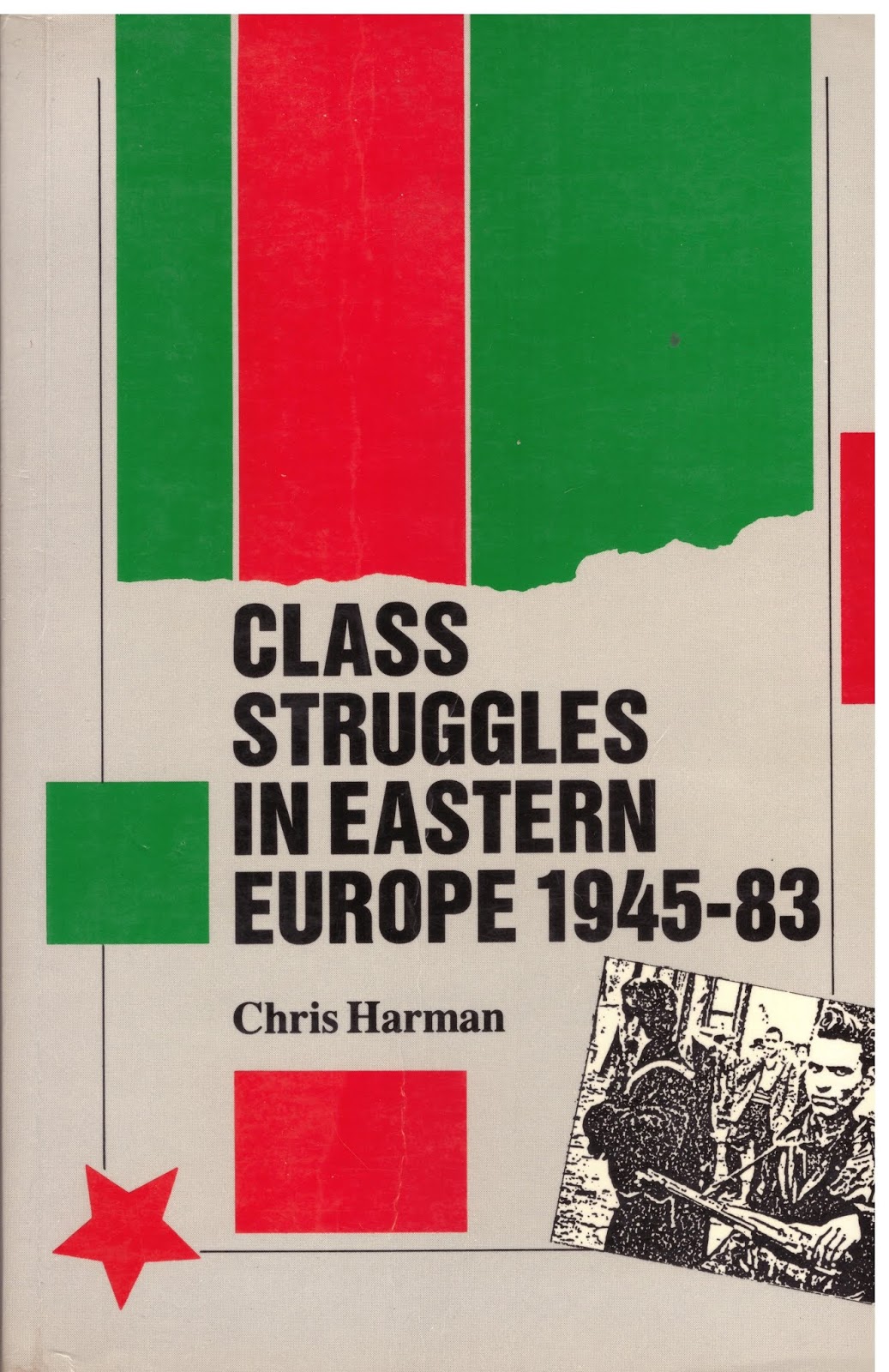
Chris Harman - Class Struggles in Eastern Europe 1945-83
It is this second aspect of Harman's life - the belief that socialism was the "emancipation of the working class, by the working class" which shapes this book. Harman, like others in the International Socialist tradition, argued that the states of Eastern Europe were not "socialist" or "communist" but "state capitalist", something he argues here was not simply a arbitrary name but a "definition, in the full meaning of the word". He continues:
The term 'state capitalism' captures the essence of the East European societies because it locates within them a dynamic which determines their historical development - the dynamic of competitive accumulation.It is the competitive accumulation, caused by East European economies' competition with the "capitalist" western economies and lead by a bureaucratic class which drove the attacks on living standards, wages, freedoms and democratic rights, which encouraged the struggles described in the book. As Harman explains:
Without the drive to accumulate, there is no explanation as to why a motley collection of planners, managers, party leaders, generals and police chiefs come to form a solid phalanx, united under a single discipline in opposition to the demands of the rest of society.Harman writes that there are two general myths that covered how people viewed the Eastern bloc (before 1989). The first, from some on the left, was the idea that these were socialist societies of one form or the other. The second, more generally from the right and their media mouthpieces, was the idea that these societies were frozen in time, lacking freedom where dissent was ruthlessly held down by near unstoppable security forces.
Yet, as the book shows, Eastern Europe from the imposition of bureaucratic rule was shaped by class struggle. Strikes, protests, occupations and insurrection were relatively common as ordinary workers and peasants fought for more rights and better living conditions. Class Struggles in Eastern Europe begins with a short history of the development of the Eastern Europe regimes. These arose, not from the mass struggles of workers and peasants, but from military imposition by Russia, and it was the Soviet Union that initially shaped (or reshaped) industrial economies in it's own interest - "[Russia] matched the Marshall Plan's consolidation of western capitalism in one half of Europe with their own form of consolidation in the other half".
The reality of "competitive accumulation" for Eastern Europe was regular, cyclical crisis. Over the decades covered, repeated attempts by governments to focus investment or cut wages failed to solve underlying economic problems - exactly like capitalist governments and companies cannot fix their own economies. The crises led to splits in the ruling class as different sections of the East European ruling classes, while united in their desire to maintain the system and continue to exploit workers, argued about different strategies. It was these splits that time and again gave workers' movements the opportunity to break through. As Harman writes about the East German workers uprising in 1953:
The SED leadership later complained that functionaries had 'fallen in to panic, had slipped into positions of capitulationism and opportunism in relation to the enemies of the party'. But the confusion of the functionaries was not an accident. It was the inevitable consequence of the splits at the top of East German and Russian society. And these splits were no accident: they flowed from the inner economic dynamic of state capitalist society, as the examples of Poland and Hungary three years alter were to show even more dramatically.Or, writing about Czechsolavika in 1968:
The first strikes broke out at a time when the whole apparatus of bureaucratic control was in turmoil. This was reflected in the attitude of local bureaucrats to the strikes. One automatic reaction was to condemn the strikes out of hand ... But some sections of the bureaucracy saw possible benefit to themselves in the strikes. Junior managers often regarded them as a lever to remove more senior Novotnyite officials or to gain a degree of autonomy for the plant they controlled.Of the "class struggles" described in the book many will be known already to readers. Two events stand out above the others. The first is the Hungarian Revolution of 1956, the second the experience of Solidarity in Poland in the early 1980s. The Hungarian Revolution deserves to listed alongside other great working class revolutions. Today it is usually remembered for the brutal intervention of Russian tanks, but 1956 was marked by all the elements of previous revolutions - mass strikes, demonstrations and workplace occupations and, crucially, the creation of workers councils which in the words of the British Communist Party's Peter Fryer, "bore a striking resemblance to the workers peasants and soldiers councils which sprang up in Russia in the 1905 revolution and in February 1917". But tragically, as Harman shows, there was a lack of any revolutionary minority that could argue for the seizure of power during the period of "dual power". In fact the leadership of the Hungarian workers' councils consciously avoided 'political decisions' leaving the existing state together with the armed might of the Russian military to retake the whole political space.
In Poland, there was no intervention from Russia,
precisely because of the depth and radical nature of the Polish movement compared to that in Czechoslovakia. They viewed a Russian military takeover of Poland as a very hazardous undertaking indeed. Poland was a much larger country with a much larger working class than Hungary or Czechoslovakia. Its population had historic traditions of armed resistance to invasions.Yet the movement in Poland also failed to break through and was defeated, with its activists arrested, imprisoned and sometimes killed. In this case, while individuals were drawing revolutionary conclusions during the height of Solidarity's workers' revolt. There was also no political party capable of linking together the struggles and challenging the vacillations of reformist leaders like Lech Walesa who were terrified of radical action from below.
Writing about Hungary in 1956, but with words that are applicable to all the struggles he writes about here, Harman argues that:
The real significance of the Hungarian revolution does not rest in any attempt at a crude balance sheet, with workers' deaths on one side and economic gains on the other. It is to be found elsewhere. The myth that 'totalitarian', state capitalist societies are immutable, with their populations brainwashed into acquiescence, was smashed once and for all. Hungary proved that the Stalinist monolith itself bred forces that could tear it asunder.The last part of the book is a discussion of why, in both east and west, accumulation leads to crisis and, often workers resistance. Harman lays out an argument that any relief for the rulers of the Eastern bloc would only be short. In 1989 the Iron Curtain collapsed in a few months as ruling classes were no longer able to solve the contradictions of their society and prevent reform or revolution. But if Harman's arguments about State Capitalism seem less important today, his wider theme - the need for activists to come together in revolutionary parties in order that the next struggle is victorious - remains utterly crucial. Class Struggles in Eastern Europe is a brilliant explanation of the importance of revolutionary organisation, through these forgotten accounts of workers' struggle.
Related Reviews
Harman - Zombie Capitalism: Global Crisis & The Relevance of Marx
Harman - The Fire Last Time: 1968 and After
Harman - Revolution in the 21st Century
Binns, Cliff & Harman - Russia: From Workers' State to State Capitalism
Harman - Marxism and History
Dent - Hungary 1930 and the forgotten history of a mass protest
Fryer - Hungarian Tragedy
Tuesday, October 30, 2018
William A. Pelz - A People's History of the German Revolution
But the German Revolution is barely remembered. Pelz notes that few of his students had ever heard of it, and Chris Harman, famously called it the "Lost Revolution". So it is welcome that this new book has been published that can rescue the events of 1918 and 1919 for a new generation of activists. It is also good that this history has been written by someone broadly sympathetic to the Revolution and the people who made it.
Pelz locates the German Revolution as a culmination of a process that begins before World War One. This is the growth of the mass German socialist party the SPD. This, Pelz argues, was revolutionary in tone yet had developed a significant base within the system. Pelz quotes historian Lynn Abrams, "A working-class family could purchase its groceries at the socialist cooperative, borrow books from the Social Democratic library, exercise at a workers' sports club, sing in the workers' choir, if necessary call on the workers Samaritan Association in the event of an accident and draw on the workers' burial fund upon the death of a family member." But Pelz shows how the SPD had helped develop a "highly politicised working class" within which a "striking six percent put forth that there most important wish was to 'settle accounts with the capitalists.'"
It was this that led them to support German involvement in the war and then to take a counter-revolutionary attitude to the anti-war and then revolutionary movements. Pelz also shows the way that the deprivations of the war and the reality of life in the trenches helped create the spark for the events that began in late 1918. He also argues, convincingly, that anti-war sentiment was very strong in the German army quite early in the conflict.
The book is called "A People's History" and Pelz highlights the role of ordinary people in making the Revolution. In particular he celebrates the central (and often downplayed) involvement of women in the movements - first during the war when they played major roles in food riots - but then during the revolution itself. Women had been sucked into the factories as the men were sent to the front and played a crucial role in overthrowing the Kaiser and ending the war. I found these sections the most interesting and people who have read other accounts of the German Revolution will find much new material here.
I did have some problems with Pelz's account. Most important of these is that Pelz repeatedly dismisses those who argue that what was central to the defeat of the Revolution was the lack of a revolutionary "Bolshevik" type party. He particularly singles out Chris Harman for this criticism. But Pelz seems to misunderstand the role of such a party. The key problem with the German Revolution, as Pelz himself acknowledges, was that at particular points no strong enough force existed outside the SPD to hold back or drive forward the movement. Even when the German Communist Party (KPD) was formed this was too immature to play such a role. Lenin's Bolsheviks' in Russia were able to play that role and thus lead an insurrection after a year of revolutionary turmoil in which they had proved themselves to the masses. The existence of such a party in Germany, built long before World War One started, could have made sure the ups and downs of 1919 helped develop the working class movement in ways that ironed out its weaknesses.
This is most clear when looking at Pelz's discussion of the January 1919 Spartakist Uprising. This clearly should not have taken place - it's failure to involve a majority of the working class simply allowed the right to accelerate their repression. Instead Pelz argues that the alternative would have been a "revolutionary committee" that could have "deposed" the government and formed a new one based on the "left-wing USPD, the KPD and revolutionary shop stewards in Berlin". That may or may not have been successful as Pelz points out, possible leading to a bloody Paris Commune or a second "socialist" revolution. But surely the reason this didn't happen was the lack of clear revolutionary leadership - and had that existed in a party - the question of a workers' government might have been moot.
Chris Harman quotes Rosa Luxemburg before she was murdered. The defeat's cause lay she said, on "the contradiction between the powerful, resolute and offensive appearance of the Berlin masses on the one hand, and the irresoluteness, timidity and indecision of the Berlin leadership on the other". Harman then continues, "With a powerful revolutionary party, the Berlin working class would probably not have walked into the trap laid by Ebert, Noske and the generals".
To be fair to Pelz, he has not set out to right a manual for Revolutionaries, but a pure work of history. But the problem is that he also knows that had the German Revolution been successful it would have likely prevented the horrors that followed in the "midnight of the century". That success would have relied on the involvement of the masses in history which Pelz celebrates. But it also required political leadership that was prepared to take it forward. So while Pelz's book has much of interest, I recommend that it is read alongside other accounts such as that by Pierre Broue or Chris Harman's work.
Related Reviews
Broué - The German Revolution 1917-1923
Reissner - Hamburg at the Barricades
Fernbach - In the Steps of Rosa Luxemburg: Selected Writings of Paul Levi
Hoffrogge - Working Class Politics in the German Revolution
Trotsky - Lessons of October
Hippe - And Red is the Colour of Our Flag
Saturday, December 18, 2010
Chris Harman - Marxism and History
Harman makes the point, that what is important for Marxists is how societies change - how do we move from one historical epoch, or mode of production to another. How does feudalism change to form capitalism for instance? Harman picks apart Marx's theory of history, to look at how the economic forces of production produce "relations of production", between people and between classes. But the forces of production rarely remain static in society. Things change - new tools are invented, new methods of organising production or agriculture, and these in turn create new relations of production. These develop and grow and produce new interests in society that may clash with the existing order, producing a period of social revolution.
Into this mix, Marx puts class struggle. Historical change is driven by class struggle at periods when the development of productive forces have made other change possible. He explores this in greater depth in the second essay which is a detailed look at the process of change from feudalism to capitalism. Harman is both taking on those particular Marxists, such as Robert Brenner who have, in his view, over simplified the argument or misunderstood the processes at work.
What's fascinating about both works, is that Harman picks from a deep knowledge of history to give many concrete examples to back up his explanations (something he does on an even greater scale with his fabulous "People's History of the World"). This has the effect of illuminating what are, in actual fact, slightly obscure academic debates.
But for Harman, these debates are crucial. The first essay in particular concludes with a look at how revolutionary processes happen and the role of ideology and political organisation. For Marxists, the question isn't simply to study history for the sake of it, but to understand history to learn from it, in order to strengthen our ability to change the world today.
Related Reviews
Harman - Revolution in the 21st Century
Monday, August 27, 2018
Peter Binns, Tony Cliff & Chris Harman - Russia: From Workers' State to State Capitalism
This short 1987 collection of essays brings together four short pieces by leading British Marxists of the International Socialists and the Socialist Workers' Party. Only the first, an introductory piece by the Palestinian Jewish Marxist Tony Cliff is new for this piece, the others are from various other socialist journals and books. Cliff's piece is short and the meat of the argument is presented by Chris Harman's pieces which deal with the defeat of the Russia Revolution and the nature of Russia and its satellite states. The first Harman piece How the Revolution Was Lost (online here) is one of the clearest arguments about why Russia, first through isolation and the defeat of the post-World War One European Revolutionary movements and then the development of a new bureaucratic class, led to the defeat of the Revolution itself. It's a classic article that I have read numerous times and which I highly recommend to socialists.
Harman's second piece can be seen as a basic introduction to the idea that defines the International Socialist tradition, that Russia was State Capitalist. Because of the origin of the articles as separate pieces there is some duplication, but again, Harman's argument is clear and accessible and like the following Peter Binn's article he returns first to a study of what capitalism is, before showing what Russia was/is. Harman shows how the basic dynamics of capitalism existed in pre-1989 Russia (and the Eastern bloc countries), showing how they could not possibly be socialist:
whereas under pre-capitalist societies production is determined by the desires of the ruling class and under socialism by the desires of the mass of the population, under capitalism the nature and dynamic of production results from the compulsion on those who control production to extract a surplus in order to accumulate means of production in competition with one another. The particular way in which the ruling class owns industry in Russia, through its control of the state, does not affect this essential point. That is why the only meaningful designation in Marxist terms of the society that has existed in Russia for the last forty years [Harman means since the 1920s] is 'state capitalism'.Peter Binn's piece The Theory of State Capitalism (which can be found online here) is an extremely good short introduction to the idea. Like Harman he develops this through a study of capitalism, with frequent references to Marx's Capital. Crucially he shows how accumulation is a central feature of the economy of Russia, and this is because Russia is not an isolated economic system but one in intense competition with the Western Powers. This competition, like the competition between rival capitalists, drives the economic accumulation. Binns shows that this is true by showing how even within the developed capitalist powers, where the concentration and monopolisation of capitalism has meant that frequently only a single multinational dominates its sphere of production, yet these remain capitalist systems. State ownership, and indeed the existence of state planning, does not undermine this dynamic.
Central to all four pieces is a study of the rise of the bureaucracy in Russia. This came initially from the reality of the young, isolated Revolution which had experienced a decimation of the revolutionary working class. But eventually this bureaucracy became a class for itself, organising in its own interests and striving to extract the maximum surplus from the workers and peasants.
A few years after this book was published, the State Capitalist regimes of Eastern Europe and the USSR collapsed. As pointed out by Tony Cliff, in none of these supposed "workers' states" did workers collectively lift a finger to protect them. I was struck reading this that the essential arguments where proved by the nature of the end of the Eastern States. While it suited the capitalists to label these as socialist and the process from 1989 to 1991 as "the end of socialism", in reality this was capitalism reforming itself to try and deal with its inherent contradictions. Why does this matter today? After all these regimes haven't existed for almost thirty years. Binns and Harman both make the point that firstly the clarity provided by returning to the basic ideas of Marxist theory helped ensure that some revolutionary socialists weren't distracted by the idea of "actually existing socialism" and secondly, because if the Revolution of 1917 could be defeated by counter-revolution and the rise of a bureaucratic class then future revolutionaries must guard against the possibility.
Related Reviews
Sherry - Russia 1917: Workers' Revolution and Festival of the Oppressed
Trotsky - Lessons of October
Birchall - Tony Cliff
Cliff - Trtosky 1923-1927: Fighting the Rising Stalinist Bureaucracy
Cliff - Trotsky 1927-1940: The Darker the Night, the Brighter the Star
Friday, July 22, 2011
Thomas C. Patterson - Karl Marx, Anthropologist
Marx was fascinated by human society in all its forms. Both Engels and he devoured contemporary books and research on archaeology, anthropology and related subjects. Patterson points out, that between 1879 and 1882, Marx filled 450 pages of notes "on topics as diverse as prehistoric Europe, the history of India, Dutch colonialism, family and gender in Roman society and American Indian societies". In part this is no doubt a result of the fascination that Marx had with history and people. But this was also a time when Marx was feverishly working on other topics, and Patterson argues that this reading reflected not just an interest, but as part of an attempt to understand non-capitalist and pre-capitalist societies. This was not a separate interest, but as part of a wider attempt to grapple with human history. In particular, Patterson argues, that Marx was trying to understand the potential for "alternative pathways of development for capitalist societies by the 1870s and for non-industrial and non-Western societies more than a decade earlier".
Marx and Engels also had a great fascination with other important subjects that were shaking up the intellectuals of Victorian England. One of these was evolution, and Marx devoured Darwin. "Absolutely splendid" was how Marx described The Origin of the Species in a letter to Engels, less than a month after its publication. Marx was critical, but he also saw how "Darwin rediscovers, among the beasts and the plants, the society of England with its division of labour, competition, opening up of new markets, "inventions" and Malthusian "struggle for existence."
This was not to argue that the social structures visible around them were mirrored in nature, but rather that Darwin and other scientists tended to reflect social ideas in their work. Their ability to locate the new scientific explanations and ideas in a wider understanding of society meant that Marx and Engels could be incredibly perceptive. Patterson demonstrates this by comparing Engels' little known pamphlet The Part Played By Labour in the Transition from Ape to Man to modern understandings of human evolution and the development of language and so on. Patterson concludes that Engels "got it right!" in his argument that the ability of proto-humans to use their hands as tools, helped to develop and encourage both this and their wider cogitative abilities. Of course, these ideas on the part of Engels were broad brushstrokes, and as with other areas of his scientific writing, Engels was often wrong. But what matters here is the approach to a subject and the attempts to link science with wider social questions.
Patterson's book is fascinating if a little hard going in places. Occasionally it feels to academic and the reader new to Marx's work (or indeed wider philosophical writings) might find some of it quite difficult. I was disappointed with the price-tag. Twenty pounds for a book of only 200 pages is a little steep, but clearly this is aimed at the academic market. This brings a second minor point - Patterson has an extensive and very useful bibliography. The one obvious missing Marxist from this is Chris Harman who had a great fascination with anthropology and wider human history. His writings I think would have fascinated Patterson and backed up some of his wider arguments. I cannot help but feel though that his absence reflects the fact that Harman was never an academic. In this context though, Harman's grounding in revolutionary practice would also have been useful to the author.
Related Links
Chris Harman reviewed an earlier book by Patterson, Marx's Ghost - Conversations with Archaeologists. You can read that here.
This review of Karl Marx, Anthropologist by an actual anthropologist is worth reading.
Monday, February 15, 2016
Spencer Dimmock - The Origin of Capitalism in England 1400 - 1600
The debate on the origins of capitalism, more specifically, the transition from feudalism to capitalism, is one that remains crucially important for understanding the nature of the present system, and its dynamics. While superficially an abstract discussion, understanding the transition has, for many Marxists been central to a wider understand of the process of historical change.Spencer Dimmock's book challenges many of the cherished ideas of Marxists who hold this point of view, and this ought to have been an important contribution to the debate. Unfortunately it is marred by its ill-tempered polemic, it's dismissive approach to many of those the author disagrees with, and its hagiographic defense of the Marxist who is most central to Dimmock's own ideas, Robert Brenner.
This is a shame as there is much of interest in The Origin of Capitalism in England particularly the detailed use of sources in the second part to emphasise crucial parts of Dimmock's arguments. There are also important critiques of non-Marxists and what might loosely be termed, critics of Brenner from the right, which may well be of use to those trying to get to grips with non-Marxist history writing. Yet time and again I found myself putting down the book out of frustration at the author's style.
Dimmock, as does other political Marxists like Brenner, directly challenge some of the central arguments of those they call the orthodox Marxists. Here, for instance, is Dimmock's assertion that
There was no growth of a bourgeois class in direct opposition to old feudal lordship drive by commercial expansion and growth of the productive forces which then defeated the latter in the 'bourgeois revolution' of the mid and late seventeenth century, as has often been contended. Instead feudal lord-ship became 'bourgeois' itself... English lords were as responsible for breaking the remaining extra-economic prerogatives of monarchy and its allies as the 'bourgeoisie' that grew up in the shell of the estate system.Leaving aside that Dimmock asserts there was "no growth of a bourgeois class" and then refers to the bourgeois "allies" who clearly had grown from something, this passage strikes me as an example of an error of approach by the author. Keen to dismiss orthodox Marxism for a teleological approach, I think he misunderstands the nature of that approach itself. To take one example, Marx never really suggested that there was an automatic process of transition from feudalism to capitalism. I was struck for instance, that in his polemic against writers such as Chris Harman, Dimmock failed to note that Harman highlights in several of his pieces the way that capitalism failed to develop out of "feudal" societies. It's far from a teleological method. Take Harman's rather more nuanced approach in his piece The Rise of Capitalism which unfortunately if not discussed by Dimmock.
On occasion Dimmock also deploys some straw men. He argues for instance "When historians speak of capitalism being driven from below, they must recognise that the majority of the commons in both towns and countryside were opposed to capitalism." He is clearly right here. It's an argument that is echoed by Michael Andrew Žmolek in his recent book Rethinking the Industrial Revolution. But the danger here is that Dimmock is implying that everyone (other than himself, Brenner and a few other political Marxists) argues this. In fact most Marxists wouldn't suggest that this is how the transition to capitalism came about. The idea of developing productive forces causing the further development of people within feudalism with an interest in overthrowing feudalism and creating a society more open to their own interests does not imply that there (I caricature) groups of people who sat down and planned the transition with a blue print of the sort of society that they wanted. Indeed most of those who ended up leading (say) the English Revolution certainly did not begin by wanting to chop off the King's head. They were lead to that position by the nature of the War itself and the extent to which the old order was vigorously defended.
At root I think there are two problems with Dimmock's book. One is a misunderstanding of Historical Materialism itself which he seems to see rather mechanically. For instance, here is Dimmock's summary of HM:
in all class societies the direct producers will, where possible, always aim to increase their wealth by seeking gains from trade through changes in productive organisation, in other words by specialisng production in response to price changes for particular commodities.This is not at all the version of historical materialism I get from reading Chris Harman or even The German Ideology. In fact, it implies a type of inherent greed to human nature which seems distant from what Marx actually described.
Secondly, and perhaps more fascinatingly, Dimmock appears to have in his sights the project for the revolutionary transformation of society. One of his core arguments is that orthodox Marxists have a particular understanding of the transition to capitalism because they want to replicate this in the transition to socialism. Here is not the space to tackle what I see as Dimmock's mistaken understanding of how that process would take place, but it is worth noting his own vision of that change.
if due to a chronic crisis of capitalism, wage workers no longer had the option of seeking capitalist employment, concessions born out of necessity in industrial and agrarian production may be drawn from big business and the sate in the form of co-operative, non-market ventures, following perhaps the election of a party given a mandate for necessary radical change.This vision of radical change coming through the voluntary giving of concessions by corporations in midst of economic crisis is in direct opposition to Marx's own ideas which saw the state as being a tool of the ruling classes to maintain their power. Such concessions would surly have already been made if capitalism had such a benevolent core. As we know from history, the system is quite happy to have reserve armies of hungry and unemployed, being motivated by their profits. Dimmock has this utopian vision of change because he rejects what he believes are the necessarily violent tendencies of orthodox Marxists, whom he accuses, most unfairly, of believing the violence and suffering of the transition to capitalism was necessary for the eventual installation of socialism. This view may have been true of those who followed Stalinist distortions of Marxists, but is manifestly not true of those whom Dimmock is polemicising against here.
These inherent weaknesses in Dimmock's book prevent me encouraging potential readers to buy it. There is much to be learnt from the debate between Robert Brenner and his critics, but I don't think that this is the book that will illuminate the differences.
Related Reviews
Harman - Marxism and History
Žmolek - Rethinking the Industrial Revolution
Friday, April 25, 2025
Nigel Harris & John Palmer (eds) World Crisis: Essays in Revolutionary Socialism
Over fifty years after World Crisis was published how does it stand up? Is it worth reading? I would argue that it is worth reading, and that it has much to offer beyond just historical curisosity for those interested in the history of the British left and the origins of the SWP. While some chapters are necessarily dated, there are others that are fascinating and retain their use today.
In the introduction Jim Higgins and John Palmer restate some orthodox Marxist ideas. The main reason for this is to highlight how much of the left, under the pressure of the existence of the Soviet Union, had abandoned central tenets of Marx's concept of workers' self-emancipation. They write:
And implicit in the struggle of a group of workers against a single employer is the struggle of all labour aginst all capital. The rise of working-class parties based on trade unions, directly or indirectly, is not accidental. Nor is it an accident that in times of fierce economic struggle workers are more receptive to political ideas. It is because of these structural and necessary features of capitalism that Marxists have identified the working class as the revolutionary class par excellence; not because it has some mystical quality of goodness, but because the nature of capitalist production and the relations within it make it so.
Writing this in 1971 is also a polemic directed at new layers of radicals, aiming to win them to a Marxist view that places working class self-activity at the heart of organisation. This book certainly does this. But the book also asks, what is changing in the world. The opening chapter is "A Day in the Life of the 'Fifties" by Peter Sedgwick and is an amusing, and insightful look at a demonstration "against German rearmament" in Parliament square. The protest is attacked by the police, and Sedgwick uses it as a way to contrast the staid life of the old left: "Almost without exception all the elements which came togehter so hopefully on that late day in January [1955], a decade and a half ago, have been probed, stripped, revealed as nothing by the merciless challenge of the years." Later however Sedgewick notes that at the time of writing workers were less likely to be on the streets, and protests are more often by groups of middle-class radicals in their "brief hour of rebellion". The workers he points out "cannot graduate... but its consciousness is slower to ignite tha that of the Instant Left." Written in a time before student life became something that masses of workers engaged in, this comes across as somewhat sectarian, especially in the aftermath of 1968. But there is a point. The workers did need to link up and develop their struggles. The limitations of this in Britain in 1968 was the weakeness of the whole movement.
Chapter two is somewhat depressingly called "The Decline of the Welfare State". Reading it one is tempted to shout out to the author Jim Kincaid, "you ain't seen nothing yet!". But Kincaid does trace the way that attacks on welfare are rooted in a capitalist approach to the economy. It's must have been a depressing read then. Now it feels like fortune telling. But Marxism as a tool is nothing if insightful, and some of the chapters here give a real sense of debates to come. Here, for instance, is Nigel Harris pointing out that capitalist development does not benefit everyone, and early discussion of topics that would become central to degrowth theory in the 21st century:
But 'growth' may not mean 'development'. The statistics may show a rising national income, even a rising average income per head, at the same time as unemployment is increasing, there is no change int he distribution of the occupied population between agricultural and non-agricultural employment and in the distribution of non-agricultural employment between manufactuing and other sectors. In human terms nothing very much may have happened, and things for the majority may even have got worse.
Paul Foot's chapter on the origins and limitations of the Labour Party is fascinating, beginning as it does with the early betrayals. Written at a time when Labour still had mass membership and considered itself a socialist organisation it is clearly a polemic designed to arm readers for individuals breaking from Labour. But it has some fascinating material that readers today who want to argue against a Parliamentary Road to Socialism will find useful. Similarly Chris Harman's brilliant essay traces the limitations of these countries as "socialist" and puts a clear argument for the importance of State Capitalism as a theory. Its importance, as Harman writes, is in clarifying the left's politics:
A clear analysis of these regimes is a necessary precondition for renewed growth of the Left in the West. Only a theory which centres on the basic problem for the rulers of these countries - that of accumulating capital - and sees this as forcing them into collision with each other and with the working class can comprehend the forms their rule takes and the policies they pursue at each historical point.
Such an analysis proved important for both building a new revolutionary left in the 1970s and developing a critique of the limitations of Stalinist parties in the same period. It also helped ensure that the SWP survived the collapse of State Capitalism in 1989. Characteristically, Tony Cliff's chapter "The Class Struggle in Britain" is an argument about what socialists should do. A couple of things stand out. One is his comment that "a declining interest in the traditional reformist organisations (the Labour Party, Communist Party, etc) does not mean the overcoming of reformist ideology." This is true, though while Cliff probably overestimated the declining interest, he was right that even when this comes, it does not necessarily mean reformism is also dispensed with. However one part of his chapter could very well be written today for socialists in Britain:
The weakness of revolutionaries in Britain at present is quite obvious. Small in number, often isolated because of their social composition - white collar and student - from the main sections of the working class, split into a number of groups, and above all lacking experience in leading mass struggles. But these weaknesses can be overcome. Readiness to learn, readiness to experiment systematically, above all readiness to try and translate the general theories into practical activities - this is what is necessary. In a complex and rapidly changing situation, readiness to move from simple tasks to more difficult ones, above all readiness to overcome one's own mistakes is crucial.
For some socialists reading World Crisis would be an act of navel gazing. Dreaming of past battles. I'm not sure of the value of that. But the clarity of the theory its authors have, their determination to root this theory in struggles, and learn and develop the theory offers much. Some of the chapters are reminders of central revolutionary ideas. Michael Kidron's article on Imperialism and the permanent arms economy is perhaps the most useful in this regard. Foot's chapter on Labour and Harman's on East Europe also offer insights and ideas that remain useful. But standing out all of them display a Marxist method essential to furthering the basis of our theory today. As Cliff reminds us:
The greatest defect of revolutionaries who have been isolated for years from the mass movement is their inclination to make a virtue out of necessity, and concentrate on theories to the exclusion of practice, forgetting that above all the duty of a revolutionary is to raise theory to the level of practice.Related Reviews
Birchall - Tony Cliff: A Marxist for His Time
Harman - The Fire Last Time: 1968 and After
Harman - Selected Writings
Harman - Class Struggles in Eastern Europe 1945-83
Sunday, June 01, 2025
John Rees (ed) Essays on Historical Materialism
The essays take up this ideological challenges in a number of ways. The first two probably stand the test of time the best. They are by Chris Harman on History, Myth and Marxism and the other is by Alex Callinicos and considers Post-modernism and its encroachment into the field of history. Callinicos' essay is perhaps one of the best short introductions to post-modernism I've read and repays a read, even if the immediate target of his writing is not as important as it was nearly thirty years ago. Another essay, by Mark O'Brien, on post-modernism and British history is also very useful - a solid defence of the importance of class through a study of the class forces and tensions within the Charist movement. In doing so O'Brien shows how the centrality of class undermines the post-modern rejection of continuity in history and the any sense of radical change.
I was also particularly taken by Mike Haynes's article on Social History and the Russian Revolution. Here he traced the way that the collapse of Stalinism was leading to a retreat by left historians of the Revolution, and an assault of Marxist histories. One thing that struck me here, was that Haynes is more explicitly critical of "Western socialists" in the aftermath of the Russian Revolution than other writings. He writes: Western intervention [against Revolutionary Russia] was only able to have the effect it did because the revolution did not spread to the West as the Bolsheviks hoped and expected and because too little opposition was developed by western socialists to the actions of their own governments in Russia."
But perhaps the best historical essay in the collection is Brian Manning's on Labour and the English Revolution, which defends a Marxist approach to the Civil War period, by closely studying the class dynamics of the revolutionary movement. He draws out who was arguing and fighting for what, and why, to demonstrate the importance of class. The question of the diverging intersts of "small producers" and "wage workers" within the Revolution is surprisingly important. He concludes:
In a bourgeois revolution, wrote Trotsky, 'that class which sacrifices most for the success of the revolution and hopes the most from it, receives the least of all... The disappointment of the masses follows quickly' and could lead to a second revolution, but 'more than once in history' this disappointment has 'become the starting point of a victorious counter-revolution'. The latter happened in the English Revolution. The disillusionment of plebeians with the immediate results of the revolution did not provoke them to further revolutionary acvitity but to the abandonment of revolutionary activity. The counter-revolution, however, was only partly successful.
Mannings article demonstrates how, and why this happened - relating the different interests of the participatory classes, to their struggles and actions and the failure to unite to move forward. Its an exemplary piece of writing, and one that many students could benefit from emulating.
John Rees' concluding article on the differences between academic and revolutionary Marxism points out that the defeats of the left and the working class movement from the 1980s onward and opened the door to a generation of Marxists who divorved their Marxism from the struggle. This, Rees points out, undermines the basis of Marxism itself and weakens the approach of the Marxists to their history. But it also makes for a Marxism that is unable to deal with new challenges and ideas. There is much food for thought here for those Marxists who both restrict themselves to academia and refuse to soil themselves by engaging in the struggle, as well as those Marxists whose ideas are ossified and are no longer developing in engagement with new and emerging struggles from below.
Related Reviews
Harman - Marxism and History
Harman - Selected Writings
Callinicos - Imperialism and Global Political Economy
Callinicos - The New Age of Catastrophe
Perry - Marxism and History