Monday, September 28, 2015

Claire North - Touch

Touch follows Claire North's brilliant and extremely successful novel, The First Fifteen Lives of Harry August, which played delightfully with time travel. This novel is a good read, with North's typically tight and breathless writing.

Here, our hero is also afflicted with an unusual problem. Instead of being doomed to repeat his life upon his death like Harry August, the individual known as Kepler can transfer his or her personality, complete with memories, between bodies at will, dependent on being able to touch skin.

At the beginning of the novel Kepler is running hard. A body he'd recently been wearing has been shot dead and Kepler only just made the transfer to the killer. We find out that Kepler's kind (for there are many) have been persecuted for centuries, considered demons or, in more enlightened times, beings that despoil or ruin those that they inhabit.

This theme of pursuit by an unknown force, with unknown motivation is a theme that readers will find familiar from Harry August. I think it works well here, but the novel is not quite as sharp and at times felt unfocused. Perhaps that was the difficultly of keeping track of precisely who was in who. Its a good read, and Claire North shows once again a flair for finding a new and unusual premise.

Related Reviews

North - The First Fifteen Lives of Harry August
North - The End of the Day

Saturday, September 26, 2015

Tamás Krausz - Reconstructing Lenin: An Intellectual Biography

In recent years there has been a intense discussion about the ideas of the Russian revolutionary Lenin. Some of this has its roots in the class struggle - the Arab Spring and the Occupy movement both threw up questions about the nature of revolutionary organisation. Others have attempted to re-examine Lenin to critique existing organisations and ideas. There have been some excellent books, articles and events debating these questions.

Tamás Krausz's important new biography must be seen as part of this debate. His work is very much an attempt to re-examine Lenin's ideas as part of a resolute defence of Lenin and his work. Krausz is clear that this is intended to take forward the revolutionary movement that can challenge and defeat capitalism.

The Lenin that comes through on these pages is far from the mechanical, doctrinal individual, whose personal single-mindedness somehow embodied the future authoritarian Stalinist state. Rather he rigorously applied the ideas of Marxism to the concrete situation, confident to update and alter his viewpoint depending on circumstances, and ever open to learning from workers. Indeed, Krausz highlights Lenin's own celebration of the importance of the workers' own spontaneity and self-organisation
Lenin considered the workers' soviet as the political arm of the uprising and an institution of the revolution. The soviets and similar popular organizations... were the product of the workers' autonomous agency. As Lenin wrote about the uprising of December 1905, 'It was not some theory, not appeals on the part of someone, or tactics invented by someone, not party doctrine, but the force of circumstances that led these non-party mass organs to realize the need for an uprising and transformed them into organs of an uprising.'
That said, Lenin's Marxism began with the concrete situation and ended with the need for the revolutionary overthrow of capitalism. This comes through clearly throughout the book, but I found the discussion of Lenin's attitude to the National Question, particularly illuminating. Krausz says
Lenin always approached the role and character of national movements from a historical and class perspective. He did not support the struggle of each and every small country fighting the great imperialist powers. He also had a strictly imposed condition: the uprising of any class more reactionary than the bourgeoisie of the center countries is not to be supported. 
It is precisely this approach that allowed Lenin to become the leading revolutionary critic of war and capitalism during the First World War. Those who supported the war ended up siding with their own ruling class. But those who did not get the question of national liberation also failed the revolutionary movement. "Lenin considered national self-determination a fundamental issue of democracy that revolutionaries 'may not undercut!'." These debates continue to have a resonance today. Lenin, for instance, opposed the slogan of "No Borders", not because he wasn't for a world without borders, but because in the concrete situation, demanding the self-determination for oppressed countries meant the defacto creation of borders.

Another excellent chapter is on the nature of the early Soviet regime. Here Krausz describes how Lenin again saw everything through the lens of the defense of the revolution. "To Lenin, mass terror counted as the most extreme instrument of struggle against the enemy and was to be applied (and often demanded by him in vain) on a case-by-case basis". Given the way that under Stalin the Soviet Union's peasantry were forced into collectivisation, its interesting to read that
In April 1919, some peasants in certain parts of the country were going to be forced to join the collectives, rather than doing so of their own free will - a behavior categorically prohibited by Lenin in the name of the Council of People's Commissars. The peasant base formed the backbone of the Red Army, and 'Compulsory measures of any kind to make the peasants pass over to the communal working of the fields are impermissible. Non-observance of this will be punished with all the severity of revolutionary law'.
Krausz's treatment here of the Civil War and the suppression of the Constituent Assembly is refreshing - seeing Lenin (and the early Soviet state) actions through the question of the defence of Revolution. Lenin is often accused of celebrating revolutionary violence. But his approach was very different, Krausz notes how in the aftermath of the defeated 1905 revolution Lenin advocated the use of political terrorism if it took the movement forward, however, he quickly changed his mind after seeing how terrorist actions in response to counter-revolution made the situation worse.

Later, as it becomes clear that the Russian Revolution was isolated, Lenin was forced down even more pragmatic roads. Krausz explores in detail the years of War Communism and the NEP, seeing these as steps along particular routes attempting to deal with particular situations. Lenin and the leadership of the Bolsheviks had always been clear that without international revolution, the Russian Revolution would become isolated. The end of the First World War did lead to revolutionary upsurges elsewhere, and real hope in Russia that countries like Germany would overthrow capitalism, and the centre of revolution would move to Berlin. Unfortunately Krausz downplays this. His focus on Russia implies that the key moment for international revolution was the failed Red Army assault on Poland in 1919. And at times, Krausz suggests that there was limited potential for a Germany revolution and for Bolshevism to spread among western workers.
Lenin also mentions another defining trait - that a majority of the Western workers were not ready to seize power. However, he only sensed that they were subjectively ill-prepared for it, and he neither analyzed the causes nor sought the origins of this phenomenon. He understood that revolutionary Bolshevism could not penetrate the cultural traditions of the Western working masses, but he lacked a well-differentiated sociological analysis of the reasons for the inner stratifications of Western labor.
If Lenin really believed that "Bolshevism could not penetrate the cultural traditions of the Western working masses" then he gave no real sign of it in his writings. Krausz bases much of this on a description of a single visit by British workers to Russia in 1920 (though he fails to mention that in 1919 and prior to the First World War) there had been near revolutionary strike movements in Britain.

While this is a disappointing it should not be used to completely rubbish Krausz's book. The author rescues Lenin as a practical revolutionary, constantly returning to the concrete situation, analysing, listening and learning from those around him. For many decades after the Russian Revolution, we were told there was "actually existing Socialism" in Russia. Lenin would have been appalled. As Krausz points out,
Lenin stated in his last public speech that the realization of socialism was not on history's agenda yet. Now was the time of the transitional period, of creating the historical-cultural preconditions for socialism
Tamás Krausz's books deserves to become a key text for those trying to change the world. As he points out, the discontented keep running into Lenin, which is why his work is endlessly debated. This is not an abstract debate, but one that Lenin would have approved of. Here's Krausz ably summing up why
certain authors have deliberately eliminated from Lenin's legacy the essential philosophical tenets and methodology that made him who he was. For one thing, they neglect his most important practical discovery, namely his precise theoretical interpretation of Marxist dialectics, its reconstruction, and his practical application of those dialectics. Lenin understood, even on the basis of its Hegelian roots, that dialectical materialism (and epistemology) incorporates the self-movement in things, phenomena, processes, as well as the conscious human activist to transform society. Thus it is not a matter of the historical dialectic of ideas, but rather the self-movement and self-creation of history through social classes and individuals. For Lenin, epistemology was not simply a matter of getting to know reality. It did not exist for its own sake. He aimed instead to seek out the truth, the solution to contradictions within things, and the struggles that resulted. He wanted to see a radical transformation of the world so that humanity could rid itself, by its own will, of the dominant powers. Lenin gave Marx's eleventh Feuerbach thesis a new urgency: 'The philosophers have only interpreted the world, in various ways; the point is to change it'. In other words, history was not an abstract whole, an object of study for him, but a tool through which the elements and tendencies to be continued or transformed could be located in the midst of 'collapse'.
Related Reviews

Lenin - Proletarian Revolution and the Renegade Kautsky

Nation - War on War: Lenin, the Zimmerwald Left and the Origins of Communist Internationalism
Cliff - Revolution Besieged
Cliff - All Power to the Soviets
Krupskaya - Memories of Lenin

Tuesday, September 22, 2015

Jonathan Weiner - The Beak of the Finch: Evolution in Real Time

The finches of the Galapagos Islands are the poster animals for Charles Darwin's ideas. On Darwin's voyage he shot and identified a number of species of finch and their variations on the different islands helped give the young scientist clues that hinted toward his theory of evolution. The finches have developed amazing variations to adapt to the different ecology of the various Galapagos Islands, and this book explores that evolution and the scientists who have studied the finches as part of an exploration of how evolution actually works.

Darwin, and most natural scientists who came after him, before the late 20th century believed that evolution was a extremely slow process, observable through fossil remains. In part that was because they lacked the tools to see it, in particular the genetic science that is now such an important part of evolutionary science. Even with this science, it is still difficult for the layman to imagine the actual processes taking place which lead to the evolution of one species into another.

A quote from Thomas Huxley, one of Darwin's most able and enthusiastic supporters, illustrates this well,
the more we learn of the nature of things, the more evident is it that what we call rest is only unperceived activity; that seeming peace is silent but strenuous battle. In every part, at every moment, the state of the cosmos is the expression of a transitory adjustment of contending forces; a scene of strife, in which all the combatants fall in turn. What is true of each part, is true of the whole.
Huxley ably captured the processes that are observed in the finches described in Weiner's book. Though he couldn't have comprehended how they were working. Finches live, like birds everywhere, by eating various foods, finding a mate and escaping danger. Some of them are more able to do these things than others, and often tiny differences can make a difference to whether or not one bird or another is able to survive. One of the surprising things in this book is how tiny these differences are, and how big an impact they can have. The finches are famous for their different beaks, and Weiner explains how during periods of abundance the finches eat varieties of food. In times of shortages however, the different shapes of their beaks allow them to specialise in foods, and here is where tiny differences have the most impact. Talking about the Grants, two scientists who have made a career studying the finches in intricate detail, Weiner writes:
Thus the Grants suspect that the finches here are perpetually being forced slightly apart and drifting back together again. A drought favors groups of one beak length or another. It splits the population and forces it onto two slightly separate adaptive peaks. But because the two peaks are so close together, and there is no room for them to widen farther apart, random mating brings the birds back together again. 
It is worth noting Weiner's consideration of environmental conditions here. They play a key role in evolution, though he includes other factors such as the role of people bringing new species, or changing the landscape of areas that in turn force changes on other species. Writing in the early 1990s, Weiner doesn't ignore the threat from global warming, though he clearly could not foresee the amount of climate change we would be facing just twenty years later. But Weiner understands that the greatest threat to diversity is human action, and he explores in details the way that this can impact upon species population and evolution.

Sometimes, the tiny changes don't get fusioned back together. And tiny differences become permanent transformations.
What drives the first widening wedge? It is... a little like the splitting of an amoeba: one population goes one way and the one goes the other. You have one vessel, one gene pool, and you end up with two. And the beginning of the splut can be a very small thing,... Even a detail that has no adaptive significance can make all the difference in the world. In other words, the origin of species can lie in the kinds of small, subjective decisions and revisions that in our species come under the heading of romance.
Sexual selection isn't the only way that species diverge, though it does seem that the shapes of beaks of finches are one of the key things that potential mates look at when hunting a partner. Perhaps key to finch evolution is the way that environmental changes, such as droughts, force a wedge between birds with different lengths of beaks. In examples studied by the Grants, we have drought conditions favouring long and short beaks. The gap widened as the drought continued, and the longer this went on, the harder it would have been for random mating to bring them back together again.

With any book that has such extraordinary detail and is written so well, it's difficult to summarise it all in one review. One thing did strike me though. Weiner is able to write brilliantly because, in part, he is describing the extraordinarily persistent and detailed work of a small group of professionals over many decades. The work of Peter and Rosemay Grant is at the heart of this work, but so are many other scientists. That they were funded to spend years of their lives on an isolated island measuring beaks and observing finches' mating has been crucial to how we have begun to understand evolution. It is worth thinking about this when universities cut their budgets.

Jonathan Weiner's excellent book is one of the best introductions to this topic that I have ever read. It deservedly won the 1995 Pulitzer Prize when it was first published and remains extremely readable and relevant today. It would be fantastic if it could be updated with more on the work of Grants and their colleagues since 1995, as well as further discussion on global warming and its impact on the Galapagos Islands. But even so, this is well worth getting hold of.

Related Reviews

Darwin - The Voyage of the Beagle
Desmond & Moore - Darwin's Sacred Cause
Jones - Darwin's Island
Simons - Darwin Slept Here

Sunday, September 20, 2015

James Morrow - This is the Way the World Ends

*Warning Spoilers* 


To what extent are those that do not speak out guilty when atrocities happen? This is one of the themes of this very funny, but extremely dark and bleak novel. George Paxman is an ordinary worker, a tombstone engraver, whose attempts to get a protective radiation suit for his daughter leads to him being charged with culpable guilt when humanity is destroyed by nuclear war. Alongside the generals and politicians whose only strategy to stop nuclear war was to build more weapons, George is put on trial by the ghosts of those who were never born.

First published in the 1980s this is a novel that is clearly influenced by the anti-nuclear war movements. The arguments for nuclear weapons are brilliant pastiches of the pro-war ideas that continue to be used to justify the bombing of other countries or the renewal of Trident nuclear submarines. Though the threat of nuclear war has retreated with the collapse of the USSR, the book feels surprisingly relevant to an era of seemingly unending war.

There are no happy endings here. Its nuclear war after all. It cannot end well. But the novel grips till its grim end, and the laughs are tinged with sadness. Justifiably republished as part of the SF Masterworks series, this is one of the best SF novels I've read.

Monday, September 14, 2015

A.L. Beier - The Problem of the Poor in Tudor and Early Stuart England

This short book is a detailed contribution to the discussion on responses to the question of the poor in early modern England. The question is an important one, because on it hinges the way that the state tried to both conceptualise the question of poverty and deal with it.

We are used to thinking of early modern society as poor. But that's a perception that probably comes from us contrasting imagined life for the majority of peasants with our own lives today. But poverty was a much deeper part of Tudor and Stuart life, and reached far into society. So Beier's can write that "reliable" tax records
suggest that a third to a half lived in or near poverty in the 1520s and again in the 1670s... thus England began the Tudor and ended the Stuart age with a great army of needy persons, possibly the majority of the country's inhabitants.
There were of course short term fluctuations, which depended mostly on the success of the harvest. We know little about what life was like for the poor, though as Beier points out it was hard. We can get some indication from prices and wages. Between 1500 and 1650 there was a "sustained" rise of about 4 percent in prices for this period, but "real wages for agricultural and industrial labour actually fell by up to 50 per cent in the period". This was closely related to the growth in population which produced a surplus of labour holding wages down.

A bigger question was that of enclosure and engrossing (the enlargement of farms) both of which tended to drive people from their land. The population at this time was surprisingly mobile and workers often moved on from employers seeking better wages. The scale of poverty (and know doubt the regular revolts against enclosure) meant that the state had to act, Beier's argues that
there was no solution to the Tudor and early Stuart poverty problem, short of a social revolution (always a remote possibility) in which wealth and power were radically redistributed. Just the same, officials intervened precisely to ensure that that did not happen.
While the author argues many individuals were generous to the poor, the poor collectively were seen as lazy and wasteful, as well as potentially rebellious. Beier argues that there were three lines of thought that led to state action on poverty. One was the fear of rebellion. The other was the belief that society was an "organism" were each section of it played a role in keeping the whole healthy. The third was what Beier calls "Renaissance humanism", a belief that the poor could be improved by education and assistance - though in particular this meant attacking "idleness".

State action meant the passing of acts forcing local authorities to raise taxes to tackle poverty. This was mainly through paying the poor "weekly cash doles" but also the provision of "housing, medical care, clothing, fuel, apprenticeships... education and burial expenses" if needed. Beier's argues then, that by 1650 there was
a powerful weapon for checking poverty on a national scale, funded by statutory taxes and administered by state officials. In the Europe of 1650 that was no mean achievement and undoubtedly contributed to England's long-term social stability compared with other states.
While I'm sceptical of his conclusion, its is no doubt true that the state had put in place mechanisms for dealing with poverty, though this was mostly of the form of supporting those in poverty, rather than raising them out of it. Alongside this action were laws to restrict movement and changing of employment and to control "dangerous trades" particularly those who travelled about, like peddlers, who could spread discontent. This helps to underline the main reason for state driven assistance for the poor. It was not to end poverty, indeed its doubtful that many in the Tudor or Stuart ruling class believed this possible, or even desirable. Instead it was to protect their own position. As Beier's concludes in this useful, if short study,
it is unlikely that the position of the poor was transformed by weekly doles and the rest, any more than that of today's is by social security payments. But for the ruling elites who instituted and administered the legislation, the poor-laws had positive results. They protected them from a host of disorders that might otherwise have threatened their social supremacy.
Those ruling elites didn't survive the next half century. And, as the British government is currently eroding the welfare state, it is worth remembering that the origins of the poor laws and welfare lie in ruling class fear of those at the bottom of society.

Friday, August 28, 2015

Julian Cornwall - Revolt of the Peasantry 1549

1549 was an extraordinary year. England was ruled by the Duke of Somerset, standing in for Edward, Henry VIII's son who had not yet reached the age of majority. The Duke wasn't the most sophisticated of rulers and he presided over a difficult situation. Cash was short, France was putting pressure on England and its possessions on the continent. Scotland was the eternal threat in the north and, most importantly, things were difficult back home.

The year saw a series of peasant risings across the country. Two major ones are the best known today, the Western Rising, or the Prayer Book Revolt that engulfed Cornwall and Devon. Better known was Kett's Rebellion in Norfolk. But there were also dozens of rebellions, protests and riots across the country, some of which required large scale military repression.

Julian Cornwall's book explores this crisis year as a whole. Often the major rebellions are written of separately, linked only by the point that repression of the Norfolk Rising could only begin when the best troops had finished putting the Cornish rebels to the sword. Julian Cornwall however argues that the risings were linked, not in any sense of being co-ordinated (they certainly were not) and not really in terms of sharing demands, but in the sense that they arose out of the political and economic circumstances - a changing Tudor society that was particularly impacting upon rural inhabitants coupled with wider changes of population.

Neither of these two major revolts should be understood as revolutions in the modern sense. They did not seek the downfall of the government, nor the king. Though interestingly sections of the ruling class clearly had thoughts that way in the aftermath. They did want change, or more accurately, most of the rebels wanted to protect their way of life, their religious practises and to improve their lot. In particular, for the rebels in the West, this meant the question of the Prayer Book introduced by Archbishop Cranmer. Julian Cornwall notes that Cornwall was very different to the rest of England, "a land apart", many spoke a different language, having strong links with Brittany and a high population of "aliens". There was much discontent with England, particularly London and a sense of exception to the rule. The country was very poor and the gentry tended to leave to seek fortunes elsewhere, helping ensure that London's grip on the region was weaker than elsewhere. The population was religiously conservative and deeply resented the changes introduced by Henry VIII and carried on by the regency. Key rebel demands concerned returning things to how they were at Henry VIII's death and ensuring that this was held until Edward reached maturity. But in June 1549 when the new Prayer Book was used for the first time, it led, almost inevitably to rebellion. As Julian Cornwall explains,
In churches throughout the land the Book of Common Prayer was opened and the new services in English read for the first time. No voice was raised in protest... And then, within a day or two, came a bombshell. The people of  remote village in Devonshire had taken up arms and defied the authorities. The magistrates had temporised, lost control of the situation... the flame of revolt was spreading like wildfire, threatening to engulf the whole county, perhaps all the West Country. And the most alarming fact was that this was no riot about enclosures purporting to stimulate enforcement of the law, but open defiance of the government, demanding the withdrawal of the Prayer Book and the restoration of the Mass.
This was very different to Norfolk. There rebellion was focused on anger at enclosures and the introduction of sheep. The rebels, after their initial uprising uprooted hedges as they marched on Norwich, the local capital. There, tens of thousands, under the able leadership of Robert Kett, laid siege to the city. Though, like in the West, with the rebel siege of Exeter, this effectively prevented any march on the capital which certainly would have led to a major confrontation.

At the root of Norfolk's demands like, what Julian Cornwall calls "a decade of acute crisis". He explains that
since four-fifths of the population depended more or less directly on agriculture, was intimately bound up with the land. The agrarian problem comprised several distinct grievances of which the most inflammatory was enclosure, so much so that it had become the omnibus term for the lot.
I have argued elsewhere though, that the religious grievances of the West were in themselves essentially economic ones. That the rebellion exploded in the West over religious issues was merely because of the peculiarities of this part of England. But the deep seated discontent that led to 1000s of Cornish and Devonshire men preparing to engage the armies in pitched battle was not dissimilar to that elsewhere in the country.

Julian Cornwall's book is a good account of this history. He concentrates on the military aspect of the rebellions and their suppression. Which is useful as we get a flavour of just how threatened the ruling class felt, and the extent to which they were prepared to put down the risings. The author notes, for instance, that the repression was so great in Cornwall that it was on a par with the per-capita death rate the French experienced at Verdun, and the shock to the psyche must have been just as great. It was a very long time before Cornwall was to partake in rebellion again and, as Julian Cornwall notes, Catholicism was essentially destroyed in the area by the repression.

There was much bloodletting in Norfolk too. The final battle at "Dussindale" was less a military confrontation than a massacre.

Intriguingly Julian Cornwall suggests that Kett's rising only reached the scale it did because military forces were committed elsewhere. It was a "calculated risk" he suggested to let Norfolk rise, while the West was put down. Norfolk was no different to any number of other 1549 rural risings which were crushed before a leader could arise who was able, like Kett, to turn a local outburst of anger into a major rebellion.
Able to flourish until a decisive victory had been gained in the West and Exeter relieved, the Norfolk rebellion was granted a further three weeks' respite while the government redeployed its forces. After that, Warwick had a walkover against farmers and labourers who had never wanted to fight in the first place, but had been driven into a posture of rebellion by the government's blunders.
But there were similarities, not least, in what Julian Cornwall describes as polaristaion", the "manifestation of peasant antagonism against the gentry". This is perhaps nicely summed up by Robert Burnham, who was hauled before the mayor for saying "There are too many gentlemen in England by five hundred". Such sentiments were rarely expressed during the rebellions themselves, but at root, these were risings to defend the livelihoods of the rural poor who faced the destruction of their traditions and religion and their impoverishment at the hands of those who wanted to use land and labour to simply make money. They are sentiments that have been shared by peasants through the ages and remain powerful demands in modern agrarian conflicts.

Related Reviews

Caraman - The Western Rising
Wood - Riot, Rebellion and Popular Politics in Early Modern England

Friday, August 21, 2015

Andy Wood - Riot, Rebellion & Popular Politics in Early Modern England

In my reviews of books on early modern rebellion's such as the Pilgrimage of Grace and the Western Rising, I've noted that the question of why people rise is often a complicated one. All too often uprisings are described as "religious" or "economic" as though there is a simple explanation for these chaotic events. Andy Wood's book arrives then, as a breath of fresh air. In it he attempts to understand the surprisingly complex question of "what is politics?" and finds that while "early modern labouring people constituted their political identities within strong senses of locality" they were also shaped by, responding too, and helping to shape wider, national politics too.

Unusually, Wood tries to define politics, coming up with the following definition
politics will be understood to occur where power is reasserted, extended or challenged. Politics is therefore the product of deliberate, human agency and is pre-eminently about conflict and change. In this analysis, politics does not occur where the distribution of power remains static and unchallenged.
In other words, the author see politics as a dynamic engagement between people and wider society. Thus changes to material conditions - access to food, or infringements on historic rights - become the subject of wider "politics" for the community.

Wood argues that the early modern state was actually quite limited in its "coercive powers", relying instead on a "broad acceptance" of "widely shared notions of law, custom and patriarchal order" to maintain control. He points out that "the early modern English state operated in a highly legalistic form... early modern rulers could not simply string lower-class dissidents up from the nearest tree". Though Wood also recognises that there are exceptions to this, but these often prove the rule, such as the massacres in the wake of the Western Uprising of 1549 committed under martial law by a local commander. Drawing on the work of Gramsci, and his ideas of cultural hegemony, Wood says that
presumes not only that social power operates to its greatest effect the through the domination of culture, but also that it thereby produces the terms of its own subversion. We also look at how, in order to press claims upon their rulers, subordinates exploited the very concepts that had been designed to win their loyalties: the same notions of law, custom and household order that integrated the early modern polity were also deployed by plebeians in popular politics
Thus we see rebellious groups and individuals using the language of the ruling class to justify their actions, appealing to the king over the heads of his lords and advisers, or expecting justice from gentlemen if they present their case fairly. Wood draws on Edward Thompson's work, noting how he argued
There is a sense in which rulers and crowd needed each other, watched each other, performed theatre and counter theatre to each other's auditorium, moderated each other's political behaviour. This is a more active and reciprocal relationship than the one normally brought to mind under the formula 'paternalism and deference'. 
This perhaps helps explain why rarely in the early modern rebellions (the noted exception is the Peasants' Rebellion of 1381) do the rebels clamour for radical change. While revolution is in the air simply because large numbers of people are in arms, their is rarely an enormous desire for change. Actually what is taking place (classically during the Pilgrimage of Grace) is an mass struggle for the maintenance of the status quo. Indeed this helps to explain why those taking part in rebellions often came from all strata of rural life. Gentlemen pressed into joining rebellion, who then (at least for a time) appear to commit themselves whole heartedly to the cause. Wood notes for instance, that in times of food shortages in England, food riots were common. But the participants rarely rioted for the distribution of free food. Instead they forced vendors to sell at a fair price.

This is particularly true of rural events during the English Civil War. Wood examines in detail the "clubmen" of the First Civil War those rural movements which often originated in attempts to protect food and land from marauding Royalist and Parliamentary Armies. While these seem superficially radical they "conservative: suspicious of innovation, hostile to outsiders, defensive of the established place off the united village community within the larger polity". Wood contrasts these to the radical Levellers and Diggers, who had more radical visions of an alternative society, but he points out that they also often focused on the village and small town as the way to organise society, imagining a sort of Utopian agricultural community, albeit one without landlords and rulers.

Wood notes how, particularly in terms of Digger statements, their language was often rooted in historic ideas and demands that would not have been out of place in 1549 or 1536, but go much further. This has less to do with demands to kill the gentlemen or the rich (a common enough cry for many centuries) but more to do with a vision of collective transformation of society. As one group of Diggers declared
Therefore you of the poorer sort, understand this, that nothing but the manuring of the common Land, will reduce you into a comfortable condition.
Through the book Alan Wood places great emphasis on the language of ordinary people and their rebellions. While this isn't really a history of those rebellions, there are many details here that will point the reader to further information and sources. He concludes,
Over the course of the early modern period, we have charted an uneven, contested, messy process by which the legitimising language of community and the institutional apparatus of parochial organisation passed into the hands of parish elites... But we have also seen how local resistance to the exercise of social power helped to form collective plebeian identities within individual villages, 'countries' and regions. 
This brings to mind Marx and Engels' famous quote about the history of early class societies being that of class struggle. Alan Wood has placed such struggles, both open and hidden, at the heart of his attempt to understand the dynamics of the early  modern period. While his book might not be accessible to those who haven't got at least some knowledge of the period, it is a fine introduction to an formative period of English history that deserves a wider readership.

Related Reviews

Hill - The World Turned Upside Down
Caraman - The Western Rising 1549
Hoyle - The Pilgrimage of Grace

Gurney - Gerrard Winstanley

Thursday, August 20, 2015

John Newsinger - Them and Us: Fighting the Class War 1910-1939

This short historical account of the class struggles in the United Kingdom during the early part of the 20th century is a tremendous introduction to a formative period for the British working class movement. John Newsinger is one of the best socialist historians writing at the moment and his books are excellent at describing struggle as well as analysing events. So while much of this book is given over to describing mass strike movements, Newsinger also explores the varied forces that led to these being successes or defeats for the workers. In particular, for this period, this means examining the growth (and nature) of the British Labour Party, and its behaviour in its first governments; the formation and activities of the Communist Party and crucially the activities of the trade union leadership.

In various ways, all of these were found wanting. But what was not lacking during this period, was the ability of ordinary workers in Britain to organise, to fight back and the act in solidarity with other workers, often in the face of huge repression and violence from the British state and the betrayals of their so called leaders.

Let's have a look at one example. In 1911 an enormous strike wave swept the country. Dockers, seamen, railway workers took part in mass, militant strikes. Whole communities fought back. In Liverpool, the local newspaper reported "residents in many instances took sides with the rioters against the police, throwing bottles, bricks, slates and stones from the houses and roofs."

Newsinger shows how the ruling class was terrified of revolution.
"George V [wrote] to Churchill to complain of 'the half-hearted employment of troops... they should be given a free hand and the mob should be made to fear them'.... In Liverpool meanwhile, the Strike Committee, chaired by Tom Mann... called a general strike, effectively closing the city down. Over 60,000 workers, men and women were out on strike. The Strike Committee was in effective control of the city... One Liberal Cabinet member, Herbert Samuel, wrote to his wife in a panic that 'Liverpool is verging on a state of revolution."
This militancy led the official union movement to try and take control. Their chief weapon was "fake militancy". As troops were mobilised to put the strike down, the unions made the strike official, but this didn't dampen militancy. At Llanelli military intervention led to two strikes being shot dead by British soldiers. But the use of troops didn't stop further workers coming out, and instead Lloyd George, the Prime Minister turned to Ramsey McDonald, the Labour leader and offered the unions a Royal Commission. This was enough to allow the unions enough to call the strikes off. As Newsinger notes, craven surrender was presented as historic victory.

This one example begins a pattern. Labour, desperate to prove that it could manage capitalism, was prepared over and over to repudiate strikes and sell out struggles. Ramsey McDonald has rightly been labelled a traitor and a scab for betraying his Labour colleagues and froming a national government. But in practice most of those in the Labour leadership were equally craven. Newsinger describes their sycophantic behaviour towards George V when they formed the first Labour led government, a government that saw public school graduates outnumber trade unionists in the cabinet. As Newsinger explains, Labour's reformism, its hope to gain small reforms from within the system, means it refused to challenge capitalism at all. Instead, when workers militancy threatened bosses profits, or even the stability of the system, Labour politicians were the first to support the status quo.

Close behind were the trade union leadership, who wedged between the workers and the bosses, time and again sided with the enemies of the workers. There are plenty of examples in Newsinger's book of their betrayals. Most obviously the 1926 General Strike which the TUC led so badly. Despite enormous solidarity, huge support for the strike and growing militancy the TUC did everything they could to dampen spirits and reduce self-activity. As the government increased the pressure, imprisoning militants from the Communist Party and putting more and more pressure on the union leadership, the TUC took the first chance they could find to pull the plug. 100,000s of miners' were left to fight alone and thousands of trade union activists lost their jobs because the TUC was more afraid of its members' militancy than the capitalists.

Where rank and file organisation did exist, we see time and again independent leadership helping to lead workers to victory. One organisation that should have been a central part of this was the Communist Party. Newsinger explains how the CP was hamstrung initially by its origins in the sectarian British left who often saw union struggles as a distraction. But the CP increasingly became tied to the needs of Russian foreign policy and in 1926 built enormous illusions in left-wing trade union leaders. Their betrayal came as a shock to the communists who had failed to prepare militants for such an eventuality.

Newsinger follows the struggles through the tough years of the 1930s, describing the powerful Unemployed workers movements that again, shook the ruling class, to the heroic anti-fascist movements that stopped the British Union of Fascists from becoming like their counter-parts in Italy and Germany. Through the whole period he rescues forgotten struggles to inspire us today - the mass busworkers strikes in London in 1935 led by rank and file workers, the huge unemployed protests in South Wales in the same that saw up to 300,000 on the streets helping to beat back further government cuts. The movements in solidarity with Republican Spain, and earlier the Russian Revolution.

Newsinger's book is excellent, though I felt it missed some important parts of the struggle. Oddly there is no mention of the 1921 struggle by Poplar Councillors against Tory attacks that saw the Labour councillors including George Lansbury jailed for their defiance. Newsinger is rightly critical of Labour's betrayals, but the Poplar struggle does show councillors who are prepared to fight can help build movements that can eventually defeat the government. Similarly there is little here about the mass anti-war movements that developed before both World War One and Two.

Nevertheless, Newsinger covers an extensive period and draws out many nuances of the class struggle in a short book, a period when workers terrified the British establishment who seemed to have spent 25 years fearing revolution. For activists today there is a great deal of material here to inspire us, and teach us valuable lessons for the fight against austerity, capitalism and racism today.

Related Reviews

Newsinger - The Blood Never Dried
Newsinger - The Dredd Phenomenon: Comics and Contemporary Society

Newsinger - Fighting Back - The American Working Class in the 1930s

Wednesday, August 12, 2015

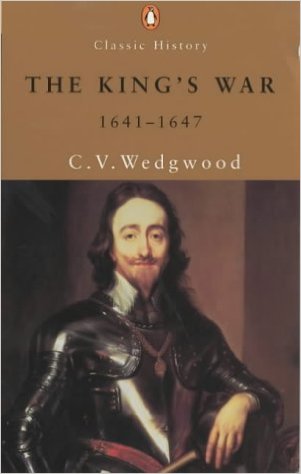
C.V. Wedgwood - The King's War 1641-1647

In his 1958 review of C.V. Wedgwood's The King's War, Christopher Hill noted that
No historian before Miss Wedgwood has attempted to retell the story with a comparable wealth of detail. She draws most skilfully and with admirable catholicity of interest on a mass of sources, old and new, published and unpublished, English, Scottish and Irish.
But he then continued that the problem with her book was that
But Miss Wedgwood's book as a whole is a narrative, not an explanation. It tells us all about the war except what they fought each other for.
Hill was absolutely right to point to Wedgwood's wealth of resources and detail. This is a lively and extremely detailed account of the Civil War. Her writing is readable and in places extremely entertaining. Despite her own Tory politics the author manages to be reasonably balanced in her account and displays an admirable understand of some of the forces at play beneath the surface.

But this is by and large a history of the big picture. Unsurprisingly, given that this is volume two of her three volumes of biography about Charles I, this mostly examines the Civil War from the point of view of the King. That said, the Charles I here is very much a prevaricating figure, prone to listening to his current favourite and ignoring advice from his skilled military leaders and those who had fallen out of temporary favoritism. In fact, at times, Charles recedes into the background precisely because his importance lies solely in because he is king. He is not a good leader, he frequently lacks clarity of ideas, tact and even the ability to express his point of view. As the military tide turns Charles scrambles around for new alliances, believing that his god given position as king will save him, and failing to understand that he is under threat because the world has moved on, and there are now bigger forces at play.

Indeed, as Hill noted, Wedgwood was able to display an admirable grasp of the way that the world was changing and the threat this meant for those of the old order.
But what really aroused their anger was the claim of humble and uneducated people to interpret the Word of God. Dr. Baillie was perturbed lest the 'silly, simple lads' in the Scots army should come into contact with opinions which might corrupt them. His anxiety for the welfare of their souls was genuine, but it arose, however innocently, from the conviction that such as he must always know, under God's guidance, what was best for 'silly, simple lads'. They were not to be encouraged to think for themselves.
But dismayingly, they were thinking for themselves. They might be heard - they were indeed heard - haggling over a stall not about the price of the wares, but about the seventh verse of the fifth chapter of he first epistle of St. John. One of the participants in this particular argument, asked if he was an Anabaptist, cried: 'No, but I am a downright separatist, and will by the grace and power of God, seal it with my blood.'
When ordinary men and women got it into their heads that it was a fine thing, but the grace and power of God, to be 'downright separatists,' the secular as well as the spiritual order was threatened.
Sadly there is not enough of this sort of analysis and rather too much detail about armies marching hither and thither and the machinations between different wings of the Royalists. Wedgwood's approach is, of course, not without value. For those hoping to learn a general history of the Civil War there are few books that come close, though the detail can be overwhelming. I also found that Wedgwood's emphasis on events in Scotland and Ireland had been neglected in my own reading of the period and she helped to illuminate this. Particularly important in understanding why the Scots gave up Charles to Parliament (to his immense surprise). Finally, Wedgwood's highlights the role of Prince Rupert, the principle architect of many of Charles' initial victories, and her book is in part an attempt to rescue Rupert's reputation. While I can take or leave princes, Rupert's military skills and role are clearly of enormous importance in understanding the war.

For all these criticisms, Wedgwood's book has much of interest to the casual and serious student of the English Civil War, but the reader would be advised to read further to fully understand why this was a period when the world was turning upsidedown.

Related Reviews

Wedgwood - The Trial of Charles I
Hill - God's Englishman
Purkiss - The English Civil War: A People's History

Monday, August 10, 2015

Paul Hampton - Workers and Trade Unions for Climate Solidarity: Tackling climate change in a neoliberal world

Paul Hampton's new book, Workers and Trade Unions for Climate Solidarity is an excellent examination of the debates around climate change and the role of workers and workplace organisation. Written from an explicitly Marxist point of view it argues that workers must have a central role in dealing with climate change. There are detailed case studies of the role of workplace environment reps in reducing emissions (a role that is not always purely positive in terms of wider workplace relations) as well as the struggle by Vestas workers to avoid their plant closing. For those of us who have been involved in the UK's One Million Climate Jobs campaign there is a discussion of this, and similar movements. Sadly the price (over £80) ensures that few workers will ever read it, which is an enormous shame.

I wrote a full review of this book for the International Socialism Journal. You can read that here.

Tuesday, August 04, 2015

Philip Caraman - The Western Rising 1549

1549 was a difficult year for the English ruling class. War with France and Scotland was on the cards and rural discontent was spreading the length and breadth of the country. In two regions, this discontent exploded into insurrections. In Norfolk the rebellion became known as Kett's rebellion after the local gentleman who assumed leadership. In the south-west, in Cornwall and Devon the rebellion became known as the Prayer book, or Western Uprising.

Philip Caraman's The Western Rising is a decent introductory history to the events in the south-west. His central argument is that this was a religious uprising which almost completely lacked any wider political or social demands, agrarian discontent was "scarcely a factor" in 1549 he writes. In this he echoes the only real contemporary chronicler, John Hooker, a Protestant historian who was based in Exeter during the siege of the city during the uprising. Hooker wrote that the rebellion was "only concerning religion which then by Act of Parliament was reformed". It is true that of the demands put forward by the western rebels on two occasions, religious questions dominated. The rebel demands cover every aspect of religious life, as Caraman explains
They asked that curates should not be restricted to administering baptism only on Sundays and feast days as the public laid down... Mass should be celebrated with only the priest communicating; the sacrament should be reserved in churches; holy bread and water was to be distributed at the church door; Mass was to be in Latin, for the Cornishmen did not understand English, and it was to be said or sung in the choir and not set forth in front of the People 'like a Christmas play'.
These, and other demands, are centred on changes being imposed by the English government. These concerned the Protestant attempts to further do away with Catholic religious practises. The changes, argues Caraman, were so significant that they forced the population "from all strata in society" into open rebellion.

Caraman is absolutely right to argue that the changes, particularly the introduction of the new prayer book by Archbishop Cranmer were significant and provoked enormous anger. Particularly important was the question of language. Many people in Cornwall did not speak English and preferred the Latin liturgy. They also saw the pomp of the traditional services as an essential part of their lives. Further, Caraman argues that the precise nature of the services meant people's relationship with their past and their ancestors was destroyed.

Until the Chantries Act of 1547 it was common for people to make donations or endowments in order for priests to say prayers or mass for the souls of the departed. By removing this right, it was no longer possible to actively try and reduce time spent in purgatory for a deceased loved one. Caraman quotes a modern historian, A.G. Dickens,
if a man really believed  that the ministration of a chantry priest shortened the bitter years of Purgatory for himself and his dearest departed relatives, then the Dissolution gave him great spiritual offence and became a matter for his passionate concern.
There were further impacts such as in one example given by Caraman were a village lost the endowments that had supplied water, cared for the sick and supported the clergy in the church. These sort of changes, together with the removal of traditional religious services and the introduction of new books and many new rules caused enormous anger.

The point I make here, and is missed by Caraman, is that the religious grievances of the population were not just religious. They were inherently social, and simply because there was no need for the population to rise against enclosures or taxes, doesn't mean that people didn't feel like their whole lives were under assault. This helps to explain the scale of the Western Rising which at times involved tens of thousands in well-armed and well-organised rebellion.

The rebellion was short lived. Despite initial successes in capturing St Michael Mount and Plymouth, the rebels became bogged down in a siege of Exeter, rather than marching on London. Had they done so, the government was so stretched dealing with multiple risings, that they may well have been able to capture London. Certainly the government thought so, and feared the rebels might put Catholic Mary on the throne instead of the boy Edward VI.

The rebels didn't. Instead their siege of Exeter lasted weeks and the government was able to mobilise forces (though only by using mercenaries for the first time against their own people) to brutally suppress the uprising.

Thousands were killed, many more were barbarically executed. Those responsible for the suppression seeming to take delight in their brutality. Because martial law had been declared no trials took place to leave us records of what the rebels might have said in their defence.

Caraman's book is a excellent introduction to the Western Uprising. But because it separates it completely from the other revolts I think it weakens the analysis of the causes of the rebellion by over-emphasising the question of "religion". Nonetheless this is a good starting place for a study of 1549.

Kim Stanley Robinson - Shaman

I read this new novel simultaneously with a book by Francis Pryor on the archaeological excavations of a bronze age site in England called Flag Fen. I was struck by a passage in that book where Pryor cautions on the dangers of projecting our own experience of society onto peoples in the distance past who would have had an extremely different understanding of the world, history and religion. Pryor wrote
we must beware of assuming that they must always have acted like us, only more ancient. 2,500 years is a very long time indeed, and I suspect we would find life in the Iron Age far stranger than just living in a round-house and eating off coarse pottery. I am convinced we would find that their whole system of beliefs, standards and values was based on a view of history that was entirely alien to us.
There is a danger then, for novelists writing about the distance past, or societies that are very different to modern capitalism that they simply recreate a version of the 21st century in the past. I am extremely happy to say that I think that Kim Stanley Robinson doesn't fall into this trap with his wonderful novel Shaman which explores the world of hunter-gatherers 25,000 years ago.

Robinson doesn't just evoke a world that seems real, he tries to portray it through the eyes of a hunter-gatherer, Loon, who is being trained as a Shaman. Loon understands the world from the magic he knows about, the stories he has been told and the way that he and his tribe are part of nature. Robinson has clearly studied hunter-gatherers extensively. So he describes how the tribes have deep and constantly developing knowledge of flora and fauna. How they live is far from ignorant, violent or savage and much their collective survival is the act of the collective. That's not to say that individual "leaders" don't exist, but in Robinson's imagining (and backed up by various real world studies) these leaders are part of a wider collective. No one in Loon's group (just as among real world hunter-gatherers) would blindly follow dangerous suggestions from their head-man. I say head-man here, even though the tribe described often consider the women to be the most important part of the group.

At the heart of this novel is a short story where Loon and others have to rescue Loon's wife from another tribe who uses them as slaves. I actually found this the least interesting and entertaining part of the book. It felt contrived and bolted on. Far from the really fascinating story of how hunter-gatherers survived, understood their world and changed it. Those who have seen the wonderful film Cave of Forgotten Dreams will recognise that some of Shaman is set within and around its location. Robinson beautifully characterises the way the paintings on the wall of that cave come to life, and seem to be real to the artist, at the same time as being part of another spirit world.

This is a great evocation of the past. Whether it is completely accurate we'll never know. But because it is based on real anthropology it is as far from the Flintstones as a fictional depiction of the past can be. It also helps that Kim Stanley Robinson is a cracking writer. Read it.

Related Reviews

Burke-Leacock - Myths of Male Dominance
Flannery & Marcus - Creation of Inequality
Stanley Robinson - Years of Rice and Salt
Stanley Robinson - Icehenge
Stanley Robinson - 2312

Sunday, August 02, 2015

Francis Pryor - Flag Fen: Life and Death of a Prehistoric Landscape

I read Flag Fen: Life and Death of a Prehistoric Landscape in preparation for a long-awaited trip to visit Flag Fen itself. I should say at the start that I thoroughly recommend a visit to this extraordinary site, which brings to life the bronze age remains hidden beneath this part of the countryside and displays the incredible finds well. It is an excellent afternoon out and the recreation of bronze age droveways (for instance) are worth visiting both for the insights into historic farming and for the wildlife attracted to the hedges, fields and areas around the lake.

Flag Fen is an excellent introduction to the site. Much of it is an extensive re-write of Francis Pryor's earlier guides to the site and contains updates, additional material and corrections. The introductory chapters are a useful guide to the development of the unique fens of this part of England which help the reader understand both how the Flag Fen archaeological remains survived and the landscape which you travel through to visit the site. Pryor is also at pains to point out that climate change will almost certainly lead to this part of the world being drowned before the century is out. Visit the site while you have time and try to do something about climate inaction in the meantime would be my conclusion!

For the non-specialist reader, the most fascinating parts of the book will be the discussion of the archaeological process that began with Pryor stumbling over a piece of worked bronze age wood in a muddy ditch and ended with the extensive site we see today at Flag Fen. Its difficult for us to understand what has been uncovered - for most people archaeological remains are things that are recognisable to us from our own experience, so Pryor is at pains to point out that we cannot always view the past life this, writing about the Iron Age at Flag Fen, but its applicable to the earlier period, he notes,
we must beware of assuming that they must always have acted like us, only more ancient. 2,500 years is a very long time indeed, and I suspect we would find life in the Iron Age far stranger than just living in a round-house and eating off coarse pottery. I am convinced we would find that their whole system of beliefs, standards and values was based on a view of history that was entirely alien to us.
This is an important point. It is no surprise that when archaeologists first looked at the sodden timbers buried at Flag Fen they assumed they had found a house, or something similar. Instead the remains are now understood as a massive long causeway of over 60,000 timbers, and a gigantic platform which sat above the surrounded marsh. Around these two enormous wooden structures were scattered the votive offerings of bronze and iron-age people - bent and broken swords, pins, knives and the occasional animal and human skeleton. The book, it should be said, is well illustrated with pictures to explain this, including the incredible shears (and their case) found at the site.

As I said, the book is chiefly an account of the finds made at the site and thus must be read in that context. As with all of his popular writing, Pryor is readable and clear. Occasionally, as elsewhere, I found his still a little over-bearing, but in this case he probably has an excuse - after-all he has been chiefly responsible for making sure that Flag Fen was turned into the important historical site it is now.

Sadly the book finishes on a downer. The Fens are continually being drained and buildings encroach. While climate change alters sea-levels, the drying Fens will also lead to the destruction of other, hidden remains. Pryor suggests that within 30 years it will all be gone even if future archaeologists get the funding to dig in this area.

Unlike other books by Francis Pryor this is probably not one that most people will read without visiting Flag Fen itself. His other books (see below) are likely to be more useful for the casual reader that this highly specific work.

Related Reviews

Pryor - Farmers in Ancient Britain
Pryor - Birth of Modern Britain
Pryor - Britain AD
Pryor - Britain in the Middle Ages
Pryor - Making of the British Landscape
Pryor - Seahenge
Reynolds - Ancient Farming

Friday, July 24, 2015

Richard Holmes - Falling Upwards: How we took to the Air

Richard Holmes' eclectic and slightly random history of the early days of ballooning is one of those books that is read for enjoyment rather than a detailed history of the subject. The early balloons were very limited technically and travelling in one was often a life or death matter. In fact, as a result, ballooning was a popular spectator sport and daredevil performers (frequently women in titillating outfits) often hung from the baskets, spent whole days and nights in them, or performed tricks. The Edwardian "balloon girl" Dolly Shepherd, used to hang on a trapeze at several thousands of feet in altitude before dropping under a parachute. She had many male admirers, though working class women seemed to love her as a "portent of women's rights".

A few individuals saw the potential for scientific investigations from the new flying machines, though unsurprisingly the first real application of the balloon, other than entertainment was military. Two fascinating chapters here deal with the role of the balloon in the American Civil War and during the Prussian siege of Paris (the one that preceded the Paris Commune for my socialist readers). In the former the balloon tended to be used as an observation device, and in the case of the South, a propaganda device. During the 1870 Paris Siege however the balloons took on an enormous propaganda role as they were used to take millions of letters and messages (and the occasional politician) from the besieged city.

France seems to have had a long relationship with the balloon. Poets, scientists and writers (and often combinations of all three) rode them, and fell in love with them. One, Camille Flammarion saw the future in the balloon,
Whither sales this ship? It sails with daylight, clothed,
Towards the Future, pristine and divine; towards the Good,
Towards the shining light of Science seen afar
Writing before the Franco-Prussian war and the military role of balloons, perhaps Flammarion could be forgiven for his belief that the balloon would help bring the shining future closer. Certainly his own travels made him think that the balloon took him to a different place,
This absolute silence is truly impressive; it is the prelude tot that which reigns in the interplanetary space in the midst of which other worlds revolve. The sky here has a tint which we never saw before... Planetary space is absolutely black.
The book ends with the age of exploration, and the Swedish explorer S A Andree, whose doomed trip to try to visit the North Pole relied on scientific and technological innovation over common sense. The three travelers who perished may have inspired and excited the newspaper reading public, but the detailed account in Falling Upwards left me thinking they were publicity obsessed idiots whose faith in engineering was misplaced because it ignored the realities of the natural world.

Holmes' earlier book, The Age of Wonder was a masterful history of the era when science and literature were holding out for a new world, where technology might free human kind. It explored the scientists and their circles striving to understand the cosmos. Falling Upwards covers a similar subject and period, but sadly I found it didn't really hold together as a book and came across as a series of anecdotes not worthy of the book's subtitle, however fascinating they might be.

 Related Reviews

Holmes - Age of Wonder
Verne - Five Weeks in a Balloon

Thursday, July 23, 2015

Emma Hughes & James Marriott - All that Glitters: Sport, BP and Repression in Azerbaijan

Published just after the European Games took place in Baku in 2015, this little book is a enormous indictment of the Azerbaijan regime, BP and those international politicians that support the government there. The games, along with other recent events, such as the Eurovision Song Contest have little to do with culture or sport, but everything to do with sanitizing the regime to "tell the right story about Azerbaijan and its ruling family".

The President of Azerbaijan, Ilham Aliyez and his family have grown enormously wealthy off the back of their country's enormous stocks of fossil fuel. The family has been central to the governance of the country going back to the Soviet era, and in the post-USSR world have worked hard to maintain their grip on wealth and power. A key part of this has been building strong links with western governments, in part to promote and encourage political support for Azerbaijan's bid for the European games.
In May 2012 he [Aliyev] met UK Prime Minister David Cameron. In the next six months he made visits to, or invited into the presidential palace, 11 European heads of state. In June... he attended the opening of the London 2012 Olympics. Finally, on 8 December 2012, the president and first lady were in Rome to hear the news that Baku had been chosen... to host the Games.
Aliyev was clear about the importance of the Games, that they were to bolster his country's "international reputation". Azerbaijan's reputation needs some improvement. There are over 100 prisoners of conscience in the country and this book details how those who speak out about human-rights abuses, expose undemocratic practices, or high levels of corruption in the state and the ruling family can find themselves in prison on trumped up charges, or bundled away in a van. Some are found dead. The investigative journalist Khadija Ismayilova had a hidden camera installed in her bedroom. A tape of her having sex was published online in an attempt to smear her reputation after she had repeatedly exposed the corruption of the Aliyez family and the way that the country's elite "had grabbed and squandered the country's money".

Behind all of this lies money, and that money stems from oil. The key to this lies in the hands of BP which has, in the words of the authors "cemented" an alliance between "an autocratic family, the demands of capital, fossil fuel dependency and the strategy of a global military power". The authors also make clear that while BP makes money from this relationship, their link to Azerbaijan is crucial in supporting the company as it goes through an enormously difficult period following the ecological disaster of Deep Water Horizon. Those who lose out are the population of Azerbaijan whose country is sucked dry of its mineral wealth and whose freedom, democracy and economy is sacrificed in the name of a few rich individuals.

Despite hopes that the wealth from oil would "liberalise" the country, the opposite has taken place. As one campaigning journalist told the authors of this book,
Before the oil and gas incomes came to Azerbaijan we had more democracy and freedom. The main income from oil came in 2006 when the Baku-Tibilsi-Ceyhan pipeline started to operate. And from that time the situation started to deteriorate. We have problems with journalists, political prisoners, religious believers being arrested - if you criticise the government you can be easily interrogated and prosecuted under fabricated charges.
There is hope. The authors point out that international events like the Euro-Games have provided a platform for activists to highlight the problems, and pressurize foreign governments and corporations. The close relationship between the country and BP is also under pressure as oil prices drop and the relatively expensive oil from the region becomes less attractive. What the future holds is not yet clear, but the authors of this powerful polemic make it very clear that there are many brave activists in Azerbaijan prepared to fight for a better deal for ordinary people. This book is about giving them support and solidarity in that struggle.

Related Reviews

Marriott and Minio-Paluello - The Oil Road

Baku: Congress of the Peoples of the East
Nikiforuk - Tar Sands
Klare - Blood and Oil
Heinberg - Snake Oil

Sunday, July 19, 2015

R.W. Hoyle - The Pilgrimage of Grace and the politics of the 1530s

In my review of Geoffrey Moorhouse' book The Pilgrimage of Grace I sketched out the rough history  of the Lincolnshire Rebellion and the Pilgrimage that make up the subject matter of both these books. In this review of Hoyle's book I want to concentrate on the authors discussion of the nature of the rebellion itself.

Hoyle is a master of his sources. Not only has he re-examined the original material but he has a commanding understanding of it. Thus he re-examines much of the contemporary letters and accounts to try to understand the social forces that led to both uprisings. His conclusion is at odds with many historical accounts of the Pilgrimage of Grace. Traditionally it has been seen as a rebellion of the gentry, leading the commons in a conservative attempt to roll back Henry VIII's reformation, defend the monasteries and reassert traditional religious values.

However, Hoyle argues that while some of this is true, at the heart of the rebellion were wider issues that made this an uprising of the commons, in particular the rural masses. But the commons felt they needed the gentry, in part because they lacked a coherent set of demands, but also because they felt that their rebellion was about wider society and the gentry were part of that society.
In the first instance the commons were a crowd, thrilled by the excitement of being gathered together in large numbers, determined that anyone who opposed them should be intimidated into submission... but unclear about tactics. At Louth, perhaps at Horncastle, certainly at Richmond, we see a struggle for control between the original agitators responsible for calling the rebels together and the gentry whom they brought to their musters and whom, in large measure they probably mistrusted. The gentry shaped the revolt by offering it discipline. They changed the composition of the commons by insisting that only a small number drawn from each township or parish went forwards and represented the whole.
Mostly the gentry tried to hold back and disperse the rebellion, in part by delaying tactics, in part by trying to petition the king for pardons and demands that would allow the ruling class to disperse the movement. The king failed to respond in kind, and this led to a major problem for the gentry who were closely associated with the rebellions. In fact, many of the gentry lost their lives as a result of Henry VIII's paranoia. He couldn't see that the gentry were forced into a leadership position by the commons, and had actually tried to undermine the rebellion. Their professions of loyalty during and after the rebellion were rarely enough to save them.

A second key aspect to Hoyle's analysis is that he sees the Pilgrimage of Grace as being different depending on its region. The East Riding rebellion was very much associated with the demands of the Lincolnshire rebels, particularly because of the role of Robert Aske. But the revolt that took place between Ripon and Richmond, spread in the name of "Captain Poverty", "was concerned with agrarian discontents, with tenure, fines and thithes, as well as the suppression of the smaller monasteries and the defence of the church". This is absent in the risings in East Riding.

Because Henry VIII failed to grasp the independent nature of the commons within the Pilgrimage of Grace he found it increasingly difficult to subdue it. The Pilgrims wanted a "dialogue" from their Prince, the King however wanted an end to their rebellion. At the same time, Henry made a series of tactical mistakes in mustering his forces. Had either the Lincolnshire rebels or the Pilgrims challenged the Royal armies in open battle, they may well have won and Henry's position would have been extremely difficult. That the rebels were dispersed is in no small part due to the tactics of the gentry themselves who suceeded where Henry had failed. Aske in particular was able to "sweet talk" the commons into disbanding based on the concessions he felt he had won. In fact these were non-existent and the King had no intention of honouring any pledges, in particular the promise of a parliament.
He [duke of Norfolk] had struck a deal with the leadership of the Pilgrims which they found sufficiently satisfactory to persuade them to disband their movement. The deal relieved them from the threat which the commons posed to them, their families, and property. There could be general satisfaction that a device had been found which allowed the commons to return home with honour. The question which cannot really be answered is how many of the gentry were actually committed to the agreement except as a cynical exercise to disperse the Pilgrims.
Henry VIII was lucky to have such loyalists around him. Their flexibility should have been rewarded. Instead, in many cases, it lead to the executioners bloc.

Hoyle's excellent history of the Pilgrimage of Grace should be read by every student of the subject. It might be seen as revisionist for its attempt to portray the rebellion as larger, wider and more in depth that previously described, but that only serves to underlines its importance as a work of history.

Related Reviews

Moorhouse - The Pilgrimage of Grace

Donny Gluckstein (ed) - Fighting on all Fronts: Popular Resistance in the Second World War

This review of Fighting on all Fronts was first published in Socialist Review #404, July/August 2015

Next month is the 70th anniversary of the end of the Second World War. There will be official events, which combine just the right amount of somberness with a celebration of the victory of “democracy” and “freedom” over fascism and tyranny.

But for the rulers of the Allied nations the war was never about democracy or freedom.

In his previous book, A People’s History of the Second World War, Donny Gluckstein argued that what actually took place was two parallel wars: a clash of imperialisms as well as a “People’s War”, fought by ordinary people, mobilised by anti-fascist, democratic sentiments.

Fighting on all Fronts brings together further examples from around the globe. The result is an illuminating book in which different authors highlight forgotten history.

Tomáš Tengely-Evans’s excellent chapter on the Slovak National Uprising describes how 78,000 partisans and soldiers fought fascist Slovakian forces and 48,000 Wehrmacht and SS troops.

We are normally told that the population of Japan blindly followed their leaders. But as the war progressed increasing numbers felt differently.

Sometimes this was on an individual level, like the kamikaze pilot who read Lenin’s State and Revolution secretly in the toilet, and just before his death concluded the war was imperialist. But it was also collective. Thousands of Japanese workers took part in strikes and protests during the war and workers’ mass absenteeism reached the staggering levels of 49 percent after the 1942 bombing of Tokyo.

This forgotten history is important because it challenges contemporary ideology.

Perhaps the most important example of this is Janey Stone’s moving chapter on Jewish resistance. Stone demonstrates that Jews did not just meekly go to their deaths in the gas chambers, but often fought back. The Warsaw Ghetto Uprising of 1943 will be familiar to many readers of Socialist Review from Marek Edelman’s book The Ghetto Fights.

Stone describes other examples such as the Minsk underground resistance, which united Jewish and non-Jewish resistance under Communist leadership. From 1941 it “ran a clandestine press and smuggled Jewish children out of the ghetto... Jews and non-Jews both engaged in sabotage within Nazi factories.” Some 10,000 Jews were saved as a result.

Colonial history also affected how the war played out. In South East Asia, European powers had dominated, but other countries wanted to expand their influence. So, for the Chinese, the Second World War began many years before Hitler invaded Poland when Japan invaded Manchuria in 1931.

Tens of millions of Chinese died, and resistance was on an enormous scale. In 1943 the Chinese Communist Red Army was supported by a militia of 7 million with another 12 million in “anti-Japanese associations”.

According to Mao Tse-tung, China’s official leadership the Kuomintang had a “line of oppressing the Chinese people and carrying on a passive resistance”, compared to the “Chinese people’s line of becoming awakened and united to wage a people’s war”.

Every chapter in this book illuminates further the central contradiction of the Second World War, but I am not convinced that this all fits neatly into the idea of “parallel wars”. Frequently the struggles influenced each other — Churchill and Roosevelt needed to talk about “freedom” to motivate the masses to fight.

Yet this rhetoric encouraged their soldiers (and the partisans listening on radios around the world) to believe that a different world was possible. As Gluckstein himself notes, “In two broad arcs stretching from Beijing through Hanoi to Jakarta and Delhi and then from Athens through Belgrade to northern Italy and Paris the masses, many of them armed, were challenging for control.”

But at times the war was even more complex. The struggle in Burma was simultaneously a battle for liberation from Japanese occupation and from pre-war British rule. This meant that the Burmese freedom fighters fought with both the British and the Japanese at different times.

But there was also a conflict within the Burmese ruling class with some wanting to return to the old colonial arrangement, others to fight for independence in which they would benefit.

Gluckstein summarises “The People’s War” as amounting to “a rejection of capitalist imperialism and imperialist capitalism”. I think the processes are more complex than this.

I was struck, for instance, by the story of the Australian troops who cheered Stalin every time he appeared in newsreels, not out of ideological conviction, but simply because it annoyed their officers.

In some parts of the world the war did lead to revolutionary moments. Elsewhere resistance movements failed to reach such heights, took the road of anti-colonial nationalism, or were suppressed by the Allies.

I don’t have to space to highlight other excellent chapters such as that on neutral Ireland, the Netherlands, or the mass struggle in the Philippines. I can only encourage readers to get hold of this book and read it.

Related Reviews

Gluckstein - A People's History of the Second World War
Heartfield - An Unpatriotic History of the Second World War
Challinor - The Struggle for Hearts on Minds

Other reviews of books by Donny Gluckstein

Gluckstein - Tragedy of Bukharin
Cliff & Gluckstein - Marxism and Trade Union Struggle
Gluckstein - The Paris Commune