Tuesday, January 31, 2017

E.P.Thompson - Customs in Common

Described as a "companion" to E.P. Thompson's classic work The Making of the English Working Class, this is actually more of a series of essays around the changes that took place in rural and working class communities with the development of capitalism. As such it is very different to Making which had a much more coherent historical narrative and argument. Customs in Common's chapters tackle much more specific issues though this doesn't detract from a very well argument and fascinating book.

Several of these essays have appeared elsewhere. Thompson's essay on Time, Work-Discipline and Industrial Capitalism is a justifiably frequently cited article that explores the nature of time and how it has been marshaled and organised as a result of the interests of developing industrial capitalism. In this, as in other articles, the reader is struck by Thompson's expert knowledge of sources and his expertise in a breadth of subjects. He moves from the Nuer (a Nilotic herding people who I have also noted had a very different attitude to 'time') to the history of clockwork, carrying the reader from one satisfying nugget of information to another while building up a powerful argument. His conclusion - that capitalism imposes a rigid structure of time on a population that had no previous need for it - should come as no surprise to the worker who has experienced the tyranny of the clocking in machine.

However the most important arguments in this book centre on the question of "custom" and how it was challenged and destroyed by the development of capitalism, yet formed a site for resistance to those changes. Thompson writes:
Agrarian custom was never fact. It was ambiance. It may be best understood with the aid of Bourdieu's concept of 'habitus' - a lived environment comprised of practices, inherited expectations, rules which both determined limits to usages and disclosed possibilities, norms and sanctions both of law and neighbourhood pressures.... within this haitus all parties strobe to maximize their own advantages. Each encroached upon the usages of the others. The rich employed their riches, and all the institutions and awe of local authority. The middling farmers, or yeoman sort, influenced local courts and sought to write stricter by-laws as hedges against both large and petty encroachments [etc]... the peasantry and the poor employed stealth, a knowledge of every bush and by-way and the force of numbers. 
Such customs and lived experience involved everything from the expectations that people had from landowners and the wealthy, to the right to use land, or cut wood, or hunt animals. They were even, anticipating latter chapters in this book, concerned with how divorce took place and the right of the collective to discipline those who had gone beyond reasonable perceived behaviour in the community.

Two chapters deal with the question of Thompson's famous "moral economy". This is the idea that within struggle, collectives of the rural poor would try to impose a more moral and more rational economic reality on those that grew, traded and sold food and goods. In particular this takes place through the authors famous discussions on food riots. Space (and the current class struggle) precludes a detailed discussion of this here, but a highlight of this book is Thompson's defence of this thesis (and his arguments around the gender question in food riots) in a follow up chapter written years after the first, more famous article.

Too few modern day socialists read E.P.Thompson's classic Making of the English Working Class and I would suggest new readers begin there. Fewer still read this lesser known book, but this collection of writings contain some powerful polemics, and some of the best researched history by a radical historian. Its also laced with wit and fire, with no fear of stepping into modern day critiques of nuclear weapons and Tory governments. For all these reasons I highly recommend it.

Related Reviews

Thompson - The Making of the English Working Class
Sutton - Food Worth Fighting For: From Food Riots to Food Banks
Linebaugh - Stop Thief!
Sharpe - In Contempt of All Authority

Hill - Liberty Against the Law

Wednesday, January 25, 2017

Alastair Reynolds - Revenger

Alastair Reynolds is the master of big themes in science fiction, so its nice and somewhat surprising that his latest book, Revenger, takes place on a much smaller scale. Closer to a more traditional space adventure, its premise feels closer to some early twentieth century's pulp science fiction, but updated for the new millennium.

In a universe very different from Reynolds' Revelation Space, this is a setting that is only gradually revealed to us. In fact Reynolds keeps a lot hidden, leaving our imaginations to fill in the gaps. Humans inhabit a small part of the galaxy, on planets and habitats that have been left over from early generations. Floating around space are the alien artifacts which contain technologies that can make fortunes. These only open periodically, and giant space going vessels ride ion drives and solar winds to rendezvous with the booby trapped baubles.

The novel draws heavily on pirate themes - and while set a long time in the future, with advanced technologies, this is a tale ship to ship battles, hand to hand fighting below decks and a fabled pirate queen trying to steal everyone's treasure. It all seems, as you write it down, faintly ridiculous and only Reynolds' brilliant story telling can hold it together. Its fun, readable, and exciting, and, dare I say it, would appeal to the young adult audience as much as Reynolds' older fans. Unusually for science fiction it also has two young female heroes which makes it even more attractive as a present for a science fiction fan looking for something out of the ordinary.

I haven't always been impressed by Reynolds' excursions from Revelation Space so I'm really happy that this is as good as it is.

Related Reviews

Reynolds - Zima Blue
Reynolds - Galactic North

Reynolds - Terminal World
Reynolds - Redemption Ark
Reynolds - House of Suns
Reynolds - Blue Remembered Earth
Reynolds - The Prefect
Reynolds - Pushing Ice
Reynolds - Century Rain

Sunday, January 22, 2017

Christopher R. Browning - The Origins of the Final Solution

Reading and reviewing books about the Holocaust is no easy matter. Christopher Browning's book is no exception. The material is horrific less because of gruesome detail and more because of the sheer scale of murder that takes place. Page after page, paragraph after paragraph mentions the deaths of thousands of people - Jews, Gypsies the mentally and physically disabled, Soviet prisoners of war, enemies of Hitlers' regime.

Browning seeks to understand precisely how this could take place. How could a single state reach the stage where six million Jews were killed, and perhaps four million other in a mechanised, bureaucratic way way? The answer is not easy, and has many lessons for today.

Browning argues early on in the book that Hitler and the Nazis did not begin with the concept of genocide - though its important to understand that they did not fear or oppose murder of their enemies on any scale. The Holocaust has its origins in both the fanatical anti-Semitism of the fascists and their belief in conquering and rebuilding Europe in the interests of the Nazi state. (This is something that has been also explored by Mark Mazower in his Hitlers' Empire, reviewed by me here).
Hitler's belief in the need for German Lebensraum implied that the Nazis would construct an empire in Easter Europe analogous to what other European imperial powers had constructed overseas... this also meant that the Nazi regime stood ready to impose on conquered populations in Europe... the methods of rule and policies of population decimation that Europeans had hitherto inflicted only on conquered populations overseas.
However the particular nature of Nazi colonialism, coloured by its violent anti-Semitism and racism meant this would inevitably lead to mass murder. The execution of Jews, prisoners and undesirables that accompanied the German army's entry in Poland and the German Wehrmacht's "feeble resistance to even the earliest manifestations of mass murder" permitted this.

Browning takes us through the different stages of the development of the Holocaust. The early attempts to relocate Jews to the East. Latter plans, that reached a surprisingly level of organisation, to turn Madagascar into a Jewish state run by the Nazis, and finally the way all of this was shaped by the invasion of Russia. None of this can be separated from the particular nature of Hitler's regime or those who managed it. Their appalling racism drove the mass murder forward, to the extent that it became the only answer to the problem of where to put the Jews being forced out of their homes in Germany, Austria and the conquered territory of western Europe. Browning details how the different stages followed each other, even in the way that the gassing of victims began as a way of dealing with the mass killing of the disabled, but then became a way of coping with the realities of mass-shootings - soldiers were unable to cope with the death. Once each decision was made it led to other follow up decisions that made further mass murder more likely. As Browning concludes:
The extermination camp was not an accident. It did not result from some mysterious process of spontaneous generation. It was a horrific monument to the perpetrators' problem-solving abilities, but they needed lead time to invent and construct it.
One aspect to this that I felt could have been developed further was an attempt to understand what led people to do this. Browning does explain the way that the particular nature of the Nazi state and its ideology helped legitimise murder, through its demonisation of Jews and others. But I think this is only part of the question - other aspects have to include the particularly brutal nature of the genocidal war on the Eastern Front, and, most importantly, that Hitler rose to power on the back of a mass movement aimed at destroying his enemies through a rhetoric of blaming Jewish-Bolshevism for Germany's economic problems. This created an mass layer in German society, won to the idea that Jews were the enemy, filled with racism and loyal to the regime. (I read this piece by Alex Callinicos at the same time and felt it helped fill in the gaps). It helps explain why Germany continued to fight for so longer after defeat was obvious, and it also makes us understand the particular nature of Nazi Germany that meant the Holocaust could take place.

This isn't a pleasant book to read. But it is an important and carefully researched one. Every argument made by the author is backed by examples and reference. It will fill the reader with sadness and horror. But it will also make them keen to fight racism, bigotry and anti-Semitism today and to organise against the fresh appearance of fascist movements in the 21st century that would seek to emulate Hitler.

Related Reviews

Mazower - Hitler's Empire
Moorhouse - Berlin at War
Black - IBM and the Holocaust
Paxton - The Anatomy of Fascism
Sereny - Into that Darkness

Tuesday, January 17, 2017

Pamela Horn - Life and Labour in Rural England 1760-1850

Reading Pamela Horn's history is always a joy. Her writing is simultaneously entertaining as well as having the ability to draw out the historical trends. This short book covers some of the same ground as her longer book The Rural World but focuses on using examples from contemporary commentary and literature to explore how people in the period covered understood the changes taking place. But Horn never once sentimentalises the life of the people in rural England. This was a time of poverty, of (especially in the aftermath of the Napoleonic wars) economic crisis for the agricultural areas and there was a vast difference between the experience of those with money and those without. Horn points out, when discussing a Wordsworth's poem The Prelude (1805) that Wordsworth's
vision of pastoral serenity conveniently ignored the harsher realities of day-to-day life on the land. It gave no indication of the long hours of drudging labour expected from most peasant cultivators or the feudal dues exacted from them by many landowners in Wordsworth's native Cumbria... This is rather a 'countryside of the mind' - a place of intellectual refuge - than one rooted in the reality of Georgian England.
She continues by quoting W.J.Keith who highlighted that "it is no coincidence that the romantic cult of wild nature flourished just at the time when the Industrial Revolution was gaining momentum; the countryside is cherished only when it is seriously threatened - and it is cherished most by those who threaten it."

What the reality was for the people of rural England is ably drawn out by Horn's writing as well as the many writers she quotes. Some of these are well known, Horn draws on William Cobbett's extensive writings about the people and places of England, as well as quotes from Charlotte Bronte and others to illustrate the class contradictions. But I was struck by the power of the quotes from ordinary people. Here's a section from a long quote by Joseph Mayett, a Buckinghamshire labourer who was demobilised from the army in 1815 at the age of 32.
I gave up gathering rags and took to work for which I received 7 shillings per week to maintain me and my wife and bread was 3 shillings per loaf.. I was much distressed by the summer coming on I was soon relieved by an advance of wages but the harvest proved very wet so that I met with a disappoint[ment] by the great loss of time I sustained but after harvest I met with a place of work at the Esquire at 10 shillings per week and the price of bread was sunk to 2 shillings per loaf and by these means things of a temporal nature began to take a favourable turn... [but] in the month of January 1818 the esquire being gone out for a long time the baily took it upon himself to reduce the wages of me and several more of the men [who] had no children for he said a man without a family could live better upon 9 shilling per week than those that [had] Children could on 10 shilling but he required us to do as much work as they so in the month of March we all left.
Here we see the lot of the labourer... bounced between employers who could change salaries on a whim, food prices that rose and fell dramatically and short term working opportunities, for low pay. It is no surprise that men life Mayett would riot, protest and destroy farm equipment in order to try and defend their jobs and wages.

Horn does look at these protests (and there were significant ones such as the Captain Swing riots during the period covered). But her major focus is to try and get across the immense change that took place in the countryside in this period.
As a result of enclosure and, in particular, of the post-[Napoleonic]war agricultural depression the number of small owner-occupiers had dwindled, and the tripartite system of land cultivation, comprising landlord, tenant-farmer and agricultural labourorer had become ever more firmly entrenched.
As a French traveller noted in the early 1860s:
the commons have been continuously reduced; thus the peasant can no longer have recourse to his own small supplies of meat, and having sold his strip of land is left with nothing but his two arms, which he now hires out.
Thus, while Horn doesn't use the word particularly, this period sees the entrenchment of agricultural capitalism, and coming to dominance of urban industry in the British economy. The world had been transformed, and the rural population, rich and poor, but particularly the poor had been changed too. Horn's book is an excellent over-view of these changes, from the role of clergy to the laws on poaching, and the changes that hit the landowners. But her focus on those who worked the land is really key and is what makes this a lovely introduction to the subject and period.

Related Reviews

Horn - The Rural World 1780-1850
Thompson - The Making of the English Working Class
Hill - Liberty Against the Law

Thursday, January 05, 2017

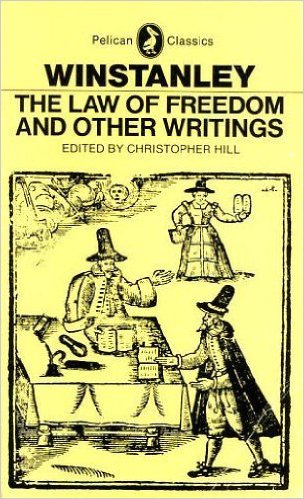
Gerrard Winstanley - The Law of Freedom and Other Writings

I've been writing a couple of pieces around the Diggers and the English Revolution recently and have taken the opportunity to delve deeply into the writings of one of the most remarkable radical thinkers that have ever been produced. Gerrard Winstanley is famous for being the leader of the Diggers who camped at St. George's Hill from April 1649 and later moved to Cobham in Surrey. They were followed by a number of other camps as the English Revolution developed following the execution of Charles I. The particular conditions of the time - a desire for fundamental change, a frustration at the lack of action after Charles' death and a land and food shortage meant that Digging was not as surprising a reaction as might be expected. The camps didn't last - mostly as a result of repression - but they did serve as a minor experiment in revolutionary new ways of living.

This collection of essays comes with an excellent introduction to the life and ideas of Gerrard Winstanley by the radical historian Christopher Hill. Since many of Winstanley's writings are available online, it would be worth searching out the book just for Hill's introduction. That said, however, the real pleasure in this volume is the remarkable writings of Winstanley himself.

This is for two reasons. Firstly Winstanley writes beautifully. Much of his polemic is deeply immersed in biblical allusion and analysis. For those of us not well-versed in the Bible, this is a challenge, but as Hill himself points out, Winstanley can actually be read like you would read poetry. But even a passing understanding of the bible allows the reader to get a sense of Winstanley viewing his world, and his history through a radical religious reading that is fundamentally challenging the status quo.

Winstanley didn't believe the bible was a literal work of history, but he did believe that God had created the world to be a common treasury for everyone. This arrangement had changed with the Fall of humanity, a fall that took place as individuals began to covert things and private property arose. For him, private property caused the fall of humanity, and led to war, jealousy and conflict. Thus the opposite was also true. A new world could be built, that would end private property and transform human relations.

The biggest gem in this collection, and perhaps Winstanley's most fascinating work is the title piece, The Law of Freedom, in which a disappointed Winstanley, who has seen the end of his efforts to built a new world through exemplary farming of waste land, appeals to Cromwell to bring about the Commonwealth. Winstanley systematically describes the workings of his utopia, from the shared storehouses that take the surplus of production to distribute to everyone who needs it, to the postal system that will ensure the news of the realm is distributed everywhere and, perhaps most importantly, to the system of annual elections that ensure corruption of officials cannot take place. It's a fascinating vision of Utopia, which has some similarities to actually revolutionary changes, in others, such as its focus on the family unit of production and its absolute patriarchy, it is clearly born of the limitations of 17th century radical politics. That said, these writings are a fascinating read, and this collection is well worth hunting out. I'll link my forthcoming piece on Winstanley here on publication.

Related Reviews

Berens - The Digger Movement in the Days of the Commonwealth
Hill - The World Turned Upside Down
Hill - Liberty Against the Law

Gurney - Gerrard Winstanley
Manning - Aristocrats, Plebians and Revolution in England

Ann Leckie - Ancillary Justice

Ann Leckie's Ancillary Justice and its sequels have been showered with praise. They've won a bunch of rewards and rave reviews from almost everywhere. So I was disappointed to find that I found the first in the series very difficult. Part of the problem is that in sections of the books the characters are split into multiple persons. Each of these carries, and communicates with the others, yet retains an independence from the whole. It must have been hell to write, but its hell to follow. I'm wary of spoiling it for future readers, but I could not work out at points who was who.

Leckie's ideas deserved better. The idea of a former Ship's AI, used to having sensory input from thousands of simultaneous sources and being simultaneously in numerous different locations, suddenly reduced to a single entity could have been brilliant. But I found the pacing, the characterisation and the dialogue wooden and unbelievable. Clearly Ann Leckie has dozens of fans, but I almost gave up on several occasions, and I won't be getting hold of the sequels. Nice cover art though.

Monday, January 02, 2017

Chris Fisher - Custom, Work and Market Capitalism: The Forest of Dean Colliers 1788-1888

Over the last year I've reviewed a number of books that look at the impact of the transition from feudalism to capitalism on ordinary people. A number of these are well known works such as Christopher Hill's Liberty Against the Law or the more recent Rethinking the Industrial Revolution by Michael Zmolek. Chris Fisher's book is less well known and deals with a relatively small geographical area and an unusual set of economic circumstances. This however does not diminish its importance for those trying to understand the development of the capitalist mode of production, and in particular, what that meant for the rural population.

In the 17th and 18th century, the Free Miners of the Forest of Dean had, or believed they had, a set of rights handed down from the distant past, to use the forest and its natural resources for themselves. While they were coal miners, they also needed the wood from the forest for fuel and for the building of the mines and the land also provided food, grazing and other opportunities.

In turn they paid taxes to the Crown for the right to work. The miners were fiercely protective of their situation. Those from outside the Forest were known as "foreigners" and could not easily become part of the mining community - having to serve a seven year apprenticeship unlike the two year term from those born in the Forest. The rights that they fought for were written down in the curiously named "Book of Dennis" from an inquisition in 1610 and listed "what the Customs and ffranchises hath been that were granted out of minde and after in tyme of the Excellent and redoubted Prince King Edward unto ye miners of the fforreste of Deane". It asserted the right to mine "every soyle of the King's of which it may be named and alsoe of all other folke without withsaying of any man". Other rights, such as the building of roads to facilitate this work were also listed.

Chris Fisher argues that two rights in particular became controversial in the nineteenth century. The first was the limitations on "foreigners" and secondly the right the miners had to be tried before their own courts within which no foreigner could take part. These courts judged internal matters, but also "limited entry to the industry". These rights severely limited the ability of outside interests to profit from the natural resources of the Forest of Dean. As Fisher explains,
The free miners' rights were use rights not real estate: they accrued to individuals and were contingent upon birth in a defined area and work in the mines for a defined period. The individual who met those tests had the right to use the coal, to dig it up and sell it, but could not alienate the right from himself or transfer its benefits to others.
A capitalist sinking a pit had no guarantee that someone else would not sink another so close to his own as to render both worthless. For foreigners and Crown alike it was desirable that the free miners' claim to an exclusive right to the coal be eliminated altogether.
Thus Parliament began a process to undermine and eliminate the ancient rights. They began with an Act in 1838 that subtly altered who had the right to mine in the Forest and "recognised property rights". This fundamentally changed how the Forest could be used. There were other strategies too. Missionaries were sent into Forest communities from about 1800, a process of "religious colonisation". This led to important changes, as one group of Methodists colliers wrote:
We no longer lay claim to his Majesty's timber or deer, nor do we attack and murder his keepers. The rising plantations grown unmolested and our neighbours' flocks graze around us unassailed. 
Many however did not agree to the changes and there was a long process of resistance. This included protests, petitions, riots and the pulling down of enclosures and fences. Some miners, Fisher points out, did want change and supported the building of railways to facilitate mining, others were violently opposed. One thing is particularly notable though. As capitalist methods of mining and employment increased within the Forest, anger at the consequences of wage slavery meant many saw the old rights in a new way, and began to struggle for their restitution. A major riot in 1831 for instance in the context of national struggles for reform, was "first and foremost, an attempt top reassert against the crown what the miners believed to be their rights in the Forest". A contemporary news report put it "the war word, as usual, is the restitution of rights, which the foresters complain have been wrested from them by the Crown".

These struggles continued for decades. The latter half of the book focuses on the fight by the miners to establish trade unions and win better pay and conditions. But the backdrop to all of this was the need for the Crown to replace the old rights with new ones that allowed it to be "unhindered in dealing with its properties through sale, lease or any other form of use for profit". This mean "changing the basis of property ownership in the Forest". Fisher argues that this was a struggle by the Crown in which the State was an autonomous actor, he argues
It would be misleading to see the process of change in the Forest as one in which a capitalist class of coal-owners, or a State servile to them, unilaterally, re-ordered affairs to their own advantage. The State had its own properties and interests to defend and they were separate from those of the [coal owners].
I think this is a misunderstanding of the role of the state in society. Instead the state is the embodiment of ruling class interests. This is not to say there is a clear set of priorities agreed by the whole ruling class, but that they do have a common interest. The destruction of rights and the creation of a system that facilitated profit was one that united the coal-owners and the Crown. The State was not a separate entity balancing this with the interests of the miners, rather it ruthlessly helped drive the change through.

Over time this changes, and some miners' may have bought into the new order out of frustration with the status quo, or a desire to improve their lot. Fisher highlights the changes "The Earlier quarrel was about which principles should govern the ownership and exchange of properties. The later was about the distribution of property and profits". Fisher is absolutely right to conclude however, that whatever the basis for some of the changes the ordinary people felt they were being robbed, and were prepared to resist. This "gave a force to talk about working-men's representation and about the inequalities of British society which might not otherwise have been made".

The struggle to defend customary rights illuminates to aspects to the history of capitalist development. It shows the very different ways that pre-capitalist society could organise, and how the new order would drive through change in the interests of a new, minority class. These changes came as a major shock to the mass of ordinary people who, as in the case of the Forest of Dean colliers, often reached back into their own histories and their own interpretation of their rights for ammunition to resist. Thus these struggles were simultaneously about shaping the new order, while looking backwards. But things could never be return to how they were, though the future could be written in new ways.

Chris Fisher's book is a detailed look at a near forgotten part of that history. Its focus on a small part of British geography and history, in a unusual set of circumstances, actually illuminates wider changes. It is to be recommended to those trying to understand what capitalism has done to our communities and how our ancestors resisted.

Related Reviews

Hill - Liberty Against the Law
Sharp - In Contempt of All Authority
Hay etc - Albion's Fatal Tree
Linebaugh - The London Hanged
Linebaugh - Stop Thief
Thompson - The Making of the English Working Class

Wednesday, December 28, 2016

GRAIN - The Great Climate Robbery

GRAIN is a non-profit campaigning organisation that supports small farmers, peasant movements and fights for a more socially just agricultural food system. It has been at the forefront of these movements and has produced some important studies into the nature of modern agriculture and how that impacts on farmers, communities and the wider ecological systems. As such this book is a welcome addition to the literature that is attempting to understand how modern agriculture drives climate change and is impacted by it.

Agriculture today is a prime driver of environmental destruction.
Food is the world's biggest economic sector, involving more transactions and employing more people by far than any other. These days food is prepared and distributed using enormous amounts of processing, packaging and transportation, all of which generation GHG emissions... With transportation accounting for 25 per cent of global GHG emissions, we can use the EU data to conservatively estimate that the transport of food accounts for at least six per cent of global GHG emissions.
GRAIN continue by highlighting the waste of the agricultural systems, the emissions from processing, packaging, deforestation, and way that the destruction of soil is helping driving climate change.
A wide range of scientific reports indicate that cultivated soils have lost between 30 per cent and 75 per cent of their organic matter during the 20th century, while soils under pastures and prairies have typically lost up to 50 per cent. There is not doubt these losses have provoked a serious deterioration of soil fertility and productivity, as well as worsening droughts and floods.... it can be estimate that at least 200 to 300 billion tonnes of CO2 have been released to the atmosphere due to the global destruction of soil organic matter. In other words, 25 per cent to 40 per cent of current excess of CO2 in the atmosphere comes from the destruction of soils and its organic matter.
GRAIN argue that what needs to happen is a complete transformation of the food system in a way that puts the "world's small farmers" back in the driving seat and limits the influence and power of the massive agricultural corporations that push fossil fuel intensive monoculture farming as the alternative. GRAIN writes that there are three shifts that need to occur:
The first is a shift to local markets and short-circuits of food distribution, which will cut back on transportation and the need for packaging, processing and refrigeration. The second is a reintegration of crop and animal production, to cut back on transportation, the use of chemical fertilisers and the production methane and nitrous oxide emissions generated by intensive meat and dairy operations. And the third is the stopping of land clearing and deforestation...
But this is not a manifesto for "eat local". GRAIN understand that the changes needed involve the complete transformation of the food system and a struggle against the multinationals. This is not simply about individuals eating better, but requires "a structural scaling back of 'Big Food' and 'Big Retail' and those who finance them". Interestingly GRAIN also do not fall into the trap that has become all to prevalent within the environmental movement recently in arguing that everyone needs to stop eating meat to save the planet.

The scale of corporate influence is enormous. Since the 1960s, an area roughly the size of the European Union has been given over to just four crops, soybean, oil palm, rapeseed and sugarcane. But these crops are not about feeding people, they are about maximising "return on investment". In contrast, despite the pressures from corporate farming, small farmers continue to provide most of the food that people need. Partly because they are more productive when compared to monocropped giant farms, and partly because they are focused on feeding local communities, not maximising profits. GRAIN conclude:
The data shows that the concentration of farmland in fewer and fewer hands is directly related to the increasing number of people going hungry each day.
Most of this book focuses on the way that the interests of the food multinationals is facilitated and protected by national governments and international legislation. An emphasis on the increase in free trade and removing barriers to the operation of corporations dominates legislation such as TTIP. The World Bank, the IMF and other institutions have driven policies in the last forty years that have decimated small farmers in the interests of multinationals. In several of these essays GRAIN explores how this has taken place. Excellent chapters on REDD+ and GMOs show how feeding the world and reducing emissions has become secondary to profits. Indeed, despite claims that neo-liberal policies would reduce malnutrition and ensure food security, the opposite has happened:
global supply chains make consumers more susceptible to food contamination. A small farm that produces some bad meat will have a relatively small impact. A global system built around geographically concentrated factory-sized farms does the opposite: it accumulates and magnifies risk, subjecting particular areas to industrial-style pollution and consumers globally to poisoned products.
This book covers an extraordinary amount of ground, and my copy is covered in highlights and pencil markings. In terms of a polemic against the role of corporate power in the agricultural system, and an emphasis on the importance of bottom up farming, it's one of the best I've ever read. I did feel that it was limited in an argument about what can be done. For instance, I felt that some more detailed examples of the way that, even within the limits of the capitalist system, peasant struggles for food sovereignty and over land ownership can bring real victories would have been useful. Ending corporate influence will however mean much more than a few such victories - it will mean dismantling the multinationals and the governments that support them. Campaigning against TTIP and other trade "deals" is important, but we must go further. Increasingly as capitalism leads us towards climate disaster, our movements will have to challenge the system, rather than just the symptoms. This is the logical conclusion of GRAIN's detailed work, but it isn't reflected within the book.

I wish I had had a chance to read The Great Climate Robbery when writing my own piece on Food, Agriculture and Climate Change for International Socialism. In that piece I tried to explore further how workers and peasants might struggle for a more sustainable food system. GRAIN's work underlines the importance of that struggle and I encourage people to read it.

Support independent left-wing publishing and book selling. Buy The Great Climate Robbery here.

Related Reviews

Angus - Facing the Anthropocene
Sutton - Food Worth Fighting For
Magdoff & Tokar - Agriculture and Food in Crisis

McMahon - Feeding Frenzy
Lymbery - Farmageddon

Thursday, December 22, 2016

Christopher Hill - Liberty Against the Law

How did the rise of capitalism in England affect those communities whose lives were not previously dominated by the capitalist mode of production? What did the ruling class need to do to ensure that private property was protected from those who had little or none? How did people try to resist, or adapt to these changes? These are the important themes in Christopher Hill's book Liberty Against the Law.

Hill argues that for capitalism to develop the system, or rather those within the system who governed and ruled it, needed to put in place a set of laws and regulations that undermined old traditions, laws and customs which dated back to "time immemorial" and impose a new set of rules that better fitted the new order.

An infamous example of this, studied at length in a number of chapters here, was the 1723 "Black Act". This Act criminalized poaching and severely restricted the rights that the rural population had to utilize the free nature that was around them - from the hunting of deer and rabbits to the wider use of the forests. This act, Hill argues, was "part of a single policy, consequent on Parliament's victory of 1688-9, of making the world safe for English merchants and landlords to increase in wealth and so to contribute to the new power of the English state".

The victory of Parliament over the Crown was crucial as it meant that the new ruling class, dominated by the interests of merchants and landowners, could set about constructing a new order that benefited them and as Hill argues, "the most important liberty to be defended was the sanctity of private property". But while Parliament changed laws that benefited those with property, it refused to abolish those rules that hit the poor.

Parliament refused to abolish tithes; big landowners voted security of tenure for themselves by abolishing feudal tenures and the Court of Wards but specifically refused to grant similar security to copy-holders. Such changes in the law as occurred between 1641 and the early eighteenth century increased popular hostility towards it. Why should the lower classes respect laws which asserted property rights against traditional popular customs in the villages?

At the same time, the countryside was being transformed in the interest of capital and landowners. Enclosure was consolidating land into the hands of the wealthier section of the population. Peasants were being driven off their traditional lands and common rights were being destroyed. Villages were increasingly polarised. Not everything was down to economics, but all of it had a common aim, the recreation of society in the image best suited to capitalism. Acts enforced a particular type of marriage, over the relative freedom hitherto enjoyed by the rural poor. Nature was commodified, land parcelled up.

Resistance took many forms. Riot, protest, petition were all common, as were songs and ballads that denounced the new order. Radicals interpreted the bible and then fought for the right to worship in their own way. Pirates replaced the violence and terror of the Navy with the liberty and democracy of self-organised vessels. Smugglers (poor man's pirates) avoided tax and helped keep prices low for the poor. Poachers risked judicial murder to provide cheap meat for their families and communities, and on occasion, fought pitched battles with the hired thugs of capital. Hill studies all these groups and charts popular attitudes through the poetry, plays and songs of the times. It's a fascinating examination of the period, perhaps merely a century in length, when the capitalist state was created and consolidated.

Related Reviews

Hill - The World Turned Upside Down
Hill - God's Englishman

Hill - The Century of Revolution
Yerby - The English Revolution and the Roots of Environmental Change

Monday, December 19, 2016

Ian Birchall - The Spectre of Babeuf

The story of the French Revolution has been the subject of countless books and articles, but the story of Gracchus Babeuf has rarely been told in the English language, so this reprint of Ian Birchall's 1997 book looking at the French revolutionary is enormously welcome.

Babeuf was, in his own words, "born in the mud" and was approaching his thirties when the Revolution broke out. In the political and economic instability of the era, Babeuf began to develop his own radical ideas. A voracious reader, Birchall explains that a key influence for Babeuf, and many other radicals at the time, was the French thinker Jean-Jacques Rousseau. But Babeuf began to go much further, and his ideas develop in ways that few others would take for many years. For instance Babeuf's views on women's equality which were rooted in his deep commitment to "human equality" where far ahead of other thinkers at the time:
Babeuf's belief in the equality of women, and his insistence that the differences between the sexes were rooted in education, not nature, set him apart from almost all the other thinkers of the revolutionary period... who stuck much more closely to Rousseau's belief in the subordination of women. It is not simply chance that Babeuf's considerations on women and collective farms should come in the same letter. By proposing collective production he was breaking with the model of the family as a unit of production... It was this... that enabled him to envisage the true equality of women.
Another example is Babeuf's firm and principled position on anti-Semitism, setting himself apart of many others at the time.
Time "to shake off the fanatical prejudices which for so long have made this peaceful people the unfortunate victim of persecutions by all sects".
Through his writings and his (mostly short-lived) newspapers, Babeuf began to build up a network of other radicals who were, to a greater or lesser extent, linked to his own ideas. Some of these would help to form the basis for the famous "conspiracy of the equals", a still-born attempt to take the Revolution to a new level in the aftermath of the Terror. Babeuf's vision was a world of freedom and equality, an era of "common happiness".

I was struck by the parallels with another great, and often forgotten revolutionary - Gerrard Winstanley. Both of them were revolutionaries who were developing their own independent ideas in the midst of periods of great social and political upheaval. Both were self-taught and both felt that their revolutions had stalled, or failed to go far enough. As a result, both attempted to take things further - Winstanley through a piece of direct action designed to usher in a new order; Babeuf through a conspiracy designed to transform the top of the revolution and pull the rest of the population in behind. Missing for both Winstanley and Babeuf was the "agency" that could radically change society.

Birchall points out that Babeuf was "clearly groping towards a concept of class struggle, although often he saw it merely in terms of rich and poor". Unlike Winstanley though, Babeuf did live when there was a growing section of society, the working class, who would become the force that could create a new world. But though the workers collectively weren't yet strong enough they did play a significant role in events during Babeuf's lifetime. It's noticeable, for instance, that Babeuf's writings were popular among some of the larger factories.

Because the workers were not yet a class for themselves, Babeuf did not yet have the language of class struggle that later thinkers like Marx and Engels would develop. But he clearly was groping his way towards it. There is a lovely quote from Babeuf that Birchall uses which gives us an indication of where Babeuf was heading. Among supporters of the French Republic there were two groups:
One wants the republic of a million, which was always the enemy, the dominator, the extortionist, the oppressor, the leech of the twenty-four million others; the million which has revelled for centuries in idleness, at the expense of our sweat and labour; the other party wants the republic for these twenty-four million, who have laid the foundations and cemented them with their blood, who nourish and support the fatherland, supply all its needs, and defend it and die for its safety and glory.
Elsewhere Birchall points out Babeuf was coming to view a future society that was moving away from the "Communism of Distribution" that characterised the Utopia of visionaries like Winstanley, towards a "Communism of Production" that would be closer to that of 19th and 20th century revolutionaries. As one of Babeuf's contemporaries summarised,
What do we mean by community of labour? Do we want all citizens to be tried to the same occupations? No; but we want the various tasks to be divided so as to leave not a single able-bodied person idle; we want the increase in the number of workers to guarantee public abundance, while diminishing individual effort; in return we want everyone to receive from the nation enough to satisfy their natural needs and the small number of artificial needs that all can satisfy.
Babeuf's conspiracy of the equals was stopped before it went anywhere. Birchall argues that it was much better planned and organised, and supported than many historians have given credit for. Certainly Babeuf and his co-conspirators, came close to winning the case that ultimately led to the execution of some of the revolutionaries. Sadly Babeuf is probably remembered too often for this conspiracy, in which he displayed some niavety and was the culmination act or a group of radicals who did not yet understand the ability of the working class to change the world, and themselves, but operating in a world were the working class had not developed enough.

But Babeuf deserves to be remembered for so much more. In fact, as the author points out, the tragedy is that Babeuf was executed in 1797 at only 36. Where his thinking and political activism had gone had he not been found guilty of conspiracy we can only speculate, but reading this biography one feels that it might have been quite profound. Nonetheless, as Ian Birchall's excellent book shows us, we still have much to learn from the revolutionary life of Gracchus Babeuf.

Related Reviews

Birchall - Tony Cliff: A Marxist for his Time
Birchall - A Rebel's Guide to Lenin
McGarr & Callinicos - Marxism and the Great French Revolution
Jaures - A Socialist History of the French Revolution

Tuesday, December 13, 2016

Andrew Charlesworth - An Atlas of Rural Protest in Britain 1548-1900

Rebecca rioters in 1843
This short "atlas" describing rural protests is a surprisingly useful book for those trying to understand the dynamics of protest in Britain's rural areas and, in particular, how communities responded to the development of the capitalist mode of production and the changes that took place in the countryside as a result. The book is broken up into small sections, many authored by key historians of the subject. In fact many of the authors within have had other works reviewed on this book, or have written key texts on their subject I'll get around to sooner or later. Some of the links are below.

The book focuses on what are described as "direct collective action", such as mass protests, food riots, demonstrations and so on. These range from riots against high prices of food, to demonstrations against militia recruitment and turnpikes. The book covers many forgotten events (who today has heard of the Midlands Revolt of 1607, or the 1596 rising?) but sometimes is short on detail. One thing that does come across though is that despite the beliefs of the authorities at the time or often simple analysis by historians since, most rural "direct collective action" was not simply blind rage and frustration and landowners or the wealthy. Many of the protests were heavily organised attempts to protect the interests of the mass of the rural population, to fight unjust laws and pricing, or even to protest at symbols of wealth that represented the enforced changes communities were experiencing.

One of the latter examples is the sustained protests that took place from 1640 to 1740 which targeted deer parks. In part these were protests against the loss of land or access to common rights. But mostly:
Where forest communities opposed the presence of deer parks, they were resisting the social and economic repercussions of landscapes created for pleasure and social prestige. Indeed, deer parks were singled out for attack immediately before and during the Civil War partly because they were symbols of aristocratic power.
These protests often involved hundreds of individuals and lead to the loss of thousands of deer. Many of the parks never recovered.

While the book has much of interest and is a good summary of events like the Rebecca Riots or the Swing protests, I found the maps confusing and of little use - not least because they were often based on limited knowledge. That said, this is a key work for those, like myself, immersing themselves in this topic.

Related Reviews

Turner - Enclosures in Britain 1750 - 1830
Hunter - Set Adrift Upon the World

Sharp - In Contempt of All Authority
Yerby - The English Revolution and the Roots of Environmental Change

Sutton - Food Worth Fighting For

Monday, December 05, 2016

David Lewis-Williams - The Mind in the Cave

This fascinating book is an attempt to answer a surprisingly complex question. Why did our Paleolithic ancestors make cave art? The beautiful images reproduced here frequently show a startling attention to detail, use of colour, the natural shape of the rocks and were often made in near complete darkness. But why was this done? David Lewis-Williams argues that this was not art in the sense that we understand it. Nor was it necessarily representational, but the art filled a social function for the communities that made the images.

Lewis-Williams begins with a fascinating history of the study of these images. I was surprised to find how important Marxism had been to this study, and the author's analysis of the strengths and weaknesses of various approaches, including that of famous thinkers like Claude Levi-Strauss is a useful introduction to their ideas.

Lewis-Williams argues that while art varies in terms of meaning and use through history, and indeed how we perceive things such as the colour spectrum is socially determined, there is one universal for anatomically modern humans, which is that we all (and we all have) experience a the same "full spectrum of consciousness". Describing the various stages that people go through in altered consciousness states, Lewis-Williams points out that "all people experience the states characteristic of the autistic trajectory. And they experience them in terms of their own culture and value system; this is what has been called the 'domestication of trance'."

Lewis-Williams argues that this means that we can trace some universals to the images on cave-walls, and understand them in terms of how various cultures have related to states of altered consciousness. Discussing the San people who made rock painting into the modern time, as part of  shamanistic religion, he points out that
Much of the painted and engraved imagery, even that which appears relastic' is shot through with these metaphors and shows signs of having been 'processed' by the human mind as it shifted back and forth along the spectrum of consciousness. The same metaphors necessarily structured the explanations of images that San people provided. The San explained the images in their own terms, not the languages of anthropologists.
So the images made by the San people represented things that meant some thing to them collectively, which is not necessarily the same thing that we might "see" when we look at them. But because altered states, or trances, produced visions that the mind interprets in terms of how the world is understood, the images painted would be of things (or shapes) that originated in their world view.
Art, cosmos and spiritual experience coalesced. The San fused the 'abstract' experiences of altered states with the materiality of the world in which they lived.
So the paintings made in the "social space" of the caves were the result of interactions between the social ideas of the group and their world-view. Lewis-Williams argues that this meant that the images were more than images, they were insights into a spirit world, or actual embodiments of that world over-lapping with the contemporary world. He writes that a "set of animals already carried... symbolic meaning for west European anatomically modern communities. It now became important for those people to fix their images of another world, belief in which was one of the key traits that distinguished them from the Neanderthals."

Lewis-Williams argues that it was the process of doing this, creating the art, that paved the way for new social relations that "we consider fully modern". I remained unconvinced by this conclusion, as I think the "images" are more likely to represent the cultural output of a community and thus reflect social relations rather than create them. But as Lewis-Williams correctly points out, we cannot every know a correct answer when trying to understand what the images mean. His book however is a fascinating insight into the reasons that humans have created cave-art and painting through history and by hunter-gatherer communities in modern times. It is well worth a read.

Related Reviews

Mithen - After the Ice: A Global Human History
Stringer - The Origin of Our Species

Tuesday, November 29, 2016

J.J.Jusserand - English Wayfaring Life in the Middle Ages

English Wayfaring Life in the Middle Ages was first published in 1889. As a work of historical investigation it wouldn't pass a modern editor's test, but as a work of literature it is a marvellous read. Filled with anecdotes, songs, poetry and obscure facts this is a piece of work that allows the reader to imagine life in the Middle Ages in a way that most academic writing fails to do. How many history books include a section on "buffoons" for instance?

Its commonly believed that people in the Middle Ages rarely travelled very far. Perhaps that's true for the bulk of the population, but even those peasants tied to the land and the land owner, had to travel at least some distance. Anyone who'd been conscripted into the army would have seen some of England and possibly some of the continent. But even trips to market could mean journey's of dozens of miles. But other parts of the population, and not just the rich, travelled far. The rich might travel great distances, Jusserand notes that bridge and road upkeep was an enormous problem that had to be regularly solved out of military necessity and royal pleasure who, when hawking, "did not want to be stopped when following their birds by a broken bridge, and they would order the commonalty, whether or not it was bound to do so, to make prompt repairs in view of their coming."

That said, the state of the infrastructure was appalling:
Though there were roads, though land was burdened with service for their support, though laws from time to time recalled their obligations to the owners of the soil, though the private interest of lords and of monks, in addition to the interest of the public,m gave occasion to reparation now and then, the fate of the traveller in a snowfall or in a thaw was very precarious. Well might the Church have pity on him and include him... among the unfortunates whom she recommended to the daily prayers of pious souls.
Along these treacherous roads travelled traders and merchants, peddlers, musicians, tumblers, messengers and those fleeing justice. Each of these groups is examined in turn, Jusserand having a talent for finding references in obscure medieval accounts, laws and poetry and song. Of particular interest to me where two sections, one dealing with itinerant preachers who were often, like John Ball in the run up to the Peasants' Revolt of 1381, to be found travelling the lands and were the subject of restrictions in the aftermath of the rebellion.
Men able to address a crowd scoured the country, drawing together the poor and attracting them by harangues filled with what people who suffer always like to hear... Their dress even and manner of speech are described; these malcontents have an austerer aspect, they go 'from county to county, and from town to town in certain habits under dissimulation of great holiness.'... Their real subject is not dogma, but the social question.
 The second fascinating section was the chapter on pilgrims and pilgrimages. Here we get a real sense of sheer numbers of people moving about to visit shrines and holy places, in England and abroad. Tens of thousands went to the shrine of Thomas a Beckett. But hundreds travelled to the Middle East, to Jerusalem, and again, not just the wealthy. Jusserand notes that guilds often included allowances for those going on pilgrimages to receive money and support from their funds. Pilgrims would return with outrageous tales, mementos and souvenirs. We can laugh at the distorted account of one pilgrim of what an elephant looked like, but these stories clearly reached thousands of people when the travellers returned. Reading these accounts I wondered to what extent the rest of the world was an alien place to the person in the Middle Ages? Many people would have known someone who had been abroad and returned to tell their stories. William Wey travelled twice to the Holy Land. On his final return he gave his souvenirs - a stone from Calvary, one from the Sepulchre, another from Mount Tabor and one from the hill where Christ's cross had stood - to a local church. Perhaps by this gift he was trying to make others feel part of his own travels, and give them share in the experience.

Jusserand concludes that the existence of a travelling culture like he describes ensured that England didn't see revolution like France had experienced. That's a step to far, but shouldn't divert from the enjoyment that this book will give its readers.

Wednesday, November 16, 2016

Michael Turner - Enclosures in Britain: 1750-1830

In Capital Karl Marx denounced the enclosure of common lands as a crime: "The parliamentary form of the robbery is that of Acts for enclosures of Commons, in other words, decrees by which the landlords grant themselves the people’s land as private property, decrees of expropriation of the people."

This robbery, the destruction of common lands in the interest of landlords, laid the basis for the capitalist economic system. Marx continued:
The spoliation of the church’s property, the fraudulent alienation of the State domains, the robbery of the common lands, the usurpation of feudal and clan property, and its transformation into modern private property under circumstances of reckless terrorism, were just so many idyllic methods of primitive accumulation. They conquered the field for capitalistic agriculture, made the soil part and parcel of capital, and created for the town industries the necessary supply of a “free” and outlawed proletariat.
For many historians of the left, such as the Hammonds and EP Thompson, this sort of analysis became the natural approach to the question of enclosure. Yet there have been a series of revisionist attempts, starting the 1940s to challenge these conclusions. This short book then, is a useful over-view of both the history of enclosure and the historiography of the subject.

Enclosure itself varied dramatically over time and geographically across the British Isles. There were two particular peaks - before 1780 and during the wars with France after the Revolution. But there was also variation in which areas were enclosed, related to the soil and the potential land use. These changes themselves had links to changing diets, the growth of urban, industrial areas and so on.

Turner argues that enclosure was a much more complex process than often understood, one that had the intention of improving agriculture and profits, but should not necessarily be understood as a deliberate attempt to capitalise agriculture. That said, at least some 19th century commentators saw things in this vein. Turner quotes the President of the Board of Agriculture, Sir John Sinclair, in 1803, "Let us not be satisfied with the liberation of Egypt, or the subjugation of Malta, but let us subdue Finchley Common; let us conquer Hounslow Heath, let us compel Epping Forest to submit to the yoke of improvement".

After 1700 Turner concludes that "enclosure by agreement" was limited, "Parliamentary enclosure" becoming the most important (if not the most dominant) form of enclosure. In studying why, Turner overturns some cherished ideals. For instance he argues that the costs of enclosure where much higher than has previously been acknowledged though these costs were disproportionately higher for smaller and poorer landowners.

The understanding that costs of enclosure were higher have led, Turner argues, to a new recognition of the "social repercussions of enclosure".
In general... it looks as though there was a considerable turnover in landowning personnel. Even if there was not a decrease in the numbers of landowners, and in particular in the numbers of the smaller owner-occupiers, the epitome of the independent peasant class, nevertheless many of these owners sold up at or shortly after enclosure. They were replaced by... people from their own agricultural and social class... Small owners also had difficulty in meeting enclosure expenses and often sold up at enclosure. 
Turner concludes then, that this
brings into fresh focus the appearance of a landless labour force to fuel the fire of industrialisation, especially if enclosure improved labour productivity rather than extended labour opportunities. ... Notwithstanding the demographic revolution which was in train and creating more hands than could be gainfully employed in an improved agricultural industry, enclosure is again under scrutiny as a possible contributor to the industrial labour force.
Turner's short but wide-ranging book then points out the limitations of an earlier generation of enclosure historians, but through an examination of more contemporary studies, finds that their conclusions about the consequences of enclosure and the political/economic situation that drove enclosure, were generally correct.

This short book was published in 1984 so there have been many studies and books that have looked at this since, but this will provide a useful basis for understanding that work and the debates that have taken place on the subject. [1]

[1] A very recent examination of this subject and of Michael Turners' book is Michael Zmolek's Rethinking the Industrial Revolution p272-274, though Zmolek incorrectly cites Turners' work as being published in 1968.

Related Reviews

Yerby - The English Revolution and the Roots of Environmental Change
Linebaugh - Stop Thief!
Horn - The Rural World - 1780 - 1850
Zmolek - Rethinking the Industrial Revolution

Sunday, November 13, 2016

David Underdown - Revel, Riot and Rebellion: Popular Politics and Culture in England 1603-1660

The English Civil War was not simply the story of a series of sieges, set piece battles and skirmishes. It was a revolutionary conflict that split England many ways. Large numbers of books have been written exploring the way that the War and Revolution allowed an explosion of radical ideas and groups, involved the mass of the urban population in resisting the King and popular politics. Fewer however have explored the impact of those tumultuous years on the wider English population. David Underdown's classic study explores this topic and seeks to understand why it was that different areas of the population reacted in different ways.

Underdown argues that root of these different regional reactions lies in the differences between arable areas of England:
By the early seventeenth century important social differences were emerging between English pasture and arable regions. These in turn were reflected in cultural differences which help to explain the varying responses of those regions to civil war. Political attitudes are a part of culture, part of that 'historically transmitted patter of meaning embodied in symbols... by means of which men communicate and develop their knowledge about and attitudes towards life'.
This is the basis for Underdown's argument, and I'll have more to say on this in a moment. But it is worth noting that whatever you might think about the author's thesis, his study of the cultural changes, political attitudes and social life of the population is both encyclopedic and extremely illuminating. This was a period when established ideas of religion, politics and sexual roles were being strained and even breaking. In his discussion on the increasing concern with "unruly women" shown in local court reports from 1560 to 1640, Underdown notes:
It may seem odd to place the witch in the category of independent women, the typical suspect being usually old and powerless. But wichcraft fantasies were often a response of the powerless to isolation and oppression that were both social and sexual in origin. Parallels between witchcraft and scolding were not lost on contemporaries: the chief fault of witches, Reginald Scot observed, 'is that they are scolds'. The scold who cursed a more fortunate neighbour and the witch who cast a spell were both rebelling against their assigned places in the social and gender hierarchies.... evidence suggest[s] that a perceived threat to patriarchal authority in the years around 1600 was a major feature of the 'crisis of order'.
This is just one of many fascinating insights into the changes taking place in English society during the period covered. But lets' look a little more at what Underdown argues about the differences between the two regions.
The parishes of the clothing districts were more divided and less cohesive than their counterparts in other regions - divided physically (because they were so often larger in area), divided socially (because of the influx of poor), and divided in religion (because of the frequent presence of knots of Puritan reformers)_. Their parish elites had the same preoccupations with order - with achieving a reformed, disciplined, industrious community - as their urban counterparts... And in the clothing region the elites were more often united. 
He continues later
But if we look beyond these local variations, the overall patterns of regional contrast ar clear enough. The cultures of the major regions were diverging as their social structures were diverging, during the half-century before the civil war. In the clothing parishes of the Wiltshire cheese country and in Somerset north and east of the Mendips, the those of Puritanism was coming to be shared not only the substantial middling sort, but by man of the smaller property-owners and better off craftsmen as well. They never succeeded in eliminating completely the disorderly recreation still popular among younger people and the poor, but because of the breadth of Puritanism's appeal they were more successful than their less numerous, more isolated counterparts in more traditional areas. Even the undisciplined poorer folk of the cheese country, their rituals suggest, shared some elements of the more individualistic outlook of their superiors, through they also retained highly conservative notions of how society and the family out to be ordered. In south Somerset, Blackmore Vale, the Wiltshire and Dorset downlands, a less polarized, more cohesive, somewhat more deferential form of society survived. So, inevitably, did older conceptions of good neighbourhood and community and the festive customs in which they were articulated. These cultural contrasts are essential to an understanding of popular politics...
As these long quotes suggest, Underdown is arguing that the development of new forms of agriculture and the diverging types of production between regions was shaping new ways of viewing the world and leading (at all levels in society) to different ideas, customs and culture. By the time of the Civil War, with society in general polarising (and as Underdown notes the common people 'taking sides')  these cultural differences settled out into antagonistic positions. In the more conservative areas Royalist ideas and support flourished, and in others support grew for Parliament. Underdown is careful not to suggest that this was either automatic, or completely uniform. Local differences (such as the political interests of a local landlord, the attitude of a respected clergyman or the behaviour of an invading army) made a real difference.

Strangely though Underdown argues that the different cultures of the regions, "related to different stages of social and economic development... does NOT imply a reductionist resort to economic determinism" (my emphasis). He then shows how some towns and areas which had more developed clothing industries were traditionally culturally conservative. The problem I think is that Underdown's ideas work when (in his words) areas are "viewed from a greater distance". The more focused the study becomes the more opportunity there is for localised variation. There was a constant dynamic between local ideas and national politics.

So Underdown's main thesis is not without value, but it was hard to isolate precisely what he is concluding. Ultimately though, the end of the civil war period saw the growing breakdown of collective, communal rights and the growing domination of individualistic ownership of land and property. This process was uneven, drawn out and frequently resisted. While I found it frustratingly unclear in places, Underdown provides some stimulating ideas. Alongside this is a wealth of detailed information of particular locations and struggles which will provide the reader many fascinating insights.

Related Reviews

Manning - Aristocrats, Plebians and Revolution in England
Carlin - Causes of the English Civil War
Hill - The World Turned Upsidedown

Tuesday, November 08, 2016

Michael Roberts - The Long Depression

Michael Roberts' The Long Depression is an accessible and important work of Marxist political economy. I'd rank it close to Chris Harman's Zombie Capitalism for activists trying to understand the current state of the world economy and what may happen to capitalism in the coming years.

Roberts' book is an attempt to explain the economic crisis that began in 2008 with the banking crisis and has now become a "long depression". He argues that mainstream economists cannot explain it properly, because they see the capitalism economic system as a stable one that is merely subject to external shocks of various sorts. In contrast, Marxist political economy sees the system as one that is inherently unstable, subject to regular economic crisis.

At the core of his argument is a reassertion of the importance of the falling rate of profit, something Marx put as the central cause of economic crisis. Firstly Roberts argues that Marx's "law" is "logically consistent", and then shows that it fits the reality of capitalism. So:
The US rate of profit has been falling since the mid-1950s and is well below where it was in 1947. There has been a secular decline... Thus the counteracting factors cannot permanently resist the law of the tendency of the rate of profit to fall. But the US rate of profit has not moved in a straight line. In the US economy as a whole after the war, it was high but decreasing in the so-called Golden age from 1948 to 1965, Profitability kept falling also from 1965 to 1982. However, in the era of what is called 'neoliberalism,' from 1982 to 1997, US profitability rose.
Following Marx, Roberts shows how there are factors that counter the tendency of the profit rate to fall, and these are at the heart of his explanation of why the economic crisis of 2008 has become a long depression. Capital is currently unable to restore profit rates, and thus move out of depression.

Roberts demonstrates the value of Marx's approach by explaining historic slumps and depressions. He shows how the rate of profit's decline was the root cause of these, even though the actual trigger for crisis varies.
The trigger in 2008 was the huge expansion of fictitious capital that eventually collapsed when real value expansion could no longer sustain it, as the ratio of house prices to household income reached extremes. But such 'triggers' are not causes. Behind them is a general cause of crisis: the law of the tendency of the rate of profit to fall.
Failing to understand this helps explain why mainstream economists have failed both in terms of their explanation of crisis but also in their ability to solve the depression. Robert systematically exposes them, in particular he is critical of "Keynesian economists" who see state investment as a solution to the situation.
For orthodox Keynesians, a slump is due to the collapse in aggregate or effective demand in the economy (as expressed in a fall of investment and consumption). this fall in investment leads to a decrease in employment and thus to less income. Effective demand is the independent variable, and incomes and employment are the dependent variables. There is not mention of profit or profitability in this schema. Investment creates profits, not vice versa.
For me, these were some of the most useful sections of  the book for they demonstrated two things. Firstly that "common sense" arguments about the way to solve the economic crisis, such as massive state investment won't work. Secondly these solutions effectively function as an ideological fig leaf for capitalism, suggesting that the system can be made to work. Roberts shows that there isn't a reformist way to patch together a system that is inherently crisis prone.

In this context Roberts also argues that the austerity policies of most capitalist governments are "not insane" as Keynesians think, they "follow from a need to drive down costs, particularly wage costs, but also taxation and interest costs, and the need to weaken the labor movement so that profits can be raised. [Austerity] is a perfectly rational policy from the point of view of capital.

So can capitalism get out of its hole? Roberts argues that it can, but doing so requires the restoration of profitability which means that huge amounts of existing capital needs to be destroyed. These solutions (just as the bank bailouts did) will benefit the system and some of the capitalists, but the majority of the population will suffer. There are likely to be many more company collapses, bankruptcies, redundancies and wage cuts (and all the social ills that accompany these) before capitalism restores its profitability. The "dead-weight" of debt remains in the system and
The current low-growth world is a reflection of the burden of still high debt levels on the cost of borrowing relative to potential return on capital and thus on growth. The job of a slump (to devalue assets, both tangible and fictitious) has not yet been achieved.
I've focused in this review on what I consider to be the key part of The Long Depression - it's systematic explanation of the cause of slump and the importance of a Marxist approach. There is much more here. Readers of Michael Robert's blog will know that the has discussed the question of robot and AI technology and whether this will lead to a rosy future or a dystopian nightmare. Again he puts the question of profitability at the heart of this, showing that a completely robotic knowledge economy in the future is impossible. The chapters that look at the economic prospects for particular countries and regions are also interesting, if sobering, accounts of the bleak future for most working people unless they fight back. In the midst of the post-Brexit discussions in the UK I also felt Roberts' discussion on the role of the EU was particularly interesting. In particular he points out that the currency union wasn't logical and only serves the interest of the two major European economic powers.
The Eurozone countries are more different from each other than countries in just about any hypothetical currency union you could propose. A currency union for Central America would make more sense. A currency union in East Asia would make more sense. A currency union that involved reconstituting the old Soviet Union or Ottoman Empire would make more sense. In fact, "a currency union of all countries on Earth than happen to reside on the fifth parallel north of the Equator would make more sense". But the currency union went ahead because of the political ambitions of France and Germany to have a Europe led by them, even after Britain refused to join.
Finally Roberts puts the economic problems of capitalism in the context of its ecological destruction. I won't rehearse his arguments as this blog has frequently discussed these. But his conclusion is a sensible place to end this review. Unless capitalism is replaced in the next fifty years, ecology destruction will be on such as scale that "economic growth will slow, natural disasters will become common, and the cost of restoration and prevention will become too much for a profit-making mode of production to handle."

Related Reviews

Harman - Zombie Capitalism
Choonara - Unravelling Capitalism
Harvey - Seventeen Contradictions and the end of Capitalism
Marx - Value, Price and Profit

Sunday, October 30, 2016

Lewis H. Berens - The Digger Movement in the Days of the Commonwealth

First published in 1906 this is an important study of the ideas of one of the most important radical thinkers of the English Revolution, Gerrard Winstanley. The edition I'm reviewing here is reprinted 2007 by Merlin Press and is a very useful overview of Winstanley's life and, most importantly, his ideas.

Winstanley is best known for leading a group of activists, the Diggers, in an attempt to create a radical agrarian society by creating a "colony" of like minded people on St. George's Hill in Surrey. Less well know is that Winstanley had developed a clearly thought through vision of how a network of such colonies could form the basis for a society of equality and freedom. The execution of Charles Stuart during the English Revolution helped encourage Winstanley's thinking along this direction. Many of his writings were made in response to events on St. George's Hill and the second colony that Winstanley created nearer his home in Cobham, after they were driven away from the hill.

Berens' makes it clear that, like many radicals of the time, Winstanley had a very clear understanding of society in the 17th century which helped fuel his radical visions of a new world. He rages against the inequality and oppression of class society. In 1648 he writes:
And this is the beginning of particular interest, buying and selling the Earth from one particular hand to another, saying ‘This is mine,’ upholding this particular propriety by a law of government of his own making, and thereby restraining other fellow-creatures from seeking nourishment from their Mother Earth. So that though a man was bred up in a Land, yet he must not work for himself where he would, but for him who had bought part of the Land, or had come to it by inheritance of his deceased parents, and called it his own Land. So that he who had no Land was to work for small wages for those who called the Land theirs. Thereby some are lifted up in the chair of tyranny, and others trod under the footstool of misery, as if the Earth were made for a few, and not for all men.
Winstanley understands that wealth comes from the labour of people and the rich get richer on the backs of others;
But all rich men live at ease, feeding and clothing themselves by the labors of other men, not by their own, which is their shame and not their nobility; for it is a more blessed thng to give than to receive. But rich men receive all they have from the laborer's hand, and what they give, they give away other men;s labors, not their own. Therefore they are not righteous actors in the Earth.
Berens' tells the story of Winstanley's life and struggles. More recent biographies have been able to make use of more sources and some of the conclusions about Winstanley that Berens' makes are probably no longer as clear cut as they were when he was writing. John Gurney argues, for instance, that links between Winstanley's ideas and Quakerism are much less clear than Beren's would have.

But the real joy in Beren's book is the writings of his subject. I was particularly struck by Winstanley's visions of agrarian Utopia. Arising out of the seizure of land by the ordinary people he imagined a world where the full fruits of the Earth would be available to all, through a system of decentralised villages. Storehouses would keep excess produce, overseen by "waiters" who would all those who need food or other goods to come and get them for free. There would be centralised government, each village required to produce a summary of its news at regular intervals which would be then distributed around the country so everyone would know what was happening. Officers would be elected and over-seers would ensure that everyone worked, though work was not intended to be excessive. While this was a patriarchal society, Winstanley also believed that people should be able to marry who they wanted and could do so easily when a couple wanted to.
When any man or woman have consented to live together in marriage, they shall acquaint all the Overseers in the Circuit therewith, and some other neighbors. And being all met together, the man shall declare with his own mouth before them all that he takes that woman to be his wife, and the woman shall say the same, and desire the Overseers to be witnesses.
Winstanley also saw a system of punishment that allowed the community to punish those who refused to take part in society, but also allowed those who broke the rules to return back to society. The death penalty was there as a final punishment for heinous crimes such as rape and murder.

Winstanley's Utopia, was an agrarian ideal. But it was based on a rational examination of the existing problems of society and communal rural life. Based on a rejection of private property his early Communism could never succeed as it meant challenging the wealth and power of those classes that the death of Charles had put in the saddle. Winstanley's pacifism meant he ultimately believed his new society could come about by simply stating clearly enough how well it could work. Unfortunately this would never convince those with wealth and power, and there was as yet no class in society powerful enough to overturn them.

But Winstanley's vision remains inspiring and his writings are entertaining and illuminating. Its excellent that this old book has been republished. Sadly in places the Merlin edition suffers from proofreading issues. These aren't significant enough to detract entirely, but are disappointing. That aside, students of radical ideas during the English Revolution will be pleased to find this available.

Related Reviews

Gurney - Gerrard Winstanley - The Digger's Life and Legacy
Hill - The World's Turned Upsidedown
Rees - The Levellers' Revolution
Manning - Aristocrats, Plebians and Revolution in England