Saturday, February 26, 2022

Kevin Murphy - Revolution and Counterrevolution: Class Struggle in a Moscow Metal Factory

In the aftermath of the disintegration of the Soviet Union archives opened up allowing historians much easier access to a mass of material that had been collected during the Revolution and post-Revolutionary eras. Kevin Murphy's fascinating book is the result of a close study of the material pertaining to a single metalworking factory in Moscow in the 20th century. The detail is based on reports from police spies, radical newspapers, factory bulletins and personal memoires. It's a rich study of how the process of revolution, and then counterrevolution, was experienced by ordinary working people.

For revolutionary socialists the most fascinating part of the book will undoubtedly be the sections dealing with the factory workers during 1917, the year of the revolution. Due to weaknesses in organisation the Bolsheviks were less strong in Moscow than in Petrograd, and this is reflected in the politics and allegiance of the workers in the factory. In particular the Social Revolutionaries [SR] are elected as delegates from the factory. Nonetheless the workers take a full part in the revolution, striking, joining protests and forcing massive demands from their management. Murphy reproduces a 16 point list of workers' demands that demonstrate both the confidence of the workers and how economic and political issues are coming to the fore for ordinary people. The first demands if for a "permanent space" for factory meetings, lectures and "cultural-educational activities". The second is for the night-shift to only do a seven hour shift, but be paid for an eight hour day. There are demands that cover health issues - baths and steam rooms, ventilation, toilets and so on, sick pay, maternity leave and pay, and holidays. 

As Murphy comments:

The variety, clarity and force of demands demonstrate workers' increased confidence and organisation. The need for a regular meeting place shows that the employees' top priority was the strengthening of their own organisation and the special demands raised in the interest of women illustrate workers' willingness to be more inclusive. While revolutionary egalitarianism was an important factor in this process, a practical consideration also drove such demands: the prerevolutionary demographic trend toward a more diverse workforce continued, and by May 1917, the concerns of 439 women simply could not be ignored.

As the revolution progressed there were intense political arguments with Bolshevik workers' fighting to win the support of the wider factory. We get a glimpse of the intensity of some of these debates. In late June, SR leaders spoke on "War until Victory". A Bolshevik Rosa Zemliachka, responded "Comrades! Many voices have rung out for continuing the war. Therefore whoever wants war should immediately sign up as a volunteer for the front lines." Murphy says that "after prolonged silence, the SR leaders left the tribune in defeat." Such political principals and systematic attempts to win workers in the factory led to success for the Bolsheviks, as Murphy explains:

The Bolsheviks did not just react to events: instead the party provided leadership for the movement. After sending in several talented organisers, the Bolsheviks fought for - and won - the ideological argument for revolution and Soviet power, as they did among workers throughout the empire.

But Murphy's meticulous study of the source material also demonstrates how, as the international revolution failed to materialise and Russia was isolated the rise of a Stalinist bureaucracy led to a break with the revolutionary ideals of the past. The Civil War decimated the factory both in terms of workforce and its ability to work. For most workers it became a case of "personal survival", and as the counterrevolution triumphed workers were unable to fight for their own collective interests. During the NEP era workers did manage to keep up pressure over pay and conditions, but by 1927/1928 Stalin's solid grip of power meant that workers' were once again being driven solely for the surplus value their labour could create and dissent was crushed. There are two markers for this that I'll note. Firstly the position of women was forced backward into an subordinate one and most of the gains of the revolution were destroyed. 

Murphy documents this process:

By mid-NEP, however, party leaders at the factory level perceived the special emphasis on women's issues as an obstacle to the pursuit of their main priority. Pressured from above to meet production quotas, management and the party apparatus started to view the female workforce strictly in productivist terms and, therefore, as as problem.

But Murphy is careful to emphasis the way the women in the factory played an active role in the revolution movement that is "hidden from history" and celebrates that this took place "in a society devastated by seven years of war and foreign intervention". 

The second marker is the repression of dissent, both within the Communist party and the systematic destruction of the norms of democracy in factory meetings. The participatory (if frequently raucous) meetings of the revolutionary era are replaced by shouting down and demonization of opponents. By the late 1920s, "personal survival... had eclipsed the politics of collective action". By the 1930s the ability to collectively organise had been destroyed. The accounts from this era - of hunger, coercion and so on are painful to read, contrasting as they do with the hope of the revolutionary epoch.

By 1932 the relationship between rulers and ruled had become firmly entrenched and there would be no return to workers' militancy. The dull drone of uninterrupted productivity drives and the seemingly endless demands for more sacrifice and austerity were not ephemeral phenomena, but now comprised the basic features of the Stalinist system. The revolutionary era, during which workers had repeatedly and confidently asserted their collective power, had now come to a decisive end.

By placing the experience of workers at the point of production at the heart of the story Kevin Murphy's book is a singular account of the highest point of workers struggle in history. It is also essential in helping understand the Stalinist counterrevolution as it felt in the factory. The archives that made is possible must hold endless more fascinating material. As I write, Putin's war machine drives Russian imperialism further into Ukraine. In the run up to that war Putin made clear that he saw the Lenin era as the origins of the Ukraine problem - this work shows how different the ideas and hopes of ordinary Russians in the Revolutionary era were far from the interests of Putin and his regime. Let's hope the spirit revives.

Related Reviews

Sherry - Russia 1917: Workers' Revolution and the Festival of the Oppressed
Smith - Red Petrograd
Serge - Year One of the Russian Revolution
Trotsky - The History of the Russian Revolution

Saturday, February 19, 2022

Paul Howarth - Only Killers and Thieves

In Queensland 1885, two boys Tommy and Billy McBride return home to find their family slaughtered. Their farm life had been precarious. Drought had practically wiped out their father's heard, and their mother could no longer get credit in the nearby town shops. Their local neighbour, John Sullivan, a ruthless, greedy man, hates Tommy and Billy's father - but it is to him they must turn when it looks like an aboriginal group has killed their family. 

The boys are pulled into a hunt by the Queensland Native Police, led by the violent Noone. As they, with Noone and Sullivan trek into the desert to find the aboriginal's responsible, the reader follows them deep into Australia, and a dark, racist past were all native people are "killers and thieves" and their only punishment in murder.

This is a difficult read. In places it's description of the treatment of aboriginal people at the hands of the militia is sickening - there is murder and rape. The boys are pulled into culpability for these crimes of revenge, even as Noone (and wider white society) gives them a gloss of legality.

Despite the difficult subject matter, this is a powerful novel about the racist genocide of the aboriginal people. The strength of the book is to put the tragic story of Tommy and Billy into this wider context. I came away from it feeling like I'd received physical blows, and at times had to rest from reading it. But this is a story that tells us a great deal about how colonial Australia developed and I was thinking about it many days after finally putting it down.

Related Reviews

Shute - A Town Like Alice

Saturday, February 12, 2022

James Boyce - Van Diemen's Land

The arrival of British colonists in Van Diemen's Land had dramatic consequences for the people that lived their, the land and the region's ecology. In this compelling history James Boyce explores what took place, putting the experience of ordinary people at the forefront of the story. He opens by arguing that the "common apprehension that 'almost everything the settler did was a re-creation of the world which had been left behind' reflects the experience of a relatively small elite." In fact, precisely because there was "more than one Britain" those who came to Van Diemen's Land brought with them a multitude of ideas, experiences and ideas. The country needs, he argues, to be understood as a "convict society" not an extension of Britain, but one shaped by the experiences of those who arrived and a society made anew. 

While Boyce never forgets the impact of European arrival on the aboriginal people who lived in Van Diemen's Land, he explains that his book is "not an Aboriginal history", it "does not pretend to describe Aboriginal culture, strategy or political organisation", the focus is on the convicts and the society they created. Of course this does mean talking about relations with the Aboriginal people and their later systematic destruction. Boyce suggest his work is really a "environmental history", because it's "primary interest is how the environment changed" the settlers. Wary that this summary could be interpreted as me saying Boyce doesn't devote enough time to the Aboriginal people, I should emphasise that the author's extensive appendices describe the genocide in detail and how it arose out of the interests of the new ruling class in Van Diemen's Land / Tasmania and the interests of British colonial rule. 

The early, convict, years in Van Diemen's Land are fascinating insight into the world that the convicts, settlers and guards had left behind. Boyce notes that the health of the new outpost was better than that of the class the convicts came from. There was plenty of food and game, land and space. But it didn't remain like this for long. Right from the start England's vile game laws were imposed on the new colony. Boyce summarises the reasons for this:

[T]he main challenge for the authorities was how to restrict food supply. Control of the island's abundant natural resources was recognised as essential to the maintenance o social order and penal discipline. The native animals of the new land were... assumed to be the property of the Crown...The game laws were seen as integral to a stable social order. In Van Diemen's Land during 1804, convicts ate emu and kangaroo, but they had to work for it.

The officers had a monopoly on hunting and thus fresh meat, and this meant they could employ convicts to work for them outside their normal working hours. Thus the game laws helped create both a market for game and strengthened particular social relations.

Simultaneously, outside the lands formally under British control, convicts were able to live a surprisingly free life:

Under the "thirds" system, the Van Diemonian elite offered their convict workers economic independence and social freedom in return for free, motivated labour and guaranteed returns. Stock owners, often resident in the towns, handed over a flock or herd to a worker prepared to risk frontier life and payed him a portion (usually a third) of the natural increase in lieu of wages. The custodian took the animals to the leased or granted land.. while he watched over the animals... while making extra money for flour, tea, sugar, tobacco and run by selling kangaroo skins. 
Indeed the inability of the authorities to control the convicts and the sheer amount of land meant that many simply slipped into the bush. There some created their own lives and space, and Boyce notes that as the colonial developed the escape to the bush, and the "bushranging" mode of life was particularly associated with a concept of freedom that went far beyond simply not being a convict. In fact the scale of this was, in Boyce's words, nothing less than a "collective convict uprising that would pose a potent challenge to imperial power". Such was the scale of this, that it would be a generation before the situation was brought under control. 

There is one further aspect to the story that should be emphasised in this review. This was, what might be called, a reassertion of power by the British authorities. In part this was physical. A new generation of settlers who had nothing to do with the convict system arrived. They parcelled up the land and wrested it back from those who had farmed it before - these were usually convicts who had served their time, but also those working in the "thirds" system. There's an irony here, that this was, in effect a new version of enclosure - land was taken by the wealthy and powerful, and transformed - Boyce emphasises - into a copy of pastoral England. Boyce describes this as a "mass eviction". He also notes that the language used to describe "ordinary Van Diemonian life" by the new arrivals and the authorities was "strikingly similar to the judgements passed on the highland Scvots and rural Irish" at similar times. These were savages who had to be kicked off the land in the interest of a modern (capitalist) agriculture. As one new immigrant said in a letter home "we all came here to make money".

Alongside the redistribution of land from the convict era settlers came a transformation of relations with the indigenous people. While the earlier relations with the Aboriginal people had never been easy -they were often violent. But a balance had been achieved, mostly because the colonial areas were relatively geographically contained. Now, however the aboriginal people posed a threat to the expansion of the colonies, and they had to be eradicated. Boyce's descriptions of the way this was done - systematic lies, violence, rape and murder are difficult, but essential reading. There was no real economic justification for this, Boyce points out that aboriginal resistance had been stopped by military action. But nontheless there was no place in the new country for its original inhabitants. Van Diemen's Land was renamed as Tasmania, in part to sever the mental link with the convict society, but also as a means to forget the original inhabitants. Tasmania though was built on the blood and violent dispersal of the Aborigines.

Its worth noting that Boyce argues that the policy of forced removal of the Aboriginal people was never "presented to, let alone sanctioned by, the Colonial Office in London". It was, he argues, "primarily a local affair". While organisationally this is no doubt true, I think the genocidal behaviour towards the indigenous people can only be understood in the context of a "mindset" created by British colonial policy. As Tom Lawson says in his book on the Tasmanian genocide, The Last Man:

[The authorities in Van Dieman's Land were] trapped within a mindset that they could not recognise made little sense even on its own terms. They were committed to a path that continually sanctioned a greater and greater degree of force, while arguing that force should be avoided. With every approval they opened up new possibilities for violence even while they continued to condemn violence itself. The British government preached protection [of the aboriginal people], while contrarily approving of measure after measure that would escalate violence. It was, at the very least, a form of self-deception.
While the British government may not have been explicitly clear on what was happening on the ground, (indeed they were actively deceived by the authorities) what took place fitted a wider, colonial, pattern. I am sure that Boyce wouldn't particularly disagree with this, but I felt it needed to be more explicit. 

Nonetheless this is a remarkable history. Boyce concludes:

The black hole of Tasmanian history is not the violence between white settlers and the Aborigines -a well-record and much-discussed aspect of the British conquest - but the government-sponsored ethnic clearances which followed it.

By placing the story of what happened to the Aboriginal people in the wider context of the transformations wrought upon Van Diemen's Land by the original "convict society" and then the further tragedies that took place, James Boyce has exposed the dirty, violent, underbelly to colonial conquest in this part of the world. It is a story that must be understood and this book is an excellent account.

Related Reviews

Boyce - Imperial Mud: The Fight for the Fens
Lawson - The Last Man: A British Genocide in Tasmania
Gammage - The Biggest Estate on Earth: How Aborigines Made Australia
Pascoe - Dark Emu: Aboriginal Australia and the Birth of Agriculture
Moorehead - The Fatal Impact

Wednesday, February 09, 2022

Neil Dahlstrom - Tractor Wars: John Deere, Henry Ford, International Harvester & the Birth of Modern Agriculture

The name of John Deere probably means very little to many households, despite its enormous importance as a manufacturer of agricultural equipment and tractors. In October 2021, a major strike by its trade union work force which secured a significant victory defending pay, pensions and conditions. The strike brought John Deere's name to public awareness in a way that the current board of directors would certainly have preferred to avoid. Deere is a major corporation and was, as Neil Dahlstrom's history shows, one of the few early agricultural companies to have successfully made the transition from horse to motorised farming.

The other two companies this book focuses on, Ford and International Harvester, both also had interesting relations with their workforce. When Cyrus McCormick Jr became the president of McCormick Harvesting (later part of International Harvester) in 1884, he drove down wages provoking a major strike by its 1,400 workers. Henry Ford was also notorious for his management style. But Dahlstrom tells a different story here that relates Ford's development of a tractor to the agricultural workforce. 

Ford came from a farming background, and having made a fortune in car manufacturing, he wanted to branch out into tractor production. Opposition from shareholders forced him to create a company with his son, Fordson, the eponymous name of the tractor they produced. But its interesting to see what motivated Ford. A New York Times interview reported that Ford "has always wanted to advance the agricultural conditions of the world so that they would keep pace with those of manufacturing and transportation". On a more altruistic level, Dahlstrom reports that Ford hoped his tractor "would finally separate farmers from their land, allowing them to tend to their fields for only a short time each year, freeing them to work in his network of factories the rest of the time".

While the early development of motorised tractors in the United States was frequently described in terms of labour saving work that would improve the efficiency and cost of food production, these two anecdotes show that the real driving interest was profit. In Dahlstrom's history it becomes clear that the Tractor Wars he describes are a classic example of the way that capitalism creates new markets, then concentrates production and profit. In 1917, he tells us, there were 100 different manufacturers of tractors. A decade later there were a handful left, and Ford in particular played a major role in driving many of those out of business.

Key to the adoption of the tractor was the First World War. Dahlstrom shows how the needs of production in the period helped shift farming technology. Ford's first tractors were shipped immediately to Europe to help avert the food crisis caused by the German submarine blockade and labour shortages. The War and government subsidies allowed manufacturers to perfect technology and build plant. It helped make tractors mainstream - though interestingly, particularly in Europe, it did not break dependence on the horse. The Second World War saw to that in England, and the post-war Marshall Plan drove it forward into mainland Europe. Again the US government placed US manufacturing at the centre of the transformation.

Disappointingly though these fascinating stories are all but obscured in Dahlstrom's history. He focuses on the inter-company "war" that shaped manufacturing decisions by the big companies. Frequently the book becomes an obscure list of machines made by different companies and for the non-expert there are too many terms that are left unexplained. What are "spade lugs" for instance? For the non-farmer there is too little explanation of how tractors and machinery transformed agriculture. What, and how, do the various cultivators, harvesters and ploughs actually do? I had hoped to learn a lot more about how farming was changed by the technology, but while we hear the voices of engineers and salesmen, we rarely hear the words of the farmers themselves.

In particular I had hoped that Dahlstrom might give us insights into how US agriculture became a food system utterly dependent on chemical and energy inputs. I'd have liked more on how the use of machinery like tractors helped drive the growth of farming and the creation of the huge, mono-cropped fields we see today. Unfortunately by ending the story in 1930 this is left untold, but I fear the authors over focus on corporate machinations would have obscured this important tale too.

Today agriculture remains big business. Since the Second World War a model of industrial farming has been imposed on much of the rest of the world. But that process began decades earlier in the late 19th and early 20th century. The early years of the 1900s were dominated by the struggle by big corporations to maximise market share and transform farming into a system that could feed their profits. Neil Dahlstrom's book tells part of the story but I suspect most readers will be left wanting more.

Related Reviews

Isett & Miller - The Social History of Agriculture
Mazoyer & Roudart - A History of World Agriculture
Holleman - Dust Bowls of Empire: Imperialism, Environmental Politics & the Injustice of 'Green' Capitalism

Magdoff & Tokar - Agriculture and Food in Crisis
Wise - Eating Tomorrow: Agribusiness, Family Farmers, and the Battle for the Future of Food
Smaje - A Small Farm Future

Tuesday, February 08, 2022

Art Spiegelman - The Complete Maus

A week or so ago the school board in McMinn County, Tennessee in the USA voted unanimously to remove Art Spiegelman's classic book Maus from school libraries. The board argued that this graphic novel was unsuitable because it featured objectionable language and nudity. Given that the subject of Maus is the Jewish Holocaust under the Nazis, these objections seemed strange. Whatever the motivating factors of the board, many people saw the ban as an attempt to limit teaching of the Holocaust in schools. An immediate side effect was the immediate return of Spiegelman's Maus to the bestseller lists as readers around the globe read, re-read or bought the book in a rejection of censorship.

One of those book buyers was me. Despite being aware of Maus, I'd never read it. Graphic novels do not come easy to me. But I think I was perhaps mostly put off because somehow I'd got the impression that Maus, by depicting Jewish people as mice, and their Nazi oppressors as cats, trivialised the events it covered. I was, as generations of readers before me know, completely wrong on this. There is no doubt that Maus is a work of genius that makes the story of the Holocaust accessible in all its horror. It ought to reside in every library in the world.

Maus is the story of Art Spiegelman's father and mother, Vladek and Anja. They were Polish Jews who spent much of World War Two in a Jewish Ghetto and then hiding before their capture and deportation to Auschwitz. Spiegelman's difficult relationship with his aged father, who was obsessive, miserly and prone to anger outbursts towards his second wife, forms the basis for the story. Spiegelman tells his parent's story within the framing of his own interviews with his dad. It makes the story of what happens even more human. The reader learns as Spiegelman tells the story about what happened in Holocaust, why his Dad behaves as he does, at the same time as the Spiegelman in the book learns. 
 
By the time the story reaches Auschwitz, we are utterly invested in the wider family - their lives, loves and relationships. In the Jewish ghetto we see how the Jews are forced to rely on dwindling amounts of money to by food - how violence is a common event and how random selections mean whole families suddenly disappear. Later in the book there are several pages where Vladek shows his son family photos. Some survive, but others don't. "Anja's parents, the grandparents, her big sister Tosha, little Bibi and our Richieu... all what is left, it's the photos." Vladek has no photos of his family: "so only my little brother, Pinek came out from the war alive.. from the rest of my family, it's nothing left, not even a snapshot".

In Auschwitz Vladek survives, in part because of his guile. He is able to teach English to a guard and work as a tinsmith and shoemaker. Spiegelman depicts his own therapist who points out to him though that it wasn't bravery or skill that Vladek and Anja survived, it was ultimately luck. Vladek's description of the death camp and its crematorium are horrific. He only saw them once, but the stories another Jew who works there removing the dead tells him sicken Vladek, even while he is in Auschwitz. But there is even more horror after they leave Auschwitz. Vladek is on a death march and he is one of a few survivors trapped in a train car, able to reach snow on the roof. His survival here is once again down to chance, not anything else.

Its a brutal book. But strangely it is also a book about humanity - the love and solidarity that can keep people going in the hardest of times. Vladek's and Anja's mutual love sustains them - though Spiegelman's mother ultimately killed herself after the war. 

It is impossible to read Maus without being moved, angered, sickened and upset. If the thing that bothers you about it is the language or a bit of nudity in a book about victims in a concentration camp, then I suggest that you have failed to understand what the book is about. I also suspect that you don't care. Preventing people reading books like Maus is a sure way to make sure that the lessons of history are not learnt. If, like me, you've never read this, then take the opportunity to do so. And then encourage others to read it as well. It will help make that old anti-fascist slogan true - "Never Again".

Related Reviews

Sunday, February 06, 2022

Henry Heller - The French Revolution and Historical Materialism

This collection of essays by Henry Heller builds, and in part incorporates, his earlier work on the French Revolution. In previous books and articles Heller has put a classical Marxist argument - that the French Revolution was a bourgeois and capitalist revolution, the "founding moment of modern history". His argument was in the face of mainstream contemporary "revisionist" thought, which argued that this was not the case. In writing his earlier works Heller explains that he had to continually reassert a Marxist position because the cause of revisionism went further than simply attacking the concept of the bourgeois revolution but its aim was to "not only to challenge the Marxist view of the revolution but to put into question its narrative of modern history, whose denouement looks toward a revolutionary transition to socialism".

The essays in this book mostly come from Heller's defence of his position and his polemic against others. Most of the chapters originate in articles in the journal Historical Materialism and as such are often more specialised than the reader with a passing interest in the Revolution will want. So while the book lacks even a short account of the French Revolution itself, the opening essay is a reprint of Heller's introduction to the most recent edition of Jean Jaurès' classic A Socialist History of the French Revolution. This was the first explicitly Marxist account and its importance to Marxist histography and Heller's own studies is abundantly clear.

Because they originate in a strident defence of Marxist thought on the Revolution, these articles are highly academic and detailed. As such they are somewhat inaccessible, though close reading will find important insights. For instance, Heller places the French Revolution in a much wider context, arguing for instance that:

West European advance came directly at the expense of Eastern Europe and Asia, Africa and Latin America. The process of West European transition throughout its early history entailed turning other areas into dependence economies and colonies. Seizing resources from less advanced areas or later on from colonised regions became an intrinsic feature of West European development. In other words, the emergence of capitalism has to be understood in terms of an ongoing world-wide process of appropriation based on uneven development both within and outside Europe.

Elsewhere Heller continues the critique of other Marxist historians such as Robert Brenner, that he developed in his book on the Birth of Capitalism. Here he notes that their failure to identify an early capitalist class in France in the Early Modern era, has "greatly reinforced the currently popular revisionist" views that argues the Revolution wasn't bourgeois. In contrast to Brenner, Heller argues:

[Brenner] overestimated the durability of the victory of the French peasantry at the end of the Middle Ages. By the latter half of the sixteenth century, most of this class in northern France was clearly placed on the defensive by both the nobility and the emerging bourgeoisie. In this context, what proved structurally determinant was the redistribution of properly among the commoners themselves at the expense of the lesser peasants and to the benefit of the bourgeoisie, both urban and rural. Brenner rejects the importance of the process of peasant social differentiation to capitalist origins in the case of English agriculture. Single-mindedly insisting on the importance of class struggle, he rejects the idea that social differentiation among peasants might have been important to the establishment of capitalist social relations.

Thus Heller argues for the centrality of the Marxist concept of primitive accumulation - the changes to land ownership which fuelled early capitalist accumulation. He sees the emergence of a manufacturing class in the cities alongside the rural capitalists. Capitalism develops "within the interstices of the seventeenth-century absolutist regime". He argues for a dynamic process of change - "the notion that contradictory economic and political processes could be at work within a given social system". This process, which culminates in the Revolution, helps create the capitalist class as a class-in-itself. But it was the "convulsions" of the revolution itself that would "produce the sense of the bourgeoisie as a class" for itself.

In exploring these themes Heller takes up many other issues - including arguments around the existence of a "working class" within the Revolutionary period, and the nature of the Jacobin regime and its attitude to manufacturing. In putting his argument Heller marshals much detail to bolster his case, and in places this made for heavy reading. Nonetheless Heller gives a real sense of a dynamic, developing economic system of (open and hidden) class warfare were capitalist relations are slowly developing in the period, until the Revolution allows them to break free.

While this is very much a specialist book aimed at those interested in debates about Marxism and the history of the French Revolution, and as such many readers might be put off, there is much here of interest and Heller makes an excellent defence of his central point, and the importance of Marxism to the study of the Revolution for today.

Related Reviews

Heller - The Birth of Capitalism: A Twenty-First-Century Perspective
Heller - A Marxist History of Capitalism

Jaurès - A Socialist History of the French Revolution
McGarr & Callinicos - Marxism and the Great French Revolution
Birchall - The Spectre of Babeuf

Sunday, January 30, 2022

Klaus Gietinger - The Murder of Rosa Luxemburg

In the introduction to The Murder of Rosa Luxemburg, author Klaus Gietinger writes that the "murders of Rosa Luxemburg and Karl Liebknecht constitutes one of the great tragedies of the twentieth century". He quotes the German Communist Paul Levi writing in 1930, that with their deaths "began the unearthly train of the dead, which resumed its course in March 1919 and dragged on for years and years".

Luxemburg and Liebknecht were two of the most respected, brave and leading German revolutionary socialists in the early twentieth century. Their opposition to World War One and their principled politics had put them at the head of the German Revolution that exploded in November 1919. In the German revolution lay the hopes for the spread of the Russian Revolution. That is the context for the "great tragedy" of their deaths and the particular bestiality of their murders.

Gietinger does not go into great detail about the revolution, or indeed the politics of Luxemburg and Liebknecht. Instead he is mostly concerned with exposing the lies and myths that were built up around the killings. In doing so challenges some of the myths of left and right, particular examining the extent to which the left-wing, but not revolutionary, German Social Democrats were culpable in the murders.

Gietinger begins with the revolution which grew rapidly in the context of war fatigue, economic crisis and mass hunger and poverty. With the revolution grew, immediately, powerful far-right counter-revolutionary forces. Many of these were led and made up of former veterans and where heavily armed. These groups, some of which were known as Freikorps, set about systematically fighting the revolution. These organisations, and the individuals who made them up, often became the basis for Nazi stormtrooper forces. Their anti-Semitism, hatred of working class organisations and fear of revolution meant they were easy converts to the fascist cause.

These were the individuals who captured Rosa Luxemburg and Karl Liebkneckt and took them to the Hotel Eden, a HQ for the counter-revolutionaries. In captivity there it must have been clear to both that they were facing likely death. I was touched to learn that Luxemburg spent her last hours reading Goethe's Faust. Both were taken from the Hotel, beaten and killed. Luxemburg's body was thrown into a nearby canal, where a monument stands to this day.

In many ways who exactly killed Luxemburg and Liebkneckt doesn't matter. They were victims of a vicious counter-revolution that wanted to destroy the German revolution and its socialist leaders. But as Gietinger shows, the individuals do matter, because the fact that the real murderers identify was obscured for so long implicates many senior political figures in her killing - including individual politicians who played a role in post-War German politics. It also matters because Hermann Souchon who very likely was Luxemburg's real killer, lived until he was 87 in Germany, without ever facing criminal charges.

But also important is the extent to which Gustav Noske, a senior figure in the German government and a leading member of the German Social Democratic Party, ordered the killing. Noske, a "pre-fascist" figure according to Gietinger, certainly "tacitly approved" of what had been done. Noske who, after World War Two, said "I cleared away the scum and cleaned up as fast as was possible", "openly wondered", "whether anyone was going to put the troublemakers out of action". Waldemar Pabst, who commanded the counter-revolutionary unit that ultimately killed the two revolutionaries, was according to Pabst close to Noske. "He was Pabst's accomplice, and Pabst was his". Noske "deliberately and against the counsel of his advisors closed down the investigation, not wishing light to be shone on this momentous crime".

Gietinger shows how other figures helped witnesses escape, destroyed evidence and helped those accused of the crimes. Not all of these were pre-fascists. Post World War Two, the German state certainly ensured that the reinvestigation of the murders was hampered, confused and the trials that did take place allowed the murderers to be framed as victims. As such this book is a condemnation of the post-war German government as much as the far-right and Social Democrat leaders at the time. And while other Social Democrats didn't quite have blood on their hands like Noske, Gietinger reminds us that:

Ebert, Scheidemann, Heine and Landsberg (who probably knew nothing of Noske's approval), proved weak in the face of the military justice system - doubtless because they, like Noske, had a soft spot for the military, whereas the names of Luxemburg and Liebknecht aroused pure scorn in their hears. Rid of their (justified) fears of a social revolution that would challenge not only war and capitalism (which did not bother the SPD leadership) but also 'Reich and nation... the former People's Deputies now believed they could return to business as usual, after re-establishing 'order' in alliance with the enemies of the republic.

As Gietinger concludes, "they would not gloat for long". The opening of the door to counter-revolutionary forces with the tacit approval of the SPD helped ensure that the Nazi movement had a strong base to grow from. After Luxemburg and Liebkneckt's death, tens of millions more would pay the price for the SPD's betrayal.

Klaus Gietinger's book is a harrowing read. It is an insight into the nature of the Freikorp movement and their fascist views, their violence and their terrorism. It is also a warning about what happens if socialist movements are not built to be able to stand up to counter-revolutionary movements. It is also an exemplary work of documentary history, a brave and original exploration of a complex series of events. I highly recommend it, not just to students of the German Revolution, or socialists, but to those trying to understand the trajectory of German history in the 20th century.

Related Reviews

Broué - The German Revolution 1917-1923
Pelz - A People's History of the German Revolution

Campbell - A Rebel's Guide to Rosa Luxemburg
Luxemburg - Reform or Revolution
Luxemburg - The Junius Pamphlet

Friday, January 28, 2022

Olga Ravn – The Employees: A workplace novel of the 22nd century

*** Warning Spoilers ***

I must admit I was intrigued when I first read reviews of Olga Ravn’s book The Employees. For socialists and trade unionists it is always fascinating to imagine life in the future – either in a socialist society, or a continuation of our existing one (assuming capitalism has a future that is). Ravn’s book was first published in Denmark and brilliantly translated by Martin Aitken to English. It has also been nominated for the International Booker and, from the length of time I had to wait to get a copy from my library, I think it is doing very well.

Told through statements by workers, this is not a long novel. In fact some of the pages are barely a few lines of text. Anyone who has had to fill in pages of nonsense on an annual appraisal will recognise that sometimes words come easily, and sometimes monosyllabic answers are best when replying to management queries.

But these statements, woven together tell a story. It’s a workplace, but not like a call centre or factory. Gradually we learn that these workers are living on a interstellar ship, that’s left Earth with no plans to return. We also learn that some of the workers are not human – they are humanoids, human in almost all biological features except that they cannot reproduce and they can be replicated from their backups. We also learn that on a planet called New Discovery the crew found some objects. These objects take different shapes and interact with their handlers – some through sound, others through emotion.

In fact sensation, and emotion are key elements of this story. Why are some of the interviewees compelled to taste, stroke, even put alien things into their mouths? Why do some of them feel the urge to scratch imaginary bumps and lumps in their skins? Is it part of their memories of home? Is it part of how they are trying to remain human? Or are the objects changing them? It's all very curious.

As we read more of the crew statements we learn two things. Firstly that work isn’t that much different. The rooms are small, unless you have to clean them. Factions run deep among the crew. Management are feared, and workers know (or assume) their every move is being watched. We encounter cleaners and pilots, those born on Earth and those who’ve never been there. And some are not human.
Something’s gone wrong. We know little about the ship, or its mission. Ravn tells us nothing about hyperdrives or other SF standards. But she tells us a great deal about what its like to live in an enclosed space, working long hours and missing your home. We also learn what the disposability of labour means on a spacecraft millions of miles from home.

This is a fascinating read. I don’t pretend to have understood it all. It is certainly a book that will warrant a re-read. But in writing about the future of work, Olga Ravn’s certainly told us much about our world today
.

Related Reviews

Aldiss - Non-Stop
Solomon - An Unkindness of Ghosts
Robinson - Aurora
Tidhar - Central Station
Strutgatsky - Hard to be a God

Tuesday, January 25, 2022

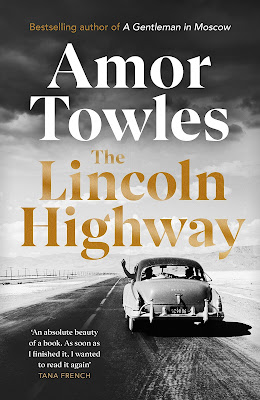
Amor Towles - The Lincoln Highway

In 1954 eighteen year old Emmett Watson is released early from juvenile detention back to Nebraska in the USA. His father has died, the farm has been repossessed and his eight-year old brother Billy wants them to take a road trip along the Lincoln Highway to San Francisco to find their mother. Emmett is resourceful, clever and equal to most tasks. But he doesn't allow to the arrival of two "friends" from the work-prison, Duchess and Woolly. These two haven't been released, in fact they escaped in the very vehicle that brought Emmett back to Billy. 

Rather than setting out westward, Duchess and Woolly have a plan to go East. Near New York City, Woolly's family home has hundreds of thousands of dollars in Woolly's trust fund and they want it. Promising a third to the brothers, but then stealing their car, these four characters engage in a complex, interlocking story, which Amor Towles uses to tell us their stories and a lot about 1950s America.

But most of all this is a story about journeys. The literal Billy obsessively reads from a boys own style book that details heroic journeys of heroes, real and mythical. In his eyes the trip along the Lincoln Highway would match those travels and his vision enraptures Woolly, a young man whose wealthy family cannot seem to cope with his needs. While Duchess and Woolly travel to NYC in the stolen car, Emmett and Billy jump the train and meet a series of brilliant characters from bottom of society, many of whom teach them (and the reader) the realities of the world while also being part of their own epic journey.

Part road trip, and indeed a homage to 1950s America, this is also a sort of adventure story as the boys find their way too each other and themselves. Its also a picaresque story whose episodes tell self contained stories but which frequently interlink. Its also deeply moving, and I was particularly touched by Woolly's character, who for the first time finds a group of people who understand him - rather than punish or tolerate him. I suspect this will be one of the best books I read all year.

Sunday, January 23, 2022

J.G.Bullocke - Sailors' Rebellion

This turned out to be a fascinating Christmas gift. Published in 1938 it is a study of episodes of 17th and 18th century sailors mutinies. Its an eclectic mix of stories, as not all of them would be considered "rebellion from below" as radicals today might describe events were crews rose up against their officers. I have a vague recollection that somewhere Leon Trotsky wrote that mutinies on ships were different to those by soldiers as the experience on ship was much more like a factory. It is certainly true that in many of these stories there are events that make the reader see the shipboard experience as like that of a huge factory, but one from which there's no escape. Discipline, living conditions, food and wages were appalling on these English naval vessels and discontent must have simmered constantly.

J.G.Bullocke was most concerned with trying to understand the origins of mutiny. In some of these accounts he simply sees rebellion as natural to the "motley crew" of sailors. In others he goes the other way and puts the blame solely on the nature of the commanding officer whose brutality and unbending disciplinary ways force the crew into open resistance. 

While not all of the mutinies are "from below", they all exhibit elements of class conflict. The first account, that of the rebellion of Admiral Benbow's captains, is perhaps the most startling. Benbow as gone down in history as a brave seaman. Yet the battle where he won his spurs, and lost a leg, was marked by the refusal of the captains of other ships to press home the fight against enemy ships. The resultant court-martial was infamous, and several were executed. Yet one fascinating aspect to this was what Bullocke describes as the dislike the other captains had for Benbow, a so called "tarpaulin" of "humble" birth who had risen from the ranks and was not a gentleman. By contrast the gentleman "was a courtier, jobbed into a command in the Navy by influential friends. He detested the rough manners of the regular seaman officer and tried to introduce into the Navy something of the more civilised demeanour he had learnt at the Court."

Benbow's elevation to the status of hero however belays some of the reality of his captaincies. He was a hard disciplinarian and happy to break the rules, the governor of Jamaica writing in 1699, that only the seamen on Rear-Admiral Benbow's ships die very fast, to supply which he impresses not only from the Merchant ships but also our people of the country and exercises his authority as if there were no other here". Benbow was also known for his punishments of sailors and Bullocke says "wherever he went trouble broke out". 

Something similar is true of Captain Bligh, who seemed to have been more willing to look after his men, but equally inflexible in command. The Mutiny on the Bounty is a major part of Bullocke's book. Here the captain isn't entirely at fault, but more to blame are the attractions (barely hinted at by the chaste Bullocke) of the island of Tahiti. Given the conditions onboard ship it seems impossible that sailors would not rebel. But of greater fascination to me here was the violent retribution that the British government served up to the mutinous sailors many years later. By then Bligh was off elsewhere and causing rebellion again.

But the greatest mutiny - the mass mutiny of naval ships at Spithead and Nore in 1797 are perhaps the most interesting. Here the entire fleet raised the red flag, elected delegates to a central leadership and placed significant demands about pay and conditions, including issues like leave and press ganging on the Admiralty. Bullocke is at great pains to argue that Spithead was not influenced by the French Revolution and "Jacobite" radicals, but that Nore was - at least in the form of Richard Parker, who was elected "President of the Fleet". Bullocke argues that Parker was the embodiment of radical ideas, implying that the rest of the sailors were somewhat unwitting followers. Nonetheless even this crude retelling of the story is fascinating and quite inspiring. No blood was spilt by the mutineers, though the retribution against Parker and others was bloody. No wonder then that a few months later when the Hermione rebelled, the crew finished off the officers.

Bullocke's book is a breathless and fascinating telling of neglected history of rebellion at sea. It's a reminder that British sea power was won not just in defeating other European powers, but also in defeating its own crews - men who fought at Trafalgar and everywhere else on rotten rations, low pay and under threat of violent discipline.

Related Reviews

Rediker - Villains of all Nations: Atlantic Pirates in the Golden Age
Rodger - The Safeguard of the Sea: A Naval History of Britain 660-1649
Rodger - The Command of the Ocean: A Naval History of Britain 1642 - 1815

Thursday, January 20, 2022

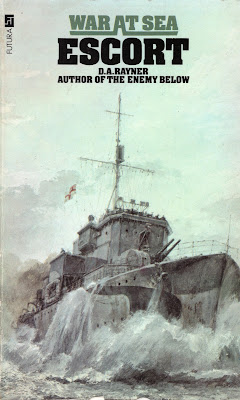
D.A.Rayner - Escort

I learnt about D.A.Rayner's autobiographical account of his experiences at sea in World War Two in Richard Woodman's history The Real Cruel Sea. I sought it out as Woodman indicated it was a authentic account of what it was like to take part in convoy escort duties. It certainly is that, but what Rayner's book does is to show how a young man in the Volunteer Reserve experienced the war itself - much bureaucracy, reposting, training and finding himself in circumstances not of his own choosing. 

Rayner also tells the chaotic story of the early part of the war, when there were few escort ships and plenty of targets for submarines. While much of his time is spent in the Western Approaches, he also finds himself in the Mediterranean and off the West African coast. There are numerous adventures and some close runs. Some of these are with his own side as Rayner is clear the type of commander willing to bend rules in order to ensure his crew have the necessities of life and to have fun. There are some slightly unbelievable accounts of parties, and other, more illuminating adventures such as when Rayner gives the nod and wink to his crew to purloin the mattresses being removed from first class cabins on an ocean linear being converted to a troop transport.

Initially commanding a trawler, then a corvette and then a group of corvettes, followed by a task force of destroyers, we see through Rayner the evolution of British convoy practice and the growing success. Its a tale well told, though Rayner, writing in the 1950s and though by now long since out of the navy, is careful to name drop and reference senior colleagues. 

But of most interest are perhaps Rayner's comments on command. He clearly was the sort of officer than crews liked. On one occasion he, together with his ship's captain, roll up their sleeves to shovel coal. The men who were crewing the ship were not navy ratings, but former fishing boat crews that expected this work to be done by shore based personnel. Rayner breaks their near-strike by leading from the front. While those who have read Nicholas Monsarrat's work might see several parallels with Captain George Ericson in The Cruel Sea, their command style is very different. Rayner is much closer to, friendlier and open with his men. 

Interestingly, despite saying towards the end that there are few women in the book because they didn't feature much, Rayner does mention women quite regularly. In fact he notes the way that the Wrens were often close to the ships, implying that many of them had multiple boyfriends on different ships that would arrive at different times, and that there were well established rules about who could see who. In this sense, and many others, this is far from many straight-laced naval biographies and gives quite a human account of the war. But certainly this is a book for enthusiasts, rather than those looking for historical work.

Related Reviews

Monsarrat - Three Corvettes
Monsarrat - The Cruel Sea
Woodman - The Real Cruel Sea: The Merchant Navy in the Battle of the Atlantic 1939-1943
Lund & Ludlam - PQ17: Convoy to Hell
Lund & Ludlam - The Fate of the Lady Emma
Lund & Ludlam – Trawlers Go to War

Sunday, January 16, 2022

Stephen Graham Jones - The Only Good Indians

I received this novel out of the blue for Christmas. I was immediately intrigued by its focus on Native American people in contemporary society, but put off by the genre. I'm not great with the gore and violence of horror novels. However The Only Good Indians turned out to be a good choice on behalf of the giver, as it is a great, if bloody, novel that takes up some interesting and important ideas. 

The novel centres on a group of friends from the Blackfeet tribe who, ten years ago, shot some elk. It was an incredibly successful hunt, but the intervention of the authorities meant that they were unable to use the dead elk properly. Now, a decade later, the are being killed by apparently supernatural forces. The spirits of the elk have returned and want their revenge.

But there is nowhere for the men to go. As they are picked off, one by one, and their friends and family threatened, they are simultaneously trapped by racism, and poverty. There is no escape for them from the monster that is killing them and the wider monster that demeans and devalues their lives in wider society. 

This is not an easy read, and as I said some people will be put off my the genre, rather than the subject matter. But I'd suggest that there's a strong tradition of horror novels being used to highlight the wider horrors of society. Stephen King's IT is a classic example. Stephen Graham Jones' The Only Good Indians stands in this tradition and updates several of those themes. 

Thursday, January 13, 2022

Oliver Rackham - The Ash Tree

The Ash Tree was dictated by Oliver Rackham from his sick bed from memory. His editor tells us that while the text was "refined" it was, nonetheless, essentially written from Rackham's memory. It is testament to the author's brain that he was able to produce, almost on demand, a book that is both detailed and passionate, as well as polemical and beautifully written. The Ash Tree was written in response to growing public awareness of a major outbreak of 'Ash Dieback' a fungus that was destroying the trees. 

Rackham was concerned about how the immediate response to Ash Dieback was to plant hundreds more trees, arguing that the roots of the problem lay in something he had been "rabbiting on about for years". Rackham argues that the 

greatest threat to the world's trees and forests is globalisation of plant diseases: the casual way in which plants and soil are shipped and flown around the globe in commercial quantities, inevitably bringing with them diseases to which the plants at their destination have no resistance.

Attempts to solve the problem are limited, Rackham argues, because "people's enthusiasm for trees comes and goes on a shorter timescale than the lifespan of trees" and that we are an "unreliable guardian of the world's trees". 

He then begins an ash odyssey. He looks at its history, its biology, its associated flora and fauna and its cultural significance in prose, song and literature. We learn about ash trees in remote areas, of huge trees and how the wood has been used for wheels, tools and gates. We learn ash's history:

Ash has been increasing throughout the Holocene. Widespread since wildwood times, it seems to have got slowly commoner as the centuries have passed. In Anglo-Saxon times it was common but not universal: the sort of tree that places could be named after. It has slowly increased ever since, both in woodland and elsewhere.

The book ends with a polemic - about how to care for trees, how to plant them, and how to consider them as part of our lives and landscape. Readers of Rackham's other books will be familiar with his concern to place woodland in the context of a human and natural landscape, interacting with and being changed by social and ecological forces. 

The Ash Tree is a gorgeous piece of nature writing, illustrated, as these books should be, lavishly with plenty of colour. But it is a book that is also, intensely Rackham. His unique style and enthusiasm shine through, as well as his own life thinking about trees and woodland. His final lines, bemoaning the decline of tree pathology as a science studied in universities leaves him feeling isolated: "I am one of the last survivors of a Critically Endangered Species. I belong in the Zoo."

Woodland maintenance has become subordinated to capital. Planting new trees in their thousands, the immediate response to Ash Dieback and, sometimes, climate change can make things worse. 

Sadly Oliver Rackham died shortly after this book has left, but we can hope that his inspiring writing, read in the context of our greatest ecological crisis, will create a new generation of tree pathologists.

Related Reviews

Rackham - Trees and Woodland in the British Landscape
Rackham - The History of the Countryside

Friday, January 07, 2022

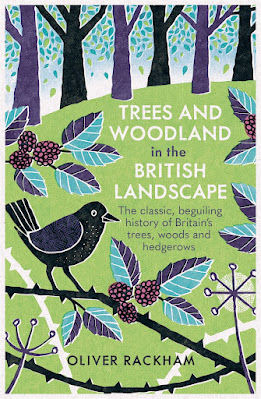
Oliver Rackham - Trees and Woodland in the British Landscape

Many years ago I stumbled across Oliver Rackham's classic book The History of the Countryside on a second hand book stall. It was a fortuitous find. At the time I described it as "unusual and slightly odd" but nonetheless a fascinating and important read. The recent republication of Rackham's book Trees and Woodland in the British Landscape prompted me to read more of his work, and again I've been pleasantly surprised. Like History of the CountrysideTrees and Woodland is a systematic exploration of the place of trees in the land - it takes a historical approach, looking at prehistory, Romans and more recent usage of the landscape (such as medieval deer parks).

It is very much a materialist approach. Rackham makes it clear that the position of trees or woodland in contemporary landscape is the consequence of both natural processes and human activity. On the difference between planned and ancient countryside, he writes:

This is one facet of a distinction that cuts deep in European social history from France to Crete. Ancient Countryside, the bocage, is the land of hamlets, of medieval farms in hollows of the hills, of lonely moats in the claylands, of immense mileages of quiet minor roads, holloways and intricate footpaths; of irregularly-shaped groves and thick hedges colourful with maple, dogwood and spindle; and of pollards and other ancient trees. Planned Countryside, the champagne, is the land of brick farmhouses in exposed positions, of flimsy hawthorn hedges, of ivied clumps of trees in corners of fields, of big villages and few roads, and above all of straight lines; it does however, often contain medieval woods, Anglo-Saxon hedges and ancient trees that the enclosure commissioners failed to destroy.

Rackham's is a beguiling style, but his approach is fascinating. Placing human activity, social history in the context of nature. But Rackham warns against seeing trees through an economic lens. He describes how forestry developed in England through continental approaches, which led to a "commitment to plantations" which introduced conifers on a massive scale in Victorian times. Trees became simply associated with wood (and profit). He says

forestry acquired a theoretical basis, and in particular became thought of as a financial operation: it was through possible to predict how much money a plantation would earn and to decide whether to invest money in trees, or in, for example, the stock market.

Sadly such a financial approach continues to be applied to nature conservation and usage today, separating nature off from its history and wider context.

The world around us has been created and shaped, rarely evolved. Rackham's book shows how this is applicable to understanding woodlands, forests, hunting and features like pools, ponds and hedges. At the same time he warns the reader of approaches to woodland conservation that simply see the presence of trees as being a good thing. Trees are part of wider ecological networks - they shouldn't be simply placed, chopped and replaced. As Rackham concludes right at the end:

For native trees the 1980s have been a time of prosperity and recovery. The prospects are good, but education still has far to go. Planting is not conservation, but an admission that conservation has failed. One can be a lifelong woodland conservationist but never plant a single tree. The conservation of woods is not the same as that of buildings: troubles (apart form that of deer) have a habit of getting better, not worse, if neglected. We need to know each kind of tree and how to work with, not against, its natural properties. Conservations is about letting trees be trees, not gateposts with leaves.

Another recent book of Rackham's, his last published before his death The Ash Tree, explores some of these themes more closely through a study of one specific tree. Rackham develops some of the themes here, looking at how conservation isolates trees from their habitats and places them in a worldwide web of ecology and profit. I'll review that book next and I recommend the reader reads it together with Trees and Woodland as they complement each other very well. 

Trees and Woodland is a classic study that those trying to understand the countryside will enjoy. It can be read on many levels - as a way of understanding features of the landscape, as well as a polemic about the world around us. It is a lovely book.

Related Reviews

Rackham - The History of the Countryside
Pryor - The Making of the British Landscape

Friday, December 31, 2021

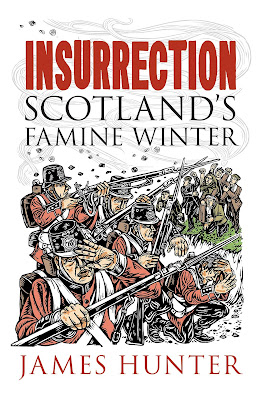
James Hunter - Insurrection: Scotland's Famine Winter

In 1846 Scotland's potato crop failed. It was destroyed by the same blight that had wiped out the crop in Ireland. In Ireland millions starved, while boatloads of food were sent abroad for export. In Scotland the potential disaster was just as great. Thousands of families relied completely on the potatoes they could grow for food. Just as in Ireland an excellent cereal crop could have fed ordinary people yet almost all of it was destined to be shipped elsewhere for massive profits.

The story of the Highland Potato Famine has not been told as frequently as events in Ireland. This is a shame because events in Scotland involve heroic resistance by ordinary women and men, that forced food exports to be halted and government action to relieve the suffering of the population. 

Insurrection tells the story of this resistance. While the book was only published in 2019, it's roots lie in James Hunter's early discovery of archive material relating to the famine and the rebellions. It has taken him nearly fifty years to turn these records into a book. But the wait has surely benefited from his long career exploring Scottish history. The story focuses on events in a narrow period of time and place, but are rooted in broader history - a tale of clearances, emigration and class struggle.

It is incorrect to say that potato blight caused the Irish or Scottish potato famines. The blight destroyed that crop - but it was the economic and social relations which meant that hungry labourers could not feed their families. As Hunter explains:

Most of them [Easter Ross crofters] were folk removed from good land to be resettled on worse - often in places where they had no alternative but to carve fields out of bogs or moors that had never been cultivated. A Morning Chronicle journalist, visiting... in the autumn of 1846, spoke with several such crofters whose potatoes, like everyone else's had been wiped out by blight, but whose cereal harvest, that year, had been better than usual. 'It was no relief to tell them that they had a larger crop of oats than formerly,' this journalist reported, 'the answer in every case being, we need all the oats for the factor.' As in Ireland, then, Ross-shire's small-scale agriculturalists could only meet their landlord's rent demands by selling all their grain. Hence the Morning Chronicle man's discovery that 'the constant anxiety of these people is to grow as much oats or barley as will pay the landlord' - they themselves, together with their families, subsisting on the output of potato plots that, in 1846, were largely bereft of potatoes.

As the famine grew, and food and money ran out, in many places mass protests took place to stop the export of cereals. What is remarkable is the scale and organisation of these protests. In some cases thousands of men and women blocked roads to prevent carts taking cereal to harbours. Ships were blockaded by fishing vessels, harbour pilots refused en masse to guide ships and women and men protested for hours until food was withdrawn from export. In many cases the exporters agreed to sell the food to local people for appropriate prices. This last point is worth highlighting as it has many links with the "Moral Economy" described by EP Thompson in 18th and 19th century food riots. Protesters did not, it is repeatedly emphasised by authorities at the time, resort to stealing food. Instead they insisted it was sold at an appropriate, and affordable price. The famine had caused huge inflation, and the poor and hungry couldn't afford the food so they organised for the food to be sold at the correct rate. The only people who lost out where the capitalists. Hunter gives numerous examples, for instance:

It would be a day or two... before military assistance could reach Moray from Fort George. In the interim, [Sheriff Innes] also knew it would be necessary for him to organise the withdrawal of his battered and demoralised special constables from Burghead. The means of doing this were provided by the arrival on the scene of a man described as a 'senior fisherman in Hopeman'. This was John MacPherson.... MacPherson had walked into town to discover he said, 'stones flying in all directions and the windows of the inn smashed into pieces'... MacPherson managed to gain access to the sherrif and, in effect, open negotiations with him. These talks centred on two demands voiced from among the crowd outside. The first was that Innes guarantee that meal would be put on sale in Burghead at a price no higher than 24 shillings a boll. 

The second demand was for the freeing of prisoners. The sheer scale of these protests must be emphasised. At one point Wick, and its harbour town of Pulteneytown, were "controlled entirely by 'the mob'." Pulteneytown was a huge working class fishing town, where living conditions, Hunter says, were on a par with those of Manchester as described by Friedrich Engels. 

The troops sent into Pultenyetown who used fixed bayonets to clear the harbour so food could be loaded onto ships, faced a mass protest. Hunter quotes eye-witnesses:

'The mob... were... very much excited.' Stones began to be hurled and women in particular started to arm themselves by entering nearby cooperages and picking up wooden 'staves' of the sort used to make barrels. 'They were brandishing [those staves], using very bad language and otherwise provoking the troops,'... 'The mob,' Sheriff Thomson said, 'were highly excited, noisy, tumultuous and threatening.' That was why he had no alternative but to read the Riot Act and 'implore the people, for God's sake, to go home'. This,' the sheriff added, 'they refused to do.' It thus became 'indispensable to clear the streets'.

As a result the troops fired upon the protesters and though no one was killed a bystander was badly injured. These events caused a political crisis for the British establishment and national anger at the soldiers for firing on starving people.

The mass protests, riots, blockades and brave confrontations with the forces of "law and order" were a great success. Hunter argues that these events between January and March 1847 led to "a marked and very welcome improvement in the food supplies available to their communities... prices also fell, often substantially, as farmers and landlords, as well as dealers, were persuaded to give greater priority to closer-at-hand purchasers." It is clear, Hunter shows, that this would not have happened without mass protest.

Longer term, Hunter sees the birth of political organisation that helped the crofters fight for further rights. He argues, contra Eric Richards, that the protest movements in Scotland in 1846 and 1847 demonstrated radical organisation: 

The placing of booms across the harbour entrance at Macduff; Buckie and Portgordon people's use of signal flags to communicate with the various coastal settlements between Garmouth and Portknockie; the maintenance for a week or two, of checkpoints on roads leading into Inverness; the blockades kept in place, for a month or more at Cromarty Firth harbours and loading paces like Foulis Point and Invergordon; the handing out of leaflets and the nailing up of placards or posters in Pultenenytown and Wick; these surely show... that organising ability was by no means lacking among men and women drawn from... 'the working classes'.

These movements fed into wider political organisation, and Hunter traces the involvement of Chartists and the eventual creation of the Highland Land Law Reform Association. This, he argues, places the Highland Potato Famine and the mass resistance it provoked, into a wider, radical history of Scotland.

When we read of the Potato Famines we are usually told that they are a story of passive acceptance of fate. Yet Hunter's book demonstrates that this was not always the case, and in parts of the Highlands at least there was a mass movement organised by women and men (and frequently led by the women) in the crofting and fishing communities that refused to allow the people to stave. Insurrection is an inspiring story of forgotten history, I hope that James Hunter's book is widely read and as a result these events become better known throughout the Highlands. 

Related Reviews

Hunter - Set Adrift Upon the World: The Sutherland Clearances
Devine - The Scottish Clearances: A History of the Dispossessed
Berresford Ellis & Mac A'Ghobhainn - The Radical Rising of 1820

Sutton - Food Worth Fighting For: From Food Riots to Food Banks
Fotheringham, Sherry & Bryce - Breaking Up the British State: Scotland, Independence & Socialism
Hutchinson - Martyrs: Glendale and the Revolution in Skye

James Ellroy - The Cold Six Thousand

The Cold Six Thousand is the follow up to James Ellroy's American Tabloid. That book finished with the assassination of John F Kennedy, and this one begins almost minutes later. The dirty alliances that formed the complex network of conspiracy in the first book are unmade and then remade by JFK's death. J. Edgar Hoover wants to ensure that the narrative of the assassination is focused on the lone gunman, and sends Ward Littell to Dallas to make sure this happens. As Littell manages the investigation he discovers wider conspiracies around Mafia money, Jimmy Hoffa and Howard Hughes' plans to take over Las Vegas. At the same time, French Pete Bondurant is locked in a personal, but CIA funded, war against Communism. This means incursions against Cuba, but quickly spreads to Vietnam as the US war there gets more and more involved. Drugs are funnelled from South East Asia to the ghettos of America, further enriching various criminal forces. Wayne Tedrow Jr, the son of a millionaire, far right businessman, arrives in Dallas from Vegas with six thousand dollars in order to find, and kill, a low level criminal who has upset the casino mafia.

Under the pressure of events, Martin Luther King's Civil Rights' campaigning is becoming more and more anti-capitalist. Drawing the wrath of the "deep state", Martin Luther King, Bobby Kennedy and a host of real life characters are under threat from several growing conspiracies that seek to strengthen the hand of organised crime and undermine the liberal left.

As with the first book The Cold Six Thousand deals with the monstrous underbelly of the US in its most turbulent years. As the Civil Rights movement explodes onto the streets, the far right and the racist establishment look to fight back. The swirling conspiracies might not be historically true, but they certainly fit the facts. This is America at its most unequal, violent and interventionist. The only decent characters are those one the streets trying to change things, but they face the most unpleasant and violent resistance. Ellroy's staccato style might not be for everyone, and I found this book slower paced than the first - perhaps because the climax of that book was the murder of JFK. But its worth persevering with Ellroy - each page is punchy and the end is a shock.

Related Reviews

Ellroy - American Tabloid
Ellroy - L.A.Confidential

Wednesday, December 29, 2021

Colin Burgess - The Greatest Adventure: A History of Human Space Exploration

I was looking forward to Colin Burgess' The Greatest Adventure, because of the subtitled focus on "human space exploration". I was hoping that the book would look at the development of space travel while also examining how humans have learnt to live in space, cope with the mental and physical impact of space travel and how that might continue in the future. Unfortunately I was disappointed. The book is mostly a history of the different missions that the US and Soviet Union made during the "space race" followed by shorter chapters bringing the book up to date with the Space Shuttle, ISS, and brief mentions of the Indian and Chinese space programmes. Finally there is an all too brief account of private space companies, which doesn't do the discussion of the role of billionaires in space justice.

Oddly, given the title, there are some notable omissions. The rivalry between fixed wing and rocket strategies to explore space in the early US space programme is given cursory mention and Burgess doesn't even mention a figure as unique and important as Chuck Yeager. More importantly there is no real attempt to explore how social questions impacted on the human angle of the space programme. Burgess mentions Valentina Tereshkova, the first woman in space, but doesn't explore why it was a further 19 years before Svetlana Savitskaya followed her. Sally Ride the first US woman in space didn't fly on the shuttle until a year after Savitskaya. Why this aversion to women in space from the space programmes? What other problems related to gender and sex discrimination did female astronauts experience? Indeed, why did Sally Ride have to hide her sexuality for 30 years? It would have been an interesting exploration of the human side of space exploration if Burgess had tried to investigate the way that space exploration seems so closely linked with macho male, and usually military, figures.

Similar points might be made about black astronauts. The first black American astronaut, Guion Bluford,  didn't go into space until 1983. At least Bluford gets a passing mention in Burgess book, which is more than can be said for Ed Dwight the first black American selected for the early US Air Force training programme for astronauts. Dwight, a test pilot, was selected in 1961 but was not selected by NASA to be an astronaut and resigned in 1966. Dwight said he was driven out by "racial politics". Surely a discussion of why the Kennedy Administration wanted a black astronaut and why he might not of been selected would have been an essential contribution to a book about the "human" side of space exploration.

The 2016 film Hidden Figures based on Margot Lee Shetterly's book, rescued the hidden history of the role of black, female, American mathematicians in calculating trajectories and orbits for the US space-programme. Yet the contribution of these women, and thousands of other men and women who supported the programme, built the rockets, made the equipment warrants no mention at all from Burgess, though at least every returning Apollo astronaut understood this. Writing a history of the "human" space programme surely should at least acknowledge that the few hundred people who have been to space do so because of the work of hundreds of thousands of others. 

A more mundane, but nonetheless crucial aspect of human space flight is the physical aspect. Returning astronauts frequently joke that the question they are most often asked by school children is "how do you go to the toilet in space?". Such basic, human, aspects to space exploration are absent from Burgess book and in discussing them Burgess could have opened up wider debates about the links between society, people and space. It would have been nice to include the illuminating story of Sally Ride being asked by NASA engineers if 100 tampons would be enough for a week in space. 

Inevitably, given the differences between the Soviet and US programmes, there is more of a focus on US missions. Burgess does at least explore a little about how the Russian programme built international links by inviting foreign astronauts to join their missions, and later invite fee paying tourists on board. 

The twelve astronauts who went to the moon, and the hundreds who have been in Earth orbit, found it a profound experience. It affected them in a myriad of different ways, and not all of the astronauts found it easy to deal with the fame and the emotional shock. Several early astronauts became alcoholics as a result. Some astronauts were penalised by NASA for taking things to space that they hoped to sell to supplement their meagre pay. Sadly, none of these interesting issues are discussed.

Space exploration is no different to any other aspect of society in that it carries with it the political and cultural divisions that capitalism creates. While it is impossible for Burgess to ignore the consequences of the imperialist rivalry between the Soviet Union and the US in creating the space race, there is almost nothing else in his book that discusses humanity and space beyond the most superficial. Instead the book is really a history of space missions, with the names of those onboard attached. Most disappointing.

Related Reviews

Shetterly - Hidden Figures
Scott & Leonov - Two Sides of the Moon
Brzezinski - Red Moon Rising
First on the Moon - A Voyage with Neil Armstrong, Michael Collins, Edwin Aldrin
Wolfe - The Right Stuff