Showing posts with label biography. Show all posts

Sunday, August 02, 2026

George Clare - Berlin Days: 1946-1947

In 1938 George Clare, then aged 17 and an Austrian Jew, fled Vienna where he had grown up to escape the Nazi annexation of the country. Clare's parents would eventually die in the Holocaust, but in those pre-war years they initially ended up in Berlin where they expected to get passes to travel to France. Somewhat surprisingly, given the political situation, Clare fell in love with Berlin. Though he eventually made it to England and spent the war there, when he eventually was called up after the war he made it back to Berlin where he began playing a key diplomatic and legal role in the denazification process that the Allies imposed on the population of defeated Germany.

Berlin Days is the second part of Clare's autobiography. The first covers his youth in Austria and the fate of his family. This is a book that covers Clare's time in Berlin, a short period but one that was foundational for European geopolitics and Clare himself. While the book looks at the denazification process and the problems that the Allied authorities faced, it is also Clare's coming to terms with what Nazism meant and how the people of Germany came to follow Hitler. In no small part it is also Clare's reckoning with the deaths of his parents in Nazi concentration camps.

Some of the most interesting, and poignant, parts of the book occur when Clare follows up on people who his family knew from before the war, or does similar on behalf of friends back home. His own family members, being Jews, have simply vanished. Clare's friends fiancee have survived, clearly having suffered through the war, and seek his support to navigate labyrinthine military beauracracy in order to get permission to work. On his arrival there's a certain naivete to Clare as he tends to see the good in people. Later he becomes more cynical as he experiences various former Nazis trying to escape the net or hide their backgrounds.

Alongside other military officers Clare eventually gets to discuss the fates of hundreds of Germans. Those wanting to take on particular jobs, in particular jounralists or actors, have to demonstrate that they hadn't been a member of the Nazi party. This is made more complicated by the different regulations for the Soviet, French, British and American sectors. The division of Berlin adds confusion when, as in the case of the famous condutor Furtwangler, one or other side (in this case the Soviets) want to use them for their own ends. On occasion Clare and his colleagues expose someone who has hidden an appalling past. They, after all, have all the Nazi documents that have escaped destruction.

Unfortunately Clare's rather plodding style doesn't suit the material and the anecdotes are often lost in the material. It's hard to get a wider picture of Berlin in these crucial period, as Clare's focus is so narrow on the immediate bureacracy he experienced. That's not to say there's nothing of interest. For instance Clare meets (in 1946 and again towards the end of her lifetime), Else Bongers the wife oif the Bauhaus architect  and socialist, Richard Paulick. Bongers helps get Paulick out of Germany immediately after the Nazis take power, saving his life. But she remains. But this interesting story is all too brief. The real problem perhaps is that too many actual Nazis were helped out by the various administrations when they had knowledge and skills that were needed.

In his attempts to understand the Nazis and the Germans, Clare is similarly disappointing. He tends to see Hitler as having a unique ability at a time of great Nationalism, to sway millions. There is no doubt truth in this, but Clare fails to grasp why fascism was so effective at destroying political opposition. That said Clare, who was a leftist at the time, does understand that the failure of unity between the Communists and Socialists was crucial to Hitler's breakthrough. He does not, however, not the systematic violence that was used to stop any opposition.

With its over focus on the bureacracy this book will probably interest specialists more than the casual reader.

Related Reviews

Moorhouse - Berlin at War: Life & Death in Hitler's Capital, 1939-1945
Kershaw - The End

Sunday, April 19, 2026

Frederic F. Van de Water - Glory Hunter: A life of General Custer

When George Armstrong Custer was killed, alongside all of the men who rode alongside him, at the Battle of the Little Big Horn, he was catapulted into eternal fame, elevated to the position of American hero, and reinvented as a military genius of unsurpassed bravery. He needed to be reinvented, because George Armstrong Custer, was a headstrong, genocidal killer, who's inability to follow orders was only matched by his supreme self-belief. Unfortunately, in the aftermath of the Little Big Horn, this was forgotten. A nation whose self-belief had been badly knocked during its centennial year needed a hero. The dead Custer was more useful than he was alive.

The principle guardian, and part inventor, of Custer's legacy was his beloved wife Elizabeth. Libby, as she was known, jealously protected Custer's legacy and made it near impossible for critical voices to be published. Men who knew him, possibly "stifled criticism for the sake of the woman who spent her widowhood glorifying a memory." Elizabeth Custer lived to until the ripe age of 91, dying only in 1933 nearly sixty years after her husband's death. As the author Frederic Van de Water frequently complains, she outlived nearly everyone who could shed light on the key events of Custer's life. 

In 1934, almost immediately after her death de Water published this, the first critical review of Custer's life. It is damning. While modern scholarship would flesh out the real story of Custer's life, this first demolition of the legend and it is highly effective. The Custer that emerges from this story is one whose headstrong hunt for glory was never satisfied. That, combined with breathtaking arrogance, led to the death of himself, hundreds of troopers and a number of his immediate family. It also saw the murder of hundreds of Indigenous people during the 1870s and, it must be emphasised, the probably massacre of some of an early command of Custer's when he abandoned them to their fate during a one-sided attack on a Native American camp.

Heroic biographies of Custer portray him as a brave and natural soldier. The reality was the opposite. Van de Water, says "few embryo soldiers have shown less qualifications". The multiple failures, defiance of authority and limited academic success that marked his time as a trainee are detailed here. Had the US not been plunged into Civil War almost immediately after Custer's graduation it would have probably been an ignoble career. But Custer, being a superb horseman, and in charge of a force of Cavalry rode his luck through the War. On several occasions victory in battle was the only reason that Custer's insubordination did not lead to discipline. The Custer that comes through here is a disagreeable bully. He enjoyed practical jokes, though these are, in hindsight, rarely amusing. Van de Water notes that they required "for inspiration, the spectacle of an abashed or discomfited victim". Even during the advance to the Little Big Horn Custer's practical joke on a "friend" terrified the man who thought he was about to be murdered by a Souix attack. 

Custer was easily bored, hunting for distractions and often found writing long letters to his beloved wife. Their times on the East Coast saw him enjoying the theatres and music, dinner parties and wealthy company. But his wife and other friends were loyal. Others were much more critical. On two occasions, once during the Civil War and once later in the "Indian Wars", troopers that Custer commanded rebelled and deserted. On the latter occasion, Custer's order to "bring in none alive" led to Court Martial and nearly a murder trial after some deserters were shot. The irony was that Custer himself was willing to desert his own command on occasion. 

In 1868 Custer massacred the village of Black Kettle at the Washita River. Van de Water writes that:

When the hour of slaughter ended they counted in one hollow the bodies of seventeen Cheyenne warriors and in a ravine, thirty-eight. One hundred and three Indian men were slain, not counting women and children. Fifty-three squaws and children were captured. Many of these had been wounded... Indian lodges, supplies and munitions were gathered for burning.

The destruction of the Native American homes and supplies condemned the remaining survivors. But the problems for Custer stemmed less from this massacre and more from his abandonment of Major Elliot and nineteen men who had got separated from the main force to their deaths. Custer's decision to not go to their aid, despite warnings from other officers and the sound of gunfire. Many have seen divisions in the 7th Cavalry that may have contributed to Custer's failure in the Bighorn as stemming from this point. De Water disagrees. He argues that the rot started much earlier, and the events at Washita simply contributed to the divisions and were amplified by the parallels in 1876 when Benteen (who mourned Elliot "with unpremeditated candor") failed to march to join Custer. As an aside, these parallels, seem to me, to be unjustified. There is simply no way that Benteen could have relieved Custer during the latter battle.

Custer's supreme arrogance, self-belief and racism led to his death. His decision to divide his forces at the Little Big Horn, arose out of monstrous belief that the Cavalry would drive all foes ahead of them, and the idea that Native Americans were weak and in no way capable of resisting. Van de Water has no doubt: 

He was a man to whome abasement was intolerable; to whome renown was essential. In pursuit of Glory, he had lynched enemy soldiers and inspired mutinies. The spring of 1876 had found him in deep disgrace. 

In Custer's willing defiance of his final set of orders, Van de Water sees the culmination of a career of insubordination. 

All his life he had been insubordinate. His career at the Academu; his blind recklessness in the war; his dispute with Sully; his disobedience in 1867 that led to his court martial and suspension; his squabble with Stanley, his scorn of Reno for not disobeying his orders and bringing the Sioux to battle - these trace the grove in which his nature ran.

Custer was "a hard-pressed egotist and a gambler. He planned to whip the Sioux alone." The opposite took place. 

"Death made him immortal" writes Van de Water. This is undoubtably true. The biography of Custer has the air of a Greek tragedy to it. Custer's character traits from his childhood onward, his prejudices and lack of self control manifest at key moments through his life led to his death. This analysis makes for a satisfying biography and Van de Water tells it well. But the book doesn't really get to grips with what happened. Van de Water is too quick to blame everything on Custer:

At Washita, Custer's luck was at its zenith. At the Little Bighorn, at its nadir. Bad generalship won his first Indian fight and lost him his last.

This analysis negates the differences on the Native American side. At Washita it was a small force, surprised in awful conditions, and at night. In 1876 the Native Americans were organised, united, out in huge numbers and fresh from a victory against Terry at the Rosebud. Custer's arrogance took him into a battle he had no hope of winning. The victory was an inspiration, albeit a temporary one, for those resisting the United States.

Since its first publication there have been many other biographies of Custer. Frederic Van de Water's book finally broke the mold. It is a masterpiece of writing though naturally dated. For those that want the unheroic truth this is an excellent starting point.

Related Reviews

Miller - Custer's Fall: The Native American Side of the Story
Brown - Showdown at Little Big Horn

Stevenson - Deliverance from the Little Big Horn: Doctor Henry Porter & Custer's Seventh Cavalry

Hämäläinen - Lakota America: A New History of Indigenous Power
Donovan - A Terrible Glory: Custer and the Little Bighorn
Dippie - Custer's Last Stand: The anatomy of an American myth

Wednesday, December 24, 2025

Paul Frölich - Rosa Luxemburg

Rosa Luxemburg was one of the most remarkable revolutionaries to emerge from the European socialist milieu in the late 19th century. There is a tendency on the left to discuss Luxemburg in the context of things that she wrote or did that were wrong. I've been to many meetings which bemoan her failure to "launch a revolutionary party" early, rather than staying part of the German Social Democratic Party, hence dooming the German Revolution. These are, of course, crude criticisms even if they do have some basis. Nonetheless it is important that we say, as Lenin did:
'Eagles may at times fly lower than hens but hens can never rise to the height of eagles'. Rosa Luxemburg was mistaken on the question of the independence of Poland; she was mistaken in 1903 in her appraisal of Menshevism; she was mistaken on the theory of accumulation of capital; she was mistaken in July 1914, when, together with Plekhanov, Vandervelde, Kautsky and others she advocated unity between the Bolsheviks and Mensheviks; she was mistaken in what she wrote in prison in 1918 (She corrected most of these mistakes at the end of 1918 and the beginning of 1919 when she was released). But inspite of her mistakes she was and remains for us an eagle. And not only will Communists all over the world cherish her memory, but her biography and her complete works will serve as useful manuals for training many generations of communists all over the world.
Paul Frölich's biography of Luxemburg was one of the very first to be written, and was published in unusal circumstances just before World War Two. In fact the English translation became a huge best seller as part of the Left Book Club during the War. It is very much a political biography that places her ideas in the context of her political activty and her organisational context. The Lenin quote above matters not just because of his list of criticisms, or indeed his celebration of Luxemburg's work - but his acknowledgement that her ideas changed in the context of struggle. Indeed part of the celebration of her work that Lenin mentions was impossible because the archive that Frölich built up was trapped by Stalin during WWII and kept from the movement.

What shines through is Luxemburg's understanding of political theory and strategy, based always on working class power. For instance, in the great debate within the German left about how the left should organise and the role of parliamentary activity, Frölich says that Luxemburg 
did not insist merely on agitation: the task of a socialist parliamentarian also consisted in taking part in the positive legislative work, whenever possible with practical success-a task which would become increasingly difficult with the strengthening of the party’s representation in parliament. The task could be correctly fulfilled only if Social Democracy retained an awareness of its role as an oppositional party and, at the same time, found the golden mean between sectarian negation and bourgeois parliamentarism-always remembering that its real strength lay outside parliament, in the proletarian masses. Above all, however, it had to give up without reservation the illusion that a working-class party could overpower a capitalist state by a majority vote in parliament, i.e. solely by parliamentary means.
Nonetheless it is clear that the context of Luxemburg's main area of work - the German socialist movement - did have its impact on her throught. Frölich's book is very much a celebration of Luxemburg's work and life - but he isn't uncritical. But in one area he does acknowledge mistakes - her debate with Lenin over the question of political organisation.
This first disagreement between her and Lenin-even if all the various background factors are taken into consideration-nevertheless revealed characteristic differences between these two great leader personalities. Luxemburg underestimated the power of organisation, particularly when the reins of leadership were in the hands of her opponents. She relied all too believingly on the pressure of the revolutionary masses to make any corrections in party policy. Lenin’s total political view prior to 1917 shows traces of unmistakably Blanquist influences and an exaggerated voluntarism, though he quickly overcame it when faced with concrete situations. To overstate the point, it can be said that Rosa concerned herself more with the historical process as a whole and derived her political decisions from it, while Lenin’s eye was more concentrated on the final aim and sought the means to bring it about. For her the decisive element was the mass; for him it was the party, which he wanted to forge into the spearhead of the whole movement.
This is a much better approach than the "she didn't set up a revolutionary party" argument. Not least because it is clear that Luxemburg did always fight for revolutionary organisation, and I was reminded that the Polish group she led played such a role in the crucial war years and during the 1917 revolutionary period.

Perhaps the most interesting discussion of Luxemburg's "mistakes" are in her work on the accumulation of capital. Here again there's a tendency for some reviewers simply to say that she was wrong. Yet in doing so they miss Luxemburg's real attempt to grapple with the limits of Marx's own work on accumulation (born out of his abstraction of the economy from reality in order to clarify his argument) and the fact that she was one of the first to link accumulation to imperialist expansion. She was also, it should be said, someone who was very clear about the role of imperialism in the destruction of indigenous peoples. Her theory here may not be fully developed, but it is a very real attempt to place a Marxist critique of capitalism into a global context. 

Luxemburg's work also included two other great pieces of work that developed revolutionary politics to adapt to new eras. Her Reform or Revolution and The Mass Strike both remain indispensible booklets for socialists in the 21st centutry as we grapple with the interactions between social movements, capital and political organisation. The Mass Strike in particular will no doubt be read again and again as workers engage in mass struggles over austerity and politics. The "Gen X" revolts spring to mind.

But it is in the last four years of her life that Rosa Luxemburg comes into her own. Her fight to shape a new revolutionary era out of the ruins of the betrayal of the German socialist movement at the start of World War One and then her attempts to learn from and extend the revolutionary epoch after the Russian Revolution of 1917. Here Frölich engages with her criticisms of the Russian Revolution and the policies of the Bolsheviks, particular towards the National and Agrarian questions. He acknowledges her errors, while placing them in context. Not least the fact that Luxemburg was in prison and had limited access to the movement at times. Nonetheless we see how Luxemburg is constantly striving to develop the movement, and with the outbreak of the German Revolution we she how her politics place her far ahead of almost all her comrades. Her clarity of ideas in December 1918 and January 1919 with the counter-revolution flexing its muscles is poignant given her murder by them in early January.

There is no doubt that the loss of Luxemburg robbed the German working class of one of its most able leaders. Frölich's book is one of the best introductions to her life and politics, but it is also an incredible celebration of working class power and the vision of socialism from below that Luxemburg strived for her whole life. If at times it feels a little hagiographic this is, perhaps, to be expected given that Frölich is writing in the darkest period for humanity as Hitler has won and Stalin's politics is stamping over the revolutionary tradition that Paul Frölich's subject stood for. 

Related Reviews

Tuesday, November 04, 2025

Lyndal Roper - Living I Was Your Plague: Martin Luther's World and Legacy

2017 saw the five hundredth anniversary of Martin Luther beginning the Reformation. By lucky coincidence, rather than design, it was also the year that Lyndal Roper's epic biography of Luther was published. As a result Roper was asked to speak at numerous debates, lectures and events that marked the Reformation and this book, is the result of that experience. In her preface Roper recounts speaking in Wittenberg, the town where Luther was based and were the Reformation was centred. She was in St Mary's Church, where Luther preached and was married, but the Church is also the site of a hideously racist antisemitic sculpture. This then was the occasion for much debate and discussion, and in particular how she thought about Luther himself, and his antisemitism.

But the book then is not another biography of Luther. Rather it is an attempt to understand Luther's life and ideas in a deeper context. It is, she writes to be taken in the spirit of Lutheranism that she admires, "its profund anti-authoritarianism, its political engagement, and its insistence on argument, discussion, and critical appraisal of its own history". At the same time Roper is open that she is critical and prepared to highlight unpleasant and "less comfortable" aspects of Luther's ideas and life.

The book opens with a study of Luther's image. Luther's Reformation ran on image and ideas. He was the first figure in history to make use of the printing press in a systematic way. But the use of the press was for more than producing large quantities of sermons and printed texts. It was also, as Andrew Pettegree has pointed out in his book Brand Luther to create a Brand. Pamphlets had a style, and as Roper shows, Luther's image was carefully curated for "instant legibility". She points out that:

There is Luther the monk, and image which had run its course by 1524; Luther in the Wartburg; Luther as a marrid man; the standard portrait; the full-body Luther; and dead Luther. Each of these was made famous by the Cranach workshop. Finally there is a type I shall term 'Luther and Co.' which was produced only after Luther's death.

This curation of Luther's image created in a time before mass media, an instantly recognisable figure and thus helped propel Luther to leadership of the Reformation itself. But Roper continues, these images went further, "gave rise to a whole new material culture of images.... Indeed, Cranach's portrait proved so successful that it escaped the bounds of Luteranism altogether and became a signifier not just for the Lutheran Church, but for German-ness itself". Luther came to stand in for the religious changes and the society they helped create.

Another chapter looks at the role of dreams in Luther's life and those of his religious contemporaries. How particular dreams are understood was important, but I mostly refer to them because while Roper says that "Luther... wa scharacteristically sceptical about the significance of dreams", she places a some importance on them in understanding Luther himself. Indeed this includes her analysis of Luther's antisemitism. Here she writes:

In contrast to medieval anti-Semitism, Luther's was linked to a set of fantasies surrounding circumcision and the Jews as the Chosen People. Psychologically, in Freudian terms, such fears would be connected with the Oedipal stage and with castration... The infant feels rivalry towarsd the father, and fears that the father will take revenge on him by castrating him. Jews, so the irrational fear would run, have undergone a kind of symbolic castration ... The circumcised Jew would therefore function as a nightmare vision of what might happen to oneself. Anti-Semitism would consequently be connected to issues about sexual difference, power and parents. It would be fundamentally concerned with identity.

This is, I think, a remarkably weak analysis of Luther's antisemitism. It should be said that Roper's account of Luther's antisemitism is incredibly important. She notes herself that it was rarely acknowledged, often ignored, and only recently have books studied it closely. This acknowledgement of Luther's antisemitism by historians, biographers and scholars has been important. But Roper's own explanation of why Luther was an antisemite here, removes Luther, his ideas, and principly the Jewish people from their historical context. Rather than seeking to explain Luther's antisemitism in Freudian terms, we need to locate it in both his own developing religious ideas and the way that Jewish people were the victim of oppression and racism due to their economic and religious positions in 16th century Europe. This chapter was disappointing and inadequate.

Roper, it must be emphasised, does not in any way diminish or excuse Luther's antisemitism. Indeed she notes how it has been both exposed, and forgotten in the final part of her study of Luther's impact - Luther Kitsch. Here she highlights the Luther Playmobil figure, the most popular such plastic figure of all time, and one that was initially made with a version of a Bible that essentially emphasised Luther's antisemitic beliefs. This was hurridly corrected, but the kitsch continues. Even today, many years after the 500th anniversary, Wittenberg's shops are full of socks, ornaments, pictures and even honey, that celebrate the image of Luther.

The essays in Living I was your Plague are interesting, but the book felt disjointed and directionless. I have found Lyndal Roper's work stimulating and enjoyable, and her biography of Luther is unparalled. But this book was weak and in places flawed.

Related Reviews

Roper - Martin Luther: Renegade and Prophet
Roper - Summer of Fire and Blood: The German Peasants' War
Treu - Katherine von Bora: Luther's Wife
Stanford - Martin Luther: Catholic Dissident
Pettegree - Brand Luther

Friday, October 03, 2025

Nicola Chester - Ghosts of the Farm: Two women's journeys through time, land & community

In late 1940 Julia White arrived in a small village in Wiltshire. She was as old as the century and she had dreamed for most of her life of being a farmer. She was to live, in a caravan, on the land of the wonderfully named Miss Marguerite de Beaumont and her "romantic and business partner" Miss Dorothy Mason. There she learnt the basics of agriculture and eventually she, alongside Dorothy, ran her own farm, taken on as the country descended further into war and Britain's agriculture became as closely managed as its military. White was to learn more than agriculture though. Her 15 years spent running Manor Farm saw it turned into one of the best in the country. Simultaneously she become a central, and much loved, figure in her community. She looked after evacuees, and scouts, introduced machinary, built roads, provided water and electricity to her tenants, and dragged Manor Farm into the latter half of the twentieth century.

If Nicola Chester had written a straightforward biography of Julia White, it would have been a good book by any measure. White's life was remarkable. Her entry into the male world of farming, her farming life at a pivotal moment in British history during a time when British agriculture was being transformed is fascinating in and of itself. 

But Chester has gone much further than that. By comparing her own life in rural Britain she has used a "distant mirror" to explore the world we live in today. From climate change to gender, from LGBT+ issues to horses versus industrial farming Chester covers some big questions. In studying the past, Chester does not romanticise. True there is fun; laughter, jokes, food and drink and happiness. But rural Britain in the 1940s and 1950s, as in the 21st century, also had poverty, tied cottages, low pay and greedy landlords. There was also the risk that the roof would fall in because the previous owner hadn't done any repairs for years.

This then, is a book about change and continuity. In his wonderful history of the Second World War, A People's War, historian Angus Calder noted that the 56,000 tractors on British farms in 1939 mushroomed to 230,000 by January 1946. Milking machines increased by 60 percent between 19424 and 1946. Calder wrote:

Agriculture was dragged... into the 20th century, the ploughman servicing hist rtractor and the farmer calculating his needs for fertilisers drew closer in spirit and attitudes to the engineers and manger who made, among other things, the new farm machinery.

Chester's account of White's period running Manor Farm shows the human reality of that change. We have the beloved older farm worker who has built, and decorated, his last haystack, the horses that are not no longer needed and the flocks of birds and clouds of insects that will disappear out as industrial agriculture sweeps across the land. As Chester says, with pain born of personal insight:

The horses vanish so quickly from the countryside, in justa few short years ,it is astonishing. And with them, so much else - wildflower meadows, clouds of butterflies, blooms of insectrs, works from the soil, birds from the sky, and people and their voices from the land. Singing. Mechanisation saves people, it feeds them; it allows ease to those punishing hard jobs and lives and covers the yawning gaps in labour.

Chester imagines herself travelling in time to talk to Misses White, Beaumont and Mason. She thinks about how they would react to books like Silent Spring. Would they be horrified? She's sure they would. White clearly loved the natural world. But would they do something different? Here Chester is less sure. Modern farming, and White's role in Manor Farm, was to maximise food production and profit. That meant getting the tractors and the combines and, sometimes, seeing the workers go into retirement.

The question of gender is, perhaps, the most central of the issues raised by Chester's book. White stood out as a female farmer. But she was part of a small number of women who entered that "realm of men". But she also wasn't that unusual. The war, writes Chester,

broke further the leather harness and traces of those social restriants already broken, kicked over or weakened by the First World War, a still-fresh and reignited memory; the fields and farms and relationships depleted of men. 

Chester gives us a rural echo of that fascinating process which saw women brought into the workforce in enormous numbers, rapidly transforming them and society and one which was impossible to reverse when peace came in 1945. With work, and money, came independence. Or at least more independence than women had ever had. It shook the system. It opened new vistas and began a slow process that would explode again in the 1960s. That said I can't help but wonder about class here. It is possible (Chester is careful not to say for definite) that White was gay. Marguerite and Doris certainly were. Chester wonders at how that was seen by the other villagers. Was their sexuality tolerated more because they were women? Or because they were from a higher class with all the protection that money can bring? Or did no one care? 

Chester points out that "we can be blind to what kind of acceptance or awareness of sexuality and gender relationships existed then on a day-to-day, getting-on-with-it attitude in a rural community." But we can't also forget that things are always shaped by the prisms of class and wealth. I like to think that there was acceptance of these women, and not just because they were the masters, but because I like to think that people are generally nice.

But no doubt everyone went through a process that saw their ideas change. Just as the locals became more accepting of women farmers in the male "realm" of farming when the saw them doing the traditionally male jobs. Perhaps this was also easier in rural communities too. After all women very much worked on farms. There's an amusing moment when a group of women collecting fruit from hedges stop to peer at White working. "Have you never seen a woman work before" shouts out one of White's (male) workers to the onlookers?

So why was it that by the 1980s Chester herself could not live her own dream? Despite her experience and knowledge, she was not able to become a farmer. While they couldn't put women back entirely in the home, there had been a rolling back of the gains of the 1960s. Margaret Thatcher might have been a female PM, but she, and her government, made things much harder for women. Chester's first book On Gallows Down covered some of those battles and defeats. But it remains clear that what had been missing in rural Britain was the sort of struggle that could have defended and extended the rights of women and the LGBT+ community. Indeed after 1945 the British countryside saw few working class struggles, and still less the trade unionism that could have led that fight - another consequence of the atomisation of industrial farming.

The past, we are told, is another country. But we can, occasionally, visit it - even if we never get the full picture. Ghosts of the Farm tells us a very real story of people striving to live the lives they want to. It also tells us much about how we have got here, and in particular, how we have arrived in a situation where the food we eat comes at the expense of the environment we rely on to produce it. Nicola Chester has not written political polemic. Instead she's produced a beautiful engagement with the people and places of the past to enable us to look around us with fresh eyes. You'll love it. I did.

Related Reviews

Chester - On Gallows Down: Enclosure, Defiance & the Cuckoo's Return
Calder - A People's War

Tuesday, August 26, 2025

Sarah Vogel - The Farmer's Lawyer: The North Dakota 9 & the fight to save the family farm

In the early 1980s rural America was devastated by economic crisis. Tens of thousands of small farmers were seeing loans called in, land values collapse and debts mount. Thousands of family farms were foreclosed, farmer suicides rose and rural communities were destroyed. It was the worst crisis for rural America since the Great Depression of the 1930s. But unlike the 1930s there was no support for the family farmer. Ronald Reagen, the new neoliberal US President was elected on the back of promising to cut the deficit and government funding. One way the government could save money was through calling in loans from farmers who had taken out multiple loans they could not afford. The line from Washington, and from the bureacrats at the Farmers' Home Association, was that these farmers were greedy, frivolous and lazy. The FmHA, the government body that was supposed to protect and support farmers, had become the vehicle for their destruction.

Of course the farmers were not lazy, stupid or greedy. Quite the opposite. They were hardworking families that had offered loans on the promise that the economy would not decline. Rather than greed driving their loans they were the only way to continue. Many had multiple jobs, worked all hours, had never had a holiday and lacked cash to buy food. Driven by policy from above, the heartless  FmHA bureaucrats were systematically driving farmers to the wall, selling their farms off to pay off debt and destroying communities.

Into this situation steps Sarah Vogel. She was a lawyer with pedigree. Her father and grandfather were also lawyers. The family's involvement in North Dakota agriculture had seen them support the Non-Partisan League, the 1920s left social movement of farmers which had fought hard for legal protection and the rights of farming communities. The NPL hadn't just lobbied. It organised thousands of farmers across the US, putting them on the streets to protest and, crucially, opposing auctions. The early chapters of Vogel's book celebrate a movement that refused to let farmers lose their farms at auction, collectively bidding pennies to keep the bankers away from their homes. Crucially though the NPL had won a series of legal victories that ensured government protection for farmers in hard times. When drought, storm, or economic crisis occured the government was supposed to step in. Now the opposite was happening.

The farmers who approached Vogel knew her as someone who would stand up for them. Vogel quickly realised that the processes that the FmHA was using to foreclose were morally repugnant, but crucially they also broke the regulations and the law. She was able to fight and win a class action that enshrined these rights and processes in law, blocked foreclosures and prevented the FmHA from continuing, returning it to a body that protected farmers.

The story of this case is told in detail in this wonderful book. Vogel is a remarkable woman. She fought the case with almost no money and no experience. A single parent she lost her home, her phone was cut off and she relied utterly on the kindness and support of others, including her father. She details how she constructed a case that would become a national action to protect thousands of farmers, while juggling being a parent and coping with the stress of little money. But what drives her is the sheer gall of the government, the lies and hatred of the FmHA bureaucrats and their lawyers and the injustice of what is happening to communities. She is also remarkably progressive. In the class action she makes sure that there are Native American plaintiffs, detailing the particular issues facing farmers of colour and those from indigenous communities.

I have no legal insights, so some of the processes Vogel describes are a little opaque. But this doesn't matter. The book reads like a John Grisham legal thriller - down to her luck in court, her opponents who are almost caricature's of evil lawyers and the support of the community. Her victory was a real boost for millions of people facing destitution from a cruel Republican government. The book is also full of amusing insights into North Dakota, the second smallest US state by population, and dominated by religious conservatism and small agricultural communities.

Vogel is able to win through perserverance and luck. Extraordinarily it was actually her first case - and the win changed US law. But she really wins because in this specific case the law was on the side of the ordinary person. As Vogel emphasises the laws were won threw the struggles of farmers and agricultural workers in previous generations. Without the fights of the NPL in the early 20th century, Vogel would not have had a case. It is an important point because our side cannot trust the law. We cannot rely on the state. But having knowledgeable and symapathetic lawyers can ensure that we can fight within the system as well as against it. This is, of course, a point that Vogel also seems to understand even if she is not quite so explicit: after their victory she sends a framed print of an old NPL poster to her fellow lawyers, linking their struggle back to the past.

But the story is more than a history lesson. Today in the US Donald Trump's tariffs and his economic policy threaten millions. In 1979 most farmers in North Dakota voted Reagen, who then turned on them. The same happened at the last US election when US farmers voted overwhelmingly for Trump. But the forces that were threatening the family farm in the 1920s and 1980s are returning. As Vogel explains, using an analogy of the whiffletree, the board on a ox team that is supposed to keep a plough on the right direction:

Today's whiffletree of agriculture policy is pulling too far toward the side of industrial-scale and corporate farm agriculture and too much in favour of massive seed, feed and chemical agribusiness. Further, the reings to the plow are being held by politicians who are okay with a crooked whiffletree because of the donations they get from those who benefit from it. As the Nonpartisan League farmers understood almost a century ago, the financial incentives of corporations providing "inputs" (patented seeds, ferilizers, pesticides, insecticides, credit and so on) do not necessarily align with farmers' well-being.

In the 1980s Vogel has to deal with the right-wing and neo-Nazis in rural America. Then they were a fringe, but a growing one. There's a satisfying moment when she disrupts a Nazi meeting for farmers. Now those forces are ever stronger and it will need more than legal arguments to deal with them. As Vogel says, "we can straighten the whiffletree by looking to the past... the shift to bigger and bigger farms and 'corporatised' farming is not inevitable."

It is a powerful argument, but one that will have to be relearnt in rural America (where there is a powerful if forgotten tradition of this). I expect that Sarah Vogel's book will be read widely among North Dakota farmers who owe her such a lot. Hopefully it can teach a layer of American farmers and agricultural workers that struggle can win. But that's not to downplay the incredible courage, dogged perseverance and self sacrifice of Sarah Vogel herself, who showed that if you fight, you can win - no matter how powerful your opponent.

Related Reviews

Carlisle - Lentil Underground: Renegade Farmers and the Future of Food in America
McDonald - The Red Corner: The Rise & Fall of Communism in Northeastern Montana
Holleman - Dust Bowls of Empire: Imperialism, Environmental Politics & the Injustice of 'Green' Capitalism
Punke - Fire and Brimstone

Sunday, August 03, 2025

Kai Bird & Martin J Sherwin - American Prometheus: The Triumph and Tragedy of J. Robert Oppenheimer

Like many others I bought American Prometheus after watching the 2023 film Oppenheimer. By any judgement, J. Robert Oppenheimer, the subject of the biography and film was a remarkable figure. A brilliant scientist who in his early career made a series of important breakthroughs in the febrile atmosphere of early 20th century physics, he was a public intellectual with connections and sympathies with many radical movements of pre-war United States. A multifaceted figure who found himself a central figure in one of the most controversial projects of World War Two - the development of the atom bomb. 

Few of Oppenheimer's enemies would have disagreed with many of these judgements. They acknowledged his genius, his political connections and his central role in the creation of viable weapons of mass destruction. But for these enemies Oppenheimer was a threat to the security of the United States because he was prepared to openly discuss the moral consequences of the atom bomb's invention and its possible future. Fearing that he would use his position to undermine the US's post-war lead in nuclear technology, challenge its military doctrines, and possibly even strengthen its enemies, they decried him as a Communist - spread lies, undermined (and possibly killed) his friends, and dredged up past mistakes to blacken his name. In the growing anti-Communist witch-hunting atmosphere of the late 1940s and 1950s, Oppenheimer was one of thousands whose lives were destroyed. The difference was that Oppenheimer was famous and wealthy. Many others, from trade unionists and civil rights activists to leftists and even a handful of actual communists had their lives ruined.

American Prometheus is the story of how Oppenheimer found himself trapped in the logic of this witch-hunt. It begins with his childhood in a nurturing, wealthy, family who offered him opportunities to develop his knowledge and genius. He was also introduced to the finer things in a wealthy family's life - travel, cars, books and fine foods. Family Oppenheimer was the perfect space for Robert to develop - even if his own personal development was stunted at times. Travelling to Europe in the 1920s, Oppenheimer finished his Phd at an incredible scientific moment, studying and contributing to the insights of the emerging fields of Quantum Mechanics and nuclear sciences.

Back in the United States he found himself at an intoxicating moment. As a scientist, physics was expanding and breaking barriers on multiple fronts. There were countless opportunities for a physicist of Oppenheimer's brilliance to make a name for themselves. But for a liberal thinker, who was well read and engaging with wider political debates, there were many other opportunities. Oppenheimer found himself in the midst of growing political radicalism, the struggle for Civil Rights, and most particularly, the early 1930s, a wave of strikes in San Francisco.

It is here that the authors of American Prometheus really get to grips with Oppenheimer as an individual. Biographers (and indeed his enemies) have of course noted his left ideas, after all Oppenheimer himself did not exactly hide these. But he was teaching at Berkeley at a singular moment - a wave of strikes hit the port of San Francisco. Oppenheimer, some of his friends, and several of his students were supportive and engaged with the struggles:

Berkeley itself was split between critics and supporters of the strike. When the longshoremen initially walked out on May 9, 1934, a conservative member of the physics faculty, Leonard Loeb, recruited "Cal" football players to act as strikebreakers. Significantly, Oppenheimer later invited some of his students... to come along with him to a longshoremen's rally in a large San Francisco auditorium. " We were sitting up high in a balcony," recalled [Bob] Serber, "and by the end we were caught up in the enthusiasm of the strikers, shouting with them, 'Strike! Strike! Strike!' " Afterwards, Oppie went to the apartment of a friend, Estelle Caen, where he was introduced to Harry Bridges, the charismatic longshoreman union leader.

What is interesting here is that Oppenheimer wasn't just a casual onlooker, though he was not a political activist. He was engaged with struggles, and supportive of them. And indeed, in the case of unionisation, he encouraged it on several occasions through his working life. The point is that Oppenheimer had been immersed in radical politics that went beyond mere abstract ideas - though he certainly also engaged in those. He took these seriously, even if he did not always agree. One acquaintance thought he had read more Marx and Lenin than mnay active Communist Party members. While he certainly was radical, and was very close to some Communist Party activists - both his lover Jean Tatlock and his wife Katherine "Kitty" Puening, were CP members and activists - he was not a member (though even CP members often thought he was). The point of this is not that Oppenheimer was close to the CP. Its more that he had a set of ideas - political and scientific - shaped by a period of struggle in US history which influenced his thinking, while not being powerful enough to enable him to understand the threat to him posed by those who hated any ideas to the left of Harry Truman.

When World War Two came, the US scrambled to reassert itself. Money was poured into projects that could strengthen its military position. One of these was the Manhattan Project - the development of the atomic bomb. Oppenheimer was an obvious choice, though his politics made him already suspect. But crucially two factors, often ignored by his detractors decades later, were central. First was that the great threat from Nazi Germany and Imperial Japan meant that people were included into military arenas that they would not normally have been allowed into. People with suspect ideas, were not considered as much of a threat as they would under McCarthyism because the danger was very real. Even liberals like Oppenheimer, who hated the idea of unrestricted military murder, felt that the atom bomb was needed because Nazi Germany would otherwise get it. Note that at this point Nazi Germany was considered the real danger by the likes of Oppenheimer. The second issue was that the Soviet Union was a friend and ally.

Oppenheimer played a central role in making the bomb real - the book details his work, his influence and his importance and we need not be distracted by that here. But Oppenheimer also played an important role in making the bombing of Nagasaki and Hiroshima happen. He drew up the instructions for the proper and best use of the first weapon. He did, as he later agonised, have "blood on his hands". Nonetheless the reality of the atrocities against Japan slowly changed his mind:

Once again [Oppenheimer] had failed to persuade the president and members of his Administration to turn their back on... "the whole rotten business." The Administration now supported a program to build a bomb 1,000 times as lethal as the Hiroshima weapon. Still, Oppenheimer would not "upset the applecart." He would remain an insider - albeit one who was increasingly outspoken and increasingly suspect.

Bird and Sherwin map the trajectory of Oppenheimer's transition from concerned scientist to outspoken critique of the nuclear strategy of the US and its allies. Though I should add here that I think they neglect the work of other scientists who tried hard to build a peace and anti-nuclear movement. This is well documented in Robert Jungk's excellent book Brighter Than One Thousand Suns. Jungk also highlights the significant role of other scientists in the development of nuclear physics, and more detail on events at Los Alamos. Bird and Sherwin's hyper-focus on Oppenheimer means that this material is often neglected undermining the larger story.

However what matters is not Oppenheimer's trajectory but the limitations of his politics. By the 1950s and 1960s, Oppenheimer retained his liberal criticisms of society. But he was very much a US patriot. The crude equation of Soviet Russia with existing Communism meant that Oppenheimer and many others, simply dismissed socialism completely and saw the US as the only option - albeit an option that had to be reformed. 

Intriguingly it is no less a figure than Albert Einstein who understood Oppenheimer's greatest weakness. As the witch-hunting grew louder and those who wanted to dethrone Oppenheimer as a Communist who was at the heart of the US nuclear machine and consequently needed to be destroyed, circled, Einstein commented "the trouble with Oppenheimer is that he loves a woman who doesn't love him - the United States government." Despite the brilliance of his mind, Oppenheimer could comprehend that the US was not a democratic system based on rational debate. It was a imperialist power prepared to murder its enemies, destroy civilians and smash opposition that threatened it - however mild it might be.

Even after he was defeated and lost his security clearance, Oppenheimer remained, according to the science sociologist Charles Thorpe. "in spirit a supporter of the fundamental direction of its [the US's] politics". Bird and Sherwin point out that despite what the US state had done to him, "Robert was determined to prove that he was a reliable patriot". Indeed, his failure to challenge the dominant politics directly led to his downfall. As one person commented, "The trouble was [Oppenheimer] accepted his accusers' terms from the beginning... He should have told them at the outset that he was the builder of the atom bomb - that he was a scientist, not an informer".

Whether that would have been enough to save Oppenheimer from his enemies is a moot point. Socialists ought to, in my opinion, acknowledge the horrors unleashed by the US's nuclear strategy, and the problems inherent in the nuclear bomb. This is not to downplay or ignore the grave injustice of the witch-hunt against Oppenheimer and the others caught up in the US's anti-communist attacks. That said, Oppenheimer did at least get some vindication - subsequent US Presidents recognised the errors and injustices, as did many thousands of scientists and others. 

The same was not true for countless radicals, trade unionists, and socialists who lost their livelihoods and sometimes their lives, as a result. Nonetheless the attacks on Oppenheimer, despite the lack of any real basis, the failure of any sense of natural justice, the collusion, smears and lies that brought him down had lasting impacts. Oppenheimer's brother Frank lost his job in his beloved physics environment. Toni, the gifted linguist daughter of Robert and Kitty, failed to get a job as a UN translator due to the FBI's grudge against the family. The rejection surely contributed to her mental health issues and eventual suicide. I think that accusations that the US government killed Jean Tatlock because of her politics and closeness to Oppenheimer have some merit.

Oppenheimer was not a Communist spy at the heart of the US nuclear programme. He was a gifted scientist and thinker who was brave enough to speak out. He was not a political activist, and once he had lost his position, he retreated from explicit criticisms of the threat of nuclear war. He seems to have made little, or no, comment on US politics - either imperialist or civil rights - in the later years of his life. As a public intellectual he had significant limits. 

American Prometheus is certainly the best biography of this complicated man. The authors have done an admirable job in drawing out the factors that shaped Oppenheimer. They are less clear on those factors that shaped the politics of the system that would destroy him, and continues to deploy nuclear weapons today. Nonetheless through this brilliant account we learn a great deal about the politics that have shaped the world that we live in today, and the individuals who built it - as well as created forces that could destroy it all. A great biography should always leave the reader feeling like they've lived the triumph and/or tragedy of its subject. American Prometheus certainly does that.

Related Reviews

Robert Jungk - Brighter Than 1000 Suns
Miller - Empire of the Stars
Cathcart – The Fly in the Cathedral
Moore - What Stars Are Made Of: The Life of Cecilia Payne-Gaposchkin

Tuesday, July 29, 2025

Karin Wieland - Dietrich & Riefenstahl: Hollywood, Berlin & a century in two lives

Marlene Dietrich was one of the great artists, actors and performers of the early twentieth century. Her life was shaped by the twists and turns of the German Weimar period, when poverty, capitalist crisis and radical politics shaped a generation. Whatever the particular nature of her beliefs, Dietrich was one who was unafraid to call out things she disagreed with. While she could be a problem to work with, and her casual dismissal of lovers and relationships left many shocked and confused, she was, no doubt on the right side of history.

Leni Riefensthal an admirer of Hitler, a calculating careerist who saw in the Nazi regime a chance to become close to power, to advance herself and to share in the wealth and adoration that went with it. At times this meant she literally used Gypsy prisoners from concentration camps as film extras, before returning them to their inevitable deaths. That she herself was playing a romanticised gypsy in the film being made only heightens the horror. 

Karin Wieland's double biography tries to tie these two individuals together. It is a difficult task. There is little or no physical overlap between the two, though a photo of them together is included. Instead what Wieland is trying to do is to tell the story of the 20th century through the lives of her two subjects. As such the book ends up falling between biography and history and getting neither particularly well. 

What the reader gets from this book will depend on their particular interests. I approached it hoping to learn more about Dietrich, who for me is the enigmatic singer and actor, who threw her lot in with Hollywood and left German as the Nazis rose. Her principled refusal to return to Germany and act in Nazi films, despite her perennial lack of money, was a genuine blow to the propaganda efforts of Hitler's regime. As a result of this, and her choice to become the entertainer of choice for the US military, sparing no effort or personal discomfort to sing, perform and cheer up the troops on the front lines, felt more like a powerful effort at anti-fascism. But Wieland also makes it clear that Dietrich also found a renewed love of applause and adoration. Here she was at her best - not the leading lady from Hollywood, but the Weimar era cabaret superstar who had a instinctive ability to speak to the crowds. 

On the other hand I had little interest in Riefenshtahl who, in my opinion had little talent, and whose close links to Nazism and Nazi leaders was carefully hidden through post-war manipulation. While she clearly had some talents as a director, it is also abundantly clear that these talents came through because of a close identification with the Nazi aesthetic cultivated by Hitler and Goebbels. 

I was, however, intrigued to see that Wieland pulls no punches in retelling Riefenshtahl's career. While there's less material that for Dietrich, she draws out the essential emptiness of Riefenshtahl's life. At the same time Wieland makes it very clear just how close to fascism and the Nazis the filmmaker was. Her post-war career is shaped by the same controlling, manipulative behaviour and a singular failure to atone for her sins. 

Unfortunately there is not enough of a parallel between the two figures to tell the story of the century. Indeed Dietrich isn't enough of a principled political thinker and Riefenshtahl's too limited an actor and performer to make the lives parallel. They just happened to live the same lives - with little or no overlap. At the end of her life Dietrich comes across as a sad, lonely and impoverished former great - someone who made some amazing films, with personal determination and principle. But she was at least a great performer and actor in her time. And after the war Dietrich was at least obsessed with trying to understand and atone for her native country's sins. Riefenshtahl comes across as a pig who got away with a host of crimes, and was accepted back by the establishment as soon as it could.

Readers wanting to learn more about either figure will find lots of material in this book of interest. But it failed too offer any insights into the period, or real connection between the two.

Related Reviews

Evans - Hitler's People: The faces of the Third Reich
Boyd - Travellers in the Third Reich

Tuesday, June 17, 2025

Andrew Bradstock - Faith in the Revolution: The political theologies of Müntzer and Winstanley

This is a fascinating little book. Its author is a Christian radical whose purpose in exploring the ideas of the German radical Thomas Müntzer and the English revolutionary Digger Gerrard Winstanley is to try and understand the role of Christianity in the struggle for revolution. Whether you have an opinion on that or not, Andrew Bradstock's summary of both these fascinating figures is very useful and interesting for radicals today. 

Bradstock begins with Müntzer. On this blog I've reviewed many books about Müntzer and the German Peasants' War that provided the context for his revolutionary ideas. Müntzer's starting point was, in the words of Bradstock, a "commitment to a transformation of the world", but he cautions that Müntzer 

takes up the cause of the poor and oppressed as much from a concern about the spiritual consequneces of such oppression as anything else. Indeed, his main worry is that, because the people have to work day in and day out to survive, they have no time to attend to the health of their souls, and are forced to reply for spiritual guidance upon the learned scholars and priests; and thus they never get to hear about the possibliilty of receiving a revelation from God.

This is an important point about Müntzer (and also, I think about Winstanley). He was a religious thinker before he was a social activist, but in becoming a social revolutionary Müntzer was not breaking from his revolutionary politics, but extending his religious activity and thinking. Müntzer "never envisaged fighting the last battle alone" - he did not see himself as a the person who was the vessel for God's actions. He say an enlightened minority the "elect" as being the people who would change the world and humanity. The non-elect were "destined for eternal damnation" and the elect would be saved. Who was who? 

The key to such knowledge... is to be found in the concept of urteyl, judgement, a gift of God to the elect by which they are enabled to know themselves to be among the chosen, and to recognised those who are the ungodly. This concept is essential for Müntzer and vital for an understanding of his leagues [his organisations], his apocalyptic, and his participation in the peasants' struggle.

Bradstock points out that Müntzer's thinking on the elect developed. But towards the end of his life he was seeing the elect as being the same as "the poor and materially oppressed common folk".  He made "the peasants' cause his own". It is tempting to draw an analogy here between Müntzer's concept of the enlightened few changing the world and Anarchist ideas of a minority changing the world for the masses. It's also possible that Müntzer was better than the average Anarchist in this sense because he understood that the elect were a mass social force. Though he doesn't seem to have abandoned his "two-tier conception of humanity".

How does this compare with Winstanley's thought? Winstanley was also shaped by the struggle around him, though England in the 17th century was much more economically developed than Germany in Müntzer's time. Winstanley was writing during and following a revolutionary movement that had beheaded a King, so his revolutionary policies in some ways are closer to modern revolutionary ideas than Münzter's. But Bradstock writes that:

Had Winstanley's millenarianism not been geuine - had he, in other words, truly been a secular thinker - it is at least arguable that he could have produced a more revolutionary programme than he did, since by interpreting the political struggle in which he was egaged religiously he failed to see it in a true historical perspective. Hi millenarianism, in other words, made it 'unnecessary' for him to demonstrate how it was possible for his programme to be realised.

I've written elsewhere on the brilliance of Winstanley's "vision of utopia". Here I think Bradstock is right. Müntzer understood that the, and the rest of the elect, had to fight. Winstanley didn't grasp that there were barriers to the implementation of his vision, so he tried to simply go out an enact it - digging on St George's Hill. Both leaders were however defeated because they underestimated their opponents and the historical context of what they were trying to win.

How does Bradstock's analysis fit with other revolutionary thinkers? He is at pains to criticise Engels' "analysis of Müntzer". This he says is basically an argument that religion is irrelevant to their struggles. He does this on a reading of Engels on the Peasants' War where Engels says that "the class struggles of that day were clothed in religious shibboleths... [but] this changed nothing and is easily explained by the conditions of the time." Bradstock here concludes that Engels (and thus all Marxists) are saying that "the presence of religious language in the revolutionary programme of a Müntzer or a Winstanley is politically insignificant". 

But this is a strange conclusion to come too, as neither Marx nor Engels thought this. They understood that religion arose in an material circumstance, and their writings on the Reformation, Luther and Müntzer reflect this analysis. So it's a strange to critique Engels for making an argument that is at the root of their materialist theory of history. Nonetheless, nowhere does Engels or Marx argue that the religious language of Münzter doesn't matter. Indeed quite the opposite. Both would have understood the centrality of Reformation thinking to the programme of Müntzer, while understanding that these ideas emerged from the economic and social context. 

Indeed despite Bradstock's clarity on some of the ideas of both the revolutionary figures he is discussing, he underplays the differences in economic, social and political development of the two contexts, which weakens his analysis somewhat.

The final section of the book is Bradstock's attempt to grapple with the issue that is central for him. What can Christianity offer revolution? Here he rightly emphasises the way that religion can be a force that encourages, inspires and offers guidance. He notes the importance of Christian thinking to radical forces in Nicaragua in the 1979 revolution as well as libertion theologists in South America. Too often though he falls back on radicalism being something brought from outside - just as Winstanley and Müntzer tried to do:

The relationship between scientific analysis and utopian visions is broadly dialectical: the former, by exposing the reality of the situation and the real possibilities for change, opens up new horizons for revolutionary activity, while utopian thinking, with its overarching vision of new people in new relationships, serves to stimulate science to explore new fields of possibility.

I think this is wrong. No mass revolutionary movement has been built because it started from utopian visions. Rather, in the case of the most successful of those movements, the visions have emerged out of the concrete reality of mass struggle. The Soviets and Workers Councils of the 1905, 1917 and 1919 revolutions in Russian and Germany were not pre-planned. They emerged because they were organs of struggle that did, or might have, become the basis for a new way of organising society. 

Unsurprisingly, as a Christian, Bradstock concludes that his religion makes revolutionaries better because they have "the certainty that neither they nor their effort will ultimately be meaningless or lost". It is, in my opinion, a little patronising to assume that non-religious, or non-Christian, revolutionaries might not feel the same. In either event, the belief in an afterlife shouldn't be some sort of get out clause for revolutionaries. What really matters is people's concrete engagement in the struggle, and the politics and theory that emerges from the testing of their ideas in practice. While Faith in Revolution is a book that I enjoyed reading this was more so for the author's penetrating insights into the ideas of two key radical figures, and less for his musings on Christianity and revolution.

Related Reads

Klaassen - Michael Gaismair: Revolutionary and Reformer
Stayer - The German Peasants' War and the Anabaptist Community of Goods
Drummond - The Dreadful History and Judgement of God on Thomas Müntzer

Tuesday, April 08, 2025

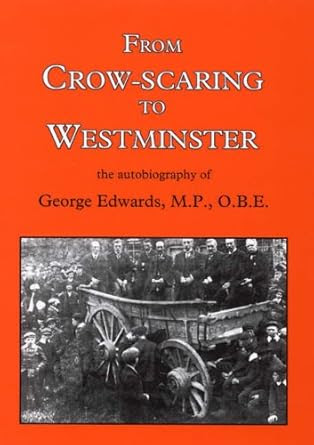
George Edwards - From Crow-Scaring to Westminster

George Edwards was born in rural Norfolk in 1850, the child in a "miserable" cottage of "two bedrooms, in which had to sleep father, mother and six children." At the time his father's wage "had been reduced to 7s. per week". Such poverty, and the appalling working and living conditions that were imposed on agricultural workers at the time, shaped Edwards' life and thought. His father had been a soldier, and an agricultural worker, thgouh his exemplary service bore him no long term benefit. Having protested against unemployment with others in the parish of Marsham, George Edward's father found himself unable to get work.

The punishment for organising against unemployment, low wages and poverty were severe, and as Edwards relates throughout his autobiography the only way to successfully do this was through trade union organising. There were two great periods in Britain of agricultural trade unionism. Edwards was part of the first, which saw the leadership of Joseph Arch and a wave of strikes that shifted the bosses massively. But he was central to the second, and by then was an established trade union leader, and on occasion, paid official. 

As the title of the book demonstrates, Edwards very much saw his most important trajectory as being from the poor beginnings to Parliament. A similar path was trodden by Arch, and both of them - the first and second agricultural workers to become MPs, fell easily into the trap of finding in Parliament the establishment recognition they craved. Arch, is must be said, comes out of it far better than Edwards. Both of them however, end up blaming the workers who cheered them on for their failures. Edwards, however, is far more of a cynic than Arch, the latter of whom retained faith in workers' struggle till the end of his life.

Edwards, by contrast, despises workers' struggle. For him it was the last choice representing failure of negotiations. At one point, in describing the battles of the 1910s, Edwards rights, "I was... determined that I would do everything that was humanly possible to prevent a strike of this magnitude". He continues:

I can't explain it, but I always had, I took a leading part in the trade union movement, the greatest horror of a strike, and would go to almost any length to prevent it, so much so that many of my friends used to say that I went too far in my peace-loving methods.... I have made many mistakes, but that is not one of them.

Edwards' revulsion of strikes stems, in part, from the position he found himself in, as a local trade union leader with an economic interest in avoiding actions that challenged the union. But also from his own weak politics. Edwards' came from a Methodist background. His socialism was not that of Marx and Engels. It was that of the pulpit and Christian socialism. An avid reader, taught to read by his beloved wife, Edwards lists many of obscure books that inspired him. Few of them would be recognisable to socialists today. His politics lacked an understanding of class and power, even though he sided with the lower classes - he is clearly unable to see that struggle is the only way to challenge the entrenched reality of capitalism. Reformism for Edwards flows from his faith and his politics.

That said when battles did happen, Edwards took his side - both on the pickets and in the union. The Norfolk union was built through hundreds of meetings, arguments and discussions. Edwards' training as a Methodist preacher served him sell here. One cannot fail to recognise that it was Edwards' hard labour (and thousands of miles of cycling) that built the trade union, and it was he who was punished by the union itself when the St Faith's strike of 1911 was sold out so that there would be no struggle to distract from the General Election. Edwards' discussion of this period in his book is in part a settling of accounts. The tiresome reproduction of motions aside, it is clear that Edwards' at least held on to a principled defence of the strikers' right to continue and their democratic decisions. Edwards was right. Fifty percent of the strikers did not get taken back, despite the union leadership's compromise.

Nonetheless historian Reg Groves is no doubt right when he wrote of Edwards:

George Edwards tells the stroy from the standpoint of one who was an active worker for the Liberal Party. He saw the growth of the union rather in terms of his own development, of his own slow passage from mesmbership of the Liberal Party to membership of the Labour Party. His opinions change little, if at all: he aw things much at the end of his life as he had done in the early days, and he remained for a long time coparatively indifferent to the changing opinions of the workers themselves, who were hearing and responding to the message of socialism.

Much of the latter half of the book is taken up with somewhat tiresome anecdotes and reprints of speeches and motions that detail the struggles inside the union as the movement went into decline. Then Edwards' election campaigns see reprints and extended quotes from favourable news reports and speeches. As a result there is very little of interest to those interested in rural history or agricultural trade unionism. The book becomes more and more about Edwards, and less and less about the conditions around him. In fact, it is noticeable, that even when describing strikes and protests that he was central too, Edwards is rarely speaks about the struggles, or those struggling. Despite the huge scale of the trade union movement at times, there's little flavour here of the strikes or the movement itself. It makes for a dry read.

One other thing that comes through is how Edwards' loyalty to the British state manifests itself against his better principles. The worst example of this is how he becomes a cheerleader and recruiter for the First World War. The horrors of those battles means he becomes determined to ensure those who returned get treated decently. But he never wavers from the idea that it was right for thousands of agricultural workers' to be sacrificed in the trenches for British capitalism. No doubt this approach is why he had such a fine time in Parliament.

Tiresome and dry though this book is, it confirms on almost every page the essential limitations of socialism without class struggle. Most readers will find in it an interesting insight into the way that Methodism and reformism found in themselves appropriate partners in the British Labour movement. It helps illuminate the way that British Labourism was born tied to the coattails of Imperialism, and how it has failed ever since to break. If you can suffer through the terrible Methodist hymns you might find something of interest. 

Related Reviews

Arch - From Ploughtail to Parliament: An Autobiography
Horn - Joseph Arch
Ashby - Joseph Ashby of Tysoe: 1859-1919
McCombs - The Ascott Martyrs
Groves - Sharpen the Sickle! The History of the Farm Workers' Union

Friday, April 04, 2025

Greg Steinmetz - The Richest Man Who Ever Lived: The life and times of Jacob Fugger

In 1526, the Tyrolean radical Michael Gaismair, wrote a remarkable document known as The Landesordnung. In it, he outlined how a radicaly democratic society could function, based on social justice, religious freedom, equality and, through curbing the actions of the rich and powerful. In it, he demanded that the mines, an important part of the Austrian economy, be bought under democratic control and taken off the likes the Fugger bankers. They, and their kin, had

forfeited their right to them for they [bought] them with money acquired by unjust usury in order to shed human blood. Thus also they deceived the common man and worker by paying his wages in defective goods…raised the price of spices and other products by buying up and hoarding stocks. They are to blame for the devaluation of the coinage, and the mints have to pay their inflated price for silver. They have made the poor pay for it, their wages have been lowered in order that the smelters can make some profit after buying the ore. They have raised the prices of all consumer goods after they gained a monopoly, and thus burdened the whole world with their unchristian usury. 

Sadly this quote doesn't appear in Greg Steinmetz' account of the life and times of Jacob Fugger. But having read it, one can certainly sympathise with Gaismair and the rebellious peasants and miners who flocked to his call. Fugger was indeed one of the richest men ever to have lived, and as Steinmetz's account makes clear Fugger was uniquely for his time, adept at seeing business opportunities and using his existing wealth and power to get further wealth and power. He counted among his clients kings, monarchs and popes, and he played politics like a giant game of chess across Europe all in order to further his own ambitions.

Unfortunately Steinmetz's book suffers from superficial analysis and simplistic comment. Writing of the great German radical Thomas Müntzer, Steinmetz says that he "was the most dangerous to Fugger. It was not because he had the most guns but because his populist agenda held enormous appeal". Müntzer did indeed rail against "the profiteering evildoers", but then so did many others. Müntzer was a threat because his brand of radicalism was linking up with a mass movement - not because he was uniquely radical. The revolutionary movement of 1525 was, after all, a massive challenge to all the powerful and weathly. 

Steinmetz charts Fugger's rise to power, and in particular highlighting the way he was able to extract wealth from labourers and use that to strengthen his hand. It is notable, and Marxists might appreciate knowning it, that the world's first capitalists and bankers were as ruthless as others. Despite the lack of serious competitors, Fugger seems personally driven to accumulate wealth for the sake of it. Even Steinmetz who is clearly sympathetic to the banker's lot is forced to acknowledge that Fugger's methods were devious and nasty. In the case of the repression of the peasantry and their allies, Steinmetz notes that Fugger "sponsored" "savagery".

Despite these insights, Steinmetz tends to give Fugger far more credit than he is due. He is portrayed as the figure who personally drives forward key moments in central European history. Steinmetz doesn't appear to be engaging in hyperbole when he improbably claims, that Fugger

roused commerce from its medieval slumber by persuading the pope to life the ban on moneylending. He helped save free enterprise from an early grave by financing the army that won the German Peasants; War, the first great clash between capitalism and communism. He broke the back of the Hanseatic League... He engineered a shady financial scheme that unitnetniotnally provoked Luther to write his Ninety-Five Theses... he most likely funded Magellan's circumnavigation of the globe.

Like Brecht, we might wonder who else built Thebes of the Seven Gates? The problem is that this account fails to acknowledge the very real changes taking place within the economic base of European society in the early 16th century. The changes that were driving all sorts of economic, political and theological changes and opening up a space for others. By placing these changes in the hands of one individual (to be fair Steinmetz does say "helped") the authors is simply engaging in that favourite bourgeois fantasy of the individual discontected from society and the wider world. 

Tragically there are no modern biographies of Jacob Fugger, and Steinmetz has at least written one that covers the key moments of Fugger's life. Sadly its not without fault. It also has some annoying mistakes. Fugger claims that Müntzer was finally defeated in battle at Mühlhausen "a small city Müntzer gad seuzed and sought to run as a communist utopia". But this is wrong. The battle took place at Frankenhausen, and is today marked by a significant museum.

Greg Steinmetz's biography of Fugger will likely have a renewed readership as a result of the anniversary of the Peasants' War. It is perhaps most charitable to say that it is the sort of biography you would expect "a securities analyst for a money management firm in New York" to write, and use it as a jumping off point for more serious studies elsewhere.

Related Reviews

Klaassen - Michael Gaismair: Revolutionary and Reformer
Blickle - The Revolution of 1525: The German Peasants' War from a new perspective
Baylor - The German Reformation & the Peasants' War: A Brief History with Documents
Drummond - The Dreadful History and Judgement of God on Thomas Müntzer

Sunday, March 30, 2025

Rudolf Hoess - Commandant of Auschwitz

This is, in everyway possible an utterly repugnant book. I must start out by saying two things. Firstly none of the proceeds from this publication go to Hoess' family. The publishers say that royalties go the "help the few survivors from the Auschwitz camps". Secondly, reading this book is an insight into the minds of the figures who made the Holocaust happen. Written as it while under arrest and facing trial for crimes against humanity, it is naturally distorted and with much self-justification. The shocking thing is that Hoess is surprisingly unashamed of his actions.

Hoess starts his book with his childhood, in a strictly Catholic family. He was himself expected to become a priest, and his parents seem strict, but highly moral. He says, without any sense of self-irony, that "I was taught that my highest duty was to help those in need". From his early life he believed in the importance of service, duty and obeyance of orders from those in superior positions. He eventually served in the First World War in Iraq, and like many Nazis, he saw action in the Freikorps. This led to his imprisonment for his role in the murder of a far-right figure who was believed to have betrayed another nationalist to the authorities. Following his imprisonment, Hoess who was already a Nazi member, lived in a far-right rural commune, until the new Nazi regime found him a position in the Concentration Camp system. Hoess' knowledge and contact with leading Nazis in the aftermath of WW1 say him rise quickly - as did his commitment to the cause, and his organisational skills.

This background is important. Partly because it is important to understand the trajectory that Hoess took to get his position runing Auschwitz. Mostly however it ensures that the reader understands that Hoess was a committed Nazi. He wasn't in charge of the world's most appalling death camp because he was good at organisation. He was in charge because he was committed to Nazi ideology and to following the orders of the regime's leaders. 

According to the Auschwitz museum, about 1.1 million people died in the camp. Most of these died while Hoess was in charge. It is impossible then for the reader to be anything but shocked by Hoess' comments. He says, for instance, of his work in Auschwitz:

I though that the construction and completion of the camp itself were more than enough to keep me occupied, but this first progress report served only to set in motion an endless and unbroken chain of fresh tasks and further projects. From the very beginning I was so absorbed, I mist say obsessed, with my task that every fresh difficulty only increased my zeal. I was determined that nothing should get me down. My pride would not allow it. I lived only for my work.

"I lived only for my work" in the death machine that was Auschwitz is such an extraordinary statement that it takes the readers breath away. With paragraph's like the above, it can seem that Hoess is trying to depict himself as a technical functionary, obsessed with the details of the "machine" but unconnected to the wider murder of the camp. Indeed, Hoess's anger at the extreme Nazism of the Der Stürmer newspaper, the newspaper that was avidly read by SS staff in the camp for its extreme antisemitism, is because it undermined the proper functioning of the camp and "far from serving serious anti-Semitism, it did a great deal of harm". This is a theme for Hoess. His frustrations at problems in the camp are because he is frustrated at being unable to properly carry out his order. Hoess himself explains.

When in the summer of 1941 [Himmler] gave me the order to prepare installations at Auschwitz where mass exterminations could take place, and personally to carry out these exterminations, I did not have the slightest idea of their scale or consequences. It was certainly an extraordinary and monstrous order. Nevertheless the reasons behind the extermination programme seemed to me right. I did not reflect on it at the time: i had been given an order, and I had to carry it out. Whether this mass extermination of the Jews was necessary or not was something on which I could not allow myself to form an opinion, for I lacked the necessary breadth of view.

While he says that he did not form an opinion at the time. He does not allow himself to argue that it was wrong after the event. Indeed, much of his criticism of the extermination policy comes, not from a moral outrage, but because he thinks it was a waste of labour. Thus the millions of Jews and others who died in the camps are dismissed by Hoess.

Indeed Hoess "watching the killing" himself. The sections of the book where he describes this, and the individual tragedies his witnessed are some of the most difficult pieces of writing I have ever read. Time and again he says things like "the killing of these Russian prisoners-of-war did not cause me much concern at the time". Hoess is more focused on describing the technical solutions, and supply problems that hampered the extermination programme. In fact, at times, the book reads most as a tract written to prove that Hoess was good at his job. Hoess was happy in his work, "In Auschwitz I truly had no reason to complain that I was bored". He continues by explaining that when he was "deeply affected by some incident" he was able to go riding, or see his family, until the "terrible pictures" had been "chased away". Homelife was idylic:

My family... were well provided for inAuschwitz. Every wish that my wife or children expressed was granted them. The children could live a free and untrammelled life. My wife's garden was a paradise of flowers. The prisoners never missed an opportunity for doing some little act of kindness to my wife or children, and thus attracting their attention.

I will spare the reader here by not quoting the passages were Hoess indifferently describes the murder of people, or watching their deaths through the windows of the gas chambers, or his efforts to make the process more efficient. In his introduction Primo Levi says that the book is "filled with evil, and this evil is narrated with a disturbing bureaucratic obtuseness; it has no literary quality, and reading it is agony". He continues that Hoess comes across as "a coarse, stupid, arrogant, long-winded scoundrel, who sometimes blatantly lies".

The "bureaucratic obtuseness" that Levi refers to is accurate. But we have to be careful at simply seeing Hoess' actions as just reflecting the "banality of evil". What Hoess did and describes in this book reflects that he was more than just a functionary. He was committed to Nazism. His strict obeyance of orders flowed not from having a personality that enjoyed organisational work, but because he saw in Himmler and Hitler leaders who he was personally and politically commited to. He was a Nazi through and through, and his last paragraph statement that he was "unknowingly a cog in the wheel of the great extermination machine created by the Third Reich" is exposed as a lie by every preceeding paragraph. Hoess was not a cog in an office far away from the camps. He was looking in through the glass observation panels as trainload after trainload of Jewish people died. He was also happy to kill himself. To those SS men whose moral was sapped he could only offer inspiration by reminding them of the Nazis' plan. 

My interest in Rudolf Hoess came from seeing the recent film Zone of Interest. If anything this book exposes Hoess as a far nastier and brutal person than the film does. I don't think I have previously read a book by a Nazi. It has left me feeling sick and angry. But also committed to making sure that the 21st century fascists never get a chance at power again.

Related Reviews

Evans - Hitler's People: The faces of the Third Reich
Evans - Telling Lies About Hitler: The Holocaust, History and the David Irving Trial
Roseman - The Villa, The Lake, The Meeting: Wannsee and the Final Solution
Mazower - Hitler's Empire: Nazi Rule in Occupied Europe
Browning - The Origins of the Final Solution