Showing posts with label Early Modern History. Show all posts

Sunday, April 26, 2026

Daniel Defoe - A Journal of the Plague Year

During the Coronavirus pandemic Daniel Defoe's A Journal of the Plague Year gained a new popularity. Despite being an account of one man's experiences during the Plague of 1665, readers found many parallels with their own experiences of sudden death, mass sickness, panic and isolation. The book reads like a historical account. It's filled with weekly deaths neatly tabulated (another familiar thing for those who lived through 2020 onward). The author's accounts of walking deserted streets, stories of their neighbours and anecdotes of a deserted London read like a real experience.

But Daniel Defoe's book is not a real account. It is a sort of meta-fiction, based no doubt on experiences that Defore had related to him, and, at times it references real people and places. But it is fictional. While the numbers quoted might be real, the reader is forced at times to question what might be real and what might be imaginery. Again, the lack of clarity, might be something familiar to those who survived Covid-19.

That said scholars do tend to think there is a lot of reality present. The account is signed HF. Defoe had an uncle with those initials, and in a slightly incongrous moment in the text, there is a reference to a cemetary, where the author is buried. The tempation to read the book as fiction, or as non-fiction remains everywhere. Nonetheless Defoe captures the experience in ways that are tempting to link to our own times.

Defoe, or his narrator, care little for the experiences of the rich and powerful. There are few references to the Court, the Royal Family, or famous figures other than those who play some role in relieving or helping the population such as the Lord Mayor. Instead Defoe demonstrates a concern for the ordinary person, reflecting the worry and uncertainty of a city whose population is leaving in droves. Take the servants that Defoe describes as worrying about their future if their masters leave:

Their Question generally was, after the first demand of, Will there be a Plague? I say, the next Question was, Oh Sir! For the Lord's sake, what will become of me? Will my Mistress keep me, or will she turn me off? Will she stay here, or will she go into the Country? And if she goes into the Country, will she take me with her, or leave me here to be starv'd and undone.

These questions Defoe says were addressed chiefly by maidservants to the various quacks and astrologers who plyed their trade in the early days. Not a few workers asked similar things of their bosses, trade unions and colleagues in the days of lockdown.

Defoe bemoans who the poor, tricked into buying useless potions were "carried away in the Dead-Carts" and "thrown into the common Graves" of every Parish. He describes these tragedies. The sudden deaths and the occasional miraculous escape. Above all he is obssessed with the empty homes and shops. More often he is also fascinated by the experiences of those found with the plague - locked into their family homes to survive as they could - and guarded by watchment. Defoe's narrator takes a salacious delight in telling the stories of those that escaped, the occasional bribery of officials or the sneaking out of back windows. 

But these examples aside the book actually chronicles a time of solidarity and support. Kindness and compassion. There are many people who stay at their posts. Or try to help. From physicians to politicians, but most often church figures - Defoe impresses on the reader that while there is crime amidst the horror, what characterises things are those who try to help. In particular I was struck by his descriptions of priests. Their numbers denuded by death and escape, dissenters who previously would have been shunned are drawn in to play the role offering prayers and salvation. And home important this was to the 17th century population:

As it brought the People into publick Company, so it was surprizing how it brought them to crowd into the Churches, they inquir'd no more into who they sat near to, or far from, what offensive Smells they met with, or what condition the People seemed to be in, but looking upon themselves all as so many dead Corpses, they came to the Churches with the least Caution, and crowded together, as if their Lives were of no Consequence, compar'd to the Work which they came about there.

Readers might also notice then that the disease democratised the religious space.

Interestingly Defoe is also impressed by the official response. He lists the rules and regulations (that modern science knows made little difference) but he also talks of the relief efforts. Those who remained in London and were well did not starve. Though Defoe does acknowledge that there would have been rebellion had such aid not been forthcoming. 

While it's not a historical account, Defoe's book feels real. It is, perhaps, an early example of historical fiction. It is also a meandering book in two ways. The first is that Defoe's narrator meanders in his account. This is not a account that follows a time line of events. Rather its like a slightly drunk storyteller who goes back and forth, returning to themes and anecdotes. Secondly, and most of interest to the modern reader, is that this is a book that meanders through space. Defoe takes us down the streets and alleyways of London, making sure we know exactly where things are and who lived where. This is not the London of the Tower, or famous bridges. It's the London of backstreets and cheap housing. His readers would have recognised every nook and crany, for much of it was rebuilt on the same plan after the fire of 1666.

A Journal of the Plague Year is a remarkable book. An insight into a previous disaster, one whose shadow long hung over the city. A tragic and shocking year that must have felt even more frightening for the lack of any real explanation. Supernatural mixes with the latest science in Defoe's telling. Don't wait till the next pandemic before you read it.

Related Reviews

Spinney - Pale Rider: The Spanish Flu of 1918 & How it Changed the World
Wallace - Dead Epidemiologists: On the Origins of Covid-19
Harrison - Contagion: How Commerce has Spread Disease
Horton - The Covid-19 Catastrophe: What's gone wrong and how to stop it happening again
Davis - The Monster Enters

Sunday, July 20, 2025

Eamon Duffy - A People's Tragedy: Studies in Reformation

As one of the preeminent scholars of the English Reformation I have always found Eamon Duffy's work to be insightful and interesting. Despite his framework differing entirely from Marxism, his frequent focus on the lives of ordinary people, the impact of religious changes and the role of religion in day-to-day life, means that there is much to be gained from a study of his work. Two of his books remain unparalleled. The Stripping of the Altars is a fantastic account of the impact of the Reformation with a nationwide view, and The Voices of Morebath is a deeply touching close study of one community's encounter with the sweeping changes of the Reformation through a half century recorded by its vicar, Christopher Trychay.

What to make of A People's Tragedy, collection of Reformation themed essays by Duffy, which mostly explores how the Reformation has been understood by people in the centuries since? While several of the essays are interesting, they are most likely to be fully enjoyed by various experts. However there are some stand out chapters. Two of these demonstrate Duffy's excellence at exploring the ordinary experience of religion. The first, on the nature and experience, of pilgrimage before the Reformation gives, like Voices of Morebath, a real flavour of ordinary lives. Here are the ordinary pilgrims, "goggling" at the splendour around them, distracting them from the shrine. The second, which looks at the doomed, pro-Catholic, rebellion of 1569, again demonstrates what I argue is the essence of the Reformation for "history from below". In England it was experienced by most people as an assault on their culture and community, from above - and thus rebellions against it must be seen as resistance to attacks on ordinary people - rather than just a defence of Catholic practice.

Other essays look in detail at how different historians, religious figures and so on have discussed and understood the Reformation. Some of these are obscure to non-specialists. Others less so. There is a fascinating chapter that dissects Hilary Mantel's trilogy on Thomas Cromwell. Exploring how the author reverses the character and behaviours of two key figures - Cromwell and Thomas More, to the detriment, Duffy argues of popular understanding of the English Reformation. While the main thrust of the argument is understandable, Duffy's desire to protect the legacy of Thomas More seems more sectarian than historical. Another fascinating chapter looks at the development of the English Bible, and its impact today.

To be fair to Duffy, he is concerned not just with pushing a more pro-Catholic viewpoint on the Reformation than most readers will be used to, but in actually exploring the legacy of the schism itself. This, he argues, was quite negative. Regarding the end of the tradition of pilgrimage, Duffy concludes that with its end, "English imagination was the poorer for it". While it is certainly true that the infrastructure and fabric of churches suffered from the consequences, was collective "imagination" really that damaged? Me thinks the writer protests too much.

Part of the problem is that Duffy is concerned about religion per se. This is particularly notable in his chapter on the rise, fall and rise again of pilgrimage to the shrine of the Virgin Mary at Walsingham. Here, in his account of contemporary politics of the event, he is keen to stress the unity of the wings of the Church, over and above the nature of the pilgrimage itself. What does pilgrimage mean in the 21st century is not really a question that Duffy tries to answer. This, I think is important, because Duffy has disconnected his religion(s) from wider economic, political and dare I say it, historical processes. Sometimes this is obvious on a specific level - for instance in the account of 1569 (a revolt entirely neglected by contemporary left historians) Duffy writes:
Till relatively recently, historians have been inclined to explain the rebellion in essentially secular terms, as the last gasp of northern feudalism, an attempt by northern grandees, resentful of their own exclusion from the corridors of power and the domination of the Elizabethan court.
Duffy, instead, reminds us that people did (at all sorts of levels in society) enthusiastically embrace the opportunity to reassert their own religion and practice in the old way: Digging up altar stones, teaching choirboys to sing the old songs and so on. But what Duffy misses is that the revolt can be understood as both aspects. Indeed it is both the desire for northern power and the desire to worship in the old ways that provided the impetuous for revolt by elite rebels and the space for some of the masses to support them.

It is Duffy's ability to disconnect religion from context (while recognising its centrality to the lives of ordinary people) that makes the book a frustrating read. Duffy might be keen to build bridges between the different Christian Churches and to argue against viewpoints that sometimes place Protestantism and being automatically more progressive than Catholicism. But this is abstract religion - there's nothing really here about the role of religion in the modern world, or indeed how a unity of purpose for different Christians might impact on wider politics. Given the uses and abuses to which religion is being purposed in the modern world, particularly by the right and far-right, its a shame that Duffy's excellent historical analysis of the Reformation as a religious process cannot be deployed in ways that might illuminate contemporary politics.

Related Reviews

Tuesday, June 17, 2025

Andrew Bradstock - Faith in the Revolution: The political theologies of Müntzer and Winstanley

This is a fascinating little book. Its author is a Christian radical whose purpose in exploring the ideas of the German radical Thomas Müntzer and the English revolutionary Digger Gerrard Winstanley is to try and understand the role of Christianity in the struggle for revolution. Whether you have an opinion on that or not, Andrew Bradstock's summary of both these fascinating figures is very useful and interesting for radicals today. 

Bradstock begins with Müntzer. On this blog I've reviewed many books about Müntzer and the German Peasants' War that provided the context for his revolutionary ideas. Müntzer's starting point was, in the words of Bradstock, a "commitment to a transformation of the world", but he cautions that Müntzer 

takes up the cause of the poor and oppressed as much from a concern about the spiritual consequneces of such oppression as anything else. Indeed, his main worry is that, because the people have to work day in and day out to survive, they have no time to attend to the health of their souls, and are forced to reply for spiritual guidance upon the learned scholars and priests; and thus they never get to hear about the possibliilty of receiving a revelation from God.

This is an important point about Müntzer (and also, I think about Winstanley). He was a religious thinker before he was a social activist, but in becoming a social revolutionary Müntzer was not breaking from his revolutionary politics, but extending his religious activity and thinking. Müntzer "never envisaged fighting the last battle alone" - he did not see himself as a the person who was the vessel for God's actions. He say an enlightened minority the "elect" as being the people who would change the world and humanity. The non-elect were "destined for eternal damnation" and the elect would be saved. Who was who? 

The key to such knowledge... is to be found in the concept of urteyl, judgement, a gift of God to the elect by which they are enabled to know themselves to be among the chosen, and to recognised those who are the ungodly. This concept is essential for Müntzer and vital for an understanding of his leagues [his organisations], his apocalyptic, and his participation in the peasants' struggle.

Bradstock points out that Müntzer's thinking on the elect developed. But towards the end of his life he was seeing the elect as being the same as "the poor and materially oppressed common folk".  He made "the peasants' cause his own". It is tempting to draw an analogy here between Müntzer's concept of the enlightened few changing the world and Anarchist ideas of a minority changing the world for the masses. It's also possible that Müntzer was better than the average Anarchist in this sense because he understood that the elect were a mass social force. Though he doesn't seem to have abandoned his "two-tier conception of humanity".

How does this compare with Winstanley's thought? Winstanley was also shaped by the struggle around him, though England in the 17th century was much more economically developed than Germany in Müntzer's time. Winstanley was writing during and following a revolutionary movement that had beheaded a King, so his revolutionary policies in some ways are closer to modern revolutionary ideas than Münzter's. But Bradstock writes that:

Had Winstanley's millenarianism not been geuine - had he, in other words, truly been a secular thinker - it is at least arguable that he could have produced a more revolutionary programme than he did, since by interpreting the political struggle in which he was egaged religiously he failed to see it in a true historical perspective. Hi millenarianism, in other words, made it 'unnecessary' for him to demonstrate how it was possible for his programme to be realised.

I've written elsewhere on the brilliance of Winstanley's "vision of utopia". Here I think Bradstock is right. Müntzer understood that the, and the rest of the elect, had to fight. Winstanley didn't grasp that there were barriers to the implementation of his vision, so he tried to simply go out an enact it - digging on St George's Hill. Both leaders were however defeated because they underestimated their opponents and the historical context of what they were trying to win.

How does Bradstock's analysis fit with other revolutionary thinkers? He is at pains to criticise Engels' "analysis of Müntzer". This he says is basically an argument that religion is irrelevant to their struggles. He does this on a reading of Engels on the Peasants' War where Engels says that "the class struggles of that day were clothed in religious shibboleths... [but] this changed nothing and is easily explained by the conditions of the time." Bradstock here concludes that Engels (and thus all Marxists) are saying that "the presence of religious language in the revolutionary programme of a Müntzer or a Winstanley is politically insignificant". 

But this is a strange conclusion to come too, as neither Marx nor Engels thought this. They understood that religion arose in an material circumstance, and their writings on the Reformation, Luther and Müntzer reflect this analysis. So it's a strange to critique Engels for making an argument that is at the root of their materialist theory of history. Nonetheless, nowhere does Engels or Marx argue that the religious language of Münzter doesn't matter. Indeed quite the opposite. Both would have understood the centrality of Reformation thinking to the programme of Müntzer, while understanding that these ideas emerged from the economic and social context. 

Indeed despite Bradstock's clarity on some of the ideas of both the revolutionary figures he is discussing, he underplays the differences in economic, social and political development of the two contexts, which weakens his analysis somewhat.

The final section of the book is Bradstock's attempt to grapple with the issue that is central for him. What can Christianity offer revolution? Here he rightly emphasises the way that religion can be a force that encourages, inspires and offers guidance. He notes the importance of Christian thinking to radical forces in Nicaragua in the 1979 revolution as well as libertion theologists in South America. Too often though he falls back on radicalism being something brought from outside - just as Winstanley and Müntzer tried to do:

The relationship between scientific analysis and utopian visions is broadly dialectical: the former, by exposing the reality of the situation and the real possibilities for change, opens up new horizons for revolutionary activity, while utopian thinking, with its overarching vision of new people in new relationships, serves to stimulate science to explore new fields of possibility.

I think this is wrong. No mass revolutionary movement has been built because it started from utopian visions. Rather, in the case of the most successful of those movements, the visions have emerged out of the concrete reality of mass struggle. The Soviets and Workers Councils of the 1905, 1917 and 1919 revolutions in Russian and Germany were not pre-planned. They emerged because they were organs of struggle that did, or might have, become the basis for a new way of organising society. 

Unsurprisingly, as a Christian, Bradstock concludes that his religion makes revolutionaries better because they have "the certainty that neither they nor their effort will ultimately be meaningless or lost". It is, in my opinion, a little patronising to assume that non-religious, or non-Christian, revolutionaries might not feel the same. In either event, the belief in an afterlife shouldn't be some sort of get out clause for revolutionaries. What really matters is people's concrete engagement in the struggle, and the politics and theory that emerges from the testing of their ideas in practice. While Faith in Revolution is a book that I enjoyed reading this was more so for the author's penetrating insights into the ideas of two key radical figures, and less for his musings on Christianity and revolution.

Related Reads

Klaassen - Michael Gaismair: Revolutionary and Reformer
Stayer - The German Peasants' War and the Anabaptist Community of Goods
Drummond - The Dreadful History and Judgement of God on Thomas Müntzer

Tuesday, May 27, 2025

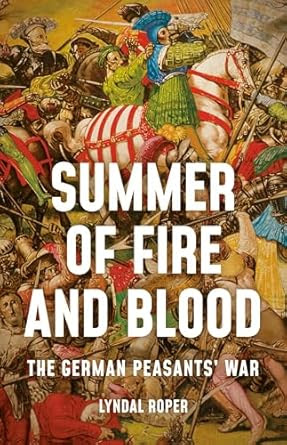
Lyndal Roper - Summer of Fire and Blood: The German Peasants' War

Lyndal Roper is one of the most prominent historians of Germany in the Reformation era. Her books include an excellent biography of Martin Luther, which I reviewed here. Just in time for the 500th anniversary her monumental history of the German Peasants' War has been published. It has been eagerly anticipated by me and many others interested in the period. 

Roper argues that understanding the Reformation, and its "possiblities, as well as its limits" cannot be done without an understanding of the German Peasants' War. But likewise the War cannot be understood without knowing "the heady atmosphere of religious excitment in which it took place". The book begins with the context for the rebellion - the religious turmoil and the conditions of oppression and exploitation of the peasants. It was a very different world. One where

animals such as oxen, horses, cows, pigs, sheep and poultry lived closely with people, and where the vagaries of the weather mattered in a way that modern generations have often forgotten. The relationship between labour, harvest, and food was obvious, rather tahn mediated by powerful firms and complex industrial processes. The energy to drive machines came from water, from wood and from charcoal and it was clear who owned these resources and evident when they restricted access to them.

Roper casts peasant life (and struggles) in its ecological context - referencing the way they relied on, understood and shaped their landscape. She understands that their relationship to the land was more than a negative one, and she criticises contemporaries, even radicals such as Michael Gaismair, when they don't grasp the peasant ecological reality. 

Roper also shows how the context for the rebellion, and the Reformation, was a slowly changing world. Referring to the rebels' grievances she says: 

The sense of exploitation is unmistakable in these grievances, as is the sheer drudgery of agricultural labour. And yet the precise cause of the misery remains intangible, a fact that may well have increased the peasants' anger, while also making it harder to negotiate in the time honoured way, becamse more than just specific practices were at stake. Though they doubtless idealised a golden age that had never existed, peasants were complaining that relationships which had formerly been based on mutual respect had become matters of compulsion. The entire system had become more complex because of its growing entanglement in an economy where many owned rural rights.

The close links between exploitation of the peasants' labour, their ecological context and the rebellion's demands are drawn out well. As Roper writes in an illuminating sentence "for the peasants, the land was a working environment; for the lords it was a locale of peasure - and a resource to be exploited for profit." 

The rebellion condensed all the anger and frustrations that the peasants' were experiencing. Roper's book explores these well, but its strength is her understanding that the rebellion arose out of the context of the Reformation and a changing economy, but then went on to pose alternatives. The Reformation, she writes, "provided a set of ideas shown that such [existing] arrangements were 'not Christian'. They had to be transformed." In the early weeks of the rising, "lordship was exposed as a bond not of affection but of domination". Consequently, the "whole social structure therefore fissured under the impact of the peasants' revolt."

What was the alternative? Much is made, rightly in my opinion, of the politics of the more utopian minded of the radical leaders - Thomas Müntzer and Michael Gaismair in particular. But running through the peasant demands from 1524 and 1525 is a vision of a world turned both upsidedown - there would be no serfs, priests would be elected, taxes would be raised locally and controlled demoncratically. But it would also be a world that functioned in a new way. The vision was not of an anarchist utopia with no leaders, but one of a "new kind of authority in which men of respect, locally known and chosen, would have power". But what was this power? Roper suggests it would have been very different to the power known from feudalism:

It took imagination to conceive of a world without the lordship that the peasants knew. They probably did not want to overturn the entire system of authority, or at least not at first, nut merely to change the system of landlordship. And yet their slogn, "We want to have no lords". addressed everyone - peasants, miners and townsfolk alike - because everyone had some experience of lordship in its different forms or could tell a story about the overbearing behaviour of some lord or other. In its place they wanted a society based on mutuality, brotherhood and trust... they began to envision a world without the familiar semifeudal structures, with a new kind of rulership that would give them agency and the power to decide.

It was a great vision, and the ruling class had to destroy it by drowning it in blood. In her grasp of this, and other key dynamics of the period and the rebellion, Roper's book is exemplary. 

Roper writes from a feminist viewpoint,and she does her best to highlight the central role of women in the rebellion. While we know only a few names of women involved in the rebellion, Roper does give us many examples of their anonymous involvement. I didn't always agree with the conclusions that arose from this viewpoint, such as her suggestion that the anonymous author of the remarkable revolutionary pamphlet To the Assembly of the Common Peasantry is writing an explicity "male vision" of revolution. Here the problem is partly language. "Brotherly love" and "brother" in the context of mass rebellion, may well be meant to include women. But it might simply not have mattered to the ordinary women and men who were engaged in a revolutionary struggle and were constructing their own "vision" and challenging those who were holding on to older stereotypes and prejudices. 

Roper makes some important points about sexual violence in the conflict. She notes that the threat of such violence was used by some of the peasants against the wives and daughters of the lords, their enemies. But she concludes "the peasant armies do not appear to have used rape as a tool of domination". The counter-revolutionary forces on the other hand, did use such violence on a large scale. Given the accusations levelled against the peasants by their contemporary enemies, and ones since, this is an important corrective. 

Roper's argues that the peasants' "ideal of brotherhood created potential kinship even with the lords, constraining the wish to make the enemy's women bear one's children." I think this gets closer to an understanding of the Peasants' War as a revolutionary movement, motivated by ideals. The discipline of its participants in the peasant armies arises out of common radical visions and politics.

But its on the question of revolution that Roper is less clear. This is particularly obvious in her critique of Marx and Engels. 

She goes so far as to say that "an unwillingness to theorise how peasants engaged in revolution was one of Marxism's great failures". This is a unhelpful, and inaccurate, generalisation. In fact Marx's analysis of the peasantry is remarkably useful for understanding the failure of the peasants to achieve their aims in 16th century Germany. Roper dismisses Marx's comment that the peasantry is a "sack of potatoes". She does this because she understands it as meaning that "peasants are all the same". But Marx was actually discussing the economic reality of a peasant economy,  that it is made up of multitudes of independent producers. Following the "potato" quote, Marx wrote:

Insofar as millions of [peasant] families live under conditions of existence that separate their mode of life, their interests, and their culture from those of the other classes, and put them in hostile opposition to the latter, they form a class. Insofar as there is merely a local interconnection among these small-holding peasants, and the identity of their interests forms no community, no national bond, and no political organization among them, they do not constitute a class. They are therefore incapable of asserting their class interest in their own name, whether through a parliament or a convention. 

The differing interests of the peasant households would inevitably lead to tensions and contradictions that would undermine any victory over the feudal lords, unless there could be a breakthrough elsewhere in society. But in 16th century Germany, the economic base in the urban areas was insufficiently developed to allow the urban producers to build a society based on collective production. Thus the best that the peasants could hope for was to win some temporary space and defeat particular lords, but they could not hope to defeat feudalism and institute a new social order. This is the source of Engels' powerful passage about Thomas Münzter being a leader ahead of his time. He could imagine the future, but not be in a position to win it, but nevertheless be compelled to fight for it. 

Marx and Engels' argument that the peasants could not win in 1525, was not because they were "mesmerised by industrial production", but because he and Marx understood that it would take further economic development at the base of European society before a system of general abundance and sustainability could be created. Roper's attacks on Marxism here felt like they were responding more to the crude economistic Marxism of the East German historians than the actual ideas of Marx and Engels.

When I set out to write this post I hoped that I wouldn't end up writing the sort of review that just denounces an author for getting Marx completely wrong. I have probably failed in that ambition. So I want to emphasise that how remarkable I think that Lyndal Roper's book is. Even for those of us who have spent years reading about the subject she has found a wealth of new material. I read and re-read sections with great excitement and found fresh insights in every chapter and learnt a great deal. I should also add that I think the book is beautifully produced and illustrated. If I disagree with her I do share Roper's inspiration at the peasants' desire to fight for a better world. So while I disagree with Roper's theoretical framing I hope people will read and enjoy Summer of Fire and Blood. 

Related Reviews

Roper - Martin Luther: Renegade and Prophet
Scribner & Benecke - The German Peasant War 1525: New Viewpoints
Bak (ed) - The German Peasant War of 1525
Blickle - The Revolution of 1525: The German Peasants' War from a new perspective
Bax - The Peasants War in Germany
Engels - The Peasant War in Germany

Tuesday, June 18, 2024

Thomas Kaufmann - The Saved and the Damned

When Martin Luther penned his 95 Theses against the Church he began a process that was to have far reaching implications. It would have far reaching implications, which went beyond the split between what became the Catholic and Protestant Churches. These implications, religious, social, economic and political would drive struggle, civil war and revolution across Europe and extend into the colonies. Karl Marx famously noted that the Reformation "began in the brain of the monk". It is, on one level a curious statement. After all, Marx's whole life was dedicated to an approach that said that pure ideas did not exist, but are shaped by the economic contexts. Luther however was not abstracted from society, and his criticisms of the Church were closely related to wider economic and political issues. The selling of indulgences, the main target of his Theses was merely represented the tip of much deeper issues.

Thomas Kaufmann's new history of the Reformation, The Saved and the Damned, is an excellent introduction to the period. Particular in "what happened". Much of the work focuses on the German Reformation. In part this has to do with Kaufmann, as the book was originally published in German. But it is also because the Reformation started in Germany and had its most explosive period there. This is not a book of detail, it is a sweeping history which starts from the premise that "the diverging fates of the Reformation in the countries of Europe were fundamnetally connected with the diverse political, ecclesiastical, cultural and social conditions".

But to really understand the Reformation we need something deeper. After all people had made criticisms of the Church beforehand and certainly there were many intellectuals on a par with Luther who were getting an audience. Why did Luther's Theses explode across Europe ("the whole of Christendom in four weeks")? Was it simply their clarity? The Printing Press? Luther's oratory? All of these were important, but mattered was that Europe was in a social crisis, and the Theses landed in the midst of this crisis and encouraged it. For the German Peasants it was a reason to rebel. For people like Thomas Münzter it began them on a path that would lead to revolution. For thousands of others it opened a door to wider criticisms of religion and the role of the Church. Issues of individual freedom, power and wealth. Kaufmann is write to argue that Luther was the "central figure, of the Reformation" without whom it would not have happened. But we cannot ignore the deeper changes.

Here we have to look at what else was changing, and tragically, despite his scholarship on the Reformation, Kauffmann all but ignores the deeper changes in European society, principly the first developments towards merchant capitalism, and the transition from feudalism to capitalist society. Here the Peasant War is informative. Because while many peasants began their critique of society by picking up a pitchfork and a copy of a Luther pamphlet, their criticisms were mostly about economic issues. Principly the right to control their land, their community and their church. While these frequently harked back to an imaginary past, they also reflect how feudal society was moving towards a more capitalist organisation. Increasingly production was for the market, not community use. Wage labour was becoming normal, and the profits of big institutions like the Fugger bank were driving discontent by concentrating wealth in the hands of a few. 

Kaufmann reacts to these simply by discussion the Weberian idea that "there is a causal connection ebtween the religious mentality of Reformed Protestanism... and a capitalistic economic disposition". This, Kaufmann thinks is overestimated. In fact he returns several times to this:

The commonly held opinion that 'Calvinism' had an affinity primarily with the nbourgeoisie hardly accounts for the complex social and political mechanisms by which its influence spread in the second half of the century of the Reformation.

Again this misses the point. Protestantism becomes the language of the bourgeoise, not because they need it to be capitalists, but because it fits the logic of how they see the world. In turn they shape protestantism in a particular way (directly opposite to how the rebellious masses understood it). Kaufmann fails to grasp that the bourgeois revolution does not begin with a set of end goals that represent the establishment of capitalism. It is why Oliver Cromwell could say "We declared our intentions to preserve monarchy" in January 1648 and "I tell you we will cut off his head with the crown upon it." by December of that year.

For Kaufmann the Reformation happens, and then has consequence. For instance Kaufmann he notes that the Reformation encouraged capitalist development because of things like the "drastic reduction in holidays". More importantly, as Kaufmann note the Reformation encouraged ideas of individalism. But in his writing these are the key deciding factors, rather than part of a dialectical relationship between society and religion.

So in terms of analysis, Kaufmann offers very little insight, except generalisations:

The Reformation in its multifarious manifestations influenced, encouraged and accelerated the developments leading to what is now called the modern West in many different ways. Nevertheless, the Reformation did not produce modern Western civilisation, neither by itself nor as a major influence, any more than any other factor. The Western modern world is the results of a very complex process of transformation - certainly one which would have taken a different course if the Reformation had not happened.

This is inadequate. What we really needed is to recognise that Europe was changing, and the Reformation was both an expression of that, and a factor shaping the change. The small, gradual processes of economic change in the towns and in rural production were driving much wider economic changes. But they aren't analysed here. It is why another Marxist reviewer commented that "Only the examination of the ways in which people reproduce their lives, enter social relations to that end, and by so doing create their whole society, can ideology in all its conflictual manifestations be understood."

This means that The Saved and the Damned feels rarified. It's history floats above the economic base, detached from wider society. This is not to condemn the book's scholarship. It is, in fact, an exemplary and recommended history of what took place across Europe in those turbulent years, and indeed, what that has meant for the Christian Church since. While it suffers from some annoying proofreading errors and a couple of extra paragraphs that were clearly intended as captions for unused pictures, I've no hesitation recommending it as a read. But I think many readers will come away wanting much more.

Related Reviews

Blickle - Communal Reformation: The Quest for Salvation in Sixteenth Century Germany
Lortz - The Reformation in Germany: Volume 1
Marshall - Heretics & Believers: A History of the English Reformation
Duffy - The Stripping of the Altars
MacCulloch - Reformation: Europe's House Divided 1490-1700

Tuesday, January 30, 2024

Kenneth Austin - The Jews and the Reformation

This is an engaging book about European Jews and the Reformation. It mostly examines how Jews were perceived and treated before, during and after the Reformation. Author Kenneth Austin begins with a survey of Jewish life before the great changes of the 16th century, and quickly moves into what the Reformation meant for Christians - he says that this frames how they thought about Jews. 

The figure that looms largest over this period is, of course, Martin Luther. Austin explores Luther's own changing attitudes which began with a more friendly attitidue to the Jews but as they failed to come over to Reformed Christianity, turned into horrificly racism. Luther's words do not need to be quoted here again, suffice to say that they were taken up by antisemites at the time and since. Austin, however argues that such beliefs were not themselves universal. Rather:

Catholic and Protestant attitudes to the Jews in the Reformation era were highly complex and multivalent. Fortunately, few were quite as hostile towards Jews as was Luther, on the other hand, there were relatively few who could be considered genuinely tolerant either. The Reformation had made Europe a religiously pluralistic society, but the place of Jews in this world was far from secure.

Exploring these "complexities" takes Austin through a fascinating account of the history of Jewish people in Europe, their specific beliefs and how Christians understood Jews in terms of their relations to Christians and Jesus. One of the fascinating aspects to this is how the study of the Bible by those contesting the Reformation caused a renewed interest in Hebrew as scholars tried to read the Bible in its original language - meaning that some Jews became highly important as teachers, and their works were published and widely read.

Austin also explores how Christianity had varying attitudes to Jews, that were not simply shaped by religious prejudices or concerns. For instance, there were a number of places were Christian rulers encouraged Jews to live in their towns or cities, for economic reasons. Jews, Austin writes, became "particularly associated" with two roles - doctors and money lending. The former was often proscribed because Jews were commonly believed to deliberately kill a proportion of their Christian patients. The latter was often the reason Jews were invited into an area, though this was often accompanied by various restrictions on life - from bans on them joining Guilds, to restrictions on their rights to travel. It lead to some contradictions, Strasbourg for instance was a city that "could claim to be... almost entirely free from a Jewish presence, while at the same time accomodating Jews in various ways to their mutual benefit." The construction of Ghettos was often about restricting Jews, but allowing them space to continue working in ways that benefited the wider economy, watched over by the anti-Jewish rulers or city council. Such contradictions arose because there was no "monolithic" position towards the Jews. Indeed, successive Popes or monarchs seemed to vary their attitudes dramatically.

The antisemitic beliefs about Jews here, including the blood libel, are explored by Austin in detail. This makes for fascinating, if uncomfortable reading. Austin explores the "blood libels" and racist beliefs, particularly over antisemitic ideas that saw Jews as responsible for killing children. These were widespread in the period covered, but without foundation. Nonetheless they led to frequent pogroms and repression of Jewish communities.

The Reformation had contradictory outcomes for Jews. On the one hand Jews became pawns for arguments from boths sides. On the other, the political demand for religious equality by Protestants, also as a by product led to the toleration and acceptance of Jewish communities. It worked the otherway too. In France, in 1561, the Protestants asked Charles IX to tolerate them, "since the Jews are allowed, and the Turks".

Kenneth Austin's book is insightful and interesting. But not without problem. His tendency to see developments in terms of purely religious differences obscures his argument in places. He argues, for instance, that the Dutch Revolt and the Thirty Years war were the result of Reformation tensions. But the religious debates are better understood as reflecting the tensions caused by the rise of the capitalist order. This new economic system caused enormously changes and, this created new problems and opportunities for Jewish people. For instance, it would have been fruitful if Austin had explored the way that the concepts of bourgeois equality and freedom created spaces for the freedom to worship. Instead Austin tends to see this as a consequence of "ongoing" religious tensions, rather than the ideological expression of a new social and economic system.

Nonetheless, at the end of the Reofrmation, both wings of the Christian Church "tried to position themselves as the heir to the Jewish people". Why that could be true is a fascinating story and it is well told by Kenneth Austin.

Note: In this review I have used "antisemitism" to refer to anti-Jewish beliefs and racism. Kenneth Austin points out that this is "rather problematic", because it tends to relate to a modern racism based on racial and genetic ideas of Jewishness, that dates to the 19th century onward. Secondly, Austin writes:

"the term implies a more positive attitidue towards the Jews than was acutally the case. Most of the fitgures who are generally described as philo-Semites valued the Jews not on their own terms, but rather because of the role they could perform. Wanting Jews in the country in order that they could convert to Christianity, thereby heralding the Last Days, could hardly be construed as genuinely sympathetic."

Related Reviews

Fishman - East End Jewish Radicals 1875 -1914
Sand - The Invention of the Jewish People
Roper - Martin Luther: Renegade and Prophet
Marshall - Heretics & Believers: A History of the English Reformation
MacCulloch - Reformation: Europe's House Divided 1490-1700
Pascal - The Social Basis of the German Reformation
Barton - A History of the Bible: The book and its faiths

Sunday, October 22, 2023

Tom Scott - Thomas Müntzer: Theology and Revolution in the German Reformation

Tom Scott is a distinguished historian of the German Peasant War and Reformation, and this, his biography of the radical Christian theologist and social revolutionary Thomas Müntzer is an excellent introduction to this fascinating figure. 

Rather than the crude revolutionary and antithesis of Martin Luther beloved of many people who write about the period, Scott very much argues that Müntzer was an individual who evolved his ideas in the context of changing circumstances and the tactical needs of the moment. Pushing radical reformation ideas forward, going beyond those of Luther and those grouped around him in Wittenberg was very much Müntzer's ambition, but how he did this definitely evolved. This require Müntzer to evolve his own ideas, as this quote from Scott shows:

Müntzer's definition of the godless changed over the years. From the Prage Manifesto onwards, where he had identified the damned with the Catholic church and clergy, Müntzer gradually widened the category of those he called, from the German Church Service onwards, the godless, to include secular rulers who oppressed the Gospel, and, once the Saxon princes had ignored his exhjortations, latterly all rulers by virtue of their daily oppression of the common people, whose misery prevented them from achieving true faith. It was at that point that Müntzer's theology finally spilled over into secullar rebellion.

Thus Scott's Müntzer is not the fully formed revolutionary who set out on a life dedicated to overthrowing society and introducing a christian utopia. Rather he is a man whose ideas developed in counter-position to the ruling ideas - both Luther's Reformation and the social hierarchy dominant in Germany at the time. When these two forces came together to block his own radicalism, his closeness to the oppressed and exploited masses allowed him to develop far more revolutionary conclusions. But Scott also argues that Müntzer was never the spokesperson for the whole of the masses. Far from it.

the links between Müntzer's theological revolution and the mass of the peasants' aspirations and deamds were fitful, fragile and foruitoous. In the end the rebels saw well enough that Müntzer's religious ideology was inadequate to their cause: it suplied the framework for organised rebellion threough the Christian leagues, but it could not offer any detailed programme for those leagues to adopt. Only the lesser townsfolk, those whose grievances least reflectged entrenched social and economic relations of production, can be said to have embraced Müntzer's essentially amorphous vision in full measure. The peasantry, bu contrast, remained an uneasy ally in both its mentality and aspirations .The mass support with which Müntzer rekoned never materialised.

It is, perhaps, a fair conclusion of where Müntzer was in relation to the masses. Does it invalidate the position of those, like Friedrich Engels, who saw Müntzer as a revolutionary ahead of his time, unable to deliver the vision of the future because of the limited development of society? I don't think so. It perhaps is more realistic an appraisal of Müntzer's actual base which is often overestimated by those on the left. Nontheless Müntzer's programme was revolutionary, and also impossible at the time. Scott's work helps us understand why. 

Related Reviews

Ming - Thomas Müntzer: Sermon to the Princes
Engels - The Peasant War in Germany
Stayer - The German Peasants' War and the Anabaptist Community of Goods
Blickle - The Revolution of 1525: The German Peasants' War from a new perspective

Wednesday, June 28, 2023

Bob Scribner & Gerhard Benecke - The German Peasant War 1525: New Viewpoints

This collection of essays stands out among the plethora of books to come out of the 450th anniversary of the German Peasant War in 1975. As I have noted in other reviews of books on this topic, there was very much a dividing line between historians of East and West around interpretations of events of 1524/5. This centred on the usefulness or not of the Marxist framework and in particular the interpretation of Friedrich Engels, which gave rise to the thesis that 1525 saw an "early bourgeois revolution". 

At the time there was a lack of accessibility to historian's work from East of the Berlin Wall. This collection provided a small sample among work from Western historians. The editors are careful though to argue that the collection should not "be judged by the standard of whether it contributes any definitive judgements on the Peasant War... rather we wish it to stimulate discussion on its relation to wider problems of historiography." Their introduction is also a useful overview of contemporary scholarship on the Peasant War.

What of the collection itself. All of the essays in it contain useful nuggets. Some of them cover rarer aspects of the period. Heide Wunder's article on The Mentality of Rebellious Peasants takes as its case study events in Samland. Then part of Germany and now part of the greater Russia, it was the most separate part of the rebellion in time and space. Sadly the author includes little detail of the struggle in this location, preferring to focus on the interaction between Prussian peasant, German peasant and local nobles. That said it is an interesting engagement.

Several essays stand out for their discussion of specifics of the War. I was much taken by Siegfried Hoyer's account of Arms and Military organisation of the Peasants. One fascinating aspect to this was the way that the rebels organised rotations to ensure that some peasants could return home to work on the land/harvest etc, but it was in turn a weakness. As Hoyer explains:
This system was dictated by the role of each peasant in production, and so probably could not be avoided. There is no doubt that individuals could gain little military experience by this short-term rotation. This defect, grounded in the historical situation, was first overcome during the later bourgeois revolutions, when the mass of the popular armies were composed of the urban classes.
Another excellent study by Siegfried Hoyer looks in detail at a neglected (and anonymous) pamphlet that he describes as one of the "very few" from the "left wing of the movement": To the Assembly of common peasantry who have angrily and defiantly risen up in Upper Germany and many other places. Continuing the tradition of Reformation and Peasant War pamphlets having very long titles, this one is a defence of the right to rebel and an argument for the rebellion. Sadly it is not printed here, but extracts can be found in Tom Scott and Bob Scribner's collection of documents. Hoyer concludes that the pamphlet is not revolutionary as its author "polemicised against a fundamental overthrow of feudal property", but that the demands place the pamphlet close to the most radical thinkers. Peter Blickle discusses his "Common Man" thesis of revolution. Heiko Oberman offers a interesting discussion of how the War has been interpreted, even in its immediate aftermath, though he points out that the description "War" is an "overdramatisation that distorts our historical perspective and tends to isolate the events of 1525". He concludes:
The main thrust of present research is oriented towards economic and social history, hence providing an insight into a large number of elements that go into the making of history. Yet this should not tempt us to permit biblical ideas, Christian apocalyptic ferment and the horizon of religious expectation on the part of the rebels to be relegated to the background, since it is only through these means that the birth and spread of the Peasants War are to be understood.
It's a nuanced view and one that these articles taken together do justice to, even if the various authors tend to come down on one specific emphasis or the other. By including "Marxist" historians from the former Eastern bloc in the collection, those of us who class themselves as Marxists today have an opportunity to engage with how those thinkers approached historical questions. This is epitomised perhaps by Max Steinmetz's Theses on the Early Bourgeois Revolution in Germany, which tries (only part successfully) to frame the War in Marxist terms. He quotes from Lenin, Stalin and Engels to bolster his theses, and makes some interesting points: 

An increasingly sharpening of class conflict was the necessary outcome of this ever more apparent clash between the development of the material forces of production within society and the traditional relations of production, which had long since become shackles of productive forces, rather than forms of their development. 

He also notes that the "second serfdom" in Germany helped enable capitalist development, despite hampering the development of a class of wage labourers as happened in England. While this can come across as dogmatic, Steinmetz does not ignore the ideological context of the Reformation, meaning that while his contribution reads somewhat stilted as a list of "theses" it can encourage further thought about the Bourgeois Revolution in the context of the 16th century. Certainly a collection of essays to be read and inspire further debate.

Related Reviews

Sunday, May 07, 2023

Martin Treu - Katherine von Bora: Luther's Wife

Short biographies of Martin Luther are other famous Reformation figures are ubiquitous in the museums and shops of Lutherstadt-Wittenberg. Martin Treu's brief biography of Katherine von Bora is the only one of Martin Luther's wife and felt worth a read. It is unfortunate that I have to refer to Katherine as Martin Luther's wife, but as the author points out in the introduction we know almost nothing about her except through her role in Luther's life. In fact he points out that we know much more about her, and indeed have several portraits of her, simply because of her marriage. This is not, for instance true, of Katherine Melanchthon or Walburga Bugenhagen, the wives of Luther's contemporary Reformers. Treu goes further an cautions that we have to also be careful that we do not assume that because we know something about von Bora, her life was "typical of a woman's role at the beginning of the 16th century". 

We do know the basic outline of von Bora's early life. She was in a convent from an early age, but then fled this alongside several other nuns when they got information about the Reformation. Martin Luther married von Bora latish in his life, and it seems their life together was loving and close. Luther took care to try and protect von Bora and his children after his death, though his attempt to leave all his possessions to his wife was illegal at the time.

During their time together we know that von Bora was an energetic and careful manager of the household. She actively attempted to extend the families financial security by buying land and property and renting out rooms to students. From Luther's famous "Table Talks" we occasionally hear her voice, and it seems she "participated to a considerable extent" in Luther's theological work. Luther clearly kept her informed when away on progress on issues through regular, loving, letters. Repeated denials from Luther that Katherine was involved in sermons and writings, imply many "suspected the opposite". But scant as evidence is for von Bora's life, the biography tends to fill in gaps from Luther's own life. For instance we read how Luther treated the children - I would be interested to know how many similar Luther biographies include this information. 

Perhaps most interesting is Treu's argument that the relationship between Luther and von Bora reflected the Biblical role of women as outlined by the story of Martha and Mary in the gospel of St. Luke. In this story, Jesus visits the two women and Martha "saw her responsibility only in making the external circumstances pleasant" for Jesus, while Mary sat quietly "at the feet of the master and listening attentively". Treu argues that both aspects "are bound together in Katherine's life". He argues that it was in these roles that Luther predominately understood and saw his wife. Nevertheless von Bora was clearly a strong, independent and active participant in public life. It is also clear that she was centrally involved in ensuring that her family grew into one of the wealthiest in the town.

Luther's death was a massive blow to this. Von Bora and her children suffered greatly in the chaos of the Thirty Years Wars and the loss of their powerful and wealthy backers. They were forced to flew Wittenberg twice, and von Bora latter years were marked by infirmity and ill health following the trials of the period. Treu remarks that the fates of her and her children were representatives of the convulsions that shook Europe following the Reformation era.

This short biography is an interesting read, particular as a guide to the family's life in Wittenberg. It suffers from the lack of evidence and source material, a problem that is not that of the author. 

Related Reviews

Stanford - Martin Luther: Catholic Dissident
Roper - Martin Luther: Renegade and Prophet

Saturday, April 29, 2023

Peter Stanford - Martin Luther: Catholic Dissident

Reading Peter Stanford's biography of Martin Luther in Wittenberg itself was a very stimulating experience. Stanford's book is the first one about Luther that I've read from an explicitly Catholic point of view, though it must be said that the author themselves is perhaps a very liberal member of his church. 

Stanford places Luther in the context of a broken and corrupt church, in a "very specific time and in a very specific set of circumstances". Like many other of Luther's biographers Stanford argues that the formative aspects to Luther's character came from his youth - in particular his father and specific experiences. These created someone with an "inflexible, troubled personality". But Stanford is not so reductionist as to simply believe that relations between parent and child led directly to the Reformation. Indeed Stanford argues that Luther was driven by, "his insights into God's justice that challenged the orthodoxy of the day, but also an array of external factors around politics, dynasties and the exercise of power in the Catholic Church."

So it is the political situation that forms the context for Luther's growing discontent with the Church and his (alleged) posting of the 95 theses on the door of the Schlosskirche in Wittenberg. For those fascinated with these things, and those visitors to the church itself, Stanford tends to suggest that the "nailing" of the theses on the door did not actually happen. Though, as he points out, this is hardly the point. The publication of these theses set in train a process that did lead to the Reformation and the break in the Church. Though as the author explains, in part this was due to mistakes by the Church hierarchy itself.

Standford shows how Luther closely linked his critique of the church with the political and economic context. For instance, Luther writes: "Before long, all the churches, palaces, walls and bridges of Rome will be built of our money. First of all we should rear living temples, next local churches and only last of all Saint Peter's." This link between religious reform and economic conditions creates the context for the mass rebellion of the Peasants War in 1525, eight years after Luther's publishes his theses.

Stanford's book opens with his own experiences in the town and this travelogue aspect to the book shapes much of the narrative.  Reading the book in Wittenberg I was struck several times by the way the official marking of key Reformation events in the city, removes the mass context. For instance Stanford describes the mass invasion of the Schlosskirche by angry townspeople who break images and protest. Something that Luther was enormously fearful of, yet which isn't recorded in the official histories on the site. Nor are similar mass participations in the attacks on monasteries. Instead there is a tendency to portray the Reformation as a passive event were ordinary people took part by attending church and reading books. Stanford, instead, describes a mass Reformation, driven by discontent theologically and economically. We see this in the fears of the ruling class when the Church orders the burning of Luther's works:

Albrecht summoned up his courage and ordered a public bonfire of Luther's books in Mainz, only to see it halted by just the sort of popular insurrection he had feared. The official charged with lighting the flames was so worried about the reaction of the crowd that had gathered in protest that he sought their consent before starting the fire. They refused, he reported back to the archbishop, on the grounds that Luther's works had not been lawfully condemned. He did not proceed.

This is most notable with his account of the Peasants' War. Stanford rightly argues that the "Church did not exist in a vacuum from the society around it. There was... no dividing line between religion and what might be broadly be called politics, economics or society". And for one group of Germans, the peasantry, this lead to outright rebellion. James M. Stayer has written that the Peasants' War was the "expression of the Reformation in the countryside", and Stanford's book supports this. Stanford writes

By the language of the street that he used, the ecclesiastical corruption and incompetence that he highlighted, and even his own relatively humble beginnings, Luther had a strong appeal for the lower orders... As he took his stand against the two great powers of the age - the Pope and the emperor - he excited an anticipation of more to come as his reform programme easily... became conflated with the prospect of better circumstances in daily lives, where economic woes would be addressed and that widespread sense of being excluded finally tackled. In the minds of his hearers , the religious and the political were one.

This made it even more shocking to the Peasants when Luther sided with the authorities and called for the rebels to be murdered. In explaining this aspect Stanford tends to argue that Luther's ideas of transformation focused on the ideological and this meant that he could not countenance the idea of radical change. But I don't think this is enough, and I think there is a deeper explanation. The problem I think is that Stanford locates Luther's Reformation in the context of the politics of the era, without trying too look deeper at the economic changes taking place. Beyond the conflicts between powers and the sense of a changing urban economy, I don't think that Stanford adequately shows how these political conflicts arose out of the gradual birth of a new capitalist order. Luther, as I think many left historians have shown, aligned his interests with the new urban merchant petty-bourgeois class. This meant he sided with the authorities against the masses. Herein lies the answer to the conundrum of Luther's behaviour during (and after) the Peasants' War, not just because he needed to "find a way of working with, rather than against, the secular authorities" to construct a new church. Though it would be similarly wrong to ignore completely this aspect.

Does this undermine the book? In my opinion not much. Stanford's sympathies are in the right place - he sees the vacillation of Luther, and understands the anger of the masses at the bottom of 16th century German society. If he doesn't adequately explain the situation, he does describe it brilliantly. 

When I first opened Peter Stanford's book on the way to Wittenberg I was expecting to be frustrated by the framing of the work through the authors' own beliefs. Instead I found myself presently surprised by a nuanced explanation of this turning point in European history. While Lyndal Roper's book is probably a better (and more detailed) biography of Luther, Stanford's is the more accessible read and it is certainly the book to read if you are in Wittenberg for four days!


Related Reviews

Roper - Martin Luther: Renegade and Prophet
Pettegree - Brand Luther
MacCulloch - Reformation: Europe's House Divided 1490-1700
Stayer - The German Peasants' War and the Anabaptist Community of Goods

Thursday, March 30, 2023

Bob Scribner (ed) - Germany: A New Social & Economic History, 1450-1630, Volume 1

Bob Scribner's "new" social and economic history of Germany is part of an academic series of works aiming to give a detailed account of the rise of the modern German state. The books are aimed very much at students, and consist of a highly self-contained chapters that look at particular aspects of the period. This volume, covering the end of the Medieval era from 1450 until 1630, is a period that includes the Reformation and much of the Thirty Years War, so it is a meaty chunk of history. 

However reading the various chapters it is difficult to get a complete sense of the period itself. So while it is useful to read chapters on, for instance, the economic landscape (Tom Scott), Diet (Ulf Dirlmeier and Gerhard Fouquet) or Daily Life (Robert Jutte), it is sometimes difficult to remember how they fit into a bigger historical narrative. This is not to say that there is not much of interest here. Tom Scott opens the book with an excellent summary of the different historical trajectory of various parts of Germany. He notes how some areas differed radically from other parts of the country and other parts of Europe:

There was no widespread enclosure movement in northern Germany in the sixteenth century along the lines of England... In general, pastoralism in northern Germany tended to serve the market for both meat and dairy produce, whereas in the Alps there was a greater concentration upon dairying.. The sharply increased demand for meat from the urban centres of southern and western Germany could no longer be covered by purely regional supplies; instead the cities came to rely upon livestock imports driven on the hoof, often over immense distances. 

Such insights are important, but they felt repeatedly discontented from other chapters which leads on the one hand to some repetition and on the other to the loss of insight. At worst they end up making much of these chapters a series of fascinating insights and facts, rather than a cohesive argument. That said, some of the chapters are really useful summaries, Christian Pfister's chapter on Population traces the complex rise and fall of the German population, from around 9 million in 1500 to 1600 when the population was around 16 million. This great rise came on the back of a 14th century collapse, that decimated and depopulated whole areas. But even the early growth was enough to provoke discontent. Pfister notes that some rebellious peasants in 1525 drew up articles complaining about the shortage of arable land. 

But it is perhaps the growth of trade, and the development of early capitalism in this period, that is of most interest. Several articles examine the implications of this and note attempts to manage and control trade. From the 14th century cities like Cologne were developing extensive links, by the 15th century saw "long-distance trade to England and Danzig with iron, steel, tin and wire". Small towns were "taking on the character of subsidiary centres for the metropolis" with many other industries such as mining, becoming important for economies across the continent. 

The implications for this on communities and the family unit were profound. One of the most interesting chapters is Merry E. Wiesner's on "Gender and the Worlds of Work" which shows how the place of women was reinforced by a conscious approach to education that forced women into subordinate roles. Wiesner notes how studying women's names and identifies helps us understand gender and social roles and position in the period:

It is important to recognise... that 'the wife of a smith' is also an occupational title in the late middle ages and did not simply indicate marital status. That title carried with it a set of responsibilities and duties which the woman herself as well as her neighbours and associates, understood; it was not honorific in the way that calling the wife of a doctor 'die Doktorin' would be in the Eighteenth century. This conflation of occupational and marital title illustrates the fusing of work identify and family identity for women.

These roles were reinforced by a whole number of institutions of "church and state", and the state worried about how they might be upset. Wiesner quotes a clerical author who "commentated that letting the wife take charge would be as bad as the Peasants' Revolt, 'when the subjects wanted to be lords'." The Reformation, they note, furthered this process by defining women's role as "mothers". As Wiesner highlights:

Over the course of the next several centuries, women were excluded from some areas of production, but, more importantly, their productive tasks were increasingly defined as reproductive, as related to 'housekeeping'. Women worked, but what the did was no longer thought of as work.

This is an important insight, and shows how the developing capitalist world transformed what the family unit did and how it functioned. Crucially this was taken to the next level by the Protestant Reformation which "gave it a strong religious sanction by making worker or mother the ideal for all people, not simply the second class Christians who could not remain celibate".  They continue:

We often view the idea of separate spheres for men and women as a product of the nineteenth century, created by the Industrial Revolution, bourgeois notions of domesticity, and Victorian sexuality. I think we can see the roots of this idea much earlier, though the economic and physical structures which would allow actual separation developed more slowly... and would never develop for lower-class people. What did being in the nineteenth century... was the enshrinement of a gendered notion of work in statistical language, defining a man as a 'day labourer' but a woman who took in washing, sewed curtains in other people's homes, sold eggs from her own chickens and taught her children to read as a 'housewife' with none of these jobs contributing to the GNP. The gendered notion of work created in Renaissance Europe is to a great extent still with us.

I've dwelt on Wiesner's capture here partly because it reflects some themes I am focussing on myself, but more importantly because it exemplifies two things about this book very well. First the first rate scholarship in the pieces. Secondly however it shows how self contained the arguments are. Each of these chapters have something to offer the reader, and readers will perhaps focus on specific chapters. Reading the book from cover to cover was, at times, a slog - not least because it is a text book. But students of the period will find much of interest.

Related Reviews

Baylor - The German Reformation & the Peasants' War: A Brief History with Documents
Blickle - The Revolution of 1525: The German Peasants' War from a new perspective
Bax - German Society at the Close of the Middle Ages

Monday, March 13, 2023

Neil Davidson - How Revolutionary were the Bourgeois Revolutions

There is no doubt that Neil Davidson's How Revolutionary were the Bourgeois Revolutions is a piece of remarkable scholarly work, and demonstrates the enormous breadth of the late author's knowledge. It is perhaps one of the most impressive works by a Marxist within a crowded field of study. The question of Bourgeois Revolutions has been hotly debated on the left, within Marxism and with other approaches to history. Davidson's work is both a study of the subject and a study of the histography of bourgeois revolutions.

The importance to Marxists of the concept of bourgeois revolution is two fold. Firstly, for Marx and Engels, the transition to capitalism, from pre-capitalist societies (most importantly feudalism in Western Europe) offered insights into the revolutionary transtition from capitalism to socialism. More importantly though, the process offered insights into the development of capitalism itself, which helped illuminate its own inner workings and the role of the capitalist class itself. Marx and Engels were keenly interested inthis class, whose machinations in 1848 held back the revolutionary movement in Germany and elsewhere, unlike their predecessors in France and, to a lesser extent, England. Davidson notes that "the Marxist theory of history required a concept of bourgeois revolution; but one did not lie readily at hand". 

The concept of bourgeois revolution also mattered because it destroyed the idea that capitalism was natural and eternal, rather it showed that capitalism had to be fought for by a class with interests in its development. As Marx and Engels said, "when the economists say that present-day relations - the relations of bourgeois production - are natural, they imply that these are the relations in which wealth is created and productive forces developed in conformity with the laws of nature". The existence of a bourgeois revolution proved the opposite.

Davidson's book then is a defence of the concept, at the same time as a demonstration that the definition of a bourgeois revolution is extremely difficult. Drawing parallels between evenst in England in the 1640s and France in the 1790s is one thing. But trying to include the American Civil War, the Germany Revolution of 1848/9, and the Russian Revolution of February 1917 make such a definition difficult indeed. The granting of a general definition becomes even harder when exploring the arrival of capitalism in countries like Japan for instance.

Davidson argues his point well, but, it is hard to sometimes work out precisely what his point is. In part this is a problem caused by the huge amount of information within the book. Davidson is fond of quoting extensively from other writers and historians, and while usefully illustrating his point (and demonstrating the author's incredibly extensive knowledge of the material) it obscures more than illuminates. A bigger problem comes from Davidson's failure to describe historical events themselves in any detail. He assumes a general awareness of the English and French Revolutions, which is fair enough in a book that is not aimed at people reading their first work about Marx. But he also assumes knowledge about every other transition - from China to Japan. Crucially, and most perplexing to me, he fails to illustrate the examples of revolution with well, accounts of revolution. The storming of the Bastille is surely a crucial revolutionary moment of the French Revolution. Yet it gets no mention. Bizarrely this 800 off page book on bourgeois revolution feels at times like it contains little actual revolution.

Davidson would no doubt defend this by arguing that the revolutionary transition is the actually transformation from one society to another, and this is, of course, correct. But the extent of the bourgeoise's revolutionary nature surely lies, in part, in what they did and didn't do. What they oversaw, encouraged and what they didn't. 

That said there are two parts of the book that are exemplary. The first of these are the chapters on Marx and Engels and what they actually said. Davidson gets too the heart of this and draws out their developing ideas brilliantly. If you only read one part of this massive book, make it this section. The other part of the book that is really good was the chapter on "preconditions for an era of bourgeois revolution" which successfully laid out, using a multitude of examples, the way that capitalist relations begin to develop and lay the basis for revolution. The importance of this lies, as Davidson says, "where and when capitalism shifted from the periphery to the center of economic life was in very large part dependent on the nature of the pre-capitalist state". It is this ambiguity of route and timing of the transition that makes the subject so extensive. Davidson gives a sense of this when he writes:

In most societies where the economy was transitional from precapitalist modes of production to the capitalist mode, states remained under the control of the precapitalist ruling class, although they adapted to the new conditions, most typically in the emergence of absolutism: society became increasingly opposed to the state. As we have seen, these tension were resolved either by a direct external challenge tot he state from the new social classes created by capitalism or, in order to avoid this outcome while enabling the ability to compete in geopolitical terms, by internal pressure from sections of the existing ruling class who themselves undertook the process of transforming the state - or some combination of these two paths, with one predominating.

On the same page he also emphasises that we have to "reject the assumption that all immediately precapitalist states have to map tidily and conveniently onto our categories of tributary, feudal estates  or feudal absolutist monarchy." Rather, Davidson points out, Marxism gives us the tools to be able to understand the transition to capitalism in the various forms that it took place without falling into a one size fits all model.

Davidson's book is epic in scope and detailed in argument. It is not an easy read, and in places I would accuse the author of indulgence. Perhaps this is unfair of me - after all Davidson writes from a Marxist tradition that I would generally agree with - and it is brilliant to see thinkers like Leon Trotsky, Tony Cliff and Chris Harman being acknowledged for their insights instead of the endless stream of Marxist academics usually held up as authorities. But upon finishing the book I was struck by the difficulties in summarising what Davidson was actually arguing, and as such I felt the book failed in answering adequately the answer the author set out to address.

Related Reviews

Perry - Marxism and History
Harman - Marxism and History
Callinicos - Making History

Saturday, December 31, 2022

Andy Wood - The Memory of the People: Custom & Popular Senses of the Past in Early Modern England

Early modern England was a society in transformation. On the one hand capitalist social relations were beginning to shape almost every aspect of life. On the other, older forms of social organisation were still important in terms of how people related to each other, as well as their expectations of what they should be able to get from society. In particular old communal relations - the use of common land, the right to get resources from woods, land and water - were crucial to life in the countryside. These relations were a fetter on the development of capitalism, and wealthier classes wanted to see them ended. But the poorer sorts wanted to defend them.

Andy Wood's book The Memory of the People is a study of how these relations, and in particular the struggles to end or defend them, shaped how people understood their place in society and their own history. In particular he looks at how what was understood as "custom" was shaped by that history and those struggles. The wider "culture" that is created out of these interacting ideas, relations and customs, should be, Wood argues following Clifford Geertz, "socially and politically". 

Karl Marx said once, in a quote that I don't think appears in Wood's book, that "Men make their own history, but they do not make it as they please; they do not make it under self-selected circumstances, but under circumstances existing already, given and transmitted from the past." This sense of humans trying to shape their own futures, but in contexts not determined by, or even favourable to, them runs through his book. For instance, Wood notes that "Peasant rights in forests and woodland... grew out of persistent, everyday friction with their lords". 

The book then can be read on two interlinked levels. Firstly, and perhaps most enjoyably, it is filled with anecdotes and accounts that Wood has dug out of historical archives and primary sources, of how ordinary people understood and defended their customs in order to protect or improve their way of life. This review could be filled with some of these quotes and stories and they are by turns inspirational, amusing and fascinating. Some of these customs are clearly about protecting scarce resources:

The 'ancient customs' of Stillington (Yorkshire) specified that the inhabitants of each ancient messuage or cottage could take three wagonloads of turves from the common every year and as much bracken as they could gather between the rising and setting of the sun on 14 September. 

As Wood points out, "such rules generated a sense of place that was grounded in common practice, regulated by collective interest". Usually customs like these were considered to have existed in "time out of memory", i.e. before any living person could remember. Frequently they were not written down, and in many fascinating passages Wood shows how the elderly were often called on to give witness and say how things had been in the past. This sometimes meant that older people from communities would tell what they had been told by parents, grandparents and older people in their youth - a social memory that could stretch back hundreds of years. Such historic and custom practice was important - it was also malleable - one a few occasions Wood cites examples were contemporary memory was clearly invented to benefit people today at the expense of the rich and the authorities.

Critically, custom was mixed up with social relations. Lords had to be careful to ensure that their interest were not overwhelmed by this dynamic. They had to remain watchful over the daily processes by which land was exchanged, common rights exercised, fuel collected and so on, because subtle shifts in those daily transactions might gradually see customary regulations shift away from the lord's control.

As Marx and Engels pointed out, class struggle is sometimes hidden and sometimes in the open. The constant push and pull that resulted in custom becoming entrenched was always there. But Wood also highlights that this struggle was not just between rich and poor, but also within communities, one which "pitted the settled poor against the rootless and utterly destitute". One group was out to protect its existing interests and the other to win rights and custom for the future. Wood engages with a number of other historians, sometimes critically, about what the significance was for this. 

We have seen how material interests underpinned a wide variety of social conflicts. But we have also observed the ways in which those conflicts over material resources were enmeshed with opposing conceptions of the world: struggles over custom entailed more than conflict over pasture, or minerals, or fuel. They involved contests over memory, identity, entitlement and notions of belonging, legitimacy and community.

It is this sense of communities struggling for their place in the world which makes Wood's book so fascinating. Economics is not enough to understand early modern social relations, what is required is an understanding of how people understood themselves. But economics did matter, and as Wood concludes, the "gentry and nobility" were concerned about custom and developed "growing contempt" for customary claims precisely because they helped the lower classes to defend their rights against the rich. 

Ultimately early modern England saw the defeat of the old order, though the process took many hundreds of years. The enclosure of land, the destruction of the commons and the creation of new capital friendly social relations were resisted by the masses. In doing so, ordinary people deployed their historic knowledge, their memories and even written archives to protect their interests. They also fought the authorities, burnt hedges and knocked over walls. This story is the backdrop to the development of capitalism and Andy Wood's brilliant book gives us further insights into a complex process. In doing so he reminds us that ordinary people's resistance drew on a rich culture that was usually ignored by the powerful.

Related Reviews

Wood - The 1549 Rebellions and the making of Early Modern England
Wood - Riot, Rebellion and Popular Politics in Early Modern England
Griffin & McDonagh - Remembering Protest in Britain since 1500: Memory, Materiality & the Landscape