Showing posts with label WW2. Show all posts

Monday, June 01, 2026

Donald A. Bowman - My Battle of the Atlantic

The corvette convoy escort ships from World War II have gained a remarkable amount of fame for a small ship that was designed to fill a military gap. As the submarine war against Allied shipping escalated in the first years of the war, convoy protection became an urgent requirement. Yet no ships existed to fill this role, and navies had little experience, despite similar events in the First War. The corvette was created to fill the gap, and almost 300 were built through the war on both sides of the Atlantic. 

The corvette is famous because it is the centerpiece of Nicholas Monsarsat's novel The Cruel Sea, and the subsequent film. Monsarrat also wrote a biographical work on his experience on the little ships. Monsarrat served in the Royal Navy, but corvettes were also used by the Canadian Navy as a key part of their commitment to the Allied war effort. Donald A. Bowman served on HMCS Edmunston escorting convoys to and fro across the dangerous Atlantic. This short biographical account of his experiences begins with his early training, and follows him through the war until HMCS Edmunston is decommissioned. Bowman was on the ship for almost its entire service life. The ship thus takes on a personality of its own.

Bowman's experiences are typical of many servicement. Hours of cold, discomfort and boredom, interpersed with moments of terror. But like any other disperate group of people forced together to work as a team, he also recounts the occasional fun and laughter. Interestingly though, he makes the point, that he never saw an enemy - alive or dead - through the war. Notably though he points out that this is the reason he volunteered. By doing so he could chose the service to be in, and this meant he could avoid the army and having to bayonet people or live in trenches. The shadow of World War One hung over his generation.

Bowman's book is very candid. He describes his sweet and lengthy marriage, and his honeymoon,cut short by the demands of the Navy, after just a couple of days. But readers will really want to know about the time on the ship. This is usually discomfort. The ships had "an open bridge... watchkeepers exposed to the weather" food was terrible:

By the fifth day at sea, bread was mouldy. The galley could not cope with baking bread for ninety-six crew. Hardtack biscuits were availale, but found few takers. A menu staple was "British Bangers" otherwise known as sausages.

The ship was crowded. Ninety-six crew in a space intended for sixty-five. And it was shared by lots of rats and cockroaches.

The corvette HMCS Sackville in Halifax, Nova Scotia

There's plenty here about life at sea. Refuelling, anti-submarine tactics and the stress of convoys at night. If that was it there would still be much to reward those interested in Naval warfare. But Bowman is equally candid about the stress and stress of life on the ship. His final chapters detail the suffering he experienced from what is now called PTSD. Googling Bowman's life beyond the book you can see the stories he tells here and how they continue to affect him. This is especially true of Charlie, a fellow trainee, he met after the war whose life was destroyed by his experiences in the war. Bowman's trauma comes in part from the loss of confidence he says he experienced as a result of taking off the uniform, which removed his sense of place in society. He also suffered terribly from the after affects of brain and hearing caused by the explosions from the "hedgehog" anti-submarine weapon. But it is actually the horror of what Charlie experienced that remains with Bowman, and every Remembrance Day "the futility of war visit my mind all day and late into the night, as I remember Charlie". Those looking for a sanitised miltiary adventure will not find it here, and nor should they.

This short book is thus much more than a memoir. It's an attempt to understand the war from the perspective of someone who was only a small cog. It's fascinating and when I visit the last corvette, HMCS Sackville in a few days time, I hope to see HMCS Edmunston's flag that Donald A. Bowman donated in memory of his friends and comrades.

Related Reviews

Rayner - Escort
Monsarrat - Three Corvettes
Monsarrat - The Cruel Sea
Woodman - The Real Cruel Sea: The Merchant Navy in the Battle of the Atlantic 1939-1943
Lund & Ludlam - PQ17: Convoy to Hell

Thursday, December 18, 2025

Catherine Merridale - Ivan's War: Life and Death in the Red Army 1939-1945

In the Second World War the Soviet Union lost almost 27 million people. The majority of those were civilians, but some 9 million were the men and women of the Red Army and other Soviet armed forces. The Soviet Union's sacrifice broke Nazi Germany's military machine and defeated Hitler, but at enormous cost. Catherine Merridale's book Ivan's War is a history of the troops who fought against fascism. It is based on hundreds of interviews in the 1990s with veterans (though it should be noted that of the interviews that made it to the book they are all Red Army soldiers, no one from the Navy or Air Force is interviewed, and all combat veterans).

At the outset Merridale sets out to counter the traditional story of the Red Army representing a cross section of Russian society willingly fighting against fascism. In fact her account demolishes a number of myths - the all powerful Red machine is shown, especially in the early stages of the war, to be badly organised, ineptly led, fearful and inexperienced. But even after the tide was turning, she shows how the men and women of the Red Army were frequently far from the heroic figures depicted in much Soviet propaganda. In particular she does not shy from describing the mass sexual assaults and rape that took place of German women when the Red Army entered the Reich. 

What is striking is that while Merridale has uncovered plenty of evidence in the archives for the less noble tale of the Red Army; records for executions, crime and so on. Few of those she interviews acknowledge this in their accounts. In fact they all very much subscribe to the official view of a united army of principled fighters for socialism against fascism. She writes:

When veterans talk of the good old days, the great communal struggle, they never mention the sleeplessness and long-term malnutrition that afflected almost everyone. They also forget the untreated toothache, the chronic infestations of lice, the diarrhea and boils. The soldiers who survived to tell their stories for this book were a small elite in physical terms. War injuries, poor diet, and strain would shorten millions of lives.
Few of them spoke of arbitary executions of prisoners, rape or sexual assault. 

There were of course, millions of acts of bravery and heroism. While much is often made of the Red Army's lack of prepardness or the role of its political officers in forcing men to fight, it must also be remembered that millions of people fought to stop Hitler, and did so bravely. This was a racialised war of genocide. The barbarity of the Nazis was met in kind by the Red Army. The savage nature of the fighting did not lend itself to the small platoons fighting together through the conflict. Merridale notes that there's nothing like the memoires of Vietnam or US troops in the Pacific were men spent years together. Survival rates were far too small. This means that memories of those who survived tend to be highly individual. 

That said I was disappointed by the book. Despite the huge number of interviews I felt that we heard the voices of the individual soldiers far to rarely. I thought Merridale took up some fascinating aspects to the Red Army - she explores the role of antisemitism among Soviet troops for instance, and shows how the Soviet Union propaganda distorted Nazi crimes by emphasising them as anti-Russian crimes. But there is almost nothing here about ordinary troop's experiences when they liberated Concentration Camps. Perhaps Merridale wasn't able to find any accounts by those who reached Auschwitz in the interviews, diaries or reports she studied. But that seems unlikely. Thus despite this being a book based on interviews, it was not really a book that gave us their voices very often.

Finally, while I thought Merridale's revisionist account that tried to find the real Red Army was interesting - I felt her book was weakened by a flawed understanding of Soviety history. There was a tendency to lump Stalinism together with the revolutionary socialism of 1917, rather than see the former as a bloody break with the later. Stalin's pact with Hitler would have been something that shocked Lenin's Bolsheviks, and was itself a great crime by a man who murdered many and casualy threw lives away in the name of socialism. 

At the end of the book she argues that the outcome of the conflict was to enshrine a "tyranny" in place. Here she ends up victim blaming. While writing that the "human cost was paid by Stalin's people, and whether they were willing soldiers or not, all but a small minority believed that they were on the right side in a true just war". But she concludes that "the Soviety peoplem who had acquiesced, however unwillingly, in the emergence of Stalinism, and who had also fought and suffered to defend it, would now permit the tyrant to remain. The motherland was never conquered, but it had enslaved itself."

This really is a strange conclusion. The Stalinist state was a powerful, brutal and dangerous beast. Merridale's book shows how it was able to use violence to drive the Red Army forward. To blame an exhausted people for the ongoing existence of that State after WW2 and to see them as "acquiescing" in Stalin's victory is unfair and historically inaccurate. It also undermines the bravery of those troops who did fight to stop Hitler. These flaws thus make for a disappointing book.

Related Reviews

Wolff-Mönckeberg - On the Other Side: To my children from Germany 1940-1945
Roseman - The Villa, The Lake, The Meeting: Wannsee and the Final Solution

Thursday, January 23, 2025

Alan Wood & Mary Seaton Wood - Islands in Danger

Islands in Danger was first published in 1955 and claims to be the first full treatment of the Nazi occupation of the Channel Islands in World War II. These events have an interest beyond their uniqueness. They give an indication of what might have happened had the British Isles themselves been occupied by Germany. Unfortunately this is not a tale of systematic resistance, but rather one of official connivence, a general "keep on keeping on" attitude and rare (but incredibly brave) resistance by individuals. In addition there was brutal violence by the Nazis against forced labourers, the deportation of Jews and violent retribution against those British subjects who dared to oppose them.

The Channel Islands, Jersey, Guerseny, Sark and Alderney were unusual in their location, a few miles from  France, their semi-independent government and the vestiges of feudal relations. But they were, nonetheless, part of Britain. Photographs (not reproduced in this book) of British policeman with their characteristic uniforms, and Nazi soldiers are available. The collaboration between the two one of the great stains on this era of history.

The British authorities on the islands essentially carried on doing what they needed to do. Their cooperation with the Nazis was pretty much complete. The Bailiff of Guernsey, Major Sherwill, made this clear at the start of the occupation when he made a long address, that included the phrase:

May this occupation be a model to the world - on the one hand tolerance on the part of the military authority and courtesy and corectness on the part of the occupying forces, and on the other, dignity and courtesy and exemplary behaviour on the part of the civilian population; conformity - the strictest conformity - with orders and regulations issued by the German Commandant and the civil authorities.

Now Sherwill, it is true, did eventually get imprisoned by the Nazis for his role in protecting British commandos who had landed, but failed to escape. This was, it should be said, brave. But Sherwill and others set a tone for the relations with the Nazis, which saw British policemen enforcing and assisting in a Nazi occupation. For some the consequences were appalling. Was there an alternative? The authors of this volume suggest not. But the problem is not whether Sherwill et al might have led a revolutionary movement against fascism, but the extent to which they greased the wheels for the Nazis. They made it easy.

The problem with this volume is that it fails to properly interrogate this. There is far too much about "Dad's Army" still shenanigans, humourous annecdoates about how the Nazis were made to remove their shoes when entering various peoples homes, and funny stories about hiding wirelesses. There is far too little about what else happened.

Hundreds of forced labourers worked and died on the Channel Islands. Their treatment is discussed at length, and there are some heartbreaking anecdotes of how individual islanders tried to help them. But the question of the Islands' part in the Holocaust is examined less well. We know, for instance, that Alderney had a transit camp for French Jews to be transported to Auschwitz. Three Jewish residents of the Channel Islands died in the Holocaust. Hundreds of other residents were imprisoned and deported. As many as 1,134 people may have died there. What do the authors say about the Jews. Rightly they are critical of the authorities:

Some actions by the authorities were harder to defend. Anti-Semitic edicts, emanating from the German command in France, were registered by the Royal Courts both in Jersey and Guernsey. It was felt that the number ofJews was so small—less than ten in each island—that it was not worth asking for trouble by making an issue of the matter. In Guernsey there was one dissentient vote.

Then they describe some of the Nazi attacks on Jews on the Channel Islands:

Coutanche successfully resisted a proposal for making Jews wear yellow stars on their backs. In the end some Jews were deported to the Continent.*
Here the asterixed footnote reads: "We were surprised to be unable to obtain any reliable information as to their ultimate fate, even from present members of the Jewish communities."

This is an extraordinary inadequate comment. I wonder what the authors imagined happened to the Jews deported to the Continent? Tragically this is the only reference to what took place.

In recent years there have been serious attempts to understand what took place on the Channel Islands, both in terms of the collaboration, the resistance and the role of the Islands in the death of hundreds of people as part of the Nazi Holocaust. Sadly this book, even allowing for limited historical data available at the time, fails to do justice to these questions. Instead the authors opt for a more entertaining tale of plucky Brits trying to outwit the nasty Germans. 

In his book Empire of Destruction, the historian Alex J. Kay asks why the experience of the occupation was different in the West of Europe, to that of the East. The answer, is in part, due to the Nazis' project of colonisation, and their belief that the Eastern population were "sub human". The tragedy of this book is that ten years after the Holocaust the authors of this account did not even consider to ask such questions.

Related Reviews

Vinen - The Unfree French: Life under the Occupation
Gildea - Marianne in Chains
Gluckstein - A People's History of the Second World War
Cobb - The Resistance: The French Fight Against the Nazis

Thursday, August 10, 2023

David De Jong - Nazi Billionaires

This is not a cheerful book, but it is an important one. It deals with the close links between German big business and the Nazi regime, primarily during Nazi rule, but it also touches on the importance of big business and its money, to helping Hitler come to power. This is not a new subject, but De Jong's book takes a slightly different approach with a deep dive into the finances and activities of a small number of very powerful, and very wealthy individuals and the corporations they headed. Tragically we find that most of the guilty, who benefited greatly from Nazi war crimes, state antisemitism and the Holocaust, got of completely, and their firms and families continue to benefit from the money made during the Nazi era.

Five families, or dynasties, are discussed in detail, the Quandts, the Flicks, the von Fincks, the Porsche-Piëch and the Oetkers. Some of the products associated with these companies, and their legacy, will be familier to readers today from the brand names. Others are less well known, but their role in banking, mining, engineering and arms manufacturing ensured they were central to the Nazi war effort. Out of this they made millions. 

The Quandts are the focus for much of the book. The complicated family tree, which alongside that of the others is helpfully reproduced in the book's appendices, shows the patriarch, Günther Quandt and a couple of children from two wives. The second of these, Magda Ritschel, became the "first lady" of the Reich, after marrying Joseph Goebbels. The complex story of Magda and Joseph Goebbels battle to adopt one of Günther's and Magda's children is told, but it is only the backdrop to the darker tale of how these close relations led to close financial and then industrial support for Hitler's regime. Magda might have been an ardent Nazi from early on, but her former husband was a classic capitalist. Willing to find wealth through whatever opportunity he could.

And opportunities abounded during the Nazi era. The Quandts, alongside the other families, saw ways to expand their influence and holdings through the takeover of factories and banks in occupied lands, the Aryanization of businesses and the manufacture of arms and ammunition for the war machine. Several of the companies, including corporations that remain house hold names, benefited from slave labour in their workplaces.

It is a sickening story, and De Jong has spent long hours in the archives drawing out the details of what took place, and often correcting official stories or judicial records. For most of the industry heads managed to paint their wartime activity in an entirely different light, rewriting history for the benefit of the future.

De Jong's book is a marvel of research. But it is also a breath taking read, taking the inexpert reader through the maze of financial transactions and legal records. Marxists have long argued that capitalism does not need liberalism or democracy, but is happy to make profits wherever it can. Here is proof that it will use the most diabolical methods to do that. But what De Jong also shows, though perhaps he doesn't draw it out enough, is that big business was keen to support the Nazis (among other right-wing possible future governments) because Hitler promised and end to the troublesome workers' movement. Indeed, the boom time of profits during Hitler's rule was not just about the massive state spending, but also because the trade unions were outlawed and the labour movement crushed.

I was disappointed that the book did not delve much into the links between business and the Holocaust. Some of this material is already known - such as the role of IBM's subsidiaries and IG Farben. More must be out there.

De Jong opens and closes the book by discussing the way that Germany today has not yet fully reckoned with the reality of corporate behaviour during the war. He illustrates this with a number of examples that show how the families and the companies today have, or more usually haven't, attempted to acknowledge their guilt. With the rise of fascist and far right organisations today, this is a legacy that must urgently be explored and highlighted. The companies must be held accountable. The possibility of this has been demonstrated by the Black Lives Matter movement which has forced corporate and public recognition of colonialism and slavery in many, though not enough, areas. De Jong argues that:

This movement toward facing the past is somehow bypassing many of Germany's legendary businessmen. Their dark legacy remains hidden in plain sight. This book, in some small way, tries to right that wrong.

With Nazi Billionaires David De Jong has made an enormous contribution to this process and I encourage everyone to read it.

Related Reviews

Black - IBM and the Holocaust
Paxton - The Anatomy of Fascism
Guerin - Fascism and Big Business
Roseman - The Villa, The Lake, The Meeting: Wannsee and the Final Solution

Friday, April 14, 2023

Penelope Houston - Went the Day Well?

A recent viewing of the Ealing Studios film Went the Day Well? (1942) led me to Penelope Houston's short book. The film itself is a remarkable oddity. Set in the quiet English town of Bramley End during World War Two, it deals with an invasion by German paratroopers who, together with a local Nazi sympathisers, are trying to take over key infrastructure ahead of the main German invasion. The disguised Germans are eventually unmasked by the resourceful villagers who through a combination of skills, luck and sheer violence manage to hold them off until the regular army can relieve them. 

The films uniqueness is partly to do with the unusual subject. British World War Two films rarely dealt with invading Germans on British soil. Modern viewers who know Ealing more for its gentile comedy will be surprised by this, and also by the thing that stood out for me - the surprising and shocking levels of violence.

Penelope Houston's book looks at the film in context, and has plenty of detail about how and why it was made. She argues that it was not designed as a specifically propaganda film encouraged by the government, particularly as by 1942 the threat of invasion had receded dramatically. She also contrasts the film with the Graham Greene story that it is based upon, and comes to some interesting conclusions. There's plenty of material about how and when the film was made that will excite real film buffs and some interesting stuff on Alberto Cavalcanti, the Brazilian director who made it.

The film, Houston argues, is unusual partly because of the things that set it out. But also because it is "imagined history posing as real history, but also aware that the pretence takes in no one". But there are some key messages. One of these is about unity - the great theme of propaganda during times of crisis. We are all in it together. There is the cross-class unity of the village in the face of the enemy. Everyone, the rich, poor, land-girls and a sailor home from service, are herded by the Nazis into the church. Houston notes the one great humorous line uttered by two characters on being herded into the Church, "but we're chapel" - a line that serves to underline the main argument of the film: We're all in it together, but we are never going to stop being British.

The enemy are also utterly brutal. If irrational. As Houston points out, there is absolutely no way that the officer would have been allowed to bring his Vienna branded chocolate (though she fails to note that it is actually incorrectly spelt for German).  Houston focuses on the violence, as many reviewers do. But I was struck by what I saw as her misinterpretation in a couple of places. She notes the "unity" of the village. But she didn't seem to pick up on the emphasis that this unity was actually unequal. There's a scene at the manor when the wealthy villagers entertain the officers before they are unmasked as Nazis. In this the hostess apologises for the lack of choice at dinner (the contemporary viewer would absolutely understand this reference to rationing). But the viewer has also been allowed to see that this lack of choice is subjective - there have been several bottles of wine and courses and the meal was served in great elegance. All in it together, but some are more in it than others.

The other point I thought that Houston missed was the nature of the propaganda. Trying to understand Went the Day Well? in the context of an instruction manual on what to do during invasion, that "careless talk costs lives" or as a lesson in British unity is not enough. The real message is actually about England (and I mean England here) is. In this, she echoes Angus Calder's reading of much propaganda during the early years reflecting a "Deep England". This is designed to appeal to a deep-seated English patriotism that sees the country as a place of small villages of thatched cottages, with limited class conflict, comfort and plenty for all. This is the England under threat, and this is the England that has to be defended. 

Houston points out that the Greene story it is based on is set in a poverty stricken working class village. The difference the film makers put into the film seems to emphasise my point. This is subtle propaganda aimed at more than just giving confidence in the face of the enemy. It's a message about the type of England the rich and powerful wanted. 

This disagreement aside, Penelope Houston's book is certainly worth reading if you want to know more about this incredible film. And there's much here that gives wider context - not least the tragic story of the innkeeper who killed himself after the film crew drank the pub dry and the villagers were somewhat pissed off. Rationing was not the same for all...

Related Reviews

Calder - The People's War: Britain 1939 - 1945
Calder - The Myth of the Blitz
Frankel - High Noon: The Hollywood Blacklist and the Making of an American Classic
Frankel - The Searchers: The Making of an American Legend
Biskind - Easy Riders, Raging Bulls

Sunday, January 08, 2023

James Holland - Fortress Malta: An island under siege 1940-1943

Between 1940 and 1943 Malta became one of the most heavily bombed parts of Western Europe. Under siege by the Axis forces because of its crucial strategic position in the Mediterranean, the fact that the island was not captured is testament to the remarkable resilience of its population and tactical mistakes made by Adolf Hitler.

James Holland's Fortress Malta is a detailed account of this story that spares none of the grim details. His accounts of the impact of the siege and the heroic defence of the islands are based on archival material and interviews with men and women who experienced these events. Their stories, frequently laced with personal tragedy, are remarkable. It is particular impressive that Holland was able to capture them given that many of those interviewed were speaking nearly sixty years after the events.

Several things stood out to me from the book. The first was that Malta's story is remarkable because of the unique experience of the island. Far from Britain, low on supplies but of high strategic importance, the defenders experienced  events that few civilian populations in Western Europe had to deal with. During the heaviest siege this meant that mass starvation was real, as rations were cut to minuscule levels. 

British people are used to imagining that only they experienced the bombing in the Blitz, ignoring what happened to people in Europe - especially Germany. But Malta had it far worse than anywhere on the British mainland. On one day more bombs were dropped by the Germans on a single airfield than hit Coventry during the whole war. Almost no buildings in Malta's towns remained standing, and had it not been for the excavations that could be made into Malta's soft sandstone civilian deaths would have been much higher. 

In this context the military made decisions they would not have done anywhere else. Mavericks who couldn't follow orders were not disciplined, but rather tolerated - and Holland focuses on the stories of several of these.

I was struck by how the British saw Malta. Admiral Andrew Browne Cunningham, who was Commander-in-chief in the Mediterranean, and was closely associated with the defence of Malta, commented in his April 1942 farewell message to the islanders, that "The very extent of the success of the forced based on Malta has led to a ceaseless battering of the fortress, but one has only to think of the air effort the enemy is diverting to this purpose to realize that this is but another of the services that Malta is rendering to the Empire". The horrific reality of siege for the Maltese was to be understood solely in terms of "service to the Empire".

Reading Fortress Malta I got the distinct impression that the British leadership cared little for the inhabitants of the island, so long as they continued to help the greater objective of strategically aiding the defence of the Empire. This is particularly noticeable when thinking about how the high command repeatedly failed to understand the real situation and the need to significant numbers of the latest Spitfires. Long after the Battle of Britain had been won, Malta's pilots were outnumbered 30 or 40 to one in air battles. Despite understanding the strategic importance of the island the British military were unable to offer the material support that would have drastically reduced the suffering on the ground. This failure was not solely because of the difficulties of convoy supply.

These mistakes were only surpassed by the idiocy of the German commanders, particularly Hitler. Malta was bombed into the ground and an invasion would have been easy for the Germans who could have severely undermined the Allied efforts in North Africa, and protected their own supply routes. Yet Hitler intervened to stop this - great for Malta, but an appallingly bad military decision.

Holland tells this story well, and I was certainly drawn into his remarkable account. He also does justice to those men and women, not all servicemen, whose lives were utterly destroyed by the war. The strain of months of siege caused enormous trauma, which today we would know as PTSD or "shell shock", but was dismissed then. Holland quotes a statement from the military, which demonstrates a horrible callousness towards those who had seen real horror, day after day:

Anxiety neurosis is the term used by the medical profession to commercialise fear. Anxiety neurosis is a misnomer which makes 'cold feet' appear respectable. To give way to fear is to surrender to the enemy attack on your morale. To admit to anxiety neurosis is to admit a state of fear which is either unreasonable or has no origin in your conception of duty as a soldier. If you are a man, you will not permit your self-respect to admit to anxiety neurosis or to show fear.

I was a little frustrated that he didn't develop some of these larger themes, and perhaps explore Malta's later history in the context of the siege and British rule. The military focus meant that Holland tended to concentrate on the experiences of the British (civilians and military personnel) with very little on what ordinary Maltese people thought and said. I would have liked to know what they thought of the British, and was interested in passing reference to a number of people who were clearly supportive of the Italian regime - how general was this? Altogether though, this is a good military history that visitors to the islands and those interested in World War Two will get much out of.

Related Reviews

Cameron - Red Duster, White Ensign
Hansen - Fire & Fury: The Allied Bombing of Germany 1942-1945

Thursday, November 03, 2022

Malcolm Brown & Patricia Meehan - Scapa Flow

Scapa Flow is at the heart of Orkney, an enormous natural harbour today curiously devoid of ships. Yet in both World Wars it was the base of Britain's main naval fleet - the location from where many ships set out to fight the German Navy at Jutland in 1916 and the home base for ships that fought the Bismark and escorted the Russia convoys. Most importantly it was home to tens of thousands of servicemen and women in both World Wars, troops from the navy, airforce and army who looked after the guns, fuelled the aircraft and above all crewed and maintained hundreds of ships.

Malcolm Brown & Patricia Meehan's brilliant oral history of Scapa Flow tells their story. It arose out of a strange set of circumstances - the BBC made a programme about Scapa Flow, introduced by Ludovic Kennedy who served there. The authors placed an ad in the Radio Times asking for reminiscences and were inundated with replies. Realising they had too much material for one programme, they used much of the remainder in writing this book.

So the history here is told mostly in the voices of the women and men who served in this lonely part of Orkney. Some of the stories are horrible - the accounts of the tragedies of HMS Vanguard in World War One and HMS Royal Oak in the second - are awful. Hundreds of lives lost in a moment. One gets a real sense of how these tragedies shocked those who witnessed them or those who cleared up afterward. One sailor remembered how a diver had seen the bodies of dead men still in their bunks after the sinking of the Royal Oak. Other tragedies such as the sinking of HMS Hampshire and the death of hundreds of sailors, plus the unlamented Lord Kitchener (architect of much slaughter) are also closely associated with Scapa Flow.

The Flow today is filled with wrecks and a favourite location for divers. Many of these are German ships, whose crews took them there for surrender after World War One. The scuttling of the ships was a memorable and shocking event, but I was struck by the accounts here that tell of how badly the German sailors were treated by the British authorities - lacking food, entertainment or much else. It was interesting to hear of a passing reference to a Sailors' Council in the German fleet at Orkney - not least because the crews had been part of the mutiny that began the German Revolution in Kiel and Wilhelmshaven. Sadly this did not spread to the British!

But actually one thing you get from these accounts is how dull and monotonous life in Scapa was. Not a few correspondents bemoan that they are not on active service, but standing guard in appalling weather waiting for action, that by and large never came. It is interesting that in both wars caution on the part of the British Naval command essentially left many warships and their crews languishing in Scapa Flow. Boredom, games, drink and loneliness characterise many accounts. Some of these are tragic, like the men who killed themselves from depression. Others are sad, such as the two guardsmen left for weeks alone who desperately tried to stretch out the weekly visits by the men who brought them supplies.

There is no doubt, with hindsight, that those in Orkney during both wars had a relatively good deal - they would probably survive. But the boredom brought with it its own difficulties and while the correspondents often remember the islands and their people fondly, they mostly remember how dull it was. Readers looking for exciting accounts of battle will not find it here. What readers will find is an insight into the war away from the frontlines, boredom and loneliness, with occasional moments of terror and tragedy. As such this excellent oral history is probably of much greater interest that you might expect.

Related Reviews

Terkel - 'The Good War': An Oral History of World War Two
Lund and Ludlam – Trawlers Go to War
Lund & Ludlam - PQ17: Convoy to Hell
Wickham-Jones - Orkney: A Historical Guide

Saturday, September 24, 2022

Ulrich Mohr - Atlantis

This is an interesting, and unusual account of the war against shipping in World War Two, for two reasons. Firstly it is, unusually, from the German point of view and secondly because the voyage described was in itself unusual. The ship at the heart of the tale is the Atlantis, a surface raider along the lines of many similar craft from the First War, that distinguished itself by disguise and manipulation to sink Allied merchant vessels.

There are some great oddities - not least the ship itself. The captain brought about a load of prams so crew could dress as women pushing children about and lull the enemy into a false sense of security. But suddenly the flags would rise, the hidden batteries open and if the enemy used their wireless to warn the admiralty then gunfire would silence them. Atlantis was very successful in what she did. and at least according to the contributions from enemy captains and prisoners, she was almost unique in that she looked after captured merchant sailors.

Ulrich Mohr, his captain Admiral Bernhard Rogge and others are keen to distance themselves from any link to the Nazi regime. Quite the contrary. Mohr argues that they were sailors first and foremost with little allegiance to the fascists. Me thinks the writers protest too much - they would like to portray their adventure as a purely military event, but there's no doubt they were pleased with their successes and their rewards. At the end Mohr points to the reality of Nazi Germany - with industrialists raking in profits and "party member" getting the wives of the sailors. Yet even the condemnation of industrialists smacks of Nazi propaganda rather than genuine, left, class anger.

That said, this is a startling voyage. Atlantis and her crew were ruthlessly efficient and good at what they did, and there are some fascinating insights. Their over-Winter on the remote, Antarctic, Kerguelen Islands is fascinating. As is their "German" viewpoints on war news. I was struck by a couple of references to discipline, including the punishment of sailors for "homosexual" activity. Of great interest were the German's own fascinating with the colonial sailors on the British ships - Indian and Chinese men - who were swiftly brought into working in the kitchens for the Germans. There's some fascinating commentary on British colonialism here for those that would like to look for it. There certainly is far more mention of the reliance of the British naval effort in World War Two and crews from the colonies in this by the "enemy" than you might find in most similar accounts by British authors.

Overall though this book offers insights into a particularly vicious sea battle whose tactics will not be seen again - though take the authors' political claims with scepticism.

Related Reviews

Rayner - Escort
Woodman - The Real Cruel Sea: The Merchant Navy in the Battle of the Atlantic 1939-1943
Lund & Ludlam - PQ17: Convoy to Hell

Thursday, January 20, 2022

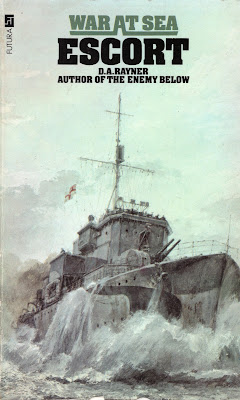
D.A.Rayner - Escort

I learnt about D.A.Rayner's autobiographical account of his experiences at sea in World War Two in Richard Woodman's history The Real Cruel Sea. I sought it out as Woodman indicated it was a authentic account of what it was like to take part in convoy escort duties. It certainly is that, but what Rayner's book does is to show how a young man in the Volunteer Reserve experienced the war itself - much bureaucracy, reposting, training and finding himself in circumstances not of his own choosing. 

Rayner also tells the chaotic story of the early part of the war, when there were few escort ships and plenty of targets for submarines. While much of his time is spent in the Western Approaches, he also finds himself in the Mediterranean and off the West African coast. There are numerous adventures and some close runs. Some of these are with his own side as Rayner is clear the type of commander willing to bend rules in order to ensure his crew have the necessities of life and to have fun. There are some slightly unbelievable accounts of parties, and other, more illuminating adventures such as when Rayner gives the nod and wink to his crew to purloin the mattresses being removed from first class cabins on an ocean linear being converted to a troop transport.

Initially commanding a trawler, then a corvette and then a group of corvettes, followed by a task force of destroyers, we see through Rayner the evolution of British convoy practice and the growing success. Its a tale well told, though Rayner, writing in the 1950s and though by now long since out of the navy, is careful to name drop and reference senior colleagues. 

But of most interest are perhaps Rayner's comments on command. He clearly was the sort of officer than crews liked. On one occasion he, together with his ship's captain, roll up their sleeves to shovel coal. The men who were crewing the ship were not navy ratings, but former fishing boat crews that expected this work to be done by shore based personnel. Rayner breaks their near-strike by leading from the front. While those who have read Nicholas Monsarrat's work might see several parallels with Captain George Ericson in The Cruel Sea, their command style is very different. Rayner is much closer to, friendlier and open with his men. 

Interestingly, despite saying towards the end that there are few women in the book because they didn't feature much, Rayner does mention women quite regularly. In fact he notes the way that the Wrens were often close to the ships, implying that many of them had multiple boyfriends on different ships that would arrive at different times, and that there were well established rules about who could see who. In this sense, and many others, this is far from many straight-laced naval biographies and gives quite a human account of the war. But certainly this is a book for enthusiasts, rather than those looking for historical work.

Related Reviews

Monsarrat - Three Corvettes
Monsarrat - The Cruel Sea
Woodman - The Real Cruel Sea: The Merchant Navy in the Battle of the Atlantic 1939-1943
Lund & Ludlam - PQ17: Convoy to Hell
Lund & Ludlam - The Fate of the Lady Emma
Lund & Ludlam – Trawlers Go to War

Wednesday, October 27, 2021

Saul David - Crucible of Hell

By chance, while reading the final part of Ian W. Toll's excellent trilogy on the Pacific War, Twilight of the Gods, I came across Saul David's latest book Crucible of Hell, which tells the story of the Battle for Okinawa. Okinawa was one of the bloodiest battles of World War Two, and because it is relatively less well known in Europe I was keen to find out more.

David tells the story from a multitude of viewpoints, relying heavily on eyewitness accounts of survivors on both sides. Given the focus on Okinawa there is, of course, far more detail than in Toll's book though the authors often use the same sources and on occasion the same quotes. David does well to get across the appalling cost of the war, and there is some more detail about specific events such as the death of General Buckner - the highest ranking US serviceman to lose their life in the war.

However the story felt superficial and David's treatment of the political and social context to the Japanese's stubborn refusal to surrender didn't do the subject justice. The final part of the book looks at the use of the atomic bombs on Hiroshima and Nagasaki, and here David is firmly in the camp of those who argue that Japan needed to experience these attacks in order to end the war without further US loss of life. David doesn't explore the more complex political dynamics taking place in the Japanese high command, which meant that surrender was much more likely than many believed.

While the book has much material of interest, it felt superficial and lacking in nuance. A big disappointment, particular reading immediately after Toll's work.

Related Reviews

David - Victoria's Wars
Toll - Twilight of the Gods: War in the Western Pacific, 1944-1945
Hornfischer - The Fleet at Flood Tide: America at Total War in the Pacific, 1944-1945

Tuesday, October 19, 2021

Ian W. Toll - Twilight of the Gods: War in the Western Pacific, 1944-1945

In the his author's note to this, the third volume of his trilogy on the Pacific War, Ian W. Toll apologies for the delay in delivering the book. He explains that "the war got very large in late 1944 and 1945, in every dimension" and he needed much extra time and space to complete the story. Those of us who have been waiting on Toll to finish the work should congratulate him for not rushing to an end. The result is an exceptional work of history about a complex, and very large, subject.

The great strength of all three of Toll's volumes is that they place the battle in the Pacific in a wider social, political and economic context. The first volume especially showed how the Japanese attack on Pearl Harbour came out of a combination of economic need, history and the nature of the Japanese regime. The second volume focusing as it does on the middle part of the war, following the US victory at Midway focuses to a much greater extent on the nature of that conflict. The start of the island hoping war, as the US gradually moved towards Japan, and the arguments among the US military leadership about the best way to prosecute the attack.

Volume three has a great deal of military history. At the heart of the book are the two enormous battles of Iwo Jima and Okinawa, as overwhelming US military superiority was brought to bear on well entrenched, committed and tactically astute Japanese forces. Toll is adept at describing these conflicts, alternating between a birds-eye overview of the battles, to reports from the ground. These two campaigns, perhaps some of the most bloody fighting of World War Two outside of the Eastern Front, are described without succumbing to glorification of either side, or warfare itself.

Despite Toll's fair coverage of the war on both sides, he does not avoid taking sides or pointing out mistakes. His account of the Battle of Leyte Gulf, the largest naval engagement in human history, makes it very clear that the US commander Admiral William Halsey made a series of tactical errors in the pursuit of his own personal agenda to lead a fleet in a crushing defeat of the enemy. It is hard not to read Toll's account without seeing Halsey as a glory seeker who should have been sacked, rather than celebrated. But, despite the space given to these important discussions, and the nail-biting account of the battle that took place which came close to being disastrous for the US, Toll never forgets the human cost. In typical style he sums up the experience for the reader by painting an emotional picture:

The seas around Leyte were littered with debris, the remnants of US and Japanese ships sunk in the great naval battle. Oil slicks polluted the beaches along Surigao Strait. Bodies, mostly Japanese, drifted with the tides and washed ashore. A Seventh Fleet officer noted that the entire area was choked with the 'odor of decaying flesh'. According to an American intelligence officer embedded with anti-Japanese guerrillas on Samar, much 'treasure' was found on the beaches in the days after the battle... Crates of rations floated ashore, containing crackers, cheese, jam, dehydrated potatoes, spam, cigarettes and coffee. Clothing and mattresses were salvaged by civilian Filipinos. A waterlogged paperback copy of Gone with the Wind was laid out... Drums of gasoline were carried away and stored... A headless body washed ashore, probably Japanese: it was cremated atop a pile of driftwood.

Here Toll gives us a sense of the mass economic superiority of the US forces that were able to defeat the Japanese and the human cost in individual lives.

But volume three is far more than military history, however personalised. The end of the war meant that questions of geo-politics became important once again. This obviously matters in two specific issues - the use of atomic bombs on Hiroshima and Nagasaki, and the post-war relations between Japan and the US. Even more interesting is that Toll is able to explain specifics of the end of the war, such as the use of suicide weapons and attacks by the Japanese, in the framework of his earlier discussions of Japanese society. Toll does not deploy any of the crude stereotypes (or racist language) that has been used by some historians to explain these attacks. But tries to show how they arose out of the ideology of the Japanese state - a highly hierarchical society whose population had been filled with racialised propaganda against Americans.

For instance Toll notes the differences between the airforce and navy when asked to launch suicide attacks. The somewhat strange behaviour of Japanese naval commanders at Leyte Gulf is thus explained by this difference:

The incubus of defeatism was spreading through their ranks. And how could it have been otherwise, when the ludicrously named 'Plan Victory' was itself a token of the regime's defeatism?

Not every soldier, sailor or commander was willing to commit suicide in desperate attacks to defend the homeland. Many were. But their decisions were the consequence of concrete circumstances. Toll's nuanced discussion of this puts many other historians to shame.

Toll doesn't fail to turn his eye on the US either. He describes the cynicism of troops towards official reporting of the war, and sometimes their cynicism towards much else - the groans and jeers that accompanied images of "Old Glory" unfurling on the movie screens. He notes the impact on the war boom at home, which "completed what the New Dealers had started - it lifted the fortunes of the poorest Americans, including blacks, Latinos and poor rural whites". Though Toll doesn't fail to record the racism and the inequality that also existed.

There are some omissions. I was surprised not to see mention of the Port Chicago explosion and mutiny by black servicemen, and I'd have liked to read more about the experience of black troops in the latter part of the campaign. 

Finally though it is worth acknowledging Toll's discussion of the use of the atomic bomb. His account certainly does not ignore the human impact of the use of the attacks on Hiroshima and Nagasaki (nor for that matter the US firebombing of civilian targets). He draws, like many historians, on John Hersey's moving account for powerful accounts of civilians in Hiroshima. Toll avoids taking a position on whether the bomb should have been dropped - though he makes if clear that the decisions behind its use were not simply about how many US troops might be saved, as crude defenders of the decision like to make. He points out how the weapon fitted into longer term US strategies for a post-war world and the start of the Cold War. Of more interest is the detail with which Toll explores the Japanese government's politics in the last weeks of the war. The vying between dove and hawk factions, the ineffectual leadership of the Emperor, and the pro-war coup that very nearly transformed the situation in the aftermath of peace. 

Ultimately though, this is the story of the most brutal of human conflicts. Toll places the combat, on land, in the air and on and under the sea, in the context of the economic, political and social forces that lead the Japanese and US government's into war. But he never forgets the human experience of that war, on both sides, in all its bloody detail. Ian W. Toll's book is a magnificent achievement and the whole trilogy comes highly recommended.

Related Reviews

Toll - The Conquering Tide: War in the Pacific Islands 1942-1944
Toll - Pacific Crucible: War at Sea in the Pacific 1941-1942
Turkel - The Good War
Leckie - Helmet for my Pillow
Hornfischer - The Fleet at Flood Tide: America at Total War in the Pacific, 1944-1945
Campbell - The Color of War

Sunday, August 08, 2021

Mathilde Wolff-Mönckeberg - On the Other Side: To my children from Germany 1940-1945

A few months ago I read Naomi Mitchison 's memoires of her wartime experience in Scotland, Among You Taking Notes. It was a fascinating combination of personal experience, political commentator and reportage. By chance I was lent a copy of On the Other Side by Mathilde Wolff-Mönckeberg. It was an opportunity to compare the experiences to very different women during World War Two, one in Germany (Hamburg) and the other in Britain.

Wolff-Mönckeberg's book consists of a series of letters she wrote to her children most of whom were uncontactable as they lived in Wales, South America, the USA and Denmark. The letters were never sent and Wolff-Mönckeberg stopped writing them when regular communications reopened in 1946. Instead they were stuffed in an envelope and not found until some years after her death. Translated and annotated by Ruth Evans, the daughter who lived in Wales, they form an occasionally fascinating but very personal memoire of life in Hamburg under the Hitler regime.

Wolff-Mönckeberg came from a privileged background. Her father was mayor of Hamburg, streets in the city are named after her relations and as a result of her two marriages she knew and worked with many important and wealthy figures in pre-war Germany. It would be fair to say that Wolff-Mönckeberg was very much an enlightenment German. Her letters are filled with quotes from Goethe's poems and books, and her second husband, and anglophile, teachers English literature through the war. Her first husband became a committed Nazi and neither she, nor the children had any contact with him. Wolff-Mönckeberg on the other hand hated the Hitler regime, and sympathised with its victims. Though she was in no way an active opponent. Interestingly one of her children became a leading Communist in South America, dying of illness during the War.

Unlike Michison's book, there is little here about politics. Perhaps Wolff-Mönckeberg was frightened of her writing being found by the authorities, though I suspect she wasn't particularly political. One gets a sense as we read of how stifling life was under the Nazis, and the fragments of news she gets are often inaccurate. Though its interesting how cynical her, and others, clearly were about news reports.

Instead much of the letters are accounts of the repeated, and overwhelming bombing raids, life in the shelters and the ongoing quest for food and resources. As the war lengthens, rationing gets worse, though I was surprised to see the freedom that Germans like Wolff-Mönckeberg did have to move around, leave the city and, most surprisingly to get the occasional letter from outside of German - often via neutral Switzerland. The reader also gets a sense of how horrific the British bombing raids on Hamburg were - they killed between 30,000 and 50,000 civilians and its hard to understand what military benefit they had. 

Through the war Wolff-Mönckeberg keeps herself going by dreaming and worrying about her children. She becomes obsessed by food, and reminisces about meals and celebrations of the past at Christmas time. Those of us who think of the big political and military aspects to the war are reminded that at the same time most people continued trying to live their lives - working, worrying about family and surviving.

The most interesting parts of the book in my opinion deal with the period after the war as British troops occupy Hamburg. Far from things improving, in reality things get worse as food is increasingly short and tensions rise with the occupiers. Wolff-Mönckeberg biggest concern - how her children are, is relieved as she starts to get letters via British troops. Also in this period she begins to learn about other events - the violence of the Eastern Front and the behaviour of the Russian troops. There are a few mentions of the victims of concentration camps, but beyond a few early sympathetic comments about the Jews in the first year of the war, there is nothing here from Wolff-Mönckeberg about her thoughts on the Holocaust etc.

An interesting book, I felt it was too focused on the personal. Of course Wolff-Mönckeberg was not writing for history, but for her own sanity and her children. Yet it is striking how little she mentions wider issues. Ruth Evans' introduction and epilogue frame the letters excellently and I was moved by the account of finally seeing her mother after seven long years. 

Related Reviews

Mitchison - Among You Taking Notes
Taylor - Dresden: Tuesday 13 February 1945
Moorhouse - Berlin at War
Hansen - Fire & Fury: The Allied Bombing of Germany 1942-1945
Kershaw - The End

Friday, July 30, 2021

Richard Woodman - The Real Cruel Sea: The Merchant Navy in the Battle of the Atlantic 1939-1943

Over 30,000 members of the Merchant Navy lost their lives during World War Two. Most of their names are inscribed on the Tower Hill memorial near the Tower of London. It's a beautiful memorial, near a smaller memorial to those Merchant sailors who died in the First World War. Both memorials are seldom visited, despite their location. 

The sacrifice of these sailors almost all of whom were men, is mostly forgotten. During the war, appalling conditions, the dangerous work and the low wages meant that crew often didn't go back to see. To counter this the British government produced a badge with the label MN to create a esprit de corps. Many men wore it upside-down, joking - or perhaps not joking - that the letters now stood for Not Wanted.

Richard Woodman's book is a detailed account of the primary battleground of Britain's Merchant Navy during World War Two - the Battle of the Atlantic. He mentions only in passing convoys to Russia and events in the Pacific and Indian oceans. It was in the Atlantic that most of those 30,000 sailors lost their lives and where their most important work was done. 

This is a massive book. Nearly 800 pages of small type, detailing in almost complete detail the events of the Battle. Open the book at random and there will almost certainly be a story of a ship that sank, a crew that abandoned ship or a heroic voyage in a lifeboat. The backdrop to this is a British Admiralty that, for most of the War, simply could not provide the escorts that were required to stop German U-Boats sinking ships. The Convoy system that was rapidly introduced after heavily initial loses went some way to saving ships. But there just wasn't the military protection that was needed - Britain was too short of destroyers and other escort vessels, and these had duties elsewhere.

As a result, the carnage dominates Woodman's history. The book opens with the loss of the passenger liner Athena. A ship sunk by a torpedo a few hours after war was declared. Over 1,400 people were on board, including 500 Jewish refugees. A model evacuation meant that the loss of life was relatively low - 117 passengers and crew. It was a propaganda disaster for Germany, and a success for the British, helping encourage a more anti-Nazi position in the US. Later ships would not be as lucky, and German submarines became adept in a total war against shipping. Some U-boat captains showed compassion to survivors, others committed war crimes, or demonstrated indifference.

In his desire to document so much, large parts of Woodman's book become almost lists of ships sunk, their cargos, and captains. But Woodman does manage to excite the material by focusing on specific tales. The best parts, and there aren't enough of them, are the oral histories of sailors. I also felt that more could have been made of the economic role of the ships. How was the war effort hampered by loss of material? Why was Britain exporting goods to the rest of the World at the time? What was being imported and why - who prioritised and decided what materials were needed. 

Woodman explains well the tactics of both sides. I was surprised to find that one great tactical mistake of the British military was to not deploy aircraft to the theatre in significant numbers. It's clear from later in the war that this made a significant improvement to the ability to combat submarines, yet the focus was always on bombing German civilian targets. A strategy that was, even at the time, known to be limited. Only one raid was made against German submarine bases, which seems incredible to me.

I was also shocked to learn that the US failed to learn the lessons. When the US entered the war, they did not take up the convoy system until hundreds of lives and ships had been lost. German submarine officers describe seeing ships silhouetted as easy targets against the backdrop of the brightly light US cities that were not blacked out.

Two other things stand out. For most of the first part of the war, British seamen were considered to have broken their articles, their contractual bond with the captain of the ship, when they were sunk. Thus survivors, who lost everything in the sinking and their dependents also lost any pay the moment they entered the lifeboats. It was an indignity and insult, and often the first their family knew was when the money stopped coming. The second thing is the multinational character of ships crews. Many of the men who died originated from British colonies and China. They lost their lives or fought for survival alongside their crewmates, fighting for a country that cared little for them, and even less for the Merchant Navy sailors. While there are occasional stories of resistance and mutiny by sailors, they are very much a handful of accounts. 

Its a neglected story, told in great detail by Richard Woodman's massive book. Sadly it finishes in 1943 when the U-boat threat was almost over. I would have liked more detail on events afterward - the troopships and return of troops after the war would have been fascinating. Had Woodman sacrificed some detail more justice could have been done to the wider story. Nonetheless for those who've read or watched The Cruel Sea, this is excellent background material.

Related Reviews

Monsarrat - Three Corvettes
Monsarrat - The Cruel Sea
Lund & Ludlam - PQ17: Convoy to Hell
Lund & Ludlam - The Fate of the Lady Emma

Wednesday, July 07, 2021

Paul Lund & Harry Ludlam - The Fate of the Lady Emma

Authors Paul Lund and Harry Ludlam are best known for their oral history works about the British Navy in World War Two. Lund served on a converted trawler during the war, and was on the infamous convoy PQ17 to the Soviet Union. The authors' account of that disaster was told, through the recollections of many participants in their excellent book PQ17 Convoy to Hell. 

Lund and Ludlam also told the history of the Royal Navy Patrol Service in their book Trawlers Go to War, which detailed the sterling work of converted fishing craft from Dunkirk to D-Day. The oral testimony in these books, plus personal experience however is put to a slightly different use in The Fate of the Lady Emma. 

Lady Emma is a work of fiction, but is clearly heavily influenced by Lund's experiences on HMS Lord Austin. The novel follows tells the experiences of a fresh recruit to the Patrol Service Peter Price as he finds his sea legs on the Lady Emma. We're introduced to a mixed crew, and Price goes through the formative experiences of being mocked and gently ribbed until he finds his niche. He learns the ropes, begins to understand the various factions and personal loyalties and hides the fact he's trying to get commissioned from his crew mates. All this is fairly standard fair for a WW2 naval novel from the 1970s.

What stands the book above others in a crowded genre is how it is clearly based on real experiences. The nerves, the stress and the sea-sickness, the detailed descriptions of the dirty jobs. These read, not as a dull series of recollections, but as part of Prices' journey to a fully fledged sailor. I also enjoyed Price's wonder at the places he visits. Take this description of a brief stop at Akureyri in Iceland:

By evening they were steaming up a placid fjord. The weather had made one of its lightning changes and the sun was shining, the air still and the atmosphere crustal clear. It was nearly 8pm when they approached a small island on which there appeared to be a collection of military huts... the 'hut's' were the houses of the most picturesque village anyone had ever see. Nestling beneath a background of towering white-clad hills, the houses were painted all the colours of the rainbow. In the centre, standing alone in its quaint beauty, was a miniature church, looking straight out of Grimm's fairy tales.... The crew stood at the ship's rail and gazed spellbound on the loveliness of this unexpected jewel shining among the rugged desolation.

I'm told that Akureyri remains as beautiful.

It is only in the second half of the novel that the "action" starts. The convoy is scattered in fog, they encounter enemy aircraft and a submarine, and rescue a shipwrecked sailor. But the point of the novel is not the action - again unusual for the genre, but rather the authors are telling the story of a voyage and the sailors' experience. For that reason the book sits comfortably alongside their non-fiction. Readers interested in World War Two, the Arctic convoys and the Naval war will enjoy this novel. But it is much more than another navy tale. It is also a moving account of the individual in a larger conflict, and the ending is remarkably touching.

Related Reviews

Lund & Ludlam - PQ17: Convoy to Hell
Lund and Harry Ludlam – Trawlers Go to War
Monsarrat - Three Corvettes
Monsarrat - The Cruel Sea

Sunday, June 06, 2021

John Hersey - Hiroshima

When two atomic bombs were dropped on the Japanese cities of Hiroshima and Nagasaki in August 1945, few people had any clue about what they were. In the aftermath, newspapers were full of the scientific achievement - the new atomic age that had been opened up. There was little or no space for what happened to the people living in the cities themselves. In May 1946, The New Yorker magazine sent journalist and author John Hersey to Hiroshima to report on what happened. His 30,000 word article, simply titled Hiroshima, was published as the sole story in the August 1946 edition, a year after the bomb dropped.

It was an instant success. The story was syndicated globally, as millions of people wanted to read this honest, moving and shocking story of the horror of the atom bomb. In the UK, were paper rationing meant that newspapers couldn't reprint the story, a quick Penguin edition was produced in 250,000 copies. Readers devoured it.

Today, we know much more about atom bombs. Nearly 80 years later, with the threat of global nuclear war hanging over several generations heads since 1945, we are much more used to the idea of what this new technology could do. But then the reality was shocking to the public. Hersey tells the story through a handful of main characters, explaining what each of them in turn did on the day. How they were thrown across the room, or broken bones and in the initial blast. How in shock they tried to find friends, family, children, colleagues. The main characters interact with a wider group of people, whose stories of lost children, wounded soldiers, vomiting refugees and the complete break down of authority are terrifying in their authenticity.

Hersey carefully chose who formed the basis for this account. Five are Japanese, a hospital doctor, an office worker, a Protestant clergyman and a older woman. Another was a German Catholic missionary. Their different accounts are at times upsetting, and shocking. What I was struck by was how people quickly organised - the Dr Sasaki set up emergency medical aid in his hospital, though he was utterly overwhelmed by the thousands who came for help; the man who ferried people back and forth across a river or fetched water for hundreds of thirsty wounded. At the same time there are individual moments that help clarify the horror - the doctor loses his glasses, the clergyman bumps into his wife and child by accident. 

Hersey shows through these stories the utter overwhelming nature of atomic war. A city is flattened almost instantaneously. The inhabitants how now way to understand what has happened. There are no supplies and promised help from the authorities fails to materialise for days. At the same time, after the initial shock, people organise to help and support each other, though the reality of radiation sickness doesn't become clear for months - it took half a year before the Red Cross hospital was "back to normal". Before it was fully functioning, the directors "put up a new yellow brick veneer façade" to ensure that it looked the part. 

I wonderedwhether the book's impact went much further than just explaining the reality of the bomb. The Japanese had been demonised in the most racist way since Pearl Harbour. But in Hiroshima the Japanese are ordinary men and women, exactly like ordinary Americans. The reading public might have found their ideas challenged in ways that were far greater than simply fearing they might be victims of atomic war.

When I finished Hiroshima I hoped a new generation would read it, and our anti-war and peace movements grow in strength once again. But I also agreed with Dr Sasaki, who said afterwards "I see they are holding a trial for war criminals in Tokyo... I think they ought to try the men who decided to use the bomb and they should hang them all."

Related Reviews

Hansen - Fire & Fury: The Allied Bombing of Germany 1942-1945
Taylor - Dresden
Toll - Pacific Crucible: War at Sea in the Pacific 1941-1942
Toll - The Conquering Tide: War in the Pacific Islands 1942-1944
Hornfischer - The Fleet at Flood Tide: America at Total War in the Pacific, 1944-1945
Lochbaum, Lyman, Stranahan & UCS - Fukushima: The Story of a Nuclear Disaster


Tuesday, April 13, 2021

Naomi Mitchison - Among You Taking Notes

Naomi Mitchison, author, poet, feminist and socialist political activist and farmer led an extraordinary life. I knew of her first through her incredible feminist science-fiction novel Memoirs of a Spacewoman and so I was very pleased to discover, tucked away in a second hand bookshop, this edition of her wartime diaries. Mitchison was part of Mass Observation, a wartime project by the British government to keep the diaries of people from every walk of life. These are a mine of information about everyday life during the war, but Mitchison's are far more more than just recordings of her activity.

They contain musings on life and love, accounts of people she knows and records of wider events. I was initially disappointed that she did not include much about events during the war, but as I read on I discovered that what was more interesting was her accounts of the reactions by herself and others to events. One thing that may well surprise people today is how unpopular Churchill was. Mitchison was a Labour Party activist and had no love at all for the Tories, but she records a general feeling of dislike for Churchill - that he wasn't doing enough, that he'd been lucky and that he didn't care for ordinary people. His speeches are less warmly received than might be expected and there is a general sense of him failing to organise the war properly.

Being of the left Mitchison has great hopes that the war will bring a better society. She suspects that it will come because the Soviet Union will dominate the post-war world. She, and most of the others in her Labour circles dislike the United States, and have a grudging admiration for Russia. Mitchison had travelled there before the war, and was certainly no apologist for what she saw there. But she disliked it far less than the brash, open capitalism of the USA. 

Living as she does on the West Coast of Scotland Mitchison is not as isolated from the war as might be expected. Visitors to her home include former POWs and Free French troops, local towns and harbours are bombed and she visits Glasgow and London in the aftermath of raids. Regular trips to London keep her in touch with events there, and several people she knows are killed. This isn't really a wartime diary about ration books and blackouts - though these subjects are there. What it is really about is the wartime experience - how the conflict drags on and people feel depressed, anxious and ill all the time. How people are worried about friends and food. How people try to make the best of things like Christmas, but it all seems a little bit like a charade. As I read it I found more than a few parallels with my life under Covid lockdown!

Mitchison's politics are also fascinating in the context of the time. She regularly argues with friends and people she meets about issues, including the question of women, house-work and employment. These arguments take on a wider importance during the war, as women's roles are transformed. But Mitchison's own personal ideas are fascinating too. I understand that later in life she and her beloved husband Dick Mitchison had an open relationship, but it is clear from the book (explicitly and implicitly) that she has several sexual relationships during the war.

Reading about these, her thoughts on politics and the war, her commentary on the government, Russia and the USA and much else I was struck by how honest a diarist she was. That she confided such innermost feelings to a public diary that was posted regularly to London is fascinating in itself.

The full diary runs to over a million words and I would have happily read every entry. I also wonder what has been excluded. For instance while Mitchison makes the occasional references to workers' strikes, I'd have liked more on class struggle in wartime. Was she aware of protests in London against the rich or in favour of better bomb shelters? She had many CP friends and protested the suppression of their press, so she would likely have known about such events.

I always feel that a sign of a great biography, memoir or journal is that when you finish reading it you feel like you've taken part in a life. While Among You Taking Notes is not a complete biography, it has an epic feel to it - partly because of the period covered by the account. I am now inspired to read Mitchison's novel The Bull Calves, which she wrote through the war.

This is a book for people wanting to understand life under wartime, but it's also a great introduction to the life of one of Scotland's most important literary figures.

Related Reviews

Mitchison - Memoirs of a Spacewoman

Sunday, July 26, 2020

Mark Roseman - The Villa, The Lake, The Meeting: Wannsee and the Final Solution

When I was young we had several trips to Berlin to visit family. There we would always look forward to visiting the Wannsee resort, playing on the artificial beach and exploring the woods. Many years later I was horrified to learn that Wannsee was synonymous with the Holocaust.

On the 20 of January 1942 senior figures in the Nazi bureaucracy assembled at a villa in Wannsee. The subject of the conference was the "Final Solution" of the "Jewish Question". The conference itself was relatively small, with 15 delegates representing different sections of the government. Convened by Reinhard Heydrich who reported to Himmler, the conference had the stamp of authority from the highest levels in the Nazi government though, ironically, author Mark Roseman argues we don't clearly know why it was called.

Wannsee would have remained forgotten had it not been that a single copy of the thirty minutes printed after the event would turn up in the post-war investigations into Nazi crimes. These minutes (known as Protocols in German) summarised the event and its conclusions. Some investigators hoped this would be the smoking gun that showed the Nazi machine deciding to embark up on programme of mass murder. But as Roseman explains, that programme had already begun. Instead, the event appears to have been an occasion to discuss the problems that arose from the planned destruction of the Jews in terms of resources, but also - chillingly - to thrash out who in the bureaucracy had ultimate responsibility. It also, as Roseman concludes, was a place where the high-command was informing lower levels of existing decisions:
The Wannsee conference is thus a king of keyhole, through which we can glimpse the emerging Final Solution. It took place at a time when the idea of a reservation had been abandoned, labour scarcities were pressing and when the Nazis may or may not have decided exactly how to eliminate all the Jews. But it is evident that Wannsee is not the place at which the murder decisions themselves es were taken. For the most part, Heydrich was disseminating conclusions drawn elsewhere. On some issues the participants had something to say; for the most part their role was to listen and to nod.
The Wannsee Protocols are published in the book's appendix, though they are easy to find online. It is a awful document to read - their structure is similar to the minutes produced from normal conferences and meetings, but their subject is mass murder. Roseman points out that the language is made up of euphemisms that disguise the real subjects - talk of Jewish "reservations" and "emigration" when the Nazis had already ruled out these strategies. Roseman writes:
The euphemisms were its normal mode of communicating about murder, and will have served here to remind recipients of the language codes they should use. At the same time it was so vital to establish the participants' shared knowledge in the killing programme that this overrode the need for caution. This is why Lammers, Stuckart and others were at such pains after the war to deny having seen the Protocol, to escape from the trap that Heydrich had set them.
But reading the Wannsee Protocol myself I was stunned by how open the language is. It is impossible to read these sentences without seeing a group of men around a conference table discussing mass murder.
Jews fit to work will work their way eastwards constructing roads. Doubtless the large majority will be eliminated by natural causes. Any final remnant that survives will doubtless consist of the most resistant elements. They will have to be dealt with appropriately.
The men having these discussions, and enjoying a brandy afterwards, were just bureaucrats. These were "educated" men, most of whom had doctorates. But almost all of whom had long years in Nazi organisations. These were dedicated fascists, who had spent years advocating the destruction of Jewish people and other undesirables. In addition, Roseman points out that "what is striking is how many people round the table had given direct killing orders or themselves had experience of killing". As a result, "no one arrived at Wannsee with even the faintest intention of speaking up for the Jews".

As mentioned Wannsee was not the moment the Holocaust was agreed. The Holocaust was a process that evolved over time, having its origins in the Nazi genocidal ideology, with its specifics arising from the realities of total war on the Eastern Front, the horrors of Nazi treatment of Jews and the violence of the fascist state. But the Wannsee conference, in Roseman's words, "cleared the way for genocide" by pulling in the fascist bureaucracy behind the plans. Mark Roseman's short book is an important insight into how, once Nazis take power, the machinery exists to turn genocidal fantasy into reality.

Related Reviews

Browning - The Origins of the Final Solution
Kershaw - Hitler, 1936-1945: Hubris
Kershaw - Hitler, 1936-1945: Nemesis
Lipstadt - Denying the Holocaust
Lipstadt - The Eichmann Trail
Evans - Telling Lies About Hitler
Black - IBM and the Holocaust