Christian Wolmar is an unashamed railway enthusiast. He's a partisan of the idea that railways should be an absolutely central part of a cleaner, more efficient, better future. And in an era of increasing oil prices, climate change and congestion blighting our cities, who can blame him.
This recent book is an attempt at a social history of the railways. Because it covers some of the ground that his earlier works have, it is patchy in places. For instance he glosses over the early years of the British railroads, while dwelling on the influence that Britain had, through its colonial interests, in the growth of railway systems on every continent. Wolmar says this is not a book for "rivet counters", but a book aimed at the general reader who has an interest in world history, transport and wider social development. Does it work?
There is no doubt that Wolmar crams a lot in. The sheer scale of his story means that much of it passes in the form of anecdotes that leave the reader wanting more. Why did the first Italian railway offer discounts to ladies who didn't wear hats, for instance? On a grander scale Wolmar praises the role of the railways in developing industry and a more modern economy. They were the "most important invention of the second millennium" he argues, that brought the
"Industrial Revolution from a few hot spots to large parts of the world. They were a democratizing force too, allowing people to travel in an unprecedented way, opening up their eyes to the world... relieved many of tedious and hard labour, and spread economic development everywhere."
Taken on its own, this would seem a naive view. But Wolmar is a good enough historian to understand that there are also negatives. The railways contributed to "environmental degradation" (though arguably less than the motor vehicle ever has) and were used to "put down rebellions and wage war" as well as helping make the Holocaust possible.
The problem for me though, is the importance of the railways to human history, cannot be reduced to a simple balance sheet of pros and cons. One has to understand them within the context of wider social systems. In particular, the need for capitalism to make profits and the existence of class divisions in society. Wolmar gets some of this, telling the reader sad stories of class divisions of Indian railways at the time of the British Empire for instance. But this is not enough.
Railways played a particular role in the early development of industrial capitalism, precisely because they allowed a small number of people to move enormous quantities of materials and consequently make bigger profits. Wolmar shows how this was usually only possible with massive state subsidies. Once the railways existed, they had further impacts - transforming the diets of the urban masses, or changing crops that were grown. Notably many railways were set up to move freight, but quickly found people were more profitable. Wolmar's book highlights these questions, but fails in my opinion to integrate them into a more general narrative. Consequently his book reads more as a succession of interesting stories, rather than a more detailed analysis of the role of railways in the development of modern society. Occasionally this drifts close to the realm of the "rivet counter", listing gauges and track speeds so on occasion my eyes glazed over.
There are some striking omissions. Some serious work has analysed the role of the railways during the famines that struck India in the 19th century. Mike Davis' extraordinary book, Late Victorian Holocausts shows how these were the consequences of the priorities of British capitalism. He also argues that railways, while designed to feed the hungry through free market principles, actually had the opposite effect. Sadly this is missing from Wolmar's book. I also feel that the role of the railways in the Holocaust deserved more than a paragraph.
Ultimately these criticisms centre on the nature of social history. In order to write such a history, the historian must integrate their subject with wider historical change, not simply list anecdotes. A social history of the railways that mentions the Russian Revolution means doing more than mentioning Lenin taking a sealed train through Germany. What of the growth of the rail unions? The workers councils on the railways? Trotsky's train from which he led the Red Army? The role of rail workers in mass strikes?
That said while Wolmar mentions on a number of occasions (far more than many other writers might) the role of workers in building the railways and keeping them running, he occasionally mentions their strikes too. But I think he underplays the significant role that the railways have played in working class struggle precisely because they are a central feature of industrial capitalism and bring together large numbers of organised workers. The railways helped keep all sides fighting in World War One. But they also spread the Russian and German revolutions around those countries. The strikes of railway workers from South America to Asia have often provided a catalyst to wider social struggles - consider the novel Gods Bits of Wood for inspiration here.
Wolmar's books are always interesting, and he is on the right side of the struggle for better, more environmentally friendly public transport. But sadly this book bites off far more than it can chew and feels inadequate.
Related Reviews
Wolmar - Fire and Steam: How the Railways Transformed Britain
Wolmar - The Subterranean Railway
Saturday, November 09, 2013
Saturday, November 02, 2013
Marcus Rediker - The Amistad Rebellion: An Atlantic Odyssey of Slavery & Freedom
It is the fascinating story of how one group of slaves rose up, killed their captors and attempted to make it back to their homes in Africa. The story of the Amistad uprising is fairly well known. But there must have been countless other attempts at rebellion, few of which were successful. So the story that Rediker tells is important because it allows us to learn from the slaves in their own words, but also understand the attitudes towards them. In particular the growing abolitionist movement in North America.
During their rebellion, the slaves didn't indiscriminately kill their former captors. They killed those who had brutalised them, taunted and tortured them. The other traders feared for their lives, but were treated with surprising humanity:
The rebels... locked Ruiz and Montes in irons, many unused sets of which they suddenly had a their disposal. When the slaveholders complained of their chains, Cinque howled in righteous fury: "You say irons good enough for nigger slave; and if they good enough for slave, they are good enough for Spaniards, too." Ruiz and Montes were likewise allowed little to drink, likely the same half teacupful of water twice a day that not long ago had been the portion of the Africans. Again they complained of their treatment and again Cinque pointed out the contradictions: "You say water enough for nigger slave; so water enough for Spaniards." The object lesson continued for two days, in order to give Ruiz and Montes "a taste of their own cruelty toward the slaves,"... thereafter the chains were removed and they were given food and water in same proportions as everyone else.
The Amistad eventually arrived in North America, where a long period of imprisonment and trial began for the Africans. The trial raised all sorts of questions - of property, slavery and freedoms. The struggle of the Africans now meshed with that of the Abolitionist movement who saw an opportunity to strengthen the struggle against slavery. Firstly that meant finding those who could speak to the Africans in their own language. This meant trawling the docks to find freed Africans who could interpret. But the abolitionists who built the campaign to free the slaves, also tought them English and religion in their prison cells. Tantalising, Rediker while quoting the slaves' letters and discussions, suggests that their liberal quoting from the Bible may have been more a tactical maneuver on their part than any real conversion: "All that can be said with certainty is that the Amistad Africans understood the importance of Christianity within the worldview of the abolitionists and acted to accommodate it, within the larger context of their main objective: to go home."
Rediker also traces the cultural and social impact of the struggle to free the Amistad Africans. Poetry, plays, pamphlets and paintings were produced in great numbers. Many of these artworks were designed to progress the struggle, and after they were freed by the US courts the Africans toured the United States to raise money for their trip home. But this art often caused a dilemma for the abolitionist movement. The high point of the struggle was the uprising against the Amistad's crew - a bloody violent moment. Yet the abolitionists were describing the Africans as "hapless victims... cast upon our shores". The narrative didn't fit the abolitionist views, who hated slavery, but still saw African people as victims, unable to struggle for themselves.
Rediker points out that the "movement in support of the Amistad Africans and the abolitionist movement were never identical". Indeed, the movement to support the struggle, and the return home raised money from many different sources. Most frequently tiny donations from ordinary working people. It is notable that the Africans visited factories and workplaces to raise money, as well as theatres and churches. The desire for freedom expressed by the uprising by the slaves, clearly chimed with large sections of the American population.
Ultimately many of the Amistad Africans made it back. Some had died during the passage across the Atlantic. Some had been sold into slavery in Cuba, others died in the rebellion or in jail in the United States. Those that made it home did so because they were prepared to risk their lives for their own freedom and that of their comrades. Their successful struggle inspired many and Rediker finishes the tale of another slave, Madison Washington, who had escaped to Canada but returned to the South to try and rescue his wife.
Captured and sold back into slavery he remembered seeing a painting of Cinque, the leader of the Amistad Africans, who had lead the revolt. Together with 18 others Washinton led his own uprising on a domestic slave ship and forced it to slave to the Bahamas were slavery had been abolished.
There "they met black boatmen and soldiers, who sympathized with the emancipation from below and took charge of the Creole, supporting the rebels and ensuring their victory." So Washington and his comrades too escaped. Thus the struggle of the Amistad rebels inspired others to fight for their freedom, but it also helped shape and generate the anti-slavery movement still further. And this book is a fitting tribute to those rebels, putting them back in their place as people who shaped their own destiny, not simply helpless figures in the abolitionist campaign.
Related Reviews
Rediker - Villains of all Nations: Atlantic Pirates in the Golden Age
Rediker - Between the Devil and the Deep Blue Sea
Rediker - The Slave Ship
Rediker & Linebaugh - The Many Headed Hydra
Tuesday, October 29, 2013
Joseph J. Varga - Hell's Kitchen & the Battle for Urban Space
In the period this book considered, Hell's Kitchen, or "Manhattan's Middle West Side" was considered by many commentators to be an area of poverty, corruption, crime and unsavoury types. In reality of course it was a home to thousands of working class people who carved their own lives out of the limited opportunities that they had. Writing in 1912, a social worker sums this up;"[Hell's Kitchen] has been known for many years as the scene of disorders, of disregard of property rights and public peace. Certain it is that in the minds of New Yorkers who live outside the district... as well as in the minds of the police... there still lingers a tendency and doubtless a liking to think and speak of the district by the name that disorders, rioting and crime won for it."
Subtitled, Class Struggle and Progressive Reform in New York City, 1894-1914, Joseph J. Varga's new book is a detailed examination of the development of this district in New York, but more importantly, an attempt to understand, using the concept of the "production of space" how that urban space was shaped and, in turn, shaped those who inhabited it.
Varga notes that one "useful approach" is to consider the different vision of land use envisaged by those who live and work in a space and those who wish to exploit it for profit, or "between those 'planning and organizing themselves to make money' though the increase of aggregate rent levels, and those striving for 'affection, community, and sheer physical survival'."
In this, perhaps its simplest form, the books' discussion on the production of space in Hell's Kitchen could be an extreme metaphor for all those urban areas being "developed" and reshaped to produce accommodation for those with money, while the mass of residents are pushed to the fringes of urban areas. However Varga takes this further. In Hell's Kitchen, the production of space
"meant different things to different people. Accounts gathered from residents show how categories such as ethnicity, class, race and gender could bring one to a sense of space, but also fragment those same categories."
So there were numerous factors shaping the space of Hell's Kitchen, and in turn shaping the population. Some of these factors were imposed on the population by changes that had taken place many years previously. For instance steam engines ran to and from the docks on the roads through Hell's Kitchen. Included in the book is a fascinating picture of a steam train running through the middle of a main road while children play on the pavements. This juxtaposition of different spaces helped to earn some of the roads nicknames such as "Abattoir Place" or "Avenue of Death". Local campaigns to change meant battling the powerful dock and railway companies and took decades, and many deaths, to win change. (As an aside it's interesting that William Cronon's excellent history of Chicago mentions similar issues.)
The docks themselves, like all workplaces, were also centres of battles for space. Several excellent chapters look at the working lives of residents, the women working in linen and textile industries, the men on the docks. These tell stories of the battle for dignity, decent wages and improved conditions, as well as standing within the wider community. One quote describing life for casual dockworkers rings earily true as tens of thousands of contemporary British workers are living on "Zero Hours Contracts".
"Daily employment for dock workers was determined by the 'shape-up' in which experienced workers gather to be called to work... based on the arrival of a laden ship... As the telegraph message announcing the imminent arrival of a ship is received, a flag of arrival is raised on the pier, and word spreads among potential workers that 'the flag is up; and a crew needed... the call to shape up beings men together in the open space in front of the pier... The men jostle for position, joke and occasionally scuffle, and await the decision on who will be called to the crew. Stevedore foremen call men based on experience, reputation or on recommendation. In certain circumstances workers pay kickbacks to hiring agents who guarantee them a working day."
Varga looks at one narrow area of a city. But he recognises that what takes place in that space cannot remain isolated from external factors - government policy for instance, or the decisions of the Rockefeller institute. He concludes that "the production of urban space, though often unduly influenced by powerful spatial coalitions, is the product of a variety of factors that often exceed the ability to control it, and is affected by numerous overlapping networks of forces that do not socially construct "reality" but produce sites for often incommensurable actions".
In other words, in a quote from Marx that Vargas is fond of paraphrasing, "Men make history, but not in circumstances of their own choosing". That said, space itself, Varga points out, has a history, that may be independent of human interaction. Wooden piers rot, land changes, rivers alter their courses. The interaction between these internal and external elements is key to understanding how urban areas, indeed human ecology, alters over time and space.
Hell's Kitchen is not an easy read. At times the language is extremely academic and references abound to other academic studies and books that the casual reader is unlikely to have encountered. Those looking for an introduction to the social history of New York, or Hell's Kitchen itself, will have to start elsewhere. Those trying to get to grips with the application of spatial theories to urban areas through the use of historical evidence will find much of interest here.
Related Reviews
Harvey - Rebel Cities
Cronon - Nature's Metropolis
Smith - Uneven Development; Nature, Capital and the Production of Space
Monday, October 28, 2013
Terry Pratchett - The Wee Free Men
Pratchett is one of those authors who does strong female characters very well. Tiffany and her iron saucepan join Susan and her poker as a threat to demons and monsters. Tiffany is just nine, and gifted with the "sight" (and second, third and fourth sights). Spotted by a witch finder (scouting for those who have magical abilities, rather than to burn them) Tiffany must undertake a trip into the magical lands to rescue her brother.
Added into the mix are the Nac Mac Feegles a clan of tiny blue pictsies whose violence is only matched by their appetite. Tiffany gradually learns that the clan have been keeping their eye on her, and on many aspects of the wider sheep ecology. The Nac Mac Feegles adopt Tiffany as their own, temporary leader, and assist her mission with customary violence and humour. This is tight, well written and funny Terry Pratchett novel, my only criticsim is that Tiffany Aching seems old beyond her nine years. Nonetheless this is a must read Discworld story, probably not the best one to start with, but certainly one to read sooner rather than later.
Related Reading
Pratchett - Wintersmith
Thursday, October 24, 2013
Tony Cliff - Trotsky 1927-1940: The Darker the Night the Brighter the Star
The last thirteen years of Leon Trotsky's life, documented in this fourth volume of Tony Cliff's biography, are among some of the hardest of the Russian revolutionary's life. The book starts with Trotsky in internal exile, having been defeated by Stalin's faction. It ends with his murder in near political isolation. Having led millions of revolutionary workers, created and then led the Red Army to defeat the hostile imperialist powers in the Civil War, by the end of his life Trotsky finds himself isolated, with a few hundred followers in the newly formed Fourth International.There is little in this book that deals with Trotsky's actual life. Cliff does document how Trotsky's family suffered. Children and grandchildren, even those with no interest in politics, are imprisoned, murdered and denied medical treatment by Stalin. In a brief passage dealing with Trotsky's personal feelings, Cliff quotes the anguished statement made by Trotsky and his wife after their son is murdered by Stalin's thugs.
But the vast majority of this book deals with the political activities and writings of Trotsky. Trotsky was a lifelong revolutionary, a committed Marxist. To attempt to write a biography of him that dealt with this period and didn't concentrate on his political activity would be impossible. In fact, in March 1935 Trotsky himself wrote:
"I think that the work in which I am engaged now, despite its extremely insufficient and fragmentary nature, is the most important work of my life - more important than 1917, more important than the period of the Civil War or any other."
What was this work? Much of it involved writing. Trotsky was prolific, producing pamphlet after article, followed by books and an endless stream of letters to his friends and comrades. Cliff argues that some of Trotsky's writings during this period are some of the finest Marxist writings ever produced. From Trotsky's extraordinary work The History of the Russian Revolution which details the transformation of the Russian economy, the growth of the revolutionary movement and the day-to-day struggles of the Bolsheviks during 1917, to his extraordinary analytically clear writings on Germany, Spain and France in the 1930s.
The chapters on France, Germany and Spain in Cliff's book are worthy of particular mention. In order to comprehend the brilliance of Trotsky's analysis, Cliff gives us a detailed overview of the situation in these three crucial countries during the 1930s. In particular Cliff details the rise of Fascism and the struggles to stop it. Trotsky's writings on Germany are among the most useful today. He argued that a United Front between the two mass left wing parties, the Communists and the Social Democrats could provide a strong enough movement to defeat Hitler's Nazis. But he also saw this method as winning masses of workers to revolutionary politics. Unfortunately, as Cliff argues, Trotsky had no forces to put this strategy into effect. The German Communists dutifully followed the Moscow line - Social Democrats were no better than the Fascists and the Communists had to resist both. The left, divided was defeated.
Cliff concludes:
"Neither the Communist Party nor the Social Democratic Party paid any heed. If Trotsky’s analysis and proposals for action had been accepted, the subsequent history of the century would have been completely different. Trotsky’s analysis of German events was particularly impressive in view of the fact that the author was removed from the scene of the events by a considerable distance. Still he managed to follow the day-to-day twists and turns. Reading Trotsky’s writings of the years 1930-33, their concreteness gives the clear impression that the author must have been living in Germany, not far away on the island of Prinkipo in Turkey."
But Trotsky wasn't always right. Tony Cliff argues that Trotsky's analysis of the degeneration of the Russian Revolution, particularly as outlined in his book The Revolution Betrayed, remains the starting point for any Marxist analysis of Stalin's Russia. But Cliff argues that Trotsky failed to understand that the bureaucracy that had arisen was a new class, with a new set of collective interests. Instead of simply being a managerial force in society, they were directing and shaping Russian society in their interests. This analysis of Russia as a degenerated workers' state was further weakened when the Red Army invaded Eastern Europe. These socialist societies were claimed, by some of Trotsky's followers after his death, as degenerated workers' states yet their had been no workers revolution to create them.
Cliff, briefly outlines his own explanation for Soviet society post 1920s, as State Capitalist. This is not, Cliff is quick to point out, to denigrate Trotsky's work, but to build on it. Cliff also critically discusses the Fourth International, the international grouping that Trotsky set up. Cliff had been a member of this, but here he tries to explain why the International didn't take off. Cliff asks if Trotsky had a choice whether he should setup the Fourth International. He rejects the approach of those who thought Trotsky could have entered a "watchtower" simply commenting on events. Instead he insists that
"if in these impossible circumstances Trotsky made some mistakes in the way the Fourth International was built – its over-ambitious structure, mistaken perspectives, including the semi-messianic spirit affecting it, let that be. Without trying to build a revolutionary party Trotsky would not have written his brilliant articles and essays at the time, analysing the situation and putting forward the strategy and tactics necessary for working class advance. Without the effort of building the revolutionary international, Trotsky’s contribution to Marxism, which kept it alive and preserved it from ossification, would not have been achieved."
But Cliff concludes that:
"struggling to build the Fourth International, which Trotsky did from 1933 onwards, was not the same as formally declaring its existence, which he did in 1938. The former was absolutely necessary, whilst the latter was almost certainly a mistake."
Volume four of this brilliant biography ends then at a difficult moment. Trotsky's death leaves a tiny number of isolated and weak revolutionary organisations dedicated to keeping the flame of Bolshevism alive. The Second World War and the Holocaust confirm the barbarity of capitalism and the continuing need for socialist revolution. Yet the revolutionary organisations that can led that struggle seem weaker than ever. Yet the great achievement of Trotsky, when many of his contemporaries gave up in the face of Stalin or were murdered on his orders, was to keep that flame alive. The last few chapters of this biography are particularly sharp, in part because they document Tony Cliffs own initial work developing Trotsky's ideas. That today we have, in however small a way, revolutionary organisations in many different countries is in large part because of the work of Leon Trotsky and those he inspired.
Related Reviews
Cliff - Trotsky 1: Towards October
Cliff - Trotsky 2: Sword of the Revolution
Cliff - Trotsky 3: Fighting the Rising Stalinist Bureaucracy
Monday, October 21, 2013
Chanie Rosenberg - Fighting Fit: A Memoir
Many members of the British Socialist Worker's Party and its sister organisations will be familiar with Chanie Rosenberg. She is one of the group's longest standing members, who helped, alongside her husband Tony Cliff, found the International Socialist tradition. In this short memoir, Chanie says that she hopes "to show that we revolutionaries are people like anyone else.. what happens between the evening meeting and the weekend paper sale?"It is an excellent reason for writing such a book, but Chanie's life has been far from normal. She grew up in a Jewish family in racist South Africa, moved to Palestine to live on a socialist kibbutz in the 1940s but found her eyes opened to the racist nature of that state, and then began to engage in illegal, underground work agitating as part of a small Trotskyist organisation. Chanie and Tony Cliff lived in extreme poverty during these years. Moving to England things improved as Chanie was able to work as a teacher, and in doing so became central to some of the major struggles in the 1960s as teachers began to organise. Chanie played a central role in the rank and file of the teachers' union, and was blacklisted for her activity. Nonetheless she clearly, and rightly, remains proud of the victories they won.
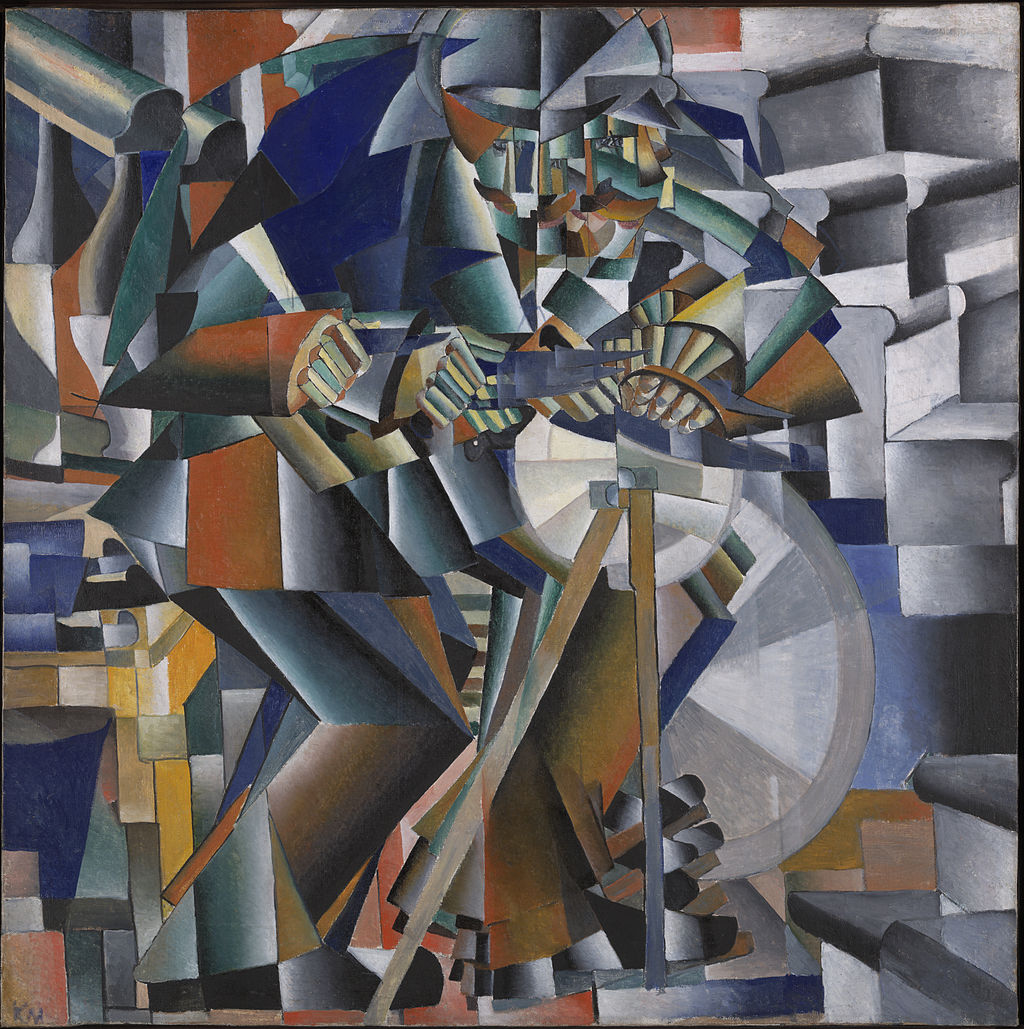
Chanie's second great love is art. When she retired she took up sculpture, and has exhibited in the Royal Academy ("I wish the 'Royal' but could be removed, but that might need to wait for the revolution" she says). But her interest in art and culture is also reflected in her writings and articles. Included in this short volume is an illustrated reprint of Chanie's pamphlet on the Russia artist Kazimir Malevich and his life and times.
Malevich and Revolution examines the evolution of the artists work, and vividly brings home the provocative, challenging nature of these "avant-garde" artists living in pre-revolutionary Russia.
They walked the Moscow streets provocatively in fancy dress, with flowers, algebraic or other motifs pained on cheeks, or masks, and violently coloured shirts.... Malevich [wore] a red wooden spoon, the symbol of Futurism, in his lapel...They tried in this way to drag the established poets and painters our of their ivory towers... into the streets, to reconcile art and society.Chanie Rosenberg's treatment of Malevich's work is fascinating, comparing him to another "giant" of 20th century art, Picasso, she writes that Malevich "had one important circumstance missing in Picasso's life - the actuality of the Russian Revolutions of 1905 and 1917. Picasso, who was a Communist, had an intellectual's orientation to the new society, but not the reality of the revolution... and this difference influenced the direction of their artistic efforts enormously."
![]() |
| Kazimir Malevich - The Knife Grinder (1912) |
This short volume should be read by anyone with an interest in the history of revolutionary socialism, particularly that of the IS tradition. But Chanie Rosenberg's life will fascinate everyone who has an interest in ordinary people who have tried to change the world. Chanie has fought her whole life for a socialist society that will free ordinary people, economically, politically and culturally. The second half of this book is an inspiring example of how revolution can do that.
Related Reviews
Rosenberg - 1919: Britain on the Brink of Revolution
Birchall - Tony Cliff: A Marxist for his Time
Dewar - The Quiet Revolutionary
Related Reviews
Rosenberg - 1919: Britain on the Brink of Revolution
Birchall - Tony Cliff: A Marxist for his Time
Dewar - The Quiet Revolutionary
Sunday, October 13, 2013
James Jones - The Thin Red Line
As a result of this approach there is no real story except the development of the battle. As we follow various individuals we see how the relationships between soldiers grow, develop or collapse. The officers in particular, some talented, many more useless, are the major factors determining how the ordinary soldier feels. As the battle progresses men are sacrificed for ambition, as well as incompetence. The fear of sudden death is matched with hope for a wound that will send the trooper back home. Sometimes the wound is too much; one of the hardest scenes in the book is the injured trooper who repeatedly screams "how will I be able to work?" when his comrades try to reassure him that his wound means he can escape from the war.
This is a classic war novel, but its excellence lies in part in the maturity with which it deals with subjects like sex (in particular a fairly frank attitude to gay sex, that must have been unusual in the early 1960s) and the reality of war. It deserves to be read alongside such classics as The Naked and the Dead.
Tuesday, October 08, 2013
Michael Löwy - The Theory of Revolution in the Young Marx
It also contains useful discussion on revolutionary organisation as envisaged by figures such as Lenin, Trotksy, Luxemburg, Lukacs and Guevara. But the bulk of the book is an attempt to analysis, using Marx's theory of Historical Materialism, the origin and development of Karl Marx's own thought. In particular his path to the idea of communist revolution.
Löwy begins by looking at Marx's ideas. He makes the point that "one must not separate Marx's theoretical work from his practical activity, the 'scientist' from the 'politician'." In particular, he strives to examine Marx's evolving ideas in the context, not just of theoretical debates, but also his experience in the world around him; particularly the arena of class struggle, and most specifically, the struggles of the developing proletariat.
Löwy points out that it is for this reason, that Marx's ideas were of his time. "Marx's doctrine could not have appeared during the peasant wars of the 16th century, not could Müntzer's doctrine have developed after the 1848 revolution." That said, there was nothing automatic about the development of these ideas, the "19th century proletariat offered many 'possibilities' besides Marxism".
Marx was not from the working class. So Löwy's discussion on why, despite this, Marx could become the most important proletarian theoretician is very useful. What matters when discussing such thinkers, Löwy says, is "not to what class he belongs... but what class he represents by his ideas."
From early in his life, Marx engaged with and in attempts to change the world. This took place at first as he tried to analyse and study the various movements taking place as various European countries tried to shake of the old vestiges of the feudal orders. At university Marx identifies with the ideas of Hegel, but he begins to break with this as his ideas clash with his experiences. As the author puts it;
"First, he obviously rejects, along with most of the Left-Hegelians, identification of the existing Prussian state with the realized rational state, and inclines towards a resolutely democratic position.... we find in his articles a virulent and radical criticism which we would look for in vain in Hegel: denunciation of particular interests and private-property owners... and pessimism regarding the possibility of making them harmonize with the general interest of the state."
But the criticism of private property owners did not automatically make Marx a communist. It did however send him down a particular route. As a newspaper editor, confronted by the class struggles of the poor, Marx begins to examine their condition. Initially his articles had as their "actual object", "peasant poverty... and not workers' poverty." But even at this early stage, Marx recognises that the poor are a "species" which "has only numerous arms with which to pluck the fruits of the earth for higher races". They are also "the only serious defender of freedom" when compared to the impotent and cowardly bourgeois.
Throughout the book Löwy demonstrates the way that Marx's ideas are evolving and changing as his study of the world as well as his experience of class struggle shapes him. For example;
"Between his break with the liberal bourgeoisie at the beginning of 1843 and this 'discovery' of the proletariat at the beginning of 1844 there lay, for Marx, a period of 'democratic-humanist' transition, a phase of ideological loss of bearings and of feeling his way which would bring him eventually to communism."
In order to understand this transition, Löwy quotes extensively from Marx's own writings. He also examines the various class struggles that influenced Marx - that of the Silesian Weavers for instance, as well as the various left wing, socialist and workers' organisations that Marx was involved in. Ultimately, Löwy helps us understand the importance of Marx's famous saying, "ThepPhilosopher's have only interpreted the world in various ways: the point is to change it." This represents not just Marx's arrival at revolutionary communism, but his break with passive philosophy and his transition to an understanding of the proletariat, as subject and object of history.
Marx's revolutionary communism then means that he spends the rest of his life engaging, in various ways, in movements to overthrow capitalism and advance the interests of the working class. Key to that, is the building of workers organisation. Löwy's discussion on what that meant for Marx and Engels forms a key part of the remainder of this book, as does his analysis of other revolutionary thinkers who followed Marx.
I found this section of the book less stimulating that the first half. In part because it wasn't in depth enough to fully grasp complexities. But also because the concluding remarks on the importance of Che Guevara's theory of revolutionary organisation felt like a break with Löwy's early chapters. Here Löwy argues that guerrilla organisation can, in certain circumstance, act as a catalyst for wider revolutionary struggles. This seems to me, to go against Löwy's (and Marx's) key point, that the emancipation of the working class must be the act of the working class. Indeed, elsewhere, Löwy is keen to emphasis the way that Lenin and other revolutionaries purposely avoided seeing vanguard organisation in these terms, celebrating the "spontaneous" role of the masses at the same time as understanding that revolutionary organisation must be in a constant, dialectical relationship with those masses. Learning from, shaping and developing the struggle.
This final criticism however shouldn't lead to potential readers avoiding this book. This is an extremely interesting book that will stimulate and provide food for thought for every socialist who reads it, and hopefully improve the understanding of both Marx and Marxism.
Related Reviews
Mehring - Karl Marx: The Story of his Life
Molyneux - The Point is to Change it: An Introduction to Marxist Philosophy
Sunday, October 06, 2013
Matthew Brzezinski - Red Moon Rising: Sputnik and the Rivalries that Ignited the Space Race
This is a very readable, interesting and entertaining introduction to the earliest years of the Space Race. It concentrates on Russia' development of rocket technology and the run up to the launches of the first two man made objects to orbit the Earth in late 1957.What makes the story interesting is less the technical aspects to this enormous scientific breakthrough, but the political and social contexts of the early years of the Cold War. What is clear from Brzezinski's book is that neither the Soviet Union nor the United States had any particular interest in reaching space. A few scientists and engineers, such as the former German scientist (and Nazi) Werner von Braun, did. But they were a minority within the rocket programmes and certainly did not have much influence on the politicians and political decision makers.
Russia's missile program arose as a result of their inability to compete with the military advancements of the United States. Following on from the doctrine of the Second World War, the US was banking on growing its military might based on air power. Hundreds of massive bombers could threaten the Soviet Union with nuclear annihilation through their long range. Key military and political figures in Washington hyped up the idea of the Soviet Union having a comparable air force and the US engaged in a bomber arms race faced with the threat of nuclear attack.
But this was built on lies. The USSR didn't have the bomber fleets and had no ability to build on a comparable level with the US. They could and did begin to develop nuclear missiles. These they felt would enable them to threaten the US at a much reduced cost. Khrushchev in particular needed the financial leeway to offer some improvements and reforms to Russia's population.
When Sputnik was launched, it terrified the American people and shocked the US government to the core. In hindsight, its clear that President Eisenhower came close to losing his position as the media and people sought a scapegoat for the new threat to the country. Indeed, his handling of the crisis, is a textbook example of how not to deal with the press.
By banking on bombers, the US had starved their missile programmes of cash. This meant their technology was far behind that of the Russians, even through they had the best German scientists and the majority of the Nazi rocket technology. One fascinating aspect to this, is how the US military were desperate to avoid von Braun and his colleagues even thinking about going to space - they tasked someone with the job of checking they didn't fuel the final stages of test rockets so that the scientists couldn't orbit something "accidentally".
Sputnik was laucnhed as a propaganda tool. It almost didn't happen, because as was the case in the US, those holding the purse strings were only interested in the military potential for rockets. The resultant propaganda coup (and the follow up when they launched a dog on the second rocket) stunned the Russian leadership as much as the Americans, though Khrushchev recovered faster.
The book finishes rather abruptly, with the US finally getting a much smaller satellite into space. Brzezinski implies that once the US had got over its shock, it rapidly set about the scientific and civilian conquest of space, while the Russian's languished with the death of their key rocket scientist. I felt this was a little limited, particularly given that once they had reached the moon, the US clearly decided it had won the space race and give up on serious manned space exploration. Because the US was engaged in a Cold War confrontation with Russia, money for its space programme dried up rapidly when that competition was won. The success of the US moon shots must be contrasted with the complete abandonment of the field from the mid 1970s onward. But this is a minor criticism of a very useful and interesting book on the history of the early space race which locates it in the midst of military and economic competition, rather than the desire to understand the universe.
Related Reviews
Scott & Leonov - Two Sides of the Moon
Monday, September 30, 2013
Stephen King - The Dark Tower
The books themselves vary. Some aren't as good as others, and strangely, the two I enjoyed the most, are the ones least about the quest. Wizard and Glass and The Wastelands both work almost as self contained books, and King's writing befits this well. That said, they are essential to the wider story, and must be read as part of that.
In reviewing the climatic novel of such a long and complex series, it would be wrong to talk about the plot. Mentioning almost any details might ruin other readers taking the same journey. I suspect that most readers are reading toward the end, though the true enjoyment of these books is the trip. King understands this (in fact, in the epilogue to this last volume, he acknowledges this explicitly, and alludes to it in the last chapter) and perhaps the ending is not as satisfying as many would hope. That said, when you have followed characters through some thousands of pages, it is difficult to not feel emotionally linked to them. The ending itself is, at first glance, somewhat flat, but the reader might have to read it again, in detail to understand exactly what is being said.
Back in 2006, I worried that this might be a "long turgid trip" to volume seven. It certainly was long, but it was rarely turgid. While occasionally I felt an editor might have removed some of the words, the imagery and characters will long remain with me.
"Go then, there are other worlds than these."
Related Reviews
King - The Gunslinger
King - The Drawing of the Three
King - Wizard and Glass
King - The Wastelands
King - Wolves of the Calla
King - The Wind Through the Keyhole
Friday, September 27, 2013
Gary Younge - The Speech: The Story Behind Martin Luther King's Dream
The speech, as Younge points out, was not just made at a huge demonstration. It was made in a year that would see immense change. It was "delivered in a year that started with Alabama governor George Wallace... declaring, 'Segregation now, segregation tomorrow, segregation forever,' and ended with President Kennedy's assassination.
Within in a year, Lyndon Johnson had passed the Civil Rights Act, which many of those who heard King's speech would see as a limited step forward. King himself was transformed by the speech, which while it was broadcast live and heard by many, only really received the iconic status it has today with the his assassination. Younge quotes one of King's colleagues as saying "Though he was extremely well known before he stepped up to the lectern, he stepped down on the other side of history."
King was a polished speaker. Younge tells us that in 1963 alone, King made 350 speeches. He takes us through the speech sentence by sentence, showing how King's training as a preacher, his politics and his religion are used at key points, to raise the crowd up, to give power to his rhetoric and to draw the listener in. No wonder that JFK remarked on hearing it, "He's damned good. Damned good."
But the speech was of its time and place. The movement was evolving and growing, but so was King. The march's culmination was King's "dream" but the speakers themselves went on to reception at the Whitehouse. That may well have been a step forward, but the links between sections of the Civil Rights movement and the democratic party helped to dampen down the more radical demands. One of the strengths of this book is that it draws this out - from the secret switch that would have allowed the US state to shut down militant speakers, to plans by the march organisers to drown out more radical action themselves with calming singing by the stewards. Indeed, right until the very last moment, key figures in the coalition that had organised the march were desperately trying to avoid radical rhetoric from their own speakers that might undermine the, essentially passive, message of the march.
King is most famous for his strategy of passive resistance, of non-violent action. Many people at the time, and since criticised this approach for being unrealistic in the face of the powers of the street. There is of course truth in this, but Younge makes the point that for all ones criticisms of King, one cannot discount Martin Luther King. To do that would be "to effectively dismiss the most prominent and popular proponent of civil rights."
King himself stood for far more than civil rights. Younge notes, for instance, that he was a leader that also wanted government intervention to help the poor, who attacked the US government for their violence, and who, towards the end of his life was beginning to look to wider social struggles. Young quotes one current congressman, who knew King arguing that "[King's] speech four years later at the the Riverside Church in New York, in which he condemned the war in Vietnam and talked about the United States as the greatest purveyor of violence in the world, was by far the best speech of his life in terms of sheer tone and substance."
It is fascinating and perhaps futile, to speculate about who King might have become had he not been assassinated. Younge avoids this, and looks instead at King's legacy, or more importantly, the US today. A country still riven by class differences, poverty, war and racism. A country that has twice elected a black President, but a country where in 2004 there were more Black men without the vote than in 1870, the year Black males got a vote. Black male life expectancy in Washington DC is lower than that in the Gaza strip, and years of Obama's leadership have meant worsening conditions for those at the bottom of US society, particularly black people.
Ultimately, King's speech was about a dream. It's power at the time lay in its "nebulous" demands as much as its rhetoric. As such it could be opened to "interpretations that are not only varied but arguable contradictory" says Younge. A veteran civil rights activist quoted points out that the speech was "easily digestible by a white audience and more palatable to them, as opposed to his antiwar speeches and critiques of capitalism". That said, King was part of a movement that began a struggle which did make an enormous difference. Others, often with more radical methods, strategies and ideas, were to follow.
Younge muses on what makes great speeches, and indeed whose speeches are actually heard:
"The speeches we believe to be most decisive can only come from those speeches we have heard about. Those given by a poor woman in Swahili, Kurdish or Quechua are far less likely to make it through the filter of race, sex, class and language than those given by wealthy white men in English, French or Spanish."
Sadly, as this indicates, the struggle that King gave his life for remains to be won. Fifty years after he outlined his "dream", a dream that remains inspiring and powerful, millions of people still have lives blighted by poverty, racism, war and unemployment.
King's struggle, and hence this book, began a discussion of what sort of movement is needed to change things. It's a powerful book, which perhaps leaves too many such questions unanswered. Nonetheless it is an excellent start for further debate.
Related Reviews
Richardson (editor) - Say it Loud! Marxism and the Fight Against Racism
Subscribe to:
Posts (Atom)