Tuesday, August 31, 2021

James Marriott & Terry Macalister - Crude Britannia: How Oil Shaped a Nation

James Marriott and Terry Macalister's new book Crude Britannia could be described as the post-war history of the relationship between the British state and BP and Shell. It is, at times, a strikingly close relationship. The authors quote James Bamberg who wrote in his history of British Petroleum [BP] that during World War Two, British government control of the company expanded so far that "the seam between the company [BP], other oil firms and the government seemed scarcely to exist at all".  

But to just describe Crude Britannia as a history of Britain and oil is inadequate. It is much more than this. The book traces the changing relationship between companies like BP and Shell and the British state, through a discussion of the rise and fall of the oil industry on the British isle in the post-war period. It does this through a unique combination of travelogue and interviews - an exploration of the physical remnants of Britain's oil infrastructure and a discussion with the men and women who worked in it, governed it and the minority who enjoyed the benefits of its immense profits.

In the post-war period the UK went from a "coal state to oil state". The authors argue that "without cheap coal there would have been no modern London" but after World War Two the capital was transformed into an oil city. Wartime pipelines were expanded and extended to fuel the needs of Heathrow and Gatwick, New Towns were built "focused on motorways". The close relationship between oil multinationals and country was exposed again in this period - "Basildon was part financed by Mobil and Shell" for instance. Britain's infrastructure was restructured in the interests of oil company profits and this primarily meant the car. As the authors comment, "London was emulating the interstate highways of the US and the autobahns of Nazi Germany where mass ownership of cars was seen as the road to national advance."

Roads are the most visible legacy of this period. But less obviously the oil companies constructed enormous oil infrastructure that is out of sight of the majority of the population. Refineries, terminals and pipelines were needed to take crude oil deliveries, transform it to fuel, plastic and other commodities, and transport it around the country. Such building work was not just about the infrastructure that could maximise profit, is was also a response to wider global political instability.

The Anglo-Iranian Oil Company, which became BP, responded to Iranian nationalisation of oil infrastructure in the 1950s, by choosing to site a new refinery on the Isle of Grain in the Thames Estuary instead of Iran. It was an explicit decision to ensure the company could "ride out any future loss of overseas refining capacity it made it possible for the company to demand, and enforce, an embargo on Iranian crude and refined products and thus put immense pressure on the Iranian state. Grain [Island] was a weapon in the economic war which underpinned the covert war and helped fell the democratic government of the largest state in the Middle East". Not for the first or last time did oil interests, mix with UK government foreign policy in ways that undermined democracy and maximised profits as well as "income to the Exchequer in London".

The oil terminals, refineries and other infrastructure had to be staffed by workers. The authors travel around the UK exploring old sites and abandoned buildings, while interviewing former and current members of staff. Occasionally these are harrowing stories of communities which have lost their main employer and now face economic stagnation and unemployed. More often they are interviews with older men who remember with great fondness working for companies like BP and Shell, and the benefits it had on their lives.

Less positive is the record of these companies outside of the UK. Several chapters look at what happened in places were the oil was extracted, in particularly the appalling experiences of the Ogoni people whose land in the Niger Delta was devastated through the extraction of oil and who saw many of their activists, including Ken Saro-Wiwa, killed or tortured for their protests against the oil company responsible. 

The authors ties these stories closely together with the way oil companies used their base in the UK to further their interests. But they also address the way those companies tried to also to shape government policy. Central to this story is North Sea oil. The authors explain how North Sea oil provided a "laboratory" for Thatcherism, but also how the oil companies fought the British government over how the oil should be extracted. As the authors say:

It was Britain's misfortune to find oil at a time when the UK's oil companies, losing control of sovereign states in the Arab World and imbibing a corporate philosophy from America, were determined to fight hard to ensure that North Sea oil should be extracted by private capital and that the companies should be evermore independent from the state. There's a tendency to blame successive UK governments for the failure to spend the treasure of oil wisely, such as by setting up a sovereign wealth fund, but this story ignores the fact that the corporations fought a determined war against such measures by the state.

The complex relationship between state and private company is brought out time and again through the book. Thatcher's government finally broke the formal link between the UK government and BP by selling off their shares. BP, Shell and others might also try to move beyond their national base as well, but they aren't able to do this entirely, and they still rely on the UK government at various times. One example of this is the way that BP leant on the British government to lobby the US government for them in the aftermath of the massive Gulf oil spill.

Today the story of Britain and oil is particularly important today because of climate change. The authors discuss the way that big-oil tried to undermine action on climate change. But they also show how BP's much vaunted attempts to move "Beyond Petroleum" ground into the dust. Fundamentally this was because the company could not maintain the level of profits that its share-holders wanted. 

The authors report a conversation with Simon Henry, Shell's chief financial officer, after the company's 2013 AGM. Henry tells them, and an indigenous environmental campaigner, that "the world's population is growing and energy demand will grow with it, we have to help meet that demand and that is why we need to explore for resources in the Arctic". The authors describe the "fundamentally contrasting views of the world" of the oil executive and the environmental campaigner. Its a contrast that does not bode well for the future.

Later, while discussing these issues with the CEO of Shell, Ben van Beurden, he raises the "energy transition" and how Shell needs "certainty" of government policy. The authors comment:

We have a flash of understanding of a future conflict between democracy and tackling climate change. And remember that in its century-long history Shell has worked in hundreds of countries and political systems, many of which were effectively one-party states. The company's task is always the same, return on capital, the nature of the state it works in comes second.

For those of us who don't put profits before people, it's a worrying reality. Despite van Beurden's promises to the authors about energy transitions and putting Shell's money where its mouth is, they say:

It seems the company is hedging its bets or heading in two different directs at once. Building a future around the core means of generating profit through carbon, plus a small amount of renewables investment on the side.

They go on to note that Shell's zero carbon target is "far below" the demands of many other institutions and organisations of 2030 as a target for zero carbon.

What becomes clear by the end of the book is that since World War Two the oil companies have gone through a series of changes. While the UK no longer has the huge infrastructure that the corporations like Shell and BP built in the 1950s, they do retain a lasting importance and centrality to the British economy. Attempts to move away from their core source of profits have proved limited and the behaviour of the oil companies over the last 70 years has demonstrated that their have always adapted and changed in order to maximise their profits from their core industry - fossil fuels.

I picked up Crude Britannia expecting it to be a lengthy polemic about oil and climate change. I was surprised to find that it is much more than this - a deeply human story of how oil companies have shaped and continue to shape our lives under British capitalism. For those of us committed for fighting for a sustainable future the book shows the tasks we face. Excellently written, accessible and full of interesting anecdote, interview and commentary (as well as some superb maps of oil infrastructure) I highly recommend socialists, trade unionists and environmental activists in the UK read it.

Related Reviews

Marriott & Minio-Paluello - The Oil Road: Journeys from the Caspian Sea to the City of London
Hughes & James Marriott - All that Glitters: Sport, BP and Repression in Azerbaijan
Nikiforuk - The Tar Sands: Dirty Oil and the Future of a Continent
Klare - Blood and Oil: How America's Thirst for Petrol is Killing Us
Huber - Lifeblood: Oil, Freedom & the Force of Capital
Heinberg - Snake Oil: How Fracking's False Promise of Plenty Imperils our Future
Malm - Fossil Capital
St. Clair & Frank - The Big Heat: Earth on the Brink
Commoner - The Poverty of Power: Energy & the economic crisis

Saturday, August 28, 2021

Tom Wolfe - The Right Stuff

When I was a space-obsessed teenager in the 1980s I loved The Right Stuff film. I watched it multiple times glorying in the realistic portrayal of the space and the US test pilot programmes. During one of 2020/2021's lockdowns I rewatched it and found it as breath-taking as I remembered. But this time I was taken by the story itself - not just the bravery of the men but also the links between the space programme and politics. This is, of course, not a new story, but it was done well in the context of the film.

So I was determined to read Tom Wolfe's book on which the film was based. Wolfe's The Right Stuff is a classic of the genre, alongside Norman Mailer's account of Apollo 11, both read today more as literature than as historic records. Wolfe's book takes an unusual angle. It focuses on the Mercury programme, the US's panicked response to the Soviet Union's success in space. An attempt to put the first person in space and make sure he [it was always a 'he'] was America. In this the programme failed and the early US rocket launches were marred by failure and humiliation.

Wolfe however focuses on the individuals, and particular the rivalry between the test pilots who were considered to be actually flying their high-velocity, high altitude planes and the astronauts who were simply passengers. It's a compelling tale and Wolfe tells it extremely well - his lyrical prose is filled with call-backs to earlier comments as his central theme of "the Right Stuff" holds the book together. Wolfe's concept of the Right Stuff is worth dwelling on. He describes it as an essential feature of the pilots at the top of the military tree - the test pilots who survive the elimination process of recruitment, promotion and the dangers of flying. It is more than chance, skill or style - though all of these have their role. It's an ethos that is supposedly inherent to the pilot, something jealously guarded and only those who know, know.

It's also bollocks. Wolfe demonstrates plainly that the pilots who had the Right Stuff had it because they had skills, didn't die accidently and made it through a vigorous training programme that sorted precisely for men life them. But these few men did manage to create an aura around them - of power, bravery and machismo that caught the attention of the press and public. In Wolfe's telling it also led to intense rivalry between the space and test pilots, particularly among the later who considered the astronauts lacking in the Stuff. The astronauts, by contrast, were desperate to prove themselves - doing so, eventually with Wally Schirra's flight where his skills saved the mission and proved the essential role of the astronaut.

The fascinating thing about the US and Soviet space programmes (and indeed the military side of things) was that the most visible men were literarily at the top of an enormous pyramid of people and machines. Wolfe's telling of the story focuses on a handful of these men, and sidelines (deliberately so) the role of almost everyone else. A handful of figures get to stand in for these - the male and female doctors who are given comic roles to highlight the seriousness of the astronauts are a classic example. The reduction of the space programme to a few brave individuals who supposedly have the "Right Stuff" obscures a much more fascinating story. That's not to say there isn't stuff of interest - the book reads like a dream and Wolfe shows how the astronauts were pawns in a larger game, but charmingly unable to cope well with fame and fortune that followed. 

I enjoyed The Right Stuff. But ultimately it felt like Wolfe set out to write a parable, not a history and it tells only a partial story. That said it gives a flavour of the excitement of the early space programme - but only hinting at a bigger story.

Related Reviews

Brzezinski - Red Moon Rising: Sputnik and the Rivalries that Ignited the Space Race
Scott & Leonov - Two Sides of the Moon
Stern & Grinspoon - Chasing New Horizons

Tuesday, August 24, 2021

Peter Linebaugh - Red Round Globe Hot Burning

Going on the title alone a casual browser in a bookshop might assume that Peter Linebaugh's latest work is a book about climate change. The phrase is actually one from the poet William Blake, and while the book is not devoted to environmental destruction, it provides a neat link between this subject and wider discussions about the transformation of humanity's relationship to the world around us during the rise of capitalism.

The long subtitle of the book draws out many of Linebaugh's themes: "A tale at the crossroads of commons and closure, of love and terror, of race and class and of Kate and Ned Despard". Most of us who have encountered the story of Kate and Colonel Edward Despard will have done so as a result of E P Thompson's pathbreaking book The Making of the English Working Class. Their story was told further, in more detail and in a somewhat different way by Linebaugh and Marcus Rediker's book The Many Headed Hydra. In this latest book Linebaugh open's with his quest to learn more about Catherine "Kate" Despard, and to try and locate her burial place. Kate (Linebaugh insists on using familiar names for the Despards, an attempt to make them closer for the reader) Despard was a creole woman from the Carribean, who married Edward and returned with him to London where they became part of a radical plot to overthrow the government.

Readers who have read the two books mentioned earlier will know some of the biography of the Despards. Those who don't know the story will not find a straightforward historical account in Red Round Globe Hot Burning. In fact Linebaugh encourages readers who want this to seek out other works. What he does instead is to develop a revolutionary narrative that links the story of the Despards to the swirling changes taking place on the burning globe in the 18th and early 19th century. In doing so he answers a question that many people must have asked around 21 February 1803 when Edward Despard was executed - how did a man who had been part of Britain's colonial project become such an ardent critic of the state?

The answer lies in the way that capitalism was transferring the world. As Linebaugh's subtitle suggests, race, class, enclosure and terrorism were part of the new world order. Despard's role as the colonial administrator in present day Belize no doubt led him to see slavery and violence at first hand, but as an Irishman he would have already known the reality of colonial rule. The racism and raw class power on the western edge of the Atlantic opened the eyes of many to the nature of capitalism, but Linebaugh highlights another, neglected, factor - the resistance of ordinary people.

There are two aspects. One are the repeated revolts of the slaves and the resistance of indigenous peoples' to the exploitation, destruction and violence of the capitalist colonisers. This culminated in the Haitian Revolution, an "historic fury" that culminated 12 years after its start in August 1791, "in the abolition of slavery and the independence of Haiti". Linebaugh tells us that "labor was most intensely exploited, enslaved and immiserated in Haiti and Ireland" providing further links between Catherine and Edward's journey to revolution. But the other aspect to the resistance is the the fight to stop the enclosure of the commons. We are used to understanding this in terms of the class struggle over common land in England, a key feature of the primitive accumulation that Marx argues was needed to kick start capitalist accumulation.

But Linebaugh argues that there is a wider enclosure of commons that shaped the politics of the Despards and many others. The first is that represented by the classical enclosures of England, "Common right... [the] power of direct, mutual appropriation, in contrast to the exclusivity of private property". The second is the "ideal commons", the "Land of Coackaigne" or other utopian visions "not restricted to the commons of property; they described general conditions of mutuality and happiness for all". Finally there is the "commons observed", "neither real nor wholly imaginary" a "European name whose referent was to the indigenous people in contrast to European settlers". In other words the generalisation, extrapolation of the "primitive communism" seen among American indigenous peoples and reported back to others. 

Linebaugh argues that "Ned and Kate experienced all three kinds of commons... They were not alone. People with experience in all three began to encounter one another during the 1790s." These encounters, produced Linebaugh says "revolutionary promise". They inspired, angered and motivated not just those who were oppressed and exploited but anyone who might look around and see injustice. Such people included Ned and Kate. The route of Edward to execution then was one travelled by many others, but he was, by no means the lone revolutionary beloved of government propaganda. He was part of a wide movement and Kate was his equal comrade. Their last hours together were spent composing his gallows' speech, agonising over the words as any writer might do at a much less stressful juncture. They were words that inspired and brought terror to the Sherriff overseeing the judicial murder.

Linebaugh's book is challenging. Its structure does not follow an easy narrative. He jumps from place to place - Ireland, the Caribbean, Africa and London. To explore his arguments he focuses in detail on obscure moments. There are many asides (sometimes many pages long) - from life in Ireland, to the minting of coins, to military sieges in South America and the enclosures in London. His language is lyrical, poetic and full of allusion and references. But this does not make the book any less scholarly or revolutionary.

It certainly was not the easiest of Linebaugh's books to read. Nonetheless it is compelling and rewarding. It reminds us that the current "Red Round Globe Hot Burning" was foreseen and resisted. Our hope for the future lies in rekindling that revolutionary burning as an answer to the capitalist destruction that Edward and Catherine Despard fought so hard against on two continents.

Related Reviews

Linebaugh - The Incomplete, True, Authentic and Wonderful History of May Day
Linebaugh - Stop Thief! The Commons, Enclosures and Resistance
Linebaugh - The Magna Carta Manifesto
Linebaugh - The London Hanged
Hay, Linebaugh, Rule, Thompson and Winslow - Albion's Fatal Tree
Linebaugh and Rediker - The Many Headed Hydra

Saturday, August 21, 2021

Daniel Bensaïd - The Dispossessed

This book collects a long essay by French Marxist Daniel Bensaïd on the nature of property and ownership with several famous articles by Karl Marx from 1842. Marx's pieces examine the debates in the Prussian parliament about the ownership and theft of wood from trees in private estates. It's a study of the way capitalism transformed property relations and how Marx's response to these events shaped his own ideas. It comes with a framing essay by the translator Robert Nichols.

I've been asked to review this book in detail for a journal and I'll post a link to that review here when it is published.

Frederik Pohl - Gateway

Frederik Pohl is a remarkable novel, but there was a fatal problem with it that I will mention in this review. This is, essentially, a spoiler, so stop reading here if you don't want to know a key plot element.

In the distant future the solar system has been colonised, but one most of the inner planets working people struggle to survive in appalling conditions of over-population, low wages, synthetic food and very low income. Robinette Broadhead is a miner, but has dreams of escaping and one day wins the lottery. With his cash he buys a trip to Gateway and signs up to be an explorer using the alien spacecraft there. Years before humanity discovered this hollowed out asteroid which contained hundreds of alien craft. The technology was barely understood, yet using the spacecraft could take their crews to far-off stars, solar systems or even outside the galaxy. At these destinations there might, and the emphasis is on might, be technology that could make the crew richer and the company that runs Gateway even richer.

But some of these destinations are lethal - perhaps the edge of a supernova or black hole, or they might need travel time in excess of the air and provisions that people like Robinette could take with them. Essentially its a gamble, but in the overcrowded, poor future, its the only way to make real wealth for those from a lowly background. So Gateway attracts those who are desperate, or hoping to turn a small amount of money into extreme wealth. 

Gateway is tightly controlled. Air, water, food costs money and potential crew must pay their bills or risk being kicked off the asteroid. Despite this, the unknowns about the flights keep Robinette from flying until he can no longer put it off. 

Gateway is a carefully constructed novel. Alternate chapters look at Robinette's interaction with his electronic shrink, trying to come to terms with some disaster that takes place, we understand, during his time flying from Gateway. The other chapters follow Robinette's adventures, his love life, partying and life on Gateway. Between these alternating stories we find extracts from Gateway's rule book and workers' contracts, small ads and reports from other missions. Some of these are automated as they describe the destruction of crews.

Its an excellent premise for a science fiction novel and Frederik Pohl brings to two parts of the story together very elegantly. But something soured the whole book for me which was when Robinette beats up his girlfriend. She leaves him, but then returns and professes her love. Its an unpleasant moment in an otherwise interesting novel. It's unclear why the author put the scene into the book as later it seems as though it never took place. I don't recollect any other science fiction of a similar era, or even by Pohl that has similar scenes and it left me feeling extremely unhappy with how the author seemed to be portraying women.

The strange moment distracted from a fascinating concept. Pohl was of the left - he'd been a Communist Party organiser in his youth, and his anti-corporate politics comes through in this, as in other science fiction classics written by him alone and in collaboration with others. Gateway is certainly a classic - though its gender politics date it a great deal. The concept of Gateway the asteroid, the unknowns that pepper the story and the interesting structure to the book make it a compelling read. This must be a key reason it spawned several sequels. Though, as I say, I was left feeling extremely discomforted by Pohl's insertion of a violent assault by his male character on his partner.

Related Reviews

Pohl & Kornbluth - Wolfbane
Clarke & Pohl - The Last Theorem

Tuesday, August 17, 2021

Evelyn Waugh - Brideshead Revisited

Completely unexpectedly I found myself reading Evelyn Waugh's Brideshead Revisited after it was recommended to me as the quintessential novel of the English Country House. Note that I said "of" not "set in". As regular readers of this book blog will probably realise I am not one for the classics of English Literature. Despite this, and perhaps despite myself, I found Brideshead Revisited a fascinating and enjoyable book. 

Much commentary has been written on this novel so I won't waste time reviewing the plot here. You can find decent synopsises in many places on the internet. Much of it discusses the exact nature of the relationship between the principle characters - the narrator Charlies and Sebastian, the young man who he is at Oxford with, whose family live in Brideshead. Personally I think its clearly intended that they had a sexual relationship, much more than the attachment that is often ascribed to the two of them.

These debates are also had out in detail across the web, and need not detain us further. I was more interested in the way the book tells the story of the final end of the aristocracy. Famously the ending details the death of Lord Brideshead, surrounded by his family and Charles. Because Brideshead reverts back to Catholicism at his death, Charles' imminent marriage falls apart. Brideshead is very much the last representative of the old landed aristocracy, his literal death ends that story. His heir is now a commerical figure and, as if to underline all this, War with Germany - it's imminence runs through the novel's final third - is about to break out. 

Brideshead the house is very much part of this. It's a massive, meandering building, that is in various states of decline. Its eventual takeover by the British Army as a training base allows Waugh to present the story as Charles' memories (though he seems to have forgotten much in the 5 or so years since he was last there). But the house is that old order - it's  a place of the landed aristocracy that could only be built and maintained by the wealth of the lands the family had. Its declining years represents the decline and power of that class.

Waugh himself was, of course, an obnoxious right-winger. He claimed that the "most of the reviews have been adulatory except where they were embittered by class resentment". Perhaps that's true. Class war is certainly a significant factor in the book - as several of the principle characters join scab forces during the General Strike and happily fight the workers. What Waugh perhaps didn't get is that the novel represents very much a particular class view. That's not to say it doesn't work as a story - it's a work of fiction that demonstrates the views and prejudices of the authors' class, which doesn't negate the novel itself. Waugh probably intended many of his characters to be sympathetic - but I found almost all of them obnoxious, and I'm not surprised that Sebastian effectively drinks himself to death. Who wouldn't?

Which, inevitably, brings me to the ending. Because Waugh fails at the climax. Rather than round the novel off in a way that works for the story itself, he gives into his own prejudices and, in an scene that can only be described as wish fulfilment, rounds off the novel with an ending that at best can be described as "flat" though I agree more with Edmund Wilson who called it "absurd".  

There's much to Brideshead Revisited, not least because of the politics of its author. But as a description of the decline and fall of the last of the aristocracy I enjoyed it immensely.

Sunday, August 08, 2021

Mathilde Wolff-Mönckeberg - On the Other Side: To my children from Germany 1940-1945

A few months ago I read Naomi Mitchison 's memoires of her wartime experience in Scotland, Among You Taking Notes. It was a fascinating combination of personal experience, political commentator and reportage. By chance I was lent a copy of On the Other Side by Mathilde Wolff-Mönckeberg. It was an opportunity to compare the experiences to very different women during World War Two, one in Germany (Hamburg) and the other in Britain.

Wolff-Mönckeberg's book consists of a series of letters she wrote to her children most of whom were uncontactable as they lived in Wales, South America, the USA and Denmark. The letters were never sent and Wolff-Mönckeberg stopped writing them when regular communications reopened in 1946. Instead they were stuffed in an envelope and not found until some years after her death. Translated and annotated by Ruth Evans, the daughter who lived in Wales, they form an occasionally fascinating but very personal memoire of life in Hamburg under the Hitler regime.

Wolff-Mönckeberg came from a privileged background. Her father was mayor of Hamburg, streets in the city are named after her relations and as a result of her two marriages she knew and worked with many important and wealthy figures in pre-war Germany. It would be fair to say that Wolff-Mönckeberg was very much an enlightenment German. Her letters are filled with quotes from Goethe's poems and books, and her second husband, and anglophile, teachers English literature through the war. Her first husband became a committed Nazi and neither she, nor the children had any contact with him. Wolff-Mönckeberg on the other hand hated the Hitler regime, and sympathised with its victims. Though she was in no way an active opponent. Interestingly one of her children became a leading Communist in South America, dying of illness during the War.

Unlike Michison's book, there is little here about politics. Perhaps Wolff-Mönckeberg was frightened of her writing being found by the authorities, though I suspect she wasn't particularly political. One gets a sense as we read of how stifling life was under the Nazis, and the fragments of news she gets are often inaccurate. Though its interesting how cynical her, and others, clearly were about news reports.

Instead much of the letters are accounts of the repeated, and overwhelming bombing raids, life in the shelters and the ongoing quest for food and resources. As the war lengthens, rationing gets worse, though I was surprised to see the freedom that Germans like Wolff-Mönckeberg did have to move around, leave the city and, most surprisingly to get the occasional letter from outside of German - often via neutral Switzerland. The reader also gets a sense of how horrific the British bombing raids on Hamburg were - they killed between 30,000 and 50,000 civilians and its hard to understand what military benefit they had. 

Through the war Wolff-Mönckeberg keeps herself going by dreaming and worrying about her children. She becomes obsessed by food, and reminisces about meals and celebrations of the past at Christmas time. Those of us who think of the big political and military aspects to the war are reminded that at the same time most people continued trying to live their lives - working, worrying about family and surviving.

The most interesting parts of the book in my opinion deal with the period after the war as British troops occupy Hamburg. Far from things improving, in reality things get worse as food is increasingly short and tensions rise with the occupiers. Wolff-Mönckeberg biggest concern - how her children are, is relieved as she starts to get letters via British troops. Also in this period she begins to learn about other events - the violence of the Eastern Front and the behaviour of the Russian troops. There are a few mentions of the victims of concentration camps, but beyond a few early sympathetic comments about the Jews in the first year of the war, there is nothing here from Wolff-Mönckeberg about her thoughts on the Holocaust etc.

An interesting book, I felt it was too focused on the personal. Of course Wolff-Mönckeberg was not writing for history, but for her own sanity and her children. Yet it is striking how little she mentions wider issues. Ruth Evans' introduction and epilogue frame the letters excellently and I was moved by the account of finally seeing her mother after seven long years. 

Related Reviews

Mitchison - Among You Taking Notes
Taylor - Dresden: Tuesday 13 February 1945
Moorhouse - Berlin at War
Hansen - Fire & Fury: The Allied Bombing of Germany 1942-1945
Kershaw - The End

Saturday, August 07, 2021

Stephen Bach - Final Cut: Dreams & Disaster in the Making of Heaven's Gate

A recent watching of the full 3 hours and 39 minute version of Heaven's Gate led me into a deep dive into the history of the film. Heaven's Gate is infamous as the film that "sunk a studio", it's $44 million cost leading directly to the sale of United Artists and the sacking of most of the staff - even those who had little to do with the film itself. Heaven's Gate, in all its different versions, was a car-crash. It's troubled creation leading to a troubled release, re-cut and then re-release, which did nothing for its popularity. 

Final Cut is the story of the making of Heaven's Gate, an insider account by UA's Head of Production Stephen Bach. It is erudite, unflinching, witty and entertaining. It is also not unsparing in its criticisms of Bach himself and his colleagues. But its principle enjoyment lies in the schadenfreude the reader gets watching a metaphorical car crash unfold. A few days into filming, the director Michael Cimino was famous already days behind schedule and vastly over-budget. Because the reader knows the end result, the fascination is watching how the Bach and others in the studio allow it to happen. The rich, famous and pompous are brought to their knees over a few hundred pages. 

The danger with a book like this is that it's one sided. Bach makes Cimino the bad guy. He doesn't exonerate the studio, but he constantly justifies their failure to hold Cimino back. To be fair to Bach the final outcome was only one of several possibilities. Cimino, after all, had just come back from making the Deer Hunter which had won him a clutch of Oscars and vast amounts of praise. The real problem, which Bach only hints at, is that movie making is not about films, or art - its about profits and UAs inability to challenge Cimino comes as a result of their greed. They were expecting record returns and this clouded their judgement.

This is not to let Cimino off the hook. His desire for perfection, his inability to work with others, a workplace culture that stinks of bullying and arrogance all had their place. Final Cut focuses more on the Studio overview, and readers can find much more about what took place on set. Famous stories of Cimino's wasting of money, pomposity and overtime bills abound. 

But I was struck how much rope Cimino was given. UA constantly worried about costs, but then seemed to be happen to write blank cheques. Their acquiescence to Cimino's repeated outrageous demands - for more time, for overtime costs and so on, make it clear that responsibility for the final disaster lies equally with UA's top brass and Cimino's behaviour.

Reading this in a time of Covid also highlighted another factor about life for studio executives in the 1980s. They lived lifestyles that seemed to match the hedonistic life of move stars themselves. Perhaps more hardworking, but flying around the globe, staying in luxury hotels and mixing with the great and the good. Its a lifestyle that seems unimaginable in a time of Covid and climate crisis. But remains a reality for the rich today (though now billionaires also go to space on a whim). 

Bach's witty self-depreciating style, and his willingness to admit when he personally was at fault meant that I finished the book rather liking him and perhaps even feeling sorry for him. In contrast I came away with a deep dislike of Cimino, a man who clearly had talents, yet squandered them on pompous, self-obsessed and bloated filmmaking. 

Bach shows that Heaven's Gate on its own didn't kill UA. The studio's troubles were already there, and the cut-throat world of filmmaking doesn't give much room for failure. But he does demonstrate how Cimino's self-obsessed dreams could not be contained by the style of management that UA had. It might have been good for art - but it was terrible for business. But that's the contradiction of art under capitalism.

Ultimately this isn't really a book about a film, but a book about the movie business. The disaster that was Heaven's Gate is the icing on the story's cake, and it's a great read even for those who have little wider interest in the movie business. 

But what of the film? Google Heaven's Gate and you'll find plenty of articles telling the reader how it has been reappraised and evaluated, and is now seen as a classic. Personally I thought Cimino's self-obsession shines through. It's a bloated, pompous film, where gorgeous landscapes drown out the story. The resultant confusion is hard to hear, hard to understand and boring. The opening and closing scenes that Bach so desperately wanted Cimino to include in order to make sure the film wasn't understood as a Western seem unnecessary, overlong, confusing and laughable. Nonetheless it's a piece of film history that ought to be watched, if only to enjoy Stephen Bach's delicious autobiography of disaster so much more.

Related Reviews

Frankel - The Searchers: The Making of an American Legend
Frankel - High Noon: The Hollywood Blacklist and the Making of an American Classic
Biskind - Easy Riders, Raging Bulls
Biskind - Seeing is Believing

Thursday, August 05, 2021

Robert Wuthnow - The Left Behind: Decline and Rage in Small-Town America

In the 2016 US election, 62 percent of rural voters voted for Donald Trump, compared to 25 percent of those in urban areas. Robert Wuthnow points of that "the smaller a county's population and the farther it was from a metropolitan area, the more likely it was to have voted for Trump". Wuthnow has been studying US rural communities and small towns for decades (he himself grew up in such a rural community) and this short book seeks to explain why a figure like Donald Trump could appeal to rural voters.

As Wuthnow says the "leading explanation for the growing rural-urban political divide was that rural people wanted change because they were suffering economically". Another reason often given is that the predominantly white population was "racist and misogynist enough... to prefer a white male candidate". As the book explains there are some truths to these answers, but Wuthnow argues that there is a much deeper explanation that goes to the heart of what small-town America is, and has experienced. 

Firstly we need to see how rural America understands itself. These small communities celebrate themselves as places were "everyone knows everyone" - even though that can't possibly be true. Small town identities are celebrated and perpetuated through community "rituals" that "marked the seasons or reminded people of the town's ethnic heritages. It was a tomato festival in one community, the dogwood festival in another, an Oktoberfest in another" and so on. The towns celebrate their individual history, sporting achievements and, importantly, their community spirit. The remoteness of the towns, distances from urban areas or healthcare, for instance, fosters an independence and a reliance on each other. Wuthnow documents extensively how voluntary organisations (usually through the Church) provide essential support groups for the ill, the poor and the elderly. 

Religion is important. Reading The Left Behind I was struck by how much people believed in America. Wuthnow makes the insightful point that "An outsider would probably say its [faiths] role was mostly therapeutic" but he then adds,

I came away thinking, too, that faith was perhaps more meaningful in small towns because few other options were available. It wasn't going to do much good to send letters to the governor in hopes of getting a new fiscal plan that would help. The nearest psychiatrist was probably an hour away and the best local alternative might be drugs or alcohol. 

Wuthnow argues that these factors come together with wider issues - economic and political - that create a feeling for these communities that they are under threat. Their history, their way of life, the very towns themselves are threatened by outsiders, by Washington, by liberals and by forces that seem beyond the experience of many. As he explains:

The basis of small-town life is not only that it is "rural" but that it is small, which means what happens is close enough to witness first-hand and to experience intimately enough to understand and have some hope of influencing. Whether Washington was "up there," "down there," or someplace else in people's minds, it was so far away that people we talked with couldn't understand it - "so distant that I just feel helpless." And they were pretty sure Washington didn't understand them. "They're just not listening to us out here."

Wuthnow continues:

Whoever Washington was listening to, it wasn't anybody "small." Not the small farmer, the small-business owner or people living in small places. It was somebody "big". It was the big interests, big cities, big businesses, and big farmers... Washington was doing everything it could either to bail out or regulate big banks, but in the meantime small banks were hurting.

This is a revealing pair of paragraphs, which I think gets to the heart of the issue. Rural America feels ignored because it has been "left behind" and successive US governments, Democrat and Republican have ignored the interests of the bulk of the rural population who have been left to try and protect each other. But, it's worth emphasising, Wuthnow rejects a simple economic explanation. He calls rural people's anger at Washington a "moral outrage" because "they view the federal government's basic mode of action in recent years as an affront to their way of life". 

The problem is that this sense of outrage is dominated by a bigoted view of the world. That's certainly not to say (and Wuthnow is concerned to emphasise this) that everyone in rural America is a bigot. But, he argues, that the dominate politics that shape the response is from the right. Sections on abortion politics and homosexuality show the complexities of this. Opposition to abortion is almost the only political position, so much so that people who are pro-choice or unsure are silenced. Homosexuality is less clear-cut, as 88 percent of rural Americans know someone who is gay (four percent admit to pollsters that they are gay themselves). Not everyone is on the right, though many are, but the many expression of anger comes from the right and people's "outrage" is shaped though a right-wing prism. 

How might things change? Here Wuthnow offers no clear answers. Though to be fair to him its not what his book sets out to do. One thing I did feel was that the book neglects one key element that has shaped rural America's past. That's the question of struggle. There have been major political and economic struggles - of workers and smallholders - that have fought to try and make sure that peoples' wages and conditions weren't degraded. But the decline of rural industry and the nature of contemporary agriculture make these sort of movements harder (though not impossible). 

The answer cannot simply be posing the Democrats against the Republicans. There needs to be a more radical set of politics - around healthcare, education, jobs and environment that is able to reach out to both the urban and rural masses and offer real hope. If this movement is to attract support it will have to make it clear on which side it stands - against the big and for the small. Without compromising on questions of political principle. Wuthnow makes it very clear that rural America is not a homogenous mass of right-wing Trump voting bigots - but a place were people feel squeezed and threatened. What needs to change is the political framework that most people experience - and that needs to come from a social movement whose starting point is that working people, in rural areas and cities, have more in common than their differences. 

Robert Wuthnow's book is a good short read that I found extremely enlightening about rural America. It is short of answers - but reading it makes it clear that the answers are not easy to come by.

Related Reviews

Newsinger - Chosen by God: Donald Trump, the Christian Right & American Capitalism
Wendling - Alt Right: From 4chan to the White House
Grandin - The End of the Myth
Clutterbuck - Bittersweet Brexit: The Future of Food, Farming, Land and Labour

Tuesday, August 03, 2021

Christopher Priest - The Affirmation

At the start of this novel Peter Sinclair is twenty-nine years old. At times during what follows the only certainty that Peter has about himself is his name, and possibly his age. It begins as he goes through a series of traumas - he loses his job, his father and splits up with his partner. His father's inheritance allows him to escape to a rural cottage where, in an attempt to come to terms with his situation, he begins to write the story of his life.

But what he writes is not his own autobiography. But that of another Peter Sinclair, who didn't/doesn't live in London and grow up in Manchester, but rather in the city of Jethra, in Faiandland. This is a completely different world, where humans live on one of many islands, some of which appear to be at war with each other, and on none of which anyone has ever heard of London. This second Sinclair has just won a lottery, the prize of which is immortality. To get this he has to take a long journey through the islands to receive some treatments. Just before he travels, he sets out to write his autobiography, not knowing at the time that it will be crucial to overcoming the inevitable amnesia that the immortality treatment causes. But the autobiography that he writes, isn't his own. It is about a Peter Sinclair who lives in London...

These two stories twist and turn, and weave in and out. It's tempting to describe it as a multi-layered book, but that's not true. The stories are closely linked and the only constant is Peter himself. Though characters in London seem to reappear in Faiandland, with different names, personalities and histories, though similar appearances. What is going on? Is Peter travelling between worlds? Is he making it up? Is anything real? We jump from the concrete certainty at the beginning - economic crisis destroys Peter's job, to uncertainty and then a fantastical alternate world.

About half way through I decided that Christopher Priest had written a very clever novel about mental illness. Perhaps he intended to portray a character going through some sort of multi-personality disorder. It is, I think, possible to read The Affirmation like this. But that only works if the reader is trying to drag the book back into reality - to give it a literalness that it doesn't need. 

Its much more interesting to see the book as an exploration of truth - how we create truths about ourselves, how we imagine what we should and could be, and the images of reality we build up inside our minds to justify, explain and cope with the world we inhabit. 

Ultimately we know that the first Peter - who lived and worked in London was real - because we know a London. But is his story actually true? In Faiandland, Peter's friend who reads his manuscript is convinced that London is impossible and not real. Crucially for Peter - which point of view is the correct one?

Christopher Priest takes us on a very unsettling journey. Perhaps it is just a glimpse into a human mind in turmoil - upended by reality. But perhaps it is really meant to be just a fantasy voyage. Either way, this is a book that will leave you feeling unsure about what you just read. Written in the author's characteristically clear and succinct fashion, there's plenty here to chew on.

Related Reviews

Priest - Inverted World
Priest - Airside

Friday, July 30, 2021

Richard Woodman - The Real Cruel Sea: The Merchant Navy in the Battle of the Atlantic 1939-1943

Over 30,000 members of the Merchant Navy lost their lives during World War Two. Most of their names are inscribed on the Tower Hill memorial near the Tower of London. It's a beautiful memorial, near a smaller memorial to those Merchant sailors who died in the First World War. Both memorials are seldom visited, despite their location. 

The sacrifice of these sailors almost all of whom were men, is mostly forgotten. During the war, appalling conditions, the dangerous work and the low wages meant that crew often didn't go back to see. To counter this the British government produced a badge with the label MN to create a esprit de corps. Many men wore it upside-down, joking - or perhaps not joking - that the letters now stood for Not Wanted.

Richard Woodman's book is a detailed account of the primary battleground of Britain's Merchant Navy during World War Two - the Battle of the Atlantic. He mentions only in passing convoys to Russia and events in the Pacific and Indian oceans. It was in the Atlantic that most of those 30,000 sailors lost their lives and where their most important work was done. 

This is a massive book. Nearly 800 pages of small type, detailing in almost complete detail the events of the Battle. Open the book at random and there will almost certainly be a story of a ship that sank, a crew that abandoned ship or a heroic voyage in a lifeboat. The backdrop to this is a British Admiralty that, for most of the War, simply could not provide the escorts that were required to stop German U-Boats sinking ships. The Convoy system that was rapidly introduced after heavily initial loses went some way to saving ships. But there just wasn't the military protection that was needed - Britain was too short of destroyers and other escort vessels, and these had duties elsewhere.

As a result, the carnage dominates Woodman's history. The book opens with the loss of the passenger liner Athena. A ship sunk by a torpedo a few hours after war was declared. Over 1,400 people were on board, including 500 Jewish refugees. A model evacuation meant that the loss of life was relatively low - 117 passengers and crew. It was a propaganda disaster for Germany, and a success for the British, helping encourage a more anti-Nazi position in the US. Later ships would not be as lucky, and German submarines became adept in a total war against shipping. Some U-boat captains showed compassion to survivors, others committed war crimes, or demonstrated indifference.

In his desire to document so much, large parts of Woodman's book become almost lists of ships sunk, their cargos, and captains. But Woodman does manage to excite the material by focusing on specific tales. The best parts, and there aren't enough of them, are the oral histories of sailors. I also felt that more could have been made of the economic role of the ships. How was the war effort hampered by loss of material? Why was Britain exporting goods to the rest of the World at the time? What was being imported and why - who prioritised and decided what materials were needed. 

Woodman explains well the tactics of both sides. I was surprised to find that one great tactical mistake of the British military was to not deploy aircraft to the theatre in significant numbers. It's clear from later in the war that this made a significant improvement to the ability to combat submarines, yet the focus was always on bombing German civilian targets. A strategy that was, even at the time, known to be limited. Only one raid was made against German submarine bases, which seems incredible to me.

I was also shocked to learn that the US failed to learn the lessons. When the US entered the war, they did not take up the convoy system until hundreds of lives and ships had been lost. German submarine officers describe seeing ships silhouetted as easy targets against the backdrop of the brightly light US cities that were not blacked out.

Two other things stand out. For most of the first part of the war, British seamen were considered to have broken their articles, their contractual bond with the captain of the ship, when they were sunk. Thus survivors, who lost everything in the sinking and their dependents also lost any pay the moment they entered the lifeboats. It was an indignity and insult, and often the first their family knew was when the money stopped coming. The second thing is the multinational character of ships crews. Many of the men who died originated from British colonies and China. They lost their lives or fought for survival alongside their crewmates, fighting for a country that cared little for them, and even less for the Merchant Navy sailors. While there are occasional stories of resistance and mutiny by sailors, they are very much a handful of accounts. 

Its a neglected story, told in great detail by Richard Woodman's massive book. Sadly it finishes in 1943 when the U-boat threat was almost over. I would have liked more detail on events afterward - the troopships and return of troops after the war would have been fascinating. Had Woodman sacrificed some detail more justice could have been done to the wider story. Nonetheless for those who've read or watched The Cruel Sea, this is excellent background material.

Related Reviews

Monsarrat - Three Corvettes
Monsarrat - The Cruel Sea
Lund & Ludlam - PQ17: Convoy to Hell
Lund & Ludlam - The Fate of the Lady Emma

Tuesday, July 27, 2021

Patrick Bond (ed) - Durban's Climate Gamble

At the end of 2011, the annual United Nations climate conference took place in Durban, South Africa. COP17 was another showcase event for the post-Apartheid regime. Yet, the context of Durban was much more contested. As this interesting book, edited by South African academic and activist Patrick Bond, shows - Durban was a city suffering from major environmental issues, the legacy of Apartheid, and ongoing racism - as well as enormous political and economic problems. The new South Africa, being shown off to the UN delegates, was far from the polished success story that the government was trying to show. But nor was the COP process itself.

This collection of essays explains some of that reality. The first section on Durban's Political Ecology looks at the political context for COP17's host city. From the battles over space, environment and wealth to wider discussions on the history of apartheid. There's a fascinating chapter by Ashwin Desai and Goolam Vahed on Durban's "Indian Quarter" - the historic class struggles that have shaped the area, but also the ongoing development that continues to threaten its inhabitants. Patrick Bond's excellent chapter on Water Wars looks at how the city is shaped by struggles over access to water, sewage, toilets as well as the beach front and fishing rights. At times inspiring - such as the movements that have reconnected shackdwellers to their water supplies, but also depressing as we see how the neoliberal city rides roughshod over its inhabitants health, labour and environment. An earlier chapter on political ecology by Bond and Aswin Desai highlights the biggest problem about Durban in the time of COP17 - the fact that the UNFCCC process will not solve the biggest challenge of climate change. In summary:

far greater emission cuts are required than the present balance of forces in negotiations will permit; secondly the UNFCCC;s failure to take climate crimes and the climate debt owed to victims of climate change seriously; thirdly the UNFCCC';s commodification of everything, from intellectual property to forests... and lastly the UNFCCC's failure to consider decommissioning the dangerous carbon markets. 

It's a depressingly litany, that those of us preparing to protest COP26 in Glasgow, ten years later, must also fight. The fact that the issues remain the same tells us that much about the fundamental flaws of the COP process itself.

Several chapters explore this further. Larry Lohmann has been a longstanding critic of market solutions to climate change. His contribution to this book is an excellent demolition of carbon markets. Lohmann's demolition of such trading schemes is well worth seeking out (he has written extensively on the subject) but as Del Weston writes in their chapter on the Politics of Climate Change in South Africa, these trading schemes in and of themselves are not the problem:

Rather it is the fundamental social relations of production, the ensuing construction of the state and the financialised global political economy - which are determining South Africa's and the world's future. 

All the authors explore this reality. The way that the capitalist system and its priorities (eg in market solutions to climate change) drive wider disparity in African society. For instance, the fact that the South African government can make huge amounts of money by selling carbon credits from the Bisasar Road Landfill meant that, despite promises to the contrary, they kept the site open. For the local Black and Indian population this meant ongoing exposure to poisons and continued health problems. 

That the South African government is part of the problem is highlighted in the book's exposure of their negative role in undermining the Copenhagen negotiations, breaking the radical united front of the African negotiators at that COP.

There is much of interest in this short book, and together with a slightly earlier work solely authored by Patrick Bond Politics of Climate Justice: Paralysis Above, Movement Below (reviewed here) it offers a valuable insight into the question of climate justice, capitalist environmental strategies and the African continent. A great strength of both books are their recognition of social movements as the force to transform the situation. Of course, as with any book written at a specific political juncture some of the material is out of date. But nevertheless this is worth digging out in order to understand exactly why, as we approach COP26, the situation is worse than it has ever been.

Related Reviews

Bond - Politics of Climate Justice: Paralysis Above, Movement Below
Böhm and Dabhi (eds) - Upsetting the Offset, The Political Economy of Carbon Markets
CTW - The Carbon Neutral Myth, Offset Indulgences for your Climate Sins
Alexander, Sinwell & others - Marikana: A View from the Mountain and a Case to Answer

Thursday, July 15, 2021

Fotheringham, Sherry & Bryce - Breaking Up the British State: Scotland, Independence & Socialism

This is an important and timely book. Published in the aftermath of a historic success for the Scottish National Party (SNP) in the May 2021 election it seeks to discuss the question of Scottish Independence in a Marxist framework and historical context. All the authors and editors are members of the Socialist Workers Party in Scotland, and it is one of the clearest arguments for a socialist strategy around Independence published so far. 

Breaking Up the British State argues that socialists must both support and actively campaign for Independence - but they must do this with clear strategic goals. The key ambition is to further the struggle for socialism through breaking up the British state and weakening capital's ability to defend itself. Thus the book critically examines the ideas of several Independence campaigners on the left, it also pushes a clear independent argument, rooted in opposition to racism, support for democracy, internationalism (particularly in terms of opposition to war and the basing of nuclear weapons at Faslane) and workers' emancipation. As Donny Gluckstein and Bob Fotheringham say in their chapter on Scotland, the National Question and Marxism, when compared to the idea of an independent capitalist Scotland,

the other side of the reformist equation suggests the movement for Scottish independence can mean more than that. Firstly, independence is an articulation of working class aspirations at a time when Labour, under Starmer, has more or less abandoned the effort... Secondly the capitalist state structure which is to be rearranged s the British state. This has an imperial history and worldwide reach and its break up would be significant.

The repeated success of the SNP is often crudely associated with left positions on many questions. There is a detailed critique of this by Iain Ferguson and Gerry Mooney who argue that in reality the SNP's reputation for left positions is superficial at best. Titled Neoliberalism with a Heart, it's a devastating critique of the role of the SNP in office - in terms of housing, education, anti-racism and environmental policies. Despite appearing better than Boris Johnson during Covid, in reality the situation in Scotland is little better - not least because of previous failings of health care policy by the Scottish government.

But understanding the current position of the SNP requires understanding three other aspects of politics in the whole UK. The first is the historic development of Scotland, second the role of the Labour Party and finally the rise and fall of workers' struggle in Scotland. The last two aspects of these are discussed in three excellent chapters. Dave Sherry's account of Red Clydeside is a brilliant summary of the struggles in the first two decades of the twentieth century on the Clyde. This includes the incredible workers' strikes during the First World War and the role of the Clyde Workers' Committee, as well as fascinating struggles over rents and housing. This culminated in the 1919 revolt when Britain was "on the brink of revolution" within which Scottish workers' played a central role. 

Charlie McKinnon's chapter on the Making of the Scottish Working Class looks at earlier periods of struggle, arguing that while these are often portrayed as nationalistic struggles this isn't strictly true. He concludes: 

working class agitation and struggle in Scotland during this period should not be seen in isolation from that of the working class in the rest of Britain. Workers north and south of the border were often engaged in common struggles, such as during the great Chartist Revolt.

That is not to say that movements north of the border did not have specific demands or contexts, but that those took place in the wider framework of the British wide class struggle. This analysis is important when looking at the issue of the Highland Clearances, which have their parallels with the enclosures movements that drove the English peasantry off the land and transformed them into wage labourers, predominantly in the cities. McKinnon explains:

The Crofters' Revolt effectively signalled the end of the Highland Clearances. Overall, they were undoubtedly a political defeat but there was clearly significant resistance to the capitalist class. [Marxist historian] Neil Davidson argues that they were unquestionably a 'historical crime' carried out by a rapacious and 'triumphant capitalist class' with a 'disregard for human life', They were not, he points out, 'inevitable' in the sense that the Highlands were peripheral to the profitability and success of capitalism across Britain. Therefore, they were not a consequence of the transition to capitalism but rather of its 'established laws of motion'.

This argument is important because, as several authors explain, Scotland is not oppressed by Britain in the way that (say) Ireland was. The Scottish ruling class merged with the English in order to develop capitalism together. 

The third part of the equation is the Labour Party. Labour in Scotland has gone from being almost the only show in town, to one that is in "steep decline and shows little chance of recovering". This decline is documented in Dave Sherry and Julie Sherry's chapter, which shows how repeated and systematic betrayals of their core voter by Labour nationally and locally created the conditions for sudden collapse. When this happened,

it happened very quickly, but in truth it was the culmination of forces that were in play since Labour's election in 1997, like Blair's Iraq war, Ed Miliband's advocating of 'austerity lite', and decades of Scottish Labour's dismal record in running major councils.

Even under Corybn Labour's position of supporting the capitalist Union, alienated even further those who saw Independence as being about a fight for a better society. The nature of Labour's betrayals, and the social movements that have taken place, means the mood for Scottish Independence is dominated by left ideals. That's not to say, as several authors in the collection emphasise, that the country is immune to the far-right or racist populists. But that one of the reasons that socialists can be positive about developments is that there is a real desire for progressive change - and very often this is manifesting itself on the streets through mass movements. 

This however poses a problem for the neo-liberal SNP, who want a capitalist Scotland able to compete on the global scale. As Gluckstein and Fotheringham note, once you understand this contradiction,

a number of perplexing questions can be answered. For example, why is the SNP, which clearly craves an independent Scotland, so hesitant in going about winning it? Why, when All Under One Banner mobilises hundreds of thousands in marches for independence, does the SNP keep them at arms length, or grudgingly send the odd speaker but little more?

The authors highlight a parallel with Marx's comments on the passivity of the German bourgeoise during the 1848 revolution when they were wary of over-throwing the old feudal order. The reason was that if they "confronted feudalism and absolutism, it saw [also] pitted against itself the proletariat". Engels continued elsewhere, that the German bourgeoisie "attempted an impossible arrangement aimed at postponing the decisive struggle." While the Scottish working class is in no way in a revolutionary mood at the moment, the fear of radical ideas and action clearly haunts the SNP leadership.

Basing itself on the ideas of Marx, Engels, Lenin and Trotsky, the authors in this volume put a powerful case for a Marxist position on Scottish Independence. It should be added though that this is not a crude regurgitation of what Marx and Engels said. Rather these are nuanced attempts to learn and apply lessons from the past to the current situation. It is worth finishing this review with Gluckstein and Fotheringham's conclusion. They argue that the Scottish capitalist class wants independence, not because they are nationally oppressed by the British state, but because 

the social system is one in which individual units... of capital compete with each other... For the Scottish bourgeoisie, full sovereignty at Holyrood is a path to greater competitiveness. On its own this would not garner any widespread support. So independence is framed in terms of expanding democracy.

Thus the demand for Independence sees the coming together of two different class interests, but both sides have different desired outcomes. So Gluckstein and Fotheringham continue:

The fight for [independence] has the potential to 'grow over' into something even more ambitious. For the true essence of permanent revolution is about how a socialist challenge to the existing order cannot be achieved in just one country. It needs internationalism rather than nationalism.

This nuanced approach characterises all the essays in this book. Debates around Scottish Independence are going to be a key political issue north and south of the border in the coming years. Socialists of all stripes will stand to learn a lot from this excellent book, that places the question of Independence in a wider context - the struggle for socialism.

Related Reviews

Devine - The Scottish Clearances: A History of the Dispossessed
Hunter - Set Adrift Upon the World: The Sutherland Clearances
Hutchinson - Martyrs: Glendale and the Revolution in Skye
Sherry - John Maclean
Berresford Ellis & Mac A'Ghobhainn - The Radical Rising of 1820

Saturday, July 10, 2021

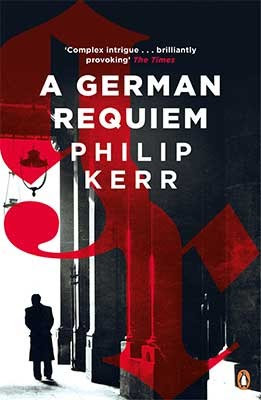
Philip Kerr - A German Requiem

After finding the first two volumes of Philip Kerr's Berlin Noir trilogy unsatisfactory and unpleasant, I was intent on reading the third volume A German Requiem merely for the sake of completion. It is, in my mind, better - perhaps because it doesn't deal with the claustrophobic atmosphere of Berlin during the Nazi era. The war is now over, Bernie Gunther has finished his stint on the Eastern Front (after a brief period in the SS where he witnessed many atrocities) and time in a Soviet POW camp. He is now eking out a living in the ruins of Berlin, where he and his wife survive mostly because she is receiving presents from a US Army Officer that she is having an affair with.

Gunther is earning a few coins after returning to his old line of work. But Berlin in 1948 is a tense place as the Russians and Western Allies begin to square off. After being approached by a Russian officer apparently on behalf of an old acquaintance, Gunther travels to Vienna to try and solve a crime and get an innocent man off Death Row. In Vienna, Gunther escapes his wife's infidelity, and gets sucked into a vortex of crime linked to the black market and former Nazis.

A German Requiem doesn't quite fit with the Berlin Noir title - being almost entirely set in Austria. That said, Kerr does show the vast difference between the two capitals, though both are being pulled apart by the conflicts of the various occupying powers. Vienna is back on its feet much quicker, there's less damage and, as Gunther quickly learns, despite the involvement of many of its citizens in the Nazi era's crimes - the Western Allies are happy to imply that Austria was an unwilling participant in Hitler's Reich.

Much of the novel is focused on Gunther's attempts to find out what happened when his acquaintance was linked to the murder of a US army officer. But the real story centres on former senior Nazis who are being used by the Americans. Here Kerr is on firm historical ground, and he (and Gunther) are suitably cynical about the way that some Nazis are found guilty and executed and others are given new identities and jobs. 

Vienna forms the backdrop, and as a neat joke, Gunther finds himself present at a couple of events linked to the filming of The Third Man, the classic film noir set after World War Two in similar circumstances. The novel is less misogynist than the previous one - women are less likely to throw themselves at Gunther as soon as they see him. Though there is at least one such scene. There is also a rather gruesome killing of a female character. 

Finishing the last of the trilogy I was left conflicted. I enjoyed them for their evocation of the Nazi era. Something Kerr excels at. He also writes a good Noir mystery. But I was left unhappy with his depiction and use of female characters. In his regard, the final novel is at least better than the first two. I remain unsure as to whether I'll return to Gunther's adventures as a result.

Related Reviews

Kerr - March Violets
Kerr - The Pale Criminal

Philip Kerr - The Pale Criminal

Volume two of the Berlin Noir trilogy featuring Philip Kerr's detective Bernie Gunther is similar to the first. While women still, improbably and repeatedly, throw themselves at Gunther, the plot is refreshingly different. Gunther is hired to find out who is blackmailing the gay son of a rich publishing house owner. Seemingly unrelated to this, Gunther is pulled into investigating a serial killer who appears to be targeting young, blond school girls. The Gestapo have found an innocent Jew to pin the blame on, as the method of murder is similar to an anti-Semitic trope being regularly used by a Nazi newspaper - Der Stürmer. 

Gunther is reluctantly brought back into the German police force by no less a figure than Reinhard Heydrich. With the powers that he has from this he tries to find the serial killer before the general public learn of the killings. As with the first novel Kerr tells us a great deal about Berlin in 1938 - the racism, paranoia, violence and increasingly militarised society through Gunther's experiences. The backdrop to the novel is the Sudeten Crisis and the Munich Agreement. Gunther's convinced there will be war, most others are not. The tension filters through all the characters.

The plot is complex, and gruesome. Kerr has depicted police procedural methods from the 1930s with seeming accuracy. However irrational the Nazi regime was, the solution to the murders and the ending of the novel are somewhat unbelievable. As is the way that Kerr ties up a lose end from the first book in a very unsatisfying way. The book is readable, enjoyable even, for the atmosphere if not the plot. Except...

In my review of the March Violets I expressed my concern at a deeply unpleasant and unnecessary described rape scene. The Pale Criminal doesn't have this, but there is a extremely unnecessary scene involving a young sixteen year old girl who arrives at Gunther's apartment to collect money for Winter Relief. There's an uncomfortable scene between her, and Gunther - who while he rejects her advances, there is too much salacious detail. This left me wondering quite how Kerr thought women behaved and why he felt he needed to include these scenes. 

Related Reviews

Kerr - March Violets
Kerr - A German Requiem

Philip Kerr - March Violets

Many people have recommended Philip Kerr's Bernie Gunther detective novels to me. Most of them are set in Berlin during, or after, the Third Reich and they are acclaimed for historical accuracy and the transportation of Detective Noir from the United States to a completely different setting.

March Violets is the first of the trilogy that make up the Berlin Noir series. The Gunther novels proved popular enough that Kerr produced more of them. But the first three are the classics. March Violets is set in 1936, as Hitler is consolidating his power and the Nazi Reich has deposed of its opponents. Attacks on the Jews are yet to reach their height, as Hitler is still concerned about the watching world. Gunther tackles his case as the Berlin Olympics take place, and the regime hides its most outward examples of antisemitism.

Kerr's detective is investigating the loss of some diamonds - owned by the daughter of one of Germany's most wealthy, and least Nazi supporting, steal magnates. The daughter and her husband have been murdered, and Gunther is asked to find the diamonds. Quickly he finds that the case is much more complicated and there are links to senior Nazis, as well as organised crime.

Its a complicated plot worthy of a classic Noir novel. Gunther is wise-cracking, tough, alcoholic and cynical. He's also not a fan of the Nazis - though to be fair he doesn't really like anyone. Readers who enjoy the likes of Philip Marlowe will appreciate the work that the author has put into recreating the atmosphere and characters.

But. And it's a big but. Gunther is not Marlowe. For a start he's to misogynist and homophobic. Marlowe was a cynic, but he wasn't openly offensive. More problematically is how the book treats women. Women throw themselves at Gunther and the sex scenes are crude. The only female character of any depth, one that Gunther falls for, disappears at the end of the book. There is also, it must be said, a particularly unpleasant rape scene which is described in far too much detail. It's unnecessary, crude and soured the book for me. 

At its best the book is a clever exploration of the way that the Nazis transformed the whole of German culture. I am not sure that it was quite as common as Gunther seems to imply that people spoke critically of Hitler and the Nazis, but by placing Gunther at the heart of the Nazi beast (and even in a Concentration Camp at one point) Kerr does manage to evoke an impression of Berlin in the late 1930s. But in this book at least, I found the negatives far outweighed the positives.

Related Reviews

Kerr - The Pale Criminal
Kerr - A German Requiem

Wednesday, July 07, 2021

Paul Lund & Harry Ludlam - The Fate of the Lady Emma

Authors Paul Lund and Harry Ludlam are best known for their oral history works about the British Navy in World War Two. Lund served on a converted trawler during the war, and was on the infamous convoy PQ17 to the Soviet Union. The authors' account of that disaster was told, through the recollections of many participants in their excellent book PQ17 Convoy to Hell

Lund and Ludlam also told the history of the Royal Navy Patrol Service in their book Trawlers Go to War, which detailed the sterling work of converted fishing craft from Dunkirk to D-Day. The oral testimony in these books, plus personal experience however is put to a slightly different use in The Fate of the Lady Emma

Lady Emma is a work of fiction, but is clearly heavily influenced by Lund's experiences on HMS Lord Austin. The novel follows tells the experiences of a fresh recruit to the Patrol Service Peter Price as he finds his sea legs on the Lady Emma. We're introduced to a mixed crew, and Price goes through the formative experiences of being mocked and gently ribbed until he finds his niche. He learns the ropes, begins to understand the various factions and personal loyalties and hides the fact he's trying to get commissioned from his crew mates. All this is fairly standard fair for a WW2 naval novel from the 1970s.

What stands the book above others in a crowded genre is how it is clearly based on real experiences. The nerves, the stress and the sea-sickness, the detailed descriptions of the dirty jobs. These read, not as a dull series of recollections, but as part of Prices' journey to a fully fledged sailor. I also enjoyed Price's wonder at the places he visits. Take this description of a brief stop at Akureyri in Iceland:

By evening they were steaming up a placid fjord. The weather had made one of its lightning changes and the sun was shining, the air still and the atmosphere crustal clear. It was nearly 8pm when they approached a small island on which there appeared to be a collection of military huts... the 'hut's' were the houses of the most picturesque village anyone had ever see. Nestling beneath a background of towering white-clad hills, the houses were painted all the colours of the rainbow. In the centre, standing alone in its quaint beauty, was a miniature church, looking straight out of Grimm's fairy tales.... The crew stood at the ship's rail and gazed spellbound on the loveliness of this unexpected jewel shining among the rugged desolation.

I'm told that Akureyri remains as beautiful.

It is only in the second half of the novel that the "action" starts. The convoy is scattered in fog, they encounter enemy aircraft and a submarine, and rescue a shipwrecked sailor. But the point of the novel is not the action - again unusual for the genre, but rather the authors are telling the story of a voyage and the sailors' experience. For that reason the book sits comfortably alongside their non-fiction. Readers interested in World War Two, the Arctic convoys and the Naval war will enjoy this novel. But it is much more than another navy tale. It is also a moving account of the individual in a larger conflict, and the ending is remarkably touching.

Related Reviews

Lund & Ludlam - PQ17: Convoy to Hell
Lund and Harry Ludlam – Trawlers Go to War
Monsarrat - Three Corvettes
Monsarrat - The Cruel Sea