Thursday, February 29, 2024

Landworkers' Alliance - With the Land

The Landworkers' Alliance (LWA) is a British based union that links small producers, farmers, landworkers and others to fight for a more sustainable, equitable and healthy food and land system. With the Land is a fascinating book that marks the first decade of the LWA's work, It is first and foremost a celebration of the ideas behind the LWA, the work of its members as well as a discussion about the struggles we need for a food system fit for the future.

It is an eclectic mix of poetry, prose, commentary, interview, photographs and art. Its a book to be enjoyed in short bursts, but one that gives a real sense of the varied work that takes place - from forestry to land-management, bee keeping to urban farming. What shines through though is a sense of the deep connection between those who work the land (however that might be) and the ecological systems they are part of.

In the most overtly political section, authors Alex Heffron and Kai Heron describe the current state of British agriculture. 

Although seventy percent of the land in Britain is used for agricultural purposes, the country produces just 55 percent of what it consumes. Of that 55% much is grown and harvested, cared for, and slaughtered by seasonal, casualised, gendered and racialised immigrant labour; under brutally exploitative conditions. The rest of Britain's food is either grown under similarly exploitative systems in the EU's industralised and polluting agribusiness sites, or in tropical climates where super-profits can be secured through the super-exploitation of the Global South's lands and labour.

The LWA arose out of many different influences, including the massive climate movement of the late 2010s and the early anti-capitalist movement, which I was part of around the millenium. It is also, and importantly, highly influenced by the politics of the global Peasant movement La Via Campesina. These influences come through in many of the articles, both in response to the appalling picture painted by Heffron and Heron, but also in the ethos of many of the projects.

One of these, very close to where I live, is the Gaskell Garden Project in Hulme, Manchester. Writing about it, Robyn Ellis talks about how the project offers much to the local community beyond just locally produced food. "We are trying to find new ways to re-learn the relationships between ourselves and our land after generations of separation, transforming wasted land into a possibility of abiodiverse green comunnity space and edible forest". Ellis points out that many projects like these are "separate" from local communities, and fail to be inclusive.

The different chapters demonstrate a real commitment to producing food and fibres in sustainable ways that utilise knowledge and expertise. But also approaches. Morgan Ody of La Via Campesina makes the point that there are two prongs to the process outlined by the LWA and their own organisation. The first is the fight for food sovereignty, the second is the building and networking of social movements that can fight for this common goal. Ody concludes "Showing solidarity is key. It might start with climate justice or with organising for workers rights, with inflation and challenges to economic isssues. We should be open and take part in other actions that we didn't create. At the same time we should be very cautious about who we build alliances with". Earlier Ody says, "What we defend is much bigger than our own interests: we defend a vision of society, and of nature, that enables us to live in peace without domination."

This vision is inspiring, and it is very much the alternative to that bleak picture described by Heffron and Heron. The problem is getting there. Writing about a fascinating local workers' cooperative in Edinburgh, Mim Black makes a very important point. Their cooperative is producing huge quantities of mushrooms. As she explains its an ideal crop for urban environments. But despite the success of the project in networking local people, producing high quality food and using old brownfield sites, Mim points out that it is not enough on its own, "There are no silver bullets or panaceas - we know that we need a systematic overhaul of food growing practices and the power relations that uphold our current unjust system." That's not to decry the work of Mim's cooperative, or many others, but rightly to recognise that there are limits to building "agroecological food systems" within capitalism.

There are other struggles too, and some of these take place within the movement itself. I was very pleased to see a powerful statement in defence of transrights by the LWA, tackling the bigotry that is coming from the top of society, but recognising that such ideas also exist within out own movements. There is also an important piece by Josina Calliste on "racial justice in farming" that talks about the racial injustice within agriculture and attempts to address it. They write:

What would a land movement in Britain look like if Afro-indigenous ancestral farming practices were at its heart? If people writing food policies were from the communities most affected by food inequalities? For fighting industrial agriculture, black communities need land power. To acieve climate justice, people of colour need to be able to grow their own food. For environmental justice, the spiritual ecologies of indigenous communities should be at the front and centre.

With the Land makes it very clear that there has been an enormous shift within society about attitidues to farming, land work and sustainable food systems. There is a deep yearning for things to change. The many authors within the book are each offering their perspectives on how that might happen. But as several of the authors make clear, we must be cautious. Small scale agroecological practices are not enough in and of themselves. They are a response to the capitalist crises we face, but the social movements they represent must also be part of a much wider struggle for equality and justice. This will need to be fought for. As Donald Mackinnon writes in the context of Scottish crofting, "We are missing the radical edge to politics that we need to deliver the change we want to see." Its a point that is, however, valid much more generally.

As such I would have liked more on some of the political fights that are needed. Important questions such as housing, wages, working conditions and so on are touched on, but not really explored. It would have been good to get a sense of what has been done and what could be done to tackle wider social justice questions that are very much part of all the communities described.

However each of these highly personal accounts demonstrates a very human yearning for justice and good food! It helps us imagine how we can live in the future, once capitalism has been destroyed. The 19th century poem Three Acres and a Cow, is reproduced in the book. We should well remember the words:

There's a certain class in England that is holding fortune great
Yet they give us all a starving wage to work on their estate
The land's been stolen from the poor and those that hold it now
They do not want to give us all three acres and a cow

it continues:

If all the land in England was divided up quite fair
There would be work for everyone to earn an honest share

You can buy With the Land via the Landworkers' Alliance here.

Related Reviews

GRAIN - The Great Climate Robbery
Sutton - Food Worth Fighting For
Lymbery - Farmageddon
Holt-Giménez - A Foodie's Guide to Capitalism
Clutterbuck - Bittersweet Brexit: The Future of Food, Farming, Land and Labour

Tuesday, February 27, 2024

Kohei Saito - Slow Down: How degrowth Communism can save the Earth

Kohei Saito is one of the key figures on the left who are exploring and developing ecological thinking through the lens of Karl Marx's ideas. Saito's book Karl Marx's Ecosocialism deservedly won the Deutscher Prize for its exploration of Marx's ecology through his notebooks. His book Marx and the Anthropocene examined what Saito has dubbed Marx's "Degrowth Communism" and has been much discussed. I would direct readers to mine and Australian socialist Padraic Gibson's critical review of it published last year. I would encourage readers to have a look at that because there's a great deal of important thoughts relevant to Slow Down, particularly our criticism of the notion of Degrowth Communism.

Despite of these academic texts, millions of people actually know Saito's name for an incredibly popular work which has been translated into English as Slow Down. It has been a bestseller in Japan, selling literarily millions of copies and translated into multiple languages. 

At the start it must be said that it is very welcome that Saito has found such a large audience for popularising Marx's ideas. It is a sign of the times that many people understand that capitalism is destroying the world and concluded that revolutionary politics are needed. But, I have to caution, that I think the Marxism Saito is offering has been shorn of its revolutionary kernal. It is an analysis that doesn't go far enough into using Marx's insights to analyse capitalism today, nor develop a revolutionary strategy for the 21st century.

Let us, however, start with the strengths. Saito offers an uncompromising approach. In the preface he writes: 

Proponents of degrwoth are often abbivalent about the need to transcend capitalism. I am not ambivalent. In my opinion, degrowth must clarify its critical position against capitalism.

When discussing actions to "prevent global warming" such as reusing bags, water bottles and electric cars, he says "these good deeds are meaningless... thinking such actions are effective countermeasures can prevent us from taking part in the larger actions truly necessary to combat climate change." 

The best parts of Slow Down are Saito's exploration of why capitalism destroys the environment, and the way that capitalist accumulation drives that process. It is a fairly convincing demonstration for the need for revolutionary anti-capitalist politics or, in Saito's words a "great change" which is "nothing less than a challenge to the capitalist system itself".

The problems begin to develop however when Saito explores Marx's work. Early in the book Saito writes that "the object of capitalism's exploitation is not just the labour power of the periphery, but also the environment of the entire earth." Similarly, he later writes, "capitalism is a system that explots not just humankind but the natural environment as well". I mention this, not to nitpick, but because Marx's understanding of exploitation was very specific - relating to the extraction, by capitalists, of surplus value from workers' labour. 

In Saito's telling this relationship is downplayed into an act akin to how a capitalist uses natural resources. It means, I think, that Saito begins from the wrong starting point - failing to grasp precisely how workers' power arises from the nature of exploitation under capitalism. In particular it encourages him to use the concept of the "Imperial Mode of Living", a currently popular academic idea that argues that workers' in the Global North essentially accept the environmental destruction and imperialist destruction of the Global South, because it materially benefits them. The problem with this is that it undermines how much workers globally have shared interests in fighting exploitation and environmental destruction. [Space precludes me developing this point, so I shall point readers to yet another article that critiques the Imperial Mode of Living theory very well.]

Why is this important? The phrase "theory of change" has become popular among radicals these days, and the criticisms above are important because they relate directly to Marx's revolutionary politics (his theory of change!) and Saito's arguments. After "rehabilitating Marx" Saito writes about a "third way", the importance of "the commons" as an alternative to "US-style neoliberalism and Soviet-style nationalization". Saito arges that the society's infrastructure (electricty, transportation) and natural environments

should be managed and operated socialistically, exempt from market norms and national regulations. It's an ideas that's beasically identical to that of 'the commons'. The main difference is one of emphasis, with the commons prioitizing shared managemet by citizens in a democratic, equal way, rather than leaving administration up to specialists as advocated by the concept of social common capital. The other decisive difference is my aim to gradually expand the commons until... they overcome and displace capitalism entirely.

Now Saito has an idea of his socialism - a world where we have redefined abundance, seeing it as arising out of common ownership and the common good, rather than out of the chaotic, unplanned market. One where humans rationally use natural resources. He also, as the above quote shows, emphasises the need for democratic control. But the change he outlines here, and reflected throughout Slow Down arises out of gradual social change. As such it is inadequate. Compare, for instance, Saito:

The means of production must be returned to the commons as well. I'm talking here about workers' co-operatives - organisations allowing workers to invest jointly in the co-ownership and co-management of the means of production without interference from capitalists and shareholders.

with Marx's vision of the "self government of the producers" inspired by the Paris Commune, outlined in his Civil War in France:

In a rough sketch of national organization, which the Commune had no time to develop, it states clearly that the Commune was to be the political form of even the smallest country hamlet, and that in the rural districts the standing army was to be replaced by a national militia, with an extremely short term of service. The rural communities of every district were to administer their common affairs by an assembly of delegates in the central town, and these district assemblies were again to send deputies to the National Delegation in Paris, each delegate to be at any time revocable and bound by the mandat imperatif (formal instructions) of his constituents. The few but important functions which would still remain for a central government were not to be suppressed, as has been intentionally misstated, but were to be discharged by Communal and thereafter responsible agents.

Marx emphasised that workers power arises out of workers' revolutionary struggle which simultaneously destroys the old capitalist state and institutes the democratic organisations through which workers control the means of production. But when Saito talks about "workers' self-management", drawing on the liberal writer Thomas Piketty, he emphasises "worker-led social ownership and particpatory management" in contrast to "workers' power". While he is right to highlight the difference between "participatory socialism" (Piketty) and Soviet-style socialism, Saito is completely wrong to argue that "Piketty's position and that of the late Marx are closer than they have ever been." Marx never lost his commitment to the idea of workers' power arising out of the smashing of capitalism. 

Saito calls for a "revolutioanry transition to communism", but does not really articulate what Marx understood this to be. Here, I venture, it would have been instructive to look at the revolutionary process in Russia through the year of 1917. Not because the Stalinist counter-revolution offers us an alternative, but because for an all too brief period, workers' power through revolutionary institutions was a real thing. 

Instead of this radical history, Saito's revolutionary change is surprisingly passive. He quotes approvingly Erica Chenoweth's idea that only 3.5 percent of the population are needed to "rise up sincerely and non-violently to bring about a major change to society." But this is far from Marx's own ideas of revolution. In contrast Marx wrote in the German Ideology that a mass revolution was needed :

Both for the production on a mass scale of this communist consciousness, and for the success of the cause itself, the alteration of men on a mass scale is, necessary, an alteration which can only take place in a practical movement, a revolution; this revolution is necessary, therefore, not only because the ruling class cannot be overthrown in any other way, but also because the class overthrowing it can only in a revolution succeed in ridding itself of all the muck of ages and become fitted to found society anew.

Kohei Saito's book is a readable and energetic critique of capitalism and its ecological catastrophe. It is wonderful that it is being widely read. But it offers a limited view of Marx's revolutionary ideas. The poly-crisis that we are facing in the 21st century demands much more.

Related Reviews

Saito - Marx in the Anthropocene: Towards the Idea of Degrowth Communism
Saito - Karl Marx's Ecosocialism: Capital, Nature & the Unfinished Critique of Political Economy
Chenoweth & Stephan - Why Civil Resistance Works
Callinicos - The New Age of Catastrophe
Harman - Revolution in the 21st Century
Choonara & Kimber - Arguments for Revolution


Sunday, February 25, 2024

Adrian Tchaikovsky - Ironclads

In the not to distant future, US troops use the British Isles as a jumping off point to fight a violent, internecine war on the European landmass. It is a savage conflict, with high tech hiding a brutal reality. Ordinary troops die, or are maimed in their thousands, while an elite officer class sit safe in their 21st century armoured "scion" skins, directing and effectively playing at being knights of the realm. They are near invulnerable, a class whom, like the knights of old made "a game of how many poor bastards they could cut up". So says Sturgeon, one of a small group of troops who have been chosen for an impossible mission.

The narrator is less sure. They're here to do a job - in this case rescue a downed scion, lost behind enemy lines. Sturgeon's history lessons niggle at the team's minds. Is it a mission they have been specially chosen for? Are they just pawns? Is there something else going on? And anyway who has the tech to actually down a scion?

Ironclads follows the team into the fray. It's a short novel that packs a lot in - partly because of its subject matter. The nature of the conflict feels much more like that in Ukraine, though it was published a few years before that slaughterhouse began. These years we are more used to highly powerful countries pulverising smaller, poorer nations. But this is a book about modern conflict in a high-tech world.

So there's lots of technology - AIs, drones, robots. But humans still get blown to pieces quite a lot. So this is military science fiction with a lot of human values in it. But, like much of Tchaikovsky's other work, it is also a deeply political novel. Sturgeon, in one of his history lessons, explains how Britain broke off from Europe, and in the ensuing economic catastophe, found itself even more closely aligned with the interests of the US. But the rest of Europe was following a different path. If the US was diving deep into a high tech, neoliberal, theocracy (the Church of Christ Libertarian!), then Europe was enjoying the fruits of state intervention, green technology and keeping the wealthy in check. 

The war, when it comes, is fought for the US multinationals who want to make sure they get back their slice of the pie, and smash the incipient European socialism. The scions aren't military top brass, they're the corporate heads who are really pulling the strings, and they have much deeper interests. There are thus some excellent jokes. As the narrator complains, "I got shelled by the 1st fighting corps of fucking Ikea last year!" 

Here Tschaikovsky has dialled up the imperialist narrative. Nearly a quarter of a century ago, US neoliberal Thomas Friedman said that ‘the hidden hand of the market will never work without the hidden fist. McDonalds cannot flourish without McDonnell Douglas. The hidden fist that keeps the world safe for Silicon Valley’s technologies to flourish is called the US army, air force, navy and Marine Corps.’ But this is not the hidden hand. Here the multinationals have merged and taken over the military. They are the warmongers. But, ironically, war is not actually that profitable if you are blowing apart your own sub-companies, emerging markets and resources.

The imperialism depicted in Ironclads is not really that different to the monopoly capitalism lying behind World War One that Lenin and Rosa Luxembourg wrote about. Good political science fiction doesn't always have to wear its politics on its sleeve. Adrian Tchaikovsky's done a very good job indeed here of placing some really interesting ideas at the heart of a very hard military science fiction work. Highly recommended.

Related Reviews

Tchaikovsky - Walking to Aldebaran
Tchaikovsky - Children of Time
Tchaikovsky - Children of Ruin

Friday, February 23, 2024

Hal Draper - The Dictatorship of the Proletariat from Marx to Lenin

In preparation for writing my book Socialism or Extinction I read all five volumes of Hal Draper's books on Karl Marx's Theory of Revolution. It was an exciting and informative experience and links to reviews of each volume can be found below. For each book I was struck by how Draper's deep grasp of the material allowed him to draw out the revolutionary heart to Marx's ideas and give fresh insights to Marx's ideas. So I was pleased to discover this much shorter volume which is a "continuation", in Draper's words, of volume three of KMTOR, extending the story beyond Marx and Engels' lifetime into the early 20th century. The book follows much the same format, exploring the references to and meanings of Dictatorship of the Proletariat as used by key Marxists, from Marx and Engels, through the Second International and onto Luxembourg, Lenin and Trotsky.

But there is no doubt that Draper has a deeper purpose. He seems to be trying to rescue the Marxist kernal of the phrase, no doubt hoping to explore its meaning in the context of critics of revolution, on the left and right. The problem here is that the meaning of the phrase is one thing. How and why it was used is another. Draper has, particularly in the case of Lenin, abstracted the phrase from the context and undermined his own cause.

There is a lot of overlap with volume three of Draper's KMTOR. He begins, as he did there, by exploring the changing meaning of dictatorship. It is an important corrective, because he shows how its classical meaning, understood by Marx and Engels, but rarely today, is far from the modern interpretation. Instead it means an "emergency exercise of power by a trusted citizen for temproary and limited purposes". Marx rarely used the phrase except in specific periods. Draper explores these, but points out that until the Paris Commune, there "was not a single case of Marx's use of 'dictatorship of the proletariat'" in the preceeding two decades. When he does use it there, it is because "it was accepted as an example of the rule (or 'dictatorship') of the proletariat. The point is, Draper argues, that Marx was using the phrase despite the Commune not excercising dictorial power. Draper writes:

In the twentieth century, it was not uncommon to read that, according to Marx, a workeres' state might or might not be a 'dictatorship of the proletariat,' depending presumeably on how severly dictatorial it had to become. This interpretation is excluded by Marx's words: the workers' state 'can be nothing but; a dictatorship of the proletartiat; in other words the two terms are synonumous... For Marx this was a staetment about the societal content of the state, the class character of thre political power. It was not a statement about the forms of the government machines or other structural aspects of government or policies.

Later Marxists, Draper argues, miss this point and see the use of the D word simple as about method, not content. He repeatedly contrasts how these Marxists use the word and compares it to how Marx meant it. There is some usefulness in this, not least in exposing the limitations of many Second International thinkers. The problem comes when Draper gets to Lenin:

By the end of Year One, it was clear that Lnein was no longer using 'dictatorship of the proletariat' to denote a workers' state that was subject to the democratic rule of the working classes. It now meant a specially organised dictatorial regime, dictatorial in the sense that had become increasinly dominant, and increasingly counterposed to abstract democarcy... a number of Bolshevik spokesmen carried this process of theroretical degeneration even further, thus facilitating (though certainly not causing) the societal counterrevolution represented by Stalin.

Here Draper gives succour to the enemies of the Russian Revolution before Stalin's rise, because he undermines what Lenin was trying to do in this period. Despite a useful summary of the Revolution's isolation and economic collapse, he continues to judge Lenin by the classical definition of Dictatorship of the Proletariat understood by Marx. He then blames Trotsky and Bukharin for taking the theoretical lead in "gutting socialism" before Stalin.

Rather than trying to explore the real meaning of 'dictatorship' in the context of an isolated revolutionary movement and the needs of the struggle - which other Marxists not least Trotsky himself have tried to do since - Draper avoids this and spends his time in Marxology. Take this passage, describing how Lenin engaged with Marx's ideas:

The rather surprising outcome was that Lenin worked out for himself, or invented, a unique definition of 'dictatorship; which, as far as I know, came out of his own head. More than ever, different people discussing 'dictatorship of the proletariat' were using a different vocabulary, talking past each other.

But what is surprising about this is that Lenin developed some of the most vibrant and interesting Marxist works around related questions. But Draper judges him not on these works and their importance, but on his differences from Lenin. Indeed, the sections where Draper tracks the changing use of the phrase by Lenin were somewhat tiresome for me, as they felt more like heresay hunting than actual engagement with Lenin's revolutionary project.

Sadly this short volume falls short of the authors' ambitions. Hal Draper comes across as a smug writer, pleased that he alone has discovered Marx's true meaning and all others have fallen by the wayside. It would have been more useful if Draper had more deeply explored what Lenin's project was, rather than trying to damn him with faint praise.

Related Reviews

Draper - Karl Marx's Theory of Revolution Volume 1: State & Bureaucracy
Draper - Karl Marx's Theory of Revolution Volume 2: The Politics of Social Classes
Draper - Karl Marx's Theory of Revolution Volume 3: The 'Dictatorship of the Proletariat'
Draper - Karl Marx's Theory of Revolution Volume 4: Critique of Other Socialisms
Draper & Haberkern - Karl Marx's Theory of Revolution Volume 5: War & Revolution

Thursday, February 22, 2024

Arthur Ransome - Great Northern

Rereading Arthur Ransome's Great Northern led me to decide that it is perhaps the finest of the Swallows and Amazons stories. Yet when I read these books as a child I was not that found of it. Looking back I think that this is due to the tense final few chapters, when the Swallows, Amazons and Dick and Dorothy are pursued by multiple enemies as they seek to protect the titular birds. It is much more young adult territory than children's book.

Great Northern is the only one of Ransome's children's books to be set in Scotland. It's connections with the books set in the Norfolk Broads as the children are protecting a birds nest and eggs from an egg collector. Looking after birds was a key theme of Coot Club and the Big Six. In this sense it is quite a modern story, as egg collecting was not frowned upon in the 1940s when Great Northern was written. The children are on a sailing trip with Captain Flint, around the Western Isles (Ransome based the book on a trip to Lewis) which has been fairly uneventful. It is only on their last day, when Dick spots a pair of Great Northern's nesting that things take a turn for the excitement. The birds have never been known to nest in the British Isles and the discovery of the nest offers fame.

Dick's visit to a bird watcher turns from triumph to horror as he realises the watcher is an egg collector. A swift children's mutiny leads Flint back to the Island where the everyone embarks on a great subterfuge to avoid the collector locating the nest. As I said, there's a great chase, the children and Flint are imprisoned by the angry natives who think they are trying to scare his deer, and the birds are eventually protected. It is all very exciting, though Ransome's left politics did not prevent him relying on the autonomous power of the local laird to stop the robbery of the eggs!

There are some interesting aspects to the book. Firstly the locals speak little English, only Gaelic - with the exception of the Laird and his son. Secondly Ransome captures well the class relations on the island. Of further interest is the environmental context. Ransome, through the children, demonstrates a great empathy for nature and landscape. This is done, in this case, through the desire by all the children (though not Flint) to protect the birds. But this concern doesn't stretch to the wider environment. Take the aftermath of the picnic, when the two oldest children, John and Nancy, leave they "quickly poked their sandwich papers deep into the pear, sank their empty lemonade bottles in a small pool and set off, with empty knapsacks flapping on their backs."

Reading this sentence in 2024 really jars! The bottles are likely still there, though at least the sandwiches were wrapped in paper and not plastic. The other jarring bits are the gender roles. Ransome is usually quite good at letting his female characters take part in adventures on the same level as the boys, usually through the medium of Titty and Nancy. But once again Susan and Peggy are left to do all the household chores, especially feeding the crew - and Susan is forced to play a motherly role to her youngest brother Roger. Worrying, and bemoaning that the iodine for his cut shin is back on the boat.

Great Northern is certainly one of the best of the Ransome novels. But it is dated, and very much of its time. Despite this, Arthur Ransome's empathy for children and nature comes through and readers who enjoyed this back in their own childhood may enjoy the revisit. Younger readers perhaps deserve a little more.

Related Reviews

Ransome - We Didn't Mean to Go to Sea
Ransome - Peter Duck
Ransome - Missee Lee
Hardyment - Arthur Ransome and Captain Flint's Trunk
Chambers - The Last Englishman, The double life of Arthur Ransome

Friday, February 16, 2024

Kent Nerburn - Neither Wolf nor Dog

This book begins with a phone call. Author and artist Kent Nerburn gets contacted by the grandaughter of an Native American elder, who wants him to write his story. Nerburn has already published several books that present the stories and memories of Native Americans who lived on the Red Lake Ojibwe reservation, and Dave Bald Eagle (Dan), a member of the Lakota, feels that Nerburn can deliver. But this writing assignment becomes a spiritual journey for Nerburn when Dan, and his friend Grover, essentially kidnap Nerburn and take him on an intellectual journey to understand Native American history, thought and, above all, anger.

There is a great deal of mutual misunderstanding in this book. Nerburn often, and openly, fails to understand what Dan and Grover are telling him. He cannot comprehend the Lakota worldview, and he is helpless in answering and understanding what he is being told. Gradually he gets closer to it, after essentially having a breakdown in the face of the emotion, intensity and power of Dan's ideas. It is a journey (spiritually and physically) that is deftly told. Dan is hard on Nerburn, rarely allowing him space, and pressing him on points and the half-baked thoughts that the whiteman makes. There's a hard hitting bit when the three travellers visit some of Dan's family, and Dan tackles Nerburn for treating one of the children differently. One of the kids is half Indian and half white and Dan accuses Nerburn, "He wasn't an Indian to you. That's why you talked to him more." Nerburn doesn't see that he did anything wrong, and this just riles Dan more - "The little guy... he's never been as far as Rapid City. He speaks Lakota. He's never even seen his white dad. But to you the other kids are more Indian."

It's a powerful moment and Nerburn's protestations are frustrated and bitter. But it's honest. It leads the author, through Dan, to explore US politics around race, genocide and the reservations themselves. Nerburn is ill-equipped to deal with the onslaught of ideas, thoughts and new approaches to the world that Dan and Grover offer him. Dan complains:

You are still writing down our story, using your words, and you are still getting it all wrong. Your words are all full of sharp edges that cut us. But we have been bleeding so long we don't even feel it anymore.

It is a powerful lesson for Nerburn, and the reader. Nerburn is ill-equipped to tell it, and that's not just because he is not a Native American. It's also because he hasn't got any political framework to explain American history. If I have one disagreement with Dan's own politics its that it doesn't acknowledge that as capitalism sought to murder the Native Americans, it also destroyed the lives of countless other peoples whose world-views and livelihoods did not fit its model. The genocide of the Native Americans took place alongside the colonial destruction of peoples across the Global South as well as the destruction of European ways of life that had entirely different relationships to the world around them.  But Nerburn doesn't even appear to have heard of Wounded Knee. He's a great writer, and perhaps his naivety is the perfect foil for Dan's hard reality, but at times I was exasperated by him for different reasons to Dan's!

Nevertheless this "neither fiction nor non-fiction" account of a road trip is a powerful and illuminating read. Add it to your list, for a sense of the raging discontent and anger that remains at the heart of the so called "American Dream".

Related Reviews

Kimmerer - Braiding Sweetgrass

Tuesday, February 13, 2024

Christopher Shaw - Liberalism and the Challenge of Climate Change

Christopher Shaw opens his book by quoting from the Intergovernmental Panel on Climate Change's 2022 report, which argued that "fundamental changes" were needed to society's "underlying values, world views, ideologies, social structures, political and econommic systems and power relationships." Those of us who have spent the last few decades arguing that capitalism cannot solve the environmental crisis that it has created could be forgiven for feeling somewhat vindicated. After all, fundamental change is what we've been calling for all along. But Shaw cautions us. His book

argues that the greatest barrier to bringing about these 'fundamental changes' is the stanglehold that liberalism has on our language, thoughts and imagination. What is presented as transformative climate action is actually action intendd to legitimise liberalism in the face of a catastrophe for which liberalism has no answers.

Liberalism, Shaw argues, is "irreconcilable" with a liveable climate. He goes further, suggesting that "our inability to even think it possible to look beyond liberalism... is a sign of ideology in action". Indeed, so embedded is liberalism as a viewpoint in Western capitalist society that it has not just shaped how we think about climate (or indeed everything) but it has also enforced a particular approach to climate solutions. I have long raged about the inadequacy of the UN COP process but Shaw shows how this politicians deliberately supplanted a scientificly driven approach with one governed by neoliberal politics and economics.

One interesting part of the book looks at the temperature limits set as the targets for climate action, in particular the often mentioned 1.5C marker. Shaw argues that this is a result of a liberal approach to nature and climate which set an arbitarary number as a target. This could be used as by politicians, conveniently shifting the problem into the future. He makes the point that the 1.5C "cultural artefact", was "constructed under a historically specific set of economic and social conditions by a handful of powerful actors... under different social and economic conditions, we might have expected a different construction of climate change to emerge".

As the world surges past the 1.5C level, we will have cause to rue the historic failure to build this different social and economic context. But Shaw's point here echoes Marx, "the prevailing ideas of society are those of the ruling class". Indeed, as he says "the political consensus drives a public consensus". This liberal consensus is that "apocalyptic scenarios... are resolved in the story through narratives of technological solutions, global negotiations and occult economic practices." But it has all failed.

To flesh out his argument Shaw posits five "guardrails" which are used by liberal politicians and thinkers to frame the climate crisis and the action that should be taken. Essentially these are ideological viewpoints enforced by the ideas and actions of capitalist society. They are worth listing:

  • Guardrail 1: Climate Change is not a challenge to individualism.
  • Guardrail 2: The liberal construction of climate change is universally true.
  • Guardrail 3: Climate change is not an historical phenomenon.
  • Guardrail 4: We have the tecnologies to solve climate change.
  • Guardrail 5: New stories will save us.
The climate movement has, in recent years, developed a serious and important component that has highlighted the importance of global justice to the fight for a sustainable future. Shaw points out the liberal guardrails entrench a view of climate solutions that see the future world as a mirror of the developed West. This view is both unsustainable and racist. Take the future envisaged by one western liberal writer:
There is flirting, gossip, philosophical cafes, street theatre, peaceful protest marches, farmers markets, marathons and rock concerts a plenty. The cars hum quietly around... beer and barbeques. Markets and trade are vibrant.
A fantasy dream for a liberal elite. Certainly a dream that is not sullied with the horror already dealt out to billions of people around the world by the existing environmental crisis. 

What is worrying about these viewpoints is that they are not just endemic to the politicians and the elite, they are also dominanting within the climate movement itself - at least the mainstream, NGO part of it. For these activists, "system change" mostly means tinkering with capitalism, not replacing it.

It is interesting then that Shaw's book finishes with the "third way". It is a breath of fresh air when Shaw says we must begin with Lenin and the Russian Revolution. The latter he rightly characterises as "a conscious intervention to end imperialism and class exploitation". Shaw continues that we need a similar "seismic historically significant social revolution today". 

While I think Shaw's arguements against liberalism are valid. I think it would have been good to draw out further his discussion about whether or not they will remain universal. As the climate crisis grows, the response from governments and elites will be to rein in liberal discourse, increase repression, border controls and racism. We get a glimpse of this with Putin and Trump, and far-right politicians around the world. I would have enjoyed more of Shaw's thoughts on this.

Nonetheless Liberalism and the Challenge of Climate Change is an important book. I opened it fearful that I was delving into a dry academic text. But instead I found an illuminating and engaging discussion, a powerful denunciation of the dominant political viewpoints that drew the most radical of conclusions. 

Related Reviews

Monday, February 12, 2024

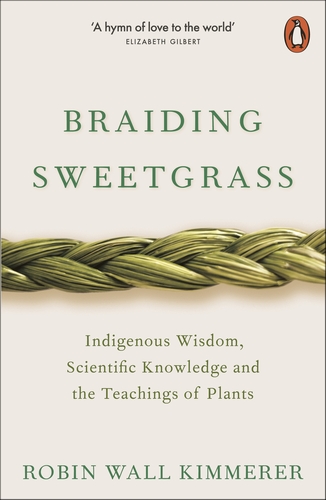
Robin Wall Kimmerer - Braiding Sweetgrass

Braiding Sweetgrass is one of those books that defies easy categorisation. I picked it up expecting a book that distilled indigineous knowledge about plants, perhaps imaginging a discussion about what plants made for good food, medicine or had other benefits. The book definitely has this within it. But it has much more. It is also part autobiography, part reportage, part biological discussion. All of this often infused with anger and sadness. Robin Wall Kimmerer draws on her many varied experiences - as a mother, scientist and university tutor - as well as an indigenous person in North America - to draw out how Native American people understand the world and nature. It makes for a remarkable book.

One of the things about Braiding Sweetgrass is Kimmerer's mixing of scientific and indigenous insights. Towards the end of the book, she writes:

The very facts of the world are a poem. Light is turned to sugar. Salamanders find their way to ancestral ponds following magnetic lines radiating from the earth. The saliva of grazing buffalo causes the grass to grow taller. Tobacco seeds germinate when they smell smoke. Microbes in industrial waste can destroy mercury. Aren't these stories we should all know?

She continues, "The stories of buffao and salamanders belong to the land, but scientists are one of their translators and carry a large responsiblity for conveying their stories to the world". But she bemoans that "scientists mostly convey these stories in a language that excludes readers."

I think the point she is making is that Western thought teachers people to understand the world in a particular way. Nature is a commidity that has been tied into a global market. Capitalism teaches us to see the world in a particular way. We relate to nature, not as nature, but as a thing, separate from us.

Kimmerer shows this often in her descriptions of time spent with student. On field trips she finds students who are incredulous at her suggestions that they listen to nature, or think of a tree, plant or stone as a person that they should communicate with. I'll admit that it seems strange to me. But the point that Kimmerer is making is that we consider the world differently when we have to think about the consequences of our actions - when we have to ask the animal if it is ok to hunt them, or the crop to cut it. The action of making gifts to nature is in part about making a recognition that nature cannot be taken for grants.

There's an excellent chapter that looks at this through a PHd students work on crop yields. This student is studying the impact of different ways of harvesting crops. The university professors are incredulous that she thinks that the act of farming the crops would increase yields. "Anyone knows that harvesting a plant will damage the population. You're wasting your time" said the Dean. Yet the opposite was proved to be true. Indigenous knowledge trumped the academy.

Kimmerer is not suggesting that indigenous knowledge should replace Western science. What she is arguing is that the approach of indigenous people to the world offers ways of understanding the world that can supplement science. Her different chapters all, in various ways, make this case - often in convincing and interesting ways.

But I think there's something missing of her analysis. The problem is not science. The problem is a social and economic system that frames science in a particular way. Rightly Kimmerer talks about the appalling genocidal treatment of indigenous people. This saw the deliberate and violent destruction of a way of life - and a way of thinking. But the rise of capitalism did this to people everywhere - including in Europe. James D. Fisher's recent book The Enclosure of Knowledge makes this point well about the experience in England. This is not to downplay the violence inflicted on Native Americans, but to argue that the rise of the bourgeois way of thinking about nature is the problem. We cannot simply graft better and more helpful ways of thinking on existing science. We need to transform the system itself.

This is why I think Kimmerer's book is sometimes misunderstood by reviewers. Because it seems hard to imagine what she is suggesting taking place - because it can seem so alien. Interestinginly at the same time as writing this review I've been reading Kent Nerburn's book Neither Wolf Nor Dog, which features similar increduality between Nerburn and his Native American companions.

Of course, it is possible to shift how people think and view the world. Kimmerer's students often make that leap - and she writes touchingly about this. Her book will also contribute to this process. But making that change is only a first step. As she writes at the very end, we need "courage" to "refuse to participate in an economy that destroys the beloverd earth to line the pockets of the greedy, to demand an economy that is aligned with life, not stacked against it. It's easy to write that, harder to do."

Unless we shatter the Settler Colonial system that alienates us from nature, and shapes our way of thinking, we will remain trapped in its framework. Kimmerer's book is thus a powerful argument for a new way of thinking, but we need to go much further.

Related Reviews

Fisher - The Enclosure of Knowledge
Tully - Crooked Deals and Broken Treaties
McMillan & Yellowhorn - First Peoples in Canada
Hunter - Glencoe and the Indians
Cozzens - The Earth is Weeping


Thursday, February 08, 2024

Sylvain Neuvel - Until the Last of Me

*** Spoilers ***

This is the second volume of Sylvain Neuvel's Take Them to the Stars trilogy. It is an alternate history of the 20th century, focusing on two groups of human like aliens that live among the wider population. For three thousand years they have fought each other. One group, the Kibsu, have tasked themselves with getting humanity to space so that they can escape Earth. These women, have hidden themselves, gently prodding and encouraging humans to gain the necessary insights to develop science and move, slowly towards the stars. The Kibsu are all women, and one of the great insights of these books is how Neuvel links the difficulties of these gentle nudges, with the wider problems of women's oppression in society and science. 

He also doesn't fall into the trap of pretending this is easy for the Kibsu. One of the ironies of the historical chapters in Until the Last of Me, is that the Kibsu often fail, or find that human scientists are already gaining the insights they need, or that their women's insights are ignored. In fact Neuvel reinforces the idea, perhaps not deliberately, that scientific advance is a consequence of humanity's collective development - not just the insights of individuals. The greatest step forward taking by Kibsu Mia though was to get the Nazi Von Braun to the US after World War Two, and then to push the Soviets into space to make it happen. This is where the second novel opens - humans are in space, but the Kibsu need them to push further outward. But there is a problem.

For thousands of years the Kibsu have run from the Tracker. The aliens, all male, hunting them. For thousands of years the motto has been "run, do not fight". In this book the last Kibsu has to fight to protect what she has found out about her origins and humanity's destiny. 

Neuvel skillfully weaves the story of the Kibsu around 20th century space exploration - making Voyager the focus of the tale. This is itself enjoyable - in a way its a more exciting and innovative vision of humanity's voyage into space than the moon landings and the space race. But it is a dead end, and its notable that the book opens with Kibsu disappointment at the lack of movement in space.

For this reason, Until the Last of Me fails to develop some of the intensity of the first book - the space race provided a tension that is lacking in the second book. Instead Neuvel relies on the back story of the Kibsu and a somewhat implausible detective story as the Kibsu use an ancient artifact (locked in a vault in China) as a map to find their way to a secret. This is a little to Indiana Jones, and it contains one of the sillest museum heist scenes I've ever read.

I suspect that Until the Last of Me, suffers from being volume two of a trilogy. A bridge between beginning and end. We shall see. The ending is a pretty good cliff hanger.

Related Reviews

Neuvel - A History of What Comes Next

Tuesday, January 30, 2024

Kenneth Austin - The Jews and the Reformation

This is an engaging book about European Jews and the Reformation. It mostly examines how Jews were perceived and treated before, during and after the Reformation. Author Kenneth Austin begins with a survey of Jewish life before the great changes of the 16th century, and quickly moves into what the Reformation meant for Christians - he says that this frames how they thought about Jews. 

The figure that looms largest over this period is, of course, Martin Luther. Austin explores Luther's own changing attitudes which began with a more friendly attitidue to the Jews but as they failed to come over to Reformed Christianity, turned into horrificly racism. Luther's words do not need to be quoted here again, suffice to say that they were taken up by antisemites at the time and since. Austin, however argues that such beliefs were not themselves universal. Rather:

Catholic and Protestant attitudes to the Jews in the Reformation era were highly complex and multivalent. Fortunately, few were quite as hostile towards Jews as was Luther, on the other hand, there were relatively few who could be considered genuinely tolerant either. The Reformation had made Europe a religiously pluralistic society, but the place of Jews in this world was far from secure.

Exploring these "complexities" takes Austin through a fascinating account of the history of Jewish people in Europe, their specific beliefs and how Christians understood Jews in terms of their relations to Christians and Jesus. One of the fascinating aspects to this is how the study of the Bible by those contesting the Reformation caused a renewed interest in Hebrew as scholars tried to read the Bible in its original language - meaning that some Jews became highly important as teachers, and their works were published and widely read.

Austin also explores how Christianity had varying attitudes to Jews, that were not simply shaped by religious prejudices or concerns. For instance, there were a number of places were Christian rulers encouraged Jews to live in their towns or cities, for economic reasons. Jews, Austin writes, became "particularly associated" with two roles - doctors and money lending. The former was often proscribed because Jews were commonly believed to deliberately kill a proportion of their Christian patients. The latter was often the reason Jews were invited into an area, though this was often accompanied by various restrictions on life - from bans on them joining Guilds, to restrictions on their rights to travel. It lead to some contradictions, Strasbourg for instance was a city that "could claim to be... almost entirely free from a Jewish presence, while at the same time accomodating Jews in various ways to their mutual benefit." The construction of Ghettos was often about restricting Jews, but allowing them space to continue working in ways that benefited the wider economy, watched over by the anti-Jewish rulers or city council. Such contradictions arose because there was no "monolithic" position towards the Jews. Indeed, successive Popes or monarchs seemed to vary their attitudes dramatically.

The antisemitic beliefs about Jews here, including the blood libel, are explored by Austin in detail. This makes for fascinating, if uncomfortable reading. Austin explores the "blood libels" and racist beliefs, particularly over antisemitic ideas that saw Jews as responsible for killing children. These were widespread in the period covered, but without foundation. Nonetheless they led to frequent pogroms and repression of Jewish communities.

The Reformation had contradictory outcomes for Jews. On the one hand Jews became pawns for arguments from boths sides. On the other, the political demand for religious equality by Protestants, also as a by product led to the toleration and acceptance of Jewish communities. It worked the otherway too. In France, in 1561, the Protestants asked Charles IX to tolerate them, "since the Jews are allowed, and the Turks".

Kenneth Austin's book is insightful and interesting. But not without problem. His tendency to see developments in terms of purely religious differences obscures his argument in places. He argues, for instance, that the Dutch Revolt and the Thirty Years war were the result of Reformation tensions. But the religious debates are better understood as reflecting the tensions caused by the rise of the capitalist order. This new economic system caused enormously changes and, this created new problems and opportunities for Jewish people. For instance, it would have been fruitful if Austin had explored the way that the concepts of bourgeois equality and freedom created spaces for the freedom to worship. Instead Austin tends to see this as a consequence of "ongoing" religious tensions, rather than the ideological expression of a new social and economic system.

Nonetheless, at the end of the Reofrmation, both wings of the Christian Church "tried to position themselves as the heir to the Jewish people". Why that could be true is a fascinating story and it is well told by Kenneth Austin.

Note: In this review I have used "antisemitism" to refer to anti-Jewish beliefs and racism. Kenneth Austin points out that this is "rather problematic", because it tends to relate to a modern racism based on racial and genetic ideas of Jewishness, that dates to the 19th century onward. Secondly, Austin writes:

"the term implies a more positive attitidue towards the Jews than was acutally the case. Most of the fitgures who are generally described as philo-Semites valued the Jews not on their own terms, but rather because of the role they could perform. Wanting Jews in the country in order that they could convert to Christianity, thereby heralding the Last Days, could hardly be construed as genuinely sympathetic."

Related Reviews

Fishman - East End Jewish Radicals 1875 -1914
Sand - The Invention of the Jewish People
Roper - Martin Luther: Renegade and Prophet
Marshall - Heretics & Believers: A History of the English Reformation
MacCulloch - Reformation: Europe's House Divided 1490-1700
Pascal - The Social Basis of the German Reformation
Barton - A History of the Bible: The book and its faiths

Sunday, January 28, 2024

Michael Collins - Carrying the Fire: An Astronaut's Journeys

Michael Collins was the third man on Apollo 11. He was the bloke that stayed in lunar orbit while Armstrong and Aldrin landed, and the one who was routinely described as the loneliest human in the universe for being the most isolated from other people. This biographical account of his life before Apollo 11, and the years afterward was published in the early 1970s. It is, by far, the best of the astronaut books that I have read. A highly driven individual, Collins went in the airforce, applied twice to be an astronaut and ended up flying to space in Gemini 10 and around the moon in Apollo 11. Had he stayed with Nasa he would likely have commanded Apollo 17 and landed on the moon.

Carrying the Fire is an exceptionally interesting biography. Collins is no wooden military pilot - he is a deep thinking individuals, fascinated by literature and poetry (as this remarkable short interview with him illustrates). Collins was, I thought as I read this, one of the Apollo astronauts that I would most liked to have drunk a cup of tea with.

The book gives a sense of the drudergy behind the headline grabbing achievements of Nasa's space programme. Collins describes the monotony of the training. Every aspect of the Apollo missions was practiced before hand. The crew trained for every eventuality, and Collins explains how they were almost on autopilot. Nothing was left to chance - every conceivable disaster, however unlikely - was considered, trained for and practiced. But it was exhausting and hard work. By the time of the mission it seems that the crew could do it blindfold.

The mission was, of course, a collective effort involving thousands of people in addition to the three astronauts. But the crew is often portrayed as a collective. But Collins implies that they were really three very different individuals, that did not quite hit it off. It's clear that he felt that he was a slight outsider - not having to train for the landing meant that Aldrin and Armstrong had a very different, closer relationship. That said, it's interesting that Collins reports that Aldrin carried a huge chip on his shoulder that Armstrong pulled rank and took the first steps on the moon. I certainly got the impression that Collins didn't really like the other too very much. He confides, "evern as a self-acknowledged loner, I feel a bit freakish about our tendency as a crew to transfer only essential information, rather than thoughts or feelings."

This comes out in small ways. I don't think I had quite appreciated the extent to which the return from the lunar surface to rendezvous with the Command Module Colombia and Collins was such an unknown. Collins talks about the stress and anxiety - orbiting the moon surrounded by magnificent sights, but only wanting the mission to move on to the next step. When the other two come back and enter into Colombia, Collins says that Aldrin is the first one in and "I grab his head a hand on each temple, and am about to give him a smooch on the forehead... but then, embarrased, I think better of it and grab his hand, and then Neil's." It's a remarkable admission that illustrates the gulf between them.

Collins is a professional, and his book is full of the sort of detail that appeals to people like myself, obsessed with the details of spaceflight. But it is also full of the human factor - the struggles he had on Gemini with using the sextant to navigate the ship. The problems he encountered on the Gemini space walk. The fear and anxiety that were constantly there, among the amazing achievements of the space programme. Collins himself was a huge advocate of futher exploration, and his dismay with the retrograde motion of Nasa after Apollo is palpable in the prefaces written forty and fifty years after the first landing. 

But after Apollo, and in the years that followed, it's clear that Collins developed a much deeper set of ideas. He writes about his ecological worries for the planet and even, in 2009 and 2019 declares that "we need a new economic paradigm to produce prosperity without growth." Degrowth enthusasts would probably be surprised to find Michael Collins was a fellow traveller!

Reading Carrying the Fire is a rewarding experience. Collins was lucky to be part of one of humanity's finest achievements. He is greatful for that. But he also describes it in terms of work and personal life. He knew he could walk on the moon if he stuck with the programme, and was encouraged to do so. But he didn't, because he also wanted to live a life with his friends and family. He writes, candidly, about how Aldrin in particular struggled with the post-Nasa life, quickly being hospitalised for mental distress. Collins avoided that, though life had its ups and downs. Collins did not go back to the moon, because he could not face two or three more years of simulator training and stress. Anyway, he thought that others would carry the fire. But the politicians and penny counters had other ideas.

Related Reviews

First on the Moon - A Voyage with Neil Armstrong, Michael Collins, Edwin Aldrin
French & Burgess - In the Shadow of the Moon: A Challenging Journey to Tranquillity 1965-1969
Swift - Across the Airless Wilds
Rubenstein - Astrotopia: The Dangerous Religion of the Corporate Space Race
Wolfe - The Right Stuff
Scott & Leonov - Two Sides of the Moon

Saturday, January 27, 2024

Sebastien de Castell - The Malevolent Seven

Riffing off The Magnificent Seven, the The Malevolent Seven is a fantasy story of a group (coven) of mages who do quests for cash, violently protecting or attacking anyone who they are paid to. The narrator, mage Cade Ombra, opens by telling the reader that "real mages don't wear funny hats". Rather they are violent, angry and dirty killers for hire. There are few "long scraggly beards" here, and rather a lot of sweary murderers covered in blood and mud.

Its an unusual twist on the genre, but of course Cade doesn't remain the indifferent angry killer, after a slow arc of redemption in The Malevolent Seven, Cade turns into an impassioned angry killer, fighting a little less for cash and a little more for a cause. Cade, and his compatriot, Corrigon (who has even fewer moral compulsions than Cade) are hired to put together the titular seven numbered coven and undertake a quest. The prize is allegedly an artificat that can grant the bearer even more powerful magical abilities. In de Castell's novel, mages gain power from other realms and their inhabitants, utlising spells through the energy and power they can draw from elsewhere. Cade, true to his corrupt self, buys such spells from an infernal demon, who has his own plans and macinations.

Much of the novel follows Cade and Corrigon's putting together of the band - just as the best bits of The Maginificent Seven film and its sequels are the finding and hiring of the other guns, the same is true of de Castell's novel. The quest actually takes up only the last third of the book. Most of the novel is scene setting - usually involving mud, blood and violence.

While it's a fun setting, it's hard to be that enthusastic about the book. The world building is superficial, and I lost interest in de Castell's explanations of how the mages powered their spells. In particular the rat mage simply didn't work as a character. The gathering of the various mages, with their different types of magic, was only a little interesting. I liked the ride, and I enjoyed a novel where magical users are not all good guys. But sadly its not enough to make this a classic.

Related Reviews

Grossman - The Magician King
Kuang - Babel
Gilman - Isles of the Forsaken
Lavalle - The Ballad of Black Tom
Ng - Under the Pendulum Sun

Wednesday, January 24, 2024

William Morris - The Pilgrims of Hope

This little book is simultaneously a piece of art and a historical document. Of the 108 pages, just forty or so are given over to the piece of the title, William Morris' poem The Pilgrims of Hope. This, as Michael Rosen says in his introduction is a "fascinating piece of work" in which the author struggles to depict a contemporary class struggle through a long, descriptive poem. For someone like myself who struggles with poetry as a literary form, Rosen's introduction and the longer discussion of the context of Pilgrims of Hope's publication by Nicholas Salmon are extremely useful, both in understanding the poem and putting it in context.

The Pilgrims of Hope tells the story of Richard, a young man living in the country, who learns about the wider world and its struggles through an encounter with a refugee from France. This leads him to London where, among other things, he attends a socialist meeting - much like the ones that William Morris himself organised - and there gets involved in Communist ideas and struggles. When the Paris Commune breaks out, Richard, his wife and his French friend travel to Paris to take part in the struggle and defend it from the counter-revolution. There they form a classic love triangle and Richard's friend and lover die on the barricades, leaving the exact nature of their relationship unclear.

Its a short story, and surprisingly, it's not well told. I am greatful to Salmon's deep reading of the poem for understanding events. What is interesting is the way the poem rises and falls, climaxing on the barricades. Here I was tempted, as Salmon suggests, to see the love triangle as representing the intensity of emotion experienced by the participants in the Commune. Interestingly Morris tends to portray socialists politics in such an emotional way. His hero's discovery of socialism at a political meeting is described as a rebirth, "I was born once long ago: I am born again to-night." After this Richard becomes the "New Proletarian" imprisoned for his role in the fight for the right to protest.

But it is the trip to join the Commune that is the centre of the story - this Morris calls "A Glimpse of the Coming Day", implying that the Commune's democracy and freedom was a vision of a future socialist society. Richard had "never yet" been abroad and his arrival but arriving in Paris:

Yet here we beheld all joyous the folk they had made forlorn!
So at last from a gray stone building we saw a great flag flu,
One colour, red and solemn 'gainst the blue of the spring-tide sky,
and we stopped and turned to each other, and as each at each did we gaze,
The city's hope enwrapped us with joy and great amaze.

Morris doesn't dwell on the gains of the Commune. Indeed the editors include a piece by William Morris written for the 16th anniversary, but even this does not include much about what the Commune and the Communards did, or any real analysis of the importance. It is, however and important read, as it demonstrates both Morris' commitment to revolution and the fact that he acknowledged the Commune as an event. Some biographers, including EP Thompson suggest that Morris never discussed the event.

It is thus important that the editors also include two short pieces by Friedrich Engels written for the 20th anniversary that both describe and analysis the Paris Commune and place it in its revolutionary context. Together these short articles explain why Morris was moved to write a long poem about the Paris Commune, and take up precious space in his newspaper week after week.

As a poem I do think that The Pilgrims of Hope lacks something. Morris experiments with the style and material. In places its over romantic and the story feels thin and contrived. Nonetheless reads, as Salmon points out, would have been familiar with events and experiences - such as the socialist meetings.

All in all this is a interesting period piece with some excellent analysis by Michael Rosen and Nicholas Salmon. Perhaps not the best place to start your reading of the history of the Paris Commune, but one to add to the list.

Related Reviews

Lissagaray - History of the Paris Commune
Abidor - Voices of the Paris Commune
Gluckstein - The Paris Commune - A Revolution in Democracy
Merriman - Massacre: The Life & Death of the Paris Commune of 1871
Marx - The Civil War in France
Greene - Communist Insurgent: Blanqui's Politics of Revolution
Lenin - The State and Revolution


Sunday, January 21, 2024

Liz Carlisle - Lentil Underground: Renegade Farmers and the Future of Food in America

Ahead of a trip to Montana I was intrigued to find Liz Carlisle's book Lentil Underground. Montana is known for it's agriculture, with thousands of farms farming almost 60 million acres of land. That farming is dominated by highly industrial agriculture, high in inputs likes fertiliser and pesticide, vulnerable to drought, and highly carbon intensive - while producing a huge percentage of grain for the United States. It is a model of farming driven from the very top - encouraged by successive US governments, and linking food production to the massive corporations that buy the wheat, and sell the tractors, combines, chemicals and fuel needed by the farmer. But as Liz Carlisle's book shows, the consequences were not good for farmers, food or the land. In the early 1980s:

Their fields looked good, at least early in the season, but the "For Sale" signs popping up amid Conrad's grain were proving a more serious menance than any weed. Behind every bankruptcy was the heartbreaking story of a good farmer undercut by dought or rising fertilier costs or poor commodity prices... Conrad's farmers tried even harder to control what they could-spraying more herbicides, cultivating more acres. But instead of solvign their provlems, these efforts just sunk the despeartae farmers further into debt.... Farmers were paying so much for the sophisticated machinery and chemicals that made their extraordinary sixty-bushel grain possible that they couldn't afford a dry year or a depressed commodity market-the margins were too tight. Meanwhile, the American heartland wasn't just losing people; it was also losing topsoil, at the rate of 3 billion tons a year. 

Intensive, industrial agriculture was undermining the basis of agriculture and the viability of farming. Carlisle points out that this favoured (and highly subsidised) farming was driving pollution, climate change and cancer. 

Lentil Underground tells the story of how a small group of farmers recognised the problems and began to adapt their agriculture. These farmers were sometimes progressive thinkers, on the left of the US political spectrum. But not always. One of the things I was reminded of while reading Lentil Underground is that the farmers, often with deep family roots in their farming communities, have a close knowledge of their land, love farming and hate the way they have become trapped by the logic of the industrial system. Even those with less progressive ideas were seeking ways out.

The way out turned out to be two-fold. A return to an older form of farming, that broke with the high-intensive, chemical driven agriculture and a change to new crops. The new crops included the lentils of the book's title but also more traditional or heritage grains like spelt, or oats were also added. These, the farmers found could be grown with less inputs, mixing crops together and crucially breaking from the favoured no-till system.

The wide open prairies of Montana are very vulberable to soil loss. To prevent this US agriculture encouraged (and subsidised) forms of farming that did not use ploughing to turn over soil. This meant the extra application of chemicals to kill weeds. But it saved topsoil. But the Lentil Underground farmers discovered that ploughing, if combined with mixed crops that protected and fertilised the soils, had the same effect - while reducing costs and pollution.

The small network of farmers that began to develop into a group of farmers essentially were returning to a more traditional approach to farming. It was less costly, was less vulnerable to external shocks, and produced better food - not least because it could be certified as organic. Quickly the farmers were able to tap into a growing market for organic foods.

It is important to point out though that this was not an automatic win for the farmers who made the switch. They still had to cope with the vicissitudes of the free market. A massive contract with a health food chain proved disastourous when the company suddenly pulled out. They also found that other farmers treated their efforts with disdain, which is why the Underground of the title became so important - the network of self help and support that developed among the farmers and families that chose to make the leap. Interestingly this network goes far beyond Montana:

Another hallmark of the lentil underground is their openness to new people and ideas. They aren't bound by an unquestioning loyalty to the way that Granddaddy did it, or by a suspicious wariness of outsiders. The heritage and heirloom crops they grow manifest deep relational ties and long experience, tbut these carefully chosen plants are certainly not xenophobes. Black medic [a type of legume that is a green fertiliser, adding nitrogen to the soil as it grows] made its way to Monatana from the American Southeast. Ley cropping came from Australia. Lentils were domesticated 10,000 years ago in the Middle East, and breeders like Al Slinkard borrowed liberally from international collections.

Lentil Underground is a remarkably interesting book. It tells the story of how US farming turned into an ecologically and socially destructive method of producing food precisely because it was transformed by industrial capitalism - profits before people and planet. A similar process took place in the British Isles. At the same time it shows that it is possible to rapidly change things in a positive direction using the inherent skills and knowledge of existing farmers and labourers. The farmers who've made the transition are still trapped by a capitalist logic, at the whims of a much larger system. But they give us an indication that things can change - and that the people who will build a future sustainable farming system are the ones who work in the existing unsustainable one.

Related Reviews

Fowler - Green Unpleasant Land
Howkins - The Death of Rural England
Dahlstrom - Tractor Wars: John Deere, Henry Ford, International Harvester & the Birth of Modern Agriculture
Isett & Miller - The Social History of Agriculture
Mazoyer & Roudart - A History of World Agriculture
Holleman - Dust Bowls of Empire: Imperialism, Environmental Politics & the Injustice of 'Green' Capitalism
Holt-Giménez - A Foodie's Guide to Capitalism

Friday, January 19, 2024

Lee Child - Killing Floor

A recent bout of sickness left me temporarily unable to concentrate on books, so I watched the first Reacher series. I chose it precisely because what it seemed to offer was what my brain needed - a strong story line, simple plot and plenty of bad guys being punched by the good guys. Having watched it, I decided to read the book it is based on, the first Jack Reacher novel by Lee Child, Killing Floor.

Reading Killing Floor directly after watching the televised version is an interesting experience. Like the series, the book propels the reader along. There's plenty of action - every few pages a new plot device keeps the reader interested - which creates this feeling in the reader that they need to keep reading. Killing Floor is set in the fictional Georgia (US) town of Margrave. Reacher gets off the bus in order to visit the site of the death of a favoured Blue Singer. His brother has told him about the town, which is the plot device that drags Reacher into the action.

The setup is rather good. Margrave is an extremely pretty, clean and unfeasible wealthy place. Reacher is quickly arrested, framed for the town's first murder in thirty years, and then released. Because of the place of his brother in this weird setup, Reacher essentially gets dragged into the police investigation to find the killer. Quickly more bodies pile up, and there are some very dubious events.

It is all highly improbable. But the reader keeps reading, and Reacher keeps finding out new information. No surprise that Margrave isn't the idyllic location it looks like at first glance. Instead it turns out to be a hot bed of international crime.

Reacher punches, kicks and shoots his way to retribution. Everything is neatly completed and packaged up by the end of the book. Its very like the series - if you enjoyed one while ill with the flu, you'll like the other. I was slightly surprised by the first person format. Perhaps that changes. Either way, its a good thriller that does what it says on the tin.

Monday, January 15, 2024

Peter Cozzens - The Earth is Weeping: The Epic Story of the Indian Wars for the American West

In 1869 General William Sherman, one of the Union Army's most successful Civil War commanders wrote to his brother Senator John Sherman, "The more I see of these Indians, the more I become convinced that they all have to be killed or be maintained as as species of paupers... Their attempts at civilisation are simply ridiculous". The irony of this statement, which serves as a summary of the attitude of most of the US Army's high command and its political leadership, was that Sherman was supposed to be a "peace commissioner", responsible for protecting the rights of the indigenous people from external threats, including from his own army. It is a contradiction that runs deep into Peter Cozzens' history of the Wars.

The problem is, that however Washington dressed up its policies toward the various indigenous tribes, however they tried to draw distinctions between belligerent and nonbelligerent bands, and however well meaning individuals might have been, policy was shaped by a series of racist assumptions that meant that the outcome was always genocidal. The Indian way of life could not be allowed to survive, because otherwise it was a barrier to the natural, unlimited, expansion of US capitalism. The tribes had to be moved to reservations, and made to conform to a new way of life. If they didn't they would starve, or be murdered. The tribes that did not conform, or resisted, or fought back, moved easily from nonbelligerent to belligerent and then the Army could unleash the guns.

Cozzens tells the story well. His account is readable, and he desperately tries to be fair. Fair, for Cozzens, means giving accounts that demonstrate the violence (and occasional non-violence) from both sides. There's plenty of the former, and precious little of the latter. Massacres, rape, murder and battles occur with depressing frequency. We learn of the inadequacies and ineiptudes of the US Army that led to the Fetterman Massacre and defeat on the Little Big Horn. But we also read of the lesser known killings and fights, and much about events far from the classic area of the Great Plains. There is also plenty of material on various figures - from US generals to Native American chiefs. 

The problem with Cozzens' book though is actually his attempt to be fair. In places it reads a little like he is looking for a "gotcha" moment. One that proves there was violence on both sides, so that the violence almost becomes justified. This is particularly noticeable when Cozzens' writes about "intertribal conflict". This sees various tribes in conflict with each other, and frequently one group siding with the US government against other Indians. Cozzens' emphasises this in the introduction. He argues it is not "appreciated". And he writes, 

the wars between Indians and the [US] government for the northern plains, the seat of the bloodiest and longest struggles, represented a displacement of one immigrant people by another, rather than the destruction of a deeply rooted way of life. 

He continues by quoting a Cheyenne chief about why they made war on the Crows, "We stole the hunting grounds of the Crows because they were the best. We wanted more room". The implication is, of course, that the US government's Army was only doing to the some Native tribes what they had already done to others. The problem is that these things are not the same. And Cozzens' repeatedly fails to grasp the distinction between the colonial violence of the US army, engaged on a genocidal project and that of the tribal warfare between existing peoples' who were historical part of a larger landscape - not invaders. In those latter conflicts you might have one side that was right, or wrong, but in the former there was a "destruction of a deeply rooted way of life" taking place - and it was not led by a immigrant people, but by the incomers.

This false equivalence, pitched as an attempt to be fair to both sides, however doesn't make it into other aspects of the book. This is noticeable when Cozzens writes about the differences between cultures. For instance he tells the reader that: 

The mutilation of enemy dead was a common Plains Indian practice in which both sexes indulged. Westerners considered it conclusive proof that Indians were irredeemable savages; for their part, the Indians believed that disfiguring an enemy's corpse protected the killer from the dead man's spirit in the afterlife. 

Something makes me uneasy about the use of the word "indulged" there. But the bigger issue for me is the implication that Europeans did not mutilate - of course they did. And there's well documented evidence for this disfurging of indigenous dead people by Westerners in the Americas and many other places. European museums are only just beginning to recognise that having the remains on display isn't that great.

Later on the same page Cozzens describes the link between sex and war for some Indian tribes. Writing about the Crow, he says,

War honors were inextricably linked to sex. They were the surest way to win a girl's heart, making them excellent motibators for young men to fight hard. A Crow man, for instance, could not marry until he had turned twenty-five or counted coup.... Among the Cheyennes, young men could not even court girls until they had demonstrated their courage in battle or on raids. Mothers grilled their daughter's' suitors on their war records and dismissed as a coward any man found wanting.

The implication is that violence is ingrained in Native American culture, shaping their response to the European arrival, rather than the nature of settler conquest. But such beliefs by the Crow and Cheyenne aren't that different to European culture either. The Knights of the Round Table supposedly went on quests to win the hearts of their maidens. And then, fifty pages later Cozzens tells us about the Seventh Cavalry's officer's behaviour after the Battle of the Washita:

Although the officers of the Seventh Cavalry were bitterly divided over Custer's handling of Elliott's disappearance [during the battle], they did agree on one thing: the desirability of their female Cheyenne cpatives.... Cheyenne survivors said Custer and his officers appeared among them to select bedmates. Custer, the captives said, chose the beautiful nineteen-year-old Monahsetah, daughter of Chief Little Rick... As other Cheuennes drifted in to surrender, the officers of the Seventh Cavalry picked out more sexual partners... Custer's unbridled sexual appetite was well establioshed, and a company commander boasted in a letter to his bother that some of the officers had ninety Cheyenne females from which to choose.

While Cozzens is in no way endorsing this behaviour, there's a very different approach to the two cultural traditions. When he describes Custer's celebration (and popularity) among the people (and women in particular) on the East Coast following military success, there's no attempt to draw parallels with Native American warriors similar portrayal. In fact I read the book as suggesting that one was inherently bad.

The Earth is Weeping tells a tragic story. But Cozzens does not have the framework to tell it properly. His desire at "historical balance" means that he sees no difference between the violence of the oppressed and the violence of the oppressor. This is perhaps most clear in the final chapter. After telling the awful story of the massacre at Wounded Knee, Cozzens simply ends the book. There's no context. No attempt to ask what the legacy was. What does it mean for Native American people today? What did it all mean for the development of the Settler Colonial States of North America? What can we learn about violence and culture in the modern US from this history? It is all neatly partioned off by the end of the Wars.

Cozzens' book does not hide the violence and slaughter of the Indian Wars, nor does it pretend that this was all one sided. Quite the opposite. But the book doesn't do justice to the history - or its victims - at all. 

Related Reviews

Tully - Crooked Deals and Broken Treaties
Estes - Our History is the Future
Cronon - Changes in the Land
Hunter - Glencoe and the Indians
Philbrick - The Last Stand: Custer, Sitting Bull and the Battle of the Little Bighorn
Grandin - The End of the Myth