Monday, March 26, 2012

Peter Robb - A Death in Brazil

The opening chapter of Peter Robb's history, cum-travelogue about Brazil, begins with the attempted murder of the author. This is somewhat unusal for a book on history, though rather cleverly, despite starting with one of Brazil's perceived problems, the author actually manages to show us something rather different.

Nevertheless, violence is quite a big part of this book. That is because Brazil's history is fairly violent. Interspersed with his musings on Brazilian food, literature and bars, Robb takes us through the story of the slaves who cut the sugar cane and earned their masters fortunes. He talks about the decimation of the indigenious peoples, who were first assaulted by European disease, then sold into slavery and attacked when they escaped.

Some of this history is fairly unknown outside of Brazil. The story of Canudos is fascinating. This was a town, founded by a wandering, radical preacher who attracted thousands of people to him, not simply because of his sermons, but because the town was a beacon of openness and religious tolerance. The Brazilian military government saw it as a threat. Talking up the stories of lewd sexuality, and worrying about an alternative centre of power to their own capital, they sent four expeditions to destroy the town. There must have been something about living in Canudos that the people found better than the lives they could expect from the Brazilian landowners, because they fought back and defeated three military attacks. The fourth, used artillary and machine guns to massacre the inhabitants, men, women and children.

Robb's book is at its best when looking at more recent history. Though we might be accustomed to tales of violent attacks on street children or tourists in Rio, the real violence was the state sponsored war on the poor that dominated the 1980s and 1990s. Here, Robb draws out the complex chains of government and state corruption, the twisted networks of bribery that dominated government. The few individuals who grew fat stealing public money for themselves. While the majority of Brazilians coped with falling pay packets and enormous inflation.

Here Robb begins the story of the resistance. The mass strikes by car workers that brought cities to a halt and military governments to their knees. Its in this environment we first read about the future Workers' Party President, Lula. Lula's story of his rise from a poverty stricken, indigenious background to the leadership of Brazil is a near fairy tale. Robb keeps it very much in the context of a system prepared to destroy the poor in the interests of the rich, and politicans who collapse under the weight of their own corruption.

Lula's victory was an immense blow to the ruling class of Brazil, though Robb points out that this only happened in the context of the Workers Party blunting some of the edges of their most radical politics. Its for this reason that Lula's presidency no longer has the hope associated with it, though there have been improvements for some of the poorest.

Much has happened since this book was published. There are more stories to be told. A Death in Brazil is a good introduction to contemporary Brazilian politics, and Peter Robb tells a good story. When some of the corrupt politicians are brought to justice, or meet their ends, it felt much like the climax to a detective novel. So while this isn't the pure piece of history you might want, it is a damn good read and will probably fill some time on a beach in Rio.

Related Reviews


Mann - 1493: How Europe's Discovery of the Americas Revolutionized Trade, Ecology and Life on Earth

Saturday, March 24, 2012

Charles C. Mann - 1493: How Europe's Discovery of the Americas Revolutionized Trade, Ecology and Life on Earth

The arrival of Columbus in the Caribbean in 1492 was a fairly minor event for a very small number of people.  The famous sea-captain's small band of men, encountered a fairly remote group of indigenous people. Elsewhere in the Americas, a vast plethora of different cultures and societies also flourished. Each organising in many, varied ways.

The impact of those that followed Columbus on the Americas was enormous. Vast numbers of the indigenous people died, mostly from the new diseases brought by sailors, explorers and colonists. Many villages were depopulated long before they saw a white man. Those that survived were often at risk from guns and slavery.

Charles C. Mann's book 1493 continues a story he began in an earlier work, 1491. There, he examined the pre-Columbian civilisations, discovering their complexity and extent, Here, Mann explores the impact of the arrival of Europeans, not just upon the people and ecology of the Americas, but on the world itself.

Coincidentally, some of what Mann explores here is also discussed in a book I reviewed recently, David Graeber's book Debt, which discusses in detail the impact of the trade in precious metals that began to leave the Americas in vast quantities soon after 1492. This is a great theme of Mann's book, and I think Mann captures far better the enormous wealth that was channelled out of the countries, but also the horror of the slavery and destruction that formed the basis for that wealth. Mann, like Graeber, discusses the way that the precious metals became part of the wider trade networks between Europe and China, how it facilitiated the great trading networks that already existed, turning them into enormous financial concerns.

However Mann doesn't limit himself to the economic consequences. He shows how our world has been transformed in the "post Colombian exchange". Large numbers of plants and crops arrived from the New World. Tobacco, maize, tomatoes, chilies and many others. These transformed both the Old World, but they also altered lives elsewhere. One of the most fascinating chapters discusses the social impact of the arrival of tobacco in China.

"As a child in the 1630s, the writer Wang Pu had never heard of tobacco. When he grew to adulthood, he later recalled, 'customs suddenly changed and all the people, even boys not four feet tall, were smoking.'"

Mann tells us how "late-waking aristocratic women, slept with their heads elevated on special blocks so that attendants could do their hair and makeup while they were unconscious - it shortened the time between waking and the first tobacco of the day."

Such attention to detail marks out Mann's book as a brilliantly readable history. His understanding of the wider social and economic relationships is fascinating, and his ability to tie in a wider ecological understanding adds a new dimension to a story that has often been discussed. In his explanation of the way that the earthworm was accidentaly re-introduced to parts of North America from where it had been driven extinct during the last ice-age, Mann links the slave trade, to the agriculture of the Americas and the practises of the ships crews that took part in the trade. His easy to follow explanation of the importance of earthworms to agriculture reflects a wider ability to explain difficult and complex ecological ideas.

Sadly much of the book is dominated by the horrific reality of the changes that arrived with Europeans in the Americas. The slave trade is one aspect of this, as is the slavery imposed on the indigenous people of South America. As capitalism develops and the New World becomes and increasingly important part of the world economy, Mann tells us of the horrors of the rubber plantations, conditions in Haitian slave plantations and the consequences of the introduction of Christianity to the continent. There is of course resistance, slave revolts and indigenous populations creating their own communities far from European towns. But much of the story centres of the cementing of a new way of organising and exploiting the natural world. It is this great transformation that is the real heart of Mann's story, one that has been central to shaping our modern world. Mann's book is a great introduction to this, that should be widely read.

Related Reviews

Cronon - Changes in the Land: Indians, Colonists, and the Ecology of New England
Graeber - Debt:  The First 5000 Years

Thursday, March 22, 2012

Stephen King - Wizard and Glass

When I started reading Stephen King's Dark Tower novels, I made a vow to only purchase them when I found them in second hand shops. Seems that number two was hard to find, but three, four and the rest seem readily available. Hence the gaps between reviews of this series will shorten.

So what of the fourth book in the series? I worried at the start that this was some sort of attempt to recreate an epic on the scale of the The Lord of the Rings. Stephen King points out in his new introduction that the Dark Tower series is very different to Tolkien's work and longer. By volume four, King is getting into his stride. The characters are now well rounded and familiar. If there are few answers to the large questions about the nature of the quest, that's because the joy is in the journey itself. However in Wizard and Glass, a whopper of an 850 page novel, most of the space is given the Roland's backstory.

Roland, the last gunslinger, originates in a world that was once a version of ours, technologically rich and oil dependent. It began to come apart at the seams and turned into a odd mix of the feudal and wild west. Surprisingly, this isn't too difficult to believe. The story is really a coming of age tale, and King shows his abilities as a storyteller by avoiding too much in the way of happy endings, giving the reader plenty of action (there is a brilliantly written piece of gunfighting) and creating some truly scary bad guys and gals.

I've said on a number of occasions that I think that Stephen King is vastly under-rated as a novelist. He might be damned as a shlock-horror writter by the critics, but I do urge you, dear reader, to take up his books. His approach - weaving a number of themes and tales together works brilliantly, and if some aspects of the tale seem tacked on at the end, that's likely because their being stored up for later use. One complaint might be the brief reapperance of the Tick Tock man. That could have played out longer and better.

If you're new to the Dark Tower series, don't begin here. If you've read the others, than I can only imagine you're waiting to find this second.

Related Reviews

King - The Gunslinger
King - The Drawing of the Three
King - The Waste Lands

Monday, March 19, 2012

Richard Vinen - The Unfree French: Life under the Occupation

I was prompted to read The Unfree French after I had read another work on the same topic, Marianne in Chains by Robert Gildea. As a result, this review is in part a reflection on the simularities and differences between the two books. I urge people to read that review in addition to this on.

I wrote that I found Robert Gildea's book unsatisfying. In part this was the omissions that I felt he had made, but it was also a question of style. I did not feel that he got to the heart of the question. What was life like for French people during the German Occupation?

Richard Vinen's book is much clearer in answering this. He concludes, rather simply, that "life for most French people between 1940 and 1944 was miserable." This is a simplification but it is illuminating. He points out that in recent years much discussion has been had about how hard life was for particular sections of French society - those Prisoners of War, or the Jews sent to concentration camps, and this implies by omission, that life was better for other groups. In reality, Vinen argues that life was hard for almost everyone.

One of the great strengths of this book, is that Vinen understands that while life was hard, not everyone suffered equally. Class plays a difference, both in terms of the experience during the war and the aftermath. So for instance, he spends time discussing the Black Market and how, for those with money, or access to other goods for trade, food could be obtained. For the majority of the population, hunger was common. Vinen continues though, by pointing out there were other differences. Some parts of the country had more food than others and rural populations often, for obvious reasons, had more food than the cities and towns. This inevitably led to conflict and lasting anger - after the liberation, those who had been seen to benefit from the Black Market were often singled out and punished.

Vinen points out that this punishment was meted out in different ways to different people. Those women who had their heads shaved for collaboration (usually meaning they had had relations with German soldiers) were more likely to be punished in this way if they were poor or working class. Better off women could either escape, or use influence to get away with this. Again there is another difference, and it is a great strength of Vinen's book that he spots this. Women were often punished for relations with German soldiers. But not one French man, who had sexual relations with a German women while they were in German was punished by their compatiorats after the war.

Some 2.5 million Frenchmen were in German during the war, either as prisoners or workers. This menas that 1 in 5 Frenchmen spent time in Germany during the war. The experiences of these men was a major part of the French war time experience and Vinen, like Gildea, spends a lot of time documenting this. But the experience was not just for those abroad. Back home, what was happening to the French POW was a major issue for ordinary people, as well as the Vichy regime. The failure of Petain to return more POWs before the end of the war was one of the major factors in people increasingly turning against him.

Unlike Gildea, Vinen seems to see the Occupation as a process of change. So he talks frequently about the way that attitudes were transformed through the war years. Initially he points out, the lives of French POWs was a major issue, but as the war progressed and suffering became more universal, the tended to be seen more as victims than as martyrs. Indeed, Vinen points out how the POWs were increasingly seen as demasculated by the experience. Their imprisonment a metaphor, perhaps, for what was happening to France.

If there are weaknesses with The Unfree French it is the lack of struggle. This is not to say that he ignores the resistance. He discusses this far more, though differently to Gildea. Gildea is at pains to understand the development of the more traditional view of the Resistance, whereas Vinen tries to understand what resistance meant. For Vinen, the French resistance was something that grew significantly out of the experience of both the Occupation and Vichy. For Gildea it was something that happened, but did not have the mass character that many implied. Resistance for Gildea was out of self motivation, for Vinen it is much more a response to the experience of war.

Unfortunately I am not sure that either author hits the nail on the head. There clearly was large scale resistance - Paris fell to the Allies in the midst of a city wide general strike and barricades on the streets. While those resisting were disorganised, ill-equiped and inexperienced, their numbers did grow throughout the war. Oddly Vinen fails to mention strikes or trade unions. In fact the only reference to strikes I read, was a comment about East European workers in Germany striking against conditions. This is, I think, because Vinen sees resistance almost purely in terms of military action, whereas Gildea, for all his faults understood that it was much more of a day to day process. Standing up to the Germans did not always mean shooting them.

The great strength of The Unfree French is that the author captures much better the essence of life during the war years. In this sense, his style is much closer to that of Angus Calder's The People's War a book about life for British people during the Second World War. The anecdotes are illuminating, but don't drown a wider analysis. Given the choice between the two, this is a better introduction to the period than Gildea's book. Unfortunately while I enjoyed reading it, I still felt that it was missing something.

But because Vinen seems to capture the changes that took place during the war and doesn't limit himself to a narrow geographical area, it is a much better book and it is worth a look if you are interested in the history of France and World War II.

Related Reviews

Gildea - Marianne in Chains
Calder - The People's War

Tuesday, March 13, 2012

George MacDonald Fraser - Flashman and the Tiger

I suspect, that had the blogosphere existed with George MacDonald Fraser's penultimate Flashman novel appeared, it would have erupted into loud moans. For decades Flashman's fans had been waiting for the novel that explained his adventures in the American Civil War. Instead Fraser produced a novelette and two short stories. I suspect that there is an element of vanity publishing here. Fraser was a successful novelist who had enough time and space (and presumably cash) to write about exactly what he wanted, and shucks to what the fans demanded.

Of course, there is much here to satisfy the Flashman fan. In my opinion, these stories round out the character of Flashman, particularly because they show how, in his later years, he was much more of the jovial old grandfather type. Keen to enjoy his well earned rest and not too prepared to show of his laurels.

The longest part of this book is the novelette The Road to Charing Cross a classic story of diplomatic underhandedness and attempted murder. It has some similarities to one of the earliest novels, Royal Flash and shares some characters with that novel. It has a couple of delightful twists too, and Flashman is left a little high and dry. Interestingly, it clearly was intended to serve as a bridge to one of the other eagerly awaited Flashman tales - the story of his involvement in the Zulu wars. Several references elsewhere have indicated that Flashman was at Rorkes drift, and while details are scarce, the final story here begins in that chaotic battle. It finishes with one of Flashman's few examples of bravery - albeit fuelled by a decent whiskey. A few literary stabs at another Victorian novelist finish things off nicely.

Finally, the middle story The Subtleties of Baccarat is by far the best. Dealing less with adventure and war, and more a drawing room scandal, the tale centres on the Royal Baccarat Scandal. This was a minor piece of ruling class snobbery, which had the characters involved been less interested in their personal images and the delight of scandal and expressed more of a collective attitude to solving problems, would have had a better outcome for all concerned.

Fraser puts his own spin on the story, but he illustrates brilliantly the life of the ruling classes in late Victorian times. Their scandals, gossip, adultery and lack of individual solidarity. The future Edward VII was dragged in front of the courts as a witness and the whole lot were made to look foolish in front of the mass of the population. The scandal was on a par with anything the Daily Mail might put on its front page today and no doubt helped to undermine respect for the ruling class at the time. Fraser illuminates history neatly with this story in a way that he would have done for the US Civil War had he lived long enough. Flashman fans should not dismiss these well written and fascinating episodes in the life of our favourite rake.

Sunday, March 11, 2012

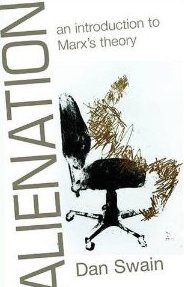
Dan Swain - Alienation: An Introduction to Marx's Theory

Karl Marx's ideas of alienation are often portrayed as being overly complex. Yet they are a rich and fascinating examination of the way that human lives are distorted by the capitalist society that we live in. Dan Swain's new book is a short, but never superficial examination of this part of Marx's work, it is a brilliant introduction to the subject and deserves a wide readership, particularly amongst people who are getting to grips with Marxist thought.

Swain locates his explanation of Marx's theories firstly in those that had come before. He describes how, out of the enlightenment, thinkers like Rousseau and later others like Hegel and Feuerbach were trying to get to grips with the place of humans within the natural world. Their criticisms of the established order of feudalism looked toward a new, more rational explanation of the world.

Marx built on their insights, but he did so critically. He located his understanding of alienation in a materialist explanation of the way that humans interact with the natural world. But he also argued that the alienation that people experience depends on their position in human society. Swain quotes Marx:

"The propertied class and the class of the proletariat present the same human self-estrangement. But the former class feels at ease and strengthened in this self-estrangement, it recognises estrangement as its own power and has in it the semblance of a human".

By locating the experience of alienation in a class society, Marx gets to the bottom of the question. Since, for Marx, what makes us human is our ability to labour on nature, to transform the natural world in our interest, alienation becomes the way that our labour is distorted and taken from us. The way that we lose control over it, the way that the products of our labour are prizes that we cannot have.

I particularly liked how Swain illustrates these theoretical ideas with practical and concrete examples. Drawing on examples from Apple factories and car plants, to working lives in call centres, he shows how people become merely extensions of the machines they work. This has practical consequences. Swain shows how there is evidence that lack of control over the working environmental is one of the biggest determining factors in physical and mental health. He quotes one report that argues "giving employees more variety in tasks and a stronger say in decisions about work may decrease the risk of coronary heart disease."

In one of the strongest chapters in the book, Swain shows how, with the growing environmental crisis, the alienation inherent in capitalism is "fast becoming one of the most important forms of alienation". The way in which the separation between humans and nature is increased under capitalism, as the natural world becomes something to be used for the production process, is directly linked to environmental crises. Swain illustrates this by pointing out that one of the proposed solutions to climate change, emissions trading schemes, is one of the clearest examples of commodity fetishism. Under capitalism, even molecules of gases are considered commodities to be sold.

As I said, this is a brilliant introduction to Marx's work on alienation. It deserves to be read widely and, it doesn't locate the question in an academic debate. Perhaps because of this, Swain is able to conclude on an optimistic note. He demonstrates how many of the problems he discusses break down during revolutionary changes. He quotes an Egyptian revolutionary speaking of the events of 2011, "Freedom for the worker did not only mean freedom to vote or freedom of expression, it also meant freedom from hunger and the constant threat of unemployment... Dignity was a meaningless notion unless it meant an end to poverty and need."

Marx's thoughts illuminate better the world around us. Swain explains them with clarity and straightforward language. He also updates them for the 21st century world of work, but shows how very little has changed from the early days of capitalism. I would recommend this introduction highly.

Friday, March 09, 2012

Neil Gaiman - Anansi Boys

Having now read three of Neil Gaiman's excellent fantasy novels, I think I've discovered a pattern. It basically  goes like this. Lead character of novel finds himself experiencing fairly inexplicable events. Turns out, reality is actually not as lead charactr thought. Magic, Gods or something else as unbelievable also share our world. Gradually said character accepts this new reality and even begins to be able to take part in it. Eventually world is saved by this character discovering hidden talents, God like powers or magic.

So it was with American Gods and Neverwhere. So it is also with Anansi Boys a novel that shares some of the world view of American Gods and at least one character. Anansi Boys though, is a much shorter, tighter and more straightforward novel than the other two. At the beginning of this story the God Anansi dies. Anansi was a trickster, enjoying jokes and tricks, poetry, singing and the finer things in life - wine, women and song. Charlie Nancy doesn't. The only things Charlie wants are a quiet life far away from his father. When his father dies, Charlie discovers a previously unknown brother, Spider, who seems to have inherited the worst aspects of their dad and proceeds to destroy Charlies life. Sleeping with his fiance, getting Charlie arrested for white-collar crime and the like.

The story, follows a traditional pattern. Charlie realises that his brother seems to have unusual powers and his attempts to have Spider banished, by making a pact with another God, only unleashes further problems. Making pacts with the Gods tend to have double sided consequences.

All in all, its a fun read. Existing Neil Gaiman fans will enjoy it, and the sub-plot, which is a neat little whodunit that ties all the strands of the magical world plot together with the bemused non-magical world orbiting Spider and Charlie, is quite fun in and of itself. The characters are pleasantly flawed. No goody two shoes here. Read it if you enjoyed American Gods, but do read that first.

Related Reviews

Gaiman - American Gods
Gaiman - Neverwhere

Wednesday, March 07, 2012

David Graeber - Debt: The First 5,000 Years

David Graeber has produced an important and stimulating book. It is a radical book that clearly has its roots in the anti-capitalist movements that the author has been part of. But it is more than simply a book that is designed to challenge capitalism. Graeber is attempt to argue that the conventional way of looking at the world is wrong, and that the way we have lived our lives in the past has been very different to how we do today.

Debt, Graeber argues, means a very specific thing to us today. It is an obligation that we accept we have to someone else, be that someone a bank or a loan shark. The obligation we feel is the sense that the debt (usually money, though not always) must always be paid back. Graeber contrasts this, with how obligations have been viewed in the past. For most of human history we have organised our lives through hunting and gathering of foods. In these societies, the obligations we had were never the result of someone making a loan with their own material interests. There were no hunter-gatherer loan sharks. Graeber illustrates this well with an example from a well documents group of hunter-gatherers, the Innuit.

One person who lived with and studied the Innuit described returning empty handed from a hunt. Fearing hunger, he found a successful hunter giving him several hundred pounds of meat. The man objected to his thanks.

"Up in our country we are human!" said the hunter. "And since we are human we help each other. We don't like to hear anybody say thanks for that. What I get today you may get tomorrow. Up here we say that by gifts one makes slaves and by whips one makes dogs."
Such attitudes do not simply come from shortages. Other anthropologists such as Eleanor Burke Leacock have documented how hunter-gatherer tribes share food out, even when there isn't enough for everyone. In other words, the obligations people feel are rooted in their collective life, not out of self-interest.

The way these attitudes change is a great theme of Graeber's book and would be difficult to cover here. He is at pains to argue that debt as a general notion has existed throughout history, though most of the time it has been more to do with human social relations than with material gains. These social debts might be the obligations you take on when marrying someone - the promise to feed and look after them. They might also be the money you give as a dowry - not a payment, but a donation towards the cost of living. Over time, Graeber argues and in many ways, such social obligations take root as material debts.

Graeber upsets a great many apple-carts. One of which is in his discussion of Adam Smith and the conventional economics that have flowed from his ideas. In trying to answer the question "what is money?", Smith and others always answer in similar ways. "Imagine a world without money. We'd have to survive with barter. I have a bag of nails, you have a loaf of bread. I must exchange bread for nails. This barter economy is cumbersome, so money develops". I paraphrase, but you get the idea.

Graeber argues that there is no evidence for "barter economies". Those who say for instance, that when the Roman Empire declined in an area, society "returned to a barter economy" are placing their vision of what they think happened over reality. The truth is that Roman money disappeared, but in its place remained alternative currencies, sometimes virtual ones. "Barter economies" says Graeber did not exist, exchange took place through elaborate systems of credit. With the development of urban economies rather than early agricultural ones, people might need bread, and only have nails, but the loaves would have a particular value assigned to them, as did nails. Graeber cites plenty of examples of societies which have distributed goods to people who need them, waiting for future payment when fishermen returned with their catch or the nails were manufactured.

So explains that after the Romans left, villages might no longer have Roman money. But they did have Roman prices. They might value a sheep as so many pieces of gold and bread as so many pieces of silver, and this allowed exchange to take place. Money wasn't real, debt existed by in a concrete sense of credit. Not an abstract one. Presumably the person who failed to come good on his or her debt was eventually refused assistance.

All this is very interesting, and it certainly seems plausible. The problem with the book for me was that I don't think that Graeber really gets a handle on what drives human economies. It isn't debt, nor is it finance. Production exists because people need to provide for their material needs and the way that production is organised determines all the other aspects of their society. The way that the forces of production in society develop, challenging and changing the relations in society ultimately helps bring about change. This is a very short explanation of historical materialism, but I think Graeber would have benefited from expressing his history in terms similar to this. Otherwise you are left feeling distinctly like human history being a series of events that are connected only through a gradual development of a money economy.

I also feel that Graeber misses out a class analysis. That's not to say he doesn't acknowledge the existence of classes. He is very clear that these do exist in society and critical of the attitudes of the rich towards the majority of society. But I don't think he explains what motivates people in different classes. Why do the rich behave like they do? Why are they so irrational in their behaviour?

Capitalism is a fundamentally different human society to earlier ones. Its economic dynamic is the need to accumulate wealth, for the sake of accumulation. This is not the same as earlier class societies. The lord of the manor did not go out and exploit the peasants for the sake of it. He did so until he had satisfied his needs. Capitalism exploits workers because it needs more wealth, to reinvest and restart the treadmill of production. This difference also shapes how we perceive ourselves and our relations to others. In this context debt between people takes on a different meaning under capitalism then it did in previous societies. We are atomised and individualised, set competing against each other.

That said, Graeber has some good insights into different eras of human history and it may well be my own personal predilections that lead me to think his chapters on hunter-gatherers are the most interesting. This is a book that will be debated and discussed at length and is worth study. While there are holes to pick and arguments to be had, the themes are generally of interest.

Readers wanting a more in depth critique of Graeber's book are directed towards this review here.

Monday, March 05, 2012

Adrian Bell - Men and the Fields

There is always a danger when reading books about the rural past, of falling into the trap that there was a wonderful utopian life that has been forgotten, destroyed or superceded. Adrian Bell's book avoids this trap precisely because it is a celebration of what he saw and loved, rather than an attempt to pretend the world  was something it was not.

Bell was himself a farmer, though he was an accomplished writer. He loved nature, people and the landscape. Men and the Fields is his celebration of those things in various rural parts of lowland Britain, particularly Suffolk and the south coast. Bell's gift is a brilliantly economic style that sums up his surroundings without feeling like the reader is having descriptions piled onto descriptions. Here he ruminates on the view from a train station, but equally important is the station master:

"Out of the cottage came a countryman dressed in gold lace: he was the station master. He gave me my ticket and recommended the view from the end of the platform. I said I had seen in beautifully from the river. He insisted it was better from the platform: you could see all along the valley both ways. So I went and sat at the end of the platform. There were two sets of arches: the railway and the road, bridging each other and the depth at different levels. It was like a dim picture of ancient viaducts I remembered sitting opposite once in a farmhouse dining room. I would have thought I had made it up from that picture in a dream. But somehow that railway ticket was never collected. I have it still."

For Bell, the countryside cannot be seperated from the people who live and work there. His descriptions of fields rarely ignore labourers. His love of birds and plants frequently are linked to locals who tell stories of them. Here's a delightful description of a farming couple:

"A woman comes round into the wind; a big woman dressed in sacks and gum boots. The sacking bulks her out and the boots make her legs look like a horses. She comes out into the gale and hardly pauses in the force of it but pushes on through giddy straws across the stackyard... Then she stands full blast and shouts orders to a man in the field - she looks stronger than the wind."

The rigid class differences of the agricultural world lie, barely concelled below the surface of Bell's accounts. The deep respect from labourers for their masters, is often combined with a cynical attitude to those betters who think they know it all. There's a telling tale from a labourer who recounts the different attitudes of farmers towards their workers. The one who offers a cold glass of beer on the doorstep on a winters day, the other who stands him by the fire with a warming whiskey.

Bell was writing about the 1930s. British farming was coming out of an enormous depression caused by withdrawels of wartime subsidies. It was about to be transformed again, the Second World War led to an enormous expansion of farming and the massive motorisation of the industry. As he writes, rural Britain is on the cusp of change. Bell notes the changes to the roads, the impact of the motor car on flocks of sheep, but he doesn't reject these, he sees them as part of an evolving, changing countryside. The beautiful language combined with the wonderful colour paintings that accompany the book, by the artist John Nash combine to make this a lovely read and a lovely piece of art in itself.


Related Links


Whitlock - Peasant's Heritage
Archer - A Distant Scene

Kerr Cameron - The Ballad and the Plough

Age of Uncertainty has more of John Nash's paintings from Men and the Fields here.

Wednesday, February 22, 2012

Stephen King - The Waste Lands

Volume three of Stephen King's series, The Dark Tower, develops the story into a much more concrete and traditional form. I found the two earlier novels slightly esoteric. They were readable, but seemed a little indistinct. The Waste Lands brings together some of the earlier loose-ends and seems to be taking the series onwards quite well.

The hero of the books, Roland, the Last Gunslinger is now permanently joined by two companions who we met in the previous book. All the characters exhibit imperfections, though Roland represents less the fallen individual, but the last of a noble race, who has watched, perhaps for centuries, his world decline. This fallen world is the real star of the story. A once powerful technologically advanced society has collapsed. Cities are ruins, population collapse has left a few small groups of people, who have lost the art of repairing their old technologies. In places these have reverted to almost medieval societies. Elsewhere groups of violent thugs scavenge the surrounding country like something from Mad Max III.

Roland's quest for answers takes him and his companions onwards. As they travel we learn more about the world around them, and our heroes themselves. But as I said, the world is the real centrepiece of the story. It appears to have some sort of relationship to our own, a crashed aeroplane is marked by insignia that we would recognise for instance. What keeps the story ticking over, like a lot of King's writing, is the desire for an explanation of what is going on. Where are they? What is the Dark Tower? What are the links with Earth? Knowing King, no definitive answers will be forthcoming even after all the sequels have been read. But the beauty of King's writing is that the reader probably won't mind. The point IS the journey.

The Waste Lands ends mid flow. It is much faster paced than the earlier stories, though I found it more readable and enjoyable. The urge to read the sequel as soon as possible has not left me yet.

Related Reviews

King - The Gunslinger
King - The Drawing of the Three
King - Wizard and Glass

Monday, February 20, 2012

Chris Stringer - The Origin of Our Species

Trying to understand the development of the earliest humans is an extremely difficult task. What evidence there is, is limited to a  few fossilised bones from a handful of sites scattered across the world. Most of the other evidence comes from the DNA extracted from those bones, or a the stone tools that seem to have been produced in vast quantities by these early humans.

Chris Stringer's new book is probably one of the best introductions to the subject that I have read. His account is determindely materialistic. It is rooted in the evidence we have, and an understanding of the wider environmental conditions hundreds of thousands of years ago. It is also approachable, though I did find some of the sections on DNA needed re-reading at times, but they are rewarding if the reader perseveres. Rarely does a writer actually explain how the DNA is obtained and how it is studied.

Stringer has a long pedigree in terms of the academic study of ancient humans. He was one of the first scientists to argue for an Out of Africa hypothesis for modern humans. The idea that our species, Homo Sapiens, spread outwards from Africa, following earlier migrations by earlier species of humans. According to this theory, which it seems, is now fairly common currency the origin of Homo Sapiens was a fairly recent one and our immediate ancestors only left Africa around 100,000 years ago. Surprisingly it took some 65,000 more years before they reached Europe. Spreading initially eastwards, through the modern Middle East and into Asia.

Of course, with limited evidence controversry reigns. Stringer doesn't shy from giving both sides of a debate, though he never fails to give his point of view, backing it up with his own examples and evidence. Take the discussion about why the Neanderthals died out and were replaced by modern humans. Stringer cites the work of colleagues like Clive Finlayson, who argue that the Neanderthals were on a long decline and that their last homes, in Gibralter, were the last places they survived. The existence of their species ended by a changing climate to which they couldnt adapt.

Stringer's argument doesn't dismiss this, but builds on it. He argues that in some places modern humans may have pushed the Neanderthals out, in others the Neanderthals may have died out unable to adapt to a changing world. Modern humans may or may not have been present, but it seems unlikely that Neanderthals and Homo Sapiens were always in competition, particularly given evidence that they may have exchanged ideas and interbred. This seems to me a more realistic answer. Trying to reduce the end of a intelligent species like our human ancestors, simply to climatic changes doesn't feel right. A more complex interaction with a changing world, with different groups struggling to adapt and one being better than the other seems much more logical.

Stringer also touches on other debates and discussions. How did language develop? Where did geographical differences in human bodies come from and when? How did changes in our bodies relate to changes in our behaviour and brains and vice versa? Many of these questions have surprisinly detailed answers given the lack of archaeological data. Chris Stringer has produced an excellent introduction to the subject. It is an excellent starting point for the debates and discussions around early human evolution.

Related Reviews

Finlayson - The Humans Who Went Extinct: Why Neanderthals died out and we survived

Thursday, February 16, 2012

Robert Gildea - Marianne in Chains: Daily Life in the Heart of France During the German Occupation

Having read Angus Calder's wonderful book on the experience of ordinary people in Britain during World War II, I began to wonder if there was a similar work that examined the lives of people elsewhere during that conflict. Marianne in Chains was suggested to me as a book that might help bring to life the experience of the German Occupation of France.

Robert Gildea argues that the French experience of the Occupation is far from the simplified one that is usually portrayed. Far from the population being divided into those who resisted, and did so united together, and those who collaborated, he believes that reality was much more complex. In particular he argues that those who resisted were very much in a minority and that most people acted under a more complex code. For instance he considers the case of employers who committed their factories to producing materials, such as weapons, for the German war effort. Here he argues that the consensual view at the time was that "employers had no choice about working for the Germans and that jobs had to be preserved [or the factory might be relocated to Germany]. What was not acceptable was doing the German's bidding with too much enthusiasm and putting pressure on workers to go to Germany."

Later he continues "[a]s a rule of thumb, actions that undermined the family, community, or nation were illegitimate... To rip off the Germans by small-scale black marketing was just Gallic cunning, but large-scale dealing that deprived the community of scarce resources was not considered right. Socially, it was acceptable to drink with a German in a bar but not to invite him home" and so on.

Where resistance did occur, Gildea implies it was rarely the action of a whole town or community. He examines one important case, the assassination of a leading German soldier Colonel Hotz by a Communist, Gilbert Brustlein. After the war, the PCF argued that this action had helped trigger mass resistance in the west of France. For the people of Nantes however, the event was remembered as ushering in repression and the murder of dozens of people in revenge.

For Gildea any resistance that took place was likely to be much more muted. A defiant piece of graffiti or displaying the French flag, singing the Marseille or engaging in illegal dances. Here though the breaking of German rules is considered rarely an act of conscious resistance as opposed to an act of rebellion against rules.

However while Gildea is clearly right to argue that any resistance to the German Occupation rarely involved thousands of people taking up guns, in his enthusiasm to pursue this theme I think he misses far more fundamental questions. This becomes clearer when he examines the events that took place as the German's ordered Jews to be identified, then deprived of their social positions and eventually deported.

Gildea argues that when it came to the "Aryanization" of the French economy - depriving Jewish business owners and workers of their positions, the removal of Jewish company directors and so on, the "French public could be a good deal more anti-Semitic and mercenary than the French administration." He lists a number of heart-breaking examples of how business owners, like the owner of the Cafe de la Ville in Saumur, "saw the opportunity to deal with a rival by complaining to the sub prefect that 'the Jew Lazare Schnerb' had not yet put up a yellow sign on his Hotel-Bar."

Other examples include firms were directors turned on Jewish directors to save their investments. Lawyers who took on the "administration" of Jewish businesses then often took over those firms. Jewish businesses that were sold off were not short of buyers. Gildea concludes that:

"The details of the process of Aryanization provide hard evidence of the anti-Semitism of at least a portion of French people, including the wealthy and privileged, a conclusion that goes against the grain of some recent writing that tends to blame the Vichy regime while exculpating the people."

While this is undoubtedly true, Gildea concentrates on business examples. His only counter examples however are from a different section of the French population - the working class:

"The labor inspector of Maine-et-Loire, Lehlmann, refused to organise a census of Jewish employees in private firms, with a view to dismissing them, saying that his job was to protect workers."

While Gildea frequently discusses strikes and actions of working class organisations, particularly the Communist Party, he lacks any class framework. This leads I think, to a lack of clarity when he's trying to explain the dynamics of the occupation. The working class prior to the war had seen enormous rebellions, particularly during the Popular Front government. The lack of any major French fascist forces was in no small part due to the activities of the working class movement in the early 1930s. The demoralisation that followed, in part because of the limits of Third Period Stalinism, had led the PCF into a dead end. The fact that significant numbers of workers did strike, even if it was mostly over bread and butter issues, during the war, shows the reality of what resistance meant.

This is not to say that Gildea is wrong to argue that the reality of France during the occupation was not one of mass resistance. As he points out, many places never saw a German soldier and the occupying forces took a conscious decision that they were not doing to France what was being done in Poland and Eastern Europe. "The Germans are not the enemies of France, but their friends" stated one German military administrator to his French colleague as he prepared to leave following the Allied invasion.

Perhaps the strongest part of the book is Gildea's examination of the transition from occupation to the post-war world. He makes the point that most of those mayors and town bureaucrats who had continued in place during the years of Vichy and Occupation remained in their seats and were re-elected. Those who joined the resistance (or claimed membership) often did so late in the day or to avoid, what they saw as the potential for Communist rebellion in the wake of the war. Gildea looks at the way that the myth of the resistance was being created even as the German vehicles pulled out of the town squares, but that often this covered up the fact that for much of the war, many bureaucrats had collaborated with the fascists believing that they had no other choice.

Robert Gildea's book has provided much food for thought. I do not think it should be the last word on this subject though as it certainly left me feeling unsatisfied. I felt that there were insights but that Gildea hadn't quite got to grips with what was really happening. The book probably suffers because it concentrates on a particular region of mid-France rather than Paris or other larger cities. Nonetheless this is an interesting read, though I am told that Robert Paxton's book on Vichy France covers the subject far better.

Wednesday, February 08, 2012

Pierre Broué - The German Revolution 1917-1923

In the introduction to his own book on the German Revolution, the Marxist Chris Harman wrote that "Revolutions that are defeated are soon forgotten. They become lost from view; footnotes to history, glossed over by all but a few specialist historians." This is indeed true of the German Revolution, in part because the defeat of this revolution was the beginning of the "midnight of the century". Had the German Revolution been successful, it is likely that Hitler would never have come to power, the Holocaust been avoided together with the Second World War and the Russian Revolution would have lost its economic and political isolation. Stalin might not have seized power and the history of the second half of the twentieth century could have been very different.

Pierre Broué's book on the German Revolution is extremely important. Its detailed analysis and systematic use of the archives available at the time it was written mean that it is an important text of history itself. This is part serves to rescue some of the "Lost Revolution" for new generations. But Broué is no objective historian, he writes with the explicit intention of understanding the defeated revolution and the forces involved to better arm future socialists and revolutionaries. He concludes that "the history of the Communist Party of Germany during the early years of the Communist International ceases to be a history of lost illusions, and become the prehistory of a struggle which continues to this day."

Despite covering an event that lasted barely five years, the book is enormous in its scope. The Brill edition that I have read weighs in at almost 1000 pages (though rather extraordinarily and frustratingly it has no index, which for a book of this nature is a terrible omission). It would be a mistake for me to attempt to tell the actual narrative of the German Revolution in this review, instead I recommend both this book and other readings below.

Broué begins with the concrete forces on the ground, or the "battlefield" as the first chapter is called. Broué weighs up the isolation of the revolutionary left in Germany during the First World War, a few thousand individuals, with no common organisation or strategy. A few individuals such as Rosa Luxembourg and Karl Leibnickt remain prominent, both from their anti-war campaigning and their prestige from years in the German Social Democratic Party. The SPD had, at the outbreak of war, abandoned its traditions of revolutionary Marxism and supported its own national bourgeoisie. Millions of workers were demoralised and isolated by this, and many supported the war itself. But as the years passed, conditions worsened and the reality of modern warfare became apparent. The German Revolution exploded in November 1918, driven by a enormous mutiny of sailors who refused to take their ships to certain destruction. Within days the revolt had spread the length and breadth of the country and revolutionary organisations, councils representing workers, sailors and soldiers were elected. This was enough to force the abdication of the Kaiser and bring an end to World War One. The weakness of the movement was the lack of political clarity and the old SPD, reclaiming its socialist mantle was able to take the movement by the head and subdue the revolutionary impulse. With a new government in power, the counter-revolution began and many militants, including Luxemburg and Liebknecht, who had just formed the German Communist Party (KPD) were murdered.

The strength of Broué research though, is to put this into the context of the changing Germany. The story of World War One here, is not one simply of passive acceptance of the slaughter in the trenches, but also of heroic individuals who organised anti-war activities, who printed leaflets and distributed them on pain of death, who organised underground networks of workers and militants to strike and protest against food shortages and worsening conditions.

This approach to the history of the revolution continues throughout the book. Broué constantly attempts to get across what the situation was like on the ground. In part he does this by reporting the slogans and "political lines" of different left organisations, such as the KPD. But he also reports from the memoirs of individuals involved. This is a social history from the bottom up, but not one were individuals are examined in isolation. The role of the political parties is scrutinised deeply, particularly the KPD and its predecessors. Related to this, is the importance to which Broué places the role of the Communist International.

The Russian Revolution had a profound importance for the German Revolution and those who took part in it. Early photos of the street demonstrations of November 1918 show placards with "All Power to the Workers Councils" written on them, and Karl Liebknecht in his speech to the assembled masses in which he declared the Socialist Republic of Germany, extended greetings to the brothers in revolutionary Russia.

The Russian Revolutionaries, conscious of the need to spread the revolution, created the Communist International to assist with this, and the influence of the International was felt throughout the years covered by this book and beyond. This was in terms of financial aid, Broué comments on how the resources of the KPD during 1923, the year of extreme economic crisis were helped by the CI which:

"in 1923, the material help of the ECCI [Executive Committee of the Communist International] permitted the Party to maintain 27 daily papers, and to pay 200 full-time workers. With its own resources, the KPD could have maintained only four papers, and barely a dozen employees."

But the assistance was also personal, both in terms of individuals like Karl Radek who spent months at a time in Russia assisting and advising the German socialists, as well as reporting back to Moscow. Additionally, delegates from the German socialist parties would visit Russia for advice and discussions.

One of Broué's themes is that the revolutionaries were frequently unprepared for events. The spontaneity of the November revolution took even the most brilliant Marxists by surprise. Yet frequently the KPD were left bewildered by events. Take the Kapp Putsch, when a proto-fascist leader attempted to seize power, only to be prevented by mass strike action happened almost independently from the KPD leadership who initially denounced the strikes.

Part of the problem was that the KPD constantly looked to Russia for advice. While this was was understandable, the Bolsheviks had, after all, made their own revolution, the situation was very different. It also led to a certain lack of self-confidence from the Germans as well as a certain naivete. Broué quotes one German KPD leader, again in 1923, as arguing that;

"under no circumstances should we proclaim a general strike. The bourgeoisie would find out what we are planning and would destroy us before we start. On the contrary, let us soften down out spontaneous movements. Let us hold back our groups in the factories and the unemployed organisations so that the government will think that the danger is over. And then - after they are lulled into an illusion of complete safety - let us strike in one night, quickly and decisively, arrest the government, storm the Reichswehr barracks and ring the knell of the last battle."

Such simplistic notions of how class struggle can be carried out were extremely worrying, but in part they had be fostered by an International that had encouraged the German's to believe that they were on the verge of revolution. Despite the bravery of thousands of communists, the belief that revolutionary movements could be turned on and off like this had soured the organisation for several years. The faith in the CI as an instrument of revolution helped undermine the ability of the KPD to understand the mood inside the workplaces and on the streets. This is why the mass strikes that brought down the Cuno government in 1923 seemed to come out of the blue for the Communists and why, when the CI insisted that another revolutionary movement was on the cards in October 1923, the leaders of the KPD were unable to argue against them, or present a more realistic portrayal of the balance of forces.

This is not to say that the CI was a negative force. Without the CI the KPD would have indeed been short of resources, as mentioned above. But they would also have been without some brilliant leaders and ideas. The turn taken by the Communist International towards United Front work in the early 1920s as the revolutionary moment ebbed was crucial in Germany. It meant that the growing KPD would try and find common ground with the members of the SPD over concrete demands, and pull them towards revolutionary politics, out of the arms of reformist leadership of the SPD. As the fascists began to grow, and increasingly use murderous methods against the left, such united tactics would prove indispensable. Their abandonment in the Stalin era, post 1923 for a set of politics that deemed the SPD worse than Hitlers' movement, would lead directly to the destruction of the left.

The problem was that the KPD became a mass party in the midst of successive revolutionary periods, or at least periods of intense class conflict. This meant that at its core were very few revolutionaries who had been skilled in years of organising. The lack of self-confidence at crucial moments, betrays a lack of confidence in their own organisation and ideas and that in turn, is a consequence of lack of experience.

This problem begins with the death of Rosa Luxemburg and Karl Liebknecht. Their murder removed the best leaders of the revolution, individuals who, had they survived would have developed and learnt from the different stages of the revolution. Certainly, it is hard to imagine Rosa Luxemburg who had, over the decades, engaged in fraternal debates and polemics with Lenin and Trotsky, accepting the ideas of the CI automatically.

A third key individual, was the revolutionary Paul Levi. Broué's book in some ways is an attempt to rescue Levi and his legacy from the mud that has been thrown at him over the years. For a period in the immediate aftermath of the deaths of Luxemburg and Liebknecht he was the KPD leadership. His instincts were cautious and balanced the ultra-leftist tendancies of the young organisation, but mixed with this caution was a genuine gift for understanding the balance of forces. His critique of the KPD in calling the March Action in 1921, an attempt to physically kick-start the revolution, was entirely accurate, yet his breach of discipline was severe enough for him to be expelled. Sadly Levi refused to attempt to work for conciliation and he became another lost leader, in a time when his experience and links to the pre-war socialist movement would have been invaluable.

Broué finishes the book with an analysis of the CI itself. It is clear that the author puts much importance to this body, indeed he wrote a history of the Third International that has yet to appear in English. For Broué the CI was a brilliant tool, but a flawed one. He quotes Lenin, arguing that many of the motions passed by the CI were "too Russian", i.e. that they were based too much on the Russian experience, with all the differences that existed between that country and those of Western Europe. As one chapter title has it, "Grafting Bolshevism onto German Stock" was never going to be easy. Broué acknowledges that often the KPD had it right,

"relations between the KPD and the Russian Party between 1919 and 1922 followed almost constantly the same pattern: a sharp conflict at the level of proposals made or initiatives taken by the Germans; a vigorous critique by the leaders of the ECCI; and then an intervention by Lenin, who while making some formal criticisms, judge the German initiative acceptable". 

With Lenin's death and the loss of his personal prestige and brilliant analysis, this process was made worse. Lenin fought to develop and build the independence of the KPD as well as maintain its organisation integrity, taking a deep and close personal interest in the ideas and activities of individual German leaders. Following the defeat of 1923, Broué concludes ominously, that the role of the CI was fundamentally different, from then onwards "the policies of the KPD were to be written almost entirely in Moscow, and in Russian."

Broué's has produced a rich and important text here. The detail is astounding and, particularly I imagine, for those engaged in the socialist movement today, the defeat and mistakes made in this period are terrible to read about. The lost opportunities doomed millions to a terrible fate in World War Two and the Holocaust. But learning from the past, and in particular, learning the lessons of revolutions, even lost ones, is something that is important to those organising today. Broué's book deserves to be a key text for revolutionaries today, those building movements or engaging in revolution will find much of use here.

At the heart of Pierre Broué's monumental work, is the idea that ordinary people can and do change the world. Its this revolutionary emphasis that makes this book more than a work history but part of helping us change the future. As he puts it near the end;

"We believe that the German Communist Party could have been victorious, even though it was defeated. There does not exist any Book of Destiny, in which the victory of the Russian October and the defeat of the German October, and the victory of Stalin and then Hitler, could have been written in advance. It is human beings who make history."


Related Reviews

Campbell - A Rebel's Guide to Rosa Luxemburg
Luxemburg - Reform or Revolution
Reissner - Hamburg at the Barricades

Recommended Reading

Chris Harman's history of the German Revolution, The Lost Revolution, is a superb introduction to this event and, while similar in analysis to Broué he has a number of differences. It is also shorter and much easier to carry on the bus. You can buy it here. Revolutions don't just have economic consequences, they change all sorts of aspects of people's lives, The German Revolution for instance, led to new freedoms for gays and lesbians, Colin Wilson's article here has much more about this aspect.

Neil Davidson has reviewed Broué's book here and I recommend that review. Leon Trotsky's Lesson's of October is a polemic written about and in response to the failure of the German Revolution. My own review of this contains further links to aspects of that discussion.

In this Socialist Worker article Ian Birchall introduces two short extracts from The German Revolution. His conclusion that "Broué was a revolutionary first and an academic second. He knew which side he was on and he knew what was at stake" is a fitting tribute. He also wrote a obituary of Broué here.

Tuesday, February 07, 2012

Ernest Cline - Ready Player One

If I was being brutally honest, I'd say that Ready Player One is a vehicle to deliver a particular kind of self-satisfaction to a geeks of a certain age. Or at least those who'd like to think they are. While the story is quite novel, the real satisfaction in his book is spotting and getting the references. As a result the story has a number of plot holes, or deus ex machina which complete the story. But that's not the point. Ready Player One is the sort of read that takes the reader along, rather than trying to deliever a fully rounded plot.

Set in the fairly near future, Earth has become an over-populated, ecological disaster zone. High prices for fossil fuel have meant that the vast majority of the world's population rely utterly on government handouts to survive, or a life of crime. As always a few have made it very rich and corporations run roughshod over people in order to maximise their profits.

As a solution to this misery, a ruclusive video-game designer, obsessed with the culture of the 1980s, creates OASIS, an alternate reality world. This multi-verse has many planets. Players can go to lessons there, move around the planets and, should they earn credits and XP, they can in turn purchase upgrades and expansions, giving them more powers and abilities. OASIS itself is a fully functioning alternate reality. Sex, violence and work exist here. Avatars fight each other for money and prizes, rather than merely points. The creator, James Halliday became the richest man on the planet, and his libetarian, benevolent views have sought to keep OASIS accessible to all.

With his death, Halliday unveils a quest. Those who find the hidden Easter Eggs can inherit his vast fortune. Such a implausible hope inspires millions of people to spend their lives mastering 1980s culture to search out and understand the clues in the hope of freeing themselves from poverty. Of course the corporations too are in on the games, they can afford to pay underlings to learn about obscure computers games, or the lyrics to 1980s songs.

And its here that this bizarre plot actually works. Rather than this becoming some strange work of fiction based on a World Of Warcraft storyline, the internal references to Midnight Oil (The Beds are Burning), the awful sequels to Indiana Jones (post Crystal Skull) and so on are enough to hook those of us who remember the 1980s, or some of it. There is also plenty here for the contemporary geek - who wouldn't vote for Cory Doctorow to be in charge of their online multiverse?

The rag-tag bunch of social misfits who try and solve the clues and win the prize, the vision of the internet / OASIS as some sort of anarchic alternative to reality and the faceless corporations that kill on a whim are not particularly new, but Ready Player One works, rather surprisingly and make for an amusing Back to the Future type of distraction for a few hours.

Sunday, February 05, 2012

Kim Stanley Robinson - The Years of Rice and Salt

Kim Stanley Robinson's alternate world history is an incredibly well thought out imagining of how our world might of developed had European civilisation been stopped completely by the Black Death. In this alternate timeline, history develops outwards from the far-East, China in particular. Thus the world is dominated by different religions, ideas and methods.

The scientific revolution takes place in Samarkand, the America's are discovered from the West by Chinese explorers and geo-politcal tensions eventually explode in a pre-atomic age world war, only in this timeline it lasts six decades.

The detail of the story is immense, rather than telling a complete narrative, the author focuses on individuals at different times. Borrowing heavily from Buddist ideas, Robinson centres the story a small group of individuals, reincarnated time and again, they occasionally remember their own pasts, and at different times and places are each others parents, lovers and friends. This allows Robinson to focus on indivudal relationships as well as the grand narrative and helps make this unreal history seem much more realistic.

At times, the book seems over-seeped in religious and ideological discussion. This can be annoying, but its worth reading through. With some of the discussions, such as the debates about reincarnation, I think Robinson is demonstrating how different ideas fit different times. In the atomic age, reincarnation seems quaint and ill sits in a world where the tiny atoms are being studied. This is a very religious novel, in the sense that religion plays an important part in the story, and Robinson clearly has done his research well. Again though, his musings on how things might develop and change are clever - I particularly like the way that the shortage of men following the great war leads to a growth of feminist thinking and new forms of Islam, influenced by these ideas.

Robinson himself develops an almost Marxist view of history, though he seems to focus mostly on a sort of inevitable rise of civilisation, through science and technology. Towards the end his characters, this time female scientists, attempt to set up a world grouping of scientists to better lead humanity and avoid nuclear war.

This is a long novel, 700 odd pages, but the different parts are very self contained, some are love stories, some tales of anguish and war. The common threads help it hang together well. There are some lovely injokes to, the Islamic archaeologists attempting to understand the purpose of stonehenge, or excited by a preserved village from medieval France and the musing of people who wonder what the world would have been like had civilisation not come from the East.

While its hard at times, The Years of Rice and Salt is a fascinating and clever novel that's worth reading.

Related Reviews

Stanley Robinson - Icehenge

Friday, February 03, 2012

James Hinton & Richard Hyman - Trade Unions and Revolution: The Industrial Politics of the early British Communist Party

How should revolutionary socialists best relate to situations that are not revolutionary? How should those socialists organise, particularly in periods when the working class is not yet confident to fight against the system, when their rights, pay and conditions are under attack by the capitalists?

These questions are not easy ones to answer, but for socialists in Britain and indeed in large parts of the world, they are crucial ones. In Britain, with its history of Labour politics and Trade Union bureaucracy, it has been common to look back to the early years of the Communist Party and attempt to learn lessons from their activity.

The British CP was founded in the early 1920s. It brought together a number of varied factions of the Marxist left, encouraged by the success and the prestige of the Russian Revolution. Early in its history, as a party of a few thousands, though with many key industrial militants and in places, significant influence in the working class movement, the CP faced one of its greatest tests - the General Strike of 1926. This strike was a bureaucratic one. It stemmed not from the anger and militancy of ordinary workers, but from the leadership of the Trade Unions. Millions of workers took part, bravely and committed yet during the strike it was rare for their own creative organisation to break through the barriers of the trade union bureaucrats. After the defeat of the strike, the CP which had used its influence to encourage workers to look towards the General Council of the TUC, rather than their own self organisation, suffered major setbacks. Along with victimisation of many committed activists, the party lost many members and much influence. Rather than learn from its mistakes, the CP continued down a mistaken path which, it could be argued, left its union militants confused about the role of the union bureaucracy for decades.

This short book, published in 1975 is an explicitly socialist attempt to understand what the CP did wrong and draw some conclusions. Hinton and Hyman make no bones about it. They believe that the CP strategy was based on an incorrect understanding of the role of the union leaderships and an incorrect vision of how to move forward. In particular, they argue that any attempt to build a mass communist organisation in the 1920s was not just doomed to failure, but a mistake that could only further damage the prospects for building the revolutionary socialist movement.

This can be summed up in their conclusion, emphasised by being provocatively re-printed on the back cover. "By attempting to build a mass revolutionary party in Britain in the 1920s, where the labour movement was in retreat, the Communist Party committed a tragic blunder. It sacrificed clarity in its propaganda and its theory, and lost the opportunity to form a revolutionary cadre."

This cadre, they argue, could have formed the basis of a much stronger party in the future, for coming struggles. There is some truth to this. The ongoing existence of many tiny socialist sects throughout the world, demonstrates that theoretical clarity can create resilience. Yet the ongoing existence of a theoretically pure, stable, yet tiny socialist organisation that merely replicates itself over the years is hardly what the founders of revolutionary Marxism had in mind. The CP were, under the influence of the Russian Revolution and the Communist International attempting to build political organisation that could lead to a successful socialist revolution in the UK.

The CP's own analysis of the union leaders was frequently excellent, and their strategies for strengthening the working class movement and building their own influence were based on some excellent initiatives. The National Minority Movement was a CP initiative aimed at "making the trade unions real militant organizations for the class struggle". This attempted to bring together the best rank and file workers with the best of the union leaderships to encourage more militant action. Yet the CP underestimated the degree to which union bureaucrats are pulled by their social position, desiring less social confrontation and more negotiation.

The betrayal of these leaders, including many lefts whom the CP had courted and worked with over the years left the organisation confused. As the authors point out, "many party leaders found the betrayal of the General Strike incomprehensible."

So why did the CP have such a confused understanding of the situation. In one sense, Hinton and Hyman are right. Lack of theoretical clarity stemmed from the confused and ofter sectarian politics that marked out the socialist organisations that had developed in Britain in the late nineteenth and early twentieth centuries. Yet there was also the dominating influence of the Communist International and, in particular the Bolsheviks. The Russian Revolution had be lead by individuals and organisations that had little practical experience of trade unions and reformist organisations. Their understanding of the role of the trade union bureaucrat was limited and, in the aftermath of the Revolution, the isolation of Russia had led the Soviet government to court those organisations in the capitalist nations that could help undermine that isolation. The Anglo-Russian Trade Unity Committee was one example that helped to encourage the British CP to support leaders of British unions.

Hinton and Hyman play down the importance of this, as an excellent critique of this book by Duncan Hallas points out;

"the CPGB was not and could not be left to itself. It was part of a centralised world movement. It owed its very existence to the Russian revolution. Its leaders and members were profoundly influenced by advice and guidance (leave aside the question of “orders”) from the Moscow centre."

Hinton and Hyman also, repeatedly play down the opportunity for building "mass" socialist organisation, it is "only in the most abstract sense that 1926 can be described as a moment of revolutionary opportunity", they continue;

"The Party was operating in a profoundly unfavourable situation... Politically, the established institutions of the labour movement exerted a profound influence over the working class..."


Earlier the authors argue that building a mass organisation of revolutionary socialists is only possible at very specific times, "[t]here are moments, but only moments, when revolutionaries should concentrate their efforts on building a mass party."

The problem with this analysis, is that it is a recipe for sitting back and concentrating on discussing abstract ideas until the moments of revolutionary crisis appear. Yet, by then the moment will be lost as Rosa Luxemburg found to her dismay. You cannot build a mass revolutionary socialist group during the throws of a revolution. 1926 was not a revolutionary moment, yet it was a year when millions of workers took extended action as part of a General Strike, albeit one with many weaknesses. The organisation may have been small, but it had prestige and influence - the Russian Revolution was still a living reality, even with its distortions and the rise of Stalin.

Had the CP operated better during 1926 they may not have become a mass organisation. Certainly they were unlikely to prevent the sell-out of the bureaucrats. Yet they could have won significant numbers of militants to a stronger understanding of their role and the role of the union leaderships. The CP could have ended the General Strike with a growing membership, rather than a shrinking and demoralised one. By tying their flag to closely to the union leaders, they left themselves isolated from the best elements of the working class and hampered themselves for some time to come.

Hyman and Hinton argue that it the CPs strategy should have been one that allowed them to strengthen their own organisation to better ride out the coming storms. But the mistakes made by the CP stemmed in large part from mistaken analysis as well as the degeneration of the political leadership of the Communist International. Socialists cannot abstain from the struggle. The best way of building a revolutionary cadre is not to sit isolated, reading Marxist tomes, but to engage with the movement and further develop the ideas and theories that you have. Theory is important, but it must breath and grow as part of the class struggle. Hyman and Hinton here are arguing against a revolutionary strategy that involved engaging with the working class and, in part, I suspect they were penning a justification for their own trajectory out of revolutionary politics.

I've devoted a lot of words here, to a very short book. In part this is my own attempt to grapple with a similar political situation in Britain. The study of the 1926 General Strike and the actions of the best militants who were organised in the CP is important so that we can avoid similar mistakes in the future. For that reason, this short book deserves to be read, but it should be read in conjunction with other writings, in particular the Duncan Hallas article linked above, but also some of the books mentioned below.

Related Reviews

Cliff & Gluckstein - Marxism and Trade Union Struggle: The General Strike of 1926
Dewar - Communist Politics in Britain: The CPGB from its origins to the Second World War
Trotsky - On Britain

Useful Articles

Chris Harman - The General Strike 
Martin Smith - Britain's Trade Unions: The Shape of Things to Come
Duncan Hallas - The Communist Party and the General Strike

Wednesday, February 01, 2012

Brian Fagan - The First North Americans

Around 15,000 years tiny bands of people travelled across a narrow band of land between what is now the far eastern end of Russia and Alaska. The land bridge caused by the colder climate at the end of the last Ice Age allowed these hunter-gatherers to arrive in a new world. A vast area without humans, but teaming in animal and plant life.

Brian Fagan's book is a brilliant introduction to the history of the next 15,000 years told through the archaeological evidence that remains to us. The earliest arrivals into the American continents left little remains, we are limited to a few handfuls of their stone tools and little else. But these first Americans rapidly developed an astonishing variety of communities and were able to exploit the varied natural world in many different ways.

The story of the Native American's very much one of change. Often this was gradual, though, as Fagan points out, it could be very rapid. For thousands of years different groups remained as hunter-gatherers. The famous site of Head Smashed In a Native American hunting area in modern Canada where bison were driven off a cliff in their hundreds was used for 7000 years. However the "buffalo jump" here was part of a much larger and more complex community rather than simply being a site for killing animals.

One of the great strengths of this book are the brilliant illustrations. Many of these are black and white photographs as well as line-drawings and maps. However pride of place goes to the stunning colour plates, some of which, such as the images of the Mesa Verde, "Cliff Palace" in Colorado are stunning. I particular liked the images of the Clovis points - spear heads used by some of the very earliest peoples in America. These are shown in full colour in someones hand, helping the reader understand why these pointed stones must have been awesome weapons.

The later depiction of the Native American peoples as savages deliberately hides the very complex and advanced societies that they had developed. The arrival of agriculture initially of maize, spread rapidly through the continent and helped some of the groups develop complex, class societies which in turn produced some of the most fascinating archaeological sites. The communities that built the Hopewell mounds or the enormous earthworks at Poverty Point in Louisiana certainly must have had very complex social structures and organisation. Poverty Point was a tiered earthwork with some 35,000 cubic metres of soil. Fagan estimates that all this material, carried in woven baskets would have taken 1,350 people three years if they worked 70 days a year.

Fagan's book covers an enormous quantity of material, rapidly and thus out of necessity it glosses some details and he admits that it concentrates on the basics rather than reporting every archaeological debate and difference. Aimed at the general public as well as students and academics, this is an accessible introduction, though sometimes it tends towards academic jargon. The word "palimpsest" should, in my opinion, never be used if the author is striving to be accessible. Its use here on the first page of chapter one might well be considered off putting.

Fagan finishes by discussing the horrific impact of European arrival on the populations of the Americas. Here he documents the genocide and disease that destroyed thousands of people and generations of culture, often in a few months.

He also discusses the way that European demand for resources such as fur changed the dynamics of the existing cultures. Here I think he underestimates the way that the European notion of commodity ownership helped destroy hunter-gatherer cultures. Prior to European arrival resources or land were mostly for the use of the community or to solve people's needs. Once European traders arrived, the exchanging of resources such as fur, created a situation were commodities were important for their value in exchange rather than their ability to serve peoples' needs. I've discussed this further in my review of William Cronon's excellent book, Changes in the Land here.

But these are minor points that come at the end of a wonderful examination of the development of many different cultures across North America. I would heartily recommend this to anyone interested in the lives of hunter-gatherer communities and the evolution of the earliest class societies. The pictures and maps are particularly enlightening and Brian Fagan deserves credit for bringing them together.

Related Reviews

Fagan - Floods, Famines & Emperors - El Nino & the Fate of Civilisations
Fagan - The Long Summer: How Climate Changed Civilisation
Mithen - After the Ice: A Global Human History, 20,000 - 5,000 BC