Saturday, October 05, 2024

Verlaine Stoner McDonald - The Red Corner: The Rise & Fall of Communism in Northeastern Montana

If you think of the politics of rural America, you probably think of it in terms of conservativism. A mixture of rugged individualistic politics, cynicism about government and conservative political leanings. There's a lot of truth to this. In 2016, 62 percent of the US rural electorate voted for Trump. This reflected the way that Trump's political movement had become the outlet for general discontent at the way small town America had been systematically undermined by successive governments, both Democrat and Republican, and forgotten by an economic system that fails ordinary people in the interest of profits for the rich. In my review of Robert Wuthnow's book The Left Behind, I noted that addressing the concerns of rural working Americans meant developing social movements "whose starting point is that working people, in rural areas and cities, have more in common than their differences."

So on a recent trip to Montana in the US, I was enormously interested to discover, that there is very much a radical tradition in rural America. The radicalism of Montana's urban areas is well known. The insurgent trade union movement of Butte remains a source of pride for working people in that town, and is well documented. But I was particularly excited to learn of Montana's "Red Corner", Sheridan County, which in the early decades of the 20th century, had an extensive radical movement which in the later part of the era, saw Communist candidates being elected to important positions in the County and significant support for left, and communist, politics.

This is a surprising revelation and Verlaine Stoner McDonald's book on the subject The Red Corner, is worth digging out for those who want to know more. McDonald begins with the context. Sheridan County, a remote part of the world even by Montana's standards is buttressed on one edge by Canada and on another by North Dakota. In the late 1800s it was settled by European farmers, many of whom came from Scandinavia, and brought with them left ideas and traditions. McDonald describes the "unforgiving climate", the lawlessness and the difficulties in living on the plains, and argues that this made the population "especially receptive" to the growing "farmers' movement of the 1910s and 1920s":

The movements' message, grounded in the persuasive strategies of other farming and mining organisations in America, would be skilfully manipulated by local political leaders, setting the stage for the astonishing rise of Communism in Sheridan County.

I will return to this comment later. But it is worth dwelling for a moment on the ideas that underpinned the support for such a movement. McDonald explains the,

northeastern Montana farmers' movement, the culture in which it arose, and the types of rhetorical appeals it would use were well grounded in traditional and very widely helf beliefs about the role of farmers in American life. Additionally, the Sheridan County Communists had the advantage of building on a foundation of home-grown populism and labour activism that had been established elsewhere on the Great Plains in the nineteenth century... In the early days of the Republic, American culture was rife with notions about what it meant to farm and to be a farmer, expressed in images that would undergird and enliven the message of the Communist Party in Montana a century and a half later.

These "Agrarian Myth" behind these politics, which celebrated the central role of the farmer to humanity, and specifically the United States, was taken up by a series of farmers' organisations in Montana, and the Plains, "devoted to education, reform, and protest in the rural Midwest and West". There was plenty to protest about and organise around; the cost of living, the price of crops and the realities of farming life on the prairie. The National Grange, one of a number of such organisations, founded in 1867, promoted 

an image of farmers as important and knowledgeable (or at least educable) members of the economic system who were standing up to assert their rights. Grangers also would not hesitate to identify those who would deprive farmers of their rights. In this effort the Grange made occasional use of appeals that would become commonplace in farmer activism, that is, pitting the producers against nonproducers. As banners in an 1873 Grange Independence Day parade asserted: "This organisation is opposed to railroad steals, salary steals, bank steals, and every other form of thieving by which the farmers and laboring classes are robbed of the legitimate fruits of their labour."

It is easy to see how politics like these could evolve into the socialist politics of the 20th century. McDonald notes how the growth of global radical politics in the early years of the new century was mirrored in the United States and Montana. Anti-war, left and socialist politics grew massively in the years before World War One, and mushroomed following the Russian Revolution in 1917. These had their echo in rural Montana where it became focused around the radical farmers' newspaper The Producers News, edited by Charles E. Taylor.

Taylor is a central figure in McDonald's book and this is not the place to retell the whole story. His newspaper became enormously influential, connected as it was to the farmers' movement the Nonpartisan League. The League was accomplished at linking political concerns to mass agitation. Organising meetings, parades and even picnics. It drew in large numbers to its events, and some of its speakers became incredibly well known. Taylor however, developed The Producers News into something more than the mouthpiece of the movement. He filled it with popular columns and editorials, injected plenty of gossip and satire, and was not afraid of mocking and insulting almost everyone else. It was a potent mix and as Taylor's own politics developed, the newspaper carried him with it. As the League morphed into the Farmer-Labour Party, Taylor was twice elected to the Montana senate.

The influence of the left, and the Communists, in Sheridan was extraordinary. As McDonald summarises, at one point 

"Reds" occupied every elected office in the county and had sent a covert Communist to Helena as their state senator for two terms. Local youths could attend camps where they were actively indoctrinated with Communist ideals, and the radicals' newspaper flourished... In [1932], former sheriff Rodney Salisbury was on the ballot in an attempt to become the nation's first Communist governor.

Taylor seems like a fascinating figure, hardworking and exuberant, with a talent for seizing the moment. He was also a socialist, and eventual member of the Communist Party. The US Communist Party had grown, in difficult conditions, out of a complicated merger from a number of different socialist organisations. It was very much a Party that was reliant on its links to the Soviet Union, and while its activists where principled and talented, its limited cadre and the hostile conditions of US politics doomed it. The CPUSA was crude and lacked nuance - it's vision of socialism was far from the emancipatory project that celebrated activism and rebellion from below. This is particularly obvious in its treatment of The Producers News. As the Russian Revolution receded into memory and revolution failed to break through in Western Europe, the leaders of the Soviet Union switched to an isolationist, State Capitalist approach to politics. This was far from the mass radical involvement that characterised Russian socialism in the era of Lenin, and it had its impact in the USA. The Producers News became increasingly a tool to celebrate the Soviet Union and its alleged achievements. Rightwing critics of the News in its rival the Plentywood Herald "acknowledging that farmers in northeastern Montana were enduring difficult times, noted that their suffering was small in comparison with that of Russian workers." 

Increasingly it seems the News was not articulating the anger of its readers, and especially while being edited by official CPUSA members while Taylor was engaged in other projects, becoming a mouthpiece of crude Soviet dogma. It was not a winning combination. The near libelous satire of Taylors' newspaper worked because it could combine local news and gossip, with frustration and anger from below. It connected to the masses, even in the absence of mass movements. The CPs model could not achieve this, and the newspaper went into decline - even when it was converted into the CPs national farmers' newspaper. Along with the decline of the Producers News went the decline of Communist influence in Sheridan County.

This is the extraordinary story that McDonald tells of the rise and fall of Sheridan's Communists. In it, she very much argues that it was the result of a some very specific circumstances. In particular she argues that without leaders like Charles Taylor and the skilled manipulation by left leaders, the movement would never have taken off. I found myself a little unconvinced by these arguments. 

It seemed to me that there was (and is) plenty for farmers in Montana to be angry about, and the left was able to articulate this in a way that was relatively unprecedented in Sheridan County. This shouldn't surprise, after all the question of crop prices, rent, taxes and evictions were screwing many workers and farmers into the ground. Unfortunately what The Red Corner doesn't really give the reader a sense of is the social movements around these issues. McDonald tends to focus on the internecine conflicts between Charles Taylor and his rivals, the arguments between the newspapers that so gripped many Montana readers or the debates within the Communist Party leadership. But there are only hints about the movements against evictions, protests and strikes. It seems to me that there is much more to this story. Radical politics can only take a hold if there is a basis for it, and I was disappointed that there wasn't more given over to the experience of farmers and workers in Sheridan County in the period. 

To give two examples. In 1918, six thousand farmers and their families came to a rally, picnic and festival, in part to hear Jeannette Rankin speak, the first woman to serve in Congress. In 1921 socialist and anti-war activist Kate Richard O'Hare, spoke to "thousands... in a cow pasture under the 'burning hot sun for two hours and ten minutes'." The venue forced on the audience because the assembly all was cancelled. If thousands of people were coming to hear radical parliamentarians and anti-war activists speak, there must have been more of a groundswell radical movement. But we read little of it here.

Verlaine Stoner McDonald's research focuses on "communication" and how activists used communication to connect with voters and the masses. There is no doubt that the role of The Producers News was significant, perhaps exemplary, in this regard. But there is a danger in framing the growth of Communism in Sheridan County, Montana solely through the lens of communication. It means that we focus on the activities of a few individuals, and ignore or downplay the activities of the people at the bottom. It would have been fascinating to learn more about what the angry Sheridan farmers and workers' were actually doing. Nonetheless this is a worthwhile read that gives a real sense of how working people everywhere can become engaged with radical ideas. Trump need not be triumphant again in rural America!

One final point that might only be of interest to fellow Trotskyist readers of this blog. Many of Sheridan's activists did carry on the struggle. A few of them ended up breaking with the Communist Party, and becoming activists in the American Socialist Workers' Party. It seems that the experience of the CPUSA, even in rural Montana, meant that some activists were prepared to carry on the struggle for a genuine socialist politics.

Related Reviews

Tyer - Opportunity, Montana
Punke - Fire and Brimstone
Carlisle - Lentil Underground: Renegade Farmers and the Future of Food in America
Doig - Bucking the Sun

Holleman - Dust Bowls of Empire: Imperialism, Environmental Politics & the Injustice of 'Green' Capitalism
LeCain - Mass Destruction: The men and giant mines that wired America & scarred the planet

Sunday, September 29, 2024

NoViolet Bulawayo - Glory

What a remarkable work Glory is. A brilliant satrical novel about post-colonial struggles, the way that the hopes and dreams of liberation struggles can be diverted and destroyed, and how that despair can turn into revolution. But perhaps most remarkable is how NoViolet Bulawayo tells the story.

George Orwell's famous political satire on the Russian Revolution, Animal Farm, tells the story using animals in a human world. Bulawayo tells her account of post-colonial Jidada with a cast of animals. Jidada is a fictional country, but the story is based on the struggles in Zimbabwe, where a movement to overthrow British rule was turned into the dictatorship of Mugabe. Glory focuses on a coup that overthrows the aged Old Horse ruler which, instead of bringing the freedom and hope the animals long for, delivers another brutal dictatorship. It is a parable of the 2017 Zimbabwe coup which saw the Old Horse Mugabe overthrown and Emmerson Mnangagwa installed as the new President.

Bulawayo tells the story through her animals. Their personalities in part dictated by the animals they are. The brave exile Destiny returning to Jidada is a goat, the vicious paramilitary regime enforcers are all nasty dogs. The masses range from chickens and kittens to pigs and sheep. It is two donkeys who raise a banner "Sisters of the Disappeared" at a government rally before the regime disappears them. 

But the novel is much more than the adult fairy tale that this setup suggests. Bulawayo experiments with different methods of telling the story. There are twitter threads, songs and chants. It is a briliant way to capture the atmosphere of both Zimbabwe and the mood on the streets. I was particularly struck by the snippets of conversation from the food queues. They range from sullen acceptance of the situation, to naive hope in the regime to growing radicalism. Like any developing revolution there's a mix of contradicatory moods and ideas. Bulawayo captures this better than any contemporary novel I've read.

It is no surprise that Bulawayo acknowledges all the "Jidadas of the world, clamouring for freedom" and says "A luta continua". While the novel finishes on the glory of the successful revolution, its climax is the revolution itself, as the dogs tear off their uniforms, throw down their weapons and break from the regime. The voices from the police, as they realise they are outnumbered by a combatative and confident mass movement, is perhaps the best depiction of the state's armed bodies of men being broken in the midst of revolution I have ever read. The fact that NoViolet Bulawayo makes this book simultaneously achingly beautiful and painfully sad is a tribute to a fantastic novelist. It is a revolutionary classic.

Saturday, September 21, 2024

John Bellamy Foster - The Dialectics of Ecology

What can philosophical preoccupations such as dialectics offer a world in the grip of a existential environmental crisis? For most commentators, indeed for most people concerned about the environment, the crisis is a technological one. Humans, the argument goes, use the wrong technologies, the wrong energy sources or use too much natural resources leading to depletion, exhaustion and pollution. The solution then is to change energy source, or use less. In this view, philosophical approaches have nothing to offer. 

John Bellamy Foster has been a leading figure in ecological Marxism for a quarter of a century. In those years he has helped reevaluate Marx's approach to nature - fostering the idea of enviornmental crisis being the inevitable consequence of a capitalist system based on capital accumulation. In his latest book Foster makes the case that dialectical thinking is a crucial insight that we inheret from thinkers like Marx and Engels, precisely because it explains why a technocratic approach is incorrect. Indeed, why such simple answers have failed to even slow the rate of environmental degradation. As he writes in the preface to this new work:

It is the method of materialist dialectics that is Marx and Engels's chief legacy to us today as we confront the twenty-first-century planetary emergency... the theoretical critique of our alienated world takes on practical significance as transformative praxis only by means of the concrete struggles carried out in relation to ever-changing historical conditions.

Foster explains that this is the point of The Dialectics of Ecology, "aimed at the integration of the ecological and political-economic critiques of capitalism with the conditions of the global struggle conceived in the broadest terms."

This reassertion of the importance of dialectics is crucial for Marxists and non-Marxists. As Foster explains Western Marxism greatest failure was to break from an understanding that placed nature's dialectics as a core part of its thinking. As he says, "Historical materialism was then robbed of any connection to nature as a force in itself, reducing the notion of materialism within Western Marxism simply to denaturalised political-economic relations". It is a poison that continues to plague some thinkers. One of the best things about this book, which develops further the theses that Foster wrote about in his Deutscher Prize winning book The Return of Nature, is the notion that Marxism after Marx and Engels was developed and explored by later thinkers. The chapter here on Engels and the Second Foundation of Marxism is an important restatement of this - exploring as it does how various thinkers fought to establish a genuine Marxism far from the promethean Stalinised version we are used to. But, as Foster points out, this is also important because it highlights how Marx and Engels' work was a collaborative and developing set of ideas - countering those, such as Kohei Saito, who argue for a fundamental break between the two thinkers. A genuine dialectics of ecology must recognise this rather than repeat the mistakes of the past.

Restating Marx's contribution to ecological thinking is worthwhile. To summarise Foster. Marx's materialist view of nature was in three parts, the universal metabolism of nature, the social metabolism of nature though human labour and the metabolic rigt that takes place when the social metabolism of nature is shattered by the dominant means of production. It is these insights, combined with Marx's understanding of the dynamic of the capitalist economy that makes his thoughts so important. 

It is a far clearer, and more useful dynamic, than that inhabited by too many "post Marxist" and "post Humanist" thinkers, who decouple economics from nature, from humanity and much more, "anything by a conception of material-senuous human beings, production, and practice".

Foster's clarity on these theoretical concepts is refreshing. Much of the book is an exploration of the importance of these core ideas to both a theoretical understanding of the society-nature relationship and to practical questions within ecological thinking. One of these, the capitalisation of nature, so called "Natural Capital" is exposed as the trick it is, further subordinating the natural world to the accumulation of wealth. 

Key chapters in the book look at China and its historical development. Foster argues that in China today, "ecological Marxism has contributed to the development not only of a powerful critique of contemporary environmental devastation but also to the promotion of ecological civilisation as an answer". Foster continues, "[t]he concept of ecological civilisation being implemented in China today is seen as representting a new, revolutionary, and transformative model of civilisation". 

The development of such a critique of capitalism and such a vision, should of course be welcomed. But the Chinese state will not be the force that can push through and implement the required change. I think Marxists should see China as being a form of capitalist economic organisation whose accumulation of wealth is driven primarily by the needs of its ruling class to grow, in the context of wider, global, imperialist relations. It is only this that can explain China's repression of internal dissent (including environmental protest) and the state's close work with multinational corporations to faciliate the exploitation of Chinese workers. 

This is not to disagree with Foster's point that Chinese philosophy and history have contributed to a greater awareness of ecological ideas in the context of materialist thinking.

As Foster has repeatedly made clear, the creation of a revolutionary socialist sustainable future will require a break with past social and economic organisation. A society based on the collective interests and activity of the "associated producers" can only be that if it is based on the maximum amount of democracy and workers' control of production from the bottom of society. Creating such as society remains the key task of Marxists today and requires the building, or rebuilding of revolutionary socialist organisation.

Key to developing an adequate transformative thinking for such organisations will be clarity of Marxist ideas. Once again John Bellamy Foster's book is an important contribution to such a task.

Related Reviews

Foster - Marx's Ecology: Materialism and Nature
Foster & Clark - The Robbery of Nature
Foster & Burkett - Marx and the Earth: An Anti-Critique
Foster, Clark & York - Critique of Intelligent Design
Foster - The Ecological Revolution: Making Peace with the Planet
Foster - The Vulnerable Planet
Foster - Ecology Against Capitalism
Foster - The Return of Nature

Sophie Yeo - Nature's Ghosts: The world we lost and how to bring it back

Nature's Ghosts is an excellent study of the way that ecological systems are inseparable from human influence, which means that re-wilding cannot be a return to some imaginary, historic pristine nature. It's a great study and a recommended read. My review of Sophie Yeo's excellent book was published in Socialist Worker here.

Related Reviews

Pearce - The New Wild: Why Invasive Species will be Nature's Salvation
Lymbery - Dead Zone: Where the Wild Things Were
Kolbert - The Sixth Extinction: An Unnatural History
Rawlence - The Treeline: The last forest and the future of life on earth
Malm - Corona, Climate, Chronic Emergency: War Communism in the 21st Century

Friday, September 20, 2024

Frank Herbert - Dune

Denis Villeneuve's recent two part film of Frank Herbert's Dune novel have reawakened interest in the author's multi-volume work. Dune was a significant milestone in science fiction, a novel that linked aspects of the 1960s counter-culture, with emerging ideas around religion, ecology and resistance. When I first read the novel after seeing David Lynch's less successful film in 1984 it immediately became a favourite, though the sequels never grabbed me and I gave up half way through the third book. I did return to the original Dune, but hadn't read it for two decades when the new films were released. Time for a re-read I thought.

How does it hold up? In short I was impressed. The novel works on a number of levels, but hasn't dated to the extent that some science-fiction of the era has. One reason for this is that the novel is low in technological detail. Unlike the various film dramatization we don't see any space flight. The "ornithopters" are simply fast moving flying machines. Herbert's great technical detail is to make the Spice that is mined on Arrakis a drug essential to plotting space travel. But the lack of details means that the reader (and film maker) can fill in what they need.

But reading the book today it is notable how much it works as a story of religious inspired anti-imperialist resistance. There are two aspects to this. Firstly the influence of Middle Eastern ideas in general and Islam in particular to the religious of the Fremen. These indigenous inhabitants of Arakis, a sand world protecting the Spice, become in the contemporary mind, the Arab masses and oil. Watching the first of Villeneuve's films it was hard not to see this particularly in the treatment of the Fremen by the Harkonnes. The more morally just rule by the Duke Atreides, which still insists on the extraction of Spice simply becomes a liberal dose of imperialism, reflecting a world, or galaxy, that runs on oil/Spice.

Reading the book in the 1980s I probably missed the religious influences and references. I did not, of course, forget the sandworms. But re-reading Dune today what I noticed was the way the sandworms are only the tip of a complex ecological system. In fact the ecological orientation of the novels is one of its best aspects - contributing both to the world-building and the plot itself, particularly the position of Liet Kynes the imperial planetologist, whose role is sadly minimised in the films. Kynes' death is one of the great moments in the novel, reflecting as he does, on the world beneath.

Dune today stands in the shadow of the two most recent films. But it deserves to be read as a brilliant work of highly original science-fiction. It works best, I suspect, if read before heading to the cinema. But because it fleshes out a strange, but simultaneously highly recognizable galaxy, it is worth reading even if you've seen the movies.

Frank Herbert's brilliance in Dune was the create a world that seems endlessly familiar. But that's because it is ultimately a film about how imperialism relates to rare and essential resources. As such its a story for all our times.

Tuesday, September 10, 2024

Margaret Renn - Paul Foot: A Life in Politics

I came to radical politics too late to see Paul Foot's contribution to the fight for socialism and against injustice in person. By the time I joined the SWP in the early 1990s, Paul Foot was an occasional, but immensely anticipated speaker in Birmingham and Manchester where I was active. Having read Margaret Renn's immensely enjoyable biography I realise that I had not appreciated his importance to the SWP, the organisation which he devoted his life, and the wider left movements. 

Paul Foot became one the most best known champions of the underdog. From victims of injustice who were falsely imprisoned accused of crimes they did not do, to those who exposed government crimes and lies, to striking workers. He was also a brilliantly eloquent advocate for socialism, something he did for decade after decade, in newspapers, magazines, pamphlets and, most brilliantly, in meetings. Many comrades, in and out of the SWP, have their favourite Paul Foot talk - from the Peasants' Revolt, to Toussaint L'ouverture. His columns in national newspapers, particularly the Daily Mirror, were avidly read and enjoyed by tens of thousands and, no doubt, helped keep the flame of resistance flying during the dark days of the 1980s.

Foot's life might have been radically different. He came from a wealthy, establishment background. His father, Sir Hugh Foot, was a senior diplomat, including playing a central role in the Britain's governship of Palestine. Foot's family included Michael Foot, and Paul could likely have had a long and important career in Parliament had he been prepared to take that step.

But Foot did not take that path. Renn explores that early, formative period, at university. It is very clear that despite the conservative nature of those around him, Foot was able to find a layer of people whose liberal politics and desire to poke fun at the Establishment began to take him down a path toward radical ideas and politics. It is common, when discussing Foot's politics, to show the importance of these relationships to his development. Several of the people Foot met at Oxford became crucial to his life - including key figures at Private Eye. Encountering socialists and revolutionaries outside of this milleau also began to change his ideas - two of these, Harry McShane and Tony Cliff, were crucial in developing Foot's own Marxism.

But it is also clear that there is another factor. After leaving Oxford University, his early work as a journalist put him in touch with working people, and engagement that would shape his life. Foot began his journalism, and his engagement with revolutionary politics in the early 1960s. It was, however, the struggles of working people that capatured Foot's imagination. Foot, Renn tells, once told an audience about how reading Karl Marx's Civil War in France, "smashed all my exciting parliamentary ambitions". But these ideas only made sense when they came into contact with the struggles of workers, and through his involvement in the International Socialists, Foot saw those ideas become concrete. By the 1970s Foot had been involved in mass struggles - strikes by workers, anti-war protests, anti-nuclear movements and so on. Throughout his life he never forgot the lessons he learnt in this period. In particular, he celebrated the self-organisation and collective power through his work.

Had Foot only been an armchair socialist, reading and writing, he would likely have produced a number of important and interesting works. But it was the way he placed himself at the heart of struggles - both collective and individual, that drove his political life. Indeed, as Renn points out, it was these experiences that made his work so powerful. When writing about racism, Foot was able to,
draw on his experience of a strike at Courtauld's Red Scar plant in Preston, in the mid 1960s. The plant employed thousands of workers, including hundreds of Asian and Caribbean workers... The local union branch of the TGWU negotiated a 50 per cent increase in workload for a meagre 3 per cent increase in wages. All the workers rejected the deal. But on 24 May 1865, amangement of the section where the Asian and Caribbean workers were concenrtared announced the introduction of the speed-up. In response, the workers downed tools. 
But the union leaders in the "white" sections of the factory refused to call out their members in solidarity. One union official described the strike as "racial". When the black workers were defeated, management introduced the speed up to all workers. Racism had divided the workers, and the failure of the white workers to unite, had led to their collective defeat.

Such lessons, and much more successful strikes, inspired Foot throughout his life. Renn shows how he was never happier than when engaged with such action. As a result, workers loved him, were inspired by him, and became activists and socialists themselves. There's no doubt that Foot was central to the growth of the SWP and its development as an organisation that could punch far above the weight implied by its few thousand members.

That said I was surprised that Tony Cliff's life and role wasn't give a larger importance by Renn. Foot finished his introduction to Cliff's autobiography by noting "there are quite a few of us socialists in Britain over the past 40 years or so who thank our lucky stars that we had the chance to stand on his shoulders." While Renn tells us of some of the disagreements between the two, I would have liked more on how they developed political ideas together, how they organised and how they discussed. Likewise, other key socialists in the SWP have only passing mentions - Chris Harman and Duncan Hallas, for instance.

These individuals were important to Foot. But it is clear that Foot's politics arose in a dialectical engagement with working class action. The struggles of the 1960s, 70s and 80s, shaped Foot. Without them he would have been a very different person. But he was not just a passive recipient celebrating workers in some abstract way. He did everything he could to develop the confidence and combativity of the working class movement. Leftists often celebrate Foot's ability to popularise and recover forgotten radical figures such as the revolutoinary poet Shelley. But it is also true that he was central to making sure that anti-racist and pro-immigrant politics were part of the left's furniture - not something that was at all automatic. His fights against injustice, the Carl Bridgewater case, the injustice suffered by Colin Wallace, the case of James Hanratty, the Guildford 4 and Birmingham Six, are well known. They were part of his struggle for a better world. 

Of course Foot was more than a socialist and journalist. Margaret Renn also tells the story of his personal and family life. Some readers will find this aspect to the biography more interesting than others. But what comes across is a the story of a man who enjoyed life, and dedicated himself to trying to make sure that ordinary people got the best of the world. Today, the world cries out for justice and an end to capitalism. The arguments made by Paul Foot, with eloquence and passion in books like Why you Should be a Socialist still resonate and hold true today. So Margaret Renn's book celebrates his amazing life, and deserves to be read by a new generation of activists. Partly this is in the hope that a new generation of investigative journalists, bloggers and podcasters will learn from Foot the sort of persistence and politics that is needed to win. But the main reason is the hope that new generations engage with the type of socialism that Paul Foot spent his life struggling for: ideas that sees the working class as the revolutionary power that can emancipate humanity.

Related Reviews

Sunday, September 08, 2024

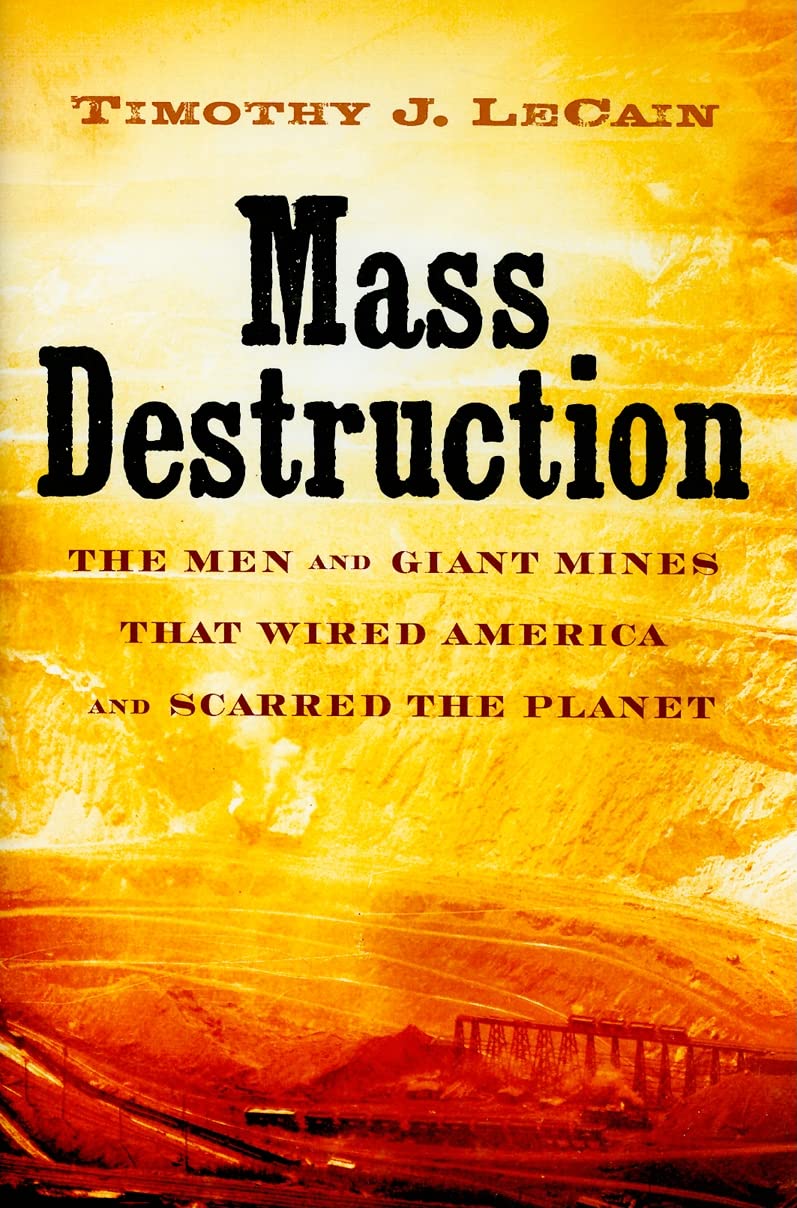
Timothy J. LeCain - Mass Destruction: The men and giant mines that wired America & scarred the planet

Just west of the former Montana mining town of Butte, famous as the site of some of the United States' biggest battles between organised workers and bosses, is the smaller town of Anaconda. The town's very name is synonymous with one of the US's most important and influential corporations - the Anaconda mining company. Approaching Anaconda it is difficult to ignore the looming, and now disused, smoke stake - the tallest masonry structure in the world. It is even harder to ignore the evidence of the polluting by products of the copper industry. Slag heaps dominate the approach along the interstate, ruined equipment, piles of dirt and dust surround the local National Park. This marks the giant smokestack, but perhaps uniquely for a US Park, visitors are forbidden. It is too poisonous. 

Similarly, south west of Salt Lake City is the gigantic Bingham Canyon Mine, a different giant corporation boasted of turning a mountain into a molehill there. As a hill of low grade copper ore was turned into a pit measuring several kilometres in depth. Low grade it might have been, but as Timothy J. LeCain's fascinating book explains, mining companies proved adept at turning such minority sources into enormous wealth - with devastating consequences for the local, regional and global environment.

LeCain argues that the development of the modern US economy, and in particular the commodity economy so central to the US view of itself - with mass production of fridges and cars, networked by copper telegraph lines and defended (or extended) by mass military power, was based on "mass destruction". In particular Butte and Anaconda, and Bingham are examples of the enormous destructive power of industrial technology deployed in the hunt for profits.

The polluting by products were devastating. Even in the early days, wind borne arsenic killed cattle and trees for miles downwind of Anaconda. The groundwater in Butte is still polluted to an incredible level. It was only anger from farmers and citizens, and the concerns of national government that forced action to be taken to reduce pollution. 

LeCain's book is an entertaining romp through this history. At points readers will roll their eyes at the shocking detachment of these corporations for people and the local environment. LeCain notes the inventor Frederick Cottrell, who developed some of the earliest equipment to extract pollutants from smoke and gases in chimneys, was "rightly suspicious of the early twentieth-century belief that corporate goals and the public good would always harmonize". It might be suggested that they never really do. But LeCain points out that "smoke abatement motivated primarily by profits failed in other unexpected ways as well". This was because the corporations realised that the extracted pollutants could be recovered and sold elsewhere. If they didn't enter the atmosphere from chimney's like that at Anaconda, they did after being used in agriculture, mining or elsewhere.

Nonetheless there was a remarkable, and persistent, belief by the corporations to pitch themselves as the root of the American dream. LeCain's book reproduces a series of fascinating adverts by Anaconda that encourage visitors to see the "Big Pit" at Butte, the massive hole in the ground produced by the mining. "See America the Bountiful" it puns, encouraging visitors on their way to Yellowstone Park to stop by. Today the same entrance allows visitors to see a pit, several kilometres wide, filled in bright blue acid which has to fire guns every few minutes to stop birds landing and dying. Some of these, perhaps on their way to Yellowstone themselves.

The modernist dream that technology will solve all humanities problem is exemplified by the attempts by corporations at Butte and Bingham to encourage visitors. But, as LeCain demonstrates, it is a feeble hope. The consequences of the production processes drive disaster on an unprecedented scale. It isn't just mining. LeCain draws parallels between these production methods and those of fishing, timber and agricultural industries. The corporations were well aware of the problems. Their solutions rarely solved the problem, simply displaced it in time and space. Or at least got rid of the ability of those affected to complain:

After years of struggling with the Anaconda and the smoke problem with little to show for it, many of the farmers were now willing to sell out. Where the Anaconda did not buy simple title to the land, it was often able to purchase "smoke rights" in which the owner agreed not to sue for any damages the smelter smoke might cause to the land. By the early 1930s the Anaconda either owned or had the legal right to pollute almost all the farm and forest land around the Washoe [smokestack].

LeCain understands that its the drive to profit that causes industry to behave like this, and he is rightfully cynical that attempts to discipline industry can succeed. Perhaps one fault with the book is that it doesn't explore how it is the logic of capitalism's drive to accumulate that causes this to happen. LeCain notes that blaming capitalism begs the question of what to replace it with, but because he believes that the Soviet Union was synonymous with socialism, he cannot see that as a solution. While he rightly points out that Soviet style government were significant industrial polluters and environmental destruction, he doesn't note that this was due to their own, state controlled, efforts to accumulate capital. A different strategy, but a similar outcome. Socialists like myself would suggest that a society based on genuine mass democratic control of industry, but the "associated producers" could do things differently. Indeed, LeCain's book celebrates the achievements of individuals like Frederick Cottrell, whose technologies could have made massive differences, but whose deployments were constrained by the limits they imposed on profits.

LeCain's work draws heavily on theoreticians critical of capitalism, not least the recently deceased James C Scott and the work of William Cronon. It might also have benefited from the insights offered by Karl Marx's idea of the "metabolic rift" between society and nature under capitalism. But this aside, this is a remarkably astute and insightful study of the way that mining corporations have destroyed people and planet in their quest for profits. No environmentalist visiting Montana should fail to read it, before visiting Butte and Anaconda - the "richest hill on Earth".

Related Reviews

Cronon - Nature's Metropolis: Chicago and the Great West
Tyer - Opportunity, Montana
Punke - Fire and Brimstone

Thursday, September 05, 2024

Len Deighton - Winter: A Berlin Family 1899-1945

Len Deighton's novels dominated the 1980s. His trilogies of spy series were massive bestsellers. His books on the Second World War, in particular, Bomber were justly well received and non-fiction books on the war and cooking also bear mention. Deighton's works filled my Dad's shelves, though I only really read the ones about aircraft! The spy novels were a little too intellectually challenging for young me.

I have probably had Winter on my own shelves since my father died but only recently picked it up. It is a classic 1980s family epic, which has loose connectioned with some of Deighton's other spy novels. As the subtitle suggests, this follows the lives of a Berlin family, the Winters, as they live through the most turbulent times of German history. The Winters are wealthy. As the new century dawns, the patriarch Harald Winter, an industralist is beginning to see the investment possibilities of German rearmanent. Throughout the next four decades, he makes millions from the manufacture of arms, despite initially convincing himself that rearming like this will prevent war, rather than lead to one.

The families' general liberal politics is neatly subverted. Harald has a mistress, a Jew, and the family complains bitterly both about the revolutionary movements that overtake Germany ending World War One, and the rise of the fascists. Both of these, they see, as bad for business. But the Nazis are also good as they stop the left, and Harald's sons are pulled closer into the emerging mass movement with the younger becoming a member of the Freikorps - the fascist movement that helped crush the workers from 1919 to 1923, and then the Nazis itself.

The other son ends up in the US, were he becomes a key figure in the Allies attempts to overthrow Hitler from without. He also ends up investigating war crimes and this leads to their final coming together.

The story is faintly ludicrous. One of those slightly contrived tales that places key figures at key moments in history so the author can tell the story of a particular period through their characters. Deighton however, does it well, not least by making most of the central figures of his book unpleasantly rich bourgeois Germans who make a mint from selling arms, and supporting fascism. As a result the story rattles along through the rise of Hitler and the collapse of Germany. There are plenty of smaller sub plots and intrigues that keep the reader engaged.

However there are some problems. There is a lot of exposition by the characters. Deighton clearly felt that some of the events he describes would be too unknown and needed explaining. This is fair enough, but there are times when the characters talk to each other weirdly because they are really talking to the reader. The other problem is that the book tends to ignore wider events. The War and Holocaust are the background, and I felt their impact and horror was somewhat deminished as a result. It means that the role of one of the sons as a senior figure in the Nazi party becomes more about his attempts to protect individual interests. Not as a cog in a wider murder machine.

All in all, its a good read and its encouraged me to revisit some of Deighton's other works and have a look at the ones I ignored all those years ago.

Related Reviews

Carré - The Looking Glass War
Carré - A Legacy of Spies
Carré - A Murder of Quality

Friday, August 30, 2024

Sai Englert - Settler Colonialism: An Introduction

Almost a year into Israel's genocidal onslaught on the Palestinians and in the myriad of books, articles and pamphlets that have appeared to analyse and explain events, the phrase "settler colonialism" regularly appears. As Sai Englert explains in his engaging new book, this is a phrase that has a long pedigree, arising out of liberation theories and ideas linked to thinkers like Franz Fanon and others. But for the wider left in Britain it is a relatively new concept, and Englert's book is an attempt to explain and contextualise the theory. It is a prescient book. First published in 2022 it is a little out of date given the events since October last year, and the mass movement in solidarity with Palestine, but this should not put off readers as what matters is the theory itself.

Englert begins by outlining the history of colonialism and, closely related to this, the development of racist ideologies that sought to justify colonialism. Here he draws heavily on the analysis of writers like Gerald Horne whose books on settler colonialism in the Americas I have reviewed before. Englert's account of colonialism reminds the reader of the sheer horrors of that colonialism, and the cynicism by which racist ideas were constructed in order to make it acceptable. Indeed Englert notes that the attempts to downplay colonialism's genocidal policies continue today, for instance in the focus that is often placed on "disease" as a killer in the Americas. This, he points out, was important, but "its role is often overstated - or at least extracted from a more general picture of settler violence and murder". It is this violence that is key to understanding what happened in colonialism, and the construction of settler colonial states.

Settler colonialism in general does not separate colonialism from the rise of capitalism. As Englert notes, "the accumulation of wealth in the Americas, based on the murder, enslavement and dispossession of Indigenous and African peoples, kick-started the rise of European empires on the world stage... which laid the ground for an accelerated emergence of capitalist relations of production and the intensification of exploitation at home."

This is important because there is a close link between the impact of colonialism and the development of "settler states" and the progress of capitalism, and its exploitation, in the heart of the colonial powers themselves. The dispossession of hundreds of thousands of peasants from land in Europe, was closely associated with the rise of industrial capitalism, as well as the movement of settlers to places like the Americas and Australasia. 

Settler societies emerged, most strikingly in the colonies that would become the US, which attempted to develop polities free from a reliance on the Indigenous populations. Their economies would be primarily dependent on settler smallholders and European bonded labourers on the one hand, and impotred enslaved African populations on the other. 

This highlights a problem for settler colonial theory, in that the experience of colonialism itself was different around the world. Some colonial projects had a genocidal policy towards indigenous people - eg in New Zealand, others saw indigenous people as making up the enslaved people for the rise of capital.

The centrality of racism to colonialism is important, in part because it helps understand how it was possible for relatively small powers to violently dominant much larger land masses by mobilising the dispossed against the indigenous people. The construction of "whiteness" which gave settlers an identification with their own ruling class, despite being the victims of an exploitative relationship with them, was part of making the settlers buy into the process. While there was solidarity between the oppressed within Settler societies, and indigenous people, it wasn't the norm, though it was not uncommon, as this important piece from Australian socialists makes clear.

Racism, Englert, argues is so central to the colonial project that fighting racism has to be linked to "ending the underlying process of domination that gave birth to it. Only by ending the social reality of settler domination can the ideology that normalises it die". Marxists or revolutionary socialists would  not disagree with this. That racism is part of capitalism, and for racism to end, so must capitalism, is something that has been associated with revolutionary ideas since the days of Marx and Engels. Englert reminds us, however, that we have to ensure that all racist ideas are included within this. He criticises "much of the literature on Whiteness for failing to address Indigenous dispossesion alongside the enslavement of African populations in racism's emergence and reproduction". 

The existence of racism, against Black and indigenous people, underminded the struggle of white workers for their own emancipation. But, Englert takes this further. He argues that settler colonialism means that white workers had, and continue to have, an interest in furthering it. This is undoubtably true of the past. Englert lists a number of occasions when the unity of Black and white workers threatened the structures of colonial power enough for violent measures to be taken to prevent such unity again. He also notes the large number of times when white workers, and their organisations - including trade unions and left parties - organised against black workers.

Englert argues:

Far from challenging the process of settler expansion, settler workers repeatedly played a key role in intensifying racial segregation and Indigenous dispossesssions. Settler class struggle was fought simultaneously against settler bosses and Indigenous workers. Settler labour movements demanded both an increase in their share of value extracted from their own labour power, as well as from the colonial loot extracted through the dispossession of Indigenous peoples. From Australia's labour-led "White-Australia" campaign to the French labour movement's near-unanimous opposition to Algerian indendence, across the colonial world, settler workers fought for the exclusion and dispossession of Indigenous and racialised people, and did so while deploying socialist, communist, or even internationalist rhetoric.

While acknowledging that there have been significant and succesful attempts to challenge racism by activists and the left in all of the settler states, does Englert's argument here remain the case? In a key part of the book, Englert discusses the nature of Settler Colonialism, and writes about "settler quietism" which he explains is "the fact that all settler classes, despite their internal social tensions and conlicts, depend on the Indigenous population's continued dispossesssion, as well as on the settler state to impose their dominance and distribute the colonial loot. Even when the situation escalates to internal military confrontation, peace can be re-established not through structural change but through the intensification of colonial violence, to the settler population's collective benefit."

Here, Englert is arguing that in settler colonial states, all "settler classes" benefit from the structures and activity of Settler Colonialism, which allows the ruling class to buy off workers. But is is that still true today? There is perhaps an argument that this is taking place in Israel, where the displacement of Palestinian people, is allowing material benefits to some Israeli workers in terms of land. This is an argument made by Englert. But is it true of the settler colonial states of Canada, the USA, Australia and New Zealand today? I am unsure. Englert continues:

Similar to the case of racism... land distribution and economic advantages to settler workers serve as powerful tools for stabilisation of settler rule. They also facilitate the economy's continued functioning as well as the reproduction of both the settler state's and capitalist class's power. In that sense, settler workers participate in securing their continued exploitation, in exchange for land and comparatively better working conditions.

I don't think it is tenable to say this is continuing everywhere and Englert offers no numerical evidence to suggest it is happening. So either Englert's arguments don't fit, or there isn't such a thing as settler colonialism. To argue the theory as no value would be entirely wrong. As Englert's book makes clear, the theory does offer many insights, even while it doesn't necessarily have a single agreed "line". What I think needs to be added to Englert's analysis is a more detailed exploration of settler colonialism as a process that takes place over time - and frequently a long time. What happened to Native Americans until the Massacre at Wounded Knee when the frontier was declared "closed", and what that meant for "settler classes", is different now to how the continued repression and oppression of Native American people impacts on working class Amercians (Black and white). 

But the process itself also matters. It is undoubtably true that people from working class backgrounds went to colonial countries. But those settlers who were "bought off" with land in the early days of (say) Canada or North American colonial history, were no longer workers. Buying them off like this, transformed their class position. They became farmers or smallholders. This is not the same as saying "settler workers" benefited as workers from the continued disspossession of indigenous people and land - and consequently secured their own continued exploitation. It is not correct to say that this process continues in (say) Australia. Israel/Palestine is a different case, which highlights the necessity of understanding specific settler colonialisms in their wider context, particularly that of the global imperialist system.

In general, with the exception of Israel and the case of South Africa under Apartheid, I don't think it is right to argue that workers benefit from settler colonialism. In Australia settler colonialism allowed some of the settler lower orders to avoid becoming wage labourers in that continent. But the workers who did not benefit like this remained workers, and saw no benefit from settler colonialism. Indeed, the racism that went alongside, undermined their position and their ability to fight for better conditions. Englert says that white Australian workers get "land and comparatively better working conditions" out of these relations. But this is simply not accurate. Englert would need to provide more detailed examples to justify this point today. Clarity on this is important, for if "settler workers" do benefit from settler colonialism, than it makes the process of workers' self emancipation either harder or impossible.

Workers everywhere have every interest in defeating racism, and the system that uses it, and they can only do so through completely unity with indigenous people, and principled opposition to all forms of racism. 

These are significant criticisms of Englert's book, but it is made in the spirit of arguing that the book is a contribution to the debates that seek to understand a world where imperialist powers continue to destroy the lives of billions of people, dispossing, oppressing and exploiting them in a unrelating drive to accumulate capital. Much more discussion and clarity is needed.

Related Reviews

Horne - The Apocalypse of Settler Colonialism
Horne - The Dawning of the Apocalypse
Fanon - The Wretched of the Earth
Clayton-Dixon - Surviving New England
Tully - Crooked Deals and Broken Treaties

Thursday, August 29, 2024

Lev Grossman - The Bright Sword

***Warning Spoilers - loads of them***

I'll admit to picking up The Bright Sword with some trepidation. I loved Lev Grossman's Magicians Trilogy, which was a sort of warts and all, grown up response to the Harry Potter monolith. The Bright Sword is a retelling of the Arthur myth. The sword of the title is, of course, Excalibur, so do we really need another account of these stories?

But I am hugely glad I did read it though. The book is a fantastic modern update of the story of Camelot, which is refreshingly 21st century and neatly subverts the genre. Lev Grossman's writing is delightfully engaging, and his construction of the story, will engage even those who know Malory or TH White's books inside out. Grossman introduces us to Collum. A talented sword fighter from the Isle of Mull, who is traveling to Camelot to find King Arthur, drunk on the stories of adventure and chivalry that he has heard. His naivety and ignorance mean that when he arrives in the aftermath of Arthur's defeat and death, he is prey for the swirling factionalism that surrounds the court. Morgan le Fey tries to draw him into her schemes, but Collum's idealism keeps him with the knights of Camelot, as we, the reader, learn through flashbacks the story of Arthur and his court.

But this is not the linear narrative of Malory or White, or even John Boorman. This is Camelot, warts and all. Merlin is a sexual predator who uses and abuses his young proteges. Arthur is a good king, but not a great swordsman. Lancelot... well Lancelot is not the person you think he is. As we go back and forth in the timeline, we learn how Camelot was held together by Arthur's idealism and his pure presence. Its a weak foundation that barely holds things together.

Grossman is to be congratulated for this approach. He could have produced a work that was modern without transforming the story. But the Arthur legend has always been retold. It is, after all, a medieval fantasy that moves 15th century society back into the post-Roman period. Malory has a lot to answer for in this regard.

But Grossman goes several steps further. He too plays loose with history (there was no Baghdad at the time of the collapse of Roman Britain) but is at least honest enough to admit this in the afterword. This allows him to make commentary on the differences between Britain and the rest of the world. His slightly tongue in cheek references to colonialism will no doubt cause some Daily Mail readers to gnash their teeth. But the knight who visits the round table from what is now the Middle East, and bemoans how dirty and backward everything is, certainly has a point.

Grossman does more, of course. There's more magic, more fairies, more of an interaction between the real world and fantasy than either White, Malory or even Boorman and Disney introduced to the genre. It makes for a more unsettling atmosphere, that gives the sense of a world in transition. There's also more honesty about who the Britons were. There are enough black and Muslim characters to further upset the Mail readers, and it must be said, there is a beautiful and touching transgender subplot. To say more would be one too many spoilers for this review.

The Arthur myth was always the story of kingly perfection and the closeness between land and ruler. It is one that always glossed over the realities of feudal society, the oppression and exploitation, and brutal war. In retelling it Grossman reminds us that stories have a power to illuminate a lot more than their subject matter. For this, and for many other reasons, I have no trouble in recommending The Bright Sword as one of the strongest, and dare I say it, most original, works of fantasy in years.

Related Reviews

Grossman - The Magicians
Grossman - The Magician's Land
Grossman - The Magician King

Thursday, August 22, 2024

Adrian Budd - China: Rise, Repression and Resistance

A recent Science article discussed an interesting conundrum. Asking "Have China's carbon emissions peaked?" it analysed the impact of China's economy on the environment. China is the single largest national emitter of carbon dioxide, "leads the world in firing up new coal-fueled plants" but is also the biggest installer of renewable energy. The article is unable to answer the question, because that depends on how long the Chinese state continues to support and use coal plants. But hidden in the article is a telling comment. Ending coal use faces a number of barriers, "including pressure from Chinese energy companies to keep coal plants producing revenue as long as possible."

China, after all, is supposed to be a socialist state. It is ruled by the Chinese Communist Party, and surely, one might argue, the revenue interests of Chinese energy companies should not be a barrier to this state meeting its emissions targets. 

Adrian Budd's new book, China: Rise, Repression and Resistance offers us a clear explanation of this seeming contradiction. In fact, it is no real contradiction at all, for as Budd argues throughout the book China is not a socialist state, in fact it is a "State Capitalist" society, whose economic logic is determined by the state's need to continuously engage in capital accumulation due to China's position within a global neoliberal capitalist system. While Budd's book engages in many aspects of China's current political situation, from its environmental impact, to its repression of LGBT+ people, women and national minorities, as well as the resistance to this national project, it is worth looking a little further at what Budd says about China's State Capitalism, as the rest of his analysis flows from this position. 

After positioning the book within a historical framework, Budd argues that contemporary China acts as it does because it has adapted to the changing global economic circumstance. It is both the workshop of the world, and a global imperialist force that is fighting to shape its own global market. Budd writes:

The structures of Chinese state capitalism have changed over the last four decades, and perhaps it even deserves a new label such as 'open state capitalism' or 'state-orchestrated capitalism'. But whatever the label, the Chinese economy is part off, and shares the general hallmarks of, the global capitalist system.

China's economic ascent has been accomplished by its ability to adapt its economy to the rules of global neoliberalism (using FDI [Foreign Direct Investment] and domestic companies to become the world' sindustrial workshop and largest exporter) while simultaneously interpreting and bending those rules to protect and dvelop its own industrial base and wider economy. State influence over borrowers and lenders allows Beijing to delay proelbmes, which would be less possible in more market-driven system, by instructing banks to lend, including to zombie companies. But if reduced dependency on inward FDI and exports proides a degree of insulation from the problems in the wider global economy, China cannot escape the economic laws of motion of capitalism that Marx discovered 150 years ago and its economy is now showing considerable signs of strain.

This last part is important. The laws of capitalist motion determine not just how China relates to other foreign powers, but to how its companies and state act in its interior. This means that China subordinates people and the environment to the logic of capital accumulation, driving both exploitation and natural degradation. This means that China is prone to the the consequences of these actions, including the resistance of workers, oppressed minorities and social movements. Xi Jinping's "mission" in Budd's wods, "is to protect the state-capitalist economy, and the interests of its ruling class, from the mounting problems it faces."

This is why, to respond to the Science article mentioned above, China simultaneously has the largest growth in renewables, yet is also beholden to the interests of its coal companies. The logic of capitalist accumulation drives the onward use of these resources, in the interest of profit. 

Budd's book discusses how the Chinese ruling class justifies this. A mix of repression and regime legitimisation is the strategy of Xi. This means stopping internal dissent, partly through violence and imprisonment and partly through trying to challenge key social issues. One of these, the rampent corruption at every level of society, is a significant barrier to China, both in terms of legitimising the rule of its leaders and in terms of social discontent. A few high profile trials aside, it is notable that Xi's response to corruption is in part to reduce the power base of his own rivals and to severally punish corrupt officials. Both of these are linked to a wider project of increasing authoritarianism within the state. Budd notes that this has close links to the intensification of nationalism as a tool to bind groups to his wider economic and political plans.

There is, however, hope. The book's final chapters look at resistance, both of social movements like those of the LGBT+ community and wider, often localised groups fighting over specific demands such as environmental issues. He has a deep focus on the workers' movement and explores some of the powerful strikes waves that have taken place. Despite the heavy repression of these, and the limitations imposed by Covid lockdowns etc, Budd does note promising signs of "a new generation of workers and acivists" inside workplaces. China has a long history of workers' struggle, and revolutionary struggle based on mass working class movements, that point to potentially transformative struggles far from the parroted "socialist" ideas of China's rulers.

In conclusion Adrian Budd's book is a brilliant dissection of China today. It places this in the context of historical class struggles, imperialist competition, framed by an understanding that human liberation and an end to China's environmental destruction can only come from a struggle against a system based on the logic of capital accumulation. In this sense the struggle of China's workers is identical to that of those in every other capitalist nation. "Workers of the world unite. You have nothing to lose but your chains".

Related Reviews

Smith - China's Engine of Environmental Collapse
Watts - When a Billion Chinese Jump
Au Loong Yu - China's Rise: Strength and Fragility
Shapiro - China's Environmental Challenges
Lafitte - Spoiling Tibet
Gittings - Changing Face of China

Sunday, August 18, 2024

Robert Ashton - Where are the fellows who cut the hay?

George Ewart Evans' book Ask The Fellows Who Cut The Hay is one of the most remarkable works of rural oral history. Rightly it is considered an indispensible work for anyone trying to comprehend the enormous changes that British agriculture has gone through in the last two centuries. More importantly perhaps it is a book that doesn't patronise its subjects. It takes the lives, beliefs and labour of the Suffolk agricultural workers it records seriously. Any reader will be carried along by its honesty and insight.

So I was excited to learn that Robert Ashton was producing a new book that was to look at "How Traditions from the Past Can Shape Our Future" based on his own connections with George Ewart Evans and the places he lived and worked. I helped sponsor the book through Unbound. The book itself is a lovely production, well made, easy to read and the cover is lovely. But I was disappointed with the content. 

The book works as a two part autobiography. Firstly it is a look at Evans himself, exploring his life and the ideas and forces that shaped him. How did Evans, having grown up in South Wales in a mining community come to live in rural Suffolk, writing and recording the lives and work of the local population? This is fascinating, and I enjoyed Ashton's exploration of the places that Evans had lived, his encounters and the occasional coincidence that allowed him to meet people who knew Evans and loved his work. Ashton himself was taught by Evan's wife. This all allows Ashton to explore further the changes that Evans saw, and those that came after.

The second autobiographical aspect to the book is Ashton's own life and times. His life as a agricultural labourer, tractor driver and finally salesperson for agricultural companies. These events, Ashton tries to use as a tool to extract more details about what has changed and developed in the British countryside, drawing some parallels with the changes that Evans himself saw, and why Evans did the work he did.

The problem is it is quite superficial, and much of the book is Ashton retelling the stories and accounts that Evans recorded. None of this is dull or boring, but it isn't what I expected. Sadly the book doesn't really do what it promises on the cover. There is no real analysis of how the traditions of the past can shape the future. Ashton does make some attempts to do this, noting how there are a return to localised production, and a move away from industrial agriculture. But there's no deep analysis, only a few of Ashton's impressions. Indeed, Ashton's thoughts on the changes that have taken place in society in general are often quite superficial, limited, for instance to noting that clothes are cheap because they are mass produced abroad for workers' on low wages.

The big question, implicit in the title, about what has happened to rural labour could have been further developed. I would have liked to read more about migrants and casual labour in British fields. How these people are organising, and how their wages and conditions differ from previous generations. 

Overall this was a nice enough read, but it lacked the real depth I'd hoped for. The most interesting bits were those about Evans himself, and even then I'd have liked a little more. The passing reference to Evans' Communist Party membership sparked my interest, but that was all there was to it. The building of sustainable, healthy agriculture and socially just societies in the future will, no doubt, require us learning from traditional methods and insights. Unfortunately this book doesn't give enough of this. It will however be enjoyed by those who live, work and travel to and through Suffolk, and would be best read there in conjunction with Robert Ashton's own hero, George Ewart Evans' work.

Related Reviews

Tuesday, August 13, 2024

Isaac Rose - The Rentier City

Friedrich Engels' classic book The Condition of the Working Class in England,  details the hardships of working people in Manchester in the first half of the nineteenth century. In it, Engels recounts a  meeting with a "bourgeoisie" in the city:
One day I walked with one of these middle-class gentlemen into Manchester. I spoke to him about the disgraceful unhealthy slums and drew his attention to the disgusting condition of that part of the town in which the factory workers lived. I declared that I had never seen so badly built a town in my life. He listened patiently and at the corner of the street at which we parted company he remarked: “And yet there is a great deal of money made here. Good morning, Sir.”

It's a justifiably famous quote, that tells us as much about Engels who himself was from an affluent background, as it does about the capitalists who were squeezing wealth and life from working people in the city. The tragedy is, as Isaac Rose shows us in his brilliant new book, its a quote that could be attributed to the city today.

Rose tells us the story of Manchester, through its people and their struggles and the lives that they led and continue to lead. He begins with the early history of Manchester, the period when Engels lived there, that saw the city becoming a colossus of capitalist industrial might. The mills and factories went alongside overcrowded, dirty and insanitary slum houses. In the intervening years, struggles over housing and working conditions, and, indeed the very space of Manchester by its working people shaped the city we now know.

In the 20th century, a process of expansion of public housing and slum clearance transformed things for working people. Houses became something that were to be proud of, not profit machines for unscrupulous landlords. For a time in the 1930s and the post-war period, there was an atmosphere of hope. Yet today, living in Manchester is dominated by an enormous housing crisis. Rents are skyrocketing, social housing has all but disappeared and that which remains is decaying and uncared for, and gleaming towers of steel and glass dominate the horizon, but are all but empty of tenants. The impact, Rose points out is worst for the poorest, and its creating a new layer of poor and vulnerable people. As he says, a recent study "has shown that the rent burden is so high in Manchester that it outstrips London for unaffordability, due to the city's lower wages". High rents and lack of social housing mean that "Manchester has the highest number of households assessed as homeless in the country".

How did this come to be? Rose argues it is the consequence of a set of neoliberal politics that are closely associated with Margaret Thatcher's Tory government of 1979 onward. More importantly though, he argues that their impact in Manchester was the result of a series of choices made by the City Council in reponse to Thatcher's assault. In particular, the failure on the part of the Council to be able to fight Tory policies that limited funds. This meant the Council essentially accepting neoliberal ideas, and then becoming the force for driving them forward in the late 1990s and 2000s. Rose says:

Manchester City Council, through the deals struck in the middle years of the last decade, handed over the extraction rights to a broad class of corporate landlords, who extract rent from the tenants and often take this wealth offshore. Manchester has become the pre-eminent example of the real estate state. This is the symbiotic relationship between politicians, the institutions of the local state and the property lobby.

Rose continues:

The local state has gone beyond simply providing the supportive policy context for development or acting as an enabler to being an executor of development. 

Drawing on the work of Marx and Engels, as well as contemporary Marxists such as David Harvey, Rose argues that "there is a profound in-built logic to the dynamics of urban development that are now underway in Manchester."

One thing that Rose highlights throughout the book is that there is a strong tradition of ordinary people in Manchester fighting to improve their conditions, and one of the key battlegrounds has been housing. But in fact in the key battles with the Thatcher government, this force was not mobilised. Where it did come on to the scene was in largely passive ways through public meetings and so on. Unlike, say, the Poll Tax revolt, there was not mass participation in tackling the government. The "dented shield" approach of the Labour councils in the 1990s was very much orientated on the idea that the councils were the only force that could fight the government.

Why is this important? Because if we are to move away from the privatised nightmare that is housing provision in Britain, we're going to have to build the type of social movements that can transform British politics. That will require mobilising the mass of working people to use their economic power, and their politic clout to transform national and local politics. Rose's book was, in his words, written with exactly this in mind, as a contribution towards "the crystallisation of a general force that could again wrest our cities back from the hands of the rentier, landlord and speculator".

The Rentier City is a superb book, powerfully written, accessible and readable, and full of the sort of facts and figures that will get repeated and quoted in pubs, cafes and meetings around the city. Everyone who cares about the great city of Manchester should read it.

Related Reviews

Christophers - The New Enclosure: The Appropriation of Public Land in Neoliberal Britain
Robbins - There's No Place: The American Housing Crisis & What it Means for the UK
Hanley - Estates: An Intimate History
Minton - Ground Control
Kynaston - Austerity Britain 1945 - 1951
Jones - Chavs: The Demonization of the Working Class
Wise - The Blackest Streets, The Life and Death of a Victorian Slum
Hollis - Cities are Good for You
Reader - Cities

Stephen Baxter - The Massacre of Mankind

The Massacre of Mankind proudly displays its badge of honour on its front cover: "Authorised by the H.G. Wells Estate". It might be authorised, but is it a worthy follow up to Wells' classic The War of the Worlds?

For those readers who have been hiding from Martians for seventy years, Wells' book was a classic account of an invasion of Victorian England, which saw the industrial, Imperial might of England defeated by fighting machines, until they are defeated in turn by one of literature's greatest deus ex machina. Baxter's follow up is set a few decades later in an alternate history shaped by the Martian's presence in the solar system, and the likelihood that they will return. The course of history has been diverted from our own timeline. World War One did not happen, Britain is in close alliance with Germany, and is a near dictatorship. Secret government projects exist to plan for the next alien arrival, but most people live in a hard, oppressive and grim world.

But Baxter's follow-up takes Wells' context, but sacrifices the original author's ability to tell a tale sharply and briefly. Baxter's work is overlong, bloated and disjointed. He attempts to tell the story of the Second Martian War as a sort of Victorian steampunk alternate history morality tale. 

The problem is that it all hangs together rather badly. There is a structural problem. Halfway through the book Baxter takes a break to suddenly introduce dozens of new characters to discuss the impact of the invasion on America, Australia, South Africa, China and the Ottoman Empire. Most of these are rapidly discarded (similar to how he discards characters in earlier chapters) and all the stories do is to tell of more destruction. It is likely that Baxter thought these stories might add colour (and it is at least good that places in the Global South get a mention) but unlike say Stephen King, who can add real depth to his wider stories with such bit parts, Baxter just adds to the book's bulk, without adding to the story.

A bigger problem though is that its hard to care about the characters. They are too one dimensional. Baxter simply cannot give his readers people who you identify with. Simply giving people long back stories is not enough. They disappear from the page and are instantly forgotten. He seems more interested in telling his alternative history (and being clever by inserting real historical figures into new situations) but even this feels contrived. The idea that the Russian Empire would leapfrog Western industrial capitalism by avoiding Revolution is incredibly far-fetched. But even that is not as far-fetched as the laughable deux ex machina that Baxter offers to end the Second War. At least HG Well's one was believable.

Overall this is a weak book, that relies too much on its original source material and seemingly clever nods to the reader. Don't bother, especially if you enjoy HG Well's original.

Related Reviews

Baxter - Raft
Baxter - World Engines: Destroyer
Baxter and Reynolds - The Medusa Chronicles
Morgan & Palmer-Patel - Sideways in Time: Critical Essays on Alternate History Fiction
Pratchett & Baxter - The Long Earth

Monday, August 12, 2024

Philip Pullman - The Imagination Chamber: Cosmic Rays from Lyra's Universe

Philip Pullman's His Dark Materials universe has been growing over the years. The initial trilogy, followed by two further books of a second trilogy, have been joined by a number of shorter works, several of these have been reviewed on this blog, and have impressed with the additional materials, and quality of production. The Imagination Chamber is less impressive. It is a collection of whimsical thoughts, that the author suggested are like the "little trails of vapour" that condense around a charged particle in a cloud chamber, though the particles in this metaphor, are charged with story.

Cloud chambers are useful for studying very small things, and these vapour trails are very small indeed, some of them barely a few sentences and stretching the material to fit the description of book is difficult. Fans of the books, particularly the first trilogy, will perhaps enjoy fitting the material into those narratives, but they offer little insight or extra information. They might flesh out things a little, but they are more designed to explore character, rather than plot.

Dedicated fans will probably find something here. But I struggled to. The Imagination Chamber offered little to me, and felt unnecessary. One for the completionists. 

Related Reviews

Pullman - La Belle Sauvage
Pullman - The Subtle Knife
Pullman - The Amber Spyglass
Pullman - Northern Lights
Pullman - The Ruby in the Smoke

Saturday, August 03, 2024

James M. Stayer - Anabaptists and the Sword

Anabaptists and the Sword is a detailed look at the evolution of the Anabaptists and their ideas, focusing particularly on the earliest period and the Reformation. James M. Stayer is one of the foremost historians of the radical Reformation, and in his opening remarks he aregues that the Anabaptists were "the most important group of radicals" and that a "major historical problem about them is that they seemed to oscillate between the polar antitheses of pacifism and revolution in their early history."

Many students of the period will notice this most obviously because we associated Anabaptism today with pacifiscm and communities isolated from the wider world. But the sixteenth century saw the forerunners of Anabaptists playing a central role in the Peasants' War in Germany, and most importantly in the capture of Münster when a theocratic radical regime took over the city in the expectation of the end of days.

Anabaptists and the Sword is not for the faint-hearted. Its detailed study of early Anabaptist ideas will appeal to specialists and historians particularly. Perhaps the most important concept is the idea of "the Sword" itself, a contested concept that evolves out of different biblical readings. Where the two powers of "coercive jurisdiction", the civil and ecclesiastical, or just one, wielded solely by the temporal (non-religious) regime. The Anabaptists held to the later, which meant that "the one, temporal, Sword stood for all the authority and force necessary to cement a social order comprised of individuals assumed to be in the vast majority radically wicked, egoistic and, hence, unresponsive to the common good". The concept of the Sword troubled the Anabaptists because it was closely tied up with ethics, and as Stayer argues, led to a multiple of ideas about whether or not it was right to use force to protect oneself, or your beliefs, or use violence to promote those same ideas. 

Writing at the end of the 1960s Stayer finds some interesting parallels between contemporary debates within social movements. But most of his focus is on the evolution of Anabaptist thought through this framework. Much of the book focuses on the evolution of these ideas through looking at key figures of this movement, from Müntzer to Hoffman. There are plenty of useful and interesting titbits and ideas here. I found it particularly interesting that Stayer points out that radical (revolutionary, and hence violent, in the context of sixteenth century Europe) Anabaptism did not end with the defeat of Münster, but lingered on even in almost guerrilla ways. 

Stayer's conclusion however is to avoid any easy generalisations. He argues that early Anabaptism was both radical and apolitical (in the sense of abstention from wider issues) but at the same time there were always important, if minority voices of "crusading radicals" such as Rothmann in Münster. Not all Anabaptists were, or perhaps are, nonviolent (nonresistant). Understanding the dynamics between the groups exposes a wider engagement of the movement with the Reformation and society in general that defies simple answers. 

Related Reviews

Stayer - The German Peasants' War and the Anabaptist Community of Goods
Kautsky - Communism in Central Europe in the time of the Reformation
Bax - The Rise and Fall of the Anabaptists