Tuesday, March 26, 2024

Naomi Klein - Doppelganger: A trip into the mirror world

Naomi Klein came to prominence as a journalist and author during the anti-capitalist movement of the early 2000s. Her book No Logo almost becoming a bible for the movement itself! After that she made her mark as an author of explicitly anti-capitalist books about the environmental crisis. Shock Doctrine told the story of how capitalism uses disaster to maximise profits and drive forward neoliberalism. This Changes Everything was one of the first, mainstream, books to link capitalism and the climate crisis. Within this Klein was also an activist, speaking and organising, within movements. 

So it might surprise some to find out that Naomi Klein has a doppelganger, who now holds diametrically opposed beliefs. In 1990, Naomi Wolf published The Beauty Myth, a feminist study of beauty, capitalism and patriarchy. But today Wolf is mostly known for her contrary and right wing positions on everything from guns to coronavirus conspiracies. Formerly a feminist icon of the mainstream media, Wolf is now beloved of the right, including figures like Steve Bannon.

Klein opens by showing how the two Naomi's were commonly mistaken for each other. She gives a number of examples, some humerous and trival, the others deeply concerning and insulting, where she is mistaken for Naomi Wolf. There's much to be said about why this happens and its not just about the same forename - I suggest it is in part because there are so few female spokespersons in the media. But this aside, Klein explores what has happened to her doppleganger to take such a shocking and stunning trajectory. It involves, as the book's subtitle says, a trip to the "mirror world", a place where conspiracy, scapegoating and distorted pictures of reality dominant - and where the real cause of societies' problems - capitalism - is let off the hook.

Klein's books about capitalism, disaster and climate change are frightening. But I actually think that Doppelganger is truely scary and discomforting for leftwing activists to read. Because what it shows is how the failure of the left to relate to wider working class concerns in the United States has opened the door to some very reactionary people and even a figure like Naomi Wolf can become part of that. 

What is most illuminating is Klein's exploration of right-wing policies, and how she shows they get a hold precisely because they speak to real concerns and are often rooted in real problems. Take the question of vaccine conspiracy:
The words she [Wolf] was saying were essentially fantasy. But emotionally, to the many people now listening to her, they clearly felt true. And the reason they felt true is that we are indeed living through a revolution in surveillance tech, and state and corporate actors have indeed seized outrageous powers to monitor us, often in collaboration and coordination with one another. Moreover, as a culture, we have barely begun to reckon with the transformational nature of this shift.
It is not enough, Klein argues, to mock the right or laugh at the ignorance on display, one has to go further. And this requires building real movements that speak to, and address concerns, while tackling misinformation and errors. The rug must be pulled out from beneath the right. Klein describes the sort of massmovement that is needed, but points out it "does not yet exist", and "it is inside this vacuum that my doppelganger is currently wreaking havoc". Wolf, "not only validates those latent tech fears but also, along with her new partner Steve Bannon, has something progressives lack: a plan for what to do about it, or at least a facsimile of one".

Some might quibble about the nature of the movement that is needed. This is to miss the point. Klein describes being heavily involved in the Bernie Sanders campaign. I wouldn't agree with that strategy, but Klein is honest enough to acknowledge the limitations of a movement based on a specific election. The important thing is that she wants much more than that.

This, I think, really comes through when Klein writes about Palestine. She makes this a central part of the argument because it shows how the right is organising, and the particular trajectory of Wolf who broke from her Synagogue to oppose an attack by Israel on Palestine, bravely stood in solidarity with the victims, but then moved away to the right. Klein argues that it is on the question of Israel and Palestine "where so many forces we have encountered on this winding journey converge and collide."

Not least with the issue of antisemitism. Klein opens this discussion by relating how her mother blamed the confusion between her and Wolf on antisemitism - "They see you both as a type". There's no doubt this is true, but Klein doesn't keep this discussion in the realms of the relationship between her and her doppleganger. She uses it to explore how and why marginalised groups are oppressed and how they resist. Her discussion on what happened to Jewish people and how they responded is powerful (and incidently mirrors some of the discussion in a new book I reviewed here recently on The Radical Jewish Tradition). Klein ties this to more contemporary racism, antisemitism and rightwing ideas. QAnon, for instance, whose antisemitic arguements are "cursing and combining and morphing in our culture". 

Why is this important? Because it is in this "mirror world" where conspiracies "detract attention from the billionaires who fund the networks of misinformation and away from the economic policies - deregultation, privatisation ,austerity - that have stratgied wealth so cataclysmically in the neoliberal era." The mashing together of antisemitism, with a resurgent right, neoliberal economics and a left that is inadequate to the task has created a situation where the likes of Wolf can rapidly evolve into significant figures, abandoning principles and raising dangerous arguements.

What then is needed? Here I was excited that Klein looked back to a period when socialist politics was counterposed to right-wing movements and was powerful enough to win, at least temporarily. She looks at the Revolutionary era after World War One, and in particular the radical Jewish socialists of the next few decades that tried to find a way forward that took on antisemitism and created a new set of ideas to appeal to working class people. Among the figures and groups she mentions, Trotsky, Rosa Luxembourg, the Bund, Walter Benjamin and so on, she identifies a set of ideas that rose and fell with the fortunes of the Russian Revolution. It was in the aftermath of this failure that Zionism became the only answer to the "Jewish Question" and embedded the idea that antisemitism could not be defeated by "getting at its roots" and instead by "holding a gun to its head." Building on this analogy Klein says:
Partitioning and performing and projecting are no longer working. The borders and walls don't protect us from rising temperatures or surging viruses or raging wars. And the walls around ourselves and our kids won't old, either. Because we are porous and connected, as so many doppelganger stories have attempted to teach us. So there has to be another way. Another portal, to another story of us.
One key figure in this is Abram Leon who wrote deeply on questions of socialist politics and antisemitism while in hiding from the Nazis and then died in a concentration camp. Leon is a major inspiration for Klein and she tells his story and his politics movingly. Developing Leon's ideas further she discusses how antisemitism is not an automatic set of ideas constantly existing in society, but rather it is a racism that rises and falls, can be understood, countered and stopped. It arises from a partiulcar set of politics, and needs another set of politics to defeat it. These are the ideas of the left, and particularly the Marxist left, that Klein argues remain so important.

As an example, Klein tells an interesting story from Canada. It's a story of two trucker convoys. One of outraged and angry drivers disgusted at the latest evidence of the genocide inflicted on the First Nations people by the Canadian state in the aftermath of the discovery of mass graves of indigenous people. The second was also angry - but this time in protest at lockdowns, vaccine passports and filled with patriotism and right wing politics. "One was progress, the other a white-lash." Klein makes the point however that "some truckers participated in both convoys". They were dopplegangers in them. The point is that there is not a comfortable binary, but there is also the potential to win people away from reaction and toward progress. But it takes work.

This story then is one where the left builds movements that can form alternative polls of attraction and can draw people in, who feel alienated, cut off, forgotten and who experience poverty, housing crisis, pay freezes and all the rest of neoliberal capital's impacts. In the process of building those movements and coalitions, we have the chance to break people from reaction. As Klein says, quoting John Berger, this is because protest and demonstration (and class struggle) "people come to realise that they are not merely individuals... but that they belong to a class. Belonging to that class ceases to imply a common fate and implies a common opportunity". 

This excellent book begins with a personal story - Klein's shock at having a "doppleganger" whose politics are moving rapidly away from hers. It evolves into an account of how capitalism has created the context, in the midst of multiple crises, for millions of people to be dragged into reactionary politics. Klein's exploration of these crises - from Palestine to the environment - demonstrates the need, and potential - for revolutionary politics that can win significant, and lasting, change. From the personal to the revolutionary. But, most importantly, this book is an appeal for activists to engage and fight to make that real, and not abandon those who are being sucked into a mirror world. It is, perhaps, Naomi Klein's greatest - and scariest - book.

Related Reviews

Tuesday, March 19, 2024

Pekka Hämäläinen - Lakota America: A New History of Indigenous Power

In the introduction to this outstanding new history of the Lakota Native American people, Pekka Hämäläinen makes the point that the Lakota are often defined by the events of a single day - June 25 187 when Lakota Souix, Cheyenne and Arapaho forces destroyed Custer's command at the Battle of the Little Big Horn. But this is problematic because it tends to ignore the rich and varied history of the Lakota both before and after that war.

Using extensive Native American sources as well as contemporary White accounts, Hämäläinen explores the long history of the Lakota, beginning when they were an "obscure tribe of hunters and gatherers at the edge of a bustling new world", through the varied conflicts and changes that led to them becoming a power on the American plains. At each stage, the Lakota demonstrate a remarkable capacity for change and adaption. Because of the images of the "Indian Wars", and especially Little Big Horn, we tend to think of them as brilliant cavalry troops, but this was only one particular point. Before they got horses (which was surprisingly late compared to other indigenous tribes) they were limited in hunting and travelling. Their were more sedentary, and like other Native Americans, often farmed for some of their food.

But they were defined by their relationship to other tribes and the European colonists. Hämäläinen gives a real sense of how the colonial wars between France and England, and later America and the European powers that remained on the American confict, shaped Lakota history. In fact, war and disease was a driving force behind the shift that saw the Lakota move into the Plains to their west, driven by the Iroquois who reacted to devastation of their population by striking out westward to capture slaves. This shift opened up the Plains, and the Lakota became part of a burgeoning trading network that saw them, and other tribes, collecting furs and hides for sale to Europeans, in exchange for food, weapons and other materials. It was a significant transformation, as this passage from Hämäläinen indicates:

By the late 1840s almost all Lakotas had made the western plains their home, visiting the Mnisose [Missouri River] only peridodically to bring their robes to steamboat stops for downriver shipment. Only Two Kettles, a small oyáte of some five hundred people, remained attached to the river. They made quick forays nto the West, but did not enage in large-scale raiding, and were known as superior hunters and tactful traders who were 'extremely fond of getting well paid for their skins'. Their semi-permanent villages near Fort Pierre were the last substantial Lakota bridgehead on the Missouri, which had lost its centrality in the Lakota universe.

The reader gets a real sense of how changing the indigenous world was, and how much they had become attached to a global economic system of trade. This transformed Lakota ideas and their social organisation, and created real tensions within their society - not least about how to relate to European power. But there is also no doubt from Hämäläinen's history that the Lakota, and other tribes were part of that great game between the colonial powers - a military and economic force that one side or the other tried to use in turn, while it also fought hard for its own interests.

Lakota power is a phrase used frequently by Hämäläinen and it is worth reminding ourselves that the Lakota were at one point, a significant national power on the North American continent. They were able, on several occasions to stop westward colonialisation, and certainly won significant gains from the American government. Indeed when their representatives negotiated with the American government they did so very much as equals.

As Hämäläinen emphasises, the Lakota's war with the US "was a shattering experience, but it did not define them as a people or their place in history". His book celebrates these "superbly flexible people" fighting for their place in a world increasingly squeezed by genocidal settlement. He continues:

Perhaps most strikingly, they emerge as supreme warriors who routinely eschewed violence, relying on diplomacy, persuasion and sheer charm to secure what they needed - only to revert to naked force if necessary. When the overconfident Custer rode into the Bighorn vally on that June day, they had already faced a thousand imperial challenges. They knew exactly what to do with him.

This is why the Lakota had to be destroyed. The Little Bighorn was their greatest moment, but it was also the beginning of their defeat. US settler colonialism could no longer keep up the pretext of living together and finding space. The punishment was explicitly genocidal, as seen at Wounded Knee, where Hotchkiss guns annihilated hundreds of Lakota.

But this was not the end, and nor did it stop the resistance, even as it transformed it. Hämäläinen continues with the history of the Lakota people in the 20th century, marked by racism and extreme oppression and economic punishment, but also by resistance. From Wounded Knee and the American Indian Movement in the 1970s to the battles over the Dakota Pipeline, the struggle continues. Hämäläinen concludes that the Lakota will prevail - "They will always find a place in the world because they know how to be fully in it, adapting to its shape while remaking it, again and again, after their own image."

Pekka Hämäläinen is an outstanding history. It never robs the Lakota of their agency, placing them in the heart of their own history - casting them not as victims, but as part of a rapidly evolving historical situation that could have gone in any one of different ways. It is noteworthy that the author uses indigenous language and spelling wherever he can, and writes from the point of view of the Lakota themselves. If you've read, like I have, countless histories of the Little Bighorn battle, then Hämäläinen's account based on indigenous sources, frames things very differently. If I have one criticism it is that I don't think the author really understands the term "imperialism" and tends to throw it about as a catch all term to describe American expansionism. For anyone interested in resistance to settler colonialism, and how that shaped and transformed the land and people on the North American continent, this is a must read.

Related Reviews

Estes - Our History is the Future
Cronon - Changes in the Land

Cozzens - The Earth is Weeping: The Epic Story of the Indian Wars for the American West
Tully - Crooked Deals and Broken Treaties
Philbrick - The Last Stand: Custer, Sitting Bull and the Battle of the Little Bighorn

Sunday, March 17, 2024

Seishi Yokomizo - Death on Gokumon Island

Seishi Yokomizo's Death on Gokumon Island is the second outing for his famous detective Kosuke Kindaichi (though oddly in the English translations its the fourth book published). Kosuke is returning from his military service during World War Two in the Japanese army when his friend Chimata Kito dies on the repatriation ship. Chimata entrusts Kosuke to return to bring the news to his wealthy family on Gokumon Island, and with his final breath warns Chimata that his sisters will be murdered unless Kindaichi can stop it.

Arriving on the island, the horrific news shocks the family, and the detective is quickly introduced to the complex social and economic relationships centred on the fishing industry of which the Kito's are heads. Rather fascinatingly there's an excellent explanation of the Labour Theory of Value among fishers here, as Kosuke learns how families like the Kito's get their wealth from other people's labour. Gokumon island itself is a strange place, linked to a long history of piracy, and isolated from the mainland. There's a repeated implication that everyone on the island is different, and strange things are expected.

One by one, the three women are murdered. Kosuke proves unable to stop the sequence, indeed at one point he's suspected of the crime. The bizarre murderes, a series of red herrings and the strange behaviour of many of the inhabitants make it tough for Kosuke to find the killer. But, it should be said, this is not a crime novel were readers will work it out for themselves. The clues aren't all there, and I felt it a little contrived.

Yokomizo was clearly building a brand with his second book. There are plenty of call backs to the first book, The Honjin Murders, and at least one recurring character. It gives the reader a comfortable reassurance, and while the book is not as strong there's still much here about Japanese society, the aftermath of World War Two and a fascinatingly complex series of crimes to solve. The dishevelled, scruffy and dandruff covered Kosuke Kindaichi is certainly a worthy detective to follow into all the sequels. 

Related Reviews

Yokomizo - The Honjin Murders
Yokomizo - The Inugami Curse

Donny Gluckstein & Janey Stone - The Radical Jewish Tradition: Revolutionaries, resistance fighters & firebrands

The introduction to Donny Gluckstein and Janey Stone's important new book locates the work exactly in contemporary debates. They make the point that there are two views of Jewish history, the "lachrymose" one (yes, I had to look it up too, it means 'sad or mournful') and one that celebrates the struggles and contributions of Jewish people to the fight for liberation and freedom. In the first, Gluckstein and Stoney argue, "Jews supposedly went to the gas chanbers like lambs to the slaughter", but it is the second that the authors are concerned with here. It is, they write,
an alternative view of modern Jewish history and an alternative solution to perpetual victimhood. We depict Jews not as victims, or a group apart, but as people who have repeatdly fought their oppression, and often in solidarity with other social groups.
The continue:
The lachrymose conception of Jewish history requires suppression of the stories of those partisans and revolutioanies, resistance fighters and firebrands because such stories suggest that Jews have it within their own power to respond to oppression and that others will in fact support them.
Why does this matter? I authors of The Radical Jewish Tradition must have begun writing their work long before the Israeli State began their current assault on Palestine. Nonetheless they write that the "lachrymose conception" of Jewish history is important to the Israeli state, because:
The persecution and expulsion of the existing local Palestininan population, the suppression of democracy in the interest of maintinain the state, the militarisation of society and the declaine of civil society because of the increasing domination of religious zealots - all these issues are subordinated to the idea that in no other way can Jews escape the historical existence of antisemitism and cease to be victims.
The above quotes come from the first two pages of the introduction, and the rest of the book can be see as refuting the arguements made by the Israeli state in this regard. The book is a refreshing and inspiring story of those Jewish radicals who fought antisemitism, racism, oppression and exploitation. Whose ideas and actions shaped the radical movements that we have today, and whose legacy remains important to everyone, not just Jews, who want to fight for a better world. 

Gluckstein and Storey's opening chapters look at what they call the "shaping of modern Jewry" showing how the pogroms and persecutions of the fedual and medieval periods fed into ideas and racism after the arrival of capitalism. The authors write:
The Jewish Marxist historian Eric Hobsbawm wrote that 'the family was a network stretching across countries and oceans... shifting between coutnries was a normal part of life'. This feature had once set Jews apart and reinforced their community ties. Now integration into many different countries created a new relationship. Radical Jews brought a sense of living class internationalism to those they interacted with at a local level.
Jewish people moved around the world - to escape persecution or to find new lives for themselves - and when they arrived they fitted into a capitalist world that integrated racism and exploitation. This forced the majority of Jews to become part of the anti-capitalist resistance, and in turn begged the question of how they related to non-Jewish activists, and how non-Jewish workers, trade unionists and radicals related to them. The authors discuss what happened by looking at some key moments in world, and Jewish, history - life under the Tsarist regime and the Russian Revolution, the life of East European Jews in Poland, the experience of working class struggle over jobs, wages and against fascism in East London as well as similar struggles in the United States. Two chapters look at the struggles of Jews and non-Jews in Germany in the run up to the Nazi victory and resistance to the the Holocaust. These two are perhaps the most important, directly challenging the idea that Jewish people were "meek" in the face of the Nazis, and demonstrating the exact opposite. Writing about the Warsaw Ghetto Uprising in April 1943, the authors say:
Defiance pre-dated the advent of the ghetto. We saw how, during the 1930s, the fight against the rising ride of antisemitism had involved Jews and non-Jews in mass struggle. This occurred in many cities and towns throughout Poland but was centred on Warsaw. The alliances that were foged at that time continued through the Nazi occupation and underlay much of the network of help and support that the ghetto inhabitants received. The population who rose up in April 1943 had been mobilising on the streets only a few years earlier in 1938. The memory must still have been there.
In the last two chapters the authors' return to the question of Palestine. Here they make the point that experience of the Holocaust has meant that many of those who fought for radical solutions to antisemitism, became part of a state that systemtically oppressed other groups in the Middle East. Left Zionism in particular "spread ideological confusion" becoming a justification for further horror:
It was a tragedy that those once inspired by the ideas of the left could become part to the forcible displacement of the Palestinian majority from their homes and country. This was the final nail in the coffin of the remarkable phenomenon of mass Jewish radicalism.
Can this tradition be rescued? The authors suggest that yes, it can. But that requires the building of mass movements of solidarity that work on the common interest of working people to fight oppression and exploitation. They say:
We have shown who historically has engaged in the fight against antisemitism. Based in the working class it was left-wing Jews and their non-Jewish comrades who defended the Jewish community against pogroms and won emancipation in Russia. The Revolution created the opportunity on an international scale to end capitalism and its divide and rule policies which bring misery to the oppressed everywhere... Despite attempts to ignore, or deny it, the progressive role of the left, and the working -class basis for it, endures.
Antisemitism, like other forms of racism and oppression benefits no-one but the ruling class. The rich tradition of Jewish radical theory and activism will inspire us to renew and rebuild those links. It is this that can free the oppressed everywhere and build a world of equality and diversity. Donny Gluckstein and Janey Stone's book is a major contribution to this fight. I urge everyone to read it.

Related Reviews

Tuesday, March 12, 2024

Clark C. Spence - Montana: A History

The States and the Nation series was a collection of books commissioned to mark the bicentennial of the United States. There were 51 in total, one for each state plus one for the District of Columbia. They were intended to be a lasting account of the states, but not comprehensive, rather a "summing up" of the history. Clark C. Spence's account of Monata is very much a summing up. Readers will find a decent overview of events - from the first furtrappers and settlers, through the era of homesteading and ranching, on to the period of mining and the modern day - up to the bicentennial at least.

But it is very much a "summing up", and the tone of the book (and indeed it's content) is very much that of its time. For instance, there is nothing here about the pre-state history. The book begins with Lewis and Clark's expedition. While they aren't depicted as entering into an empty land, the Native American societies that had existed in this part of North America for thousands of years are given no history at all. Indeed, this undermines any real attempt to understand what happened next as US settler colonialism exploited and destroyed the indigenous population and natural resources.

The book is dated in other ways. Consider this line on the Lewis and Clark expedition about the Native American woman who travelled with them: "Every schoolgirl thrills to the name of Sacagawea, the Shoshone lass, a mere slip of a girl of seventeen who carried her infant son, Pomp, on her back to the Pacific and return, and who made real contributions, though often her role is unduly magnified." I suppose we should be grateful that Spence even named this woman, before dismissing her as being of real interest only to schoolgirls. Doubly patronising.

The book is on stronger ground with later events. The reader gets a real sense of Montana as a place exploited for its resources, land and beauty, shaped by a series of changing economic interests - firstly the fur trade, then ranching and homesteading and finally mineral extraction. While these changing economic circumstances are summarised well, the consequences for people - indigenous and white - are often all to brief. There is a chapter on "Control of the Indians" gives a sense of the way that racist government policies destroyed entire peoples but it is inadequate. The chapter's title perhaps gives a clue to the approach taken. The author's desire to appear neutral undermines any attempt to draw conclusions. Notably The Battle of the Little Big Horn - Montana's seminal moment in the Indian Wars, only gets a brief sentence. There is a slightly longer treatment for the trade unionists, socialists and miners of Montana, especially during the Copper Wars and the First World War when figures like Frank Little made brave radical stands against war and exploitation. 

Modern readers will perhaps find the description of the arc of history, most interesting. Particuarly the way that agriculture and mining shaped the wider politics of the state. The influence of the mining capitalists on state politics is fascinting, as is the story of the 20th century which saw enormous poverty and hunger through the state. Tourists will be interested to read how much of the infrastructure (and indeed landscape) of the state park system came out of unemployment projects in the 1930s which built bridges and roads and planted thousands of trees. But the succession of politicians described from the post-WWII period is tiresome for a modern reader, though no doubt essential in 1978. 

All in all this is very much a summary, and a dated one. Readers looking for a comprehensive and modern history of Montana will inevitably find this because of the lack of alternatives. We'll have to find more info elsewhere - especially because the all to brief accounts and references hint at some fascinating detail.

Related Reviews

Carlisle - Lentil Underground: Renegade Farmers and the Future of Food in America
Lause - The Great Cowboy Strike: Bullets, Ballots & Class Conflicts in the American West
Hunter - Glencoe and the Indians
St. Clair & Frank - The Big Heat: Earth on the Brink

Monday, March 11, 2024

A.B. Guthrie, Jr - The Big Sky

The Big Sky is part of a loose trilogy of books that A.B.Guthrie wrote about the opening up of the American West by European colonists and descendents. It follows the adventures of Boone Caudill, who runs away from his violent and abusive father at the age of 17 and makes his way to the frontier where he becomes a trapper. Attracted by the romaticism and the adventure, Caudill goes through a baptism of fire as he quickly loses prized possessions to a thief and is let down by the law, at the same time as meeting the man, Jim Deakins, who would become his best friend.

The book is episodic, we next hear of Boone on a trip upstream to get furs and return a Native American girl, Teal Eye, to her tribe. A few brief sentences fill in the gaps between these chapters, allowing Guthrie to skip time and space, and avoid tedious stories of travelling. It makes the novel a little discombulating, but things hold together. Boone arrives on the frontier at a moment of change. The bison and beaver are becoming hard to find, the Native Americans are restless with the encroaching hunters and pressure is on from more permanent colonists who want to farm, not to hunt in the landscape.

Boone's teacher in this is the much more experienced Dick Summers, who leaves to take up farming in the East. Summers is a key character in one of the other books in the trilogy, widely travelled, experienced and hopelessly in love with the wild landscape. Is a poignant moment as he takes a last look around before heading back East to farm. Boone follows this pattern, becoming a loner, unable to cope with other people and visiting civilisation once a year to trade, drink and buy sex. His despair at the changing landscape is only matched by what his friends see as his desperate search for Teal Eye, last having seen her as a girl and wanting to make her his wife.

Here is one of the parts of the book that really jarred with me (the other is the repeated use of the N word). Boone is in love with Teal Eye, and the book sets this up from the moment he sets eyes on her. She's repeatedly described as a beautiful eleven or twelve year old earlier in Boone's life. By the time he finds her later, she is a woman. But Boone's obsession is thus deeply unpleasant and uncomfortable for the reader. Women in The Big Sky are very much cardboard cutouts, to be used by men for sex, or making home. This is exemplified by his relationship with Teal Eye, who as his wife (Boone lives with the Native American tribe) barely has anything to do other than cook and sleep with him. Later Boone abandons her, and rapes another (European) woman when he briefly returns home. In fact, by buying his marriage to Teal Eye - we're in no doubt that women are a commodity to Boone.

I have no doubt that Guthrie was trying to portray a particular moment in time, and a set of attitudes towards women and Native Americans. But the result is actually to remove the humanity of both Native Americans and most of the women (white and indigenous). A better writer could have told the same story, and made it much more rounded. I just got the impression Guthrie didn't care - he was more interested in the landscape.

There are some interesting set pieces. The chapters when Boone and Jim, and some travelling companions who want to open up a faster way to the West over the mountains to make more money, are trapped through the winter are well done. They give a sense of the horror and danger at the frontier.

But Boone for all the description of frontier life, hunting and the racous nature of the White outposts in Native American land, this rests on brutal violence and mass death. The Big Sky gives us a sense of some of this, but it wasn't the great classic I was expecting.

Thursday, February 29, 2024

Landworkers' Alliance - With the Land

The Landworkers' Alliance (LWA) is a British based union that links small producers, farmers, landworkers and others to fight for a more sustainable, equitable and healthy food and land system. With the Land is a fascinating book that marks the first decade of the LWA's work, It is first and foremost a celebration of the ideas behind the LWA, the work of its members as well as a discussion about the struggles we need for a food system fit for the future.

It is an eclectic mix of poetry, prose, commentary, interview, photographs and art. Its a book to be enjoyed in short bursts, but one that gives a real sense of the varied work that takes place - from forestry to land-management, bee keeping to urban farming. What shines through though is a sense of the deep connection between those who work the land (however that might be) and the ecological systems they are part of.

In the most overtly political section, authors Alex Heffron and Kai Heron describe the current state of British agriculture. 

Although seventy percent of the land in Britain is used for agricultural purposes, the country produces just 55 percent of what it consumes. Of that 55% much is grown and harvested, cared for, and slaughtered by seasonal, casualised, gendered and racialised immigrant labour; under brutally exploitative conditions. The rest of Britain's food is either grown under similarly exploitative systems in the EU's industralised and polluting agribusiness sites, or in tropical climates where super-profits can be secured through the super-exploitation of the Global South's lands and labour.

The LWA arose out of many different influences, including the massive climate movement of the late 2010s and the early anti-capitalist movement, which I was part of around the millenium. It is also, and importantly, highly influenced by the politics of the global Peasant movement La Via Campesina. These influences come through in many of the articles, both in response to the appalling picture painted by Heffron and Heron, but also in the ethos of many of the projects.

One of these, very close to where I live, is the Gaskell Garden Project in Hulme, Manchester. Writing about it, Robyn Ellis talks about how the project offers much to the local community beyond just locally produced food. "We are trying to find new ways to re-learn the relationships between ourselves and our land after generations of separation, transforming wasted land into a possibility of abiodiverse green comunnity space and edible forest". Ellis points out that many projects like these are "separate" from local communities, and fail to be inclusive.

The different chapters demonstrate a real commitment to producing food and fibres in sustainable ways that utilise knowledge and expertise. But also approaches. Morgan Ody of La Via Campesina makes the point that there are two prongs to the process outlined by the LWA and their own organisation. The first is the fight for food sovereignty, the second is the building and networking of social movements that can fight for this common goal. Ody concludes "Showing solidarity is key. It might start with climate justice or with organising for workers rights, with inflation and challenges to economic isssues. We should be open and take part in other actions that we didn't create. At the same time we should be very cautious about who we build alliances with". Earlier Ody says, "What we defend is much bigger than our own interests: we defend a vision of society, and of nature, that enables us to live in peace without domination."

This vision is inspiring, and it is very much the alternative to that bleak picture described by Heffron and Heron. The problem is getting there. Writing about a fascinating local workers' cooperative in Edinburgh, Mim Black makes a very important point. Their cooperative is producing huge quantities of mushrooms. As she explains its an ideal crop for urban environments. But despite the success of the project in networking local people, producing high quality food and using old brownfield sites, Mim points out that it is not enough on its own, "There are no silver bullets or panaceas - we know that we need a systematic overhaul of food growing practices and the power relations that uphold our current unjust system." That's not to decry the work of Mim's cooperative, or many others, but rightly to recognise that there are limits to building "agroecological food systems" within capitalism.

There are other struggles too, and some of these take place within the movement itself. I was very pleased to see a powerful statement in defence of transrights by the LWA, tackling the bigotry that is coming from the top of society, but recognising that such ideas also exist within out own movements. There is also an important piece by Josina Calliste on "racial justice in farming" that talks about the racial injustice within agriculture and attempts to address it. They write:

What would a land movement in Britain look like if Afro-indigenous ancestral farming practices were at its heart? If people writing food policies were from the communities most affected by food inequalities? For fighting industrial agriculture, black communities need land power. To acieve climate justice, people of colour need to be able to grow their own food. For environmental justice, the spiritual ecologies of indigenous communities should be at the front and centre.

With the Land makes it very clear that there has been an enormous shift within society about attitidues to farming, land work and sustainable food systems. There is a deep yearning for things to change. The many authors within the book are each offering their perspectives on how that might happen. But as several of the authors make clear, we must be cautious. Small scale agroecological practices are not enough in and of themselves. They are a response to the capitalist crises we face, but the social movements they represent must also be part of a much wider struggle for equality and justice. This will need to be fought for. As Donald Mackinnon writes in the context of Scottish crofting, "We are missing the radical edge to politics that we need to deliver the change we want to see." Its a point that is, however, valid much more generally.

As such I would have liked more on some of the political fights that are needed. Important questions such as housing, wages, working conditions and so on are touched on, but not really explored. It would have been good to get a sense of what has been done and what could be done to tackle wider social justice questions that are very much part of all the communities described.

However each of these highly personal accounts demonstrates a very human yearning for justice and good food! It helps us imagine how we can live in the future, once capitalism has been destroyed. The 19th century poem Three Acres and a Cow, is reproduced in the book. We should well remember the words:

There's a certain class in England that is holding fortune great
Yet they give us all a starving wage to work on their estate
The land's been stolen from the poor and those that hold it now
They do not want to give us all three acres and a cow

it continues:

If all the land in England was divided up quite fair
There would be work for everyone to earn an honest share

You can buy With the Land via the Landworkers' Alliance here.

Related Reviews

GRAIN - The Great Climate Robbery
Sutton - Food Worth Fighting For
Lymbery - Farmageddon
Holt-Giménez - A Foodie's Guide to Capitalism
Clutterbuck - Bittersweet Brexit: The Future of Food, Farming, Land and Labour

Tuesday, February 27, 2024

Kohei Saito - Slow Down: How degrowth Communism can save the Earth

Kohei Saito is one of the key figures on the left who are exploring and developing ecological thinking through the lens of Karl Marx's ideas. Saito's book Karl Marx's Ecosocialism deservedly won the Deutscher Prize for its exploration of Marx's ecology through his notebooks. His book Marx and the Anthropocene examined what Saito has dubbed Marx's "Degrowth Communism" and has been much discussed. I would direct readers to mine and Australian socialist Padraic Gibson's critical review of it published last year. I would encourage readers to have a look at that because there's a great deal of important thoughts relevant to Slow Down, particularly our criticism of the notion of Degrowth Communism.

Despite of these academic texts, millions of people actually know Saito's name for an incredibly popular work which has been translated into English as Slow Down. It has been a bestseller in Japan, selling literarily millions of copies and translated into multiple languages. 

At the start it must be said that it is very welcome that Saito has found such a large audience for popularising Marx's ideas. It is a sign of the times that many people understand that capitalism is destroying the world and concluded that revolutionary politics are needed. But, I have to caution, that I think the Marxism Saito is offering has been shorn of its revolutionary kernal. It is an analysis that doesn't go far enough into using Marx's insights to analyse capitalism today, nor develop a revolutionary strategy for the 21st century.

Let us, however, start with the strengths. Saito offers an uncompromising approach. In the preface he writes: 

Proponents of degrwoth are often abbivalent about the need to transcend capitalism. I am not ambivalent. In my opinion, degrowth must clarify its critical position against capitalism.

When discussing actions to "prevent global warming" such as reusing bags, water bottles and electric cars, he says "these good deeds are meaningless... thinking such actions are effective countermeasures can prevent us from taking part in the larger actions truly necessary to combat climate change." 

The best parts of Slow Down are Saito's exploration of why capitalism destroys the environment, and the way that capitalist accumulation drives that process. It is a fairly convincing demonstration for the need for revolutionary anti-capitalist politics or, in Saito's words a "great change" which is "nothing less than a challenge to the capitalist system itself".

The problems begin to develop however when Saito explores Marx's work. Early in the book Saito writes that "the object of capitalism's exploitation is not just the labour power of the periphery, but also the environment of the entire earth." Similarly, he later writes, "capitalism is a system that explots not just humankind but the natural environment as well". I mention this, not to nitpick, but because Marx's understanding of exploitation was very specific - relating to the extraction, by capitalists, of surplus value from workers' labour. 

In Saito's telling this relationship is downplayed into an act akin to how a capitalist uses natural resources. It means, I think, that Saito begins from the wrong starting point - failing to grasp precisely how workers' power arises from the nature of exploitation under capitalism. In particular it encourages him to use the concept of the "Imperial Mode of Living", a currently popular academic idea that argues that workers' in the Global North essentially accept the environmental destruction and imperialist destruction of the Global South, because it materially benefits them. The problem with this is that it undermines how much workers globally have shared interests in fighting exploitation and environmental destruction. [Space precludes me developing this point, so I shall point readers to yet another article that critiques the Imperial Mode of Living theory very well.]

Why is this important? The phrase "theory of change" has become popular among radicals these days, and the criticisms above are important because they relate directly to Marx's revolutionary politics (his theory of change!) and Saito's arguments. After "rehabilitating Marx" Saito writes about a "third way", the importance of "the commons" as an alternative to "US-style neoliberalism and Soviet-style nationalization". Saito arges that the society's infrastructure (electricty, transportation) and natural environments

should be managed and operated socialistically, exempt from market norms and national regulations. It's an ideas that's beasically identical to that of 'the commons'. The main difference is one of emphasis, with the commons prioitizing shared managemet by citizens in a democratic, equal way, rather than leaving administration up to specialists as advocated by the concept of social common capital. The other decisive difference is my aim to gradually expand the commons until... they overcome and displace capitalism entirely.

Now Saito has an idea of his socialism - a world where we have redefined abundance, seeing it as arising out of common ownership and the common good, rather than out of the chaotic, unplanned market. One where humans rationally use natural resources. He also, as the above quote shows, emphasises the need for democratic control. But the change he outlines here, and reflected throughout Slow Down arises out of gradual social change. As such it is inadequate. Compare, for instance, Saito:

The means of production must be returned to the commons as well. I'm talking here about workers' co-operatives - organisations allowing workers to invest jointly in the co-ownership and co-management of the means of production without interference from capitalists and shareholders.

with Marx's vision of the "self government of the producers" inspired by the Paris Commune, outlined in his Civil War in France:

In a rough sketch of national organization, which the Commune had no time to develop, it states clearly that the Commune was to be the political form of even the smallest country hamlet, and that in the rural districts the standing army was to be replaced by a national militia, with an extremely short term of service. The rural communities of every district were to administer their common affairs by an assembly of delegates in the central town, and these district assemblies were again to send deputies to the National Delegation in Paris, each delegate to be at any time revocable and bound by the mandat imperatif (formal instructions) of his constituents. The few but important functions which would still remain for a central government were not to be suppressed, as has been intentionally misstated, but were to be discharged by Communal and thereafter responsible agents.

Marx emphasised that workers power arises out of workers' revolutionary struggle which simultaneously destroys the old capitalist state and institutes the democratic organisations through which workers control the means of production. But when Saito talks about "workers' self-management", drawing on the liberal writer Thomas Piketty, he emphasises "worker-led social ownership and particpatory management" in contrast to "workers' power". While he is right to highlight the difference between "participatory socialism" (Piketty) and Soviet-style socialism, Saito is completely wrong to argue that "Piketty's position and that of the late Marx are closer than they have ever been." Marx never lost his commitment to the idea of workers' power arising out of the smashing of capitalism. 

Saito calls for a "revolutioanry transition to communism", but does not really articulate what Marx understood this to be. Here, I venture, it would have been instructive to look at the revolutionary process in Russia through the year of 1917. Not because the Stalinist counter-revolution offers us an alternative, but because for an all too brief period, workers' power through revolutionary institutions was a real thing. 

Instead of this radical history, Saito's revolutionary change is surprisingly passive. He quotes approvingly Erica Chenoweth's idea that only 3.5 percent of the population are needed to "rise up sincerely and non-violently to bring about a major change to society." But this is far from Marx's own ideas of revolution. In contrast Marx wrote in the German Ideology that a mass revolution was needed :

Both for the production on a mass scale of this communist consciousness, and for the success of the cause itself, the alteration of men on a mass scale is, necessary, an alteration which can only take place in a practical movement, a revolution; this revolution is necessary, therefore, not only because the ruling class cannot be overthrown in any other way, but also because the class overthrowing it can only in a revolution succeed in ridding itself of all the muck of ages and become fitted to found society anew.

Kohei Saito's book is a readable and energetic critique of capitalism and its ecological catastrophe. It is wonderful that it is being widely read. But it offers a limited view of Marx's revolutionary ideas. The poly-crisis that we are facing in the 21st century demands much more.

Related Reviews

Saito - Marx in the Anthropocene: Towards the Idea of Degrowth Communism
Saito - Karl Marx's Ecosocialism: Capital, Nature & the Unfinished Critique of Political Economy
Chenoweth & Stephan - Why Civil Resistance Works
Callinicos - The New Age of Catastrophe
Harman - Revolution in the 21st Century
Choonara & Kimber - Arguments for Revolution


Sunday, February 25, 2024

Adrian Tchaikovsky - Ironclads

In the not to distant future, US troops use the British Isles as a jumping off point to fight a violent, internecine war on the European landmass. It is a savage conflict, with high tech hiding a brutal reality. Ordinary troops die, or are maimed in their thousands, while an elite officer class sit safe in their 21st century armoured "scion" skins, directing and effectively playing at being knights of the realm. They are near invulnerable, a class whom, like the knights of old made "a game of how many poor bastards they could cut up". So says Sturgeon, one of a small group of troops who have been chosen for an impossible mission.

The narrator is less sure. They're here to do a job - in this case rescue a downed scion, lost behind enemy lines. Sturgeon's history lessons niggle at the team's minds. Is it a mission they have been specially chosen for? Are they just pawns? Is there something else going on? And anyway who has the tech to actually down a scion?

Ironclads follows the team into the fray. It's a short novel that packs a lot in - partly because of its subject matter. The nature of the conflict feels much more like that in Ukraine, though it was published a few years before that slaughterhouse began. These years we are more used to highly powerful countries pulverising smaller, poorer nations. But this is a book about modern conflict in a high-tech world.

So there's lots of technology - AIs, drones, robots. But humans still get blown to pieces quite a lot. So this is military science fiction with a lot of human values in it. But, like much of Tchaikovsky's other work, it is also a deeply political novel. Sturgeon, in one of his history lessons, explains how Britain broke off from Europe, and in the ensuing economic catastophe, found itself even more closely aligned with the interests of the US. But the rest of Europe was following a different path. If the US was diving deep into a high tech, neoliberal, theocracy (the Church of Christ Libertarian!), then Europe was enjoying the fruits of state intervention, green technology and keeping the wealthy in check. 

The war, when it comes, is fought for the US multinationals who want to make sure they get back their slice of the pie, and smash the incipient European socialism. The scions aren't military top brass, they're the corporate heads who are really pulling the strings, and they have much deeper interests. There are thus some excellent jokes. As the narrator complains, "I got shelled by the 1st fighting corps of fucking Ikea last year!" 

Here Tschaikovsky has dialled up the imperialist narrative. Nearly a quarter of a century ago, US neoliberal Thomas Friedman said that ‘the hidden hand of the market will never work without the hidden fist. McDonalds cannot flourish without McDonnell Douglas. The hidden fist that keeps the world safe for Silicon Valley’s technologies to flourish is called the US army, air force, navy and Marine Corps.’ But this is not the hidden hand. Here the multinationals have merged and taken over the military. They are the warmongers. But, ironically, war is not actually that profitable if you are blowing apart your own sub-companies, emerging markets and resources.

The imperialism depicted in Ironclads is not really that different to the monopoly capitalism lying behind World War One that Lenin and Rosa Luxembourg wrote about. Good political science fiction doesn't always have to wear its politics on its sleeve. Adrian Tchaikovsky's done a very good job indeed here of placing some really interesting ideas at the heart of a very hard military science fiction work. Highly recommended.

Related Reviews

Tchaikovsky - Walking to Aldebaran
Tchaikovsky - Children of Time
Tchaikovsky - Children of Ruin

Friday, February 23, 2024

Hal Draper - The Dictatorship of the Proletariat from Marx to Lenin

In preparation for writing my book Socialism or Extinction I read all five volumes of Hal Draper's books on Karl Marx's Theory of Revolution. It was an exciting and informative experience and links to reviews of each volume can be found below. For each book I was struck by how Draper's deep grasp of the material allowed him to draw out the revolutionary heart to Marx's ideas and give fresh insights to Marx's ideas. So I was pleased to discover this much shorter volume which is a "continuation", in Draper's words, of volume three of KMTOR, extending the story beyond Marx and Engels' lifetime into the early 20th century. The book follows much the same format, exploring the references to and meanings of Dictatorship of the Proletariat as used by key Marxists, from Marx and Engels, through the Second International and onto Luxembourg, Lenin and Trotsky.

But there is no doubt that Draper has a deeper purpose. He seems to be trying to rescue the Marxist kernal of the phrase, no doubt hoping to explore its meaning in the context of critics of revolution, on the left and right. The problem here is that the meaning of the phrase is one thing. How and why it was used is another. Draper has, particularly in the case of Lenin, abstracted the phrase from the context and undermined his own cause.

There is a lot of overlap with volume three of Draper's KMTOR. He begins, as he did there, by exploring the changing meaning of dictatorship. It is an important corrective, because he shows how its classical meaning, understood by Marx and Engels, but rarely today, is far from the modern interpretation. Instead it means an "emergency exercise of power by a trusted citizen for temproary and limited purposes". Marx rarely used the phrase except in specific periods. Draper explores these, but points out that until the Paris Commune, there "was not a single case of Marx's use of 'dictatorship of the proletariat'" in the preceeding two decades. When he does use it there, it is because "it was accepted as an example of the rule (or 'dictatorship') of the proletariat. The point is, Draper argues, that Marx was using the phrase despite the Commune not excercising dictorial power. Draper writes:

In the twentieth century, it was not uncommon to read that, according to Marx, a workeres' state might or might not be a 'dictatorship of the proletariat,' depending presumeably on how severly dictatorial it had to become. This interpretation is excluded by Marx's words: the workers' state 'can be nothing but; a dictatorship of the proletartiat; in other words the two terms are synonumous... For Marx this was a staetment about the societal content of the state, the class character of thre political power. It was not a statement about the forms of the government machines or other structural aspects of government or policies.

Later Marxists, Draper argues, miss this point and see the use of the D word simple as about method, not content. He repeatedly contrasts how these Marxists use the word and compares it to how Marx meant it. There is some usefulness in this, not least in exposing the limitations of many Second International thinkers. The problem comes when Draper gets to Lenin:

By the end of Year One, it was clear that Lnein was no longer using 'dictatorship of the proletariat' to denote a workers' state that was subject to the democratic rule of the working classes. It now meant a specially organised dictatorial regime, dictatorial in the sense that had become increasinly dominant, and increasingly counterposed to abstract democarcy... a number of Bolshevik spokesmen carried this process of theroretical degeneration even further, thus facilitating (though certainly not causing) the societal counterrevolution represented by Stalin.

Here Draper gives succour to the enemies of the Russian Revolution before Stalin's rise, because he undermines what Lenin was trying to do in this period. Despite a useful summary of the Revolution's isolation and economic collapse, he continues to judge Lenin by the classical definition of Dictatorship of the Proletariat understood by Marx. He then blames Trotsky and Bukharin for taking the theoretical lead in "gutting socialism" before Stalin.

Rather than trying to explore the real meaning of 'dictatorship' in the context of an isolated revolutionary movement and the needs of the struggle - which other Marxists not least Trotsky himself have tried to do since - Draper avoids this and spends his time in Marxology. Take this passage, describing how Lenin engaged with Marx's ideas:

The rather surprising outcome was that Lenin worked out for himself, or invented, a unique definition of 'dictatorship; which, as far as I know, came out of his own head. More than ever, different people discussing 'dictatorship of the proletariat' were using a different vocabulary, talking past each other.

But what is surprising about this is that Lenin developed some of the most vibrant and interesting Marxist works around related questions. But Draper judges him not on these works and their importance, but on his differences from Lenin. Indeed, the sections where Draper tracks the changing use of the phrase by Lenin were somewhat tiresome for me, as they felt more like heresay hunting than actual engagement with Lenin's revolutionary project.

Sadly this short volume falls short of the authors' ambitions. Hal Draper comes across as a smug writer, pleased that he alone has discovered Marx's true meaning and all others have fallen by the wayside. It would have been more useful if Draper had more deeply explored what Lenin's project was, rather than trying to damn him with faint praise.

Related Reviews

Draper - Karl Marx's Theory of Revolution Volume 1: State & Bureaucracy
Draper - Karl Marx's Theory of Revolution Volume 2: The Politics of Social Classes
Draper - Karl Marx's Theory of Revolution Volume 3: The 'Dictatorship of the Proletariat'
Draper - Karl Marx's Theory of Revolution Volume 4: Critique of Other Socialisms
Draper & Haberkern - Karl Marx's Theory of Revolution Volume 5: War & Revolution

Thursday, February 22, 2024

Arthur Ransome - Great Northern

Rereading Arthur Ransome's Great Northern led me to decide that it is perhaps the finest of the Swallows and Amazons stories. Yet when I read these books as a child I was not that found of it. Looking back I think that this is due to the tense final few chapters, when the Swallows, Amazons and Dick and Dorothy are pursued by multiple enemies as they seek to protect the titular birds. It is much more young adult territory than children's book.

Great Northern is the only one of Ransome's children's books to be set in Scotland. It's connections with the books set in the Norfolk Broads as the children are protecting a birds nest and eggs from an egg collector. Looking after birds was a key theme of Coot Club and the Big Six. In this sense it is quite a modern story, as egg collecting was not frowned upon in the 1940s when Great Northern was written. The children are on a sailing trip with Captain Flint, around the Western Isles (Ransome based the book on a trip to Lewis) which has been fairly uneventful. It is only on their last day, when Dick spots a pair of Great Northern's nesting that things take a turn for the excitement. The birds have never been known to nest in the British Isles and the discovery of the nest offers fame.

Dick's visit to a bird watcher turns from triumph to horror as he realises the watcher is an egg collector. A swift children's mutiny leads Flint back to the Island where the everyone embarks on a great subterfuge to avoid the collector locating the nest. As I said, there's a great chase, the children and Flint are imprisoned by the angry natives who think they are trying to scare his deer, and the birds are eventually protected. It is all very exciting, though Ransome's left politics did not prevent him relying on the autonomous power of the local laird to stop the robbery of the eggs!

There are some interesting aspects to the book. Firstly the locals speak little English, only Gaelic - with the exception of the Laird and his son. Secondly Ransome captures well the class relations on the island. Of further interest is the environmental context. Ransome, through the children, demonstrates a great empathy for nature and landscape. This is done, in this case, through the desire by all the children (though not Flint) to protect the birds. But this concern doesn't stretch to the wider environment. Take the aftermath of the picnic, when the two oldest children, John and Nancy, leave they "quickly poked their sandwich papers deep into the pear, sank their empty lemonade bottles in a small pool and set off, with empty knapsacks flapping on their backs."

Reading this sentence in 2024 really jars! The bottles are likely still there, though at least the sandwiches were wrapped in paper and not plastic. The other jarring bits are the gender roles. Ransome is usually quite good at letting his female characters take part in adventures on the same level as the boys, usually through the medium of Titty and Nancy. But once again Susan and Peggy are left to do all the household chores, especially feeding the crew - and Susan is forced to play a motherly role to her youngest brother Roger. Worrying, and bemoaning that the iodine for his cut shin is back on the boat.

Great Northern is certainly one of the best of the Ransome novels. But it is dated, and very much of its time. Despite this, Arthur Ransome's empathy for children and nature comes through and readers who enjoyed this back in their own childhood may enjoy the revisit. Younger readers perhaps deserve a little more.

Related Reviews

Ransome - We Didn't Mean to Go to Sea
Ransome - Peter Duck
Ransome - Missee Lee
Hardyment - Arthur Ransome and Captain Flint's Trunk
Chambers - The Last Englishman, The double life of Arthur Ransome

Friday, February 16, 2024

Kent Nerburn - Neither Wolf nor Dog

This book begins with a phone call. Author and artist Kent Nerburn gets contacted by the grandaughter of an Native American elder, who wants him to write his story. Nerburn has already published several books that present the stories and memories of Native Americans who lived on the Red Lake Ojibwe reservation, and Dave Bald Eagle (Dan), a member of the Lakota, feels that Nerburn can deliver. But this writing assignment becomes a spiritual journey for Nerburn when Dan, and his friend Grover, essentially kidnap Nerburn and take him on an intellectual journey to understand Native American history, thought and, above all, anger.

There is a great deal of mutual misunderstanding in this book. Nerburn often, and openly, fails to understand what Dan and Grover are telling him. He cannot comprehend the Lakota worldview, and he is helpless in answering and understanding what he is being told. Gradually he gets closer to it, after essentially having a breakdown in the face of the emotion, intensity and power of Dan's ideas. It is a journey (spiritually and physically) that is deftly told. Dan is hard on Nerburn, rarely allowing him space, and pressing him on points and the half-baked thoughts that the whiteman makes. There's a hard hitting bit when the three travellers visit some of Dan's family, and Dan tackles Nerburn for treating one of the children differently. One of the kids is half Indian and half white and Dan accuses Nerburn, "He wasn't an Indian to you. That's why you talked to him more." Nerburn doesn't see that he did anything wrong, and this just riles Dan more - "The little guy... he's never been as far as Rapid City. He speaks Lakota. He's never even seen his white dad. But to you the other kids are more Indian."

It's a powerful moment and Nerburn's protestations are frustrated and bitter. But it's honest. It leads the author, through Dan, to explore US politics around race, genocide and the reservations themselves. Nerburn is ill-equipped to deal with the onslaught of ideas, thoughts and new approaches to the world that Dan and Grover offer him. Dan complains:

You are still writing down our story, using your words, and you are still getting it all wrong. Your words are all full of sharp edges that cut us. But we have been bleeding so long we don't even feel it anymore.

It is a powerful lesson for Nerburn, and the reader. Nerburn is ill-equipped to tell it, and that's not just because he is not a Native American. It's also because he hasn't got any political framework to explain American history. If I have one disagreement with Dan's own politics its that it doesn't acknowledge that as capitalism sought to murder the Native Americans, it also destroyed the lives of countless other peoples whose world-views and livelihoods did not fit its model. The genocide of the Native Americans took place alongside the colonial destruction of peoples across the Global South as well as the destruction of European ways of life that had entirely different relationships to the world around them.  But Nerburn doesn't even appear to have heard of Wounded Knee. He's a great writer, and perhaps his naivety is the perfect foil for Dan's hard reality, but at times I was exasperated by him for different reasons to Dan's!

Nevertheless this "neither fiction nor non-fiction" account of a road trip is a powerful and illuminating read. Add it to your list, for a sense of the raging discontent and anger that remains at the heart of the so called "American Dream".

Related Reviews

Kimmerer - Braiding Sweetgrass

Tuesday, February 13, 2024

Christopher Shaw - Liberalism and the Challenge of Climate Change

Christopher Shaw opens his book by quoting from the Intergovernmental Panel on Climate Change's 2022 report, which argued that "fundamental changes" were needed to society's "underlying values, world views, ideologies, social structures, political and econommic systems and power relationships." Those of us who have spent the last few decades arguing that capitalism cannot solve the environmental crisis that it has created could be forgiven for feeling somewhat vindicated. After all, fundamental change is what we've been calling for all along. But Shaw cautions us. His book

argues that the greatest barrier to bringing about these 'fundamental changes' is the stanglehold that liberalism has on our language, thoughts and imagination. What is presented as transformative climate action is actually action intendd to legitimise liberalism in the face of a catastrophe for which liberalism has no answers.

Liberalism, Shaw argues, is "irreconcilable" with a liveable climate. He goes further, suggesting that "our inability to even think it possible to look beyond liberalism... is a sign of ideology in action". Indeed, so embedded is liberalism as a viewpoint in Western capitalist society that it has not just shaped how we think about climate (or indeed everything) but it has also enforced a particular approach to climate solutions. I have long raged about the inadequacy of the UN COP process but Shaw shows how this politicians deliberately supplanted a scientificly driven approach with one governed by neoliberal politics and economics.

One interesting part of the book looks at the temperature limits set as the targets for climate action, in particular the often mentioned 1.5C marker. Shaw argues that this is a result of a liberal approach to nature and climate which set an arbitarary number as a target. This could be used as by politicians, conveniently shifting the problem into the future. He makes the point that the 1.5C "cultural artefact", was "constructed under a historically specific set of economic and social conditions by a handful of powerful actors... under different social and economic conditions, we might have expected a different construction of climate change to emerge".

As the world surges past the 1.5C level, we will have cause to rue the historic failure to build this different social and economic context. But Shaw's point here echoes Marx, "the prevailing ideas of society are those of the ruling class". Indeed, as he says "the political consensus drives a public consensus". This liberal consensus is that "apocalyptic scenarios... are resolved in the story through narratives of technological solutions, global negotiations and occult economic practices." But it has all failed.

To flesh out his argument Shaw posits five "guardrails" which are used by liberal politicians and thinkers to frame the climate crisis and the action that should be taken. Essentially these are ideological viewpoints enforced by the ideas and actions of capitalist society. They are worth listing:

  • Guardrail 1: Climate Change is not a challenge to individualism.
  • Guardrail 2: The liberal construction of climate change is universally true.
  • Guardrail 3: Climate change is not an historical phenomenon.
  • Guardrail 4: We have the tecnologies to solve climate change.
  • Guardrail 5: New stories will save us.
The climate movement has, in recent years, developed a serious and important component that has highlighted the importance of global justice to the fight for a sustainable future. Shaw points out the liberal guardrails entrench a view of climate solutions that see the future world as a mirror of the developed West. This view is both unsustainable and racist. Take the future envisaged by one western liberal writer:
There is flirting, gossip, philosophical cafes, street theatre, peaceful protest marches, farmers markets, marathons and rock concerts a plenty. The cars hum quietly around... beer and barbeques. Markets and trade are vibrant.
A fantasy dream for a liberal elite. Certainly a dream that is not sullied with the horror already dealt out to billions of people around the world by the existing environmental crisis. 

What is worrying about these viewpoints is that they are not just endemic to the politicians and the elite, they are also dominanting within the climate movement itself - at least the mainstream, NGO part of it. For these activists, "system change" mostly means tinkering with capitalism, not replacing it.

It is interesting then that Shaw's book finishes with the "third way". It is a breath of fresh air when Shaw says we must begin with Lenin and the Russian Revolution. The latter he rightly characterises as "a conscious intervention to end imperialism and class exploitation". Shaw continues that we need a similar "seismic historically significant social revolution today". 

While I think Shaw's arguements against liberalism are valid. I think it would have been good to draw out further his discussion about whether or not they will remain universal. As the climate crisis grows, the response from governments and elites will be to rein in liberal discourse, increase repression, border controls and racism. We get a glimpse of this with Putin and Trump, and far-right politicians around the world. I would have enjoyed more of Shaw's thoughts on this.

Nonetheless Liberalism and the Challenge of Climate Change is an important book. I opened it fearful that I was delving into a dry academic text. But instead I found an illuminating and engaging discussion, a powerful denunciation of the dominant political viewpoints that drew the most radical of conclusions. 

Related Reviews

Monday, February 12, 2024

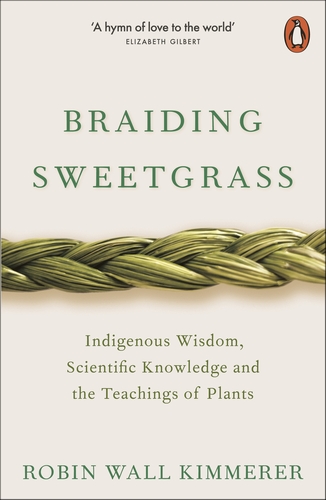
Robin Wall Kimmerer - Braiding Sweetgrass

Braiding Sweetgrass is one of those books that defies easy categorisation. I picked it up expecting a book that distilled indigineous knowledge about plants, perhaps imaginging a discussion about what plants made for good food, medicine or had other benefits. The book definitely has this within it. But it has much more. It is also part autobiography, part reportage, part biological discussion. All of this often infused with anger and sadness. Robin Wall Kimmerer draws on her many varied experiences - as a mother, scientist and university tutor - as well as an indigenous person in North America - to draw out how Native American people understand the world and nature. It makes for a remarkable book.

One of the things about Braiding Sweetgrass is Kimmerer's mixing of scientific and indigenous insights. Towards the end of the book, she writes:

The very facts of the world are a poem. Light is turned to sugar. Salamanders find their way to ancestral ponds following magnetic lines radiating from the earth. The saliva of grazing buffalo causes the grass to grow taller. Tobacco seeds germinate when they smell smoke. Microbes in industrial waste can destroy mercury. Aren't these stories we should all know?

She continues, "The stories of buffao and salamanders belong to the land, but scientists are one of their translators and carry a large responsiblity for conveying their stories to the world". But she bemoans that "scientists mostly convey these stories in a language that excludes readers."

I think the point she is making is that Western thought teachers people to understand the world in a particular way. Nature is a commidity that has been tied into a global market. Capitalism teaches us to see the world in a particular way. We relate to nature, not as nature, but as a thing, separate from us.

Kimmerer shows this often in her descriptions of time spent with student. On field trips she finds students who are incredulous at her suggestions that they listen to nature, or think of a tree, plant or stone as a person that they should communicate with. I'll admit that it seems strange to me. But the point that Kimmerer is making is that we consider the world differently when we have to think about the consequences of our actions - when we have to ask the animal if it is ok to hunt them, or the crop to cut it. The action of making gifts to nature is in part about making a recognition that nature cannot be taken for grants.

There's an excellent chapter that looks at this through a PHd students work on crop yields. This student is studying the impact of different ways of harvesting crops. The university professors are incredulous that she thinks that the act of farming the crops would increase yields. "Anyone knows that harvesting a plant will damage the population. You're wasting your time" said the Dean. Yet the opposite was proved to be true. Indigenous knowledge trumped the academy.

Kimmerer is not suggesting that indigenous knowledge should replace Western science. What she is arguing is that the approach of indigenous people to the world offers ways of understanding the world that can supplement science. Her different chapters all, in various ways, make this case - often in convincing and interesting ways.

But I think there's something missing of her analysis. The problem is not science. The problem is a social and economic system that frames science in a particular way. Rightly Kimmerer talks about the appalling genocidal treatment of indigenous people. This saw the deliberate and violent destruction of a way of life - and a way of thinking. But the rise of capitalism did this to people everywhere - including in Europe. James D. Fisher's recent book The Enclosure of Knowledge makes this point well about the experience in England. This is not to downplay the violence inflicted on Native Americans, but to argue that the rise of the bourgeois way of thinking about nature is the problem. We cannot simply graft better and more helpful ways of thinking on existing science. We need to transform the system itself.

This is why I think Kimmerer's book is sometimes misunderstood by reviewers. Because it seems hard to imagine what she is suggesting taking place - because it can seem so alien. Interestinginly at the same time as writing this review I've been reading Kent Nerburn's book Neither Wolf Nor Dog, which features similar increduality between Nerburn and his Native American companions.

Of course, it is possible to shift how people think and view the world. Kimmerer's students often make that leap - and she writes touchingly about this. Her book will also contribute to this process. But making that change is only a first step. As she writes at the very end, we need "courage" to "refuse to participate in an economy that destroys the beloverd earth to line the pockets of the greedy, to demand an economy that is aligned with life, not stacked against it. It's easy to write that, harder to do."

Unless we shatter the Settler Colonial system that alienates us from nature, and shapes our way of thinking, we will remain trapped in its framework. Kimmerer's book is thus a powerful argument for a new way of thinking, but we need to go much further.

Related Reviews

Fisher - The Enclosure of Knowledge
Tully - Crooked Deals and Broken Treaties
McMillan & Yellowhorn - First Peoples in Canada
Hunter - Glencoe and the Indians
Cozzens - The Earth is Weeping


Thursday, February 08, 2024

Sylvain Neuvel - Until the Last of Me

*** Spoilers ***

This is the second volume of Sylvain Neuvel's Take Them to the Stars trilogy. It is an alternate history of the 20th century, focusing on two groups of human like aliens that live among the wider population. For three thousand years they have fought each other. One group, the Kibsu, have tasked themselves with getting humanity to space so that they can escape Earth. These women, have hidden themselves, gently prodding and encouraging humans to gain the necessary insights to develop science and move, slowly towards the stars. The Kibsu are all women, and one of the great insights of these books is how Neuvel links the difficulties of these gentle nudges, with the wider problems of women's oppression in society and science. 

He also doesn't fall into the trap of pretending this is easy for the Kibsu. One of the ironies of the historical chapters in Until the Last of Me, is that the Kibsu often fail, or find that human scientists are already gaining the insights they need, or that their women's insights are ignored. In fact Neuvel reinforces the idea, perhaps not deliberately, that scientific advance is a consequence of humanity's collective development - not just the insights of individuals. The greatest step forward taking by Kibsu Mia though was to get the Nazi Von Braun to the US after World War Two, and then to push the Soviets into space to make it happen. This is where the second novel opens - humans are in space, but the Kibsu need them to push further outward. But there is a problem.

For thousands of years the Kibsu have run from the Tracker. The aliens, all male, hunting them. For thousands of years the motto has been "run, do not fight". In this book the last Kibsu has to fight to protect what she has found out about her origins and humanity's destiny. 

Neuvel skillfully weaves the story of the Kibsu around 20th century space exploration - making Voyager the focus of the tale. This is itself enjoyable - in a way its a more exciting and innovative vision of humanity's voyage into space than the moon landings and the space race. But it is a dead end, and its notable that the book opens with Kibsu disappointment at the lack of movement in space.

For this reason, Until the Last of Me fails to develop some of the intensity of the first book - the space race provided a tension that is lacking in the second book. Instead Neuvel relies on the back story of the Kibsu and a somewhat implausible detective story as the Kibsu use an ancient artifact (locked in a vault in China) as a map to find their way to a secret. This is a little to Indiana Jones, and it contains one of the sillest museum heist scenes I've ever read.

I suspect that Until the Last of Me, suffers from being volume two of a trilogy. A bridge between beginning and end. We shall see. The ending is a pretty good cliff hanger.

Related Reviews

Neuvel - A History of What Comes Next