The Battle of Verdun, that took place in early 1916 was one of the most horrific clashes of World War One - well over 700,000 men were killed, wounded or went missing in the battle. It was marked by enormous barrages, the first systematic use of flame throwers and like the Battle of the Somme does, it continues to cast its shadow over subsequent generations of Frenchmen and Germans alike.
Jules Romains' novel Verdun is, at least according to the blurb here, a "lost treasure", first published in 1938 it is an unusual novel. There is almost no narrative structure, save that of the Battles' history itself. Instead chapters are devoted to a few individuals, some soldiers, the occasional person fighting on the "home front", officers and generals and on one sole occasion, the Kaiser himself - the only appearance of the German enemy in the book. I picked it up, expecting that this would be a French version of All Quiet on the Western Front. As a novel it is very different to that powerful story. Yet in an unusual way, despite the occasional lapse in translation or the somewhat overblown dialogue in places, this remains an interesting work, though its lack of narrative makes it hard to follow at times.
The first chapters deal, as many novels of World War One do, with the way that the patriotic glee of the opening days are to be contrasted with the dull horrors of trench warfare.
"Were were those battles for freedom which begin with the soudning of the "charge" and end with cheering and the song of victory? The people of France almost blushed to think that they had ever believed in such things."
Nonetheless, if there was one ambition that remained;
"it was the destruction of war itself; its suppression for ever, its deletion from the pages of history. That, and that alone, must be the object of this war. There should never be another."
Passages like this, and the late reference to France as the great friend of Poland are perhaps a reaction to the coming Second World War. Yet the book itself is less an anti-war novel as a book about the reality of war. So we have the ordinary soldier scrabbling in mud and snow and praying for his life, together with the plump industrial profiteer, getting rich on the shoddy equipment he's selling to the army. Finally, Romains holds real contempt for the generals and politicians , those men who play games with others lives. As one of the soldiers remarks as he's about to return to Verdun;
"War, claims many victims, but very few of them are innocent. For some time now, as I think I've told you already, the spectacle of my fellow-men has filled me with loathing. The trouble is that those who are most to blame are not, as a rule, those who suffer the worst punishment."
Romains however makes this a soldiers war. The home front knows little of the reality of the trenches. The Generals care less, but talk of sacrifice. Only the soldiers understand and they have their "freemasonry of front-line fighters" to keep them going.
As the novel finishes with truck-loads of French soldiers heading for the front and a renewed offensive, we are left with little but despair and hopelessness. This perhaps was the feeling of many of those French people who survived Verdun, and lost friends and family to its horror, as they contemplated renewed European war.
Related Reviews
Tuchman - The Guns of August
Friday, January 27, 2012
Tuesday, January 24, 2012
J. Samuel Walker - Three Mile Island: A Nuclear Crisis in Historical Perspective
For a few brief years following the 1979 incident at the Three Mile Island plant, it was known as the world's worst nuclear accident. The far greater disaster at Chernobyl in 1986 soon rightly took that accolade. Three Mile Island has however gone down in infamy. J. Samuel Walker's account of the event is an attempt both to describe the accident as part of the history of nuclear power and to try to separate the real story from the myths.
In the public perception TMI lead to large releases of radiation into the surrounding atmosphere. While there were some releases both controlled, as the technicians struggled to stabilise the damaged reactor, and uncontrolled. The amounts released were not as great as many thought. Walker's summary of health studies afterwards errs on the side of those that argue there were few, if any humans injured or made sick by the accident in the short or long term. That said, one thing the book does make clear is that at TMI the United States came close to a situation which could have had very severe consequences for the population surrounding the plant.
The clean-up operation after the accident took many years and cost huge amounts of money. Money that by and large came from central government, not the private nuclear industry. But the most important consequences are not as easily quantifiable. Walker documents the dip in public support for further plants - a dip that when exacerbated by the Chernobyl disaster, pretty much screwed the US nuclear industry completely.
In addition the existing nuclear agencies were roundly condemned. Several of these proved lacking in their hour-to-hour handling of the situation. Walker documents the clash of managerial styles between the company running the plant and the national bodies setup to regulate the industry. The was frequent disagreement over interpretation of what was happening in the reactor and this, combined with aggressive media interest, meant representatives frequently contradicted each other and gave differing accounts of what was going on.
One of the ways that this was most felt was in the discussion about whether to evacuate the surrounding population. Evacuation plans were limited and the area contained many schools, hospitals and several prisons. At the height of the crisis when evacuation was on the agenda as a serious option most of those responsible wanted to avoid it, condemning those who supported the call. The factors determining their opposition to evacuation were linked to political and economic consquences as well as the risk of injury during any panic.
Walker notes one such example. A key figure in the Presidential staff assigned to the TMI question, Jessica Matthews, concluded that "evacuation was not advisable", basing her judgement "primarily on the pitfalls and costs of conducting a large-scale evacuation, and secondarily on the harmful effect it would have on the nuclear industry."
With quotes like this, it is not hard to conclude that many of those taking decisions in the immediate wake of the TMI accident were not doing so primarily based on the interests of the population surrounding the reactor complex.
This is not to say that individuals, primarily those technicians at TMI did not work very hard in a potentially fatal situation to avoid serious catastrophe. Walker tries to avoid describing heroics, so we learn few of the names of individuals who clearly risked their lives trying to prevent a core meltdown. However much of the post-accident analysis concluded that it was individual error that was the biggest single factor in the developing problem.
In summary for instance, Walker says that TMI, along with Chernobyl were accidents "due largely to operator errors that exacerbated design flaws or mechanical malfunctions. In both cases, technicians overrode safety systems that could have prevented or mitigated the damage."
However phrasing the problem like this implies that the mistakes lay simply with the technicians. In the case of TMI, Walker also explains early on that once the accident took place it proved very difficult for experts on the ground to understand what was happening. Alarms that represented different problems all had the same sound and banks of flashing warning lights did not help technicians prioritise. Key information such as the level of coolant in the reactor was simply not available. The lack of this piece of information led to one of the key mistakes made as officials turned off cooling mechanisms and precisely the moment they were needed.
As one of the investigations into the accident at TMI later concluded was that those trying to anticipate problems and prevent accidents in nuclear reactors was preoccupied "with the safety of the equipment, resulting in the down-playing of the importance of the human element in nuclear power generation."
Walkers' book is a interesting social history as well as a technical one. He notes for instance that most families did not evacuate themselves, preferring to believe that the accident was not as serious as they imagined, despite some dramatic press reports. But the reasons people gave for not evacuating are interesting in themselves. "[I]n households in which no family members evacuated, 65% cited their conviction that 'whatever happens is in God's hands' as a reason for not leaving their homes." Though the same report also showed that 71% of "respondents" said that they did not evacuate because they were waiting for an evacuation order.
Walker is attempting to give a balanced account of the accident. Despite his sponsorship by the US Nuclear Regulatory Commission he does manage to be nonpartisan in his approach. As a result however those who have positions opposed to, or in favour of nuclear power are likely to read this book to find information that will only bolster their own positions. Those who argue for nuclear power and its safety will argue that from TMI, "lessons have been learnt" and "designs improved" meaning it could not be repeated.
As a convinced opponent of nuclear power, my own conclusions are the opposite. What TMI proves is that nuclear accidents cannot be avoided altogether. When something does go wrong through human error or technical failure the consequences have the potential to be enormous. That is not to say that all reactors will ultimately fail, nor that all accidents will inevitably lead to death and destruction on a vast scale, but that the potential remains in a way that doesn't exist with other forms of power generation.
The more recent tragedy at Fukushima has only underlined the inherent problems of nuclear power. This is a source of power that is not needed either to generate electricity or to combat climate change. The alternatives exist, yet the obsession with nuclear energy from governments around the world remains. At times, Walker's detailed, moment-by-monent account of events at Three Mile Island is both fascinating and nerve-wracking. But it should also give food for thought for those who continue to advocate this extremely dangerous way to boil water.
Related Reviews
Caldicott - Nuclear Power is not the Answer
In the public perception TMI lead to large releases of radiation into the surrounding atmosphere. While there were some releases both controlled, as the technicians struggled to stabilise the damaged reactor, and uncontrolled. The amounts released were not as great as many thought. Walker's summary of health studies afterwards errs on the side of those that argue there were few, if any humans injured or made sick by the accident in the short or long term. That said, one thing the book does make clear is that at TMI the United States came close to a situation which could have had very severe consequences for the population surrounding the plant.
The clean-up operation after the accident took many years and cost huge amounts of money. Money that by and large came from central government, not the private nuclear industry. But the most important consequences are not as easily quantifiable. Walker documents the dip in public support for further plants - a dip that when exacerbated by the Chernobyl disaster, pretty much screwed the US nuclear industry completely.
In addition the existing nuclear agencies were roundly condemned. Several of these proved lacking in their hour-to-hour handling of the situation. Walker documents the clash of managerial styles between the company running the plant and the national bodies setup to regulate the industry. The was frequent disagreement over interpretation of what was happening in the reactor and this, combined with aggressive media interest, meant representatives frequently contradicted each other and gave differing accounts of what was going on.
One of the ways that this was most felt was in the discussion about whether to evacuate the surrounding population. Evacuation plans were limited and the area contained many schools, hospitals and several prisons. At the height of the crisis when evacuation was on the agenda as a serious option most of those responsible wanted to avoid it, condemning those who supported the call. The factors determining their opposition to evacuation were linked to political and economic consquences as well as the risk of injury during any panic.
Walker notes one such example. A key figure in the Presidential staff assigned to the TMI question, Jessica Matthews, concluded that "evacuation was not advisable", basing her judgement "primarily on the pitfalls and costs of conducting a large-scale evacuation, and secondarily on the harmful effect it would have on the nuclear industry."
With quotes like this, it is not hard to conclude that many of those taking decisions in the immediate wake of the TMI accident were not doing so primarily based on the interests of the population surrounding the reactor complex.
This is not to say that individuals, primarily those technicians at TMI did not work very hard in a potentially fatal situation to avoid serious catastrophe. Walker tries to avoid describing heroics, so we learn few of the names of individuals who clearly risked their lives trying to prevent a core meltdown. However much of the post-accident analysis concluded that it was individual error that was the biggest single factor in the developing problem.
In summary for instance, Walker says that TMI, along with Chernobyl were accidents "due largely to operator errors that exacerbated design flaws or mechanical malfunctions. In both cases, technicians overrode safety systems that could have prevented or mitigated the damage."
However phrasing the problem like this implies that the mistakes lay simply with the technicians. In the case of TMI, Walker also explains early on that once the accident took place it proved very difficult for experts on the ground to understand what was happening. Alarms that represented different problems all had the same sound and banks of flashing warning lights did not help technicians prioritise. Key information such as the level of coolant in the reactor was simply not available. The lack of this piece of information led to one of the key mistakes made as officials turned off cooling mechanisms and precisely the moment they were needed.
As one of the investigations into the accident at TMI later concluded was that those trying to anticipate problems and prevent accidents in nuclear reactors was preoccupied "with the safety of the equipment, resulting in the down-playing of the importance of the human element in nuclear power generation."
Walkers' book is a interesting social history as well as a technical one. He notes for instance that most families did not evacuate themselves, preferring to believe that the accident was not as serious as they imagined, despite some dramatic press reports. But the reasons people gave for not evacuating are interesting in themselves. "[I]n households in which no family members evacuated, 65% cited their conviction that 'whatever happens is in God's hands' as a reason for not leaving their homes." Though the same report also showed that 71% of "respondents" said that they did not evacuate because they were waiting for an evacuation order.
Walker is attempting to give a balanced account of the accident. Despite his sponsorship by the US Nuclear Regulatory Commission he does manage to be nonpartisan in his approach. As a result however those who have positions opposed to, or in favour of nuclear power are likely to read this book to find information that will only bolster their own positions. Those who argue for nuclear power and its safety will argue that from TMI, "lessons have been learnt" and "designs improved" meaning it could not be repeated.
As a convinced opponent of nuclear power, my own conclusions are the opposite. What TMI proves is that nuclear accidents cannot be avoided altogether. When something does go wrong through human error or technical failure the consequences have the potential to be enormous. That is not to say that all reactors will ultimately fail, nor that all accidents will inevitably lead to death and destruction on a vast scale, but that the potential remains in a way that doesn't exist with other forms of power generation.
The more recent tragedy at Fukushima has only underlined the inherent problems of nuclear power. This is a source of power that is not needed either to generate electricity or to combat climate change. The alternatives exist, yet the obsession with nuclear energy from governments around the world remains. At times, Walker's detailed, moment-by-monent account of events at Three Mile Island is both fascinating and nerve-wracking. But it should also give food for thought for those who continue to advocate this extremely dangerous way to boil water.
Related Reviews
Caldicott - Nuclear Power is not the Answer
Sunday, January 22, 2012
Ralph Darlington & Dave Lyddon - Glorious Summer: Class Struggle in Britain 1972
"I was a 22 year old docker, I'd been working in the docks for two years. And I turned up at the World's End massive building site in Chelsea rather sheepishly and knocked on this little wooden door to be greeted by Frank Campbell, one of the IS builders, who said 'Thank God, you're here now'. And I just stood at the door while Frank went inside and shouted 'There's a dockers' picket line, everybody out'. And they all came out..."
1972 was the year when rank-and-file action by workers from the dockers, to the railworkers; from building workers to engineers and most importantly coal miners fought a British government to a standstill and broke the back of their attempts to undermine trade union organisation and attack pay and conditions.
Forty years later, when most British workers are used to unions dominated by their bureacracy, who seem rarely to fight back and often appear to capitulate in the face of governments, stories like that of the docker above may seem impossible. Yet the 1972 strikes were not predicted by anyone. The government was fairly confident that it would be able to push through legislation that curbed union activity and many of the union leaders at the time were wary of a major struggle.
As a year of battle, 1972 developed quickly. The miners took on the Tories early in the year and rapidly learnt new methods of organising and fighting. These were driven by the bottom of the union. Ordinary trade unionists, often shop-stewards, learnt that two things were needed - militant mass action by union members and solidarity. So the miner's strikes of 1972 were not won simply by the strikes, but by mass pickets that encouraged solidarity action and prevented coal being moved. As the lights failed and coal stocks dropped, the cabinet met by candle-lit. Darlington and Lyddon quote an article from that bastion of revolutionary socialism, Management Today which argued that the miner's strike was "unquestionably the most bitterly contested. The determination, not to say ferocity, of the pickets will be remembered for a long time yet. Their tactic of preventing coal moving not just out of the colleries but into the power stations was novel, intelligent and very largely successful."
Other groups of workers quickly learnt that if you want to win, you need solidarity. Fighting alone would lead to defeat, as a high-profile strike by Postal Workers had shown a few years previously. When the dockers came out, later in 1972, and several were imprisoned for breaking the government's shiny new Industrial Relations Act, mass strike action and picketing out of workplaces like the World's End building site mentioned above quickly forced a government turn-around. In all of this, as airports closed, building sites shut down, trawler fleets refused to fish and trains stopped at the mere sight of a union placard, the official leadership of the union movement remained unable to act. As an unofficial general strike grew from the bottom up, the TUC's leaders struggled to stay in charge. In effect they became irrevlevant in the face of rank and file organisation and activity.
The docker mentioned above, Bob Light, is quoted later by the authors. Talking about the five dockers imprisoned in Pentonville and the effective general strike that forced them to be released, he remarks;
"Why is it there are no badges, no mugs? Why is it that Pentonville is the forgotten epic? It is precisely because it doesn't suit the rotten stinking politics of all the reformists who control the labour movement in the country. The lessons of Pentonville are essentially revolutionary."
Glorious Summer is a tremendously important book for trade union militants today. In the wake of the November 2011 strikes, when 2.5 million workers went out in a brilliant display of solidarity and workers' power we need to learn the lessons of the past. The trade union leadership will only fight if pushed from below. Much of this book enables us to understand the dynamics and potential of a workers' movement growing in confidence. In places it is full of detail - of the machinations of the union leadership or the precise natures of government offers. This isn't mere historical information but helps give the reader a sense of the precise situation that workers were fighting in.
Ultimately the Tory government of the early 1970s was left reeling by this mass action. From Saltley Gate to Pentonville, workers had shown they wouldn't take orders from the bosses' party. Further strikes in 1974 brought Edward Heath to the floor and his government was broken at the next election.
Sadly the revolutionary left at the time was too small to shape the struggles and allow them to grow and develop further. The Communist Party by then was too obsessed with making sure that left union leaders weren't damaged by the action. While individual members of the CP (and of groups like the International Socialists) led brave battles, the CP itself proved unable to shape the future.
So the lessons here, as Bob Light says are essentially revolutionary. If we want to bring down the current crop of Tory politicians, we'll have to learn them. Our best hope is that ordinary workers and trade unionists will develop some of the spirit of their parents and grand-parents in the 1970s, and not be held back by opportunistic union leaders.
Related Reviews
Cliff & Gluckstein - Marxism and Trade Union Struggle: The General Strike of 1926
Henderson - Life on the Tracks: Memoirs of a socialist worker
Bookmarks, who published Glorious Summer, have recently brought out a short pamphlet by Pete Jackson, celebrating one of the high-points of 1972 - the Battle of Saltley Gates. There is a commerative website and Jackson's pamphlet Close the Gates can be purchased here.
1972 was the year when rank-and-file action by workers from the dockers, to the railworkers; from building workers to engineers and most importantly coal miners fought a British government to a standstill and broke the back of their attempts to undermine trade union organisation and attack pay and conditions.
Forty years later, when most British workers are used to unions dominated by their bureacracy, who seem rarely to fight back and often appear to capitulate in the face of governments, stories like that of the docker above may seem impossible. Yet the 1972 strikes were not predicted by anyone. The government was fairly confident that it would be able to push through legislation that curbed union activity and many of the union leaders at the time were wary of a major struggle.
As a year of battle, 1972 developed quickly. The miners took on the Tories early in the year and rapidly learnt new methods of organising and fighting. These were driven by the bottom of the union. Ordinary trade unionists, often shop-stewards, learnt that two things were needed - militant mass action by union members and solidarity. So the miner's strikes of 1972 were not won simply by the strikes, but by mass pickets that encouraged solidarity action and prevented coal being moved. As the lights failed and coal stocks dropped, the cabinet met by candle-lit. Darlington and Lyddon quote an article from that bastion of revolutionary socialism, Management Today which argued that the miner's strike was "unquestionably the most bitterly contested. The determination, not to say ferocity, of the pickets will be remembered for a long time yet. Their tactic of preventing coal moving not just out of the colleries but into the power stations was novel, intelligent and very largely successful."
Other groups of workers quickly learnt that if you want to win, you need solidarity. Fighting alone would lead to defeat, as a high-profile strike by Postal Workers had shown a few years previously. When the dockers came out, later in 1972, and several were imprisoned for breaking the government's shiny new Industrial Relations Act, mass strike action and picketing out of workplaces like the World's End building site mentioned above quickly forced a government turn-around. In all of this, as airports closed, building sites shut down, trawler fleets refused to fish and trains stopped at the mere sight of a union placard, the official leadership of the union movement remained unable to act. As an unofficial general strike grew from the bottom up, the TUC's leaders struggled to stay in charge. In effect they became irrevlevant in the face of rank and file organisation and activity.
The docker mentioned above, Bob Light, is quoted later by the authors. Talking about the five dockers imprisoned in Pentonville and the effective general strike that forced them to be released, he remarks;
"Why is it there are no badges, no mugs? Why is it that Pentonville is the forgotten epic? It is precisely because it doesn't suit the rotten stinking politics of all the reformists who control the labour movement in the country. The lessons of Pentonville are essentially revolutionary."
Glorious Summer is a tremendously important book for trade union militants today. In the wake of the November 2011 strikes, when 2.5 million workers went out in a brilliant display of solidarity and workers' power we need to learn the lessons of the past. The trade union leadership will only fight if pushed from below. Much of this book enables us to understand the dynamics and potential of a workers' movement growing in confidence. In places it is full of detail - of the machinations of the union leadership or the precise natures of government offers. This isn't mere historical information but helps give the reader a sense of the precise situation that workers were fighting in.
Ultimately the Tory government of the early 1970s was left reeling by this mass action. From Saltley Gate to Pentonville, workers had shown they wouldn't take orders from the bosses' party. Further strikes in 1974 brought Edward Heath to the floor and his government was broken at the next election.
Sadly the revolutionary left at the time was too small to shape the struggles and allow them to grow and develop further. The Communist Party by then was too obsessed with making sure that left union leaders weren't damaged by the action. While individual members of the CP (and of groups like the International Socialists) led brave battles, the CP itself proved unable to shape the future.
So the lessons here, as Bob Light says are essentially revolutionary. If we want to bring down the current crop of Tory politicians, we'll have to learn them. Our best hope is that ordinary workers and trade unionists will develop some of the spirit of their parents and grand-parents in the 1970s, and not be held back by opportunistic union leaders.
Related Reviews
Cliff & Gluckstein - Marxism and Trade Union Struggle: The General Strike of 1926
Henderson - Life on the Tracks: Memoirs of a socialist worker
Bookmarks, who published Glorious Summer, have recently brought out a short pamphlet by Pete Jackson, celebrating one of the high-points of 1972 - the Battle of Saltley Gates. There is a commerative website and Jackson's pamphlet Close the Gates can be purchased here.
Tuesday, January 17, 2012
Richard Gott - Britain's Empire: Resistance, Repression and Revolt
If there is one conclusion that can be drawn from Richard Gott's extensive analysis of the resistance to the British Empire, it is that for most of the time those people unfortunate to live on the pink coloured parts of the map, simmered with resentment. Frequently they rebelled, revolted and fought back against British forces. Most of the time they were defeated, sometimes they weren't and on occasion they won stunning victories against the odds.
This view of Empire is far from the benevolent, benign one that has been portrayed by some historians recently. In seeking to justify more recent international interventions some historians have tried to look back into the past to find examples of Imperial benefits. Gott's book shatters those myths.
Some of the stories in here will be familiar. The "Great Rebellion" of the Indian regiments against their officers and rulers that forms the climax to Gott's book has been written about in great detail elsewhere. Gott places this enormous piece of resistance at the end of a long chain of events. The brutal reality of British rule, combined with a number of other setbacks and defeats that helped give the people of India a belief that they could defeat the British.
Other accounts of rebellion though have almost been forgotten and it is a great strength of Gott's book that he brings these back to our attention, rescuing the stories, as well as some of the individuals from oblivion. No doubt the Xhosa people of Cape Colony, who fought the British to a standstill on a number of occasions are remembered and celebrated in that part of the world today, but their names are almost forgotten to those of us who live in the British Isles. Defeat and massacre don't help to justify Imperial adventure. The "self destruction" of the Xhosa, convinced as they were that divine intervention would soon help them rid their country of the British, does not mask the fact that the defeat of their people after half a century of resistance was the opportunity for British representatives to open up new lands to settlers.
The settlers of the British Empire - frequently men and women fleeing persecution, poverty or hunger back home, such as the Scots and Irish form a second, interesting and neglected role in the story of Empire. Frequently these groups who settled down on land stolen from native peoples, themselves found themselves revolting against British domination. Most obviously, the white settlers of Cape Town who fled Britain's rule and setup the Orange Free State. But Gott documents resistance and rebellion by similar groups from Canada to Australia.
This is not to downplay the fight of the aboriginal, native peoples though. In every country Britain annexed or invaded they needed to use military muscle to keep their land. Sometimes this wasn't enough, as in the amazing stories of the defeat of British expeditions to South America. Native people destroyed settlements and fought some of the best regiments back into the sea to keep these particular Europeans out.
Violence and brutality tended to follow as well as precede rebellion. Defeated peoples were destroyed in many cases. The infamous treatment of the people of Tasmania is one example:
"Taking a leaf from the policing model of New South Wales, Colonel Arthur decreed in November 1828 that the Tasmanian Aborigines should be subject to martial law. Arthur claimed he only wanted to punish the Aborigine 'leaders', but the settlers.. aimed more widely. In one case... thirty Aborigines were massacred by convict 'servants' of the Van Diemen's Land Company, who threw the survivors over a cliff. Many Aborigines were killed, and several women were axed to death. Prisoners were shot. Renewed in 1830.... martial law lasted until 1832, effectively breaking Aborigine resistance in Tasmania."
By putting resistance at the heart of the story of the British Empire, Richard Gott has perhaps made one of the clearest statements yet about the reality of British Imperial rule. However the book is not without flaws.
Firstly the sheer scale of the material has meant that much of what Gott has covered is done superficially. This is not helped by the lack of maps (though there are some fantastic images in the text). Many of the places are obscure and maps would have helped. This would also have given a greater sense of the scope of resistance.
Gott attempts to tell the story chronologically, but this means we are presented with a series of very short chapters, that skip around different parts of the Empire. For instance, the story of the Xhosa (chapters 23, 54, 57 and 65) is scattered through the book which makes it hard to understand the very real continuity between different parts of their story. This format also means that you skip around to such an extent that the readers head hurts - the last five chapters of part five for instance, deal with Africa, the Persian Gulf, Mauritius, Seychelles and Indonesia, Nepal and then Ceylon.
My biggest criticism is that Richard Gott offers very little in the way of analysis. Almost nowhere does he attempt to explain the British Empire. What is its driving force? Why is so much money and resources, as well as human life pumped into overseas expansion? This can leave the reader confused. Was the problem with Empire simply bad local management, or the actions of particularly racist or violent individual leaders? Or was there something else? Related to this is the lack of any explanation of the role of racism - or its development as part of the slave trade. The book ends up being a long litany of abuse and resistance, without any real explanation of the other forces that drive these two factors.
Rather oddly the book finishes with the 1857 Indian Rebellion. While the rebellion was an enormous blow to Imperial hopes, it was hardly the end of Empire. Gott skips over the remaining hundred or so years of British Colonial Rule - so there is nothing here about the final defeat of Britain in India, or the Mau Mau rising in Kenya for instance. Despite a final chapter that tries to rapidly fill in the blanks, the book does feel unfinished.
Sadly though, I do have to take issue with Gott's final comments. Rightly he points out that there is an "unhappy legacy" today of Empire and that Britain continues to fight wars in parts of its former Empire today. But then argues that "much of the British population has reverted with-out question to its old position of accepting unthinkingly what is being done in its name in distant parts of the globe."
Considering that in Britain in the last decade that has been marked by an enormous repulsion towards what is being done abroad by the British military at the behest of successive governments, this is a strange conclusion. Two million people protested on one day against the war on Iraq. Even as the wars in Afghanistan and Iraq took place, many hundreds of thousands protested, rallied, petitioned and campaigned to end those wars and bring the forces home. The failure of the anti-war movement to prevent war, should not be taken as an acceptance of what is being done abroad. One of the most popular slogans of the anti-war movement; "Not In My Name" continues to have a resonance today. This statement is as much a rejection of British Imperialism today, as it would have been in the 17th, 18th, 19th or 20th century.
Related Reviews
Newsinger - The Blood Never Dried: A People's History of the British Empire
This view of Empire is far from the benevolent, benign one that has been portrayed by some historians recently. In seeking to justify more recent international interventions some historians have tried to look back into the past to find examples of Imperial benefits. Gott's book shatters those myths.
Some of the stories in here will be familiar. The "Great Rebellion" of the Indian regiments against their officers and rulers that forms the climax to Gott's book has been written about in great detail elsewhere. Gott places this enormous piece of resistance at the end of a long chain of events. The brutal reality of British rule, combined with a number of other setbacks and defeats that helped give the people of India a belief that they could defeat the British.
Other accounts of rebellion though have almost been forgotten and it is a great strength of Gott's book that he brings these back to our attention, rescuing the stories, as well as some of the individuals from oblivion. No doubt the Xhosa people of Cape Colony, who fought the British to a standstill on a number of occasions are remembered and celebrated in that part of the world today, but their names are almost forgotten to those of us who live in the British Isles. Defeat and massacre don't help to justify Imperial adventure. The "self destruction" of the Xhosa, convinced as they were that divine intervention would soon help them rid their country of the British, does not mask the fact that the defeat of their people after half a century of resistance was the opportunity for British representatives to open up new lands to settlers.
The settlers of the British Empire - frequently men and women fleeing persecution, poverty or hunger back home, such as the Scots and Irish form a second, interesting and neglected role in the story of Empire. Frequently these groups who settled down on land stolen from native peoples, themselves found themselves revolting against British domination. Most obviously, the white settlers of Cape Town who fled Britain's rule and setup the Orange Free State. But Gott documents resistance and rebellion by similar groups from Canada to Australia.
This is not to downplay the fight of the aboriginal, native peoples though. In every country Britain annexed or invaded they needed to use military muscle to keep their land. Sometimes this wasn't enough, as in the amazing stories of the defeat of British expeditions to South America. Native people destroyed settlements and fought some of the best regiments back into the sea to keep these particular Europeans out.
Violence and brutality tended to follow as well as precede rebellion. Defeated peoples were destroyed in many cases. The infamous treatment of the people of Tasmania is one example:
"Taking a leaf from the policing model of New South Wales, Colonel Arthur decreed in November 1828 that the Tasmanian Aborigines should be subject to martial law. Arthur claimed he only wanted to punish the Aborigine 'leaders', but the settlers.. aimed more widely. In one case... thirty Aborigines were massacred by convict 'servants' of the Van Diemen's Land Company, who threw the survivors over a cliff. Many Aborigines were killed, and several women were axed to death. Prisoners were shot. Renewed in 1830.... martial law lasted until 1832, effectively breaking Aborigine resistance in Tasmania."
By putting resistance at the heart of the story of the British Empire, Richard Gott has perhaps made one of the clearest statements yet about the reality of British Imperial rule. However the book is not without flaws.
Firstly the sheer scale of the material has meant that much of what Gott has covered is done superficially. This is not helped by the lack of maps (though there are some fantastic images in the text). Many of the places are obscure and maps would have helped. This would also have given a greater sense of the scope of resistance.
Gott attempts to tell the story chronologically, but this means we are presented with a series of very short chapters, that skip around different parts of the Empire. For instance, the story of the Xhosa (chapters 23, 54, 57 and 65) is scattered through the book which makes it hard to understand the very real continuity between different parts of their story. This format also means that you skip around to such an extent that the readers head hurts - the last five chapters of part five for instance, deal with Africa, the Persian Gulf, Mauritius, Seychelles and Indonesia, Nepal and then Ceylon.
My biggest criticism is that Richard Gott offers very little in the way of analysis. Almost nowhere does he attempt to explain the British Empire. What is its driving force? Why is so much money and resources, as well as human life pumped into overseas expansion? This can leave the reader confused. Was the problem with Empire simply bad local management, or the actions of particularly racist or violent individual leaders? Or was there something else? Related to this is the lack of any explanation of the role of racism - or its development as part of the slave trade. The book ends up being a long litany of abuse and resistance, without any real explanation of the other forces that drive these two factors.
Rather oddly the book finishes with the 1857 Indian Rebellion. While the rebellion was an enormous blow to Imperial hopes, it was hardly the end of Empire. Gott skips over the remaining hundred or so years of British Colonial Rule - so there is nothing here about the final defeat of Britain in India, or the Mau Mau rising in Kenya for instance. Despite a final chapter that tries to rapidly fill in the blanks, the book does feel unfinished.
Sadly though, I do have to take issue with Gott's final comments. Rightly he points out that there is an "unhappy legacy" today of Empire and that Britain continues to fight wars in parts of its former Empire today. But then argues that "much of the British population has reverted with-out question to its old position of accepting unthinkingly what is being done in its name in distant parts of the globe."
Considering that in Britain in the last decade that has been marked by an enormous repulsion towards what is being done abroad by the British military at the behest of successive governments, this is a strange conclusion. Two million people protested on one day against the war on Iraq. Even as the wars in Afghanistan and Iraq took place, many hundreds of thousands protested, rallied, petitioned and campaigned to end those wars and bring the forces home. The failure of the anti-war movement to prevent war, should not be taken as an acceptance of what is being done abroad. One of the most popular slogans of the anti-war movement; "Not In My Name" continues to have a resonance today. This statement is as much a rejection of British Imperialism today, as it would have been in the 17th, 18th, 19th or 20th century.
Related Reviews
Newsinger - The Blood Never Dried: A People's History of the British Empire
Monday, January 16, 2012
Neil Gaiman - Neverwhere
Rather like his later novel American Gods, Neil Gaiman's Neverwhere deals with the seedier underbelly of modern society. Fantastic parallel worlds mark both stories - the reality of Gods in the first, living hidden from human view amongst us is similar in many respects to the alternate world that exists beneath the major cities of human civilisation in the second novel.
Neverwhere is set in both Londons. The one we all know, populated by bankers and workers, commuters and schoolchildren is London Above. Here, our reluctant hero Richard Mayhew lives as a fairly successful, if unexciting banker. His fiance is possibly one of the most annoying people in London, yet Richard's engagement to her is part of a seemingly unstoppable treadmill. He will marry her, they'll have children, he'll get promoted and eventually his life will end.
The other London is one that Richard strays into because he takes the time to care for a stranger. Someone who looks dirty and dangerous, someone to ignore and move on. The fact that Richard stops and helps Door while his fiancee continues to her business dinner marks out their diffrences.
From this Richard enters a new fantastic reality - London Below. Here are the forgotten people. The people who sit hungry on street corners, the people who die forgotten and unwanted. The people who live on the edges of society. The homeless, the penniless, the mad. Invisible to London Above, their magical lives have not brought them freedom from the cares of the human world. But they may have a purpose Below.
This other London feels astonishingly familiar. Who hasn't wondered who the Black Frairs were, or which aristocrat sat in Earl's Court? The Shepherds of the Bush are to be feared and forgotten tube stations like British Museum are entries into other worlds. The dirt and squalor, the exagerated violence and the pain of London Below mirrors our own world. Money means nothing here, exchange, barter and personal debts mean everything.
Richard embarks on a quest with the Lady Door. He has rescued her, but lost and scared in this half familiar world he needs her as she needed him. Their quest brings them into contact with the weird and violent. Their bodyguard Hunter, for instance, who killed the Bear beneath Berlin and others is a particularly well drawn character.
This earlier work of Gaiman's is not as fully rounded as American Gods, though it is still a work of brilliance. The idea of a hidden, parallel world to great cities is not particularly new, but the genius here is that it is both strange and familiar. When Richard leaves the London Above for the strangeness of Below, we feel perhaps, the precarious nature of our own existence. Its a powerful metaphor for a world where economic crisis could easily bring unemployment, hunger and homelessness to so many, used to the trappings of London Above.
Related Review
Gaiman - American Gods
Neverwhere is set in both Londons. The one we all know, populated by bankers and workers, commuters and schoolchildren is London Above. Here, our reluctant hero Richard Mayhew lives as a fairly successful, if unexciting banker. His fiance is possibly one of the most annoying people in London, yet Richard's engagement to her is part of a seemingly unstoppable treadmill. He will marry her, they'll have children, he'll get promoted and eventually his life will end.
The other London is one that Richard strays into because he takes the time to care for a stranger. Someone who looks dirty and dangerous, someone to ignore and move on. The fact that Richard stops and helps Door while his fiancee continues to her business dinner marks out their diffrences.
From this Richard enters a new fantastic reality - London Below. Here are the forgotten people. The people who sit hungry on street corners, the people who die forgotten and unwanted. The people who live on the edges of society. The homeless, the penniless, the mad. Invisible to London Above, their magical lives have not brought them freedom from the cares of the human world. But they may have a purpose Below.
This other London feels astonishingly familiar. Who hasn't wondered who the Black Frairs were, or which aristocrat sat in Earl's Court? The Shepherds of the Bush are to be feared and forgotten tube stations like British Museum are entries into other worlds. The dirt and squalor, the exagerated violence and the pain of London Below mirrors our own world. Money means nothing here, exchange, barter and personal debts mean everything.
Richard embarks on a quest with the Lady Door. He has rescued her, but lost and scared in this half familiar world he needs her as she needed him. Their quest brings them into contact with the weird and violent. Their bodyguard Hunter, for instance, who killed the Bear beneath Berlin and others is a particularly well drawn character.
This earlier work of Gaiman's is not as fully rounded as American Gods, though it is still a work of brilliance. The idea of a hidden, parallel world to great cities is not particularly new, but the genius here is that it is both strange and familiar. When Richard leaves the London Above for the strangeness of Below, we feel perhaps, the precarious nature of our own existence. Its a powerful metaphor for a world where economic crisis could easily bring unemployment, hunger and homelessness to so many, used to the trappings of London Above.
Related Review
Gaiman - American Gods
Tuesday, January 10, 2012
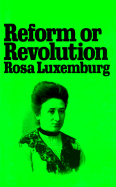
Rosa Luxemburg - Reform or Revolution
Rosa Luxemburg's short book Reform or Revolution is often overlooked these days, in favour of her more famous, Mass Strike. Written while in her late twenties, Reform or Revolution demonstrates the keeness of Luxemburg's Marxism and the sharpness of her polemic.
The book is a response to a series of articles and an eventual book by Eduard Bernstein. Berstein was an important figure in the German Social Democratic Party (SPD) to which Luxemburg also belonged. Bernstein was arguing for a movement away from the ideas embodied in classical Marxism.
"..hi conception of the march of economic development is incompatible with the Marxist theory of surplus value. Therefore, Bernstein abandons the theory of value and surplus value, and, in this way, the whole economic system of Karl Marx."
In fact, Luxemburg argued that he was breaking with the whole of Marxist thought - thought that was the rock upon which the SPD was built. The SPD had been founded as an avowed revolutionary organisation. It's leading members in the late 19th century had been close to Marx and Engels, but several where now demonstrating a break with that tradition. As the quote above suggests, Bernstein had dropped, or questioned a series of key Marxist ideas. In particular, he was hinting that the revolutionary transformation of society was no longer required because capitalism had the potential to solve its own contradictions.
Famously, she quotes Bernstein "The Final goal, no matter what it is, is nothing; the movement is everything.” Bernstein saw the socialist movement and the workers' organisations, such as the Trade Unions, not as weapons to further the struggle for socialism, but as tools to tame capitalism.
Luxemburg's anger at Bernstein's betrayal of the movement shines through. Yet her writting is never simply polemical. It is a clear restatement of basic Marxist arguments, in part an attempt to educate and win new workers to the revolutionary movement. Her final dismissal of Bernstein emphasises this:
"Not the shadow of an original though! Not a single idea that was not refuted, crushed, reduced into dust, by Marxism several decades ago!"
"Bernstein appear as an unconscious predestined instrument, by means of which the rising working class expresses its momentary weakness, but which, upon closwer inspection, it throws aside contemptusously and with pride."
This is a wonderful piece of polemic. Luxemburg clearly believed that Bernstein and those who rallied around him should be challenged, but she also clearly believed that the problem of reformism, or opportunism as she called it, was simply one of ideology. Defeated by a re-assertion of Marxism, she hoped the reformists would vanish and the SPD would continue along the correct road.
Unfortunately, what wasn't clear to her, was the extent to which reformism had a very real, material base within the SPD. Having made the transition from illegality to legal organisation, the SPD had built an immense organisation. Hundreds of newspapers and workers' clubs, thousands of full-timers. The organisation, as hinted by the quote from Bernstein above, was becoming an end in itself. Revolutionary activity, that challenged the state and the capitalists put all this in jeopardy. As Duncan Hallas once wrote, "they had much more to lose than their chains".
The rot went deep. Luxemburg herself details a number of examples of the way that the party had, in some localities, compromised with the capitalist system. This was, barely two decades after the publication of the book, to come to a head with the complete capitulation of the SPD's leaders to the system when it backed the First World War. In the aftermath of that, Luxemburg and a few other German revolutionaries were left almost alone to try and rebuild revolution organisation in the midst of World War. The lack of an independent, mass revolutionary socialist party was one of the major factors in the failure of the German Revolution that erupted at the end of the First World War.
Reform or Revolution is not an easy read as it contains many contemporary references. Though a decent introduction in the edition I read, by Donny Gluckstein put the work in context and had many useful endnotes. The question she addresses though, remains important. It is the basic arguement about how to challenge capitalism. Today, reformist organisations seem bankrupt. Here in the UK the Labour Party is a shadow of its former self. Yet reformist ideas remain the dominant ones in workers heads. Re-reading Rosa Luxemburg's polemic is a useful tool for all of us as we engage in the debates taking place today in every workplace and college about how to best challenge capitalism. Luxemburg's clear call for revolution speaks to millions today.
Related Reviews
Campbell - A Rebel's Guide to Rosa Luxemburg
Luxemburg - The Mass Strike
The book is a response to a series of articles and an eventual book by Eduard Bernstein. Berstein was an important figure in the German Social Democratic Party (SPD) to which Luxemburg also belonged. Bernstein was arguing for a movement away from the ideas embodied in classical Marxism.
"..hi conception of the march of economic development is incompatible with the Marxist theory of surplus value. Therefore, Bernstein abandons the theory of value and surplus value, and, in this way, the whole economic system of Karl Marx."
In fact, Luxemburg argued that he was breaking with the whole of Marxist thought - thought that was the rock upon which the SPD was built. The SPD had been founded as an avowed revolutionary organisation. It's leading members in the late 19th century had been close to Marx and Engels, but several where now demonstrating a break with that tradition. As the quote above suggests, Bernstein had dropped, or questioned a series of key Marxist ideas. In particular, he was hinting that the revolutionary transformation of society was no longer required because capitalism had the potential to solve its own contradictions.
Famously, she quotes Bernstein "The Final goal, no matter what it is, is nothing; the movement is everything.” Bernstein saw the socialist movement and the workers' organisations, such as the Trade Unions, not as weapons to further the struggle for socialism, but as tools to tame capitalism.
Luxemburg's anger at Bernstein's betrayal of the movement shines through. Yet her writting is never simply polemical. It is a clear restatement of basic Marxist arguments, in part an attempt to educate and win new workers to the revolutionary movement. Her final dismissal of Bernstein emphasises this:
"Not the shadow of an original though! Not a single idea that was not refuted, crushed, reduced into dust, by Marxism several decades ago!"
"Bernstein appear as an unconscious predestined instrument, by means of which the rising working class expresses its momentary weakness, but which, upon closwer inspection, it throws aside contemptusously and with pride."
This is a wonderful piece of polemic. Luxemburg clearly believed that Bernstein and those who rallied around him should be challenged, but she also clearly believed that the problem of reformism, or opportunism as she called it, was simply one of ideology. Defeated by a re-assertion of Marxism, she hoped the reformists would vanish and the SPD would continue along the correct road.
Unfortunately, what wasn't clear to her, was the extent to which reformism had a very real, material base within the SPD. Having made the transition from illegality to legal organisation, the SPD had built an immense organisation. Hundreds of newspapers and workers' clubs, thousands of full-timers. The organisation, as hinted by the quote from Bernstein above, was becoming an end in itself. Revolutionary activity, that challenged the state and the capitalists put all this in jeopardy. As Duncan Hallas once wrote, "they had much more to lose than their chains".
The rot went deep. Luxemburg herself details a number of examples of the way that the party had, in some localities, compromised with the capitalist system. This was, barely two decades after the publication of the book, to come to a head with the complete capitulation of the SPD's leaders to the system when it backed the First World War. In the aftermath of that, Luxemburg and a few other German revolutionaries were left almost alone to try and rebuild revolution organisation in the midst of World War. The lack of an independent, mass revolutionary socialist party was one of the major factors in the failure of the German Revolution that erupted at the end of the First World War.
Reform or Revolution is not an easy read as it contains many contemporary references. Though a decent introduction in the edition I read, by Donny Gluckstein put the work in context and had many useful endnotes. The question she addresses though, remains important. It is the basic arguement about how to challenge capitalism. Today, reformist organisations seem bankrupt. Here in the UK the Labour Party is a shadow of its former self. Yet reformist ideas remain the dominant ones in workers heads. Re-reading Rosa Luxemburg's polemic is a useful tool for all of us as we engage in the debates taking place today in every workplace and college about how to best challenge capitalism. Luxemburg's clear call for revolution speaks to millions today.
Related Reviews
Campbell - A Rebel's Guide to Rosa Luxemburg
Luxemburg - The Mass Strike
Sunday, January 08, 2012
John Molyneux - Will the Revolution be Televised? A Marxist Analysis of the Media
John Molyneux's short book on Anarchism that I reviewed recently is an excellent and fraternal critique of the main threads of Anarchist thought. His book on the media, which came out nearly simultaneously is a very important book, given some of the scandals and issues that arose in 2011, notably the crisis of the Murdoch press following the 'phone hacking scandal.
Molyneux sets out to answer a number of questions that radicals often pose about the media. His starting point though, is the irrationality of the system. The fact that there is poverty in the midst of plenty. Hunger and over consumption co-existing. Billions spent on weaponry, yet death due to absence of simple medicines. Molyneux asks why it is that people tolerate this system? Why do people accept ideas that are manifestly untrue? And consequently, why do people accept this state of affairs.
One answer that is often given, is the media. The media is seen as an all powerful force, disseminating ideas that are favourable to the capitalists and under-mine those of the radicals. The media as a whole serves the status quo. Molyneux sets out to examine the media - who runs it, and in whose interest as well as ask whether it is, indeed all powerful.
The media, be it television, radio or newspapers is demonstrably the tool of the wealthy. Murdoch's empire shows this. As a result, the media tends, to portray a particular view of the world. One in which capitalist ideas are the norm. Molyneux gives several examples, not all of them obvious. Most socialists and radicals are used to the way that even so called "independent" or "non-political" news outlets fail to report even the most enormous protests. When they do so, they often concentrate on the actions of a small minority, or accept, unquestioningly figures from the police for attendance. More subtly though, Molyneux shows how many other aspects of the media's output back up the status quo. Gameshows for instance, encourage the idea of competitiveness. Prizes are awarded to a lucky few for outdoing their opponents.
Molyneux argues that this is very much because of the interests of the system. That the media is not neutral, but is part of a system that protects itself from criticism, and were "common sense" ideas are those of the status quo. Even prestigious outlets, like the BBC, supposedly neutral, rarely allow critical voices to be heard. For them, neutrality lies midway between the left and right of mainstream politics. Yet the mainstream parties of the UK are all pro-capitalist. Neutrality hear gives no voice to socialist or other anti-capitalist ideas.
There is much more to Molyneux's short work. There is a fascinating examination of reality TV, how it has developed and how it again, portrays a particular image of society. Molyneux tries to explain the popularity of these. While I am not sure I entirely agree with his conclusion that "in watching the programmes and, importantly, in discussing them with family, friends, workmates etc, viewers are able to use them as a sounding board by which to judge standards of conduct, norms of behaviour, in times when these are changing rapidly", it is certainly an interesting point.
Molyneux looks at other aspects of culture, perhaps rarely discussed by Marxists. Why are their so few non-white people in Eastenders? A programme set in one of the most ethnically diverse areas of London? Similarly, why are so few of them actual workers, rather than owners of small businesses? His brief examination of the role of advertising in setting the agenda of newspapers is also interesting.
Finally Molyneux argues that rather than the media giving consumers "what they want", they create a market for what they offer. In times when millions of people question the world around them, and more importantly, when they are engaged in collectively changing things, such as during the Egyptian Revolution, Molyneux shows how "what people want" from the media changes dramatically. In fact, his examples of voting patterns and social attitudes from studies of newspaper readers show how even the hold of this media on its dedicated readers is often tenuous and more complex. Not everyone who reads the Daily Express is, it turns out, actually a rabid racist.
I suspect that much of what is in this short book will not be new to those studying the media. But I recommend Molyneux's analysis because it is remarkably clear and cuts through some of the academic jargon that dominates discussion of this topic in academia. He also points the way forward to some interesting articles for further study.
Related Reviews
Molyneux - Anarchism: A Marxist Critique
Molyneux sets out to answer a number of questions that radicals often pose about the media. His starting point though, is the irrationality of the system. The fact that there is poverty in the midst of plenty. Hunger and over consumption co-existing. Billions spent on weaponry, yet death due to absence of simple medicines. Molyneux asks why it is that people tolerate this system? Why do people accept ideas that are manifestly untrue? And consequently, why do people accept this state of affairs.
One answer that is often given, is the media. The media is seen as an all powerful force, disseminating ideas that are favourable to the capitalists and under-mine those of the radicals. The media as a whole serves the status quo. Molyneux sets out to examine the media - who runs it, and in whose interest as well as ask whether it is, indeed all powerful.
The media, be it television, radio or newspapers is demonstrably the tool of the wealthy. Murdoch's empire shows this. As a result, the media tends, to portray a particular view of the world. One in which capitalist ideas are the norm. Molyneux gives several examples, not all of them obvious. Most socialists and radicals are used to the way that even so called "independent" or "non-political" news outlets fail to report even the most enormous protests. When they do so, they often concentrate on the actions of a small minority, or accept, unquestioningly figures from the police for attendance. More subtly though, Molyneux shows how many other aspects of the media's output back up the status quo. Gameshows for instance, encourage the idea of competitiveness. Prizes are awarded to a lucky few for outdoing their opponents.
Molyneux argues that this is very much because of the interests of the system. That the media is not neutral, but is part of a system that protects itself from criticism, and were "common sense" ideas are those of the status quo. Even prestigious outlets, like the BBC, supposedly neutral, rarely allow critical voices to be heard. For them, neutrality lies midway between the left and right of mainstream politics. Yet the mainstream parties of the UK are all pro-capitalist. Neutrality hear gives no voice to socialist or other anti-capitalist ideas.
There is much more to Molyneux's short work. There is a fascinating examination of reality TV, how it has developed and how it again, portrays a particular image of society. Molyneux tries to explain the popularity of these. While I am not sure I entirely agree with his conclusion that "in watching the programmes and, importantly, in discussing them with family, friends, workmates etc, viewers are able to use them as a sounding board by which to judge standards of conduct, norms of behaviour, in times when these are changing rapidly", it is certainly an interesting point.
Molyneux looks at other aspects of culture, perhaps rarely discussed by Marxists. Why are their so few non-white people in Eastenders? A programme set in one of the most ethnically diverse areas of London? Similarly, why are so few of them actual workers, rather than owners of small businesses? His brief examination of the role of advertising in setting the agenda of newspapers is also interesting.
Finally Molyneux argues that rather than the media giving consumers "what they want", they create a market for what they offer. In times when millions of people question the world around them, and more importantly, when they are engaged in collectively changing things, such as during the Egyptian Revolution, Molyneux shows how "what people want" from the media changes dramatically. In fact, his examples of voting patterns and social attitudes from studies of newspaper readers show how even the hold of this media on its dedicated readers is often tenuous and more complex. Not everyone who reads the Daily Express is, it turns out, actually a rabid racist.
I suspect that much of what is in this short book will not be new to those studying the media. But I recommend Molyneux's analysis because it is remarkably clear and cuts through some of the academic jargon that dominates discussion of this topic in academia. He also points the way forward to some interesting articles for further study.
Related Reviews
Molyneux - Anarchism: A Marxist Critique
Wednesday, January 04, 2012
Edwin Black - IBM and the Holocaust
This book is a detailed demolition job. Edwin Black explores in great detail, with solid evidence what IBM, one of the largest, wealthiest and most important multinationals did during World War II. As such, the book also tells us something about the priorities of business.
Edwin Black argues that IBM's desire to maximise profits and in particular, the instincts and priorities of Thomas Watson, its chairman directly contributed to the Holocaust. IBM Germany, or Dehomag as it was known during the Hitler era, was run by "openly rabid Nazis" and IBM New York "always understood - from the outset in 1933 - that it was courting and doing business with the upper echelon of the Nazi Party".
Thomas Watson could not claim to be unaware of what was happening in Germany. Edwin Black uses the New York Times to illustrate exactly what was being reported about events in Germany following Hitler's election and occupied countries after the beginning of the war. He chooses this newspaper because it was the major newspaper of the city in which Watson lived and worked, and the city from where he frequently travelled to Germany, or sent representatives, to micro-manage IBM's business.
Black begins his story with the background to IBM and the key individuals who founded the business. Their ruthless business instincts make for fascinating reading, particularly in the light of later events. IBM's business and its fortune were based on mechanical counting and sorting machines. These machines, constantly being innovated and jealously guarded by patent, used punched cards to store data. IBM had sold these machines to the US government for use in censuses. For the first time detailed information could be stored and analysed, without laborious human work. With their introduction it was possible for the government to count the number of people with particular skills, or in age-groups or match up groups of people to almost any desire. Work that would previously have taken months now took hours. The success of the machines in the US census quickly meant that IBM could sell the technology to other governments and organisations. Soon, most of the capitalist world was using IBM technology to guide trains, count people or sort information.
Edwin Black details the rise of Hitler and Nazi Germany. He spends time dwelling on some of Hitler's plans and ideas. This is more than a simple rehash of history, Black is demonstrating as much as possible, the type of government that IBM was prepared to do business with. Anyone who sold counting machines to Hitler's Germany for censuses, and used their technical expertise to detail and prepare the punch cards required, could not have helped but know to what use they would be put to. IBM kept a monopoly on the manufacture and sale of the punch cards, essential to the work of the sorting machines. They did this for two reasons, one so they could continue to make profits from the machines once they had been leased and secondly to protect their monopoly of the business. IBM made themselves essential to Hitler's Germany and what they did.
That is not to say that IBM only did business with Fascist regimes, though their particular need to identify groups of individuals meant they were in high demand. IBM also sold machines to Allied governments. At one point IBM machines were being used to store information on movements of military equipment for both sides. IBM technology was used to decode Germany military messages at Bletchley Park. It was also used by the German's to encode them prior to transmission. As the German's invaded Poland, Czechoslovakia and France the machines were captured and put to use by the Nazis. IBM made sure that its company was kept up to date with the location of all the leased machines, understanding that its interests would be protected as a company from a country that was not yet involved.
As the years passed since Hitler's coming to power, popular opinion in the US turned heavily against the Nazis. As each story of atrocity emerged, more and more people and companies joined a boycott of Germany business. This boycott bit hard into the German economy. Thomas Watson became a central figure in arguing against the boycott. He was Germany's business man in the US. Free Trade to bring the world closer together and prevent war was his mantra. So pleased were his friends in Berlin that they gave him a medal at a glittering ceremony and party in the capital. Watson ensured that few in the US knew IBM's business links and Watson's relished his role as unofficial ambassador.
The Holocaust needed IBM punch cards. When the SS arrived in a town and produced a list of Jews they wanted, the names were sorted on the basis of data organised using IBM equipment. When those Jews were packed into cattle cars and taken to concentration camps, the trains ran to a timetable organised using IBM equipment. When the Jews were selected for forced labour, their skills and experiences were listed on cards. And when they were killed or sent to their deaths, the punch cards were marked to list their deaths. In Dachau, prisoners understood that the removal of the cards meant those individuals had been selected to die.
The Holocaust would have happened without IBM. But the business of mechanised slaughter and forced labour, as well as the ability to wage war was facilitated by IBM. The outbreak of war with the US meant that IBM's German operations were separated from New York, but Watson could rest easy, knowing that his interests, and the company's were protected for future peacetime. To make sure that IBM did not lose out, Watson created a group of soldiers from drafted IBM personnel. These men visited company premises with the advancing armies, securing IBM equipment. When IBM's involvement was exposed, the US civil servant who broke the news to his government was eventually told to keep it quiet. The US government wanted to make sure that they could have access to IBM's particular skills after the war, to make Europe work again.
The importance of IBM's equipment and the assistance that they offered to Nazi Germany in the years before the US entered World War II cannot be under-estimated. Edwin Black documents that in Norway, the resistance tried to destroy the sister company there with bombs (the company was called Watson Norsk) to stop the Nazis using the information to organise slave workers. Watson Norsk's "longtime manager", Tellefson ensured that information had been stored off-site in anticipation of such an attack, which "allowed IBM's lucrative service to continue. In Norway, annual revenues doubled from 161,000 crowns in 1940 to 334,000 crowns in 1943."
In 1941, Watson "set the stage for IBM Europe's wartime conduct". In instructions he wrote and sent out, he said that because of the war, "we cannot participate in the affairs of our companies... as we did in normal times... you are advised that you will have to make your own decisions and not call on us for any advice or assistance". As Edwin Black points out, this instruction did not tell them to stop working with the Hitler regime, or stop selling punch cards to the concentration camps, only to stop telling the New York office what was happening.
The centrality of IBM to the Holocaust is summed up by the one small positive story that exists in the book. This concerns an individual who deserves to be known as a hero to all of us today. Rene Carmille was a French military technologist who offered to take charge of the IBM machines to process the census returns. However the anticipated lists of Jews never materialised. Instead, when the invasion of Algeria began, the US forces had a ready list of Frenchmen able to join the Free French forces. The section of the punch cards "column 11" which asked for Jewish identity was never filled in. Carmille was a double agent for the French resistance. He produced 20,000 fake identity passes and a database of 800,000 former French soldiers, but he never produced a list of Jews for the SS.
Carmille was finally arrested in 1944 and tortured by the infamous Klaus Barbie. He never talked and eventually died in Dachau in early 1945. His personal contribution to blocking the production of the lists, illustrates the importance of IBM and the role of individuals who worked for it. The Author contrasts France with Holland were in a similar situation, IBM equipment was used to create a database of Jews and send them to concentration camps.
"Of an estimated 140,000 Dutch Jews.... 102,000 were murdered - a death ration of approximately 73 percent. Of an estimated 300,000 to 350,000 Jews living in France... about 85,000 were deported... barely 3,000 survived. The death ration in France was approximately 25 percent."
The destruction of the French Jews was made infinitely harder because of the lack of a working punch card system. Carmille and his mis-use of the IBM equipment played a central role in this.
IBM has never come clean about its operations during World War II, nor those of its affiliates in Europe. Important documents remain locked in archives and historians are not allowed access. Edwin Black's own researches have been restricted and blocked by IBM. Black says that IBM seems to be "hoping the matter will simply go away." A careful reading of Black's book has left me in no doubt that members of IBM's senior management during the 1930s and the early 1940s were well aware that their equipment was being used in Germany, and had detailed knowledge of the type of work that was being done with it. By continuing to produce punch cards for that market, training individuals in Germany and other European countries and offer maintenance contracts, IBM made enormous profits. IBM should come clean about this role and open up their archives for scrutiny by Holocaust experts.
However we should be clear about one thing. Thomas Watson was not a Nazi. Nor is it likely that any others in IBM New York's senior management were pro-Hitler. Nor was Watson particularly anti-Semitic. Indeed several of his close friends were Jewish and some, in Germany suffered under the regime, as did a number of Jewish employees of IBM in Germany. The logic driving IBM's involvement with Germany and the particular work that they did was the logic of capitalist business. Watson was particularly unprincipled in this, but nobody else in the organisation criticised the source of the money flowing into the bank. IBM found itself in a unique position and its senior staff drove home this advantage.
Fascism in power has close links with big business. Despite its appeal to the small businessman and the middle classes, Hitler's movement was about ensuring the continuation of the capitalist system. Hitler courted and was courted by businessmen from across the world. IBM and Thomas Watson were just one example. They were able to profit out of that relationship in spectacular ways and they should be held to account for it.
Related Reviews
Paxton - The Anatomy of Fascism
Guerin - Fascism and Big Business
Sereny - Albert Speer - His Battle with Truth
Edwin Black argues that IBM's desire to maximise profits and in particular, the instincts and priorities of Thomas Watson, its chairman directly contributed to the Holocaust. IBM Germany, or Dehomag as it was known during the Hitler era, was run by "openly rabid Nazis" and IBM New York "always understood - from the outset in 1933 - that it was courting and doing business with the upper echelon of the Nazi Party".
Thomas Watson could not claim to be unaware of what was happening in Germany. Edwin Black uses the New York Times to illustrate exactly what was being reported about events in Germany following Hitler's election and occupied countries after the beginning of the war. He chooses this newspaper because it was the major newspaper of the city in which Watson lived and worked, and the city from where he frequently travelled to Germany, or sent representatives, to micro-manage IBM's business.
Black begins his story with the background to IBM and the key individuals who founded the business. Their ruthless business instincts make for fascinating reading, particularly in the light of later events. IBM's business and its fortune were based on mechanical counting and sorting machines. These machines, constantly being innovated and jealously guarded by patent, used punched cards to store data. IBM had sold these machines to the US government for use in censuses. For the first time detailed information could be stored and analysed, without laborious human work. With their introduction it was possible for the government to count the number of people with particular skills, or in age-groups or match up groups of people to almost any desire. Work that would previously have taken months now took hours. The success of the machines in the US census quickly meant that IBM could sell the technology to other governments and organisations. Soon, most of the capitalist world was using IBM technology to guide trains, count people or sort information.
Edwin Black details the rise of Hitler and Nazi Germany. He spends time dwelling on some of Hitler's plans and ideas. This is more than a simple rehash of history, Black is demonstrating as much as possible, the type of government that IBM was prepared to do business with. Anyone who sold counting machines to Hitler's Germany for censuses, and used their technical expertise to detail and prepare the punch cards required, could not have helped but know to what use they would be put to. IBM kept a monopoly on the manufacture and sale of the punch cards, essential to the work of the sorting machines. They did this for two reasons, one so they could continue to make profits from the machines once they had been leased and secondly to protect their monopoly of the business. IBM made themselves essential to Hitler's Germany and what they did.
That is not to say that IBM only did business with Fascist regimes, though their particular need to identify groups of individuals meant they were in high demand. IBM also sold machines to Allied governments. At one point IBM machines were being used to store information on movements of military equipment for both sides. IBM technology was used to decode Germany military messages at Bletchley Park. It was also used by the German's to encode them prior to transmission. As the German's invaded Poland, Czechoslovakia and France the machines were captured and put to use by the Nazis. IBM made sure that its company was kept up to date with the location of all the leased machines, understanding that its interests would be protected as a company from a country that was not yet involved.
As the years passed since Hitler's coming to power, popular opinion in the US turned heavily against the Nazis. As each story of atrocity emerged, more and more people and companies joined a boycott of Germany business. This boycott bit hard into the German economy. Thomas Watson became a central figure in arguing against the boycott. He was Germany's business man in the US. Free Trade to bring the world closer together and prevent war was his mantra. So pleased were his friends in Berlin that they gave him a medal at a glittering ceremony and party in the capital. Watson ensured that few in the US knew IBM's business links and Watson's relished his role as unofficial ambassador.
![]() |
| A Hollerith machine, as used by the Nazi regime. Note the IBM logo. |
The Holocaust would have happened without IBM. But the business of mechanised slaughter and forced labour, as well as the ability to wage war was facilitated by IBM. The outbreak of war with the US meant that IBM's German operations were separated from New York, but Watson could rest easy, knowing that his interests, and the company's were protected for future peacetime. To make sure that IBM did not lose out, Watson created a group of soldiers from drafted IBM personnel. These men visited company premises with the advancing armies, securing IBM equipment. When IBM's involvement was exposed, the US civil servant who broke the news to his government was eventually told to keep it quiet. The US government wanted to make sure that they could have access to IBM's particular skills after the war, to make Europe work again.
The importance of IBM's equipment and the assistance that they offered to Nazi Germany in the years before the US entered World War II cannot be under-estimated. Edwin Black documents that in Norway, the resistance tried to destroy the sister company there with bombs (the company was called Watson Norsk) to stop the Nazis using the information to organise slave workers. Watson Norsk's "longtime manager", Tellefson ensured that information had been stored off-site in anticipation of such an attack, which "allowed IBM's lucrative service to continue. In Norway, annual revenues doubled from 161,000 crowns in 1940 to 334,000 crowns in 1943."
In 1941, Watson "set the stage for IBM Europe's wartime conduct". In instructions he wrote and sent out, he said that because of the war, "we cannot participate in the affairs of our companies... as we did in normal times... you are advised that you will have to make your own decisions and not call on us for any advice or assistance". As Edwin Black points out, this instruction did not tell them to stop working with the Hitler regime, or stop selling punch cards to the concentration camps, only to stop telling the New York office what was happening.
The centrality of IBM to the Holocaust is summed up by the one small positive story that exists in the book. This concerns an individual who deserves to be known as a hero to all of us today. Rene Carmille was a French military technologist who offered to take charge of the IBM machines to process the census returns. However the anticipated lists of Jews never materialised. Instead, when the invasion of Algeria began, the US forces had a ready list of Frenchmen able to join the Free French forces. The section of the punch cards "column 11" which asked for Jewish identity was never filled in. Carmille was a double agent for the French resistance. He produced 20,000 fake identity passes and a database of 800,000 former French soldiers, but he never produced a list of Jews for the SS.
Carmille was finally arrested in 1944 and tortured by the infamous Klaus Barbie. He never talked and eventually died in Dachau in early 1945. His personal contribution to blocking the production of the lists, illustrates the importance of IBM and the role of individuals who worked for it. The Author contrasts France with Holland were in a similar situation, IBM equipment was used to create a database of Jews and send them to concentration camps.
"Of an estimated 140,000 Dutch Jews.... 102,000 were murdered - a death ration of approximately 73 percent. Of an estimated 300,000 to 350,000 Jews living in France... about 85,000 were deported... barely 3,000 survived. The death ration in France was approximately 25 percent."
The destruction of the French Jews was made infinitely harder because of the lack of a working punch card system. Carmille and his mis-use of the IBM equipment played a central role in this.
IBM has never come clean about its operations during World War II, nor those of its affiliates in Europe. Important documents remain locked in archives and historians are not allowed access. Edwin Black's own researches have been restricted and blocked by IBM. Black says that IBM seems to be "hoping the matter will simply go away." A careful reading of Black's book has left me in no doubt that members of IBM's senior management during the 1930s and the early 1940s were well aware that their equipment was being used in Germany, and had detailed knowledge of the type of work that was being done with it. By continuing to produce punch cards for that market, training individuals in Germany and other European countries and offer maintenance contracts, IBM made enormous profits. IBM should come clean about this role and open up their archives for scrutiny by Holocaust experts.
However we should be clear about one thing. Thomas Watson was not a Nazi. Nor is it likely that any others in IBM New York's senior management were pro-Hitler. Nor was Watson particularly anti-Semitic. Indeed several of his close friends were Jewish and some, in Germany suffered under the regime, as did a number of Jewish employees of IBM in Germany. The logic driving IBM's involvement with Germany and the particular work that they did was the logic of capitalist business. Watson was particularly unprincipled in this, but nobody else in the organisation criticised the source of the money flowing into the bank. IBM found itself in a unique position and its senior staff drove home this advantage.
Fascism in power has close links with big business. Despite its appeal to the small businessman and the middle classes, Hitler's movement was about ensuring the continuation of the capitalist system. Hitler courted and was courted by businessmen from across the world. IBM and Thomas Watson were just one example. They were able to profit out of that relationship in spectacular ways and they should be held to account for it.
Related Reviews
Paxton - The Anatomy of Fascism
Guerin - Fascism and Big Business
Sereny - Albert Speer - His Battle with Truth
Sunday, January 01, 2012
George V. Higgins - The Friends of Eddie Coyle
Described in the introduction as the "game changing crime novel of the last fifty years" it is difficult to understand the hype that surrounds The Friends of Eddie Coyle. It certainly is a well written novel, a tale told almost entirely through conversations between central characters. But while the conversations certainly allow the author to demonstrate his skills, but this isn't enough to make the novel as brilliant as many claim.
Eddie Coyle is a small time, and fairly inept gangster. Facing jail for his part in a minor crime, he is offered a way out if he is prepared to tell the police about other, bigger crimes he knows of. Coyle is a small cog in a larger, wider criminal network. Amongst these acquaintances are gun-smugglers, murders and bank robbers.
The choice Eddie faces, which "friend" to sell out makes up the central part of the story. The problem is that the police want more, and once Eddie has begun the journey of selling out his friends, it is difficult to go back. The conclusion is not-unexpected, but at least the drama mounts and the story holds till the end.
I'm not sure that this really is "one of the greatest crime novels ever written". But it is fairly enjoyable and it'll keep you off the streets yourself for an hour or so.
Eddie Coyle is a small time, and fairly inept gangster. Facing jail for his part in a minor crime, he is offered a way out if he is prepared to tell the police about other, bigger crimes he knows of. Coyle is a small cog in a larger, wider criminal network. Amongst these acquaintances are gun-smugglers, murders and bank robbers.
The choice Eddie faces, which "friend" to sell out makes up the central part of the story. The problem is that the police want more, and once Eddie has begun the journey of selling out his friends, it is difficult to go back. The conclusion is not-unexpected, but at least the drama mounts and the story holds till the end.
I'm not sure that this really is "one of the greatest crime novels ever written". But it is fairly enjoyable and it'll keep you off the streets yourself for an hour or so.
Wednesday, December 28, 2011
Richard Fortey - Trilobite! Eyewitness to Evolution
I used to think that the trilobite was merely one of those instantly recognisable fossils, sort of like an elongated and flattened woodlouse. The sum total of my knowledge of trilobites was, in the style of a foot note to a child's introduction to fossils, that they were distant relations of the modern horseshoe crab. Growing up in Birmingham, I'd never seen a horseshoe crab, though on visits to Dudley Zoo, I should have become more acquainted with its older ancestor. Trilobites are found in vast numbers in quarries around that Midland town, and the 'Dudley Locust' as it was known, features on the town's crest.
Richard Fortey's book on trilobites is full of such facts. However it is much more than the sort of history that rests everything on a collection of similar pieces of information. The trilobite forms an important moment in the evolution of life on Earth, and its very success has enabled scientists like Fortey to contribute enormously to our understanding of the history of the planet.
The tale is also the tale of Fortey's own career. From his early discovery of a trilobite as a young boy looking for fossils, "other boys discovered girls, I discovered trilobites" to exhibitions as wide-spread as Spitsbergen, Canada and China, his studies of the thousands of trilobite species have led him to be one of those few individuals lucky enough to be pursuing a career in a childhood passion. But Fortey's own interests are much wider than trilobites. Alongside detailed explanations of natural history and planetary geology, his book is peppered with literary quotes and poems. All this makes for a readable and fascinating account.
So why are these animals so important. Its not their size. Few of the species seem to have grown more than a foot or so, many of them were a few centimetres in size. Their sheer numbers are stunning. Some of the pictures in the book of enormous quantities of fossils and pieces of fossil, piled on top of each other, are testament to the numbers of trilobites that must have existed on sea bottoms and in the depths of the water. Trilobites were amazingly successful. They came into being when the continents themselves were part of earlier arrangements - before the Pangean super-continent, stretching back millions of years. They lasted for 300 million or so years, far longer than our own species.
Its this longevity that in part explains tribolite importance. Mapping out the places that their fossils are found can help identify the locations of ancient seabeds and coastlines. The very movement of the Earth's plates, and hence the continents, around the globe are marked by were fossils of trilobites can be found.
There's much more too. Despite the 540 million or so years since they lived, trilobites were not primitive creatures. Their hard shells demonstrate eons of evolution themselves. Able to curl up and protect themselves from predators, or on occasion produce spears and tridents to help get their food, scientists have identified trilobites that roamed the surface, swam in the Cambrian oceans and lived under the mud.
A few lucky scientists have made careers from bridging the boundaries of their disciplines. Most trilobites could see, growing crystals of calcite that focused light onto sensitive cells. The very notion of an animal with eyes partially made from the same substance as rocks or shells is stunning, and Fortey devotes a fascinating chapter to the evolutionary and biological questions that this throws up.
The trilobite is a humble creature. Fortey says that he has given up hope that there remains a remote ocean-valley holding a still living colony of these creatures. It seems, sadly, that despite the animal's success, it was unable to survive the changing environment. However, the insight that we can gain from its life into sciences as varied as plate-tectonics, genetics and evolution, surely gives this animal an importance far beyond its own humble life. Richard Fortey's wonderful book is a brilliant insight into all of these subjects and far beyond.
Related Reviews
Cadbury - The Dinosaur Hunters
Richard Fortey's book on trilobites is full of such facts. However it is much more than the sort of history that rests everything on a collection of similar pieces of information. The trilobite forms an important moment in the evolution of life on Earth, and its very success has enabled scientists like Fortey to contribute enormously to our understanding of the history of the planet.
The tale is also the tale of Fortey's own career. From his early discovery of a trilobite as a young boy looking for fossils, "other boys discovered girls, I discovered trilobites" to exhibitions as wide-spread as Spitsbergen, Canada and China, his studies of the thousands of trilobite species have led him to be one of those few individuals lucky enough to be pursuing a career in a childhood passion. But Fortey's own interests are much wider than trilobites. Alongside detailed explanations of natural history and planetary geology, his book is peppered with literary quotes and poems. All this makes for a readable and fascinating account.
So why are these animals so important. Its not their size. Few of the species seem to have grown more than a foot or so, many of them were a few centimetres in size. Their sheer numbers are stunning. Some of the pictures in the book of enormous quantities of fossils and pieces of fossil, piled on top of each other, are testament to the numbers of trilobites that must have existed on sea bottoms and in the depths of the water. Trilobites were amazingly successful. They came into being when the continents themselves were part of earlier arrangements - before the Pangean super-continent, stretching back millions of years. They lasted for 300 million or so years, far longer than our own species.
Its this longevity that in part explains tribolite importance. Mapping out the places that their fossils are found can help identify the locations of ancient seabeds and coastlines. The very movement of the Earth's plates, and hence the continents, around the globe are marked by were fossils of trilobites can be found.
![]() |
| A trilobite fossil, yesterday. |
A few lucky scientists have made careers from bridging the boundaries of their disciplines. Most trilobites could see, growing crystals of calcite that focused light onto sensitive cells. The very notion of an animal with eyes partially made from the same substance as rocks or shells is stunning, and Fortey devotes a fascinating chapter to the evolutionary and biological questions that this throws up.
The trilobite is a humble creature. Fortey says that he has given up hope that there remains a remote ocean-valley holding a still living colony of these creatures. It seems, sadly, that despite the animal's success, it was unable to survive the changing environment. However, the insight that we can gain from its life into sciences as varied as plate-tectonics, genetics and evolution, surely gives this animal an importance far beyond its own humble life. Richard Fortey's wonderful book is a brilliant insight into all of these subjects and far beyond.
Related Reviews
Cadbury - The Dinosaur Hunters
Monday, December 26, 2011
Neil Gaiman - American Gods
![]() | ||
| I read the "author's preferred text". |
Gaiman's view of the United States is not one that the American government would like. His America is one that is more than the superficial niceness of shopping malls, or the repetitive nature of identikit roadside restaurants. Gaiman peers through this to the uneven, dirty America beneath. One of poverty and shallowness, of kindness and hope mixed with despair. For most people, hope has been replaced by the short-term desire for objects and feelings that will numb the over-riding feeling of pointlessness.
Gods arise out of belief. When the first farmers gave thanks for their crops, or the hunters turned to the skies and praised those that had given them an easy kill, Gods were created. They drew strength from their followers. The more that made sacrifice or prayers the more powerful they were. America, a land populated by immigrants from the time of the last ice-age has many imported Gods. Those who arrived on the shores and gave thanks to the old Gods, created new versions of them on the new continent. The vikings (and other more fantastical visitors such as the Egyptians) brought Odin and Loki and numerous others. But the worship dwindled with the failure of those communities. Later immigrants brought Gods from Ireland and elsewhere. Some prospered, some are reduced to poverty, themselves praying for followers and urging worships.
But new Gods prosper and grow strong. The Gods of commodification and short-term pleasure. Gods of money and electricity, of railways and engineering. These might be seen as an analogy for capitalism itself, its dynamism throwing up new objects of worship, which are rapidly eclipsed like steam power gives way to electricity. The Gods engage in a final battle for supremacy, and Shadow, the hero of the piece is drawn in. As bodyguard and then as a central piece in the chess game itself. The battle between old and new is a metaphor for America itself. The backdrop is the very development of the continent and the lives of the people who made it.
The idea of Gods having strength from worship is not new. Nor is the mortality of Gods who lose their followers. Pratchett did it in Small Gods and Douglas Adams also played it for laughs in Dirk Gently. Gaiman creates a many-layered world of belief and magic, parallel to, but not separate from our own world. The differences between good and bad are blurred here. The unity of the Gods, old versus new, obscures the fact that both sides have their own divisions. For most of the Gods, humans worship them, but are also objects to satisfy their own base desires. People to be seduced, laughed at and scorned. You could if you want, employ a further metaphor here, human life generates the religious value that the Gods crave and need to continue their blind, irrational lives. The further accumulation of belief requires the further use and abuse of humans, even if some Gods enjoy the exploitation less than others.
I will avoid the temptation to draw out the detail of the story. The climatic battle between old and new here does not necessarily herald a change in the human world, though one is left with the feeling that a world were the only Gods that exist are ones that represent Internet shopping and machine guns would not be a good things for ordinary folk. Whether humanity ever ever throw off the Gods themselves is left to the imagination. His voyage through America as Shadow explores the other world that he has hitherto not observed, is a work of detail. From the small towns, with their delicious undercurrent of pain and suffering, to the rank, sterile life of shopping malls and banks, the book is part travelogue, part crime caper, part fantasy and in large part, a tale of retribution and revenge. It is a wonderful read that will suck you into an alternate world, but one that is strangely familiar.
Wednesday, December 21, 2011
Philip José Farmer - The Dark Design
Volume three of Philip José Farmer's Riverworld series is one of those novels were you wonder if the series is about to "jump the shark". The two earlier ones, set as they are, on a baffling and fantastic planet were the vast majority of humans from all epochs of history have been resurrected, are excellent reads.
Farmer's orginal idea though, was so vast in scope that there was no way that it could be limited to one or two books. Indeed, in the preface to this novel he explains that the story continued to grow. What was meant to be the final volume became the penultimate.
Farmer is trying to tie up lose ends here. His various characters, or groups of characters are all famous individuals from Earth's history. Unlikely groupings of people like Mark Twain and Cyrano de Bergarac, Jack London and Richard Burton are some of the figures that are trying to find their way to an enormous tower at the centre of an arctic sea. As suggested by its name, Riverworld is dominated by a single river that stretches from pole to pole and back around the other side of the globe. This continuously flowing stream is surrounded by millions of humans. Despite these numbers, chance encounters seem common enough. Certainly enough that Farmer can experiment with the lives (both actual and fictional) of his characters.
Despite some good ideas here the plot occasionally feels of artifical. In one area of the planet the stone age society (there are limited metals and minerals on Riverworld) is running short of the flint it needs for tools and weapons and society is moving backwards. Yet elsewhere, one of the planet's founders has been able to divert an asteroid to provide a huge variety of material for technological development. So some explorers, travelling now by assorted balloons, steam boats and blimps have helicopters and lasers, which seems to me to undermine the point of the story somewhat. Elsewhere the novel seems to have been limited by its editorship. Do we really need to have every measurement in both imperial and metric values? The following sentence, for instance, should win a prize;
"In this deep, cold cup the water surrendered warmth, so much that the temperature at 1524 metres or 5000 feet was 2 degrees above Centigrade."
On the same page, on character orders de Bergarac, the pilot of his airship to 'Take her down to 1530 metres, Cyrano'. The exactness of the figures seems unnecessary.
The quest to get to the tower dominates the lives of the characters, the sole point of the world that the author has created is to beg the question why has this happened and why have human's been resurrected upon it. The quests to the tower, initiated by a rogue member of the intelligent beings that created the planet are part of finding the answers. Yet the story keeps running away from the author. It is non-linear too, Farmer weaving plot-lines around each other in a confusing mix. Farmer created a wonderful fantasy world here. I just hope that the final parts of the story answer the questions posed early on and don't confuse things more.
Related Reviews
Farmer - To Your Scattered Bodies Go
Farmer - The Fabulous Riverboat
Farmer's orginal idea though, was so vast in scope that there was no way that it could be limited to one or two books. Indeed, in the preface to this novel he explains that the story continued to grow. What was meant to be the final volume became the penultimate.
Farmer is trying to tie up lose ends here. His various characters, or groups of characters are all famous individuals from Earth's history. Unlikely groupings of people like Mark Twain and Cyrano de Bergarac, Jack London and Richard Burton are some of the figures that are trying to find their way to an enormous tower at the centre of an arctic sea. As suggested by its name, Riverworld is dominated by a single river that stretches from pole to pole and back around the other side of the globe. This continuously flowing stream is surrounded by millions of humans. Despite these numbers, chance encounters seem common enough. Certainly enough that Farmer can experiment with the lives (both actual and fictional) of his characters.
Despite some good ideas here the plot occasionally feels of artifical. In one area of the planet the stone age society (there are limited metals and minerals on Riverworld) is running short of the flint it needs for tools and weapons and society is moving backwards. Yet elsewhere, one of the planet's founders has been able to divert an asteroid to provide a huge variety of material for technological development. So some explorers, travelling now by assorted balloons, steam boats and blimps have helicopters and lasers, which seems to me to undermine the point of the story somewhat. Elsewhere the novel seems to have been limited by its editorship. Do we really need to have every measurement in both imperial and metric values? The following sentence, for instance, should win a prize;
"In this deep, cold cup the water surrendered warmth, so much that the temperature at 1524 metres or 5000 feet was 2 degrees above Centigrade."
On the same page, on character orders de Bergarac, the pilot of his airship to 'Take her down to 1530 metres, Cyrano'. The exactness of the figures seems unnecessary.
The quest to get to the tower dominates the lives of the characters, the sole point of the world that the author has created is to beg the question why has this happened and why have human's been resurrected upon it. The quests to the tower, initiated by a rogue member of the intelligent beings that created the planet are part of finding the answers. Yet the story keeps running away from the author. It is non-linear too, Farmer weaving plot-lines around each other in a confusing mix. Farmer created a wonderful fantasy world here. I just hope that the final parts of the story answer the questions posed early on and don't confuse things more.
Related Reviews
Farmer - To Your Scattered Bodies Go
Farmer - The Fabulous Riverboat
Monday, December 19, 2011
David J. Breeze - The Antonine Wall
The northern-most frontier of the Roman Empire, marked out by the Antonine Wall is often overlooked by its more impressive southern cousin built by Hadrian. The history of the Antonine Wall is much shorter, and according to David Breeze, it was likely to have been built by a new Emperor, keen to extend his Imperial boundaries in order to win a triumph. But extending the borders like this didn't really win the Emperor much, Breeze points out that he conquered "territory which had once been Roman and, we might expect, had been kept under Roman surveillance ever since."
Unlike Hadrian's wall, much of Antonine's was constructed from turf, rather than stone. An impressive military way would have shadowed the wall, and forts and fortlets helped soldiers patrol and guard the approach. Again, as with Hadrian's wall, this was less of a military defence and more of a border or statement of power. Breeze locates the wall in a wider "military landscape", with Roman forts, settlements and patrols extending over a wider area, north and south of the actual border line.
For those academically interested, there is a wealth of detail here - distances and sizes, lists of military forces based at particular points and so the like. There is also a smidgen of humour, I liked that the chapter dealing with the day to day life of the soldiers stationed on the wall, is called "Life on the Edge". For those soldiers who may have served, or originated in Africa, as evidence of ancient cooking styles implies, this cold northerly location at the most extreme end of the Empire must have felt very isolated indeed. Very much an edge between the known and unknown.
Sadly little of Antonine's wall survive. Extensive parts have fallen foul of the plough, but Breeze's book provides a useful guide to the best places to view the wall. From personal experience I recommend Rough Castle, not simply for the remains, but because of the sense of the wider landscape that the Romans would have been located in. This is a useful introduction to the history of this part of the Roman world and some of the debates and discussions that are still absorbing academic minds. Breeze is honest enough to admit that he has emphasised the evidence that backs his own theories, but I suspect that much of this would mean little to the lay reader anyway, and is unlikely to detract from a useful introduction to a small part of Roman Britain.
Related Reviews
Watkins - The Roman Forum
Parenti - The Assassination of Julius Caesar
Beard - Pompeii; The Life of a Roman Town
Beard - The Roman Triumph
Unlike Hadrian's wall, much of Antonine's was constructed from turf, rather than stone. An impressive military way would have shadowed the wall, and forts and fortlets helped soldiers patrol and guard the approach. Again, as with Hadrian's wall, this was less of a military defence and more of a border or statement of power. Breeze locates the wall in a wider "military landscape", with Roman forts, settlements and patrols extending over a wider area, north and south of the actual border line.
For those academically interested, there is a wealth of detail here - distances and sizes, lists of military forces based at particular points and so the like. There is also a smidgen of humour, I liked that the chapter dealing with the day to day life of the soldiers stationed on the wall, is called "Life on the Edge". For those soldiers who may have served, or originated in Africa, as evidence of ancient cooking styles implies, this cold northerly location at the most extreme end of the Empire must have felt very isolated indeed. Very much an edge between the known and unknown.
Sadly little of Antonine's wall survive. Extensive parts have fallen foul of the plough, but Breeze's book provides a useful guide to the best places to view the wall. From personal experience I recommend Rough Castle, not simply for the remains, but because of the sense of the wider landscape that the Romans would have been located in. This is a useful introduction to the history of this part of the Roman world and some of the debates and discussions that are still absorbing academic minds. Breeze is honest enough to admit that he has emphasised the evidence that backs his own theories, but I suspect that much of this would mean little to the lay reader anyway, and is unlikely to detract from a useful introduction to a small part of Roman Britain.
Related Reviews
Watkins - The Roman Forum
Parenti - The Assassination of Julius Caesar
Beard - Pompeii; The Life of a Roman Town
Beard - The Roman Triumph
Thursday, December 15, 2011
Gitta Sereny - Albert Speer: His Battle With Truth
Gitta Sereny's detailed and scholarly examination of one of the key figures in Hitler's leadership is also extremely readable and powerful, two qualities rare in biography. At times it is terrible to read, the subject matter by necessity must examine details of the Holocaust and the use of slave labour that is repugnant. There is a compelling fascination though. For anyone who has ever wondered how the Holocaust could happen, how fairly ordinary men and women could be complicit in the mass murder of six million Jews, and millions of communists, socialists, trade unionists, Gypsies, gays and lesbians and countless other "undesirables" there is a desire to try and understand the reality of life under German Fascism.
There is meticulous research behind this book. Sereny seems to have spent a lifetime in archives, reading documents and interviewing every conceivable participant who knew the individual she was writing about. From his secretaries and servants in Hitler's bunker, to his wife and prison guards. But most of all, she interviewed Speer himself.
Following his trial at Nuremberg for his involvement in war-crimes, Speer was sentenced to 20 years in prison. Even before the trial itself he was undergoing a transformation. By the time of his release, he seemed obsessed with expressing his own repentance. Many of his existing circle of friends disowned him - they could not understand his desire to distance himself from Hitler, nor criticise the former Fuhrer. This process had begun, at least publicly, for Speer in the dock, when he'd attacked the man to whom he owed so much. Even in Spandau prison, several of his co-defendants could not forgive him for this.
Sereny's biography beings with Speer's childhood. Given the realities of German life in the early twentieth century, Speer was lucky to be the son of a prosperous, if unloving architect. The stilted and cool atmosphere of the middle class upbringing shaped Speer's own inability to display warmth. No doubt, his later relationship with Hitler carried echoes of the relationship that Speer would have liked to have had with his own father. However, to reduce their complex friendship to this would make nonsense of the other factors and realities of Speers' life.
By chance Speer found himself the favoured architect of Hitler. Speer had never been a party man, though he rapidly found himself at the heart of the Nazi organisation, joining formally in the early 1930s. However his rise was startling, and by the time of the war, he had moved on from designing homes to prominent Nazis, to heading up some of the most important industries of the German war economy. He proved extremely able. Even during the height of the bombing campaigns Speer helped ensure that the German economy continued to produce munitions and equipment for the armed forces. Central to this was the question of slave labour, labour that originated in the concentration camps, from Jew's exiled from their homes and from captured prisoners.
At the heart of the book, and indeed most articles about Speer is the question of his knowledge. To what extent was he aware of the mass murder taking place? Sereny's answer is couched in riders. Firstly she argues that it wasn't true that everyone in Germany was aware of the mechanised slaughter taking place at death-camps in Poland. This is not to say that people didn't think killing was taking place, or that something was going on. She includes Speer in this - he must have been aware that large numbers of people were being transported away from their homes, just has he must have known that hundreds of thousands of labourers were coming from somewhere.
Central to this debate, is whether or not Speer was present at an infamous speech that Himmler made to leading members of the SS. The text of Himmler's speech, which mentioned the slaughter and what needed to be done to solve the Jewish question, refers to Speer on several occasions, as if Speer himself was in the hall. Speer admits that he was there in an earlier session, speaking on questions of wartime production, but claims to have left. When the speech was made public, Speer spent many long hours trying to prove that he wasn't there, by sitting in the archives looking for evidence.
It is worth at this point noting Sereny's own brilliance as a researcher and historian. She examines Speer's life day by day, sometimes hour by hour, trying to tease out exactly where he was and when. What could he have known, who else was with him, what might he have heard. The detail is almost overwhelming, but builds up her central thesis, that Speer knew far more than he let on. This level of detail is important for Sereny too, because Speer spent many many ours creating his own story in an attempt to free himself of suspicion.
This desire to clear his name shaped Speer's later life. His defence at Nuremberg, was to denounce Hitler and his actions, accepting his responsibilities, but not his guilt. However once his imprisonment began, he seems to have begun to construct a careful web of stories that highlight his independence and criticism of Hitler as well as ignore his links to the aspects of the regime that would have acknowledged his awareness of the Holocaust. One example of this, is in the description of his final meeting with Hitler. Speer claims in his book, Inside the Third Reich, that he re-afirmed his personal loyalty, but admitting to working to countermand Hitler's final scorched earth policies. In a famous paragraph, Sereny points out that:
"Psychologically, it is possible that this is the way he remembered the occasion, because it was how he would have liked to behave, and the way he would have liked Hitler to react. But the fact is that none of it happened; our witness to this is Speer himself." [529]
Speer's original draft manuscript for the book, written in prison, contained no such story - surely something that would have been at the forefront of his mind. In fact the opposite is then claimed, Speer saying that he did not confess to Hitler. Similar examples abound in Sereny's book, as she uncovers the detailed process that Speer went through, before presenting his carefully selected story to the world. Speer makes much of his break with Hitler - his desire to protect the German people. So much so, that Speer claimed to have made plans to kill the Fuhrer.
After reading over 700 pages of Sereny's detailed account, its difficult to believe anything that Speer says. Not necessarily because he deliberately lied all the time, but because he was keen to portray himself in a particular way. He was after all, one of the last remaining figures from Hitler's inner circle and few could contradict him.
Sereny doesn't limit herself simply to telling, or criticising Speer's story. She spends time examining other aspects to the story of Nazi Germany. Some of the powerful parts are the tales of those that did know about the Holocaust and sought to alert the world. Some of these tales are tragic, as the fairly to be believed or listened to, drove individuals to despair and suicide. Sereny highlights these tales, to argue that some people were brave enough to stand up, or at least find out what was going on. Those who argue that the only chance to survive the dictatorship was to keep ones head down, may have been accurate, but they took a particular moral path.
Speer did not do this. He feigned ignorance and enjoyed his privileged life as long as he could. That said, he did clearly break with Hitler. He seemed to be one of the few who could challenge Hitler's madness, though Speer was not brave enough to break completely. There is an element, at least in how SEreny describes it, of love between the two men. Or perhaps hero worship by Speer. His return to Berlin to see Hitler one last time, smacks vaguely of the behaviour of a lover who cannot quite bring themself to say a final goodbye.
Sereny shows that many of those who knew Speer, during the war, during his imprisonment and after his release seem to have fallen into a kind of spell. Speer was clever, articulate, handsome and dashing. But she reminds us, he worked closely with people who had inspected concentration camps. Drank champagne with men who organised the Holocaust and had visited the slave labour camps. Even if the experience here shocked him enough to demand improved conditions for the workers.
Sereny concludes by quoting an exchange with Speer. An article she'd written quoted some word's of Speer's, written in 1977:
"However to this day I still consider my main guilt to be my tacit acceptance [Billigung] of the persecution and the murder of millions of Jews."
After he had checked this with her, and added a clarifying footnote which, if anything, strengthens the statement, Sereny asks why he was saying this now after denying it for so long. The article he had written was in response to a Holocaust denial book and Speer explained that he could no longer "hedge" the question, "for this purpose". Sereny comments that had Speer said this at Nuremberg, he would have hung with the other Nazis.
Sereny's book leaves little doubt that Speer knew far more than he admitted. His survival at Nuremberg and the second career he carved out as a writer stem from his ability to selectively tell a horrific story. But it is also clear that Speer was himself horrified by what had been done. The Holocaust was the outcome of the coming to power of a powerful political force that had been moulded by Hitler. The fascist bands that made Germany safe from socialist revolution relied on racism and prejudice to cement the street gangs together. They broke the communists and the trade unions, but they also opened the door to mass murder. Speer, and many of the industrialists that he came to work closely with during the war, found the world of Hitler one that they could do business with. A tiny number turned their backs and walked away, Speer and many others did not.
Related Reviews
Sereny - Into that Darkness: From Mercy Killing to Mass Murder
Paxton - The Anatomy of Fascism
Guerin - Fascism and Big Business
Lipstadt - Denying the Holocaust, the Growing Assault on Truth and History
There is meticulous research behind this book. Sereny seems to have spent a lifetime in archives, reading documents and interviewing every conceivable participant who knew the individual she was writing about. From his secretaries and servants in Hitler's bunker, to his wife and prison guards. But most of all, she interviewed Speer himself.
Following his trial at Nuremberg for his involvement in war-crimes, Speer was sentenced to 20 years in prison. Even before the trial itself he was undergoing a transformation. By the time of his release, he seemed obsessed with expressing his own repentance. Many of his existing circle of friends disowned him - they could not understand his desire to distance himself from Hitler, nor criticise the former Fuhrer. This process had begun, at least publicly, for Speer in the dock, when he'd attacked the man to whom he owed so much. Even in Spandau prison, several of his co-defendants could not forgive him for this.
Sereny's biography beings with Speer's childhood. Given the realities of German life in the early twentieth century, Speer was lucky to be the son of a prosperous, if unloving architect. The stilted and cool atmosphere of the middle class upbringing shaped Speer's own inability to display warmth. No doubt, his later relationship with Hitler carried echoes of the relationship that Speer would have liked to have had with his own father. However, to reduce their complex friendship to this would make nonsense of the other factors and realities of Speers' life.
By chance Speer found himself the favoured architect of Hitler. Speer had never been a party man, though he rapidly found himself at the heart of the Nazi organisation, joining formally in the early 1930s. However his rise was startling, and by the time of the war, he had moved on from designing homes to prominent Nazis, to heading up some of the most important industries of the German war economy. He proved extremely able. Even during the height of the bombing campaigns Speer helped ensure that the German economy continued to produce munitions and equipment for the armed forces. Central to this was the question of slave labour, labour that originated in the concentration camps, from Jew's exiled from their homes and from captured prisoners.
At the heart of the book, and indeed most articles about Speer is the question of his knowledge. To what extent was he aware of the mass murder taking place? Sereny's answer is couched in riders. Firstly she argues that it wasn't true that everyone in Germany was aware of the mechanised slaughter taking place at death-camps in Poland. This is not to say that people didn't think killing was taking place, or that something was going on. She includes Speer in this - he must have been aware that large numbers of people were being transported away from their homes, just has he must have known that hundreds of thousands of labourers were coming from somewhere.
Central to this debate, is whether or not Speer was present at an infamous speech that Himmler made to leading members of the SS. The text of Himmler's speech, which mentioned the slaughter and what needed to be done to solve the Jewish question, refers to Speer on several occasions, as if Speer himself was in the hall. Speer admits that he was there in an earlier session, speaking on questions of wartime production, but claims to have left. When the speech was made public, Speer spent many long hours trying to prove that he wasn't there, by sitting in the archives looking for evidence.
It is worth at this point noting Sereny's own brilliance as a researcher and historian. She examines Speer's life day by day, sometimes hour by hour, trying to tease out exactly where he was and when. What could he have known, who else was with him, what might he have heard. The detail is almost overwhelming, but builds up her central thesis, that Speer knew far more than he let on. This level of detail is important for Sereny too, because Speer spent many many ours creating his own story in an attempt to free himself of suspicion.
This desire to clear his name shaped Speer's later life. His defence at Nuremberg, was to denounce Hitler and his actions, accepting his responsibilities, but not his guilt. However once his imprisonment began, he seems to have begun to construct a careful web of stories that highlight his independence and criticism of Hitler as well as ignore his links to the aspects of the regime that would have acknowledged his awareness of the Holocaust. One example of this, is in the description of his final meeting with Hitler. Speer claims in his book, Inside the Third Reich, that he re-afirmed his personal loyalty, but admitting to working to countermand Hitler's final scorched earth policies. In a famous paragraph, Sereny points out that:
"Psychologically, it is possible that this is the way he remembered the occasion, because it was how he would have liked to behave, and the way he would have liked Hitler to react. But the fact is that none of it happened; our witness to this is Speer himself." [529]
Speer's original draft manuscript for the book, written in prison, contained no such story - surely something that would have been at the forefront of his mind. In fact the opposite is then claimed, Speer saying that he did not confess to Hitler. Similar examples abound in Sereny's book, as she uncovers the detailed process that Speer went through, before presenting his carefully selected story to the world. Speer makes much of his break with Hitler - his desire to protect the German people. So much so, that Speer claimed to have made plans to kill the Fuhrer.
After reading over 700 pages of Sereny's detailed account, its difficult to believe anything that Speer says. Not necessarily because he deliberately lied all the time, but because he was keen to portray himself in a particular way. He was after all, one of the last remaining figures from Hitler's inner circle and few could contradict him.
Sereny doesn't limit herself simply to telling, or criticising Speer's story. She spends time examining other aspects to the story of Nazi Germany. Some of the powerful parts are the tales of those that did know about the Holocaust and sought to alert the world. Some of these tales are tragic, as the fairly to be believed or listened to, drove individuals to despair and suicide. Sereny highlights these tales, to argue that some people were brave enough to stand up, or at least find out what was going on. Those who argue that the only chance to survive the dictatorship was to keep ones head down, may have been accurate, but they took a particular moral path.
Speer did not do this. He feigned ignorance and enjoyed his privileged life as long as he could. That said, he did clearly break with Hitler. He seemed to be one of the few who could challenge Hitler's madness, though Speer was not brave enough to break completely. There is an element, at least in how SEreny describes it, of love between the two men. Or perhaps hero worship by Speer. His return to Berlin to see Hitler one last time, smacks vaguely of the behaviour of a lover who cannot quite bring themself to say a final goodbye.
Sereny shows that many of those who knew Speer, during the war, during his imprisonment and after his release seem to have fallen into a kind of spell. Speer was clever, articulate, handsome and dashing. But she reminds us, he worked closely with people who had inspected concentration camps. Drank champagne with men who organised the Holocaust and had visited the slave labour camps. Even if the experience here shocked him enough to demand improved conditions for the workers.
Sereny concludes by quoting an exchange with Speer. An article she'd written quoted some word's of Speer's, written in 1977:
"However to this day I still consider my main guilt to be my tacit acceptance [Billigung] of the persecution and the murder of millions of Jews."
After he had checked this with her, and added a clarifying footnote which, if anything, strengthens the statement, Sereny asks why he was saying this now after denying it for so long. The article he had written was in response to a Holocaust denial book and Speer explained that he could no longer "hedge" the question, "for this purpose". Sereny comments that had Speer said this at Nuremberg, he would have hung with the other Nazis.
Sereny's book leaves little doubt that Speer knew far more than he admitted. His survival at Nuremberg and the second career he carved out as a writer stem from his ability to selectively tell a horrific story. But it is also clear that Speer was himself horrified by what had been done. The Holocaust was the outcome of the coming to power of a powerful political force that had been moulded by Hitler. The fascist bands that made Germany safe from socialist revolution relied on racism and prejudice to cement the street gangs together. They broke the communists and the trade unions, but they also opened the door to mass murder. Speer, and many of the industrialists that he came to work closely with during the war, found the world of Hitler one that they could do business with. A tiny number turned their backs and walked away, Speer and many others did not.
Related Reviews
Sereny - Into that Darkness: From Mercy Killing to Mass Murder
Paxton - The Anatomy of Fascism
Guerin - Fascism and Big Business
Lipstadt - Denying the Holocaust, the Growing Assault on Truth and History
Tuesday, December 06, 2011
Brian Greene - The Elegant Universe: Superstrings, Hidden Dimensions, and the Quest for the Ultimate Theory
In this challenging book "string theorist" Brian Greene has attempted to being together the most recent understanding of this complex branch of theoretical physics together with the context that it was developed in. He starts, as any explanation of modern physics must, with the inadequacies of our own experience of the universe. We can, to borrow Greene's analogy, understand why a ball might bounce, but we cannot use the same set of ideas to explain what happens when a star enters a black hole, or what happens to particles travelling close to the speed of light.
So Greene begins with a detailed explanation of the big picture. Starting with Newtonian physics, he quickly moves through the developments that led Einstein to his Special theory of Relativity and thence onto the General Theory. Having efficiently and clearly covered this ground, Greene turns to the other end of the scale and teaches the reader Quantum Mechanics in a few chapters. These sections of the book are some of the best, most accessible and well written. Greene is given to the over use of metaphor, something that is always a problem when discussing theoretical physics, but sometimes the metaphor's are culturally limited and difficult to understand ("It's as if you were playing The Price is Right and Bob Parker gives you ten billion billion dollars and challenges you to purchase products that will cost... all but 189 of the dollars").
Having reached general relativity and quantum mechanics physicists were then challenged with finding the link between them. Or rather a theory that could include both. Both work extremely well on the macro and micro levels, but though general relativity should theoretically work on a quantum level, the equations break down. String Theory is an attempt to link the two together and get us closer to a Grand Theory of Everything.
Now String Theory is a way of looking at the building blocks of the universe as being small loops of vibrating string. The different vibrations represent different energies and hence, because mass and energy are linked, different types of particles. All well and good. Explanations beyond this become complex and difficult and you really need to find a good book to explain it further.
The question is, has Brian Greene written that book? I have to say that I don't think so. Its been immensely popular, and even if it has slightly dated in the decade or so since first publication, it pretty much covers the basic areas covered by modern string theory. But does it explain it well?
Firstly I struggled to work out who the book was aimed at. Certainly not string theorists themselves (many of whom are name-checked here). It is designed as an introduction to the topic. What about scientifically literate readers such as myself? Well I have a degree in Maths and Physics and some of the sections in here were baffling to me, despite repeated readings. In places I felt I needed more (perhaps more equations and numbers would have helped). The biggest problem was I felt, that without a fairly detailed grasp of the equations themselves, no amount of metaphor can explain the concept of dimensions folded in on themselves, or other equally complex ideas. Certainly I felt that without some grounding in science, many readers would have great trouble understanding what was being written about.
There are of course some fascinating parts to the book and it is worth reading just to get a general idea of what is happening. Its clear that string theorists believe that they are, or at least were, on the cusp of further great insights into the universe. Greene avoids saying to definitely that he thinks string theory will lead directly to the Grand Theory, though he clearly thinks its our best chance. Towards the end of the book, he concludes that "[c]enturies from now, superstring theory... may have developed so far beyond our current formulation that it might be unrecognizable even to today's leading researchers". This is probably fair. Even if string theory is found to be a dead end in some respects, it will have at least helped break the reliance on a particular way of looking at the universe.
My final gripe though is that Greene leaves much of the work shrouded in fog. Time and again we are told of a scientist or a researcher developing some insight, making a breakthrough or clearing something up. Yet we're not told how this work progresses. I presume its through some form of computer modelling, yet this is rarely mentioned. It can't all be sitting there with a blank page staring at equations. Take these lines, for instance:
"What about the other forces of the standard model? How do their intrinsic strengths vary with distance? In 1973, Gross and Frank Wilczek at Peinceton, and, independently, David Politzer at Harvard, studied this question and found a surprising answer".
Yet nothing is explained about their study. How did they do it? Later, Greene continues, the scientists "argued that this difference is actually due to the different effect that the haze of microscopic quantum activity has on each force. Their calculations showed that if this haze is penetrated by examining the forces..."
Yet this haze is a metaphor. No instruments exist that can peer that closely into quantum relations. What is the mechanism for this penetration? How exactly did the scientists proceed in their examination? The reader remains in the dark.
Sadly I feel that this book was a missed opportunity. For the layman, most of it will be incomprehensible. Some will finish it and be tempted to dismiss the whole subject as a dark art. Even for a physics student used to the rarefied ways that scientists can talk, some of this will be difficult. Sadly the book falls between two audiences and will, I suspect only be enjoyed by a small number of readers which is a great tragedy.
Related Reviews
Clegg - Infinity
Cathcart - The Fly in the Cathedral
So Greene begins with a detailed explanation of the big picture. Starting with Newtonian physics, he quickly moves through the developments that led Einstein to his Special theory of Relativity and thence onto the General Theory. Having efficiently and clearly covered this ground, Greene turns to the other end of the scale and teaches the reader Quantum Mechanics in a few chapters. These sections of the book are some of the best, most accessible and well written. Greene is given to the over use of metaphor, something that is always a problem when discussing theoretical physics, but sometimes the metaphor's are culturally limited and difficult to understand ("It's as if you were playing The Price is Right and Bob Parker gives you ten billion billion dollars and challenges you to purchase products that will cost... all but 189 of the dollars").
Having reached general relativity and quantum mechanics physicists were then challenged with finding the link between them. Or rather a theory that could include both. Both work extremely well on the macro and micro levels, but though general relativity should theoretically work on a quantum level, the equations break down. String Theory is an attempt to link the two together and get us closer to a Grand Theory of Everything.
Now String Theory is a way of looking at the building blocks of the universe as being small loops of vibrating string. The different vibrations represent different energies and hence, because mass and energy are linked, different types of particles. All well and good. Explanations beyond this become complex and difficult and you really need to find a good book to explain it further.
The question is, has Brian Greene written that book? I have to say that I don't think so. Its been immensely popular, and even if it has slightly dated in the decade or so since first publication, it pretty much covers the basic areas covered by modern string theory. But does it explain it well?
Firstly I struggled to work out who the book was aimed at. Certainly not string theorists themselves (many of whom are name-checked here). It is designed as an introduction to the topic. What about scientifically literate readers such as myself? Well I have a degree in Maths and Physics and some of the sections in here were baffling to me, despite repeated readings. In places I felt I needed more (perhaps more equations and numbers would have helped). The biggest problem was I felt, that without a fairly detailed grasp of the equations themselves, no amount of metaphor can explain the concept of dimensions folded in on themselves, or other equally complex ideas. Certainly I felt that without some grounding in science, many readers would have great trouble understanding what was being written about.
There are of course some fascinating parts to the book and it is worth reading just to get a general idea of what is happening. Its clear that string theorists believe that they are, or at least were, on the cusp of further great insights into the universe. Greene avoids saying to definitely that he thinks string theory will lead directly to the Grand Theory, though he clearly thinks its our best chance. Towards the end of the book, he concludes that "[c]enturies from now, superstring theory... may have developed so far beyond our current formulation that it might be unrecognizable even to today's leading researchers". This is probably fair. Even if string theory is found to be a dead end in some respects, it will have at least helped break the reliance on a particular way of looking at the universe.
My final gripe though is that Greene leaves much of the work shrouded in fog. Time and again we are told of a scientist or a researcher developing some insight, making a breakthrough or clearing something up. Yet we're not told how this work progresses. I presume its through some form of computer modelling, yet this is rarely mentioned. It can't all be sitting there with a blank page staring at equations. Take these lines, for instance:
"What about the other forces of the standard model? How do their intrinsic strengths vary with distance? In 1973, Gross and Frank Wilczek at Peinceton, and, independently, David Politzer at Harvard, studied this question and found a surprising answer".
Yet nothing is explained about their study. How did they do it? Later, Greene continues, the scientists "argued that this difference is actually due to the different effect that the haze of microscopic quantum activity has on each force. Their calculations showed that if this haze is penetrated by examining the forces..."
Yet this haze is a metaphor. No instruments exist that can peer that closely into quantum relations. What is the mechanism for this penetration? How exactly did the scientists proceed in their examination? The reader remains in the dark.
Sadly I feel that this book was a missed opportunity. For the layman, most of it will be incomprehensible. Some will finish it and be tempted to dismiss the whole subject as a dark art. Even for a physics student used to the rarefied ways that scientists can talk, some of this will be difficult. Sadly the book falls between two audiences and will, I suspect only be enjoyed by a small number of readers which is a great tragedy.
Related Reviews
Clegg - Infinity
Cathcart - The Fly in the Cathedral
Sunday, December 04, 2011
Alan Moorehead - The Fatal Impact
This is a beautifully written book about the terrible legacy of European exploration of the Pacific. Alan Moorehead's classic study of the impact of European arrival in Tahiti, Australia and to a lesser extent the Antarctic is a tale of death, destruction and ecological distortion.
The story begins with Captain Cook, who arrived in Tahiti in 1769. As many books, films and stories since have told, Tahiti was at first glance an island paradise. Certainly for those who had travelled there on Cook's tiny ships, underfed, sick and tired, Tahiti must have been a dream come true. The Tahitians rarely wanted for food - their island was well stocked with a rich variety of fruits, plants and animals. Work was limited and the Tahitians had attitudes to sex that were far from the sailors' morally restricted lives back home. While life there was not utopian, there were inter-tribal wars and ritual sacrifice for instance, this was certainly a far better place to live than the lives the sailors were used to.
Alan Moorehead documents the rapid decline of the island once the Europeans arrived. From the first encounters with Cook's men, the Tahitians, lacking European notions of ownership were want to try and take the amazing objects that they saw for themselves. Guns and parts of the ships would vanish and Cook had to lead a number of punitive exhibitions to retrieve these. On later trips Cook attempted to introduce European animals to the islands, distorting and changing the ecology of Tahiti. Within a few years, the highly embellished tales of the exotic life on the islands attracted more explorers. Tahiti became fashionable, and the opportunities for replenishment of ships meant it also became a pawn in inter-colonial rivalry. Those who suffered the most of course, where the Tahitians. Their isolated lives had left them unable to deal with the arrival of the Europeans. Technologically or militarily they could not compete, nor did their world-view allow them to comprehend what could happen to them. Their isolation also left their bodies unprepared for the arrival of small pox or STDs, and within 50 years of Cook's first arrival, the population had crashed form 40,000 to 9,000.
A similar tale can be told of what happened to the Aboriginal peoples of Australia, when Europeans arrived. Initially, the barren and dry country was not seen as a prime destination. It was only a few decades later, when Britain sought a location of the victims of its over-zealous attitudes towards crime that Australia was considered. The 800 convicts who first arrived in Botany Bay in 1788 found a land badly suited to European notions of farming and society. Many died and many more almost perished. Once again it was the native peoples who suffered; the complexities of their hunter-gather communities over-looked by Europeans unable to see anything other than a childlike simplicity. This reached its extreme with the systematic murder and genocide directed against the people of Tasmania, hunted down like animals by European settlers.
This is a classic book. Historically it is detailed and as a work of literature it reads more like a tragic novel than a piece of academic writing. In places it is somewhat dated, Moorehead's use of language that was considered appropriate in the 1960s would not pass the proofing stage today. But the author's sympathies lie with those whose lives were destroyed by colonialism. Unlike some today, he is no apologist for Empire. His writings, particularly of the lives of the aboriginal people of Australia are fascinating because they uncover the complex nature of their lives, culture, language and customs. This would be a useful place to start for anyone wanting to explore these topics further. For Moorehead there are few happy outcomes from the exploration of the Pacific ocean. Apart from the tragedies that befell the natives of these islands, most of the sailors he mentions meet early deaths, as does Captain Cook himself (though the story is far from the tale of murder at the hands of savages that I learnt as a child).
The Fatal Impact might be considered an early example of the type of history that attempts a more detailed look at the intertwined fates of people, environment and their ecology as representatives of different modes of production meet. The story was repeated in many ways, in many places over the period described here. Its an aspect of history that deserves further study as we continue to consider the impact of our own society on the wider environment.
Further Reading
More on Alan Moorehead's fascinating life and writings can be found here. (PDF file)
The story begins with Captain Cook, who arrived in Tahiti in 1769. As many books, films and stories since have told, Tahiti was at first glance an island paradise. Certainly for those who had travelled there on Cook's tiny ships, underfed, sick and tired, Tahiti must have been a dream come true. The Tahitians rarely wanted for food - their island was well stocked with a rich variety of fruits, plants and animals. Work was limited and the Tahitians had attitudes to sex that were far from the sailors' morally restricted lives back home. While life there was not utopian, there were inter-tribal wars and ritual sacrifice for instance, this was certainly a far better place to live than the lives the sailors were used to.
Alan Moorehead documents the rapid decline of the island once the Europeans arrived. From the first encounters with Cook's men, the Tahitians, lacking European notions of ownership were want to try and take the amazing objects that they saw for themselves. Guns and parts of the ships would vanish and Cook had to lead a number of punitive exhibitions to retrieve these. On later trips Cook attempted to introduce European animals to the islands, distorting and changing the ecology of Tahiti. Within a few years, the highly embellished tales of the exotic life on the islands attracted more explorers. Tahiti became fashionable, and the opportunities for replenishment of ships meant it also became a pawn in inter-colonial rivalry. Those who suffered the most of course, where the Tahitians. Their isolated lives had left them unable to deal with the arrival of the Europeans. Technologically or militarily they could not compete, nor did their world-view allow them to comprehend what could happen to them. Their isolation also left their bodies unprepared for the arrival of small pox or STDs, and within 50 years of Cook's first arrival, the population had crashed form 40,000 to 9,000.
A similar tale can be told of what happened to the Aboriginal peoples of Australia, when Europeans arrived. Initially, the barren and dry country was not seen as a prime destination. It was only a few decades later, when Britain sought a location of the victims of its over-zealous attitudes towards crime that Australia was considered. The 800 convicts who first arrived in Botany Bay in 1788 found a land badly suited to European notions of farming and society. Many died and many more almost perished. Once again it was the native peoples who suffered; the complexities of their hunter-gather communities over-looked by Europeans unable to see anything other than a childlike simplicity. This reached its extreme with the systematic murder and genocide directed against the people of Tasmania, hunted down like animals by European settlers.
This is a classic book. Historically it is detailed and as a work of literature it reads more like a tragic novel than a piece of academic writing. In places it is somewhat dated, Moorehead's use of language that was considered appropriate in the 1960s would not pass the proofing stage today. But the author's sympathies lie with those whose lives were destroyed by colonialism. Unlike some today, he is no apologist for Empire. His writings, particularly of the lives of the aboriginal people of Australia are fascinating because they uncover the complex nature of their lives, culture, language and customs. This would be a useful place to start for anyone wanting to explore these topics further. For Moorehead there are few happy outcomes from the exploration of the Pacific ocean. Apart from the tragedies that befell the natives of these islands, most of the sailors he mentions meet early deaths, as does Captain Cook himself (though the story is far from the tale of murder at the hands of savages that I learnt as a child).
The Fatal Impact might be considered an early example of the type of history that attempts a more detailed look at the intertwined fates of people, environment and their ecology as representatives of different modes of production meet. The story was repeated in many ways, in many places over the period described here. Its an aspect of history that deserves further study as we continue to consider the impact of our own society on the wider environment.
Further Reading
More on Alan Moorehead's fascinating life and writings can be found here. (PDF file)
Subscribe to:
Posts (Atom)