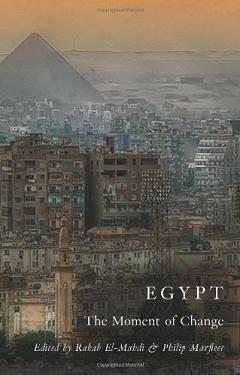
Revolutions these days seem two a penny. Mass strikes and protests did for Tunisia's dictator Ben Ali in what seemed like a few days. Egypt's Mubarak held on for longer, but as the mass of people in Cairo's Tahrir Square refused to give up in the face of the state's repressive force and strikes broke out across the country, even he couldn't remain in power. As I write this, Libya's Colonel Gadaffi appears to only have the most brutal of methods left to secure his position.
The authors of this collection of essay's published in 2009 are all political activists, if not revolutionary socialists. But they cannot have foreseen the events that have shaken the Middle East. The book though, is not dated by recent events. If anything it is even more relevant and I would argue, it is a crucial read for all those trying to understand the Egypt Revolution. Revolution is a process - and what happens is dependent on what has gone before. Egypt: the Moment of Change is about what has gone before.
Each chapter of the book looks at a particular aspect of Egypt's history and political/economic situation. All of them come together to give a unique picture of why the revolution broke out and who the major forces are. Egypt as a society is dominated by one key economic factor - the continued attempts to open up the economy to the free market. Pushed, over the past two decades by a variety of "economic advisers", who mostly hailed from Washington, the Egyptian state has been quick to sell off assets - state companies, land and so on, to outside investors. Such profiteers have helped drive up the cost of living for ordinary people, making the very richer even richer, and the majority of the people poorer.
Here is the contradiction that is so visible to the visitor - high security compounds and shopping malls - which allow in the rich, but deny access to the poor. It's why Egypt has experienced a variety of strikes and protests over the years. The corruption, the rising price of food, lack of access to jobs and drinking water combine to create a society bubbling over with indignation.
Various forces have sought to push this process forward and hold it back. The Trade Union movement up until 2011 was very much one of state unions. These existed to close down workers action, prevent strikes and form deals with the bosses. Union officials were little more than hired functionaries of the state, and many did very well out of this relationship. Various democracy organisations have exploded onto the streets over the years. The Kifaya movement (meaning Enough) in 2004 did a lot to prove the state was not all powerful. Many brave men and women suffered indignation, brutality, torture and sexual assault because they dared to call for change. The chapter on these movements by Rabab El-Mahdi is particularly interesting because it shows how much the global movement against the Iraq War and in support of the Palestinian people helped to encourage things.
But economic factors aren't the only reason for this uprising. This repressive state, with its allegiance to the US and it's failure to stand up against oppression in the wider Middle East, in particular the question of the Palestinians and the US War on Terror, has been part of generating wider discontent and radical ideas.
The repression that Mubarak's state forces imposed on those prepared to stand up for something different is horrific. But it certainly wasn't the result of a few rotten apples. Aida Seif El-Dawla's chapter on state repression puts torture as an endemic and central part of the repressive process - on that exists and is supported at every level. Combined with the huge amounts of corruption amongst state functionaries and this leads to enormous brutality, often with little or no evidence.
But this state force effectively melted away in Tahrir Square. The police proved ineffectual at stopping a real mass movement. The army, itself a bloated and influential body, swollen on US "aid" dollars, were also unable to make a difference. But this must in part be due to the close links between a mass conscript army and the ordinary people of Egypt.
The struggles for land, against repressive taxation and corrupt landlords, the mass strikes that have shaken Egypt over the last five years have a common root. Those who argue today that Mubarak's fall was simply to do with the use of twitter or facebook, misunderstand the social processes that developed over years, involving many different actors, which culminated in the overthrow of the dictator. Mubarak's downfall is not the end of the story. The Egyptian Revolution has a longer road to travel. The struggle for justice and democracy, or access to water and decent food, for proper wages and the right to organise at work, will not be won by dispensation from a benevolent army council - it will have to be fought for. The Egyptian people have shown over the years that they are up to this task. We can wish them well and be inspired for our own struggles for justice.
This short book is an invaluable resource for all those wanting to get to the bottom of the process. It comes highly recommended and should be required reading. I hope they write a follow-up which details the revolutionary year of 2011.
Further Reading
A more detailed review from Socialist Review is here.
Socialist Worker (UK) continues to have unrivalled coverage and analysis from Egypt and the wider Middle Eastern struggles. Editor Judith Orr's eyewitness accounts were inspirational. Further analysis pieces will no doubt follow, though this article by Alex Callinicos on whether the revolution was a coup or not, is particularly useful.
For more on the mass strike movement prior to 2011 this article from the IS Journal by one of the contributors to Egypt: The Moment of Change, is very useful. An interview with an Egyptian socialist one the strike movement from 2007 is also interesting, in particular because it looks briefly at the relationship between socialists and the Muslim Brotherhood in various struggles.
Wednesday, February 23, 2011
Tuesday, February 22, 2011
Terry Pratchett - Unseen Academicals
Capitalism is very adept at taking old traditions, remoulding and repackaging (and occasionally reinventing) them in its own interests. These interests are usual those of short term profit, but they can also be in the interest of propaganda, or the creation of ideas of nation or racial superiority. One of the things that has been adapted and distorted by modern society are the games that communities have played. From traditional games played in working class communities or on village greens, multi-billion pound international sports have been created.
This is perhaps most obvious with football and in his latest Discworld novel, Terry Pratchett satirises the process extremely well, adding in his usual comic mix of magic and chaos. Pratchett has the eye for a good opportunity for satire. In my opinion football is worthy of this, not least because of the way that it is already fairly funny. It's million pound players, who seem to have little of worth to say, the entourage of glamorous wives who follow these players around and gather such bizarre press attention. The strange customs of the fans and the odd little traditions. All of these are stretched and distorted by Pratchett.
In the novel, football is a mass participatory sport, enjoyed mostly for the opportunities for fighting between the groups of fans. Huge crowds swell the streets, there are limited rules to the actual game and the state (via the medium of Ankh-Morpork's Watchmen) have little or no control on match-days. Games are the occasion for much anarchy and revelry. Much like the original football "matches" here in Britain.
Such anarchy needs to be brought under control and the city's leader Lord Vetinari does what rulers have done through the ages. He brings the game under his wing, offers it reward and respectability and fashions order from chaos. No matter that the games has lost its real roots, it is now a method of control and profit.
Pratchett does all this well. By setting up the comic figures of the city's Wizards as a new football team the story has some roots. This unlikely idea is designed to attract those readers who already have pictured the new players as over-weight, lazy academics. But this need to be in the know may well confuse newer readers.
Here again is a criticism I've previously made of Pratchett's more recent novels - because they come across as formulaic, they aren't as amusing as they used to be. There are fewer laugh out loud moments in Unseen Academicals. The characters all have their predetermined parts to play, and us regular readers will come to expect them to have their walk on parts sooner or later. There are a host of new individuals, but they seem to flit onto the stage and leave without leaving us with much.
Pratchett is a brilliant writer. We'll all continue to read his books even though they are now weaker than they were, not simply out of loyalty but also out of genuine love. But there does seem to be something increasingly missing from them.
Related Reviews
Pratchett - Wintersmith
Pratchett - Thud
Pratchett - Going Postal
Pratchett - Colour Of Magic
This is perhaps most obvious with football and in his latest Discworld novel, Terry Pratchett satirises the process extremely well, adding in his usual comic mix of magic and chaos. Pratchett has the eye for a good opportunity for satire. In my opinion football is worthy of this, not least because of the way that it is already fairly funny. It's million pound players, who seem to have little of worth to say, the entourage of glamorous wives who follow these players around and gather such bizarre press attention. The strange customs of the fans and the odd little traditions. All of these are stretched and distorted by Pratchett.
In the novel, football is a mass participatory sport, enjoyed mostly for the opportunities for fighting between the groups of fans. Huge crowds swell the streets, there are limited rules to the actual game and the state (via the medium of Ankh-Morpork's Watchmen) have little or no control on match-days. Games are the occasion for much anarchy and revelry. Much like the original football "matches" here in Britain.
Such anarchy needs to be brought under control and the city's leader Lord Vetinari does what rulers have done through the ages. He brings the game under his wing, offers it reward and respectability and fashions order from chaos. No matter that the games has lost its real roots, it is now a method of control and profit.
Pratchett does all this well. By setting up the comic figures of the city's Wizards as a new football team the story has some roots. This unlikely idea is designed to attract those readers who already have pictured the new players as over-weight, lazy academics. But this need to be in the know may well confuse newer readers.
Here again is a criticism I've previously made of Pratchett's more recent novels - because they come across as formulaic, they aren't as amusing as they used to be. There are fewer laugh out loud moments in Unseen Academicals. The characters all have their predetermined parts to play, and us regular readers will come to expect them to have their walk on parts sooner or later. There are a host of new individuals, but they seem to flit onto the stage and leave without leaving us with much.
Pratchett is a brilliant writer. We'll all continue to read his books even though they are now weaker than they were, not simply out of loyalty but also out of genuine love. But there does seem to be something increasingly missing from them.
Related Reviews
Pratchett - Wintersmith
Pratchett - Thud
Pratchett - Going Postal
Pratchett - Colour Of Magic
Monday, February 14, 2011
Antony Beevor - D-Day; The Battle For Normandy
Antony Beevor's latest book is an excellent addition to his earlier works, particular those on the battles for Stalingrad and Berlin. In some ways for this reader, coming from Britain, it's a book that is closer to home. After all this was a battle fought by Allied soldiers who were either British or invading the continent from Britain.
The battles themselves are described in gruesome detail, as is the nature with Beevor's writing. He doesn't shirk from the horrors of battle, nor does he fall into the trap of describing a generic "bad" enemy and "good" allies. So we hear about the killing of POWs by the Germans and by the British, Canadian, American and other allied forces. Of course, Beevor is quick to point out that there was a particular brutal response from some of the German forces - the massacres of entire villages in response to resistance fighters for instance - by the SS in particular.
At the top of the story is the relationships between the various allied leaders. Here the differing styles and emphasises has the most impact. It's clear that there were real personal clashes between say the Americans and British had a lasting impact. The British General Montgomery comes across as a real barrier to the further development of the front in the crucial weeks after the invasion. Beevor does point out that Montgomery took on the hardest and most entrenched enemy forces, and the contribution of the British certainly helped the Americans elsewhere. But there is no doubt that there is a lasting anti-Montgomery prejudice from the official American military histories.
The liberation of Paris and the particular role of the insurrectionary resistance fighters in the capital forms the end of the chapter. The story of the particular factions involved in this is fascinating, as is the clear fear from the allied leaders of a Communist inspired revolutionary take over. Here Beevor is astute enough to also argue that this was a fear for Stalin, who had now moved so far from the politics of international revolution that he had no interest in such an outcome on the Western Front.
Beevor's conclusion is the invasion of Normandy was a crucial point in World War Two. Not particularly because it changed the outcome of the conflict - that had already been decided outside Stalingrad, but because it allowed the United States in particular, and to a much lesser extent Britain and France a voice in the post-war carve up of Europe. This is an important argument, challenging the more common idea that it was the West that won the war. It is because he makes such realistic appraisals, despite their likely unpopularity amongst sections of his readership, which makes Antony Beevor such an excellent military historian.
The battles themselves are described in gruesome detail, as is the nature with Beevor's writing. He doesn't shirk from the horrors of battle, nor does he fall into the trap of describing a generic "bad" enemy and "good" allies. So we hear about the killing of POWs by the Germans and by the British, Canadian, American and other allied forces. Of course, Beevor is quick to point out that there was a particular brutal response from some of the German forces - the massacres of entire villages in response to resistance fighters for instance - by the SS in particular.
At the top of the story is the relationships between the various allied leaders. Here the differing styles and emphasises has the most impact. It's clear that there were real personal clashes between say the Americans and British had a lasting impact. The British General Montgomery comes across as a real barrier to the further development of the front in the crucial weeks after the invasion. Beevor does point out that Montgomery took on the hardest and most entrenched enemy forces, and the contribution of the British certainly helped the Americans elsewhere. But there is no doubt that there is a lasting anti-Montgomery prejudice from the official American military histories.
The liberation of Paris and the particular role of the insurrectionary resistance fighters in the capital forms the end of the chapter. The story of the particular factions involved in this is fascinating, as is the clear fear from the allied leaders of a Communist inspired revolutionary take over. Here Beevor is astute enough to also argue that this was a fear for Stalin, who had now moved so far from the politics of international revolution that he had no interest in such an outcome on the Western Front.
Beevor's conclusion is the invasion of Normandy was a crucial point in World War Two. Not particularly because it changed the outcome of the conflict - that had already been decided outside Stalingrad, but because it allowed the United States in particular, and to a much lesser extent Britain and France a voice in the post-war carve up of Europe. This is an important argument, challenging the more common idea that it was the West that won the war. It is because he makes such realistic appraisals, despite their likely unpopularity amongst sections of his readership, which makes Antony Beevor such an excellent military historian.
Tuesday, February 08, 2011
Eleanor Burke Leacock - Myths of Male Dominance
Eleanor Burke Leacock's collection of essays, Myths of Male Dominance (Collected Articles on Women Cross-Culturally) is one of the most important works for those who argue that the way we live our lives today is not the natural order of things. Leacock's articles are a powerful defence of the Marxist notion of "Primitive Communism" - the idea that in humanity's past, our societies were egalitarian, private property was unknown in a general sense and class differences nonexistent. Most interestingly, this means that there were also differences in the way that men and women related - monogamy has not always been the natural way of doing things, men have not always been dominant in relationships or society, and different attitudes to sexuality have been far more common that most commentators would have us believe.Leacock's own research was centred on a Canadian tribe called the Montagnais-Naskapi. These were people who, in their hunter-gather past had lived in a "primitive communist" society. What is almost unique about them, is that this lifestyle had been extremely well documented by the Europeans who encountered them. The Montagnais had lived by collected the fruit and berries of their local area, as well as hunting the plentiful game at different times of the year. European traders arrived in the 1600s and began to trade goods, with the Montagnais in exchange for vast quantities of furs - beaver and the like.
This caused a fundamental transformation of Montagnais life. From a society were private property was almost unknown, were decision making was a collective process and status in society was not based on property or any form of economic power, the Montagnais were transformed into a people were private property (in this case the animal traps and the associated areas of rivers / land) formed part of their lives. This introduction of private property changed all the other relationships in their society, as did the cynical and regular interference of Jesuit missionaries. The Jesuits who documented the lives of the indigenous people, also attempted to introduce more European things - like leaders, monogamy, physical beating of children and so on. Prompting one Montagnais to say "You Jesuit's love only your own children, we love all of them".
By the time Leacock was able to live with the Montagnais, a surprising amount of their earlier social relations still existed. She describes how hard she found it to understand the collective decision making process as someone who has only lived in a society with leaders and social hierarchies.
These experiences and the documentary evidence of a people with a completely different set of relations of productions to those we see in the vast majority of the world today shape most essays in this book. Leacock looks at the role of women in Montagnais society - and similar societies around the world, family relations and so on. She also look critically at the ideas of two of the thinkers who have most often dominated this form of discussion for the left - Lewis Morgan and Friedrich Engels.
Collected here is her introduction to Lewis Morgan's classic book of anthropology - Ancient Society. The book itself informed Engels' own work (as well as Marx) in particular, The Origin of the Family, Private Property and the State. Leacock wrote a classic introduction to this as well, of which sadly only part is in here.
Rather impressively, Leacock also includes articles and critical responses from other anthropologists - together with her reactions. This is of great interest, in part because she is a born polemicist, but also because it is fascinating to see her ideas tested, and passing the test.
For anyone with an interest in ancient cultures, this is a fascinating book. However it should also be required reading for everyone who wants to argue, or dares to believe that the "natural" relationships that we experience under capitalism are anything but natural.
Related Reviews
Wednesday, February 02, 2011
Edward Vallance - A Radical History of Britain
Before anything else is said about this book, the author should be congratulated at the very least, for attempting this monumental task. Anyone trying to get to grips with almost 800 or so years of radical history has set themselves an enormous job. To cover everything, even in 551 pages would be almost impossible, to do what is covered justice would take a historian of some note.
What is good about this book then, is the sense of rescuing a hidden history. The moments in Britain's past when men and women took it on themselves to attempt to change their world. Sometimes this was in small ways - local protests and uprisings. Sometimes they tried to overturn the whole world order. And we should learn this history - the story of the Peasant Revolt of 1381 has its lessons for today (don't trust the ruling class when they are forced to negotiate) for instance. To bring the stories of the English Revolution, the Levellers and the Diggers, the struggle for the vote, the battles for rights and justices is an important task. I hope that many people learn about these struggles from Vallance's book and take the time to delve deeper.
That said, the book itself is an immense disappointment. In part this is because the book is so large in its scope. Important points of history often receive only the briefest of mentions (more on that later) and sometimes Vallance (as with his discussion on the English Revolution) sticks to a very mainstream retelling of the history.
Another problem is the author's focus. All too often this radical history is a history of key figures or big names. I rarely felt I was hearing the voices of the ordinary people most affected by what was going on. That's not to say that people like Tom Paine, the Pankhurst's or the leading names of the Revolution aren't important. But moments of great radical change come because there are social forces moving, and they move because of other factors.
Why did women want the vote? What made people join Cromwell's forces? How come people marched to Trafalgar Square to demand the right to assemble in the 1890s, but not 10 years before hand?
To be fair, Vallance might say he wasn't writing a "People's History". That's a point, but by definition a radical history has as it's focus, changes to the system that are in the interests of the ordinary people at the bottom of society, rather than those at the top. But even so Vallance is selective in his choice of important radicals. William Morris gets a few pages, the Pankhurst's get whole chapters. King Alfred, rather bizarrely gets a good chunk. But there are strange omissions - George Lansbury gets a couple of oblique mentions, despite putting himself at the head of one of the largest radical revolts in recent history. John McLean gets a passing mention (Scotland is barely discussed) and Communist MPs like Phil Piratin or William Gallacher, who lead real mass movements, aren't discussed.
Perhaps these references reflect my own orientation on the history of Britain as seen through the eyes of a Trotskyist. But what about such figures as Owain Glyndŵr or William Wallace who must surely fit into the broadest definition of radical. Even Gordon Brown is referrenced more times than William Wilberforce (a figure that most liberal historians would consider fairly radical - Wilberforce that is, not Brown). Actually it's a great crime that the entire struggle against Slavery is missing.
Then there is the detail. It shold be said that the book gets worse the closer we get to contemporary times. The earliest chapters, particular those on the Peasants Revolt and the periods around the French Revolution are well written, though the chronic lack of references makes it difficult to learn more. The chapter on the English Revolution is very complex and difficult. If you don't know anything about this particular period, it is not a good place to start at all, painted as it is as a battle dominated by religious arguments.
But because Vallance doesn't start from what's happening in wider society, but begins with the individuals at the head of movements he comes unstuck. The struggle for Women's liberation for him, is dominated by the arguments between the militants and the rest of the movement. He concludes that militant action fails to deliver and becomes a hindrance and ends up with a position that implicitly argues that the Suffragettes had to wait for a more friendly government to arrive. No to a point this is true, but what Vallance misses is that the radical militancy stemmed from a movement that had failed to mobilise the mass of working people into it's orbit.
Had the working class movement used its powers to force change, then the battle would have been shorter. The tragedy of the Suffragette movement was that much of it was dominated by a Middle Class leadership who, while brave enough to go to jail and risk their lives, were terrified of wider social unrest that could have forced the governments to listen. Breaking windows gets media coverage, but it doesn't frighten the forces of the state and the descent by sections of the movement into even more radical acts reflects the frustration of this.
Vallance also fails to grasp the wider situation. For him, the involvement of women in the workforce during the First World War was something that came and went, with little lasting impact. He argues that most of the jobs they did were ones that they had before the war, which I don't think stands up to scrutiny (munitions work?) Yet he also misses the way that this changed perceptions of women's roles and their perceptions of themselves - once lots of people had seen women driving buses then they weren't easily going to be able to put them back in their pre-war boxes.
If this wasn't the case, why did so much effort have to be put into forcing women back into their pre-war roles. The creation of women's Trade Unions and involvement of women in the wider union movement on an unprecedented scale certainly changed the working class movement. So by looking superficially, Vallance fails to grasp the real changes in society that were happening.
After the Suffragettes, Vallance has a chapter on the fight against Fascism (which devotes barely 2 pages to the question of Cable Street and the battles against the British Union of Fascists). He doesn't explain why fascism failed in Britain, but was successful elsewhere. Even if you don't believe (as he doesn't) that Cable Street was particularly important, surely the debate deserves more than he offers here. There is nothing here about the Second World War, or even the post-war battles against fascists and the later NF.
But radical history apparently stops for Vallance with World War Two, but even his post 1900 history is severely wanting. The 1926 General Strike gets less than one page. The Great Unrest is by-passed, as is Red Clydeside and the 1919 strikes ("Britain on the Brink of Revolution"). The Russian Revolution apparently had no impact here - the Communist Party being irrelevant. Other missing moments are New Unionism (the Match girls get a couple of paragraphs) and George Lansbury's 1921 refusal to impose Tory economic policies on the poorest sections of British society. I could go on. In fact I will, because students of more recent radical history will be amazed that the mass movements against Apartheid, Racism and Fascism in the 1970s are missing, the union militancy that did for Edward Heath, the Miners Strike, CND, Wapping, the Poll Tax and finally the Stop the War movement of the last decade.
Actually to be fair, Vallance salutes the anti-Iraq war movement in his last paragraph, though he doesn't name it. But he ignores the fact that it also opposed war in Afghanistan. Now I might not expect Vallance to write a work of history that keen readers of Socialist Worker would appreciate, but to miss out the Miner's Strike and CND in a work on the radical history of Britain, is a bizarre error. This is a problem, because arguably the struggles of the 20th Century have shaped our culture, politics and social structures far more than those of much earlier times.
The problem is of course, the one that has beset liberals for decades - the question of the Labour Party. Ultimately this is a history that is about the struggle to get the Labour Party to office, through the enfranchisement of the poorest in society. This means of course, that criticism of Labour is frowned upon and more recent radicalism is brushed under the carpet because it might show Labour in a worse light. Thus the culmination of radical history for Vallance is the building up of the Labour party into a party fit to govern. Towards the end of his book he explicitly says this, arguing that few in Britain's radical history wanted to level out things. In other words, British radicalism is a different beast to that of France or Russia - it is not about building a new world, but creating a nice capitalism, overseen by a friendly government.
By concentrating more on the earliest period of radical history (important though they are) you end up with a book that will be appreciated by Gordon Brown and Ed Miliband. You can look left wing and radical by informing the masses about Wat Tyler and Tom Paine. But don't let on about how Labour failed the miners, or how the TUC has failed the organised working classes time and again. To do that, might have ramifications today, and we can't risk the next General Election can we?
What is good about this book then, is the sense of rescuing a hidden history. The moments in Britain's past when men and women took it on themselves to attempt to change their world. Sometimes this was in small ways - local protests and uprisings. Sometimes they tried to overturn the whole world order. And we should learn this history - the story of the Peasant Revolt of 1381 has its lessons for today (don't trust the ruling class when they are forced to negotiate) for instance. To bring the stories of the English Revolution, the Levellers and the Diggers, the struggle for the vote, the battles for rights and justices is an important task. I hope that many people learn about these struggles from Vallance's book and take the time to delve deeper.
That said, the book itself is an immense disappointment. In part this is because the book is so large in its scope. Important points of history often receive only the briefest of mentions (more on that later) and sometimes Vallance (as with his discussion on the English Revolution) sticks to a very mainstream retelling of the history.
Another problem is the author's focus. All too often this radical history is a history of key figures or big names. I rarely felt I was hearing the voices of the ordinary people most affected by what was going on. That's not to say that people like Tom Paine, the Pankhurst's or the leading names of the Revolution aren't important. But moments of great radical change come because there are social forces moving, and they move because of other factors.
Why did women want the vote? What made people join Cromwell's forces? How come people marched to Trafalgar Square to demand the right to assemble in the 1890s, but not 10 years before hand?
To be fair, Vallance might say he wasn't writing a "People's History". That's a point, but by definition a radical history has as it's focus, changes to the system that are in the interests of the ordinary people at the bottom of society, rather than those at the top. But even so Vallance is selective in his choice of important radicals. William Morris gets a few pages, the Pankhurst's get whole chapters. King Alfred, rather bizarrely gets a good chunk. But there are strange omissions - George Lansbury gets a couple of oblique mentions, despite putting himself at the head of one of the largest radical revolts in recent history. John McLean gets a passing mention (Scotland is barely discussed) and Communist MPs like Phil Piratin or William Gallacher, who lead real mass movements, aren't discussed.
Perhaps these references reflect my own orientation on the history of Britain as seen through the eyes of a Trotskyist. But what about such figures as Owain Glyndŵr or William Wallace who must surely fit into the broadest definition of radical. Even Gordon Brown is referrenced more times than William Wilberforce (a figure that most liberal historians would consider fairly radical - Wilberforce that is, not Brown). Actually it's a great crime that the entire struggle against Slavery is missing.
Then there is the detail. It shold be said that the book gets worse the closer we get to contemporary times. The earliest chapters, particular those on the Peasants Revolt and the periods around the French Revolution are well written, though the chronic lack of references makes it difficult to learn more. The chapter on the English Revolution is very complex and difficult. If you don't know anything about this particular period, it is not a good place to start at all, painted as it is as a battle dominated by religious arguments.
But because Vallance doesn't start from what's happening in wider society, but begins with the individuals at the head of movements he comes unstuck. The struggle for Women's liberation for him, is dominated by the arguments between the militants and the rest of the movement. He concludes that militant action fails to deliver and becomes a hindrance and ends up with a position that implicitly argues that the Suffragettes had to wait for a more friendly government to arrive. No to a point this is true, but what Vallance misses is that the radical militancy stemmed from a movement that had failed to mobilise the mass of working people into it's orbit.
Had the working class movement used its powers to force change, then the battle would have been shorter. The tragedy of the Suffragette movement was that much of it was dominated by a Middle Class leadership who, while brave enough to go to jail and risk their lives, were terrified of wider social unrest that could have forced the governments to listen. Breaking windows gets media coverage, but it doesn't frighten the forces of the state and the descent by sections of the movement into even more radical acts reflects the frustration of this.
Vallance also fails to grasp the wider situation. For him, the involvement of women in the workforce during the First World War was something that came and went, with little lasting impact. He argues that most of the jobs they did were ones that they had before the war, which I don't think stands up to scrutiny (munitions work?) Yet he also misses the way that this changed perceptions of women's roles and their perceptions of themselves - once lots of people had seen women driving buses then they weren't easily going to be able to put them back in their pre-war boxes.
If this wasn't the case, why did so much effort have to be put into forcing women back into their pre-war roles. The creation of women's Trade Unions and involvement of women in the wider union movement on an unprecedented scale certainly changed the working class movement. So by looking superficially, Vallance fails to grasp the real changes in society that were happening.
After the Suffragettes, Vallance has a chapter on the fight against Fascism (which devotes barely 2 pages to the question of Cable Street and the battles against the British Union of Fascists). He doesn't explain why fascism failed in Britain, but was successful elsewhere. Even if you don't believe (as he doesn't) that Cable Street was particularly important, surely the debate deserves more than he offers here. There is nothing here about the Second World War, or even the post-war battles against fascists and the later NF.
But radical history apparently stops for Vallance with World War Two, but even his post 1900 history is severely wanting. The 1926 General Strike gets less than one page. The Great Unrest is by-passed, as is Red Clydeside and the 1919 strikes ("Britain on the Brink of Revolution"). The Russian Revolution apparently had no impact here - the Communist Party being irrelevant. Other missing moments are New Unionism (the Match girls get a couple of paragraphs) and George Lansbury's 1921 refusal to impose Tory economic policies on the poorest sections of British society. I could go on. In fact I will, because students of more recent radical history will be amazed that the mass movements against Apartheid, Racism and Fascism in the 1970s are missing, the union militancy that did for Edward Heath, the Miners Strike, CND, Wapping, the Poll Tax and finally the Stop the War movement of the last decade.
Actually to be fair, Vallance salutes the anti-Iraq war movement in his last paragraph, though he doesn't name it. But he ignores the fact that it also opposed war in Afghanistan. Now I might not expect Vallance to write a work of history that keen readers of Socialist Worker would appreciate, but to miss out the Miner's Strike and CND in a work on the radical history of Britain, is a bizarre error. This is a problem, because arguably the struggles of the 20th Century have shaped our culture, politics and social structures far more than those of much earlier times.
The problem is of course, the one that has beset liberals for decades - the question of the Labour Party. Ultimately this is a history that is about the struggle to get the Labour Party to office, through the enfranchisement of the poorest in society. This means of course, that criticism of Labour is frowned upon and more recent radicalism is brushed under the carpet because it might show Labour in a worse light. Thus the culmination of radical history for Vallance is the building up of the Labour party into a party fit to govern. Towards the end of his book he explicitly says this, arguing that few in Britain's radical history wanted to level out things. In other words, British radicalism is a different beast to that of France or Russia - it is not about building a new world, but creating a nice capitalism, overseen by a friendly government.
By concentrating more on the earliest period of radical history (important though they are) you end up with a book that will be appreciated by Gordon Brown and Ed Miliband. You can look left wing and radical by informing the masses about Wat Tyler and Tom Paine. But don't let on about how Labour failed the miners, or how the TUC has failed the organised working classes time and again. To do that, might have ramifications today, and we can't risk the next General Election can we?
Tuesday, January 25, 2011
Frederick Engels - The Origin of the Family, Private Property and the State
Frederick Engels' book, The Origin of the Family, Private Property and the State was an incredible achievement. It shows Engels' and Marx's fascination by every aspect of human life and history. Engels shows a deep knowledge of his subject, which while dated by today's understanding, must have meant he was at the forefront of contemporary anthropological work.
Origin is an attempt to demonstrate that the way in which human society is organised has radically changed through the years. Human's haven't always lived in a society that is based on competition, earlier societies, particularly those we would now call hunter-gathering communities, were Engels argued based on primitive communism. In these there was no private property of land or materials and this meant that human relationships were based on eglatarian principles.
Engels' starting point for much of his work are the writings of Lewis Morgan, who was the first person to propose a stagiest history for humans, arguing, based on his understanding of langugages around the world, that people tended to follow a particular set of social organisations through the centuries. These three stages, savagery, barbarism and civilisation had with them a particular set of social organisations, particular those to do with the family and marriage.
Engels is particularly keen to show that the subjagated position of women under capitalism, was not something that was always true. He writes "That woman was the slave of man at the commencement of society is one of the most absurd notions that have come down to us from the Enlightenment".
Engels, following Morgan, writes that the modern family arises as part and parcel of the development of private property relations. Because in the first instance, material objects (such as tools) and the produce of agriculture end up in the hands of males in society (due to the division of labour that takes place as women take on the primary role of bringing up children) this leads to the male lineage becoming important for the inheritance of wealth. This then, for Engels is the world historic defeat of the female sex. It is also a defeat for males to, as it creates a situation were no one can be happy. Engels is at his best when he demonstrates, that we live in a world were monogamy is held up to be the ideal, but is not the reality (particularly for men) and this situation will continue until the means of production are once again held in common - and the individual family ceases to be the basic economic unit in society.
Much of the central arguments of Engels work, on the social relationships between people in ancient societies and their languages can be shown to be flawed. But this doesn't invalidate the central themes of his book, that the rise of class societies and the associated move towards private property leads to radically different family relations.
The section on the state is the most useful here. Engels shows how the state machinary develops as classes arise, with the needs of one group (the ruling class) to protect its interests and its wealth. Engels contrasts the complex machinary of the state, with its police and judges and so on, with the "child like simplicity" of earlier societies that needed no such armed bodies of men. This state, Engels argues needs to be smashed and placed in a musuem alongside the "spinning wheel and the bronze axe". This will require a revolution in property relations, and the creation of a world which holds the means of production in common.
This new world would bring with it the emancipation of women. Only when women are able to take a full part in production within society will they truely hold an equal position in society - in other words, when women are free to do what they want, because of socialised childcare, because of full access to abortion and contraception and because they are not held back by artificial social constructs like the family under capitalism.
Engels work is still inspirational, if a little complex at times. It's worth perservering with, because it is the first real attempt by a Marxist to grapple with some of the complex questions thrown up by human history. If you get a copy, it's worth finding an edition that has an introduction that takes up some of the anthropological questions and develops these. The Marxist anthropologist Eleanor Burke Leacock wrote an introduction that did this, though I am not aware that it is in print. Part of it was reprinted in her collection Myths of Male Dominance, which I will review shortly. It is also mostly available here at Google Books.
Related Reviews
Engels - Socialism: Utopian and Scientific
Marx and Engels on the Population Bomb
Engels - The Condition of the Working Class in England
Dee - The Red in the Rainbow - Sexuality, Socialism & LGBT Liberation
Origin is an attempt to demonstrate that the way in which human society is organised has radically changed through the years. Human's haven't always lived in a society that is based on competition, earlier societies, particularly those we would now call hunter-gathering communities, were Engels argued based on primitive communism. In these there was no private property of land or materials and this meant that human relationships were based on eglatarian principles.
Engels' starting point for much of his work are the writings of Lewis Morgan, who was the first person to propose a stagiest history for humans, arguing, based on his understanding of langugages around the world, that people tended to follow a particular set of social organisations through the centuries. These three stages, savagery, barbarism and civilisation had with them a particular set of social organisations, particular those to do with the family and marriage.
Engels is particularly keen to show that the subjagated position of women under capitalism, was not something that was always true. He writes "That woman was the slave of man at the commencement of society is one of the most absurd notions that have come down to us from the Enlightenment".
Engels, following Morgan, writes that the modern family arises as part and parcel of the development of private property relations. Because in the first instance, material objects (such as tools) and the produce of agriculture end up in the hands of males in society (due to the division of labour that takes place as women take on the primary role of bringing up children) this leads to the male lineage becoming important for the inheritance of wealth. This then, for Engels is the world historic defeat of the female sex. It is also a defeat for males to, as it creates a situation were no one can be happy. Engels is at his best when he demonstrates, that we live in a world were monogamy is held up to be the ideal, but is not the reality (particularly for men) and this situation will continue until the means of production are once again held in common - and the individual family ceases to be the basic economic unit in society.
Much of the central arguments of Engels work, on the social relationships between people in ancient societies and their languages can be shown to be flawed. But this doesn't invalidate the central themes of his book, that the rise of class societies and the associated move towards private property leads to radically different family relations.
The section on the state is the most useful here. Engels shows how the state machinary develops as classes arise, with the needs of one group (the ruling class) to protect its interests and its wealth. Engels contrasts the complex machinary of the state, with its police and judges and so on, with the "child like simplicity" of earlier societies that needed no such armed bodies of men. This state, Engels argues needs to be smashed and placed in a musuem alongside the "spinning wheel and the bronze axe". This will require a revolution in property relations, and the creation of a world which holds the means of production in common.
This new world would bring with it the emancipation of women. Only when women are able to take a full part in production within society will they truely hold an equal position in society - in other words, when women are free to do what they want, because of socialised childcare, because of full access to abortion and contraception and because they are not held back by artificial social constructs like the family under capitalism.
Engels work is still inspirational, if a little complex at times. It's worth perservering with, because it is the first real attempt by a Marxist to grapple with some of the complex questions thrown up by human history. If you get a copy, it's worth finding an edition that has an introduction that takes up some of the anthropological questions and develops these. The Marxist anthropologist Eleanor Burke Leacock wrote an introduction that did this, though I am not aware that it is in print. Part of it was reprinted in her collection Myths of Male Dominance, which I will review shortly. It is also mostly available here at Google Books.
Related Reviews
Engels - Socialism: Utopian and Scientific
Marx and Engels on the Population Bomb
Engels - The Condition of the Working Class in England
Dee - The Red in the Rainbow - Sexuality, Socialism & LGBT Liberation
Friday, January 21, 2011
Keith Miller - St Peter's
The church of St Peter's is surely one of the most awe inspiring pieces of architecture in the world. Whether or not you find it beautiful, or whether you yourself inspired into religious excitement by it is a different question. It's a powerful statement of strength by the Catholic Church, perhaps summed up by one visitor, Florence Nightingale who wrote that:
"No event in my life except my death can ever be greater than that first entrance into St Peter's, the concenrtated spirit of the Christianity of so many years, the great image of our faith which is the worship of grief."
Keith Miller explores the buildings history and its links with the growing power of the Popes and the Church. The building itself is a strange amalgam, being built on the site (and incorporating some of the walls of a much older St. Peters). Miller points out that this may in part be deliberate - by re-using ancient materials, we get a sort of concrete (excuse the pun) statement about the triumph of the Christian church over paganism. Its architects seem inumerable and its inspirations are many. Fashion comes and goes in the world of bricks and mortar as much as in that of fashion, and the changes of style and design over the centuries are well documented here.
For the non architectural expert, some of the book is daunting. Like all experts there is a private language which, even in books that are attempting to be accessible can only serve to mask what is being said. What are pilasters for instance, and how do windows "snarl" as Michelangelos are supposed to? The book is perhaps also a little incomprehensible to those who haven't visited St Peters, unlike some of the others in this series, you really have to have been there. And perhaps this is the real aim of the book - it is a trawl through the history that frames St Peters - the stories of the ruling classes who have used the building, or sought to use its image to strengthen their own social position, rather than a blow by blow account of the building itself.
St Peter's continues to inspire - many buildings have borrowed its dome in particular - the Bank of England and St Paul's for instance. Though I was interested to learn that while a recent church in the Ivory Coast has done the same, their dome is bigger!
So if you're going to Rome, and plan to visit St Peter's this is a great guide book. It is fascinating and amusing and doesn't simply fall into the trap of listing sculpture after sculpture with some meaningless dates.
Related Reviews in the Wonders of the World series
Watkin - The Roman Forum
Fenlon - Piazza San Marco
Tillotson – Taj Mahal
Goldhill - The Temple of Jerusalem
Gere - The Tomb of Agamemnon
Ray - The Rosetta Stone
Hopkins & Beard - The Colosseum
"No event in my life except my death can ever be greater than that first entrance into St Peter's, the concenrtated spirit of the Christianity of so many years, the great image of our faith which is the worship of grief."
Keith Miller explores the buildings history and its links with the growing power of the Popes and the Church. The building itself is a strange amalgam, being built on the site (and incorporating some of the walls of a much older St. Peters). Miller points out that this may in part be deliberate - by re-using ancient materials, we get a sort of concrete (excuse the pun) statement about the triumph of the Christian church over paganism. Its architects seem inumerable and its inspirations are many. Fashion comes and goes in the world of bricks and mortar as much as in that of fashion, and the changes of style and design over the centuries are well documented here.
For the non architectural expert, some of the book is daunting. Like all experts there is a private language which, even in books that are attempting to be accessible can only serve to mask what is being said. What are pilasters for instance, and how do windows "snarl" as Michelangelos are supposed to? The book is perhaps also a little incomprehensible to those who haven't visited St Peters, unlike some of the others in this series, you really have to have been there. And perhaps this is the real aim of the book - it is a trawl through the history that frames St Peters - the stories of the ruling classes who have used the building, or sought to use its image to strengthen their own social position, rather than a blow by blow account of the building itself.
St Peter's continues to inspire - many buildings have borrowed its dome in particular - the Bank of England and St Paul's for instance. Though I was interested to learn that while a recent church in the Ivory Coast has done the same, their dome is bigger!
So if you're going to Rome, and plan to visit St Peter's this is a great guide book. It is fascinating and amusing and doesn't simply fall into the trap of listing sculpture after sculpture with some meaningless dates.
Related Reviews in the Wonders of the World series
Watkin - The Roman Forum
Fenlon - Piazza San Marco
Tillotson – Taj Mahal
Goldhill - The Temple of Jerusalem
Gere - The Tomb of Agamemnon
Ray - The Rosetta Stone
Hopkins & Beard - The Colosseum
Tuesday, January 18, 2011
J.G. Farrell - The Siege of Krishnapur
The Indian Rebellion against British Rule in 1857 has had a number of interesting treatments in novel form, I think in particular of Fraser's Flashman novel, Flashman In the Great Game. Both Fraser's book and this one use the comic form to great effect, though Farrell's book is, it must be said, far better.
Concentrating on the fictional town of Krishnapur, Farrell examines the lives of the upper-class English residents there. Years of peaceful rule has left them bored and remote from the locals. Diverted by hunting and dinner parties, as well as the endless search for a marriage partner there are few among them even aware of the changing world around them. Farrell's characters each represent a particular strand of thought, or ideals (though they are never wooden). The central character, The Collector, epitomises the sense of industrial progress at the heart of the Victorian colonial dream. Having been inspired by the Great Exhibition, he has learnt it's catalogue of by heart, and many of the exhibits have made their way to his home. He dreams of the civilising powers of British capitalism, railroads across India and the like.
The Magistrate is his foil, a Chartist in his youth, he cynically notes the excesses of colonialism, but finds his ideals gradually undermined by events, mostly because the rich and pampered people around him cannot comprehend breaking from their lives of luxury. Two different doctors represent the old and the new, their endless debates about how to deal with a Cholera epidemic that strikes the besieged town, highlighting different traditions - the old irrational and the new scientific. The worst though are the women, endlessly fanning themselves and worrying about the servants. Gossiping and shunning those who've broken the complex and rigid social codes that maintain themselves even in a state of war.
And here's where the comedy at the heart of the novel comes from. It stems from the inability of those trapped in the siege to break with their rigid class structures as society breaks down. As the dead and wounded pile up, as food runs out and the poshest of ladies are reduced to eating horses, then dogs and eventually insects, they still argue about who should sit where given their social positions.
By concentrating in this way on this tiny group of individuals, all trying to reshape India in their own way, with their own prejudices, Farrell highlights the racism and arrogance that allowed the British rulers to be so shocked by the great Mutiny. We don't hear the voices of the Indian people themselves often, though occasionally we see how shallow the support amongst event the most loyal of servants is (I particularly liked the servants who gradually put up the prices for cleaning clothes as the siege continues, till even The Collector must wash his own shirts, adjacent to the lowest of the servants).
There is much to this novel - Victorian attitudes to sex, marriage and technology all come under the darkly comic scrutiny of the author. It's a fabulous novel, that will keep you gripped till the end. Farrell does such a good job of painting the central characters as the most annoying, obnoxious colonial representatives you can imagine, I kept hoping the rebels would wipe out every last one of them - but you'll have to see for yourself what does actually happen.
Related Reviews
Ward - Our Bones Are Scattered
Farrell - Troubles
Farrell - Singapore Grip
Macrory - Signal Catastrophe; The Story of the Disastrous Retreat from Kabul 1842
Concentrating on the fictional town of Krishnapur, Farrell examines the lives of the upper-class English residents there. Years of peaceful rule has left them bored and remote from the locals. Diverted by hunting and dinner parties, as well as the endless search for a marriage partner there are few among them even aware of the changing world around them. Farrell's characters each represent a particular strand of thought, or ideals (though they are never wooden). The central character, The Collector, epitomises the sense of industrial progress at the heart of the Victorian colonial dream. Having been inspired by the Great Exhibition, he has learnt it's catalogue of by heart, and many of the exhibits have made their way to his home. He dreams of the civilising powers of British capitalism, railroads across India and the like.
The Magistrate is his foil, a Chartist in his youth, he cynically notes the excesses of colonialism, but finds his ideals gradually undermined by events, mostly because the rich and pampered people around him cannot comprehend breaking from their lives of luxury. Two different doctors represent the old and the new, their endless debates about how to deal with a Cholera epidemic that strikes the besieged town, highlighting different traditions - the old irrational and the new scientific. The worst though are the women, endlessly fanning themselves and worrying about the servants. Gossiping and shunning those who've broken the complex and rigid social codes that maintain themselves even in a state of war.
And here's where the comedy at the heart of the novel comes from. It stems from the inability of those trapped in the siege to break with their rigid class structures as society breaks down. As the dead and wounded pile up, as food runs out and the poshest of ladies are reduced to eating horses, then dogs and eventually insects, they still argue about who should sit where given their social positions.
By concentrating in this way on this tiny group of individuals, all trying to reshape India in their own way, with their own prejudices, Farrell highlights the racism and arrogance that allowed the British rulers to be so shocked by the great Mutiny. We don't hear the voices of the Indian people themselves often, though occasionally we see how shallow the support amongst event the most loyal of servants is (I particularly liked the servants who gradually put up the prices for cleaning clothes as the siege continues, till even The Collector must wash his own shirts, adjacent to the lowest of the servants).
There is much to this novel - Victorian attitudes to sex, marriage and technology all come under the darkly comic scrutiny of the author. It's a fabulous novel, that will keep you gripped till the end. Farrell does such a good job of painting the central characters as the most annoying, obnoxious colonial representatives you can imagine, I kept hoping the rebels would wipe out every last one of them - but you'll have to see for yourself what does actually happen.
Related Reviews
Ward - Our Bones Are Scattered
Farrell - Troubles
Farrell - Singapore Grip
Macrory - Signal Catastrophe; The Story of the Disastrous Retreat from Kabul 1842
Thursday, January 13, 2011
Karl Kautsky - The Agrarian Question - Volume 1
![]() |
| Karl Kautsky 1854 - 1938 |
However Kautsky did have an excellent knowledge of Marxist economics, he was a popular and extensive writer though, according to the biographical sketch at the start of this volume, he wasn't a particularly good public speaker and didn't enjoy taking a political lead.
This extensive inquest into the history and politics of agriculture was certainly one of the first of its kind. Kautsky wrote it to get to grips with the politics of the peasantry and farmers at a time when most of the countries of Europe still had significant rural populations. The book arises out of an attempt by the German Social Democratic Party to get to grips with the subject as they developed their program.
It was hugely influential. Lenin, who went on to write a number of works on the question agrarian question as well as the peasantry was enthusiastic, it was the "most important event in present-day economic literature since the third volume of [Marx's] Capital" he said. The role of the peasantry and the rural masses was significant during the Russian Revolution. The policy of the Bolsheviks towards them, was in no small way influenced by some of the ideas at the heart of Kautsky's book.
So what are the ideas? There are many, and again, they can't all be covered in this review. But I think the key question is that of large and small farms. Kautsky challenged the idea that there would be a tendency towards larger and larger farms. Marxists have shown how under capitalism, there is a tendency towards monopolies - larger and larger blocks of capital, as firms swallow up competitors etc. That this was inevitable in agriculture too, was directly challenged by Kautsky's systematic work. The evidence he piles up, shows that this is not the case.
This has important ramifications for revolutionaries - if the farms become larger, there is an increasing tendency towards proletarianisation amongst the peasants and it makes question of collectivism flows then from the actual experience of the farmers (See Tony Cliff article at end of this review for more on this discussion).
Kautsky's detail of the particular situation and changing circumstances of agricultural workers in various countries is fascinating. He shows how farming practices are slow to change - using a US report that showed French peasants still using the Roman plough in the 19th century. He also expands in detail on the value of individual farms versus their larger competitors. The later are more efficient and better at utilising technology, though often suffer from being run by wage labourers rather than individuals with a personal interest in the farm's well being.
The question of the life of the peasant is important to Kautsky - he details their suffering, their hard work, pointing out that their dependency on the market is a weight around their neck - a good harvest, once a blessing under earlier economic systems, becomes a curses under capitalism if the price of corn collapses.
Kautsky also looks at important technical questions - the role of synthetic fertilisers, the separation of town and country, the size of fields and so on. This is an investigation of great depth and thought.
The second volume deals with the more political questions of the role of the peasantry, though Kautsky argues that "Agriculture's political significance is in inverse proportion to its economic significance". This is plainly wrong for many countries even today, and had Lenin followed this line, the outcome of the Russian Revolution would not have been such an initial success for the Bolsheviks.
He also displays a particularly mechanical method in his application of the Marxist method. At one point, he argues that "the effects of climate, topography and other natural circumstances represent a vanishing term when set against the specific impact of the mode of production". While this might be strictly true in some circumstances, I am not sure that in an period of environmental crisis such as the one we now live in, this is a helpful counterposing of ideas.
Finally, Kautsky is particularly good at clarifying the question of the Marxist theory of Ground Rent, which is far too much to go into here, but students reading this in the hope of cribbing for an essay are well advised too look into the explanation in Kautsky's book.
I will return to the second volume of the Agrarian Question later.
Related Information
In 1964, the Marxist Tony Cliff took a look at the question of agriculture and built on some of the ideas of Kautsky and Lenin, developing and critiquing some aspects of what they said. This short article is well worth a read for the student of Agrarian issues. It can be read online here.
Sunday, January 09, 2011
Joseph Choonara & Charlie Kimber - Arguments for Revolution
Subtitled, "The Case for the Socialist Workers Party", this is a shamelessly partisan book. It's a book that argues the case for the radical, revolutionary change in society and puts the case that to do so socialists must be organised into a revolutionary organisation capable of shaping and leading that struggle.
Joseph Choonara and Charlie Kimber are both leading activists in the British SWP. This short book by them is a clear and basic introduction to the Marxist ideas that inform the politics and practice of that organisation. There a facts and figures to arm readers for arguments against capitalism, but more than this, it is an introduction to a wealth of ideas that can shape the world.
Capitalism they argue is a system that creates immense wealth, but that wealth is concentrated in the hands of a tiny number of individuals (1011 billionaires) who have spent the last few years doing very well out of the economic crisis. This wealth could provide for the needs of everyone on the planet, yet is used not in the collective interests of people, but in the interests of that tiny elite and the system they represent.
Starting from the nature of the very system, the authors show how capitalism isn't the usual way for humans to organise society. The exploitation at it's core, the systematic extraction of surplus value from the mass of workers, simply didn't exist in earlier societies. The drive for profits, the accumulation of wealth that is the motor of the dynamics of capitalism is also the cause of its periodic economic crises (on average every 6.3 years in the US) and what drives the capitalists to constantly seek to cut pay and conditions and undermine the welfare state.
The authors show however the way in which capitalism creates in the words of Karl Marx, its own "gravediggers". The working class who have the power both to overthrow capitalism and create a new socialist society based on collective democratic society. But the workers don't simply have this importance because of their economic power, they quote Engels; who pointed out that the working class "cannot emancipate itself without abolishing the conditions of its own life. It cannot abolish the conditions of its own life without abolishing all the inhuman conditions of life of society today which are summed up in its own situation".
The working class, through the revolutionary struggle throws off the muck of ages and creates the democratic bodies that can form the basis of a new society. The capitalists don't however roll over, they have a myriad of ways to protect their interests, the authors again tackle the question of the state who protect class rule and explain how the Marxist attitude to the state differs from that of say the Anarchists. The look critically at the historic role of the British Labour Party - a reformist organisation that whenever it has been tested has propped up the system rather than side with the interests of the workers. They also look at the way the working class is divided by sexism, homophobia and racism.
Finally the sections on revolution look at the Russian Revolution and how it was distorted and defeated by the rise of Stalin, rescuing as they do so, the sense that socialism has to have the concept of the "self emancipation of the working class" at its heart.
This short book covers a tremendous amout of ground. There will be many socialists who think they know it all and have heard it all before. In a sense this is true but refreshing old arguments in the context of new, emerging struggles is always important. But this book is one to be read, passed on and distributed far and wide. At the beginning of 2011 capitalism offers millions of ordinary workers a bleak future. The only hope is the struggle of working people to challenge the power of capital. This short book with its extensive further reading list is a guide to new activists, young and old, about how to do that.
(Find out more via the Facebook group or purchase online here)
Related Reviews
Choonara - Unravelling Capitalism: A Guide to Marxist Political Economy
Harman - Revolution in the 21st Century
Engels - Socialism, Utopian and Scientific
Joseph Choonara and Charlie Kimber are both leading activists in the British SWP. This short book by them is a clear and basic introduction to the Marxist ideas that inform the politics and practice of that organisation. There a facts and figures to arm readers for arguments against capitalism, but more than this, it is an introduction to a wealth of ideas that can shape the world.
Capitalism they argue is a system that creates immense wealth, but that wealth is concentrated in the hands of a tiny number of individuals (1011 billionaires) who have spent the last few years doing very well out of the economic crisis. This wealth could provide for the needs of everyone on the planet, yet is used not in the collective interests of people, but in the interests of that tiny elite and the system they represent.
Starting from the nature of the very system, the authors show how capitalism isn't the usual way for humans to organise society. The exploitation at it's core, the systematic extraction of surplus value from the mass of workers, simply didn't exist in earlier societies. The drive for profits, the accumulation of wealth that is the motor of the dynamics of capitalism is also the cause of its periodic economic crises (on average every 6.3 years in the US) and what drives the capitalists to constantly seek to cut pay and conditions and undermine the welfare state.
The authors show however the way in which capitalism creates in the words of Karl Marx, its own "gravediggers". The working class who have the power both to overthrow capitalism and create a new socialist society based on collective democratic society. But the workers don't simply have this importance because of their economic power, they quote Engels; who pointed out that the working class "cannot emancipate itself without abolishing the conditions of its own life. It cannot abolish the conditions of its own life without abolishing all the inhuman conditions of life of society today which are summed up in its own situation".
The working class, through the revolutionary struggle throws off the muck of ages and creates the democratic bodies that can form the basis of a new society. The capitalists don't however roll over, they have a myriad of ways to protect their interests, the authors again tackle the question of the state who protect class rule and explain how the Marxist attitude to the state differs from that of say the Anarchists. The look critically at the historic role of the British Labour Party - a reformist organisation that whenever it has been tested has propped up the system rather than side with the interests of the workers. They also look at the way the working class is divided by sexism, homophobia and racism.
Finally the sections on revolution look at the Russian Revolution and how it was distorted and defeated by the rise of Stalin, rescuing as they do so, the sense that socialism has to have the concept of the "self emancipation of the working class" at its heart.
This short book covers a tremendous amout of ground. There will be many socialists who think they know it all and have heard it all before. In a sense this is true but refreshing old arguments in the context of new, emerging struggles is always important. But this book is one to be read, passed on and distributed far and wide. At the beginning of 2011 capitalism offers millions of ordinary workers a bleak future. The only hope is the struggle of working people to challenge the power of capital. This short book with its extensive further reading list is a guide to new activists, young and old, about how to do that.
(Find out more via the Facebook group or purchase online here)
Related Reviews
Choonara - Unravelling Capitalism: A Guide to Marxist Political Economy
Harman - Revolution in the 21st Century
Engels - Socialism, Utopian and Scientific
Thursday, January 06, 2011
Edgar Rice Burroughs - The Caspak Trilogy
The Caspak Trilogy comprises three of Edgar Rice Burroughs less famous novels - The Land That Time Forgot, The People That Time Forgot and the oddly named Out of Time's Abyss.
If I am going to be honest, all of these novels read like spoof 1920s adventure tales. Of course this isn't high literature, this is pulp fiction and that's a particularly generous description. That's not to say that mass market novels don't have any merit, even when they are swamped in the prejudices of their time - see for instance this review of a Jules Verne novel I did recently.
However these three novels are in a class of their own. If you've seen the film that carries the same title as volume one, you'll know the rough plot line. Heroic, square-jawed types get captured by cowardly Germans in a submarine and get taken to a uncharted island that turns out to be populated by prehistoric people and animals. Lots of shooting of ancient dinosaurs occurs and there is some love interest. Frankly if you've seen the film and not the book, leave it at that.
The book is truely awful. Even at the time of printing, people must have read it and though, "he's taking the piss isn't he? He's trying to see how awful a book he can get away with?" Let me give you an example of what I mean, by exploring the use of coincidence in the first couple of chapters of book one.
One of our American heroes is on a transatlantic liner (a neutral one) for this is the early days of World War One. His ship is torpedoed by a submarine which, being a submarine designer he both recognises as one he built and also knows how to control. Finding an empty rowing boat in the ocean following the ship's sinking, he rescues a young woman on her way to Germany to get married to a German Naval officer. Hero is in turn rescued (along with his dog) by a English tug, which then is attacked several days later by the same U-boot. The heroic English captain tries to ram the U-boot, which our heros manage to capture and because they have the knowledge to pilot now, they can take to England. One board the U-boot is a nasty, evil German officer. Guess what? Yes, he is the person that beautiful maiden intended to marry.
Frankly it doesn't get better than that and we haven't even met the dinosaurs. I jest.
Oddly enough, Burroughs doesn't simply have prejudices, he is also a downright nasty rightwinger. One of the traitors who does over our heroes is, guess what? Not a German spy, but a member of the IWW who "hates America". Shades of Mcarthy there.
The only other fascinating bit here, apart from the endless shooting of dinosaurs, traitors, wild men and Germans, is the evolution that the prehistoric island of Caspak has. Burroughs realised that he couldn't have a snapshot of time, otherwise Tyrannosaurus Rex couldn't chase Cro Magnon. Rather oddly he invents a new evolutionary method - everyone and everything passes through every stage of their evoution on the island, from small tadpole to primitive then older creature. It's fascinating for a while, then you spot the plot holes.
Anyway. Read this if you are a sucker for really bad novels or like dinosaurs being shot. But avoid it if you really want to try and read Dickens.
If I am going to be honest, all of these novels read like spoof 1920s adventure tales. Of course this isn't high literature, this is pulp fiction and that's a particularly generous description. That's not to say that mass market novels don't have any merit, even when they are swamped in the prejudices of their time - see for instance this review of a Jules Verne novel I did recently.
However these three novels are in a class of their own. If you've seen the film that carries the same title as volume one, you'll know the rough plot line. Heroic, square-jawed types get captured by cowardly Germans in a submarine and get taken to a uncharted island that turns out to be populated by prehistoric people and animals. Lots of shooting of ancient dinosaurs occurs and there is some love interest. Frankly if you've seen the film and not the book, leave it at that.
The book is truely awful. Even at the time of printing, people must have read it and though, "he's taking the piss isn't he? He's trying to see how awful a book he can get away with?" Let me give you an example of what I mean, by exploring the use of coincidence in the first couple of chapters of book one.
One of our American heroes is on a transatlantic liner (a neutral one) for this is the early days of World War One. His ship is torpedoed by a submarine which, being a submarine designer he both recognises as one he built and also knows how to control. Finding an empty rowing boat in the ocean following the ship's sinking, he rescues a young woman on her way to Germany to get married to a German Naval officer. Hero is in turn rescued (along with his dog) by a English tug, which then is attacked several days later by the same U-boot. The heroic English captain tries to ram the U-boot, which our heros manage to capture and because they have the knowledge to pilot now, they can take to England. One board the U-boot is a nasty, evil German officer. Guess what? Yes, he is the person that beautiful maiden intended to marry.
Frankly it doesn't get better than that and we haven't even met the dinosaurs. I jest.
Oddly enough, Burroughs doesn't simply have prejudices, he is also a downright nasty rightwinger. One of the traitors who does over our heroes is, guess what? Not a German spy, but a member of the IWW who "hates America". Shades of Mcarthy there.
The only other fascinating bit here, apart from the endless shooting of dinosaurs, traitors, wild men and Germans, is the evolution that the prehistoric island of Caspak has. Burroughs realised that he couldn't have a snapshot of time, otherwise Tyrannosaurus Rex couldn't chase Cro Magnon. Rather oddly he invents a new evolutionary method - everyone and everything passes through every stage of their evoution on the island, from small tadpole to primitive then older creature. It's fascinating for a while, then you spot the plot holes.
Anyway. Read this if you are a sucker for really bad novels or like dinosaurs being shot. But avoid it if you really want to try and read Dickens.
Tuesday, January 04, 2011
Robert Roberts - A Ragged Schooling
Robert Roberts wrote one of the all time great studies of working class life, The Classic Slum, but this short book is a truly wonderful account of his boyhood growing up in the slums of Salford in the early years of the 20th Century.Roberts' life is difficult. There are moments of real pain and suffering. Schooling was minimal and even then what they had was driven by his mother's desire for them to become educated - this passion makes her the real hero of the tale. She is the one that dresses their wounds and helps them with the problems of everyday childhood. But she slaves and works to make this possible.
One of the interesting points raised, is that the shop enables Robert's family to have a better life than most of those on the estates around them. But it still requires backbreaking work. One Christmas day, Robert's mother lies in till 10am. Because it is the only whole day a year that the shop is closed. She then gets up and makes a Christmas dinner for eight.
As the children grow older, the tensions between his parents grow - on Robert's journey to the world of adulthood and work, he tells us of the theatres and the music, the children's games, their explorations (I'd love to know more about the history of Salford's "poisoned wood" that they try and find), sexual awakenings. There are stories of strikes and protests against the Duke of Wellington, the burning out of a Jewish shopkeeper by a local man, the dreams of Roberts' father who buys a second rate piano for his children.
"tumbled a river on whose purling waters the very rainbows appeared, at times to melt, though basically it ran the colour of plain chocolate. But catch the stream in happy mood and under one's eyes brown would dissolve into Mediterranean blue, azure slide into rich crimson.... standing entranced upon a bridge, we threw quantities of rubbish over to mix the creeping palettes".
Stories that bricks would float near Victoria station are dismissed by the author as "libel", but the output of the dye factories around the river meant that Roberts thought it would be 2040 before salmon swam the Irwell again.
This is a lovely little book for anyone who wants to understand working class life in Salford 100 years ago. There are still those around who will recognise from their parents the place names and descriptions, but it is a vanishing world, and every time they erect another block of identity kit yuppie flats that will remain empty for years, they wipe away an important bit of history that should not be forgotten - the struggle of ordinary people simply to live in dignity in the face of the ever hungry capitalist system.
Friday, December 31, 2010
Elaheh Rostami-Povey - Iran's Influence

Despite the rhetoric you hear from many of the leading politicians of the western world, and even from sections of the more liberal establishment, Iran is not the monolithic Islamic state that they would have us believe.
Elaheh Rostami-Povey's multi-layered book explores in detail the country's history, its part in the wider economic, political and cultural history of the Middle East as well as the role of various political forces, religions and external influences in shaping it, to give us a rounded and useful understanding of the country today.
Quite rightly, Rostami-Povey argues that no country is monolithic. In particular she demonstrates that despite the view of some, the Islamic regime that consolidated its power following the 1979 revolution against the Shah, was one that had immense popular support, and hence helped introduce a huge variety of popular reforms that made a real difference to the lives of ordinary people in Iran.
Again, contrary to the view that today's Iran is a conservative country dominated by those who would restrict women to wear full body coverings and stone those who commit adultery, she shows an Iran were there are competing political and ideological forces, many of whom are lead by women and trying to resist the further strengthening of conservative forces.
But in terms of the forces shaping modern Iran, the biggest factors are external - the existence of Israel and its continued assault on the Palestinians and the US's imperialist ventures in the region. This has a historical importance because the 1979 revolution against the Shah was as much against his role in supporting Israel and backing Western interests as against his internal repression. The support for the regime post 1979 hence also stems from the perception of it as anti-Imperialist and anti-Zionist.
This causes problems for those inside Iran who want to change the country. The pro-democracy movement that burst onto the streets of Iran in 2009 following the election there, is often viewed with suspicion because of the Wests support for it. Even though those involved are very clear that they reject the vision the West (particularly the US) has for the Middle East, the actions of the US etc in the Middle East have the effect of strengthening the conservative position in Iran. The real threat of US attack leads to a strengthening of the existing government.
Rostami-Povey is particularly strong on two aspects of the history of Iran and the region - firstly the role of women in the various anti-imperialist, anti-colonial and pro-democracy movements that exist today and have existed in the past. This is essential because often we are presented an image that all Islamists are against women's participation in society, and this is clearly untrue even in Iran.
She is also very strong when she writes about how other forces in the Middle East are influenced by Iran's anti-imperialism and its political support, but don't necessarily follow its line or instructions. Most importantly the role of Hezbollah and Hamas in resisting Israel in Lebanon and Palestine. Both these movements enjoy Iran's support, but economically they are far more dependent on international and local donations from those impressed by their ability to stand up to the Zionists and to provide the basic needs for the people whose lives have been destroyed by war and imperialism. Rostami-Povey is particularly impressive when she traces the way in which Hezbollah for instance has be so central to providing basic healthcare and food, that it receives the support of people (rich and poor) from across the religious spectrum, including substantial numbers of non-Muslims.
Rostami-Povey is firmly on the side of those who want to see more democracy, more rights for women, more involvement of minorities and less sectarianism. She shows how the simple demonisation of Iran will make this worse, as in the past when the destruction of secular, nationalist and leftist movements by the US helped to create the Taliban and Al-Qqaeda. In her conclusion she says
"The impact of sending more ships and missiles to the Persian Gulf by Obama has been negative for the democracy movement in Iran, as the conservatives within the regime have used the pressure from outside as an additional protect to clamp down even more fiercly. In this context, history is repeating itself: the West in the past destroyed the secular and nationalist movements that were fighting for democracy and independence in Iran and the wider region; now they are destroying the Islamist modernists through the constant threat of military intervention."
The wider support for Iran across the Middle East comes because it is seen precisely as a country that has stood up to the US and western intervention. Iran's own history shows however, that the ordinary people of the wider Middle East are the force best positioned to overthrow dictators and right-wing leaders. Rostami-Povey also shows how these people want solutions that mean those from different cultures, religions and communities can live together. To do this means changing the power relations in the Middle East and that means uniting against oppression and foreign intervention.
For those wanting to get a good understanding of the current situation in the Middle East, this is an essential read. Sadly the price of £18.99 for a 264 page book (including references and index) will put many off. I hope that should it get republished, the publishers will consider that such high prices limit readership.
Related Reviews
Marshall - Revolution and Counter-Revolution in Iran
Rose - The Myths of Zionism
A useful short introduction to the current political situation in Iran can be found in this article here.
Sunday, December 26, 2010
Tim O'Brien - If I Die In A Combat Zone
This Vietnam memoir follows Tim O'Brien from his basic training to his time on the front line in Vietnam. It finishes with his time in a safer post, behind the lines working in the administration. By the time he got there, he'd seen several friends killed and injured and dodged sniper fire in the places that became infamous for the massacre at Mai Lai.
While the storyline has become a fairly standard structure for the Vietnam film or novel (or indeed many other war stories), here it works because of the authors brutal honesty. He documents his plans to run to Sweden - researched in detail and planned in depth, because of his terror at going. He talks about the ineptness of one of his commanders and he admits to barely seeing the enemy during his tour of duty.
The power of the book, apart from its honesty, is the way in which we see reflected the greater struggles that take place. Hindsight gives us a particular set of images when we hear the name Mai Lai, but for Tim as he moved around there it was simply another place.
Definitely one of the classics that came out of that war, it'll help clarify the fears and emotions of those soldiers who went to Vietnam but also fueled the struggles against the war and against Imperialism.
Related Reviews
Marlantes - Matterhorn
While the storyline has become a fairly standard structure for the Vietnam film or novel (or indeed many other war stories), here it works because of the authors brutal honesty. He documents his plans to run to Sweden - researched in detail and planned in depth, because of his terror at going. He talks about the ineptness of one of his commanders and he admits to barely seeing the enemy during his tour of duty.
The power of the book, apart from its honesty, is the way in which we see reflected the greater struggles that take place. Hindsight gives us a particular set of images when we hear the name Mai Lai, but for Tim as he moved around there it was simply another place.
Definitely one of the classics that came out of that war, it'll help clarify the fears and emotions of those soldiers who went to Vietnam but also fueled the struggles against the war and against Imperialism.
Related Reviews
Marlantes - Matterhorn
Friday, December 24, 2010
Jules Verne - Five Weeks in a Balloon
Jules Verne was rather a prolific writer. Many of his novels have gone down in history as representing the hopes for a technological future. One in which nothing was beyond the realms of human achievement so long as the technology could be invented. In doing this he created incredible adventures, often populated with tremendous machines and larger than life heroes.
Five Weeks in a Balloon was Verne's first novel. It's rather more sedate then some of the others, and the specific nature of the voyage described inside means that the story line is mostly a collection of experiences of observations from a hot air balloon as it crosses the African continent. Verne was writing in the era of Livingstone and Stanley and other great explorers. Africa was one of the few places that Europeans hadn't quite got their heads around yet. Important discoveries remained - the exact route of the Nile, the origin of other cities and what places like Timbuktu were really like. It was fertile ground for an adventure novel, and by placing his explorers in a balloon, Verne doesn't have to explore in great detail what life was really like on the ground below.
Though the Africa Verne does describe is very much that of the Victorian fantasy. Africa is populated by savages and cannibals and all sort of other prejudices against the people who live there. Here is Verne describing a battle between two tribes that the balloon passes over;
"The mutual massacre continued with axe and assegai. As soon as an enemy fell... his adversary would at once cut off his head. The women, mingling with the tumult, picked up these bleeding heads and piled them up at either end of the battlefield, often fighting among themselves for possession of the hideous trophy".
Here we have combined the vision of the African as a savage, so savage that African women actually take to the battlefield and fight over the human remains. Why might they do this? Verne continues;
"The chief of one of these savage armies was distinguishable by his athletic build.. once he hurled away his blood-stained assegai, threw himself upon a wounded man, cut of his arm with a single blow, picked it up and, raising it to his mouth, bit into it with his teeth".
Such cannibal behaviour is too much for our heroes, who shoot the chief with a rifle from their vantage point above the battle.
The heroes themselves are cut from singular cloth. The organiser and chief explorer, Dr. Fergusson, who invents the new type of balloon capable of making the trip and is destined for scientific greatness, is the archetypal hero. So much so, that as a boy he "never appears to have known fear, quickly displayed a bright intelligence, an inquiring mind, a remarkable propensity for scientific work. In addition he displayed unusual skill in getting out of difficulties. Nothing ever perplexed him, not even the handling of his first fork, with which children are not as a rule very successful."
With such children in their midst, how could Europeans fail to bend the rest of their world to their will?
The storyline itself is mostly the observations from the balloon. One of the travellers, Fergusson's manservant, displays ample self knowledge when he sacrifices himself to avoid the balloon being destroyed. But Fergusson, ever the Victorian gentleman, rescues his servant in reward for his selfishness. Rescue features again later, when a European explorer is rescued from the hands of a murderous tribe.
Verne puts moral codes at the heart of the story. The servant who always knows his place and will do whatever his master wants. The loyal friends who never give up searching for their lost companions, the difficult choices faced by those who find great wealth in the desert, but can't carry it in an over-laden balloon.
The novel itself probably found a great audience on it's first publication, catering to the mass audience that was fascinated by newspaper tales of exploration. It should be read today, chiefly for it's insights into the moral codes and prejudices of Victorian society.
Five Weeks in a Balloon was Verne's first novel. It's rather more sedate then some of the others, and the specific nature of the voyage described inside means that the story line is mostly a collection of experiences of observations from a hot air balloon as it crosses the African continent. Verne was writing in the era of Livingstone and Stanley and other great explorers. Africa was one of the few places that Europeans hadn't quite got their heads around yet. Important discoveries remained - the exact route of the Nile, the origin of other cities and what places like Timbuktu were really like. It was fertile ground for an adventure novel, and by placing his explorers in a balloon, Verne doesn't have to explore in great detail what life was really like on the ground below.
Though the Africa Verne does describe is very much that of the Victorian fantasy. Africa is populated by savages and cannibals and all sort of other prejudices against the people who live there. Here is Verne describing a battle between two tribes that the balloon passes over;
"The mutual massacre continued with axe and assegai. As soon as an enemy fell... his adversary would at once cut off his head. The women, mingling with the tumult, picked up these bleeding heads and piled them up at either end of the battlefield, often fighting among themselves for possession of the hideous trophy".
Here we have combined the vision of the African as a savage, so savage that African women actually take to the battlefield and fight over the human remains. Why might they do this? Verne continues;
"The chief of one of these savage armies was distinguishable by his athletic build.. once he hurled away his blood-stained assegai, threw himself upon a wounded man, cut of his arm with a single blow, picked it up and, raising it to his mouth, bit into it with his teeth".
Such cannibal behaviour is too much for our heroes, who shoot the chief with a rifle from their vantage point above the battle.
The heroes themselves are cut from singular cloth. The organiser and chief explorer, Dr. Fergusson, who invents the new type of balloon capable of making the trip and is destined for scientific greatness, is the archetypal hero. So much so, that as a boy he "never appears to have known fear, quickly displayed a bright intelligence, an inquiring mind, a remarkable propensity for scientific work. In addition he displayed unusual skill in getting out of difficulties. Nothing ever perplexed him, not even the handling of his first fork, with which children are not as a rule very successful."
With such children in their midst, how could Europeans fail to bend the rest of their world to their will?
The storyline itself is mostly the observations from the balloon. One of the travellers, Fergusson's manservant, displays ample self knowledge when he sacrifices himself to avoid the balloon being destroyed. But Fergusson, ever the Victorian gentleman, rescues his servant in reward for his selfishness. Rescue features again later, when a European explorer is rescued from the hands of a murderous tribe.
Verne puts moral codes at the heart of the story. The servant who always knows his place and will do whatever his master wants. The loyal friends who never give up searching for their lost companions, the difficult choices faced by those who find great wealth in the desert, but can't carry it in an over-laden balloon.
The novel itself probably found a great audience on it's first publication, catering to the mass audience that was fascinated by newspaper tales of exploration. It should be read today, chiefly for it's insights into the moral codes and prejudices of Victorian society.
Tuesday, December 21, 2010
Hassan Mahamdallie - Crossing The River Of Fire: The Socialism Of William Morris
One of the central arguments of Hassan Mahamdallie's introduction to the life and politics of William Morris, is that all to often he is reduced to an artist, a poet, or simply a lover of nice things. Even when Morris' politics are considered, they are described as a strange mix of abstract socialism with a hoped for return to some sort of medieval utopia. This no doubt lies behind Tony Blair's declaration that William Morris had been a "inspiration" while he was a student. Morris' socialism isn't seen as being challenging today, indeed it can be used to give a red veneer to those who want to be on the right, but need to look left.
Hassan Mahamdallie smashes this nonsense. For him, William Morris was a dedicated revolutionist who spent his life fighting for a better world and dreaming of a time when the workers would seize power. In perhaps his most famous work, News from Nowhere, one of Morris' characters describes the social change that lead to the creation of the future socialist society. "Did the change... come peacefully?" he is asked;
"Peacefully?"..."What peace was there amongst those poor confused wretches of the 19th century? It was war from beginning to end: bitter war, till hope and pleasure put an end to it."
Mahamdallie traces William Morris' development as a political activist and Marxist. From his earliest days in the radical movements, his disillusionment with the parliamentary activity he saw around him and the formation of the Socialist League that Morris remained loyal to for most of his life. Morris spent much of his life touring the country, lecturing, speaking and inspiring workers. News from Nowhere was apparently written on the train to and from meetings. He published huge numbers of articles in the League's newspaper Commonweal, even when the newspaper was no longer representative of Morris' own socialist ideas.
One of the best parts of this short book is the section where the author looks at Morris' environmental outlook. Many have argued that Marx and his followers have shown little interest in this subject, but as John Bellamy Foster writes, William Morris' ecology is very much "in the spirit of Marx". Morris understood that people's "alienation from the earth" was the "ultimate foundation/pre-condition for capitalism".
It's for this reason that the sections of his writings that mention the natural world - especially News from Nowhere - are so important - the belief that socialism wouldn't simply be an economic change, but would involve a fundamental change in human relationships with the natural world.
Morris wasn't without fault. Many of his errors and in particular his sectarianism towards parliamentary struggles and the Leagues refusal to be involved in many of the mass industrial struggles stem from the weaknesses of the earliest socialist movements in Britain. But Mahamdallie points out that rather than Morris stepping back from revolution towards the end of his life, his Marxist understanding was developing and growing.
Unfortunately it was too late for Morris to be part of those later struggles that shaped the early part of the 20th Century. His death in 1893 was the occasion for outpourings of grief from the working class movement. But already his socialism was being denigrated and denied in the obituaries. The simpler and easier story of Morris the Middle Class wallpaper designer was being written. Hassan Mahamdallie's book rescues the far greater and more inspiring story of the all-round socialist who wanted to see beauty and art for everyone, in a society that was free of oppression and exploitation.
Related Reviews
Behrman - Shostakovich: Socialism, Stalin & Symphonies
Hassan Mahamdallie smashes this nonsense. For him, William Morris was a dedicated revolutionist who spent his life fighting for a better world and dreaming of a time when the workers would seize power. In perhaps his most famous work, News from Nowhere, one of Morris' characters describes the social change that lead to the creation of the future socialist society. "Did the change... come peacefully?" he is asked;
"Peacefully?"..."What peace was there amongst those poor confused wretches of the 19th century? It was war from beginning to end: bitter war, till hope and pleasure put an end to it."
Mahamdallie traces William Morris' development as a political activist and Marxist. From his earliest days in the radical movements, his disillusionment with the parliamentary activity he saw around him and the formation of the Socialist League that Morris remained loyal to for most of his life. Morris spent much of his life touring the country, lecturing, speaking and inspiring workers. News from Nowhere was apparently written on the train to and from meetings. He published huge numbers of articles in the League's newspaper Commonweal, even when the newspaper was no longer representative of Morris' own socialist ideas.
One of the best parts of this short book is the section where the author looks at Morris' environmental outlook. Many have argued that Marx and his followers have shown little interest in this subject, but as John Bellamy Foster writes, William Morris' ecology is very much "in the spirit of Marx". Morris understood that people's "alienation from the earth" was the "ultimate foundation/pre-condition for capitalism".
It's for this reason that the sections of his writings that mention the natural world - especially News from Nowhere - are so important - the belief that socialism wouldn't simply be an economic change, but would involve a fundamental change in human relationships with the natural world.
Morris wasn't without fault. Many of his errors and in particular his sectarianism towards parliamentary struggles and the Leagues refusal to be involved in many of the mass industrial struggles stem from the weaknesses of the earliest socialist movements in Britain. But Mahamdallie points out that rather than Morris stepping back from revolution towards the end of his life, his Marxist understanding was developing and growing.
Unfortunately it was too late for Morris to be part of those later struggles that shaped the early part of the 20th Century. His death in 1893 was the occasion for outpourings of grief from the working class movement. But already his socialism was being denigrated and denied in the obituaries. The simpler and easier story of Morris the Middle Class wallpaper designer was being written. Hassan Mahamdallie's book rescues the far greater and more inspiring story of the all-round socialist who wanted to see beauty and art for everyone, in a society that was free of oppression and exploitation.
Related Reviews
Behrman - Shostakovich: Socialism, Stalin & Symphonies
Saturday, December 18, 2010
Chris Harman - Marxism and History
These two essays from Chris Harman form one of the clearest and most accessible introductions to the question of history in Marxist thought that it's possible to find. The first essay deals with the oft confused concepts of Base and Superstructure that Karl Marx refers to in one of his articles. The base - the economic organisation at the bottom of different societies allows the creation of a superstructure - the political, legal and cultural structures at the top of society. Different, or changing societies, organised along different economic lines allow different types of superstructures. Both of these react back and forth of each other, depending on the changing balance of forces in society.
Harman makes the point, that what is important for Marxists is how societies change - how do we move from one historical epoch, or mode of production to another. How does feudalism change to form capitalism for instance? Harman picks apart Marx's theory of history, to look at how the economic forces of production produce "relations of production", between people and between classes. But the forces of production rarely remain static in society. Things change - new tools are invented, new methods of organising production or agriculture, and these in turn create new relations of production. These develop and grow and produce new interests in society that may clash with the existing order, producing a period of social revolution.
Into this mix, Marx puts class struggle. Historical change is driven by class struggle at periods when the development of productive forces have made other change possible. He explores this in greater depth in the second essay which is a detailed look at the process of change from feudalism to capitalism. Harman is both taking on those particular Marxists, such as Robert Brenner who have, in his view, over simplified the argument or misunderstood the processes at work.
What's fascinating about both works, is that Harman picks from a deep knowledge of history to give many concrete examples to back up his explanations (something he does on an even greater scale with his fabulous "People's History of the World"). This has the effect of illuminating what are, in actual fact, slightly obscure academic debates.
But for Harman, these debates are crucial. The first essay in particular concludes with a look at how revolutionary processes happen and the role of ideology and political organisation. For Marxists, the question isn't simply to study history for the sake of it, but to understand history to learn from it, in order to strengthen our ability to change the world today.
Related Reviews
Harman - Revolution in the 21st Century
Harman makes the point, that what is important for Marxists is how societies change - how do we move from one historical epoch, or mode of production to another. How does feudalism change to form capitalism for instance? Harman picks apart Marx's theory of history, to look at how the economic forces of production produce "relations of production", between people and between classes. But the forces of production rarely remain static in society. Things change - new tools are invented, new methods of organising production or agriculture, and these in turn create new relations of production. These develop and grow and produce new interests in society that may clash with the existing order, producing a period of social revolution.
Into this mix, Marx puts class struggle. Historical change is driven by class struggle at periods when the development of productive forces have made other change possible. He explores this in greater depth in the second essay which is a detailed look at the process of change from feudalism to capitalism. Harman is both taking on those particular Marxists, such as Robert Brenner who have, in his view, over simplified the argument or misunderstood the processes at work.
What's fascinating about both works, is that Harman picks from a deep knowledge of history to give many concrete examples to back up his explanations (something he does on an even greater scale with his fabulous "People's History of the World"). This has the effect of illuminating what are, in actual fact, slightly obscure academic debates.
But for Harman, these debates are crucial. The first essay in particular concludes with a look at how revolutionary processes happen and the role of ideology and political organisation. For Marxists, the question isn't simply to study history for the sake of it, but to understand history to learn from it, in order to strengthen our ability to change the world today.
Related Reviews
Harman - Revolution in the 21st Century
Monday, December 13, 2010
Sheila Rowbotham - Hidden from History
This is no doubt one of the classic books of working class history. First published in the early 1970s though, it's groundbreaking aspect was too look at the "hidden history" of the struggle of women for equality and rights, in the context of the broader working class struggles and movement.As such it takes on some uncomfortable truths. Despite the fact that at least on the surface the labour movement in the UK (and one hopes much wider afield) supports the notion of women's equality, the right for women to play a full role within the labour movement and wider society, as well as equal pay, maternity rights and access to childcare etc, this wasn't always true. Indeed, it's not always true now.
But also it was true within personal relationships - Rowbotham shows how women often found their socialist partners would, once married, revert to the same expectations of the role of women in the family as their bourgeois contemporaries.
But the author doesn't try to find some natural antagonism between men and women, she places such relations firmly in the context of a system that saw both the need to divide and rule, and to place the burden of raising the next generation of workers on the woman.
The struggle for the right to vote for women forms the backdrop to most of the book, though the turning point comes with the first world war, with women entering the workplaces in large numbers for the first time. Even though this ended to a certain extent with the return of peace, the fact that women had taken on jobs seen as being exclusively male fundamentally shifted social attitudes. This even survived the mass unemployment of the 1930s. Further struggles were ahead, ones that weren't simply about economic equality, though these were important. But struggles over childcare, the right to abortion and access to contraception were ones that eventually became those of the whole movement.
Rowbotham's book finishes in the 1930s. The later struggles are no less important, and this early work of hers has made me keen to search out her more recent work.
Thursday, December 02, 2010
Barbara W. Tuchman - The Proud Tower: A Portrait of the World Before the War: 1890 - 1914
The "Proud Tower" of Barbara Tuchman's title belongs to Edgar Allan Poe and from it "Death looks gigantically down". Any writing about the period covered in this work is of course coloured by the knowledge that it ends with the slaughter of the First World War.
Tuchman's history of the "world before the war" however is often at great pains to avoid discussing this. She wants to understand the period without its ending. Though she cannot but help herself occasionally, mentioning for instance, without comment, that a follow up to the Hague peace conference is scheduled to take place in 1916.
This crisis at the top of society is best explored in Tuchman's chapter on the Dreyfus Affair. Dreyfus, a Jewish soldier is wrongly accused of being a German spy. Despite a lack of evidence, lies and forgeries from the military high-command result in a prosecution that rapidly becomes a cause celebre. France is riven by a huge debate, engulfing everyone. This much we know. But what Tuchman argues is that the affair, and the eventual release and pardon of Dreyfus marks the end of an era for France. The older order, a France dominated by an aristocratic military is no more, the world changes and new forces come on to the scene.
This sense of social crisis is nicely summed up in her chapter on Germany, which deals in depth with cultural changes in music and the arts, "A restlessness fermenting under the superabundant materialism was producing in artists a desire to shock; to rip and slash the thick quilt of bourgeois comfort."
The problem with the book isn't with the writing or the history. Well researched, and eminently readable, Tuchman has a fantastic prose that brings to life the characters she describes. Often her brief portraits can both capture and skewer an individual. Lord Salisbury the British Prime Minister "cared nothing for sport and little for people. His aloofness was enhanced by shortsightedness so intense that he once failed to recognize a member of his own Cabinet, and once, his own butler". Tuchman does not fail to point out Salisbury's hatred of the lower orders and his fear of popular democracy.
The problem comes because Tuchman starts with the individuals. Any attempt to give a narrative to the history other than the most simplistic one of a society in crisis, is thus lost. Even though the build up to war, the growing economic and industrial power of the future belligerents and the potential for international clashes are there through out the book, Tuchman doesn't put this at the heart of the story, so the reader is left high and dry when trying to understand why war began in August 1914.
The problem becomes worse when you look at what is missing. Tuchman doesn't deal with the world beyond Europe and North America much - with barely a mention of South America, Asia or Africa, except as the arenas for Great Power clashes. And while the mass of the population is referred to obliquely (in terms of numbers of votes for instance) they don't really enter the story except very occasionally. Tuchman is only interested in the majority when they have some impact upon on the few individuals she is discussing.
This becomes almost distressing in her two chapters on the radicals. We are again treated to a long list of pen portraits of famous Anarchists and Socialists, some of which are frankly insulting - Rosa Luxemburg is described as "not good-looking". Yet the radical ideas of these individuals exist in a vacuum for Tuchman - there is no sense that some of these individuals commanded mass organisations, with the allegiance of millions of workers.
It is true to an extent that the leading members of the Social Democratic parties in the early 20th Century did become detached from those of the mass of workers. But to believe that millions of working people did not oppose the coming war, even if they felt unable to act against it, flies in the face of the evidence that she herself quotes.
Of course, this doesn't mean the book is without value. There is much to learn from Tuchman's wide reading and accessible language. Some obscure but fascinating moments in western history are brought out that illuminate the wider period. The chapter on Dreyfus is a fantastic summary of that complex and eventful time. The chapter that deals with Richard Strauss' radical and challenging music which caused shock and debate across Europe in a way that seems incredible today is fascinating, especially if you want to understand later developments in music, and the hopes for the international peace conferences convened by the great powers seem naive with hindsight, but clearly carried the aspirations of millions.
Subscribe to:
Posts (Atom)


