Monday, July 29, 2013

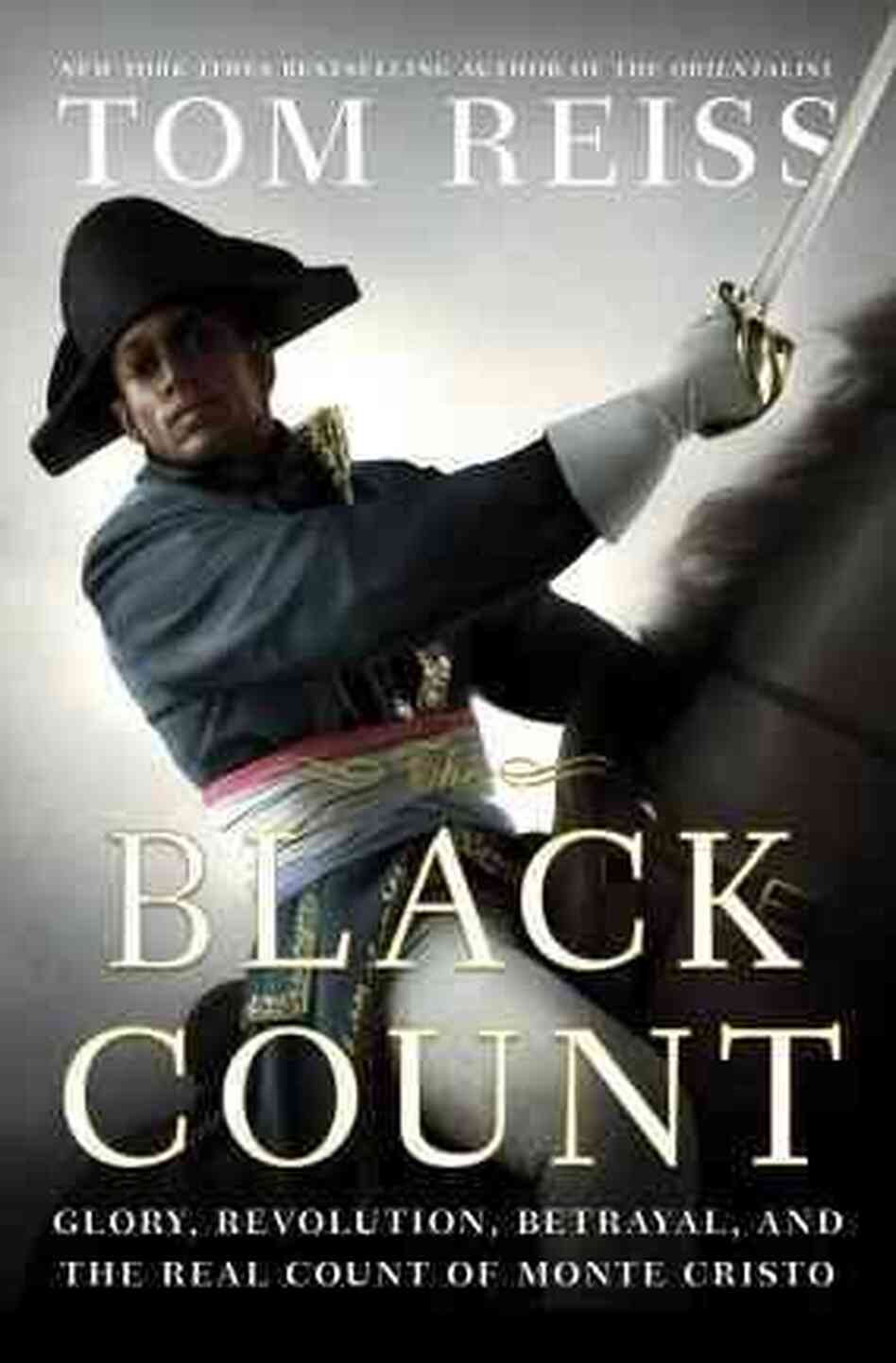
Tom Reiss – The Black Count: Napoleon's Rival, and the real Count of Monte Cristo – General Alexandre Dumas.

Almost nobody will know however that the stories that inspired the often unbelievable, adventures The Three Musketeers or The Count of Monte Cristo was the life of Alexandre Dumas' father, Alex.

Here for instance, is a near contemporary account of the General who, at thirty-five, commanded three armies and was the toast of Revolutionary France, yet five years later was to die, ignored and dismissed by Napoleon's post-revolutionary regime.

“During the conquest of Italy... he went forward to observe enemy movements with about twenty dragoons detached as scouts.... Seeing how few men stood in their way, the Austrian cavalry charged vigorously; Dumas's escorting troops were defeated before Dumas could reach them.... Seeing the danger, General Dumas rushed alone to the bridgehead and held back a squadron of enemy cavalry for several minutes, forcing them to retreat. Surrounded by some twenty Austrians he killed three and wounded eight.”

General Dumas was an expert swordsman, an educated and clever man, brave and dedicated to his troops, who in turn lionised him. However, what makes Dumas so interesting is that he was black. The son of a French count who had gone to Haiti and married a slave.

General Dumas arrived back in pre-revolutionary France as a young man and as debts assailed him and his family, he joined the army. Not as an officer as his social position would have permitted, but as a private. His skills, loyalty and politics soon led him to rise upwards.

General Dumas was, according to the 1797 report, “every but of deserving of admiration as those of a native of the Old World. Indeed, who has a greater right to public respect than the man of color fighting for freedom after having experienced all the horrors of slavery? To equal the most celebrated warriors he need only keep in mind all the evils he has suffered.”

This was not hyperbole. Dumas' was his father's favourite son. His brothers and his mother were sold back into slavery by his father when he returned to France to claim his estate.

But the General's rise in the ranks was as much to do with the changing revolutionary world as his skills with sword and men. As Reiss explains, it was Revolutionary France, long before the Civil Rights movement, long before William Wilberforce that granted equality and freedom to everyone within its Empire. The abolition of slavery as part of the 1789 revolution helped inspire revolution and revolt by slaves across France's dominions, as well as inspire millions of other “slaves”. Within France the equality was real. Black people were treated the same by the revolutionary state in a way that would not be seen again until the 20th century. Reiss points out that this is particularly remarkable given that France's economy depended very much on the wealth generated by the slave plantations of Saint-Domingue.

Sadly, it was this that helped led to General Dumas' fall from grace. After leaving the Egyptian campaign, Dumas was captured and spent two years in an Italian prison, nearly dying from the deprivation. This story is the model for his son's Count of Monte Cristo. But, Dumas arrived back to a very different France. Napoleon's regime certainly wasn't concerned with equality. Black people faced discrimination and the return of slavery. Dumas however, never seems to have lost his ideals, those shared by millions during the revolution.

What makes Tom Reiss' book such fascinating reading is not simply his rediscovery of a forgotten figure of history, but the way that General Dumas' life is linked to the wider world. The rise of the French Revolution lifts the General up. He shares its ideals and aspirations and is prepared to die for them. His fall from grace and his forgotten story is a reflection of the degeneration of the Revolution. This is a wonderful well told story that should be read widely to remember that once "Liberty, Equality, Fraternity" was something that millions of people were ready to fight for.

Tuesday, July 23, 2013

Bruce Neuburger - Lettuce Wars: Ten Years of Work and Struggle in the Fields of California

While in part biography, Bruce Neuburger's Lettuce Wars is really a history of life and work for agricultural labourers in California in the early 1970s. At its heart is the day to day struggle to make ends meet for tens of thousands of workers, mostly immigrant labour. But this is also a celebration of the struggle of those workers to get organised, and their victories against the bosses. Sometimes, this is in spite of their trade union leaders, and often it was because of a few individuals like Neuburger, prepared to stand up and be counted.

So here are the stories of the forgotten men and women, often working illegally who struggled to give others a voice and to improve their lot. Despite the remoteness of the fields and the language barriers, these struggles were not in isolation. People like Neuburger were heavily influenced by wider radical ideas - the struggle against the war in Vietnam, the women's liberation movements, and revolutionary socialist ideas. Some of the fascinating parts of the book are Neuburger's accounts of his involvement with the "coffee shops", setup to relate to soldiers heading to Vietnam.

But these radical ideas were not just those of the socialist left that Neuburger was part of. They had currency amongst much wider sections of the agricultural workers and their organisations. Neuburger mentions wearing a Chairman Mao badge and being asked by all his "crew" in the fields if they could have one too. A even clearer understanding of the world is demonstrated by a stunning photo of evicted families living in tents in 1972, one of which has posted a sign, "La Posada - My Lai. Same enemy - US bosses and guns".

Neuburger explains how the bosses in the fields knew exactly how to turn people against each other, using faster workers to encourage slower ones, or encouraging harder work by offering bonuses if certain amounts of vegetables were cut or boxed in an hour. They also used racial divisions to divide people - on a couple of occasions, Neuburger is offered promotion because of his white skin.

Neuburger's experience in the fields and working with these labourers transformed his wider understanding of the world, and developing his Marxism in a way that just reading books alone can never do:
Rather than seeing farmworkers as isolated from mainstream middle class life, I began to regard the urban middle class as isolated in the big cities, cut off from the reality of those who supplied their food. And because the conditions in which the farmworkers labored and lived had more in common with billions of oppressed people in communities around the world,, I felt the situation in the fields more closely reflected the broad reality of the world than the privileged world I'd come from. I also began to feel in a very personal way how different social realities affect our consciousness, giving form to Marx's observation that 'social being determines social consciousness'.
The "conditions" that the author refers to are horrific. Overcrowded, dirty dormitories, rundown housing with no hot water to clean off the mud from the fields, no toilets in the fields, lack of holiday pay or overtime. It is these conditions that the workers organise against and the struggle which Neuburger involves himself in.

There was a long history of union organising by workers in the fields. But the union was not perfect. Inspired by wider struggles of the 1960s and early 1970s and led by the charismatic and confident Cesar Chavez the union made important and rapid gains. But as time went forward the union itself became less confident to challenge the farm bosses. Its bureaucracy began to look both to the Democrats as a potential ally, and to the benefits accrued from deals made with the bosses themselves. As this happened strikes began to be more of a threat than a central part of the workers tactics. Rank and file activists, particularly those who were communist or socialist like Bruce Neuburger were targeted and forced out.

To those of us in the European union movement, the level of violence in US class struggles is always shocking. But so is the violence deployed against the left during the 1970s, as Chavez sought to strengthen his hold on the union. "Chavez", Neuburger writes, "used anti-communism as an internal bond. It also served to cement ties with the Democrats and the establishment in general. I think this, in part, explains his fanatical, out of proportion preoccupation with leftists in the union." A not unfamiliar situation for those of us in certain British unions today.

Even more shocking was the racism that the union used against immigrants, arguing that attacking migrants and illegal immigrants would protect its members' jobs; despite them coming from similar backgrounds. Neuburger relates that:
the union set up tents along the border to stop workers coming across the border, to prevent them from breaking the strike. There were rumours about union actions on the border, not very pretty ones.
To Neuburger's credit he and other left-wingers argue against this capitulation to divide and rule, but are themselves further isolated and eventually defeated by the union bureaucracy. Sadly, Neuburger understood even then that what was needed more was the militancy of the left to fight the bosses, rather than the support of the Democratic Party.

For those of us today organising to strengthen radical trade unionism and socialist organisation, there is a certain inspiration in Neuburger's descriptions of his early attempts to produce radical newspapers and literature. His satisfaction at seeing the paper passed from hand to hand, or read aloud. As well has his early naivety when the paper upsets the union bureaucracy. For those organising today, in the fields, or in call centres there is still much to learn here.

In his epilogue, Bruce Neuburger returns to the fields. He finds there are more than two million year-round and seasonal workers in the US, including 100,000 children. One in ten of them is a US citizen. Today, US capital relies very much on the cheap labour it can get from Mexico and Latin America. Neuburger points out though that the difference is that it is not just agriculture, but other industries too. Conditions are better in some ways - portable toilets seem more common - but overcrowded homes and the threat of the immigration police remain. Interestingly pay seems far worse than in the 1980s.

So today the struggles for justice by some of the poorest and most exploited workers in America continue. But Neuburger's book demonstrates beyond doubt that when those workers do organise they can make real gains, holding immense power in an industry which makes enormous profits from their labour. While some socialist readers may consider Neuburger's Maoist politics incorrect it is hardly a distraction from one other lesson - that a network of socialists, arguing socialist ideas can make a crucial difference to workers' struggles. As such, this book is recommended to everyone trying to organise to change the world today.

Sunday, July 21, 2013

Neil Smith - Uneven Development: Nature, Capital, and the Production of Space

Neil Smith's Uneven Development is a classic work of Marxist geography that deserves to be read by everyone trying to understand the way that capitalism shapes, and reshapes the natural world. Smith's central thesis is that capitalism has transformed the natural world, but it has also transformed our "social relation with nature" in unprecedented ways.

Smith's analysis draws heavily on Marx. Like John Bellamy Foster in Marx's Ecology Smith emphasises the dialectical interaction between humans and nature, and develops the concept of metabolism. Describing the work of the Marxist, Alfred Schmidt, he writes:

"The concrete form taken by this metabolism may change historically... In the pre-bourgeois era, 'man is as yoked to his natural existence as to his body,' and there there is an 'original... abstract identity of man with nature.' With the emergence of bourgeois conditions of production, this identity changes into its equally abstract opposite; the radical divorce of labor from its objective natural conditions."

Smith argues that rather than thinking of human society dominating nature, we must consider the "much more complex process of the production of nature". Smith writes:

Where capitalism is unique is that for the first time human beings produce nature at a world scale. Hence Marx's brilliant observation, over 120 years ago, that 'the nature that preceded human history... today no longer exists anywhere (except perhaps on a few Australian coral islands of recent origin)'.
Smith has, however, a sense of the alternative to this. That in the process of struggling against capitalism, the working class has the potential to "truly define human nature". The working class itself is unnatural, a product of capitalism. The victory of that struggle would bring a "historically unique opportunity for human beings to become the willing social subjects not the natural subjects of their own history."

Smith then takes his explanation of the production of nature into a discussion of the production of space. In earlier societies he argues, there was no differentiation of "space" from matter, force or power. There was a "unity of nature... space, substance and meaning were one".

But our concepts of space change historically, the "spatial form of the capitalist city, for example, is quite different from the feudal city". Under capitalism, space becomes a commodity, and this is not restricted to the creation of "physical space", but "the production of space also implies the production of the meaning, concepts and consciousness of space which are inseparably linked to its physical production." Rather neatly Smith explains that in "Euclidean terms" the height of an apartment in a block of flats might be equivalent to the height of a tree, but the "distance between floors of the tenement can also be measured in terms of social rank and class, whereas the height of the tree cannot". Or, consider how under feudalism the serfs were tied to the land, so a definition of class relations also included a definition of the absolute space of the peasants work.

Smith analyses the development of capitalism in the later part of the book. He places particular emphasis on the way that capitalism is founded upon the division between town and country, industry and agriculture. This doesn't begin with capitalism, but is inherited from the developing capitalist relationships under feudalism. The separation of town and country becomes the foundation for capitalism.

In turn, capitalism reshapes the world "after its own image". This doesn't simply mean that capitalism reshapes nature in its image and for its interests, but "the dynamism of geographical space is equally  an expression of the image of capital." The tendency of capital to centralise and create monopolies, the tendency for the system to leap upon areas where new markets are to be found, or new profits to be made, creates an unequal, uneven capitalist space. Capitalism creates unevenness within itself, and this is reflected in the unevenness of the system around the world, but also in social inequalities - rich and poor, cheap and expensive housing. And, in a powerful comment, Smith points out that uneven development of capitalism is at the heart of imperialism - "uneven development, thy name is war" he writes.

Abolishing this inequality is not simply a social struggle, Smith argues, but a "geographical project". This might sound strange to those of us thinking of geography as a school subject about rivers and mountains, but Smith is putting across  the idea that capitalism is a system that shapes and creates space on an enormous scale, and it can only be challenged on that scale.

In the afterword to the third edition, published a few years before his death. Smith points out that unevenness has only got worse since the book was first published. "The pay of CEOs in 1982 in the US was 42 times that of wage workers.... it has risen to an astonishing ratio of 364:1". Unusually for an academic, Smith doesn't abandon his belief that things can be changed, concluding that it "may not be too optimistic to begin again to encourage a revolutionary imaginary".

While this is not an easy book, and covers some complex and difficult ideas, it is an important one, and Neil Smith deserves reading to do just what his conclusion suggests, encourage a revolutionary vision.

Related Reviews

Foster - Marx's Ecology
Malm - The Progress of this Storm

Burkett - Marx and Nature

Friday, July 19, 2013

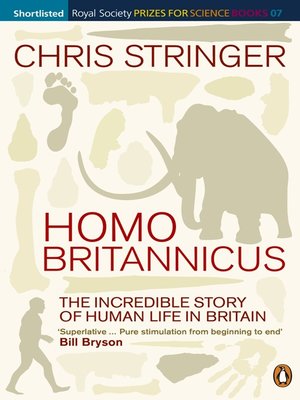
Chris Stringer - Homo Britannicus: The Incredible Story of Human Life in Britain

Chris Stringer's Homo Britannicus is a short, popular introduction to the history of humans living in the region that we now know as the British Isles. Anyone silly enough to infer from the title that this is a history that gives justification to the lunatics of the far right who believe that being British means tracing your ancestry back to some far distinct British caveman, will be disappointed. Instead what Stringer does is to present the evidence that humans in Britain have come and gone over an immense period of time, stretching back to well before the most recent Ice Age. In addition, the geography of Britain has changed substantially - not just from changing sea levels, but also through the erosion of a chalk ridge that connected south east England to north western France.

Human history goes back a long way, and Stringer takes us through the complex and often conflicting scientific evidence for our earliest history. The timescale is enormous. We have clear evidence that early species of humans were using stone tools in Africa more than two million years back. Even in British sites, evidence such as the "vole clock" place the tool use at one site as long ago as 700,000 years.

The "vole clock" is one of the fascinating examples of the archaeological process that Stringer uses to illustrate how scientists know so much about the ancient past. Here, the different species of voles, known to have evolved or gone extinct at specific points in the past, are used to date contemporary human remains. Much of the book is based on the work of the Ancient Human Occupation of Britain (AHOB) project. Indeed the last section is a series of descriptions of those involved in the project, and how they came to work in this career. It is notable that only one of the AHOB scientists is a woman, reflecting a wider problem of female under-representation in science.

Stringer tells us the story of human history (as well as that of our cousins such as the Neanderthals) but he also tells us about the voyage of discovery that science has also gone through. From early scientists trying to explain the presence of hippo bones in England or linking the age of the Earth to Noah's flood, Stringer shows us not just what we know, but how we know it.

For anyone wanting an entertaining introduction to our early history, as well as insights into the work of archaeologists, there probably isn't a better book. While the section on climate change at the end felt a little like a polemic shoe-horned in, it doesn't detract too much from a more general discussion on the position of humans in a wider natural world. It's also the first work of anthropology that I have ever read, which begins with the description of ancient women and children eating warm, moist hippo brains.

The paperback has some wonderful illustrations, but if possible you might want to try and get the hard-back which has even more photographs and diagrams.

Related Reviews

Stringer - The Origin of our Species

Wednesday, July 17, 2013

Larry Niven - Destiny's Road

Destiny's Road is a return to a science fiction theme that made Larry Niven famous. Like in his classic Ringworld series, the hero of this novel is exploring an alien planet, and the reader, through Jemmy Bloocher's eyes is doing the same.

The planet Destiny was first colonised from Earth some 250 years ago. Their mothership disappeared and the landing craft also vanished, but in the process it burnt an enormous road across the landscape. The road begins as a spiral, giving the name to the small town that grows up there. But no one has ever seen the end, other than the merchants who periodically arrive in Spiral Town trading wares, in exchange for the products of Spiral Town's remaining Earth technology.

The merchants also bring something else - "speckles" - a spice like food product that humans must eat to survive, as natural life on Destiny appears to be missing some vital ingredient.

After accidental killing someone, Jemmy Bloocher flees Spiral Town and tries to travel the length of the Road. His adventures and discoveries form the basis for the book.

Sadly though, this 1997 Larry Niven novel is not a patch on his earlier work. While there is some interesting stuff, particularly the descriptions of alien life forms, and cooking them, Niven has copied too much from Ringworld. Rather like in that novel, Niven has an obsession with leading characters shagging anyone they meet. In Ringworld this was justified as an attempt by alien beings to relate to each others strangeness, in Destiny's Road it seems merely an attempt to appeal to a particular type of fan. While Niven does eventually provide the reader with a plot device to explain this behaviour, it feels like an after-thought, rather than a startling revelation.

Fans of Larry Niven will already have read this. It probably should only be picked up by newer fans trying to read all his works. It doesn't deserve the "truly remarkable" accolades on the cover and there is far better SF out there, including works by Niven himself.

Related Reviews

Niven - Ringworld
Niven - Ringworld's Children
Niven - Crashlander

Tuesday, July 09, 2013

Anna Minton - Ground Control: Fear and Happiness in the Twenty-First-Century City

Ground Control is an excellent study of the modern urban space, and the way that neo-liberal politics, post Margaret Thatcher have shaped our towns, our housing and ourselves. Anna Minton begins with that icon of capitalism, Canary Wharf in East London. When I lived in Tower Hamlets the flashing light on the top used to shine straight into my bedroom on a council estate, symbolically ruining my sleep in a metaphor for the destructive power of capitalism.

Canary Wharf symbolises capitalism, but it also is a perfect example of the way that neo-liberal economics benefit only a tiny minority. Those living in overcrowded flats on estates a few minutes walk from the privatised space around the tower's base have got nothing out of the millions spent on the complex around the tower. Built with the idea that economic growth on its own would benefit all, Minton argues that "Trickle down hasn't worked in Docklands... Yet this model endures because of the high rates of growth it beings in good times, even if the benefits are very unevenly spread, entrenching enclaves of poverty as well as wealth."

In order to make it easier for venture capitalists to throw up buildings, shopping centres and the like, Thatcher altered many planning regulations, removing controls and democratic accountability on the process. The result has been a plethora of ill thought out sites that have begun to fundamentally reshape our cities. Sadly New Labour did nothing to reverse these trends, indeed what happened under Blair was "to find a way around planning restrictions, shopping centres have moved wholesale into the centre of cities".

These private shopping centres often have an identikit feel to them. The same shops, designs and even similar names. Minton explores them, and uncovers some worrying trends. Part of this is about access and public space. Like Canary Wharf, few of these new sites are public land and private companies have extraordinary powers to restrict access. Those who don't fit the image or have enough disposable income are removed. The designs themselves, lacking seating or atmosphere don't encourage the elderly or infirm to sit and relax. That would give the wrong impression. As one manager tells Minton these spaces are not about people, they are about profit:
We're a commercial organization which retailers invest in to improve the retail environment. It's nice to make it clean, but we're not doing it for the community agenda, we're doing it for the bottom line.
Contrast this approach with the results of a 2007 study by the Joseph Rowntree Foundation that looked at how people used public space. It found "that one of the most important functions of public space is to allow people to 'do nothing'... an 'essential role which shouldn't be eradicated'."

Minton explores many other aspects of urban life. The way that long standing communities have been broken up in order to re-market areas or sell homes to others for higher prices. Again a vision of reshaping cities in the interest of a minority, not the existing communities. Minton, like Owen Jones in Chavs locates the problems today in the lack of public housing as being rooted in the decision to allow council tenants to buy their own homes, but prevented councils reinvesting this cash in the building of further homes. Minton develops the vision of public housing much further, arguing that the original idea of mixed areas would still serve us well today. A mixture of families and couples or individuals, with different backgrounds and social positions would help to create a much better and enjoyable community atmosphere.

A central, and fascinating part of the book is Minton's exploration of gated communities, a subject that she has spent some time studying and writing about. She shows how those who live behind gates and bars, fearing the outside world, reinforce their fears and stereotypes - becoming more isolated and more worried. Combined with an analysis of the way the media systematically over reports declining violent crimes, Minton shows how certain sections of society have become more and more fearful of the wider population, with very little reason. Shades of the Victorian fear of "the mob".

This is a readable and fascinating book. Unlike some other books I've read recently on modern cities, Minton begins with those who live, work and play in the areas. So she interviews and follows council workers, bored youngsters and those on council estates in the shadow of Canary Wharf. She also introduces us to those who have struggled against the developers and campaigned to defend their communities.

My over-riding conclusion after finishing it however, was that the real barrier to the sorts of communities that we would all love to see, is a system that puts profits first. Anna Minton's excellent book is a good explanation of what is wrong with urbanisation under capitalism and offers some fascinating insights into how things might be.

Related Reading

Jones - Chavs
Hanley - Estates: An Intimate History
Hollis - Cities are Good for you
Robbins - There's No Place

Thursday, July 04, 2013

John Wyndham - Web

John Wyndham is best known for three superb science fiction novels, The Day of the Triffids, The Kraken Wakes and The Chrysalids. He is less well known for his short stories, which are often marked by wonderfully subtle British humour (I recommend Pawley's Peepholes as a wonderful example of this), or a great sense of the macabre.

Web was not published until ten years after his death. In a bare 140 pages Wyndham tells a terrifying tale of human fallibility in the face of nature. Its a tight novel, shorn of any embellishment. While there are lots of characters, we know a minimum about them, because the story here is not really about people, but what happens to them.

A millionaire English lord desperate to be remembered for posterity for more than simply endowing a college fund, decides to create a Utopia in the middle of the Pacific. Choosing the remote island of Tanakuata he dispatches a small group of colonists, armed with the latest technology and backed up by large sums of money.

The island is the real story here. Shaded in mist at the beginning, we know little of the physical place, but we know its history. Tales of shipwreck and cannibalism and more recently the betrayal of the islanders who lived there before the place was hit by radiation from a nearby testing of a nuclear bomb. Readers will not be surprised to know that it is here that it all goes wrong.

This is a genuinely creepy novel, that doesn't shy from some interesting philosophical musings on the relationship between humans and nature. But its one that will probably sit longer in the mind than some longer and more detailed books. It'll also probably make you check for cobwebs before you sleep.

"Strange, so few birds... I'd have expected thousands of birds."

Tuesday, July 02, 2013

John Reader - Cities


Çatal Hüyük a large Turkish neolithic site has been described as the world's first city. Stretching back over 9000 years, at times up to 10,000 people might have lived there. Certainly it is a site of immense historic and social importance. John Reader argues it wasn't a city, more of an overgrown village, and indeed, after reading this sweeping history of "cities" it is hard to see how such a neolithic site could be a city in the sense that we understand today.

Nonetheless, permanent settlements like Çatal Hüyük were extremely important. True permanent settlement could only occur when agriculture developed. Only then could a surplus be provided that could support non-agricultural workers. Reader argues though that the dynamic was more complex and that early urban areas encouraged the further development of agriculture, rather than the other way around.


But Çatal Hüyük is remarkable in one other respect. It is the site of the first known example of art, where humans portrayed themselves within a recognisable landscape. The Çatal Hüyük wall painting includes the outline of a nearby volcano as well as buildings. The painters deliberately noted a site of economic importance - the volcano which provided the rich soil that enabled farmers to support the city.


Here then is the real importance of the city; once humanity moves towards an urban environment, that urbanisation dominates and shapes both people, and the world around them.


While much of Readers' book concentrates on the development of the modern city, the chapters on ancient cities are fascinating. An extended discussion of Rome, for instance, brings home just how much the economic dynamics of that Empire worked. In particular the way that Rome was absolutely in hock to countries that could supply the vast amounts of grain needed to feed the population. Here environment, politics and economics combine to give Rome both its power, but also its strategic weakness.


As early as 1200 CE a network of European cities was in place. Some of them came from older cities, many of them much newer, and again rooted in the development of agriculture and trading. The growth of these cities was rooted in the surrounding agriculture, but they were also dependent on the surroundings to maintain the population. As Reader explains:


"The fact is that until recently (and then only in the developed world) more people died in cities than were born in them. So here is another way that the city parasites the countryside.... Just as city-dwellers could not produce their own food, nor could they raise enough children to replace the citizens who died... the Agricultural Revolution had not only powered the Industrial Revolution - it had also fuelled the Demographic Revolution that filled the cities."


And fill them it did. London went from a population of about 80,000 in 1551 to 865,000 just 250 years later. This despite London's birthrate being 13% lower than in the countryside, and a 50% higher death rate.


Much of the discussion of modern cities concentrates on trends that we still see today - housing, pollution, transport and other "problems". There is a fascinating discussion about sewage that mirrors much of debates that inspired Karl Marx's own concerns around the degradation of agricultural soil and the "waste" of human excrement in the Thames. Reader looks at similar cases in Paris and notes a more rational approach to the question, which will fascinate anyone who has read John Bellamy Foster's Marx's Ecology. 


This book was written in 2005 and in its ecological discussion it is perhaps most dated. Few today might share Reader's optimism that we can deal with environmental crisis through technological innovation. But that said, he does explore solutions in terms of solar cell technology.Similarly, Reader's discussions on the links between the urban environment (and the domestication of animals) with the growth of disease and epidemics are very interesting.


Unfortunately the greatest weakness of this book comes with the discussion of the future. Reader rightly concludes that the future lies in cities; but rather like Leo Hollis' more recent book on the city; he looks to enlightened planning procedures and politicians as the answer to over-crowding and pollution. No one should dismiss these factors and Reader rightly points to some of the weaknesses.


But what is missing here again is any sense of the city as a site of class struggle. This is not to simply glorify revolution, strikes or workers' protest. But a sense of the way that cities themselves have been shaped by mass movements. It was the fear of revolution, for instance, that lead to Baron Haussman designing Paris' enormous boulevards to make it harder to build barricades. 


Nor is there any sense of the collective struggles that fought to improve slums, reduce rents which helped lead to the building of public housing in Britain in the 20th century. Certainly there is no mention of the struggles that have come from those on the periphery of the developing worlds' great cities - struggles that have been fought over water and electricity, and problem stand more of a chance of shaping the future cities than many an enlightened planning officer.


Related Reviews

Hollis - Cities are Good for you

Harvey - Rebel Cities

Saturday, June 29, 2013

Leo Hollis - Cities are Good for You

Marx and Engels argued that a prerequisite of capitalism was the displacement of people from rural areas into towns and cities. This separation between town and country was one of the defining points of capitalist society for them, creating as it did a metabolic rift between humans and the natural world.

In the two centuries of so since the birth of capitalism Marx and Engels' insights have been proved right time and again. Today, as a majority of the human population live in cities (3,303,992,253 in 2007 according to the UN) the problem of the "rift" is even more important given the threat of environmental crisis.

The solution however is not some return to a rural past. Leo Hollis' new book is a celebration of the city and its potential, as well as an exploration of the problems for citizens of urban areas. Hollis goes so far as to say that the city is the best chance we have for survival as a species.

Some cities, particularly in the developing world, are growing enormously. In the next five years Yamoussoukro in the Ivory Coast will expand by 43.8 percent, the Chinese city of Jinjiang by 25.9 percent, but London and Tokyo will only grow by 0.7 and 1 percent respectively.

Once in the city, people are shaped and dominated by it. Hollis tells us that "the city offers more chances of making connections than anywhere else.... it is these 'impersonal, superficial, transitory' relationships that make the city so unique and important." Hollis makes much of the energy given to a city by its people, and he celebrates the idea that cities can be designed to maximise that energy. "Can we design an urban space to encourage people to kiss?" he asks rhetorically, and indeed demonstrates that properly thought out spaces can make people linger and relax.

One of the strengths of this book is that it presents interesting aspects of urbanisation to the non-specialist. Hollis gives us studies that discuss how people flow through streets, or where they congregate to chatter on the pavement.

Over the decades various architects have sought to design the ideal city, a rational place to maximise comfort, health and pleasure. Ebeneezer Howard for instance, inspired by utopian novels of the 19th century, came up with a design for a future city in his Tomorrow: A Peaceful Path to Real Reform published in 1898. He argued that

"Human society and beauty of nature are meant to be enjoyed together... Town and country must be married, and out of this joyous union will spring a new hope, a new life, a new civilisation."

Howard's idealism here, echoes Marx and Engels in their hope that the rift between town and country would end in a socialist society, but it also reflected the belief that cities needed to be redone from scratch. Not surprising that Howard's ideas became influential for later town planners - the new Garden Cities of the early 20th century were built along similar lines to Howard's plans.

This quest for the better city is one that has always concerned urban planners. But it has also been a concern for those living in cities as they grow, develop and change. From the early days of skyscrapers when residents worried about being cast into shadow, to those who try to redesign streets in order to encourage walking. But Hollis is also rightly worried about the direction that cities are moving in today. He points out how our space is being restricted and taken from us, quoting the author Anna Minton:

"Who controls the roads and the streets is... enormously important to how cities function. Today there has been no public debate about the selling of streets at all. Instead, as ownership of British cities goes back to private landlords, the process of removing public rights of way is buried in the arcane language and technical detail of the most obscure parts of planning law... there is an adage in highway law which says 'once a highway, always a highway'... In many British towns and cities, this common-law right is being quietly eroded."

Hollis thus celebrates those movements that have sort to defend and challenge this attack on public space; the book is recent enough to note the Occupy movements, and discusses Lefebvre's Right to the City as a slogan and tactic. The Right to the City, Hollis argues following David Harvey, is more than being about ownership of space in a city, it is about access, democracy, control and involvement.  Taking the pressing issue of housing Hollis argues that instead of allowing homes to be foreclosed during the credit crunch, instead

"the city could buy the property from the banks at a good price, creating manageable housing cooperatives, guaranteeing that families can stay where they are and maintain their participation in the life of the city."

The problem is, of course, that capitalism doesn't work like that, and here, as with Hollis' other wonderful suggestions of how cities could be cleaner, safer and more involving for citizens, I fear that what is lacking is a strategy to challenge the forces that really shape cities. These are, of course, the forces of capital and the state's "armed bodies of men". This isn't to say Hollis is not aware of these problems, his understanding of the roots of the 2011 British riots in police racism demonstrates this. But Hollis' strategy to reach the better city seems to be based mostly on electing enlightened politicians who can bring about reform.

Of course, a good mayor can make enormous differences to a city, and Hollis has some great examples, particularly from South America. But he stops short of showing how the energy of the citizens themselves can really begin to alter power relations in society and rebuild their city. It would have been interesting to hear the author's thoughts on the way that great revolutionary movements of the past - the Paris Commune of 1871 or Red Petrograd in 1917 for instance - reshaped their urban environments.

Hollis claims that "most of us now live in suburbs where there are fewer people and sprawl allows us to live behind fences". This is a strange idea, given the descriptions he gives of the mass overcrowding in cities around the world, but perhaps reflects the audience his book is aimed at.

I did notice one significant error. Hollis claims that Friends of the Earth support plans for HS2 the High Speed Rail link being built in the UK as a way of reducing emissions. As far as I am aware, this is not true, as can be seen in FoE's response to the draft HS2 consultation here, where they say "current High Speed Rail plan will do little to cut carbon emissions".

These minor criticisms aside, this is an interesting and stimulating book for those thinking about alternatives to the unsustainable society that we currently live in.

Sunday, June 23, 2013

John Bellamy Foster - Marx's Ecology: Materialism and Nature

Published in 2000 John Bellamy Foster's Marx's Ecology was and is an extremely important work. It reasserted a crucial element of Karl Marx's thought for a new generation of activists and for more long standing revolutionary socialists. John Bellamy Foster argues that at the core of Marx's ideas is a nuanced and dialectical understanding of human ecology, rooted in his materialism. This rests in part in Marx's understanding and development of ancient philosophers, but is also a break with his contemporary thinkers which enabled him to develop a more radical and far reaching critique of capitalism, and vision of communism.

Foster begins this book by looking at the philosophy that underpins Marx's thought. In particular he engages with Marx's early work (including his PHd) which was based on the ideas of Epicurus. Foster shows how 19th century materialism developed and how Marx's own materialism developed from his critical engagement with other thinkers.

Foster quotes Bhaskar who writes that
For Marx, in contrast [to Hegel], 'neither thought nor language... form a realm of their own, they are only manifestations of actual life',,, so that 'consciousness can never be anything else than conscious existence.
Foster emphasises the importance of this approach, saying it rests "on a perpetual and close connection between natural science and social science, between a conception of the material / natural world and the world of society. For this reason, Marx continually defined his materialism as one that belonged to the 'process of natural history'."

There has been a tendency to see a break between the thought of the young Marx and the later writings of the old Marx. For some writers the young Marx was interested in the relationships between man and nature, as exemplified through Marx's writings on alienation. The older Marx by contrast, was more analytically, given to a scientific study of capitalism rather than the more general philosophical concepts. Foster argues that this is an artificial break, that Marx always began from a idea that "what individuals are depends on the material conditions of their production." Foster writes:
Marx and Engels thus started out from a materialist or realist ontology in which nature, the material world, was a precondition of human existence, and production of the means of subsistence was a precondition of human life in all its manifold determinations and hence human society.
This is in contrast to other thinkers, like Feuerbach, who Marx and Engels argued, "posits 'Man' instead of 'real historical man" - abstracting humans from their social world.

But because humans are part of nature for Marx and because it is their ability to transform nature through their labour, the changing relationship to nature has an impact upon man (as well as nature). Thus Marx's theory of alienation developed in his 1844 manuscripts is far more than a study of the way that the worker is disenfranchised by wage labour. Alienation for Marx "estranges man from his own body, from nature as it exists outside him, from his spiritual essence, his human essence."

Foster points out that from 1844 onwards Marx always treated nature as an extension of the human body. This is crucial to understanding the way in which Marx's later analysis is less of a break with earlier writings and more of a continuation. For it is only by understanding the centrality of this human-nature relationship, this metabolism as Marx described it, that we can understand the impacts of the great transformation that capitalism has wrought upon the world.

Marx argues that the precondition for capitalism was the primitive accumulation of wealth, which takes place through the displacement of people from the soil, making possible the historical development of capital. This separation, manifested in the "antagonistic separation of town from country" is the root of much of the great environmental and ecological crises of the 19th century.

Foster goes into detail the way in which Marx and Engels engagement with contemporary scientific literature, as well as their economic studies enabled both of the revolutionaries to understand that capitalism not only destroyed workers lives through exploitation, but it also destroyed the natural world. Thus they argued for a world (free of alienation and exploitation) that could restore the "rift". As Engels writes:
Abolition of the antithesis between town and country is not merely possible. It has become a direct necessity of industrial production itself, just as it has become a necessity of agricultural production and, besides, of public health. The present poisoning of the air, water and land can be put an end to only by the fusion of town and country; and only such fusion will change the situation of the masses now languishing in the towns, and enable their excrement to be used for the production of plants instead of the production of disease.
Such an analysis betrays a far greater understand of the ecological relationship between humans and nature than is often attributed to Marx and Engels by more recent green thinkers. But, as Foster demonstrates throughout this book, it wasn't an aberration for them, rather an integral part of their thinking.

To back up this argument, Foster's book covers far greater ground than I can possibly do justice to in this review. He examines for instance the ideas of Thomas Malthus and the way in which both Marx and Engels engaged with debates around population. He also discusses the roots of Darwin's ideas and the parallels between the development of his materialism and Marx and Engels own ideas. In an important section he also explains what it was that Marx precisely meant in his infamous comment that Darwin's evolutionary ideas offered the "basis for our view" in nature.

This is an important and engaging work of Marxism. It deserves to be read and re-read by socialists who are trying to develop ideas around sustainability and the links between capitalist crisis and ecological destruction. I would also suggest it is a crucial book for those in the wider environmental / green movement.

In parts (particularly the early chapters) it is not an easy read, particularly for those of us without a background in the study of philosophy, but it is worth persevering and, reading some of John Bellamy Foster's other works (links to my reviews below) would certainly help in preparing the reader.

Related Reviews

Foster & Clark - The Robbery of Nature
Foster & Burkett - Marx and the Earth: An Anti-Critique
Foster, Clark & York - Critique of Intelligent Design

Foster - The Ecological Revolution: Making Peace with the Planet
Foster - The Vulnerable Planet
Foster - Ecology Against Capitalism
Foster - The Return of Nature

Thursday, June 20, 2013

David Harvey - Spaces of Global Capitalism

This collection of short essays by David Harvey begins with an essay on Neo-Liberalism and the Restoration of Class Power.  This a very clear argument about how the model of capitalism that arrived with Ronald Reagan and Margaret Thatcher allowed the ruling class to establish their control over the economy and their populations. Harvey explains that the

"neo-liberal state looks to further the cause of and to facilitate and stimulate ... all business interests, arguing that this will foster growth and innovation and this is the only way to eradicate poverty... The neo-liberal state is particularly assiduous in seeking the privatization of assets as a means to open up fresh fields for capital accumulation"

He continues;

"The free mobility of capital between sectors and regions is regarded as crucial to reviving profit rates and all barriers to that free movement (such as planning controls) have to be removed except in those areas crucial to 'the national interest'."

From this Harvey argues we get the notion of flexibility. Workers, trades unions, public services must all be prepared to bend and change in the interests of the wider system, which is supposed to bring improvements to all. In reality of course this means that wages are cut and rights are removed, public services are dismantled in the interest of business profits which is supposed to be the same as the "national interest".

Neo-liberalism didn't get deployed everywhere but where it did there were "rapid increases in social inequality". However neo-liberalism did not solve underlying problems for capitalism, countries that had implemented neo-liberalism were still in economic difficulty even if they had dismantled or weakened many of the barriers to the capitalist class' drive to accumulate. Indeed Harvey points out that it was the centre-left, Clinton and Tony Blair who worked hardest not to blunt the worst aspects of the neo-liberal agenda, but to expand and consolidate it.

The defeat or weakening of traditional opponents of the capitalists through the use of neo-liberalism both ideologically and economically is the origin of Harvey's suggestion that neo-liberal policies have restored the capitalist class power.

The essay argues that there was an uneven implementation of neo-liberal policies geographically. This fits with the second A Theory of Uneven Geographical Development. Here Harvey looks at the various ways that different regions of the world have arrived at many different economic situations. He argues that "uneven geographical developments reflect the different ways in which different social groups have materially embedded their modes of sociality into the web of life, understood as an evolving social-ecological system."

This challenges those for instance who argue that Africa must always be poor or others like Jared Diamond who suggest that the key question is whether or not there are particular natural resources available in an area.

But this is not to ignore "nature". Harvey takes an extreme position (paralleled by William Cronon's analysis in his environmental history of Chicago), arguing that you cannot understand uneven geographical development without understanding how "the production of nature" has occurred through capitalist activities.

In a quote that will infuriate many if taken out of context he writes that "there is... nothing unnatural about New York City". What he means is that human activity and the economic systems that humans have created, has built and shaped New York. It is as much a product of nature as anything else. Harvey continues, by quoting Robert Park approvingly, that "in making the city man remade himself".

For Harvey the only solution to the problems that bedevil us today is not through single issue campaigns like environmentalism, or feminism, though those are important struggles that cannot be ignored. However they are at best "protective coverings" [Polanyi] even as they are "pitted against the dynamics of free-market commodification". Rather we need a movement that can "actually do something to check if not transform what a predatory capitalism is about."

The final essay in this book is a discussion of the notion of "space". Space for Harvey is more than a fixed geographical area, it is a dynamic changing region in time and location. It is something that is shaped by history, our actions, experiences and the economic system. To think about places or areas in isolation limits our ability to understand those spaces, or indeed change them. In a comment that echoes some of the ideas that dominated recent Occupy! movements, Harvey quotes Don Mitchell:

"In public space - on street corners or in parks, in the streets during riots and demonstrations - political organisations can represent themselves to a larger population and through this representation give their cries and demands some force. By claiming space in public, by creating public spaces, social groups themselves become public."

This is not of course the end of the struggle, but it does give a hint at how wider forces can see the role of "space" in political struggle, which can then lead to wider confrontations with the system. Ultimately the question becomes one of political power as movements come into conflict with the state. But if there is one weakness that this book shares with Harvey's more recent book Rebel Cities it is that it raises these further questions, but fails to answer them.

Related Reviews

Harvey - Rebel Cities

Monday, June 17, 2013

Tony Cliff - Trotsky 1923-1927: Fighting the Rising Stalinist Bureaucracy

Of the four volumes of Tony Cliff's biography of Leon Trotsky, I suspect that this one was the hardest to write and it may well be the hardest to read. The first volume Towards October dealt with the early years of Trotsky's revolutionary life. His work in small political organisations, followed by the 1905 revolution which Trotsky helped to lead. It's a work that captures Trotsky's political brilliance and his organisational genius as he led the St. Petersburg Soviet through advances and retreats.


Volume two, Sword of the Revolution also deals with an inspiring period, that of the Russian Revolutions of 1917 as well as Trotsky's time in exile. Here again Cliff stresses the role of Trotsky in organising the insurrection, as well as his brilliance during the Civil War.

By contrast volume three deals with the defeat of Trotsky's ideas. This defeat cannot be separated by the isolation and defeat of the Russian Revolution itself and the triumph of an entirely different set of ideas - those of Stalin and the notion of Socialism in One Country.

Cliff discusses the various political forces ranged against Trotsky, those individuals around Stalin - particularly Kamenev and Zinoviev - and the growing strength of the bureaucracy. Cliff argues that Trotsky never abandoned a revolutionary outlook. Stalin on the other hand, retreated into the idea that socialism could survive alone in Russia in the midst of a capitalist sea. The struggle between these two viewpoints became the core debate in Russian politics, being reflected in, as well as shaping wider discussions on foreign policy, agrarian questions and the economy. As such much of this book is devoted to the factional struggles within the Communist Party.

Trotsky did badly in these battles. It clearly wasn't his natural territory, despite being politically and intellectually head and shoulders above his opponents, he wasn't able to break through. Towards the end of the book Cliff asks why this was, and can only conclude that it was the very isolation of the revolution and the retreat of the international working class movement that was hampering Trotsky. As Cliff writes;

"One should have a sense of proportion about the strengths and weaknesses of Trotsky's stand in the years 1923-27. While his strategic direction was correct, he made a number of serious tactical blunders and compromises. The point is not that had he been firmer he would have been able to beat Stalin, but that he would have laid firmer bases for the growth of the Opposition, not allowing the 1923 Opposition to wither on the vine, not disorienting his followers in the foreign Communist Parties."

But during a period of retreat, Trotsky's mistakes had far greater consequences than in a period when the working class was moving forward, "not a few mistakes were committed by the Bolshevik leaders during 1917 and the period of the civil war. But the sweep of the revolution repaired the errors. Now the march of reaction exacerbated the impact of every error committed by Trotsky."

The isolation of the revolution led to a number of serious problems for Trotsky. One of these was the lack of a cadre who understood what the party had been through and who Trotsky was. When Stalin and his cohorts argued that Trotsky had disagreed with Lenin and quoted him out of context, or pointed to his errors, many Communists were disorientated. But many of those who understood the past were gone. Support amongst Old Bolsheviks for Trotsky and the Opposition to Stalin was significant, yet in 1922 there were only 10,431 party members who had joined before February 1917. By 1927 the figure was less than half of this.

Some of the core chapters of this book also look at Trotsky's attempts to understand the failures of the wider struggles in the international working class. Cliff retells some stories familiar to readers of this blog, he looks at the defeat of the 1923 German Revolution, the British General Strike and the Chinese Revolution. Cliff argues that these were important, because in all cases, their victories could have helped end Russia's isolation. More importantly the incorrect analysis applied to the events by Russian revolutionaries, and Stalin in particular stemmed from the weakness of their own politics. Even today Trotsky's analyses from afar are often head and shoulders above anyone else.

The period of transition between the revolutionary era and the Stalin era was a slow drawn out process, but one that has concrete roots in economics and international politics. Cliff's analysis is beautifully clear and he is not afraid of criticising his subject. In fact I was quite surprised at how weak and compromising Trotsky was at times. In fact for a period of 18 months in the aftermath of the defeat of the 1923 Opposition, Cliff says that Trotsky effectively abstained from fighting inside the party leadership. He even remarks that Trotsky sat reading novels during Central Committee meetings.

Nonetheless, eventually Trotsky did come out fighting. He made a compromising alliance with Kamenev and Zionviev. When they proved inadequate in the face of Stalin's onslaught, Trotsky along with many of his supporters and other Oppositionists were drummed out of the Communist Party. Trotsky spent the rest of his life keeping the flame of international revolution alive in the face of Stalinist lies and slander. As Tony Cliff concludes:

"After 1927, when Trotsky grasped the enormity of Stalin's crimes, and called him the 'gravedigger of the revolution'. when the bloc with Zinoviev and Kamenev fell apart - from then onwards Trotsky became completely uncompromising."

The story of his final years of struggle is in volume four of Cliff's biography.

Related Reading

Cliff - Trotsky Volume One: Towards October
Cliff - Trotsky Volume Two: Sword of the Revolution
Hallas - Trotsky's Marxism
Lewin - Russian Peasants and Soviet Power: A Study of Collectivisation

Sunday, June 16, 2013

Carol Birch - Jamrach's Menagerie

Warning Spoilers

Jamrach's Menagerie begins with a scene only slightly surreal in its content as our hero Jaffy Brown, aged 8, is nearly carried off by a tiger that is wandering around the streets of London's East End Docklands. I say slightly surreal because in her afterword Carol Birch tells us that the incident actually happened.

Jaffy meets the eccentric Jamrach who imports exotic animals from around the globe and sells them to rich Londoners. Jaffy has a talent for looking after the animals, calming and understanding them. He forms a friendship with a fellow worker, a slightly older boy named Tim. Jamrach gets Tim to join a Whale ship bound to the East Indies in search of Whale Oil. Jaffy too joins the ship to take part in the capture of a giant "dragon" which they know will make their fortunes.

Carol Birch has an easy going style. She brings to life the dirt and poverty of East London, and the terror of a Whaling boat. The story of the ship's disaster and the long voyage on the life boats is expertly painted. The problem is that about half way along I realised I'd read it all before. At one point on the voyage Jaffy and Tim are entertained by some old salt who tells them of the cursed waters where the Whaleship Essex sank.

Jamrach's Menagerie follows that story very closely. In fact most of the key points that happen once Tim and Jaffy's ship is wrecked and they take to the Whalers are taken from the story of the Essex. Birch notes that those wanting to know more about that story should read Nathaniel Philbrick's In the Heart of the Sea. Frankly I found myself drifting along with our shipwrecked heroes and lost interest in the story.

This is a shame because Birch has excellent writing talents and does well to bring the story to life, but because In the Heart of the Sea did such a good job of telling the amazing story of the crew of the Essex, I couldn't enjoy this re-telling. I'd encourage those interested to read the historical book, rather than this dramatisation. Given that history involved cannibalism, heroism and amazing sailing skills, in this case history is better than art.

Related Reading

PhilBrick - In the Heart of the Sea

Thursday, June 13, 2013

Christopher Empson - The Far Horizons: Thirty Years Among the Gauchos of Uruguay

In many ways Christopher Empson led a fairy-tale life. As a young boy, he had listened to his father's tales of his adventures in far off Uruguay, and dreamed of going there. Leaving the British Navy at the end of the First World War his payout was enough to get him a trip on a steamer to South America. Carrying a pile of letters of introduction, but not knowing a single word of Spanish, he arrived in the country and began to work in the cattle farms and on the open plains of the country.

Being hardworking and English he rose to be quite a trusted man. Eventually he was able to purchase his own farm and run a farm. Thirty years later he eventually retired to England and these memoirs seem to have mostly been written for friends and family, though he dreamed of having them published. They weren't in his lifetime and we owe this edition to the editorship of Renée Scott who has translated and annotated them.

Empson's life was lucky. Most farm-workers in Uruguay, working on the herding and export of cows and sheep for European meat and wool markets didn't have it anywhere near so good. His working days are punctuated by time off from work for shooting and picnics.

Sadly Empson's writing really isn't good enough to make this a must read memoir of times past. He fails to bring the country or the people to life, and it the book hangs together as a collection of anecdotes. Sometimes these are fascinating - such as the description of the perils of locusts and how Empson spent one day collecting sack after sack of them, with help from the local army, in an effort to reduce crop damage. But sometimes the memories are little more than family history for his children and grandchildren - the list of pets for example, tells us of the skunk that disappeared and several dogs that played a lot. English readers might be interested to learn that the local meat factory was in the port city of Fray Bentos, explaining the origin of the British food brand name.

I suspect for someone interested in the detailed history of Uruguay's agriculture or particular individuals in the cattle industry, this book might have its uses. Unfortunately it is not a particularly well written story and Empson's life, while worthy, doesn't seem to illuminate the people, place or time much.

Monday, June 10, 2013

William Cronon - Nature's Metropolis: Chicago and the Great West

William Cronon's history of Chicago is a brilliant ecological history that puts the development of capitalism at the heart of the story of the city and shows how the market itself shaped Chicago and its surrounding country. Cronon roots his analysis in a materialist understanding of historical change and his insights are surely applicable to cities around the globe both historically and today.

In the early days of Chicago many American entrepreneurs hoped that Chicago (or other cities like it) would become the great gateway to the American West. They believed in a sort of "geographical determinism" which argued that there were particular parts of the American continent which had the right mix of climate, natural resources and transport links that would enable the city to grow automatically, bringing wealth and profits for everyone.

"In their eyes, nature would combine with the progress of human population to call forth a metropolis to lead the Great West.... triumphant cities of the past, stretching back to classical antiquity, had achieved lasting fame.. because their destiny had been an imperialist one... 'the ultimate crowning city' would achieve comparable fame by making all of North America - indeed, all the world - its empire."

He continues:


“...the Great West would rise as a commercial hierarchy with its foundation in the rural countryside, and its ascending levels in village, town, and city. At the apex would stand the great central metropolis which was cause, effect, and emblem of its region’s continuing prosperity”

None of this was automatic. What was needed was human intervention that could shape the city and the world around. Cronon begins by looking at three natural resources that ultimately led to the explosion of Chicago's population and wealth, as well as the transformation of the Great Plains. These were cattle, wood and grain.

The story of the deforestation of enormous tracts of land in order to provide wood for the expansion of American capitalism is not surprising. Cronon's story of the way that the capitalists ultimately chopped down the very source of their profits echoes a chapter by Engels who uses a similar example from Cuba to demonstrate the short-termism of the capitalist system. It is a familiar ecological story. So to is the story of beef. Before cattle could be reared in their millions, the Plains had to be emptied of former inhabitants - both human and beast. The massacre of the buffalo was necessary before the beef industry could make its profits. In a brilliantly dialectical passage Cronon explains the way that the destruction fed further changes:

"The bison met their end because their ecosystem had become attached to an urban marketplace in a new way. The very market forces that had led hunters nearly to exterminate the species now encouraged other people to find a suitable replacement... Even before the bison had entirely gone, their heirs apparent - horses, sheep, and especially the longhorn cattle... were already beginning to make buffalo country their own. Called into being by the same urban markets that had sent the hunters scurrying across the plains in the first place, the new herds would be tied to the cities by the same iron rails that had turned the plains into a slaughterhouse."

But it is the story of Chicago's grain business that is most fascinating. Here Cronon tells the familar tale of how the natural world was transformed so that grain could be grown over vast areas. The grasses and animal life of the Plains were destroyed in order to encourage mono-cultural farming so that vast quantities of grain could reach Chicago. But capitalism doesn't stand still, and it is the story of how the grain industry transformed itself that really captures the imagination.

In the early days farmers would bring their crops to Chicago and sell them onward. The farmers would own the sacks of grain right until they reached the purchaser. What the grain companies did to simplify the process was to turn the grain into a uniform commodity. Each farmer's stock was graded and then mixed with all the other grain of that type in enormous "elevators". The farmer received a receipt that entitled him to money, or a identical amount of grain. As Cronon explains:

"A person who owned grain could conveniently sell it to a buyer simply by selling the elevator receipt  and as long as both agreed that they were exchanging equivalent quantities of like grain - rather than the physical grain that the seller had originally deposited in the elevator - both left happy at the end of the transaction  It was a momentous change... The grading system allowed elevators to sever the link between ownership rights and physical grain, with a host of consequences."

One of the consequences was the development of a market in grain futures. For the fluctuating price of grain meant that the receipts had changing values. Speculators could buy and sell receipts and make profits on the market. This lead to the issuing of more receipts than there were grain and inevitably there were market booms and crashes as speculators tried to maximise profits. The madness of the market is summed up on one occasion when number 2 grade grain was selling at a higher price than the better quality number 1, because the market in the former had been cornered and prices artificially inflated.

There are few better examples of the way that capitalism doesn't just transform the natural world, but also human perceptions of it. As Cronon points out:

"To understand wheat or corn in the vocabulary of bulls, bears, corners, grades and futures meant seeing grain as a commodity, not as a living organism planted and harvested by farmers as a crop for people to mill into flour, bake into bread, and eat."

This process was encouraged and accelerated by technological development. In particular the rail-roads that took the commodities eastwards and the telegraph that brought the news of price changes. The rail-roads form the basis for a brilliant chapter where Cronon explains how they removed the "isolation that had constrained the trade and production." He quotes Marx, pointing out that rail means the "annihilation of space by time" and says that:

"Wherever the network of rails extended, frontier became hinterland to the cities where rural products entered the marketplace. Areas with limited experience of capitalist exchange suddenly found themselves much more palpably within an economic and social hierarchy created by the geography of capital."

Because he understands the dialectical relationship between city and country, between technology and markets, and humans and nature, Cronon's story of Chicago is far more than a simple one of urban destruction of the environment. His writing is beautifully clear and his analysis has much to offer us now. The question of the sustainability of urban life and the impact of cities on the natural world has never been so important and this historical study has a great deal to offer those of us trying to understand this today.

Related Reviews

Cronon - Changes in the Land
Harvey - Rebel Cities

Thursday, June 06, 2013

Naomi Mitchison - Memoirs of a Spacewoman

Naomi Mitchison seems to have led an extraordinary life. Born into an English establishment family, she was the younger sister of the communist scientist J. B. S. Haldane. Married to a socialist politician, she certainly seemed to have shared some of their politics. She seems to have mixed from an early age with scientists, Niels Bohr, apparently gave her a tiny jug for her dolls house and she is thanked in James Watson's Double Helix.

Both these aspects of her life come through in Memoirs of a Spacewoman, her 1962 novel that is perhaps her most well known. To the modern reader of science fiction it seems a little strange. There is little detail of science and technology, in this future, humans can travel to far galaxies and communicate, often telepathically with alien species. Mitchison is not particularly concerned with great plot arcs, though it is not quite true to say, as it does in the introduction to my edition, that there is no plot at all.

The story centres on Mary, the spacewoman of the title, whose job is to establish communications with alien species, in order to further humanities understanding of the universe. Most of the chapters concern Mary's encounters with various alien flora and fauna, which she tries to understand and communicate with. On occasion I was reminded of the stories in James White's Sector General series which deals with a space-going hospital that cares for aliens. Mary, like the characters in the Sector General, have to try and understand alien behaviour as well as completely foreign ecologies and metabolisms. Often the solutions arise  from looking at available evidence in a non-human way.

What makes Mitchison's book different, and the reason it perhaps shocked many on its original publication, is that it is fairly uninhibited about sexual changes in the future. Mary, for instance, is made pregnant by a Martian in one chapter. Martians communicate through the manipulations of different parts of their bodies, including their sexual organs. Such manipulations are, apparently, very subtle and often require touch. The consequences are unusual, as Mary explains:

"Before I knew where I was, I was beginning to feel elated. I wanted to pass this on as quickly as possible. I reached for his sexual organ and began to communicate on that. It seemed most peculiar that in its non-communication aspect it should have any effect on a Terran."

If this passage should make the reader snort with derision, I would urge caution. Mitchison's book is playing with ideas that are far more than a science fiction story. Her future society, is a very vague, post capitalist, post-scarcity society (there is a passing reference to revolution) and humans have very different relationships. Men and women are clearly intellectually and economically equal, at least in the space service that Mary works for. Details of the future society and peoples' lives are deliciously vague, meaning that the book has dated very little when compared to early novels.

What is fascinating though, is that the book precursors some of the Feminist writings that developed in the 1960s and 1970s. It is, in many ways, revolutionary, and not just for the sex. But it is also somewhat old fashioned in terms of gender roles. Women are thoughtful, caring and kind, in part because of their child rearing role, a role that seems to remain the remit of their sex.

This is a book that should be rediscovered by a new generation of science fiction fans. In its exploration of future worlds, sexuality, and the emotions felt by scientists studying alien ecologies, it has much to offer. It is also perhaps, a fascinating insight into the way some people were thinking "out of the box" at the beginning of the revolutionary 1960s.

Tuesday, June 04, 2013

E.E.Evans-Pritchard - Kinship and Marriage among the Nuer

Before reading this review, I would encourage you to read my review of Evans-Pritchard's earlier book The Nuer: A Description of the Modes of Livelihood and Political Institutions of a Nilotic People. 

Evans-Pritchard's works on the Nuer people are classics of anthropology and even though they were written over 70 years ago, they are still of fundamental importance in understanding human relations in pre and early class societies. He described communities where private property played a fundamentally different role in human society, where collective organisation dominated in a way that seems completely alien to us today and where political organisation was not about the concentration of wealth and power in the hands of a small minority but rather about the common interests of wider society.

In this second volume Evans-Pritchard develops some of these themes and looks at further aspects of Nuer society. In particular he examines the complex social organisation around marriage and kinship, relationships between human beings, that have very important ramifications for wider Nuer society.

For the Nuer relationships between family groups are the most fundamental aspects of society. These family groups however are very different from the family that we know from modern capitalism. Far from a couple having a number of children, there is a wider grouping of individuals who are seen as being the family. In her extremely useful introduction, the anthropologist Wendy James comments that there is:

"A vivid Nuer image for this... that of the beast with four legs - right hindleg, father's brother; left hindleg, mother's brother; right foreleg, father's sister; left foreleg, mother's sister".

Lineage in Nuer society is not through Patriarchal lines; as Wendy James comments:

"Lineage continuity thus depends not on the male fertility of a given community but on its economic and political ability to transfer bridewealth and marry wives to the names of its members (including some women and some deceased men) and to recruit new persons through adoption and other means."

This means that it can be difficult to comprehend family relationships amongst the Nuer for those of us used to our version of the family. Children for instance have different names depending on whether they are living with their father or mother.

Sex features widely in this book. To understand the Nuer is to understand how they reproduce the next generation of their community. This involves complex exchanges of wealth (cattle) and even more complex and ever changing social relationships, that I will come onto.

But the Nuer also have very interesting attitudes to sex. Before discussing Nuer marriage, Pritchard looks in detail at the concept of "incest" amongst the Nuer. Incest here is more of a cultural taboo on sexual and marital relationships between certain people.

It is more important to the Nuer because it spreads "marriages of members of any local group and [creates] innumerable links through women between persons in many different communities." Notably, incest taboos do not necessary preclude sex but are barriers to marriage.

If this challenges the notion that this might be related to any future offspring, the reader should note that to the Nuer a marriage isn't considered complete until the first child is born.

Relationships amongst the Nuer are further complicated, because when a woman marries a man, she is also considered to have married that man's brothers. Thus, "when a man dies... there is no question of the widow being remarried to one of his brothers, for the brothers already count as her husbands. The dead man's lineage have a right to inherit his wife because she is their wife, the wife of their cattle."

Readers must be careful not to interpret statements like this as meaning that the Nuer saw women as property to be exchanged who have no freedom. From a sexual point of view women in Nuer society seemed to have had a great deal of freedom. Pritchard points out that by the time a girl is 15 or 16 she has at least one lover and probably one each in the neighbouring villages. He goes on to say that "I doubt whether any girl in Nuerland goes to her husband a virgin". When it comes to marriage, proposals will be sometimes initiated by the young woman, and no reputation in Nuer society is more shameful than that of a wife beater.

And sex is not the taboo that we might think it is - "adultery in their eyes is an illegal but not an immoral act." Pritchard comments that he was struck by the frequency of adultery and the infrequency of quarrels "or even talk about it."

Women in Nuer society sometimes seem to have little choice, but the reality different:

"So long as a girl is married to a man with cattle she has fairly free choice of a mate. Much depends on whether the girl's family approve of the man's family. In theory, the parents choose their daughter's husband and only formally ask her consent, which she should give in duty to her parents, for marriage is not her business but the business of her menfolk. In fact, it is very difficult for parents to force their daughter to marry a man she dislikes, and strong-minded girls stand up against family pressure on this issue."

But Pritchard puts economics at the core of his explanation of Nuer society. This is the exchange of cattle that is central to the marriage process. This has extremely strict rules and both sets of parents will spend long periods in negotiations. "The usual payment [of cattle] is from 20 to 30... the bridewealth cannot fall to less than 16 beasts. On the other hand, it cannot rise to more than the bridegroom and his people possess or are prepared to give."

Note that this is very different from a dowry. This is wealth given to a family to compensate for the loss of a daughter. This exchange is a fundamental part of Nuer society, as Pritchard explains:

"Nuer can be very generous in this matter and if a son-in-law is respectful and industrious they will not break the union because he takes along time to pay the final cows, for marriage is not simply handing over a girl in exchange for cattle but is the creation of a series of new social relationships which, once formed, are not easily or lightly severed, especially when the union is completed by the birth of a child."

While the marriage rules and conventions seem complex, the Nuer are relatively relaxed in other aspects of family life. Pritchard explains that:

"Nuer do not attach great importance to physiological paternity. Men prefer to beget their own sons, but it is not ignominious to nurture children begotten by others. Nuer pay little regard to the manner of begetting so long as the legal fatherhood of the child is well established."

Nor do the Nuer necessarily worry too much about the sex of individuals in a marriage. Pritchard says that it is possible for a Nuer marriage to take place between two women. One of whom takes on the social position of the husband. Such marriages "are by no means uncommon... and they must be regarded as a form of simple legal marriage for the woman-husband marries her wife in exactly the same was as a man marries a woman. When the marriage rites have been completed the husband gets a male kinsman or friend or neighbour... to beget children by her wife. When the daughters of the marriage are married he will receive for each a 'cow of the begetting'."

For the Nuer there is a clear sexual division of labour. But the woman plays a key part in production. It is her work, milking the cattle and as dairymaid and cook that is crucial to the family. The man is considered "helpless" without a wife and thus marriage is the only way a man can have a home of his own. This means that Nuer women have a central and important role in the political and economic life of the community.

Labour for the Nuer is a very different thing to the work we see under capitalism. No one in a Nuer village would starve unless everyone was starving, children are nursed and looked after by the extended group, not simply their mothers and while the family produces much of what it needs, collective work is common. Activities such as hunting are communal, as are things like garden clearance. In these tasks "hospitality is provided for friends and kin, who accept the invitation to take part in the work because they are friends and kin. The owner of the homestead does not supervise the work and each does as much or as little as he chooses."

These social, cultural and economic differences point to a fundamentally different dynamic between people than the atomised, hierarchical, sexist society that characterises capitalism. Life for the Nuer was not however a Utopia. There was violence, jealously, conflict, as well as hunger and disease. However the different approach to life, arising as it does from a different mode of production, means that people solved those problems differently. Given the enormous material advances that modern capitalism has given us, we should know from studies of people like the Nuer that the barriers to us living in fundamentally different ways in the future are not down to human nature, but are social.

Related Reviews

Evans-Pritchard - The Nuer
Burke-Leacock - Myths of Male Dominance