Wednesday, April 25, 2012

Heather Rogers - Green Gone Wrong: How Our Economy is Undermining the Environmental Revolution

As the scientific reports on the reality of global warming grow ever more frightening, Heather Rogers' book Green Gone Wrong explores the myths and realities of the solutions that we are offered. Her starting point is that most people want to do something about climate change, to reduce their carbon footprint, and so she examines some of the options that we are given. Some of these, such as using a car that is more efficient, or powered by electricity, are limited she points out, partly by the cost of the vehicles. Being Green in this situation is the realm of the wealthy. However she also points out that there is a structural problem with the economics of cars and car companies that prevent low emissions, or more efficient cars becoming mainstream.

To explore this further she examines the ways that the automobile industry destroyed public transport in the US, by buying up the tram companies. In their quest for profits, they first ensured that the public had to rely on cars. Now, in a situation where most Americas need a car, they only sell ones that maximise their profits. Sadly these are not the ones that reduce fuel use, or run on sustainable energy supplies. The barrier is not technology - far better cars are the norm in Europe. The barrier is profits. Switching away from the large comfortable, fuel guzzlers that the advertisers have sold to the US market for so long, would reduce profits in the short term. That is something that the industry is not prepared to tolerate. So emissions continues to rise.

Surprisingly, there are parallels with agriculture. Consumers are told that buying organic, or buying Fair Trade items will improve the planet and the lives of those working the fields. Travelling around the US and South America, Rogers finds the reality is far from the glossy brochures. The image of organic foods being the realm of small farmers living on decent incomes is rarely true in the States. While often the food is far better, margins are tighter and overheads high. More importantly, the industry is squeezed by the big multinationals, who in the US as well as the rest of the Americas have reshaped agriculture, not to provide nutrition and decent food, but to maximise profits.

In South America, far from the eyes of almost any consumers, Rogers finds organic farming that is far from organic, with suppliers using pesticides and other chemicals. She explains the problems and limitations of the bodies that approve the logos, for organic or fair trade foods. Too few inspectors, open to bribery and shadowy business deals. She also finds farmers and indigenous people, who are lied to, promised the earth and stolen from. Many of these tales are tragic. She returns occasionally to the story of one group of indigenous people, the Dayaks, farming their ancestral lands, and often trying to prevent the logging of their forests. One group of Dayaks have confiscated chain saws from the loggers. In a misunderstanding of the scale and strength of their multinational foes, they clearly believe that the saws will form a bargaining chip that will enable them to protect their lands.

Despite what is on the label, Rogers concludes that in some cases, "Fair Trade status binds these growers to a single processor and trader because the cost of certification is so high. Despite how it may look from afar, the system meant to ensure ethical standards and ecological well-being can deal small farmers out from the start."

Conclusions like this point directly to the real enemy. As Roger's explains vested interests lobby to ensure that "control over greenhouse gas emissions [are left] to market forces." Saving the planet is only possible in this economic system, if it is profitable. And the efficiencies made, in reducing energy use, or emissions are, under the current way of organising society, channelled back, worsening the problem. Rogers' quotes an activist at the Land Institute:

"When the Wal-Marts of the world say they're going to put in different lightbulbs and get their trucks to get by on half the fuel, what are they going to do with that savings? They're going to open up another box store somewhere. It's just nuts."

Rogers avoids the trap that many environmentalists make of simply believing that consumers have the power to change things. She points the blame at an economic system that has the accumulation of wealth as its motor. While she doesn't dwell on the alternatives to this, she certainly finds the real enemy. Shopping is not the answer, because the products we buy are open to corruption and bribery, but also because shopping is part of that system, "we can vote with our wallets all we want, but the people with the most money - precisely those who lavishly benefit from a system built on ransacking nature - will inevitably control the most votes."

Rogers is a excellent and readable writer. He book is part travelogue and part critique of capitalism. As in her earlier work on capitalism's waste problem, Gone Tomorrow, she stops short of arguing that a democratically, planned economy can be the heart of the solution to the environmental crisis we face. Nonetheless, both books are a powerful read and a damning indicment of a system that'll destroy the planet in its quest for larger profits.

Related Reviews


Rogers - Gone Tomorrow: The Hidden Life of Garbage
Monbiot - Heat: How to Stop the Planet Burning
Carbon Trade Watch: The Carbon Neutral Myth
Foster - Ecology Against Capitalism
Bello - The Food Wars 
Böhm & Dabhi (eds) - Upsetting the Offset: The Political Economy of Carbon Markets

Monday, April 23, 2012

Franz Mehring - Karl Marx: The Story of his Life


Unsurprisingly, Karl Marx is one of those figures in history who attracts biographers. Some of these are sympathetic, some are hagiographies, others are attempts to explore Marx's thought by understanding him as a man, and others are attempts to justify all sorts of contemporary ideas by appealing to the great man himself.

One of the most recent biographies was the 1999 book by Francis Wheen. It is certainly an accessible read, and in parts is a good introduction to Marx's life and times. Wheen is not a Marxist and he struggled here, and in a later book, to explain some of Marx's concepts. Wheen also was obsessed with Marx the man, portraying him as a grumpy old man, who spends lots of time in dark rooms, writing impenetrable texts, and forming lifelong feuds with former friends over minor points of doctrine.

Franz Mehring on the other hand, was a dedicated Marxist and one of the leading members of the German socialist movement in the run up to World War One. Along with his comrades, Rosa Luxemburg and Clara Zetkin, he fought to retain the genuine, revolutionary socialist tradition through the war years, when most of the socialist movement had capitulated to the needs of the German ruling class.

His biography is very important, because it is both a sympathetic account of Marx's life and an attempt to explain and reassert Marx's ideas. Unlike Wheen's book, Mehring does not dwell on Marx's private life. It is not that Mehring thinks it unimportant. Marx's lifelong friendship and collaboration with Frederich Engels clearly was extremely important to his ideas, and his ability to get them down on paper. 

Similarly, Mehring doesn't dismiss Marx's marriage. Jenny Marx shared in many of Marx's struggles through his life and the descriptions of their joint suffering when one of their children dies are deeply moving. Jenny Marx pre-deceased Karl by barely a year, and while Mehring doesn't dwell on this part of their lives in detail, it's heart-rending to realise that Marx was too ill to attend her funeral. His despair at her death remains with him in that dark final year.

For Mehring, far more important than the private tribulations of the Marx family, is Karl Marx the activist, the revolutionary fighter. Its difficult to reconcile this Marx with those critics who complain that the great socialist did not know workers, because he lived on donations from his rich friend. Marx and his family certainly knew poverty, but more important, Marx knew hard work. While he never turned a lathe or laid bricks, his life was one of constant writing, meetings and argument. His editorship of several newspapers during times of revolutionary upheavel were certainly difficult jobs, but essential to his life. Marx was not a revolutionary who sat back and commentated on events, he took part and actively engaged and tried to shape movements; often at risk of prison, or worse punishments.

Anyone who has been around the socialist movement for any length of time will recognise the debates and discussions that Marx and Engels engage in. In particular, the rows, polemics and arguments during the rise and fall of the First International seem eerily familiar. But again, this is Marx in his element, part of the struggle, trying to change the world.

Franz Mehring
Mehring takes time to explain Marx's developing thought through the book. In fact, placing his ideas at the core of the work makes the book far superior to other biographies. Marx's ideas developed and changed over time, as he learnt from the world outside and the experience of struggle. The first chapters on Marx's earlier philosophy are a little hard going as the explore the works of figures like Hegel, but Mehring shows how Marx breaks from these as he watches the struggle of workers, living and fighting in the real world. 

At each stage in Marx's life, Mehring examines his life and his work. So he takes us through the debates with other writers, the writing of the Communist Manifesto and Capital. The detail of the Paris Commune and Marx's brilliant polemic The Civil War in France is a fascinating chapter. Here we see Marx learning from the movement, but also actively engaging in solidarity. His home became a refuge for those fleeing the persecution of the Commune and his daughters married Communards.

Mehring describes some of the feuds Marx engaged in. Marx was no saint and like many socialists since, he was wrong occasionally and he was prone to believe false rumours about those he disagreed with or disliked. Mehring criticises his subject when describing the debates Marx had with Bakunin for instance, and has many good words to say about that class fighter, despite his critique of anarchism.

The Karl Marx in these pages is a fighter - a man angry at injustice, but thoughtful and inspiring. Someone prepared to fight his corner against all comers, but in no way monolithic in his thought. The author too comes through as deeply familiar with his source material and knowledgeable about obscure letters and newspapers. This is clearly the culmination of a lifetimes work. Like Marx, Mehring was a revolutionary who fought to change the world. If at times this book errs a little into the history of Germany and Prussia, it is in part because Mehring is engaged in debate and argument with his own comrades, as well as describing the background to Marx’s life. 

For those who want to know Karl Marx better, as well as understanding his ideas, I can think of no finer biography.

Lloyd Biggle, Jr - All the Colours of Darkness

Spoilers ahead:

On of the fascinating things about reading science fiction is the way that, despite deploying fantastical ideas, it dates so rapidly. Nonetheless, well written SF can still be immensely readable, decades later, despite its technological limitations.

That certainly is true of Wilson Tucker's The Long Loud Silence that I reviewed recently. Sadly it's not as true of Lloyd Biggle's All the Colours of Darkness which was written in 1963. This novel deals with the invention of a teleporting system and uniquely perhaps, the technological angle works really well, despite the book being half a century old.

The Universal Transmitting Company's breakthrough stands to make its directors' fortunes. Step into a booth in Manhattan and instantaneously you arrive at your destination, anywhere in the world. While hinting at the consequences for the freight, railroad and airline industries, AtCoD mostly concentrates on a detective plot around this technological marvel. On the first day of operation, several "passengers" go missing, but these persons have no public records, no relatives and no one, but the teleport operators, notice their passing. Our hero, is detailed to find them.

Despite owning the book for a couple of decades, I hadn't realised that detective Jan Darzek is a character in a whole series of novels, I doubt I'll look them out, because once the reader has exhausted the possibility of teleportation as a plot device, this is fairly mundane stuff. It is true that Biggles does well with the mystery of the unknown (aliens are, unsurprisingly involved) and there is a final treat at the end of the book. Biggles finishes the novel by posing his hero a major personal dilemia. Smacking slightly of those episodes of Star Trek that featured "Q", this raises the story a little above others of its genre.

Saturday, April 21, 2012

Peter O'Donnell - Modesty Blaise

There have probably been a hundred James Bond impersonators. Few of them match Ian Fleming's style and writing ability. Peter O'Donnell's Modesty Blaise is, in some ways, a far more interesting character than Fleming's Bond. O'Donnell can certainly write and his stories of the female agent and her sidekick Willie Garvin read well and have a certain humour that is lacking in most fiction like this.

Written in the mid-60s, at first it's hard not to see this book as being influenced in some ways by the growing women's movement. Its strong, central female character is unusal in the secret agent genre. But in reality, the stereotypes here are as terrible as any Bond girl. Modesty Blaise knows how to use a gun and is an expert in unarmed combat, yet at the end of every operation she cries to herself, while her male Garvin gives her a shoulder to rest upon.

The extraordinary detail about guns, knives, explosives and unarmed combat here, practiced by women and men, hides a much more annoying set of cliches. Women are emotional, men are strong. Even when Modesty tells her lover that he must agree to follow her orders when on an operation, he points out that when they're in bed, she is happy to follow his. Here is a female assassin, dressed in tight clothing and shimmering stockings designed to titulate. O'Donnell frankly spends rather a lot of time describing his heroine's underwear.

The actual story is fairly standard fare. A shipment of diamonds is to be robbed by an eccentric arch-criminal. His use of technology and an evil female hench-women is standard Bond, as is the climax which is stuffed full of technological wizardry and just-in-time solutions.

Modesty Blaise is famous for being a long-running cartoon and book series. Perhaps the novels improved over time, but don't fall into the trap of beliving that this is anything other than James Bond in a dress.

Thursday, April 19, 2012

Gunnar Brulin & Malin Klingzell-Brulin - Food for Thought: On Food, Power and Human Rights

Swedish journalists and trade unionists Gunnar Brulin and Malin Klingzell-Brulin have here attempted to produce a book that helps us understand the networks of companies, industries and individuals that are behind the food that we see on our plate. Based in Sweden, and working in conjunction with the Food Workers' Union, they trace some of the strands backwards from Swedish shops to the many different parts of the world were workers are producing food, and more often than not organising to protect and improve their conditions.

We meet for instance, the workers of Coca-Cola in the Philippines, who are fighting the increased casualisation in their industry. The women who work for Nestle in Brazil, who are fighting an epidemic of Repetitive Strain Injuries caused by bad working practices. The authors travel to interview tea workers in India and trade unionists everywhere fighting to establish workplace recognition and building networks.

Anyone who has been involved in the union movement for any length of time will recognise the situations described here. We may never have been to the developing world, but many of us understand the difficulties getting a union off the ground, enthusing people to come to meetings, sitting in long debates with management, distributing leaflets outside factory gates. Partly based on their links with the International Union of Food Workers, the authors paint a picture of the importance of international solidarity, of workers who work for a Transnational Corporation understanding what their colleagues do and need half a globe away.

In many ways this is exciting, though the book is too short for us to learn much about many of the places and people we are introduced too. The story also shows the links between the climate crisis, the financial crises and the food crises. A system which means that 800 million people go to bed hungry every day. Further, the authors, or the union leaders that they interview are very radical, talking of sustainable industries and agriculture, dignity, democracy and empowerment. They challenge the company priorities, though there is an occasional tip of the hat to a business that is seen as more progressive than another - Coca Cola over it's rival Pepsi, which doesn't work with the unions at all.

But the problem for me is that there is little sense of a workers movement fighting for change here. There is organising, and the occasional mention of a strike or protest. But much emphasis is placed on working with the bosses in the interest of everyone. Coca Cola is mentioned because its management seem to have recognised the need to work with the trade unions. Is this why there is barely any mention of the death of trade unionists working for the company in South America? Rather we are told who easy it is for western trade unionists to raise questions of an ethical nature with their management.

This is a well produced book, that highlights the reality of the struggles that take place behind the food that we eat. Whether its coffee, chicken, pork or prawns this is the modern food system. The reality is that western food is built on a pyramid of casual, underpaid labour, that occasional relies on children, that frequently sacks trade unionists and that needs to be fought every inch of the way. As the authors detail well in the appendices, there are a tiny number of undemocratic, powerful and rich corporations controlling almost all the world's food.

If we're to have decent jobs, healthy and sustainable food than we'll need fighting trade unions. When this happens, it is clear that everywhere workers take an interest in the bigger picture. Brulin and Brulin show that this is beginning to happen but the bureaucratic approach taken by the cosy Scandinavian union's described here will not blunt the teeth of the capitalist tiger. We need much more than this.

Thursday, April 12, 2012

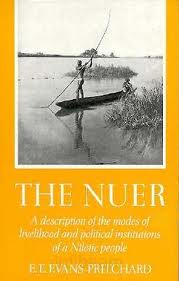
E.E.Evans-Pritchard - The Nuer: A Description of the Modes of Livelihood and Political Institutions of a Nilotic People

The Nuer of the Southern Sudan live in the country that borders the Nile river and other tributary rivers. Their life revolves around their cattle, which form both a major source of their food and a mainstay of their social interactions. They are also fishermen and farmers planting crops of millet on small islands that rise above the wider marsh.

Evans-Pritchard's book was first published in 1940 and is considered a classic of social anthropology. It is the first in a series of extensive studies of the Nuer made by the author. The very first chapter deals with his first visits to the area and the difficulties he has in positioning himself for these studies.

From Evans-Pritchard's descriptions, the Nuer in the 1930s seemed to practice a life that must have been very similar to that of the first agriculturalists. In fact their modes of organising society seem to be almost a bridge between what might be called a hunter-gatherer society and full, permanent agriculture.

This is particularly interesting because of the lack of class in their different communities. Class society could only come about when agricultural arrived as it was only then that there could be a surplus of food to support non-productive members of the population. But this was not immediate; there would have been plenty of transitory societies where agricultural was increasingly dominant but were the old, egalitarian, aspects had not been lost.

This is described in great detail in this study. As the blurb on the back puts it, the Nuer's "economic life is related to the absence of chieftainship and to their democratic sentiment."

This is not to say that the Nuer lived a life in perfect Utopia. Food shortages were common, war, feuds, adultery and occasional murder are part of their society. But this was based on very different attitudes to the world around them, and each other.

In part this is reflected in their attitudes to leadership. There are leaders, but they are not permanent ones whose every word must be obeyed. Evans-Pritchard describes the tut a "chief man of his family and joint family" who "takes the most prominent part in settling the affairs of these groups, but he cannot ... be said to have political authority... A joint family decide on the advice of their tut to change camp... but other joint families decide not to move till another day. Leadership in a local community consists of an influential man deciding to do something and the people of other hamlets following suit at their convenience."

Much of this book is spent in great, perhaps labourious, detail exploring the particular lines of kinship, the particular way that feuds and social relations are followed through. Most of this is only going to be of interest to the student of anthropology, though for the lay reader, nuggets continually shine through. I was struck by the author's explanation of the way that the Nuer have an entirely different conception of time. For them there are more spacings of time in the morning, when they are busiest looking after cattle than in the afternoon. Because of the lack of written records their history never grows beyond a few memorable generations. Evans-Pritchard points out that for the Nuer, the "distance between the beginning of the world and the present day remains unalterable" and was shown the tree under which humans came into being.

Private property played a different role for the Nuer. To them, cattle were everything, they enabled someone to get married, to atone for crimes to help a family member setup home. But the accumulation of cattle was meaningless. Once a Nuer male had enough cattle he would marry again or pass them on. Nuer would, it is true, had more than they needed of certain things, such as good fishing spears. But these would be taken from them by people who needed them and no crime was ascribed. Strict protocols governed the Nuer's life. "I have never heard of a Nuer stealing a cow from a fellow tribesman merely because he wanted one" points out Evans-Pritchard. Though the Nuer were perfectly happy to steal from a neighboring tribe.

One thing that struck me about the descriptions of Nuer life was the lack of discussion about the role of women. All the examples quoted above were based on the author's conversations with men, and it is clear from examples in the book to do with marriage, that women had a subordinate role in Nuer society. It is possible that this topic is covered in more detail in the later volumes of Evans-Pritchard's work. Clear divisions of labour existed in Nuer life. But often these were not based on sex, but on age groups. Age groups played a much more important role in Nuer society, though the examples of Age-Sets given in the final chapter here, are all about men. It would be illuminating to read further on this question.

I could write much more, but I would rather encourage people to read further. In summary, what Evans-Pritchard's detailed studies show, is that people who have different modes of production have different social organisation which consequently shapes different ideas in people's heads. Trying to get the heads around these ideas is very difficult for those who view from outside. This is why it is so wrong to described pre-capitalist, or even pre-class modes of production as "primitive". They are anything but. It is for this reason that the author spends so much time looking at the details of inter-tribal relations and the like. But for most of us, we can simply delight in reading about a different way of organising society, not because we want to return to such a way of living, but because it shows that human-nature is not fixed and may well change again.

Related Reviews

Evans-Pritchard - Kinship and Family amongst the Nuer
Burke-Leacock - Myths of Male Dominance
Scott - Against the Grain: A Deep History of the Earliest States
Flannery & Marcus - The Creation of Inequality
Engels - Origin of the Family, Private Property and the State
Lee - The !Kung San: Men, Women & Work in a Foraging Society

Wednesday, April 11, 2012

Wilson Tucker - The Long Loud Silence

Waking in a dirty, run down hotel, Corporal Gary finds that his drunken binge has left him in a really bad fix. While he slept off the alcohol the United States has been attacked. Nuclear weapons and germ warfare have left the Eastern States of the USA plague ridden and deadly. Desperate to return to his beloved army, Gary finds that the bridges across the Mississippi have been destroyed. The river now forms an internal border, the existence of the plague on the eastern side has left a few survivors, but these are carriers. Should they cross the river they'll spread the disease and decimate the rest of the Americas.

Given this short science fiction novel was written in the early 1950s, it has dated very well indeed. Wilson Tucker has written a short, tight and very readable novel that examines what happens when people are suddenly cut off from their own support networks. The United States government forgets the survivors in the east. When they try and cross into the safe areas they're mercilessly gunned down. But the radio tells stories of another enemy spy prevented from entering.

To say much more would ruin the plot. If you want to get the spoilers, the Wikipedia entry has a fairly comprehensive breakdown of what happens. Tucker portrays a dog-eat-dog world. But one with surprising amounts of human solidarity. Given its early publication date (1952), I was surprised to see a polygamous relationship at one point. Tucker may well have been ahead of the curve when compared to some other SF writers of his era.

One final point. The original story had a darker, bleaker ending according to Wikipedia. Interestingly, given that this barely ends on a positive note, I think I'd have preferred his original one. Wilson Tucker was a new author for me, but one I shall return to on the strength of this novel.

Sunday, April 08, 2012

Francis Pryor - Seahenge: A Quest for Life and Death in Bronze Age Britain


Readers may remember the excitement near the end of 1999 when a wooden circle was discovered on a Norfolk beach. Surrounding a central, uprooted tree stump, a circle of timber looked like a wooden Stonehenge. Quickly the media dubbed it Seahenge and the name has stuck. This irritates some students of archaeology, as the circle is not a henge in the sense that Stonehenge is. Rather the timber circle was actually made of planks, touching to form a continuous wall. It's only after thousands of years of action from water that we see the timber reduced to stumps, and the appearance of a henge.

Francis Pryor's book is much more than an exploration of what Seahenge was, and what it was for. It is a deep, semi-autobiographical trawl through the way that studies of the Bronze Age have changed during the last hundred years. Pryor is now one of the foremost archaeologists of the Bronze Age, and he has helped over see a changing view of the way that the people of that era lived, worshipped, farmed and died.

This book begins with Seahenge, but rapidly looks at a number of sites that Pryor has concentrated on. In particular, the Flag Fen site near Peterborough, which Pryor has been instrumental in excavating, exploring and bringing to the attention of the public. As he discusses his involvement with these sites, he teaches the reader how he, looks at the Bronze Age landscape. For Pryor, it is not enough to look at a site or a find in isolation, you have to understand it in the context of the wider world of the people who lived there, or buried the item in the ground. This means looking at the importance of boundaries, roads, paths and the edges of water. Pryor shows us how Bronze Age people might have seen the world around them, based on the layout of their farms and the positions of their buildings. His archaeological research is practical, and his statements, while they occasionally border on whimsy, frequently are based on experience. Pryor knows that you can't have a central chimney on a Bronze Age round house, because he's tried it and had to flee the recreation as it filled with dense smoke. Pryor begins with Seahenge, but he finishes there too. You cannot explain Seahenge without understanding the wider Bronze Age experience, and this is one of the reasons that the book is so strong - the author is giving us the intellectual basis to understand Seahenge. You cannot explain a monument (if that is the right word) like this, without this. It would be like trying to sum up the Magna Carta, or Karl Marx's thought in a single sentence.

This is a practical book, in the sense that Pryor is a hands on writer. He talks as he works, we learn the detail of how to excavate a trench. One of the things I particularly like is the way that Pryor never forgets everyone who is involved in a dig. From the driver of the JCB to the people who work the metal detectors, Pryor sees archaeology as a collective effort, a democratic one too, if his descriptions of the working meetings are anything to go by. This is reflected in Pryor's own view of history:

"At the end of the second season in 1972 I gave a paper at a conference in Newcastle, in which I described the emerging picture of well-regulated life in the Bronze Age. No sooner had I stepped down from the stage than half a dozen academics declared that such order and organisation could only be due to the presence of a powerful political elite, who controlled those otherwise unruly prehistoric Fen folk. I don't know why, but this assumption irritated me. Why couldn't they control the way they behaved themselves? Why do some always have to look for a ruling class, just because ordinary people seem to be running their lives efficiently and well?"

There are some interesting bits here. Pryor discusses the neolithic revolution, the moment in human history, when agriculture transformed our ways of life and pushed us in the direction of class society and the accumulation of ever greater wealth. He points out that this was less of a revolution than a gradual process, agriculture having its roots in early experiences, even of hunter-gathering communities. While the transformation was revolutionary, it was not a process that happened overnight, nor was it simultaneous everywhere. This view feels more natural, though I think Pryor underplays the importance of the term revolution in this context. The development of agriculture and the transition to a life dominated by sedentary life, rather than movement was a culmination of what had happened before, but it was also a break from it. Humans constantly develop their forces of production, sometimes they transform their situation into a new mode of production. Hunter-gathering had elements of agriculture to it, but it is a fundamentally different system to one based on agriculture.

But these are really the minor quibbles of a Marxist obsessed with early farming. Pryor's book is one of the best introductions I've ever read into Bronze Age history and archaeology. If it doesn't make you want to read more, or visit the stones of Carnac in Brittany, or Flag Fen itself, then I really cannot imagine what will. Most of all though, Pryor is a writer who likes people. Those that lived, worshipped and were sometimes buried at the sites he describes are real, rounded individuals who lived in the midst of a landscape they tried to shape and understand. For this reason alone, Pryor is an archaeologist who, it feels to me is on the right side.


Related Reviews

Pryor - Britain BC 
Pryor - Britain AD
Pryor - Britain in the Middle Ages
Pryor - The Making of the British Landscape

Monday, March 26, 2012

Peter Robb - A Death in Brazil

The opening chapter of Peter Robb's history, cum-travelogue about Brazil, begins with the attempted murder of the author. This is somewhat unusal for a book on history, though rather cleverly, despite starting with one of Brazil's perceived problems, the author actually manages to show us something rather different.

Nevertheless, violence is quite a big part of this book. That is because Brazil's history is fairly violent. Interspersed with his musings on Brazilian food, literature and bars, Robb takes us through the story of the slaves who cut the sugar cane and earned their masters fortunes. He talks about the decimation of the indigenious peoples, who were first assaulted by European disease, then sold into slavery and attacked when they escaped.

Some of this history is fairly unknown outside of Brazil. The story of Canudos is fascinating. This was a town, founded by a wandering, radical preacher who attracted thousands of people to him, not simply because of his sermons, but because the town was a beacon of openness and religious tolerance. The Brazilian military government saw it as a threat. Talking up the stories of lewd sexuality, and worrying about an alternative centre of power to their own capital, they sent four expeditions to destroy the town. There must have been something about living in Canudos that the people found better than the lives they could expect from the Brazilian landowners, because they fought back and defeated three military attacks. The fourth, used artillary and machine guns to massacre the inhabitants, men, women and children.

Robb's book is at its best when looking at more recent history. Though we might be accustomed to tales of violent attacks on street children or tourists in Rio, the real violence was the state sponsored war on the poor that dominated the 1980s and 1990s. Here, Robb draws out the complex chains of government and state corruption, the twisted networks of bribery that dominated government. The few individuals who grew fat stealing public money for themselves. While the majority of Brazilians coped with falling pay packets and enormous inflation.

Here Robb begins the story of the resistance. The mass strikes by car workers that brought cities to a halt and military governments to their knees. Its in this environment we first read about the future Workers' Party President, Lula. Lula's story of his rise from a poverty stricken, indigenious background to the leadership of Brazil is a near fairy tale. Robb keeps it very much in the context of a system prepared to destroy the poor in the interests of the rich, and politicans who collapse under the weight of their own corruption.

Lula's victory was an immense blow to the ruling class of Brazil, though Robb points out that this only happened in the context of the Workers Party blunting some of the edges of their most radical politics. Its for this reason that Lula's presidency no longer has the hope associated with it, though there have been improvements for some of the poorest.

Much has happened since this book was published. There are more stories to be told. A Death in Brazil is a good introduction to contemporary Brazilian politics, and Peter Robb tells a good story. When some of the corrupt politicians are brought to justice, or meet their ends, it felt much like the climax to a detective novel. So while this isn't the pure piece of history you might want, it is a damn good read and will probably fill some time on a beach in Rio.

Related Reviews


Mann - 1493: How Europe's Discovery of the Americas Revolutionized Trade, Ecology and Life on Earth

Saturday, March 24, 2012

Charles C. Mann - 1493: How Europe's Discovery of the Americas Revolutionized Trade, Ecology and Life on Earth

The arrival of Columbus in the Caribbean in 1492 was a fairly minor event for a very small number of people.  The famous sea-captain's small band of men, encountered a fairly remote group of indigenous people. Elsewhere in the Americas, a vast plethora of different cultures and societies also flourished. Each organising in many, varied ways.

The impact of those that followed Columbus on the Americas was enormous. Vast numbers of the indigenous people died, mostly from the new diseases brought by sailors, explorers and colonists. Many villages were depopulated long before they saw a white man. Those that survived were often at risk from guns and slavery.

Charles C. Mann's book 1493 continues a story he began in an earlier work, 1491. There, he examined the pre-Columbian civilisations, discovering their complexity and extent, Here, Mann explores the impact of the arrival of Europeans, not just upon the people and ecology of the Americas, but on the world itself.

Coincidentally, some of what Mann explores here is also discussed in a book I reviewed recently, David Graeber's book Debt, which discusses in detail the impact of the trade in precious metals that began to leave the Americas in vast quantities soon after 1492. This is a great theme of Mann's book, and I think Mann captures far better the enormous wealth that was channelled out of the countries, but also the horror of the slavery and destruction that formed the basis for that wealth. Mann, like Graeber, discusses the way that the precious metals became part of the wider trade networks between Europe and China, how it facilitiated the great trading networks that already existed, turning them into enormous financial concerns.

However Mann doesn't limit himself to the economic consequences. He shows how our world has been transformed in the "post Colombian exchange". Large numbers of plants and crops arrived from the New World. Tobacco, maize, tomatoes, chilies and many others. These transformed both the Old World, but they also altered lives elsewhere. One of the most fascinating chapters discusses the social impact of the arrival of tobacco in China.

"As a child in the 1630s, the writer Wang Pu had never heard of tobacco. When he grew to adulthood, he later recalled, 'customs suddenly changed and all the people, even boys not four feet tall, were smoking.'"

Mann tells us how "late-waking aristocratic women, slept with their heads elevated on special blocks so that attendants could do their hair and makeup while they were unconscious - it shortened the time between waking and the first tobacco of the day."

Such attention to detail marks out Mann's book as a brilliantly readable history. His understanding of the wider social and economic relationships is fascinating, and his ability to tie in a wider ecological understanding adds a new dimension to a story that has often been discussed. In his explanation of the way that the earthworm was accidentaly re-introduced to parts of North America from where it had been driven extinct during the last ice-age, Mann links the slave trade, to the agriculture of the Americas and the practises of the ships crews that took part in the trade. His easy to follow explanation of the importance of earthworms to agriculture reflects a wider ability to explain difficult and complex ecological ideas.

Sadly much of the book is dominated by the horrific reality of the changes that arrived with Europeans in the Americas. The slave trade is one aspect of this, as is the slavery imposed on the indigenous people of South America. As capitalism develops and the New World becomes and increasingly important part of the world economy, Mann tells us of the horrors of the rubber plantations, conditions in Haitian slave plantations and the consequences of the introduction of Christianity to the continent. There is of course resistance, slave revolts and indigenous populations creating their own communities far from European towns. But much of the story centres of the cementing of a new way of organising and exploiting the natural world. It is this great transformation that is the real heart of Mann's story, one that has been central to shaping our modern world. Mann's book is a great introduction to this, that should be widely read.

Related Reviews

Cronon - Changes in the Land: Indians, Colonists, and the Ecology of New England
Graeber - Debt:  The First 5000 Years

Thursday, March 22, 2012

Stephen King - Wizard and Glass

When I started reading Stephen King's Dark Tower novels, I made a vow to only purchase them when I found them in second hand shops. Seems that number two was hard to find, but three, four and the rest seem readily available. Hence the gaps between reviews of this series will shorten.

So what of the fourth book in the series? I worried at the start that this was some sort of attempt to recreate an epic on the scale of the The Lord of the Rings. Stephen King points out in his new introduction that the Dark Tower series is very different to Tolkien's work and longer. By volume four, King is getting into his stride. The characters are now well rounded and familiar. If there are few answers to the large questions about the nature of the quest, that's because the joy is in the journey itself. However in Wizard and Glass, a whopper of an 850 page novel, most of the space is given the Roland's backstory.

Roland, the last gunslinger, originates in a world that was once a version of ours, technologically rich and oil dependent. It began to come apart at the seams and turned into a odd mix of the feudal and wild west. Surprisingly, this isn't too difficult to believe. The story is really a coming of age tale, and King shows his abilities as a storyteller by avoiding too much in the way of happy endings, giving the reader plenty of action (there is a brilliantly written piece of gunfighting) and creating some truly scary bad guys and gals.

I've said on a number of occasions that I think that Stephen King is vastly under-rated as a novelist. He might be damned as a shlock-horror writter by the critics, but I do urge you, dear reader, to take up his books. His approach - weaving a number of themes and tales together works brilliantly, and if some aspects of the tale seem tacked on at the end, that's likely because their being stored up for later use. One complaint might be the brief reapperance of the Tick Tock man. That could have played out longer and better.

If you're new to the Dark Tower series, don't begin here. If you've read the others, than I can only imagine you're waiting to find this second.

Related Reviews

King - The Gunslinger
King - The Drawing of the Three
King - The Waste Lands

Monday, March 19, 2012

Richard Vinen - The Unfree French: Life under the Occupation

I was prompted to read The Unfree French after I had read another work on the same topic, Marianne in Chains by Robert Gildea. As a result, this review is in part a reflection on the simularities and differences between the two books. I urge people to read that review in addition to this on.

I wrote that I found Robert Gildea's book unsatisfying. In part this was the omissions that I felt he had made, but it was also a question of style. I did not feel that he got to the heart of the question. What was life like for French people during the German Occupation?

Richard Vinen's book is much clearer in answering this. He concludes, rather simply, that "life for most French people between 1940 and 1944 was miserable." This is a simplification but it is illuminating. He points out that in recent years much discussion has been had about how hard life was for particular sections of French society - those Prisoners of War, or the Jews sent to concentration camps, and this implies by omission, that life was better for other groups. In reality, Vinen argues that life was hard for almost everyone.

One of the great strengths of this book, is that Vinen understands that while life was hard, not everyone suffered equally. Class plays a difference, both in terms of the experience during the war and the aftermath. So for instance, he spends time discussing the Black Market and how, for those with money, or access to other goods for trade, food could be obtained. For the majority of the population, hunger was common. Vinen continues though, by pointing out there were other differences. Some parts of the country had more food than others and rural populations often, for obvious reasons, had more food than the cities and towns. This inevitably led to conflict and lasting anger - after the liberation, those who had been seen to benefit from the Black Market were often singled out and punished.

Vinen points out that this punishment was meted out in different ways to different people. Those women who had their heads shaved for collaboration (usually meaning they had had relations with German soldiers) were more likely to be punished in this way if they were poor or working class. Better off women could either escape, or use influence to get away with this. Again there is another difference, and it is a great strength of Vinen's book that he spots this. Women were often punished for relations with German soldiers. But not one French man, who had sexual relations with a German women while they were in German was punished by their compatiorats after the war.

Some 2.5 million Frenchmen were in German during the war, either as prisoners or workers. This menas that 1 in 5 Frenchmen spent time in Germany during the war. The experiences of these men was a major part of the French war time experience and Vinen, like Gildea, spends a lot of time documenting this. But the experience was not just for those abroad. Back home, what was happening to the French POW was a major issue for ordinary people, as well as the Vichy regime. The failure of Petain to return more POWs before the end of the war was one of the major factors in people increasingly turning against him.

Unlike Gildea, Vinen seems to see the Occupation as a process of change. So he talks frequently about the way that attitudes were transformed through the war years. Initially he points out, the lives of French POWs was a major issue, but as the war progressed and suffering became more universal, the tended to be seen more as victims than as martyrs. Indeed, Vinen points out how the POWs were increasingly seen as demasculated by the experience. Their imprisonment a metaphor, perhaps, for what was happening to France.

If there are weaknesses with The Unfree French it is the lack of struggle. This is not to say that he ignores the resistance. He discusses this far more, though differently to Gildea. Gildea is at pains to understand the development of the more traditional view of the Resistance, whereas Vinen tries to understand what resistance meant. For Vinen, the French resistance was something that grew significantly out of the experience of both the Occupation and Vichy. For Gildea it was something that happened, but did not have the mass character that many implied. Resistance for Gildea was out of self motivation, for Vinen it is much more a response to the experience of war.

Unfortunately I am not sure that either author hits the nail on the head. There clearly was large scale resistance - Paris fell to the Allies in the midst of a city wide general strike and barricades on the streets. While those resisting were disorganised, ill-equiped and inexperienced, their numbers did grow throughout the war. Oddly Vinen fails to mention strikes or trade unions. In fact the only reference to strikes I read, was a comment about East European workers in Germany striking against conditions. This is, I think, because Vinen sees resistance almost purely in terms of military action, whereas Gildea, for all his faults understood that it was much more of a day to day process. Standing up to the Germans did not always mean shooting them.

The great strength of The Unfree French is that the author captures much better the essence of life during the war years. In this sense, his style is much closer to that of Angus Calder's The People's War a book about life for British people during the Second World War. The anecdotes are illuminating, but don't drown a wider analysis. Given the choice between the two, this is a better introduction to the period than Gildea's book. Unfortunately while I enjoyed reading it, I still felt that it was missing something.

But because Vinen seems to capture the changes that took place during the war and doesn't limit himself to a narrow geographical area, it is a much better book and it is worth a look if you are interested in the history of France and World War II.

Related Reviews

Gildea - Marianne in Chains
Calder - The People's War

Tuesday, March 13, 2012

George MacDonald Fraser - Flashman and the Tiger

I suspect, that had the blogosphere existed with George MacDonald Fraser's penultimate Flashman novel appeared, it would have erupted into loud moans. For decades Flashman's fans had been waiting for the novel that explained his adventures in the American Civil War. Instead Fraser produced a novelette and two short stories. I suspect that there is an element of vanity publishing here. Fraser was a successful novelist who had enough time and space (and presumably cash) to write about exactly what he wanted, and shucks to what the fans demanded.

Of course, there is much here to satisfy the Flashman fan. In my opinion, these stories round out the character of Flashman, particularly because they show how, in his later years, he was much more of the jovial old grandfather type. Keen to enjoy his well earned rest and not too prepared to show of his laurels.

The longest part of this book is the novelette The Road to Charing Cross a classic story of diplomatic underhandedness and attempted murder. It has some similarities to one of the earliest novels, Royal Flash and shares some characters with that novel. It has a couple of delightful twists too, and Flashman is left a little high and dry. Interestingly, it clearly was intended to serve as a bridge to one of the other eagerly awaited Flashman tales - the story of his involvement in the Zulu wars. Several references elsewhere have indicated that Flashman was at Rorkes drift, and while details are scarce, the final story here begins in that chaotic battle. It finishes with one of Flashman's few examples of bravery - albeit fuelled by a decent whiskey. A few literary stabs at another Victorian novelist finish things off nicely.

Finally, the middle story The Subtleties of Baccarat is by far the best. Dealing less with adventure and war, and more a drawing room scandal, the tale centres on the Royal Baccarat Scandal. This was a minor piece of ruling class snobbery, which had the characters involved been less interested in their personal images and the delight of scandal and expressed more of a collective attitude to solving problems, would have had a better outcome for all concerned.

Fraser puts his own spin on the story, but he illustrates brilliantly the life of the ruling classes in late Victorian times. Their scandals, gossip, adultery and lack of individual solidarity. The future Edward VII was dragged in front of the courts as a witness and the whole lot were made to look foolish in front of the mass of the population. The scandal was on a par with anything the Daily Mail might put on its front page today and no doubt helped to undermine respect for the ruling class at the time. Fraser illuminates history neatly with this story in a way that he would have done for the US Civil War had he lived long enough. Flashman fans should not dismiss these well written and fascinating episodes in the life of our favourite rake.

Sunday, March 11, 2012

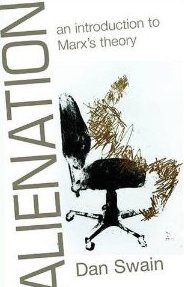
Dan Swain - Alienation: An Introduction to Marx's Theory

Karl Marx's ideas of alienation are often portrayed as being overly complex. Yet they are a rich and fascinating examination of the way that human lives are distorted by the capitalist society that we live in. Dan Swain's new book is a short, but never superficial examination of this part of Marx's work, it is a brilliant introduction to the subject and deserves a wide readership, particularly amongst people who are getting to grips with Marxist thought.

Swain locates his explanation of Marx's theories firstly in those that had come before. He describes how, out of the enlightenment, thinkers like Rousseau and later others like Hegel and Feuerbach were trying to get to grips with the place of humans within the natural world. Their criticisms of the established order of feudalism looked toward a new, more rational explanation of the world.

Marx built on their insights, but he did so critically. He located his understanding of alienation in a materialist explanation of the way that humans interact with the natural world. But he also argued that the alienation that people experience depends on their position in human society. Swain quotes Marx:

"The propertied class and the class of the proletariat present the same human self-estrangement. But the former class feels at ease and strengthened in this self-estrangement, it recognises estrangement as its own power and has in it the semblance of a human".

By locating the experience of alienation in a class society, Marx gets to the bottom of the question. Since, for Marx, what makes us human is our ability to labour on nature, to transform the natural world in our interest, alienation becomes the way that our labour is distorted and taken from us. The way that we lose control over it, the way that the products of our labour are prizes that we cannot have.

I particularly liked how Swain illustrates these theoretical ideas with practical and concrete examples. Drawing on examples from Apple factories and car plants, to working lives in call centres, he shows how people become merely extensions of the machines they work. This has practical consequences. Swain shows how there is evidence that lack of control over the working environmental is one of the biggest determining factors in physical and mental health. He quotes one report that argues "giving employees more variety in tasks and a stronger say in decisions about work may decrease the risk of coronary heart disease."

In one of the strongest chapters in the book, Swain shows how, with the growing environmental crisis, the alienation inherent in capitalism is "fast becoming one of the most important forms of alienation". The way in which the separation between humans and nature is increased under capitalism, as the natural world becomes something to be used for the production process, is directly linked to environmental crises. Swain illustrates this by pointing out that one of the proposed solutions to climate change, emissions trading schemes, is one of the clearest examples of commodity fetishism. Under capitalism, even molecules of gases are considered commodities to be sold.

As I said, this is a brilliant introduction to Marx's work on alienation. It deserves to be read widely and, it doesn't locate the question in an academic debate. Perhaps because of this, Swain is able to conclude on an optimistic note. He demonstrates how many of the problems he discusses break down during revolutionary changes. He quotes an Egyptian revolutionary speaking of the events of 2011, "Freedom for the worker did not only mean freedom to vote or freedom of expression, it also meant freedom from hunger and the constant threat of unemployment... Dignity was a meaningless notion unless it meant an end to poverty and need."

Marx's thoughts illuminate better the world around us. Swain explains them with clarity and straightforward language. He also updates them for the 21st century world of work, but shows how very little has changed from the early days of capitalism. I would recommend this introduction highly.

Friday, March 09, 2012

Neil Gaiman - Anansi Boys

Having now read three of Neil Gaiman's excellent fantasy novels, I think I've discovered a pattern. It basically  goes like this. Lead character of novel finds himself experiencing fairly inexplicable events. Turns out, reality is actually not as lead charactr thought. Magic, Gods or something else as unbelievable also share our world. Gradually said character accepts this new reality and even begins to be able to take part in it. Eventually world is saved by this character discovering hidden talents, God like powers or magic.

So it was with American Gods and Neverwhere. So it is also with Anansi Boys a novel that shares some of the world view of American Gods and at least one character. Anansi Boys though, is a much shorter, tighter and more straightforward novel than the other two. At the beginning of this story the God Anansi dies. Anansi was a trickster, enjoying jokes and tricks, poetry, singing and the finer things in life - wine, women and song. Charlie Nancy doesn't. The only things Charlie wants are a quiet life far away from his father. When his father dies, Charlie discovers a previously unknown brother, Spider, who seems to have inherited the worst aspects of their dad and proceeds to destroy Charlies life. Sleeping with his fiance, getting Charlie arrested for white-collar crime and the like.

The story, follows a traditional pattern. Charlie realises that his brother seems to have unusual powers and his attempts to have Spider banished, by making a pact with another God, only unleashes further problems. Making pacts with the Gods tend to have double sided consequences.

All in all, its a fun read. Existing Neil Gaiman fans will enjoy it, and the sub-plot, which is a neat little whodunit that ties all the strands of the magical world plot together with the bemused non-magical world orbiting Spider and Charlie, is quite fun in and of itself. The characters are pleasantly flawed. No goody two shoes here. Read it if you enjoyed American Gods, but do read that first.

Related Reviews

Gaiman - American Gods
Gaiman - Neverwhere

Wednesday, March 07, 2012

David Graeber - Debt: The First 5,000 Years

David Graeber has produced an important and stimulating book. It is a radical book that clearly has its roots in the anti-capitalist movements that the author has been part of. But it is more than simply a book that is designed to challenge capitalism. Graeber is attempt to argue that the conventional way of looking at the world is wrong, and that the way we have lived our lives in the past has been very different to how we do today.

Debt, Graeber argues, means a very specific thing to us today. It is an obligation that we accept we have to someone else, be that someone a bank or a loan shark. The obligation we feel is the sense that the debt (usually money, though not always) must always be paid back. Graeber contrasts this, with how obligations have been viewed in the past. For most of human history we have organised our lives through hunting and gathering of foods. In these societies, the obligations we had were never the result of someone making a loan with their own material interests. There were no hunter-gatherer loan sharks. Graeber illustrates this well with an example from a well documents group of hunter-gatherers, the Innuit.

One person who lived with and studied the Innuit described returning empty handed from a hunt. Fearing hunger, he found a successful hunter giving him several hundred pounds of meat. The man objected to his thanks.

"Up in our country we are human!" said the hunter. "And since we are human we help each other. We don't like to hear anybody say thanks for that. What I get today you may get tomorrow. Up here we say that by gifts one makes slaves and by whips one makes dogs."
Such attitudes do not simply come from shortages. Other anthropologists such as Eleanor Burke Leacock have documented how hunter-gatherer tribes share food out, even when there isn't enough for everyone. In other words, the obligations people feel are rooted in their collective life, not out of self-interest.

The way these attitudes change is a great theme of Graeber's book and would be difficult to cover here. He is at pains to argue that debt as a general notion has existed throughout history, though most of the time it has been more to do with human social relations than with material gains. These social debts might be the obligations you take on when marrying someone - the promise to feed and look after them. They might also be the money you give as a dowry - not a payment, but a donation towards the cost of living. Over time, Graeber argues and in many ways, such social obligations take root as material debts.

Graeber upsets a great many apple-carts. One of which is in his discussion of Adam Smith and the conventional economics that have flowed from his ideas. In trying to answer the question "what is money?", Smith and others always answer in similar ways. "Imagine a world without money. We'd have to survive with barter. I have a bag of nails, you have a loaf of bread. I must exchange bread for nails. This barter economy is cumbersome, so money develops". I paraphrase, but you get the idea.

Graeber argues that there is no evidence for "barter economies". Those who say for instance, that when the Roman Empire declined in an area, society "returned to a barter economy" are placing their vision of what they think happened over reality. The truth is that Roman money disappeared, but in its place remained alternative currencies, sometimes virtual ones. "Barter economies" says Graeber did not exist, exchange took place through elaborate systems of credit. With the development of urban economies rather than early agricultural ones, people might need bread, and only have nails, but the loaves would have a particular value assigned to them, as did nails. Graeber cites plenty of examples of societies which have distributed goods to people who need them, waiting for future payment when fishermen returned with their catch or the nails were manufactured.

So explains that after the Romans left, villages might no longer have Roman money. But they did have Roman prices. They might value a sheep as so many pieces of gold and bread as so many pieces of silver, and this allowed exchange to take place. Money wasn't real, debt existed by in a concrete sense of credit. Not an abstract one. Presumably the person who failed to come good on his or her debt was eventually refused assistance.

All this is very interesting, and it certainly seems plausible. The problem with the book for me was that I don't think that Graeber really gets a handle on what drives human economies. It isn't debt, nor is it finance. Production exists because people need to provide for their material needs and the way that production is organised determines all the other aspects of their society. The way that the forces of production in society develop, challenging and changing the relations in society ultimately helps bring about change. This is a very short explanation of historical materialism, but I think Graeber would have benefited from expressing his history in terms similar to this. Otherwise you are left feeling distinctly like human history being a series of events that are connected only through a gradual development of a money economy.

I also feel that Graeber misses out a class analysis. That's not to say he doesn't acknowledge the existence of classes. He is very clear that these do exist in society and critical of the attitudes of the rich towards the majority of society. But I don't think he explains what motivates people in different classes. Why do the rich behave like they do? Why are they so irrational in their behaviour?

Capitalism is a fundamentally different human society to earlier ones. Its economic dynamic is the need to accumulate wealth, for the sake of accumulation. This is not the same as earlier class societies. The lord of the manor did not go out and exploit the peasants for the sake of it. He did so until he had satisfied his needs. Capitalism exploits workers because it needs more wealth, to reinvest and restart the treadmill of production. This difference also shapes how we perceive ourselves and our relations to others. In this context debt between people takes on a different meaning under capitalism then it did in previous societies. We are atomised and individualised, set competing against each other.

That said, Graeber has some good insights into different eras of human history and it may well be my own personal predilections that lead me to think his chapters on hunter-gatherers are the most interesting. This is a book that will be debated and discussed at length and is worth study. While there are holes to pick and arguments to be had, the themes are generally of interest.

Readers wanting a more in depth critique of Graeber's book are directed towards this review here.

Monday, March 05, 2012

Adrian Bell - Men and the Fields

There is always a danger when reading books about the rural past, of falling into the trap that there was a wonderful utopian life that has been forgotten, destroyed or superceded. Adrian Bell's book avoids this trap precisely because it is a celebration of what he saw and loved, rather than an attempt to pretend the world  was something it was not.

Bell was himself a farmer, though he was an accomplished writer. He loved nature, people and the landscape. Men and the Fields is his celebration of those things in various rural parts of lowland Britain, particularly Suffolk and the south coast. Bell's gift is a brilliantly economic style that sums up his surroundings without feeling like the reader is having descriptions piled onto descriptions. Here he ruminates on the view from a train station, but equally important is the station master:

"Out of the cottage came a countryman dressed in gold lace: he was the station master. He gave me my ticket and recommended the view from the end of the platform. I said I had seen in beautifully from the river. He insisted it was better from the platform: you could see all along the valley both ways. So I went and sat at the end of the platform. There were two sets of arches: the railway and the road, bridging each other and the depth at different levels. It was like a dim picture of ancient viaducts I remembered sitting opposite once in a farmhouse dining room. I would have thought I had made it up from that picture in a dream. But somehow that railway ticket was never collected. I have it still."

For Bell, the countryside cannot be seperated from the people who live and work there. His descriptions of fields rarely ignore labourers. His love of birds and plants frequently are linked to locals who tell stories of them. Here's a delightful description of a farming couple:

"A woman comes round into the wind; a big woman dressed in sacks and gum boots. The sacking bulks her out and the boots make her legs look like a horses. She comes out into the gale and hardly pauses in the force of it but pushes on through giddy straws across the stackyard... Then she stands full blast and shouts orders to a man in the field - she looks stronger than the wind."

The rigid class differences of the agricultural world lie, barely concelled below the surface of Bell's accounts. The deep respect from labourers for their masters, is often combined with a cynical attitude to those betters who think they know it all. There's a telling tale from a labourer who recounts the different attitudes of farmers towards their workers. The one who offers a cold glass of beer on the doorstep on a winters day, the other who stands him by the fire with a warming whiskey.

Bell was writing about the 1930s. British farming was coming out of an enormous depression caused by withdrawels of wartime subsidies. It was about to be transformed again, the Second World War led to an enormous expansion of farming and the massive motorisation of the industry. As he writes, rural Britain is on the cusp of change. Bell notes the changes to the roads, the impact of the motor car on flocks of sheep, but he doesn't reject these, he sees them as part of an evolving, changing countryside. The beautiful language combined with the wonderful colour paintings that accompany the book, by the artist John Nash combine to make this a lovely read and a lovely piece of art in itself.


Related Links


Whitlock - Peasant's Heritage
Archer - A Distant Scene

Kerr Cameron - The Ballad and the Plough

Age of Uncertainty has more of John Nash's paintings from Men and the Fields here.

Wednesday, February 22, 2012

Stephen King - The Waste Lands

Volume three of Stephen King's series, The Dark Tower, develops the story into a much more concrete and traditional form. I found the two earlier novels slightly esoteric. They were readable, but seemed a little indistinct. The Waste Lands brings together some of the earlier loose-ends and seems to be taking the series onwards quite well.

The hero of the books, Roland, the Last Gunslinger is now permanently joined by two companions who we met in the previous book. All the characters exhibit imperfections, though Roland represents less the fallen individual, but the last of a noble race, who has watched, perhaps for centuries, his world decline. This fallen world is the real star of the story. A once powerful technologically advanced society has collapsed. Cities are ruins, population collapse has left a few small groups of people, who have lost the art of repairing their old technologies. In places these have reverted to almost medieval societies. Elsewhere groups of violent thugs scavenge the surrounding country like something from Mad Max III.

Roland's quest for answers takes him and his companions onwards. As they travel we learn more about the world around them, and our heroes themselves. But as I said, the world is the real centrepiece of the story. It appears to have some sort of relationship to our own, a crashed aeroplane is marked by insignia that we would recognise for instance. What keeps the story ticking over, like a lot of King's writing, is the desire for an explanation of what is going on. Where are they? What is the Dark Tower? What are the links with Earth? Knowing King, no definitive answers will be forthcoming even after all the sequels have been read. But the beauty of King's writing is that the reader probably won't mind. The point IS the journey.

The Waste Lands ends mid flow. It is much faster paced than the earlier stories, though I found it more readable and enjoyable. The urge to read the sequel as soon as possible has not left me yet.

Related Reviews

King - The Gunslinger
King - The Drawing of the Three
King - Wizard and Glass

Monday, February 20, 2012

Chris Stringer - The Origin of Our Species

Trying to understand the development of the earliest humans is an extremely difficult task. What evidence there is, is limited to a  few fossilised bones from a handful of sites scattered across the world. Most of the other evidence comes from the DNA extracted from those bones, or a the stone tools that seem to have been produced in vast quantities by these early humans.

Chris Stringer's new book is probably one of the best introductions to the subject that I have read. His account is determindely materialistic. It is rooted in the evidence we have, and an understanding of the wider environmental conditions hundreds of thousands of years ago. It is also approachable, though I did find some of the sections on DNA needed re-reading at times, but they are rewarding if the reader perseveres. Rarely does a writer actually explain how the DNA is obtained and how it is studied.

Stringer has a long pedigree in terms of the academic study of ancient humans. He was one of the first scientists to argue for an Out of Africa hypothesis for modern humans. The idea that our species, Homo Sapiens, spread outwards from Africa, following earlier migrations by earlier species of humans. According to this theory, which it seems, is now fairly common currency the origin of Homo Sapiens was a fairly recent one and our immediate ancestors only left Africa around 100,000 years ago. Surprisingly it took some 65,000 more years before they reached Europe. Spreading initially eastwards, through the modern Middle East and into Asia.

Of course, with limited evidence controversry reigns. Stringer doesn't shy from giving both sides of a debate, though he never fails to give his point of view, backing it up with his own examples and evidence. Take the discussion about why the Neanderthals died out and were replaced by modern humans. Stringer cites the work of colleagues like Clive Finlayson, who argue that the Neanderthals were on a long decline and that their last homes, in Gibralter, were the last places they survived. The existence of their species ended by a changing climate to which they couldnt adapt.

Stringer's argument doesn't dismiss this, but builds on it. He argues that in some places modern humans may have pushed the Neanderthals out, in others the Neanderthals may have died out unable to adapt to a changing world. Modern humans may or may not have been present, but it seems unlikely that Neanderthals and Homo Sapiens were always in competition, particularly given evidence that they may have exchanged ideas and interbred. This seems to me a more realistic answer. Trying to reduce the end of a intelligent species like our human ancestors, simply to climatic changes doesn't feel right. A more complex interaction with a changing world, with different groups struggling to adapt and one being better than the other seems much more logical.

Stringer also touches on other debates and discussions. How did language develop? Where did geographical differences in human bodies come from and when? How did changes in our bodies relate to changes in our behaviour and brains and vice versa? Many of these questions have surprisinly detailed answers given the lack of archaeological data. Chris Stringer has produced an excellent introduction to the subject. It is an excellent starting point for the debates and discussions around early human evolution.

Related Reviews

Finlayson - The Humans Who Went Extinct: Why Neanderthals died out and we survived