Wednesday, May 30, 2012

Steve Burrow - Shadowland: Wales 3000-1500BC

Produced by the National Museum of Wales, this is a lavishly illustrated, short but comprehensive guide to a distinctive period of Welsh history. 3000BC to 1500BC effectively corresponds with the end of the stone age and the late bronze age.

The title of the book, Shadowland, sets the tone for Steve Burrow's explanation of these fifteen centuries. The people, he argues, are like shadows on the Welsh landscape. Almost nothing of their daily lives has been found. Few homes, few farms, few implements. Even the relatively common post-holes that normally mark the locations of ancients homes are few and far between. This is not to say the lands were unpopulated. What these people did leave us were extensive funerary remains. We also know a great deal about specific areas of their lives - extensive copper mining at Great Orme for instance. We can infer a great deal, but we cannot say much specifically about their lives.

Burrows takes us sytematically through what we do know. From the shapes of flint knives and tools, to the standardised burials we find, surprisingly, that there tended to be common styles or fashions across what is now Wales. It is tempting to view this as a common culture, but Burrows argues that it is unlikely that there was a single unified cultural set of beliefs across the area. Rather there was an extensive trading and communication network throughout Wales and England, stretching into the European continent.

This network is best imagined through the enormous distances that the stones for Stonehenge were brought from Wales. But goods, ore, designs and on occasion funeral soil appears to have been moved, often great distances, to places of use or symbolic importance.

This cultural unity is unusal when compared to even a few years later. At the end of the book, Burrow's makes the point that by the time of the Roman arrival, they described Wales as being dominated by just four tribes or kingdoms. Very different to the period under consideration.

The book takes up many recent debates and arguments in archaeology. Burrow's argues that there probably weren't a specific "beaker people" for instance, despite the preponderance of this style of pottery across the region.

Despite the occasional academic feel to the book, this is a readable introduction to the period. It's a tragedy of modern nationalism that we feel the need to examine an areas pre-history through the lens of a country that didn't exist thousands of years ago, whose people and economy couldn't have been seperated out geographically in the way, say the British Isle and Europe can be. Nonetheless, this is a good book to read if you're trying to get to grips with early human history in these isles. I shall look forward to reading the authors, earlier, companion book.

Related Reviews

Burrow - The Tomb Builders
Pryor - Britain BC

Tuesday, May 29, 2012

Joseph Kanon - The Good German

Partly because of its setting, this is an unusual detective story. Set in the midst of the ruins of Berlin in the immediate aftermath of the European theatre of the Second World War, the hero is no detective, but a journalist, sent to the capital to cover the Potsdamn Conference. At the conference, our hero, the oddly named Jake Geismar, finds a body in a lake, and begins a quest to explain what's happened and get his last, great wartime story.

Like many detective novels, there are coincidences aplenty. The author however gets away with alot because his descriptions of the destroyed city and the people who continue to survive there are amazing. Perhaps the author gleaned his knowledge of the streets from Google Maps, but I suspect that he has sat down at a cafe in the Oliverplatz.

More interestingly, Joseph Kanon is an expert at portraying the weird duality of life in postwar Germany. The struggle for food and survival, and for identity. He captures those who haven't quite comprehended what's happened. In a clever bit of dialogue a young German woman is hoping to escape to London with her lover, a British Soldier. She imagines it all destroyed, like the Berlin around her, and cannot believe Jake's assurances that London is not flattened. But they told us it was, she says, refering stubbonly to the wartime propaganda.

Oddly the rather strange and convoluted plot seem to matter little because, to use a cliche, the real hero of the novel is the city itself. Nonetheless, the complicated strands are drawn together well, and tightly, and the ending is unsatisfactory, because it is dealing with the contradictions of Berlin in 1945. The Potsdam Conference that opens the story is the beginning of the end of the wartime Allies. By the end of the story, the world's two superpowers are jokeying for position and often the pawns in their game are some of the Germans who made the war possible. Dealing with the consequences of that, meant ignoring some of the more unpalatable truths about wartime behaviour. The solution to Jake Geismar's puzzle is rooted in that, and it creates an excellent bit of tension.

Nathaniel Philbrick - The Last Stand: Custer, Sitting Bull and the Battle of the Little Bighorn


The Battle of the Little Bighorn is one of those historical events that inspires endless books, articles and obsession. Towards the end of this history of the conflict, Nathaniel Philbrick describes a Custer re-enactor who has spent his life researching the general, dresses as him and hangs around battlefield re-enactments.

This obsession with the destruction of Custer's army that took place in 1876, seems to have begun almost as soon as the last shot was fired. The defeat was an immense shock to the collective American psyche, then in the midst of celebrating its centennial, and hence its own national superiority. Philbrick also argues that the Battle marked a turning point, when American imperialism turned outwards, having conquered its internal lands, it began to gaze at territories abroad.

Even here in the UK, the Little Bighorn held an immense fascination for me. One of the earliest books I read was a Ladybird account of events. The image of the Indian about to kill a cavalryman on the cover is part of my own psyche now. Flashman's fictional account of his time on the battlefield is a surprisingly detailed story of what occurred at Custer's last stand. George McDonald Fraser, like Philbrick was able to draw on a wealth of accounts, transcripts and reports of those involved in the battle. Within a few weeks or months of the battle, reporters and amateur historians were already taking town the stories of participants. Philbrick uses many of these accounts, including the fascinating pictograph drawn by Native American participants, to give an eyewitness feel to the story.

Native American pictogram depicting the battle
What was of course omitted from the Ladybird story, was the chaos at the heart of Custer's command. The mistaken decisions (dividing forces before a superior enemy, leaving Gatling Guns behind, and choosing single-shot over repeating rifles) are well known. But what Philbrick does is to show how each of these decisions on its own wasn't the key problem, what mattered was the way that Custer's command was internally divided and lacking in training to be able to challenge the forces massed by Sitting Bull. I was very surprised to learn how young and inexperienced many of Custer's troops were, many it seems had never even galloped a horse, let alone experienced gunfire.

Those who did survive, under the command of Benteen for instance, did so often because experienced troopers took control at key moments. What Philbrick also shows, is that many experienced officers failed the task. He dwells on Reno's drinking during the battle, but this is the most extreme example of the problem. Other officers, such as Benteen, clearly spent the crucial early parts of the battle stunned and unable to command. Reno though comes out of this book with a dark spot against his name, his cowardice at the start of the battle, almost meant that his own troop was routed like Custer's.

For those who are not obsessives, or experts on Custer's fight, Philbrick's book is a excellent introduction. It is full of the type of detail that shows how easy it would be to become an obsessive. Did Peter Thompson actually see General Custer, miles from his command at the height of the battle, or was he hallucinating due to lack of water? Thompson was now coward, and clearly not a man prone to lying. Surprisingly, Philbrick concludes that Thompson may have seen a General renowned for his ability to gallop off alone to see the lay of the land.

The Native American troops here are not forgotten. Philbrick puts their actions squarely in the context of what he calls Imperialism, the destruction and desecration of their lands and people. He is careful to show that while many, including Sitting Bull, clearly hoped for peace, they were not afraid to fight when it became clear that the Seventh Cavalry had no such interests. General Custer's arrogance towards the Indians, rooted in racial stereotypes of the different tribe led him to believe he was destined towards victory. Its clearly possible that many of Custer's battlefield decisions were rooted in attempts to maximise the scale of his own, personal victory. The Native Americans massacred the Cavalry. They also tortured them, and mutilated their corpses. This may seem shocking, but they were responding to genocide and hoped that a significant defeat of Custer might prevent their extinction. Sadly, it failed to alter the course of events significantly.

Tragically, Custer is remembered as an all American hero. The reality is very different. There were many heroes on that day in 1876, most of them were Indian, not a few of them were ranking troopers. Most of the latter died horribly, because of the self-serving dreams of generals, the cowardice of their officers and above all, a destructive set of military priorities that aimed for the destruction of an entire people. Nathaniel Philbrick's book is a brilliant introduction to this pivotal moment in US history which rescues the real story of the Battle of the Little Bighorn from the myths that have grown around it in the name of US history.

Related Reviews

Philbrick - In the Heart of the Sea

Sunday, May 27, 2012

Peter Fryer - Mrs Grundy: Studies in English Prudery

Peter Fryer's history of prudery begins by pointing out that the Roman Cicero advised his friends not to say, "little pavements" because the Latin word created, would suggest the word penis. Some two thousand years later, Fryer points out, that the Birtish Transport Ministry, avoided using certain three letter letters because they hinted at words that apparently Cicero wouldn't have liked. So Birmingham number plates could use BOC and DOC, but not the appalling COC. Leeds, AUM or CUM, but not BUM.

Such anecdotes make us smile today, though even in these enlightened times self censorship, or prudery pervades many public bodies. We might like to think of ourselves as better than the Romans or the Victorians, but despite the changes we have seen, much remains the same.

Fryer's book is mostly an account, if a structure-less one, of changing attitudes. He begins with language, early chapters trace the changing words, the way that the word belly (first used in 1340) became replaced gradually by stomach (1375). "Respectable Englishwomen" he tells us, were shocked by European doctors who used the word belly in the 1900s. Embarrassment about ones own body seems a particular affliction of the English speaking lands. The idea that one could be shocked by the use of the word belly seems strange, but far less strange than those Americans who could not bear to describe individual legs,  as it drew attention to the shape of their bodes. Fryer includes stories of Doctors unable to treat patients who couldn't tell him which "limb" was hurting. Animals and inanimate objects suffered too, the "leg of a chicken became second wing in Britain, second joint or trotter, or the dark meat in the USA".

Fryer's history continues. On occasion it becomes mere lists of words, the succession of synonyms that came into favour, and then were considered offensive, reading like a line rude schoolboy poetry;
perform the work of nature (1607), ease nature (1701), obey the call(s) of nature (1747), do a job(for oneself)...pay a call, pay a visit, relieve nature, see a man about a dog and wash ones hands.

But there is much more than this to Fryer's history. The chapters on dancing and Sunday's in particular demonstrate the battle that took place between some in society (almost always those at the top) who wanted to restrict the behaviour of the masses. Even in Medieval times, the establishment was forbidding drinking and dancing on Sunday's though, in the case of Richard II this was more to encourage archery practise. By the time of the reformation and later, attacks on such behaviour was an attempt to regulate people into worship on their sole day off.

Its at this time that attempts to police behaviour increasingly come to the fore. Networks of informers and gossipers, spying on those who danced, made love, sang or had a glass of beer on Gods Day, led to more than one person being put in the stocks, imprisoned or ostracised.

The most entertaining chapter is that which deals with attempts to reduce drinking. Drink, the curse of the devil, was supposed to destroy morals and set people onto a road of wickedness. Fryer tells use the stories of debaters and pamphleteers who set up stall against the brewers and publicans. Of huge campaigning organisations that tried to force pubs to close on Sundays and educate the masses about the dangers of drink. Many of these books and stories raise a wry smile:

Another curiosity of teetotal prose, standing out even in a genre where eccentricity of presentation is never unexpected, is 'Tippling and Temperance' (1890) by Charles Bateman. Everyone of its 1289 words begins with the letter t, and 'this terse treatise... trenchantly traverses tattling, time-serving table-talkers; temerarious tolerance to the trivial, trifling, truckling toss-pot
Sadly, this is really all there is too the book. In Fryer's introduction he declares what he won't do:
different classes tend to have different standards of sexual morality; it would be an arduous undertaking to study the changing class attitudes to sex in this country over the last four hundred years...
Which is disappointing, because such a study would have been of great interest, and Fryer, the man who wrote the monumental "Staying Power" a history of Black people in Britain, would surely have been capable of such a work. So despite Fryer's 1960s warning that there is "no reason Mrs Grundy is incapable of returning to a position of influence", his book lacks any attempt to understand the root causes of changing social attitudes. There is nothing here, for instance, which tries to explain why, in the 19th century, male doctors suddenly were expected to assist at childbirth without a woman removing her voluminous dresses. Why were medical men no longer able look at a woman's naked body? What had changed in attitudes to women, and why? Sadly, the lack of such social context, turn this history into little more than an entertaining smirk at the prudes of the past. Without offering any analysis of why things were like Fryer describes. Given Fryer's Marxism and other radical writings, this is a surprising omission.

 Related Reviews

Fryer - Hungarian Tragedy

Thursday, May 24, 2012

John Molyneux - Marxism and the Party

First published in 1978, this book by John Molyneux helped convince a layer of socialists that they needed to be part of a revolutionary party. As I read it, I thought it a shame that I hadn't read it 20 years ago. Not because I didn't join such an organisation, but because the clarity of its arguments would have helped me understand some of the basic ideas of revolutionary politics much earlier.

Molyneux begins by looking at some of the core ideas of Marxism. The way that society is structured into classes, with exploitation at the core of the economic process. He then looks at the way that Marx believed it was possible for the mass of the population, the working class, who create wealth for the bosses, to overthrow the system and build a new one based on need not greed.

However Molyneux points out that Marx also understood there was a gap between the potential for the workers to be a class "in itself" and one "for itself". There were significant barriers to the creation of a revolutionary leadership that could lead from within. Molyneux takes us through a potted history then of attempts to create such revolutonary organisation. Marx himself, together with Engels engaged in a series of political organisations, finally abandoning them when the revolutionary wave of the late 1800s ebbed.

In the revolutionary movements that marked the early 20th century, and in particular the revolutions that followed World War One, there were a number of individuals who contributed to the theories of revolutionary organisation. Chief amongst these, was Lenin and Molyneux devoted substantial space to examining how Lenin's ideas of the party developed and grew. Lenin's early writings, influenced by the political realities of Tsarist Russia meant that he saw the party as being made up of professional revolutionaries. Under the experience ofthe 1905 revolution, Lenin adapted and transformed his views, developing the Bolshevik party into an organisation that was organically linked to the mass of the working class, was led by workers in every area, yet was a democratic, disciplined party.

Molyneux looks at the other visions of party organisation that existed at the time. He examines why the mass socialist parties of the 1800s had become, by the early 20th century, reformist organisations that were no longer capable, or willing to lead revolution. But he also looks at the debates between revolutionaries themselves - in particular Rosa Luxemburgs critique of Lenin. He sees these debats as a fraternal debate between socialists committed to overthrowing capitalisms, and unlike many who call themselves Leninists, he doesn't dismiss out of hand Luxemburgs emphasis on revolutionary spontaneity. Yet he concludes:


"Luxemburg's theory of the party and its relationship to the working class  remains a useful weapon in a labour movement which, throughout the world, has suffered decades of bureaucratic domination by social democracy and Stalinism alike. But ultimately, it is a useful weapon only insofar as it is integrated into the framework of Leninism. As an alternative to Leninism, Luxemburgism must be judged invalid."

Some of the book is dated. As the last quote implies, the work is in part a critique of the "official" Communist Parties that claimed to carry Lenin's banner into the 1960s and 1970s. These Molyneux shows have little to do with genuine revolutionary organisation, pandering to reformism in many parts of the globe. Today the bulk of those parties have vanished into obscurity, and the sharpness of the debate with them is less needed, though readers will find the critiques of interest as new organisations and ideas are thrown up by mass movements today. Others, particularly those used to seeing Gramsci's name in association with debates around ideology in society may find the chapter on Gramsci's contribution to revolutionary organisation interesting. I would also suggest that it is read along side Molyneux's more recent book on Marxism and Anarchism.

Despite the dated sections and even in the introduction to the 1986 edition, the author indicates that he would re-write certain sections, this is a short book which has much to offer those of use looking to the new mass movements around the world, in the hope that they can finally bury capitalism.

Related Reviews

Molyneux - Anarchism: A Marxist Criticism
Molyneux - Will the Revolution be Televised? A Marxist analysis of the Media

Tuesday, May 22, 2012

Raymond Chandler - Playback

In the introduction to my edition of this novel, Chandler's biographer tells us that the author was drunk and depressed for most of the time he wrote Playback. If this was true, it is testament to Raymond Chandler's genius that the writing doesn't suffer as much as might be expected. Nonetheless, the story carries with it all the signs of depression that were associated with Chandler's last years.

In this final complete novel, Philip Marlowe returns. Now his amusing cynicism is deeply ingrained. His frustration and short-temper bringing sometimes violent confrontation with those he encounters. As with other Marlowe novels, the story itself matters only a little, the language and style being far more stimulating. Unusually for Marlowe though, the plot twists on our hero turning on his employer and siding with the victim. Also unusual is the lead character Eleanor King, who appears to be both vulnerable and scheming. Running from her own past, she's pursued by several others, each hoping to get her money or their own vengeance. Only Marlowe, who knows little about the back-story, stands between her and them.

There's a high body count, as well as a beautifully crafted love scheme between Marlowe and the secretary of his employer. The beauty here is not in any detailed erotica, but the passion of a couple both highly alienated and depressed, coming together for mutual support and satisfaction, albeit for only a few hours.

The novel itself finishes with a surprising continuity for this type of book. The tying up of lose ends feels like Chandler himself was finishing off some little details. Its hard not to think he knew the end of his life was approaching and didn't want to leave his most famous creation hanging cynical and alone. The tragedy of Chandler's life is that is exactly how his ended.

Wednesday, May 16, 2012

Ian Kershaw - The End

There will probably never be an end to the publication of books about World War Two. The sheer scale and horror of the conflict, combined with the enormous numbers of people involved, both as combatants and non-combatants will produce an endless variety of viewpoints and histories. Two of the big names have new books about the war out now, or in the near future, and I suspect that I'll join those who read Max Hastings or Antony Beevor eventually. Despite their brilliance as writers and historians, it has to be open to question how much more they'll add to the discussion.

On the other hand, Ian Kershaw's latest book is a very different work. Kershaw is famous for his studies of Hitler, including an exceptional two volume biography, which is reviewed in detail here, by the British Marxist Alex Callinicos. In The End Kershaw turns his hand to the last year of the European war. His approach is to ask a seemingly obvious question, which, it turns out, is remarkably difficult to answer simply. Why did the Germans keep on fighting despite the obvious facts that they were military defeated?

Kershaw makes the point that most countries, faced with military defeat eventually seek terms. Germany didn't. The fact that they kept fighting right up to the moment that Russian troops arrived near Hitler's bunker and the Dictator finally shot himself, brought immense destruction upon the German people and country. Kerhsaw sums it up:

"In the ten months between July 1944 and May 1945 far more German civilians died than in the previous years of the war, mostly through air raids and in the calamitous conditions in the Eastern regions after January 1945. In all, more than 400,000 were killed and 800,000 injured by Allied bombing... The Soviet invasion then occupation of the eastern regions of Germany after January 1945 resulted in the deaths.... of around half a million civilians... Had the attack on Hitler's life in July succeeded and the war been promptly bought to an end, the lives of around 50 per cent of the German soldiers who died would have been saved."

There are many more similar statistics that Kershaw uses, that only underline this point. The attempt on Hitler's life in July 1944, was a turning point and its right that Kershaw uses this as the pivot point of his book. Its not so simple to suggest that had that succeeded, all would have been ok. Kershaw himself points out that at that point in the war there were sufficient numbers of fanatical Nazis alive who could have precipitated civil war in an attempt to keep the wishes of the Dictator alive. But Hitler was a lynch pin. Kershaw describes his rule as charismatic, and puts him, as he did in his earlier works, at the centre of a network of belief and bureaucracy that generated its own momentum.

This momentum meant, that in the midst of collapse the bureaucratic state machine that Hitler headed up, continued to function. During the last seconds of the war, civil servants sat at their desks under a hail of Russian missiles, completing meaningless paperwork. On the Western Front, police men filled out requisition forms for replacement buckets damaged in bombing.

So were the German people simply mesmerised by Hitler? Kershaw argues not. He points out that in places people did rebel against the regime (though usually in an act of last minute desperation, rather than an organised uprising. One exception seems to be Cologne, where a small scale rebellion took place, which was ruthlessly put down). Central to Hitler's ideology, and indeed to much of the inter-war year German Nationalist arguments was the concept of the "stab in the back" that took place at the end of the First World War. The German Revolution of 1919, that effectively ended Germany's part in the First World War and brought the conflict to a close involved millions of people in a genuine mass revolution. Hitler was terrified that this would reoccur and much of his activity in the last months of the war was geared to preventing this.

So, in addition to the ruthless nature of the regime, and in particular in the aftermath of the attempted coup in July 1944, Hitler removed even more of those who, from top to bottom of the system, might be seen as potential internal enemies. By doing this, he selected, particularly in the armed forces, for even more fanatical and brutal officers, which helped to make the war even more prolonged. In addition, the reality of war, particularly on the Eastern Front meant people fought, because they had nothing to lose. Soviet territories had been subject to a horrific onslaught by the German army, and their response, was brutal. German propaganda portrayed the "Bolsheviks" as brutal monsters, though the reality for many wasn't far off. This helped to provoke individual Germans to even more bitter defence, prolonging the war and making fear of occupation even greater.

Those who ran away were killed or returned to the front. The top of the German hierarchy, in particular the Nazi party ensured that continued right to the last moment. Those immediately below Hitler were all, at particular moments, convinced that the end was near. Interestingly, Kershaw points out that the particular nature of the dictatorship meant that there was no easy way that this could be achieved. The need for the individual leaders to build their own power base, at the same time as jockeying for favours from Hitler meant they were a band of warring brothers. Constantly worried about their own position and never able to form a block against the Dictator. This contrasts, Kershaw points out, with Italy, where the monarchy and Fascist party formed a block which could oppose Mussolini at times, and did, eventually stop him. Despite the misgivings of the German leadership, few acted in ways that would have curtailed the war, saved lives, or challenged Hitler's madness. This condemned millions of death, injury and suffering.

The End contains much more. The stories of the last days of particular towns can be heartbreaking. The senseless murder of individuals who had had enough and wanted to stop. The continued murders in the Gas Chambers and the death marches of concentration camp victims, that took tens of thousands of lives, right up to the last moments of the war, the stories of refugees and bomb victims, as well as the soldiers who lost their lives trying to capture some last redoubt, where some fanatical Nazis refused to give in, are horrific, and perhaps unique to this conflict. Also telling are the stories of the higher ups, who used their position to better themselves and save their families even to the last moment, then abandoned their principles rapidly when all fell to pieces in front of them.

One final aspect of Kershaw's book that was new to me, was the way that he points out that Hitler's death didn't simply precipitate an immediate end. Hitler's successor, Admiral Donitz kept the war going as long as he could, in the belief that he could save troops from the Eastern Front. In part this was a naive belief, shared by many in the Nazi Party, that the Western Allies would seek Germany as a new ally against the Soviet Union. Donitz's unreal grasp of the situation and tactical blunders as he sought to big himself up as the new leader of Germany actually condemned thousands more to death or the work camps of Siberia. It was a tragic end to an even greater tragedy.

Ian Kershaw's brilliant writing makes this a stunning read. His eye for detail and story mean that it is not an overwhelming book, though it is difficult to read in places. His final answer to the question posed at the beginning is a dialectical one. All the factors that meant individuals might continue to fight, or undermined their desire to surrender combined together in a particular set of circumstances, created by Hitler's ideology and the structures of the Nazi Party. When we say "Never Again!" today, and organise against modern fascists, we do so, on the understanding that those tiny movements today could contain the seeds of future war and holocaust. Kershaw shows the ultimate horror of what happens when they aren't stopped.

Related Reviews

Black - IBM and the Holocaust
Sereny - Albert Speer: His Battle with the Truth
Paxton - The Anatomy of Fascism
Boll - And Where Were You, Adam?
Grossman - Life and Fate

Monday, May 14, 2012

Emir Sader & Ken Silverstein - Without Fear of Being Happy: Lula, the Workers Party and Brazil

The election of Lula as President of Brazil in 2003 was one of a series of left wing shocks that shook Latin America in the early to mid-2000s. Lula, the undisputed leader of the Brazilian Workers Party had long been seen as a far left opponent of the Brazilian ruling class.

This early book was published in the aftermath of Lula's failed attempt to win the Presidency in 1989. Lula tried again in 1994 and 1998 before winning in 2003. As such, the book is very dated. But its usefulness in part stems from its examination of the Lula's own early politics and the development of the Workers Party. For those of us who are engaging with Brazilian radical politics for the first time, this history is invaluable. Though I would suggest that people who would like a more up to date discussion of Lula, Brazil and the Workers Party look at more recent publications, such as Sue Branford and Bernardo Kucinski's book Lula and the Workers' Party in Brazil.

Lula took office declaring that ""my government will be for the excluded, the discriminated, the humiliated and the oppressed." While those hopes rapidly diminished, his statements reflect the radical origins of his party and his own politics. Lula comes from a poor, indigenious background, he rose to help found and lead the Workers Party as a reaction to the poverty and oppression that he saw. This short book examines well the recent history of Brazil, the time of the dictatorship that saw living standards crash and rights eroded. The growth of the Workers Party organically from a series of mass strikes and systematic campaiging are one of the reasons the party had such a root amongst the working class. The authors detail both the hard work that Workers Party activists engaged in, as well as the problems their approach took.

The Workers Party prided itself on breakign with that they saw as old forms of organsing the left. The authors are keen to describe part of the success of the party, as being due to Brazil lacking a large, leftist tradition. While in its early years, the Workers Party was absolutely clear that it was fighting for a transformation of Brazil towards a socialist economy, it lacked a clear theoretical understanding of how that would be achieved, and what it meant. Since much of its work concentrated on electoral success, this lead to major problems, particularly when Workers Party mayors found themselves clamping down on strikers in the cities they controlled.

The story of Lula's 1989 defeat makes up the final pages of this book. It's a fascinating story, because it shows the fear with which the ruling class of Brazil, and the United States had for a potential Lula victory. The Brazilian establishment closed ranks around its chosen candidate and Lula was defeated, in part by a series of dirty tricks. However, it was also clear that the Workers Party had failed to build deep enough roots in the wider non-working class population. In this regard, the sections on the Workers Party's early rural programme are particularly useful.

Sadly Lula's eventual victory in 2003 did not hold up to the ideals that are described in the short interview with him in the back of the book. This interview is probably worth digging out, for it shows the principles with which Lula fought the 1989 election. Early allegations of corruption and his pro-business policies that led to Lula clamping down on left wing deputies marred the first few months of his presidency. The mild reformism with which he governed has done little to benefit the ordinary people of Brazil, though it didn't stop him winning a second election and the Workers Party winning a third. The formation of the PSOL as a radical alternative to the Workers Party was one response, but that story is far ahead of the period covered by this early work.

Related Reviews

Robb - A Death in Brazil
Galeano - Open Veins of Latin America

Chappell - Beginning to End Hunger 
Sader - The New Mole

Wednesday, May 09, 2012

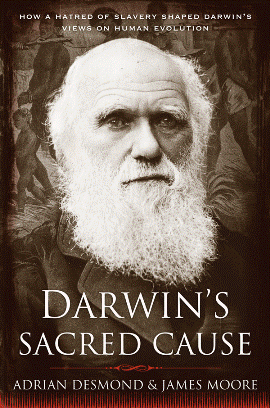
Adrian Desmond & James Moore - Darwin's Sacred Cause

Charles Darwin is one of those people whose lives inspire in all sorts of ways. His work on evolution is one part of this, his insights and his method are worth studying for the brilliance of his scientific method. But his science cannot be separated from his life and Darwin's travels, writings and activities are also fascinating in themselves. He is one of the few individuals who can inspire people to follow in his footsteps simply because he stands like some sort of colossus over science and history.

As a result of this, Darwin has had many biographers and Desmond and Moore's book at first seems like an attempt to find a new hook on which to hang yet another book about his life. The central idea of their work, is that Darwin's science and life cannot be separated from one of his great "passions", the movement to abolish slavery. From the desire to end slavery, and prove that all humans descended from the same origin, the authors argue, all the rest of Darwin's work flows.

What initially seems a convenient hook rapidly becomes a very readable and convincing biography that puts Darwin's genius in the midst of the intellectual and scientific debates of the 19th century, rather than locating the man, simply as a scientist with particularly brilliant insights.

The boo, and Darwin's life, can be split into two parts. The first centres of Darwin's upbringing. His family were rooted in the liberal anti-slavery movement. The authors show how Darwin's childhood and early adult years would have been seeped in political discussions about slavery. The accounts of the barbaric mid-Atlantic passage, the murder of slaves and life on the plantations were something that Darwin would have known well. His family were subscribers to a number of political campaigns on the question, attending meetings and supporting candidates that pushed for abolition and reform. By the time he got to university, Darwin's blood was thoroughly abolitionist. At university Darwin worked closely for some weeks with an ex-slave. The authors speculate, with some basis, on the way that their conversations would have turned to the realities of slavery. Interestingly, Darwin's notebooks and diaries contain no hint of racism or prejudice. To him, the black man teaching him to stuff animals was another man, slightly lower on the social scale, but in no way unequal. This contrasts, the author's point out, with the reality of life in the cities as viewed by many from the United States. Visitors from the other side of the Atlantic were appalled to see white and black couples parading the streets, arm in arm.

Darwin's experiences on the Beagle are well documented, as are his disagreements with his Captain over the question of slavery. Less well know, are the way that these experiences and what he saw of the reality of slavery helped steel his anti-slavery position. This might seem unsurprising, but several of Darwin's contemporaries later in life, visited the states and came to opposite, pro-slavery positions. Darwin's experience with indigenous people in South America also bore fruit later in his life, as he took up the political and scientific arguments associated with the origins of humans.

The second part of the book, and, it could be argued Darwin's life, is associated with the work that he began towards publishing his two masterpieces, the Origin of the Species and the Descent of Man. These two works are the culmination of a lifetime of study and research, and I will not repeat the science here. But the authors of this biography put them squarely at the heart of the changing debates that took place in England in the aftermath of the abolition of slavery.

During the campaign to free the slaves and end the slave trade, the notion of equality between black and white was taken as read. In the aftermath though, there was a increasing tendency to argue that the "races" were different. White people were superior, and blacks represented either a different race, or an earlier place in the development of humans. These debates were tied up with political questions justifying the existence of Empire, or the supposed lack of civilisation in Africa, for instance. They were also rooted in some of the new science that was developing, around the questions of brain size and head shapes.

Darwin placed himself in the camp of those who argued for a common ancestry for humans. But to explain this took Darwin decades of work and study. His reading was enormous, on everything from geology to the breeding of pigs and sheep. He ordered specimens from around the world and, in order to make sure that his scientific credentials were valid, he made himself a world expert on barnacles. Most interestingly, as the authors document, he engaged in the great debate about the origin of domesticated animals. In order to prove that domesticated pigs, sheep, cows and pigeons came from single origins, rather than multiple locations he needed to demonstrate that the great variety of life was possible from a single pair on animals. In order to do this, Darwin became an expert pigeon breeder. He spent time with working class breeders in their homes, to learn all he could and finally proved beyond doubt that it was possible to create enormous variations in animals from a single breeding pair.

This obscure work on pigeons was greatly important, because it undermined that argument that different "races" of humans, with their different coloured skins and different body shapes must have originated from different apes around the globe.

"After setting up his [Darwin's] target,
'The doctrine of the origin of our several domestic races from several aboriginal stocks, has been carried to an absurd extreme by some authors...
he would let pigeons lead the fight-back. The social context of Darwin's offensive has slipped away and been subsequently lost, but recovering makes sense of the project in Darin's moral world. It scientifically undermined the ethnographic drive for segregation and 'aboriginal' homelands so comforting to the 'slave holding Southerns'."

As America descended into Civil War, intellectuals on both sides grasped different aspects of the argument to polemicise in favour or against slavery. Darwin found himself part of that debate, his publications being quoted in the arguments and used against the pro-slavery side. But Darwin was propelled to his work by the growing crisis. He understood that part of winning the war, was undermining the idea that black people were suited to slavery because they were not biologically equal for Darwin "Slavery, race and evolution remained inseparable."

The book finishes with Darwin publicising his final work on human evolution. As with Origins it caused enormous debate and argument. Darwin had long since abandoned his religious beliefs, but if anything he was a stronger and harder fighter against racial ideas.

This is a rather astounding book. At times it reads like a scientific thriller, as you will Darwin to publish his book and damn those establishment figures he's concerned about upsetting. At others, it is a clear and readable introduction to the ideas at the heart of Darwin's science. Above all though, this is a masterful explanation of why at a certain particular moment in history, Darwin (and to a certain extent other scientists) were able to make the intellectual leaps that meant that evolution could become a live scientific idea. Ideas cannot be separated from the society in which they develop. The world around Darwin was changing. Slavery had been morally repugnant, and then was in danger of becoming scientifically supported. Darwin's work was a result of that world and a response to it.

As I read this book, I was reminded of biography of another, similar figure that I recently read. Karl Marx's life shares many similarities with Charles Darwin. This is not to say I am trying to claim Darwin as a Marxist - that would be laughable. But both men were engaged in a struggle to better understand the world they lived in. They were also in different ways, trying to change it. Both engaged in bitter polemics and struggles with friends and people on the other side of the world. Both were driven to despair at their work and frustration at other thinkers. Karl Marx dedicated the first volume of Das Kapital to Darwin, in part because of his great respect for The Origin of the Species. While there is no evidence that Darwin read Das Kapital, he would have understood the blood, sweet and tears that went into producing it, because it mirrored in many ways his own life's work.

Adrian Desmond and James Moore have produced a fascinating, readable and passionate look at Darwin's life and ideas. For its clarity in explaining both his thought and its origin, it should be read by everyone who wants to better understand the world we live in, and evolutionary science today.

Related Reviews

Darwin - Voyage of the Beagle
Simons - Darwin Slept Here
Rediker - The Slave Ship - A Human History

Wednesday, April 25, 2012

Heather Rogers - Green Gone Wrong: How Our Economy is Undermining the Environmental Revolution

As the scientific reports on the reality of global warming grow ever more frightening, Heather Rogers' book Green Gone Wrong explores the myths and realities of the solutions that we are offered. Her starting point is that most people want to do something about climate change, to reduce their carbon footprint, and so she examines some of the options that we are given. Some of these, such as using a car that is more efficient, or powered by electricity, are limited she points out, partly by the cost of the vehicles. Being Green in this situation is the realm of the wealthy. However she also points out that there is a structural problem with the economics of cars and car companies that prevent low emissions, or more efficient cars becoming mainstream.

To explore this further she examines the ways that the automobile industry destroyed public transport in the US, by buying up the tram companies. In their quest for profits, they first ensured that the public had to rely on cars. Now, in a situation where most Americas need a car, they only sell ones that maximise their profits. Sadly these are not the ones that reduce fuel use, or run on sustainable energy supplies. The barrier is not technology - far better cars are the norm in Europe. The barrier is profits. Switching away from the large comfortable, fuel guzzlers that the advertisers have sold to the US market for so long, would reduce profits in the short term. That is something that the industry is not prepared to tolerate. So emissions continues to rise.

Surprisingly, there are parallels with agriculture. Consumers are told that buying organic, or buying Fair Trade items will improve the planet and the lives of those working the fields. Travelling around the US and South America, Rogers finds the reality is far from the glossy brochures. The image of organic foods being the realm of small farmers living on decent incomes is rarely true in the States. While often the food is far better, margins are tighter and overheads high. More importantly, the industry is squeezed by the big multinationals, who in the US as well as the rest of the Americas have reshaped agriculture, not to provide nutrition and decent food, but to maximise profits.

In South America, far from the eyes of almost any consumers, Rogers finds organic farming that is far from organic, with suppliers using pesticides and other chemicals. She explains the problems and limitations of the bodies that approve the logos, for organic or fair trade foods. Too few inspectors, open to bribery and shadowy business deals. She also finds farmers and indigenous people, who are lied to, promised the earth and stolen from. Many of these tales are tragic. She returns occasionally to the story of one group of indigenous people, the Dayaks, farming their ancestral lands, and often trying to prevent the logging of their forests. One group of Dayaks have confiscated chain saws from the loggers. In a misunderstanding of the scale and strength of their multinational foes, they clearly believe that the saws will form a bargaining chip that will enable them to protect their lands.

Despite what is on the label, Rogers concludes that in some cases, "Fair Trade status binds these growers to a single processor and trader because the cost of certification is so high. Despite how it may look from afar, the system meant to ensure ethical standards and ecological well-being can deal small farmers out from the start."

Conclusions like this point directly to the real enemy. As Roger's explains vested interests lobby to ensure that "control over greenhouse gas emissions [are left] to market forces." Saving the planet is only possible in this economic system, if it is profitable. And the efficiencies made, in reducing energy use, or emissions are, under the current way of organising society, channelled back, worsening the problem. Rogers' quotes an activist at the Land Institute:

"When the Wal-Marts of the world say they're going to put in different lightbulbs and get their trucks to get by on half the fuel, what are they going to do with that savings? They're going to open up another box store somewhere. It's just nuts."

Rogers avoids the trap that many environmentalists make of simply believing that consumers have the power to change things. She points the blame at an economic system that has the accumulation of wealth as its motor. While she doesn't dwell on the alternatives to this, she certainly finds the real enemy. Shopping is not the answer, because the products we buy are open to corruption and bribery, but also because shopping is part of that system, "we can vote with our wallets all we want, but the people with the most money - precisely those who lavishly benefit from a system built on ransacking nature - will inevitably control the most votes."

Rogers is a excellent and readable writer. He book is part travelogue and part critique of capitalism. As in her earlier work on capitalism's waste problem, Gone Tomorrow, she stops short of arguing that a democratically, planned economy can be the heart of the solution to the environmental crisis we face. Nonetheless, both books are a powerful read and a damning indicment of a system that'll destroy the planet in its quest for larger profits.

Related Reviews


Rogers - Gone Tomorrow: The Hidden Life of Garbage
Monbiot - Heat: How to Stop the Planet Burning
Carbon Trade Watch: The Carbon Neutral Myth
Foster - Ecology Against Capitalism
Bello - The Food Wars 
Böhm & Dabhi (eds) - Upsetting the Offset: The Political Economy of Carbon Markets

Monday, April 23, 2012

Franz Mehring - Karl Marx: The Story of his Life


Unsurprisingly, Karl Marx is one of those figures in history who attracts biographers. Some of these are sympathetic, some are hagiographies, others are attempts to explore Marx's thought by understanding him as a man, and others are attempts to justify all sorts of contemporary ideas by appealing to the great man himself.

One of the most recent biographies was the 1999 book by Francis Wheen. It is certainly an accessible read, and in parts is a good introduction to Marx's life and times. Wheen is not a Marxist and he struggled here, and in a later book, to explain some of Marx's concepts. Wheen also was obsessed with Marx the man, portraying him as a grumpy old man, who spends lots of time in dark rooms, writing impenetrable texts, and forming lifelong feuds with former friends over minor points of doctrine.

Franz Mehring on the other hand, was a dedicated Marxist and one of the leading members of the German socialist movement in the run up to World War One. Along with his comrades, Rosa Luxemburg and Clara Zetkin, he fought to retain the genuine, revolutionary socialist tradition through the war years, when most of the socialist movement had capitulated to the needs of the German ruling class.

His biography is very important, because it is both a sympathetic account of Marx's life and an attempt to explain and reassert Marx's ideas. Unlike Wheen's book, Mehring does not dwell on Marx's private life. It is not that Mehring thinks it unimportant. Marx's lifelong friendship and collaboration with Frederich Engels clearly was extremely important to his ideas, and his ability to get them down on paper. 

Similarly, Mehring doesn't dismiss Marx's marriage. Jenny Marx shared in many of Marx's struggles through his life and the descriptions of their joint suffering when one of their children dies are deeply moving. Jenny Marx pre-deceased Karl by barely a year, and while Mehring doesn't dwell on this part of their lives in detail, it's heart-rending to realise that Marx was too ill to attend her funeral. His despair at her death remains with him in that dark final year.

For Mehring, far more important than the private tribulations of the Marx family, is Karl Marx the activist, the revolutionary fighter. Its difficult to reconcile this Marx with those critics who complain that the great socialist did not know workers, because he lived on donations from his rich friend. Marx and his family certainly knew poverty, but more important, Marx knew hard work. While he never turned a lathe or laid bricks, his life was one of constant writing, meetings and argument. His editorship of several newspapers during times of revolutionary upheavel were certainly difficult jobs, but essential to his life. Marx was not a revolutionary who sat back and commentated on events, he took part and actively engaged and tried to shape movements; often at risk of prison, or worse punishments.

Anyone who has been around the socialist movement for any length of time will recognise the debates and discussions that Marx and Engels engage in. In particular, the rows, polemics and arguments during the rise and fall of the First International seem eerily familiar. But again, this is Marx in his element, part of the struggle, trying to change the world.

Franz Mehring
Mehring takes time to explain Marx's developing thought through the book. In fact, placing his ideas at the core of the work makes the book far superior to other biographies. Marx's ideas developed and changed over time, as he learnt from the world outside and the experience of struggle. The first chapters on Marx's earlier philosophy are a little hard going as the explore the works of figures like Hegel, but Mehring shows how Marx breaks from these as he watches the struggle of workers, living and fighting in the real world. 

At each stage in Marx's life, Mehring examines his life and his work. So he takes us through the debates with other writers, the writing of the Communist Manifesto and Capital. The detail of the Paris Commune and Marx's brilliant polemic The Civil War in France is a fascinating chapter. Here we see Marx learning from the movement, but also actively engaging in solidarity. His home became a refuge for those fleeing the persecution of the Commune and his daughters married Communards.

Mehring describes some of the feuds Marx engaged in. Marx was no saint and like many socialists since, he was wrong occasionally and he was prone to believe false rumours about those he disagreed with or disliked. Mehring criticises his subject when describing the debates Marx had with Bakunin for instance, and has many good words to say about that class fighter, despite his critique of anarchism.

The Karl Marx in these pages is a fighter - a man angry at injustice, but thoughtful and inspiring. Someone prepared to fight his corner against all comers, but in no way monolithic in his thought. The author too comes through as deeply familiar with his source material and knowledgeable about obscure letters and newspapers. This is clearly the culmination of a lifetimes work. Like Marx, Mehring was a revolutionary who fought to change the world. If at times this book errs a little into the history of Germany and Prussia, it is in part because Mehring is engaged in debate and argument with his own comrades, as well as describing the background to Marx’s life. 

For those who want to know Karl Marx better, as well as understanding his ideas, I can think of no finer biography.

Lloyd Biggle, Jr - All the Colours of Darkness

Spoilers ahead:

On of the fascinating things about reading science fiction is the way that, despite deploying fantastical ideas, it dates so rapidly. Nonetheless, well written SF can still be immensely readable, decades later, despite its technological limitations.

That certainly is true of Wilson Tucker's The Long Loud Silence that I reviewed recently. Sadly it's not as true of Lloyd Biggle's All the Colours of Darkness which was written in 1963. This novel deals with the invention of a teleporting system and uniquely perhaps, the technological angle works really well, despite the book being half a century old.

The Universal Transmitting Company's breakthrough stands to make its directors' fortunes. Step into a booth in Manhattan and instantaneously you arrive at your destination, anywhere in the world. While hinting at the consequences for the freight, railroad and airline industries, AtCoD mostly concentrates on a detective plot around this technological marvel. On the first day of operation, several "passengers" go missing, but these persons have no public records, no relatives and no one, but the teleport operators, notice their passing. Our hero, is detailed to find them.

Despite owning the book for a couple of decades, I hadn't realised that detective Jan Darzek is a character in a whole series of novels, I doubt I'll look them out, because once the reader has exhausted the possibility of teleportation as a plot device, this is fairly mundane stuff. It is true that Biggles does well with the mystery of the unknown (aliens are, unsurprisingly involved) and there is a final treat at the end of the book. Biggles finishes the novel by posing his hero a major personal dilemia. Smacking slightly of those episodes of Star Trek that featured "Q", this raises the story a little above others of its genre.

Saturday, April 21, 2012

Peter O'Donnell - Modesty Blaise

There have probably been a hundred James Bond impersonators. Few of them match Ian Fleming's style and writing ability. Peter O'Donnell's Modesty Blaise is, in some ways, a far more interesting character than Fleming's Bond. O'Donnell can certainly write and his stories of the female agent and her sidekick Willie Garvin read well and have a certain humour that is lacking in most fiction like this.

Written in the mid-60s, at first it's hard not to see this book as being influenced in some ways by the growing women's movement. Its strong, central female character is unusal in the secret agent genre. But in reality, the stereotypes here are as terrible as any Bond girl. Modesty Blaise knows how to use a gun and is an expert in unarmed combat, yet at the end of every operation she cries to herself, while her male Garvin gives her a shoulder to rest upon.

The extraordinary detail about guns, knives, explosives and unarmed combat here, practiced by women and men, hides a much more annoying set of cliches. Women are emotional, men are strong. Even when Modesty tells her lover that he must agree to follow her orders when on an operation, he points out that when they're in bed, she is happy to follow his. Here is a female assassin, dressed in tight clothing and shimmering stockings designed to titulate. O'Donnell frankly spends rather a lot of time describing his heroine's underwear.

The actual story is fairly standard fare. A shipment of diamonds is to be robbed by an eccentric arch-criminal. His use of technology and an evil female hench-women is standard Bond, as is the climax which is stuffed full of technological wizardry and just-in-time solutions.

Modesty Blaise is famous for being a long-running cartoon and book series. Perhaps the novels improved over time, but don't fall into the trap of beliving that this is anything other than James Bond in a dress.

Thursday, April 19, 2012

Gunnar Brulin & Malin Klingzell-Brulin - Food for Thought: On Food, Power and Human Rights

Swedish journalists and trade unionists Gunnar Brulin and Malin Klingzell-Brulin have here attempted to produce a book that helps us understand the networks of companies, industries and individuals that are behind the food that we see on our plate. Based in Sweden, and working in conjunction with the Food Workers' Union, they trace some of the strands backwards from Swedish shops to the many different parts of the world were workers are producing food, and more often than not organising to protect and improve their conditions.

We meet for instance, the workers of Coca-Cola in the Philippines, who are fighting the increased casualisation in their industry. The women who work for Nestle in Brazil, who are fighting an epidemic of Repetitive Strain Injuries caused by bad working practices. The authors travel to interview tea workers in India and trade unionists everywhere fighting to establish workplace recognition and building networks.

Anyone who has been involved in the union movement for any length of time will recognise the situations described here. We may never have been to the developing world, but many of us understand the difficulties getting a union off the ground, enthusing people to come to meetings, sitting in long debates with management, distributing leaflets outside factory gates. Partly based on their links with the International Union of Food Workers, the authors paint a picture of the importance of international solidarity, of workers who work for a Transnational Corporation understanding what their colleagues do and need half a globe away.

In many ways this is exciting, though the book is too short for us to learn much about many of the places and people we are introduced too. The story also shows the links between the climate crisis, the financial crises and the food crises. A system which means that 800 million people go to bed hungry every day. Further, the authors, or the union leaders that they interview are very radical, talking of sustainable industries and agriculture, dignity, democracy and empowerment. They challenge the company priorities, though there is an occasional tip of the hat to a business that is seen as more progressive than another - Coca Cola over it's rival Pepsi, which doesn't work with the unions at all.

But the problem for me is that there is little sense of a workers movement fighting for change here. There is organising, and the occasional mention of a strike or protest. But much emphasis is placed on working with the bosses in the interest of everyone. Coca Cola is mentioned because its management seem to have recognised the need to work with the trade unions. Is this why there is barely any mention of the death of trade unionists working for the company in South America? Rather we are told who easy it is for western trade unionists to raise questions of an ethical nature with their management.

This is a well produced book, that highlights the reality of the struggles that take place behind the food that we eat. Whether its coffee, chicken, pork or prawns this is the modern food system. The reality is that western food is built on a pyramid of casual, underpaid labour, that occasional relies on children, that frequently sacks trade unionists and that needs to be fought every inch of the way. As the authors detail well in the appendices, there are a tiny number of undemocratic, powerful and rich corporations controlling almost all the world's food.

If we're to have decent jobs, healthy and sustainable food than we'll need fighting trade unions. When this happens, it is clear that everywhere workers take an interest in the bigger picture. Brulin and Brulin show that this is beginning to happen but the bureaucratic approach taken by the cosy Scandinavian union's described here will not blunt the teeth of the capitalist tiger. We need much more than this.

Thursday, April 12, 2012

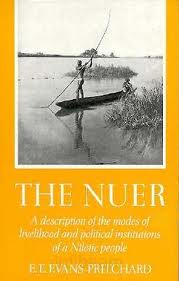
E.E.Evans-Pritchard - The Nuer: A Description of the Modes of Livelihood and Political Institutions of a Nilotic People

The Nuer of the Southern Sudan live in the country that borders the Nile river and other tributary rivers. Their life revolves around their cattle, which form both a major source of their food and a mainstay of their social interactions. They are also fishermen and farmers planting crops of millet on small islands that rise above the wider marsh.

Evans-Pritchard's book was first published in 1940 and is considered a classic of social anthropology. It is the first in a series of extensive studies of the Nuer made by the author. The very first chapter deals with his first visits to the area and the difficulties he has in positioning himself for these studies.

From Evans-Pritchard's descriptions, the Nuer in the 1930s seemed to practice a life that must have been very similar to that of the first agriculturalists. In fact their modes of organising society seem to be almost a bridge between what might be called a hunter-gatherer society and full, permanent agriculture.

This is particularly interesting because of the lack of class in their different communities. Class society could only come about when agricultural arrived as it was only then that there could be a surplus of food to support non-productive members of the population. But this was not immediate; there would have been plenty of transitory societies where agricultural was increasingly dominant but were the old, egalitarian, aspects had not been lost.

This is described in great detail in this study. As the blurb on the back puts it, the Nuer's "economic life is related to the absence of chieftainship and to their democratic sentiment."

This is not to say that the Nuer lived a life in perfect Utopia. Food shortages were common, war, feuds, adultery and occasional murder are part of their society. But this was based on very different attitudes to the world around them, and each other.

In part this is reflected in their attitudes to leadership. There are leaders, but they are not permanent ones whose every word must be obeyed. Evans-Pritchard describes the tut a "chief man of his family and joint family" who "takes the most prominent part in settling the affairs of these groups, but he cannot ... be said to have political authority... A joint family decide on the advice of their tut to change camp... but other joint families decide not to move till another day. Leadership in a local community consists of an influential man deciding to do something and the people of other hamlets following suit at their convenience."

Much of this book is spent in great, perhaps labourious, detail exploring the particular lines of kinship, the particular way that feuds and social relations are followed through. Most of this is only going to be of interest to the student of anthropology, though for the lay reader, nuggets continually shine through. I was struck by the author's explanation of the way that the Nuer have an entirely different conception of time. For them there are more spacings of time in the morning, when they are busiest looking after cattle than in the afternoon. Because of the lack of written records their history never grows beyond a few memorable generations. Evans-Pritchard points out that for the Nuer, the "distance between the beginning of the world and the present day remains unalterable" and was shown the tree under which humans came into being.

Private property played a different role for the Nuer. To them, cattle were everything, they enabled someone to get married, to atone for crimes to help a family member setup home. But the accumulation of cattle was meaningless. Once a Nuer male had enough cattle he would marry again or pass them on. Nuer would, it is true, had more than they needed of certain things, such as good fishing spears. But these would be taken from them by people who needed them and no crime was ascribed. Strict protocols governed the Nuer's life. "I have never heard of a Nuer stealing a cow from a fellow tribesman merely because he wanted one" points out Evans-Pritchard. Though the Nuer were perfectly happy to steal from a neighboring tribe.

One thing that struck me about the descriptions of Nuer life was the lack of discussion about the role of women. All the examples quoted above were based on the author's conversations with men, and it is clear from examples in the book to do with marriage, that women had a subordinate role in Nuer society. It is possible that this topic is covered in more detail in the later volumes of Evans-Pritchard's work. Clear divisions of labour existed in Nuer life. But often these were not based on sex, but on age groups. Age groups played a much more important role in Nuer society, though the examples of Age-Sets given in the final chapter here, are all about men. It would be illuminating to read further on this question.

I could write much more, but I would rather encourage people to read further. In summary, what Evans-Pritchard's detailed studies show, is that people who have different modes of production have different social organisation which consequently shapes different ideas in people's heads. Trying to get the heads around these ideas is very difficult for those who view from outside. This is why it is so wrong to described pre-capitalist, or even pre-class modes of production as "primitive". They are anything but. It is for this reason that the author spends so much time looking at the details of inter-tribal relations and the like. But for most of us, we can simply delight in reading about a different way of organising society, not because we want to return to such a way of living, but because it shows that human-nature is not fixed and may well change again.

Related Reviews

Evans-Pritchard - Kinship and Family amongst the Nuer
Burke-Leacock - Myths of Male Dominance
Scott - Against the Grain: A Deep History of the Earliest States
Flannery & Marcus - The Creation of Inequality
Engels - Origin of the Family, Private Property and the State
Lee - The !Kung San: Men, Women & Work in a Foraging Society

Wednesday, April 11, 2012

Wilson Tucker - The Long Loud Silence

Waking in a dirty, run down hotel, Corporal Gary finds that his drunken binge has left him in a really bad fix. While he slept off the alcohol the United States has been attacked. Nuclear weapons and germ warfare have left the Eastern States of the USA plague ridden and deadly. Desperate to return to his beloved army, Gary finds that the bridges across the Mississippi have been destroyed. The river now forms an internal border, the existence of the plague on the eastern side has left a few survivors, but these are carriers. Should they cross the river they'll spread the disease and decimate the rest of the Americas.

Given this short science fiction novel was written in the early 1950s, it has dated very well indeed. Wilson Tucker has written a short, tight and very readable novel that examines what happens when people are suddenly cut off from their own support networks. The United States government forgets the survivors in the east. When they try and cross into the safe areas they're mercilessly gunned down. But the radio tells stories of another enemy spy prevented from entering.

To say much more would ruin the plot. If you want to get the spoilers, the Wikipedia entry has a fairly comprehensive breakdown of what happens. Tucker portrays a dog-eat-dog world. But one with surprising amounts of human solidarity. Given its early publication date (1952), I was surprised to see a polygamous relationship at one point. Tucker may well have been ahead of the curve when compared to some other SF writers of his era.

One final point. The original story had a darker, bleaker ending according to Wikipedia. Interestingly, given that this barely ends on a positive note, I think I'd have preferred his original one. Wilson Tucker was a new author for me, but one I shall return to on the strength of this novel.

Sunday, April 08, 2012

Francis Pryor - Seahenge: A Quest for Life and Death in Bronze Age Britain


Readers may remember the excitement near the end of 1999 when a wooden circle was discovered on a Norfolk beach. Surrounding a central, uprooted tree stump, a circle of timber looked like a wooden Stonehenge. Quickly the media dubbed it Seahenge and the name has stuck. This irritates some students of archaeology, as the circle is not a henge in the sense that Stonehenge is. Rather the timber circle was actually made of planks, touching to form a continuous wall. It's only after thousands of years of action from water that we see the timber reduced to stumps, and the appearance of a henge.

Francis Pryor's book is much more than an exploration of what Seahenge was, and what it was for. It is a deep, semi-autobiographical trawl through the way that studies of the Bronze Age have changed during the last hundred years. Pryor is now one of the foremost archaeologists of the Bronze Age, and he has helped over see a changing view of the way that the people of that era lived, worshipped, farmed and died.

This book begins with Seahenge, but rapidly looks at a number of sites that Pryor has concentrated on. In particular, the Flag Fen site near Peterborough, which Pryor has been instrumental in excavating, exploring and bringing to the attention of the public. As he discusses his involvement with these sites, he teaches the reader how he, looks at the Bronze Age landscape. For Pryor, it is not enough to look at a site or a find in isolation, you have to understand it in the context of the wider world of the people who lived there, or buried the item in the ground. This means looking at the importance of boundaries, roads, paths and the edges of water. Pryor shows us how Bronze Age people might have seen the world around them, based on the layout of their farms and the positions of their buildings. His archaeological research is practical, and his statements, while they occasionally border on whimsy, frequently are based on experience. Pryor knows that you can't have a central chimney on a Bronze Age round house, because he's tried it and had to flee the recreation as it filled with dense smoke. Pryor begins with Seahenge, but he finishes there too. You cannot explain Seahenge without understanding the wider Bronze Age experience, and this is one of the reasons that the book is so strong - the author is giving us the intellectual basis to understand Seahenge. You cannot explain a monument (if that is the right word) like this, without this. It would be like trying to sum up the Magna Carta, or Karl Marx's thought in a single sentence.

This is a practical book, in the sense that Pryor is a hands on writer. He talks as he works, we learn the detail of how to excavate a trench. One of the things I particularly like is the way that Pryor never forgets everyone who is involved in a dig. From the driver of the JCB to the people who work the metal detectors, Pryor sees archaeology as a collective effort, a democratic one too, if his descriptions of the working meetings are anything to go by. This is reflected in Pryor's own view of history:

"At the end of the second season in 1972 I gave a paper at a conference in Newcastle, in which I described the emerging picture of well-regulated life in the Bronze Age. No sooner had I stepped down from the stage than half a dozen academics declared that such order and organisation could only be due to the presence of a powerful political elite, who controlled those otherwise unruly prehistoric Fen folk. I don't know why, but this assumption irritated me. Why couldn't they control the way they behaved themselves? Why do some always have to look for a ruling class, just because ordinary people seem to be running their lives efficiently and well?"

There are some interesting bits here. Pryor discusses the neolithic revolution, the moment in human history, when agriculture transformed our ways of life and pushed us in the direction of class society and the accumulation of ever greater wealth. He points out that this was less of a revolution than a gradual process, agriculture having its roots in early experiences, even of hunter-gathering communities. While the transformation was revolutionary, it was not a process that happened overnight, nor was it simultaneous everywhere. This view feels more natural, though I think Pryor underplays the importance of the term revolution in this context. The development of agriculture and the transition to a life dominated by sedentary life, rather than movement was a culmination of what had happened before, but it was also a break from it. Humans constantly develop their forces of production, sometimes they transform their situation into a new mode of production. Hunter-gathering had elements of agriculture to it, but it is a fundamentally different system to one based on agriculture.

But these are really the minor quibbles of a Marxist obsessed with early farming. Pryor's book is one of the best introductions I've ever read into Bronze Age history and archaeology. If it doesn't make you want to read more, or visit the stones of Carnac in Brittany, or Flag Fen itself, then I really cannot imagine what will. Most of all though, Pryor is a writer who likes people. Those that lived, worshipped and were sometimes buried at the sites he describes are real, rounded individuals who lived in the midst of a landscape they tried to shape and understand. For this reason alone, Pryor is an archaeologist who, it feels to me is on the right side.


Related Reviews

Pryor - Britain BC 
Pryor - Britain AD
Pryor - Britain in the Middle Ages
Pryor - The Making of the British Landscape