Sunday, February 28, 2016

Diarmaid MacCulloch - Reformation: Europe's House Divided 1490-1700

Diarmaid MacCulloch's Reformation is an impressive and monumental achievement. It's massive size reflects the scope of the material covered - over two centuries of detailed history of countries from Ireland in the west, to Poland, Lithuania and Transylvania in the east. As well as Spain, Scandinavia and Italy. The book even touches on the impact of the Reformation for those who lived in the Americas and those who emigrated there (as well as the slaves who were brought there).

For MacCulloch the history of the Reformation is very much one of ideas. It's the changing attitude to the Church and its activities that drives the Reformation, but the Reformation in turn drives all sorts of other social, political and economic processes. He writes:
The old Church was immensely strong, and that strength could only have been overcome by the explosive power of an idea. The idea proved to be a new statement of Augustine's ideas on salvation. That is why there is so much description of apparently abstract thought in my account of the Reformation... Monarchs, priests, nuns, merchants, farmers, labourers were seized by ideas which tore through their experiences and memories and made them behave in new ways... Social or political history cannot do without theology in understanding the sixteenth century.
It is of course true to say that you cannot understand this period of history without understanding the ideological changes, and the ideas themselves. But I fear that MacCulloch reduces history down to "the idea" without really getting to grips with the thorny question of why it was in the 16th century such diverse groups of society would accept them and drive the change onward.

Of course, some of this was about the role of individuals. MacCulloch highlights the contribution of men like Luther:
He spoke at so many different levels: he debated with scholars, shouted from the pulpit, wrote vigorous German and sang his message in German hymns and songs. Perhaps the hymns were the most persuasive to the wavering because they were the least polemical. Luther's impact was naturally greatest on his fellow German speakers, but it was much wider than that in the 1520s. It was not just he impact of print, vital through it was: the Reformation was a matter of the spoken and sung (some might say, the ranted) word, as much as the word on paper.
But here again, MacCulloch fails to explain why these words had such power. I believe this is why a materialist historical analysis is so important, because it can show how the new ideas fitted more closely with a changing economic world - one based increasingly on trade and manufacturing for the accumulation of wealth. The beginning, in other words, of the capitalist era.

This isn't to say that MacCulloch's work is not without value. It is a detailed history and it's 700+ pages are packed full of history that repays study. The idea of the Reformation and the Counter-Reformation as Europe spanning movements that transformed the whole world eventually works well in this format. MacCulloch's historical knowledge is as clear when writing about 16th century Poland as events in England, Scotland and Ireland a century before or after. MacCulloch is also an entertaining writer, and his account is full of details of the lives of ordinary people as well as the rulers. Indeed the final chapters are an examination of the way that the Reformation changed people's lives in such important matters as marriage, love and sex.

On occasion MacCulloch's historical method lets him down. It is a simplistic analysis that links the violence of "twentieth-century Belfast, Mostar or... Rwanda" with the St Bartholomew's massacres in Rouen and Antwerp. Reducing these conflicts simply to "hatreds" between different religions is inadequate.

But MacCulloch is right to point to the importance of these changing ideas. As were the ruling classes of the 16th and 17th century. MacCulloch quotes one of Charles I's generals, WIlliam Cavendish, "The Bible in English under every weaver's and chambermaid's arm hath done much harm... for controversy is a civil war with the pen which pulls out the sword soon afterwards."

While there are many criticism's to be made of this work of history, it has much that will repay the reader, particularly those trying to get a sense of the sweeping changes that took place in Europe in this period, ones that had profound impacts on the people of the whole globe.

Related Reviews

Fletcher & MacCulloch - Tudor Rebellions
Wilson - The People and the Book
Tawney - Religion and the Rise of Capitalism

Monday, February 22, 2016

Karl Marx & Frederick Engels - The German Ideology

Reading The German Ideology I am once again reminded about how clear the writing of Marx and Engels can be. That said, it's always useful to have a good guide, and this student edition from Lawrence and Wishart, has an excellent introduction by C.J.Arthur which puts The German Ideology into the context of the developing ideas of Marx and Engels, as well as the debates taking place at the time.

The German Ideology was written as a polemic, and explores Marx and Engels vigorous debates with various other philospohers. This is why the introduction is important, because most of these philosophers have been forgotten to history, except as the recipient of the authors' critique and wit. To cut down the amount of this, C.J.Arthur has edited the work to bring out the key selections from this important work, and these are fantastic to read.

The German Ideology is where Marx and Engels first set down the ideas that will eventually become the body of thought known as Historical Materialism. Arthur describes it as the "first recognizably 'Marxist' work". He quotes Engels saying with hindsight that it "consists of an exposition of the materialist conception of history which proves only how incomplete our knowledge of economic history still was at the time".

The authors begin by challenging the "Young Hegelian" view of the world, an idealistic one where "the relationships of men, all their doings, their chains and their limitations are products of their consciousness". Famously, Marx and Engels challenge this, with their materialism.
Men can be distinguished from animals by consciousness, by religion or anything else you like. They themselves begin to distinguish themselves from aniumals as soon as they begin to produce their means of subsistence, a step which is conditioned by their physical organisation. By producing their means of subsistence, men are indirectly producing their actual material life.
This core idea runs through the whole work, that humans are shaped by the society that they build. Marx and Engels explore how this develops with a brief, and somewhat simplistic survey of history, inverting the Hegelians,
The production of ideas, of conceptions, of consciousness, is at first directly interwoven with the material activity and the material intercourse of men, the language of real life. Conceiving, thinking, the mental intercourse of men, appear at this stage as the direct efflux of their material behaviour.... Men are the producers of their conceptions, ideas, etc - real, active men, as they are conditions by a definite development of their productive forces and of the intercourse corresponding to these, up to its furthest forms.
And to reiterate their criticisms, Marx and Engels continue,
In direct contrast to German philosophy which descends from heaven to eartth, here we ascend from earth to heaven.
In other words, human ideas evolve out of the real world, they aren't created randomly, or arise out of some general truth. In my own work on ecology and human history, I've often noted how the approaches to nature and the surrounding world are radically different depending on the way in which socieities are organised. Capitalism has a particular relationship to nature, because for capitalist production, nature is seen as a resource; part of the productive process geared towards accumulation. This contrasts with nature as conceived of by hunter-gatherer communities for instance. Nature is also central to the historical materialist account in The German Ideology. Marx and Engels put it at the heart of their analysis of human history, in contrast to the philosophers they critique who see it as eternal, unchanging and passive.

Marx and Engels are full of damnation for the limits of German Philosophy. They write at one point, that "across the Rhine...history has stopped happening".

While the authors would go on to clarify and develop their ideas, the book has some excellent expositions of their ideas. Here for instance, is the culmination of a summary of their understanding of the process of historical change, which might be seen also as the basis for later Marxists' theories of Permanent Revolution.
Thus all collisions in history have their origin, according to our view, in the contradiction between the productive forces and the form of intercourse. Incidentally, to lead to collisions in a country, this contradiction need not necessarily have reached its extreme limit in this particular country. The competition with industrially more advanced countries, brought about by the expansion of international intercourse, is sufficient to produce a similar contradiction in countries with a backward industry (e.g. the latent proletariat in Germany brought into view by view by the competition of English industry). [Form of Intercourse would eventually be clarified to Social Relations] 
For the general reader trying to get a handle on the essential ideas of Marx and Engels this might not be the best starting point. But for the reader with a good grounding in Marx's ideas and a decent edition (this one also has some useful and relevant supplementary material) this is a rewarding work.

Related Reviews

Marx - Value, Price and Profit
Marx - The Civil War in France
Engels - The Origin of the Family, Private Property and the State
Perry - Marxism and History
Carr - What is History?
Harman - Marxism and History

Monday, February 15, 2016

Spencer Dimmock - The Origin of Capitalism in England 1400 - 1600

The debate on the origins of capitalism, more specifically, the transition from feudalism to capitalism, is one that remains crucially important for understanding the nature of the present system, and its dynamics. While superficially an abstract discussion, understanding the transition has, for many Marxists been central to a wider understand of the process of historical change.

Spencer Dimmock's book challenges many of the cherished ideas of Marxists who hold this point of view, and this ought to have been an important contribution to the debate. Unfortunately it is marred by its ill-tempered polemic, it's dismissive approach to many of those the author disagrees with, and its hagiographic defense of the Marxist who is most central to Dimmock's own ideas, Robert Brenner.

This is a shame as there is much of interest in The Origin of Capitalism in England particularly the detailed use of sources in the second part to emphasise crucial parts of Dimmock's arguments. There are also important critiques of non-Marxists and what might loosely be termed, critics of Brenner from the right, which may well be of use to those trying to get to grips with non-Marxist history writing. Yet time and again I found myself putting down the book out of frustration at the author's style.

Dimmock, as does other political Marxists like Brenner, directly challenge some of the central arguments of those they call the orthodox Marxists. Here, for instance, is Dimmock's assertion that
There was no growth of a bourgeois class in direct opposition to old feudal lordship drive by commercial expansion and growth of the productive forces which then defeated the latter in the 'bourgeois revolution' of the mid and late seventeenth century, as has often been contended. Instead feudal lord-ship became 'bourgeois' itself... English lords were as responsible for breaking the remaining extra-economic prerogatives of monarchy and its allies as the 'bourgeoisie' that grew up in the shell of the estate system.
Leaving aside that Dimmock asserts there was "no growth of a bourgeois class" and then refers to the bourgeois "allies" who clearly had grown from something, this passage strikes me as an example of an error of approach by the author. Keen to dismiss orthodox Marxism for a teleological approach, I think he misunderstands the nature of that approach itself. To take one example, Marx never really suggested that there was an automatic process of transition from feudalism to capitalism. I was struck for instance, that in his polemic against writers such as Chris Harman, Dimmock failed to note that Harman highlights in several of his pieces the way that capitalism failed to develop out of "feudal" societies. It's far from a teleological method. Take Harman's rather more nuanced approach in his piece The Rise of Capitalism which unfortunately if not discussed by Dimmock.

On occasion Dimmock also deploys some straw men. He argues for instance "When historians speak of capitalism being driven from below, they must recognise that the majority of the commons in both towns and countryside were opposed to capitalism." He is clearly right here. It's an argument that is echoed by Michael Andrew Žmolek in his recent book Rethinking the Industrial Revolution. But the danger here is that Dimmock is implying that everyone (other than himself, Brenner and a few other political Marxists) argues this. In fact most Marxists wouldn't suggest that this is how the transition to capitalism came about. The idea of developing productive forces causing the further development of people within feudalism with an interest in overthrowing feudalism and creating a society more open to their own interests does not imply that there (I caricature) groups of people who sat down and planned the transition with a blue print of the sort of society that they wanted. Indeed most of those who ended up leading (say) the English Revolution certainly did not begin by wanting to chop off the King's head. They were lead to that position by the nature of the War itself and the extent to which the old order was vigorously defended.

At root I think there are two problems with Dimmock's book. One is a misunderstanding of Historical Materialism itself which he seems to see rather mechanically. For instance, here is Dimmock's summary of HM:
in all class societies the direct producers will, where possible, always aim to increase their wealth by seeking gains from trade through changes in productive organisation, in other words by specialisng production in response to price changes for particular commodities.
This is not at all the version of historical materialism I get from reading Chris Harman or even The German Ideology. In fact, it implies a type of inherent greed to human nature which seems distant from what Marx actually described.

Secondly, and perhaps more fascinatingly, Dimmock appears to have in his sights the project for the revolutionary transformation of society. One of his core arguments is that orthodox Marxists have a particular understanding of the transition to capitalism because they want to replicate this in the transition to socialism. Here is not the space to tackle what I see as Dimmock's  mistaken understanding of how that process would take place, but it is worth noting his own vision of that change.
if due to a chronic crisis of capitalism, wage workers no longer had the option of seeking capitalist employment, concessions born out of necessity in industrial and agrarian production may be drawn from big business and the sate in the form of co-operative, non-market ventures, following perhaps the election of a party given a mandate for necessary radical change.
This vision of radical change coming through the voluntary giving of concessions by corporations in midst of economic crisis is in direct opposition to Marx's own ideas which saw the state as being a tool of the ruling classes to maintain their power. Such concessions would surly have already been made if capitalism had such a benevolent core. As we know from history, the system is quite happy to have reserve armies of hungry and unemployed, being motivated by their profits. Dimmock has this utopian vision of change because he rejects what he believes are the necessarily violent tendencies of orthodox Marxists, whom he accuses, most unfairly, of believing the violence and suffering of the transition to capitalism was necessary for the eventual installation of socialism. This view may have been true of those who followed Stalinist distortions of Marxists, but is manifestly not true of those whom Dimmock is polemicising against here.

These inherent weaknesses in Dimmock's book prevent me encouraging potential readers to buy it. There is much to be learnt from the debate between Robert Brenner and his critics, but I don't think that this is the book that will illuminate the differences.

Related Reviews

Harman - Marxism and History
Žmolek - Rethinking the Industrial Revolution

Tuesday, February 09, 2016

Anthony Fletcher & Diarmaid MacCulloch - Tudor Rebellions

Any student of the Tudor and Early Modern periods is likely to know Anthony Fletcher and Diarmaid MacCulloch's Tudor Rebellions well. You don't need to read much about the 1549 rebellions, the Pilgrimage of Grace or indeed general histories of the period without seeing it referenced.

Despite being a "standard textbook" of the subject, the book is neither dry nor lacking in stimulating analysis. It also contains very useful translations of contemporary documents, particularly useful because material relating to the rebellions is often difficult to access. This review pertains to the extensively revised fifth edition, produced 36 years after its first edition.

The authors' highlight the very different society that was England in the early Tudor period. Much less urban than the rest of Europe, towns were usually populated by only 6,000 to 8,000 people. This, the authors suggest, meant that "personal and political relationships were inextricably confused". They continue that
Expressions of class hatred are mostly isolated outbursts of rage by individuals... Even in time of rebellion the fundamental assumptions of Tudor society persisted: the commons expected the gentry to give the lead. If the gentry closed the gates of their parks and retired to their manor houses the commons went and sought them out. They persuaded or intimidated them into taking their side.
This in fact leads to the somewhat perplexing examples of the way in which the hostile gentry were often won over to lead peasant rebellions, before switching allegiance back to the king and government (or, in some cases, failing to prove their true nature and facing a traitor's death). The Pilgrimage of Grace is a notable case in point, and Fletcher and MacCulloch examine it in detail.

Much of the book is dominated by accounts and analysis of various rebellions, their causes, paths and consequences. Almost all of these are what might be termed rebellion from below - rebellion by the lower orders against one or more aspects of royal or government policy. It is notable the way that the ruling class in the period was extremely wary of upsetting the lower classes, and responses to rebellion often took, at least initially, the form of attempts to mollify or offer concessions. Brutal violence was however never far away. Indeed, the authors note that violence was actually a necessary part of the legal process
The processes of English common law actually encouraged formalised acts of violence, such as symbolic trespass on land, in order to get a legal case started, while in order to get a grievance into the most effective court in the land, [the] Star Chamber, it was absolutely necessary to construct a riot, which might be collusive between the two sides just as much as a random piece of angry violence.
But this pales into insignificance when we consider the violent retribution and punishment that the ruling class imposed on rebels in the aftermath of rebellions such as the Pilgrimage of Grace, the 1549 Western Uprising and Kett's Rebellion.

Forms of rebellion, such as the camps set up in 1549, the "camping time" also had their origins in traditional forms of social organising. The authors note, for instance, simularities between these rebel camps and the "meetings of the assizes" that regularly took place in village life. Tradition hung heavily over rebellion as much as it did over normal life, and there where places, such as St. Keverne in Cornwall, that definitely had a tradition of rebellion through out the Tudor period.

That said though, the ruling class lived in fear of rebellion. When it broke out, they often assumed it was the work of outside agitators, or individuals with particular axes to grind. In reality, causes were much more complex. Many of those engaged in rebellion in 1549 felt that they were doing so inspired by, or with the support of the Lord Protector, who had set himself against the interests of the larger landowners. Repeatedly the demands of rebel camps throughout the period begin by pledging loyalty to the crown, and demand action against corrupt ministers.

I've mostly considered the rebellions of the rural populations here. The turbulent politics of the Tudor period meant that there were other rebellions, particularly in the aftermath of Henry VIII's rule. These reflected the different interests of sections of the ruling classes. I've alluded to the difference in opinion over relations with the rural population and the question of enclosure during the minority of Edward IV. Other rebellions took place as the Catholic and Protestant sections of the ruling class vied for power particularly following Edward IV's early death. The Reformation hangs heavy over the entire period, the Western Rebellion in 1549 particularly being inspired against the introduction of the new prayer book.

But the authors note that the end of the Tudor period and after saw less rebellion from below. This they attribute to the way in which during Elizabeth's rule those who were most likely to lead rebellions, "the yeomen leadership" were "becoming closer to the gentry than to the class below". Their wealth was increasing, and they were more inclined to use lawcourts rather than riots. This can only be associated with the growth of a new section of society who were motivated by capitalist interests. So while the old peasant rebellions might be passing into history, there was a growth of rebellion against enclosure and engrossement, and ultimately there would be a rebellion of a new class against the whole order. Much of this is after the period of this fascinating book, but is very much informed by the history of the Tudor period, and Fletcher and MacCulloch's book is an important introduction to this.

Related Reviews

Hoyle - The Pilgrimage of Grace and the Politics of the 1530s
Wood - Riot, Rebellion and Popular Politics in Early Modern England

Duffy - Voices of Morebath
Wilson - The People and the book
Land - Kett's Rebellion
Caraman - The Western Rising of 1549

Friday, February 05, 2016

Paul McAuley - Something Coming Through

Reading Something Coming Through delighted me in many ways. Not least because it reminded me that there is new, interesting and challenging science fiction out there - the trick is, of course, to find it. Part science fiction novel, part detective-noir and very tightly written, this is a surprisingly left-wing novel that with tongue firmly in cheek, challenges the reader's expectations.

Firstly there is the protagonist. Few science fiction and detective works have a female hero, and Chloe Millar is one for the 21st century. Paul McAuley avoids the twin stereotypes of female lead characters - she's neither incompetent, nor superbly energetic and trained in twelve types of martial art. Just an ordinary woman, trying to do her day job, plunged into incomprehensible situations.

Secondly there's the circumstances. I understand that McAuley's set a number of short stories in this universe where the alien Jackaroo have appeared to humanity and given them fifteen worlds and a regular shuttle service to colonise them. These fifteen worlds have the archaeological remains of dozens of forgotten and extinct species and clearly the Jackaroo are keen to have humanity as their latest acquisition. They're delightfully enigmatic, and Earth has benefited (or at least had the chance to benefit) from alien technology. McAuley manages to seamlessly insert this into his descriptions of a not too distant London.

But London, in McAuley's near future is not what it could be. Trafalgar Square was obliterated by a nuclear weapon a few years before the story, and the world and its people have fallen victim to climate change and pollution. We learn in passing of the climate refugees living in shanty towns in Norfolk having fled a flooded Netherlands. We also learn of the rogue alien plants that clog up the rivers and oceans. Not all alien imports are beneficial.

All this would make for a great setting. But McAuley alternates Earth's story with tale of a detective Vic Gayle out on one of the Jackaroo planets. Gayle is hunting a murderer, linked to illegal trading in alien artifacts. The brave-new world is anything but, Earth's colonists have brought with them everything from McDonalds to corrupt politicians. The juxtaposition of this world with that of Earth is brilliantly done, and McAuley brings the two strands of the story together neatly.

There's much else to enjoy here. I particularly liked the right-wing, anti-alien politician, clearly modeled on a contemporary UKIPer, who has pulled the future Tories to the right, and campaigns against the negative influence of the Jackaroo on British culture. It all seems frighteningly real.

Sunday, January 31, 2016

Arthur Ransome - Missee Lee

Re-reading Missee Lee after a break of perhaps 30 years, I am struck by how very different it is from the other books in Ransomes' children's novels. This is not simply because it is not a "real" story, in the sense that it is the imaginations of the Swallows and Amazons, rather than an account of their adventures. But its more because the story is centered in an adult world, which intrudes closely upon the enclosed stories that the Swallows and Amazons normally have. For instance, in Missee Lee the "natives" have guns and shots are fired. Execution and imprisonment are real, and the children face real peril that is beyond anything experienced in other stories.

The other great shock is the appalling stereotypical behaviour and speech of the Chinese characters. Ransome was writing in a period when such stereotypes were considered acceptable, but read today the language jars horribly. I don't recollect any such feelings when I read it as a boy, but that's perhaps a reflection on England in the 1970s more than anything else.

The story itself is centered on the events that follow the destruction of the Wild Cat, Captain Flint's sailing ship. He and the children are on a round the world tour, and they abandon ship to land on a hidden group of islands ruled by the pirate Missee Lee. Lee herself is an interesting character, her power stems from being the daughter of the pirate who united the islands, and she plays a careful role, balancing the interests of the other rulers. Educated in Cambridge, she aches for the idolised past that she left behind, and imprisons the children with Latin lessons. Ransome cleverly inverts the roles of the Swallows and Amazons themselves, making childish Roger the expert in Latin who shows up the others.

The danger to the children lies in that they represent England's colonial power. Hearing that John's father is a Captain in the navy panics the pirates who fear that a gunboat will be sent to destroy their island base. Missee Lee wants to keep them forever, and the tensions break open the truce by which the islands remain united.

As a children's novel this is perhaps the least satisfying of the series. The magic of the others was that the children remain mostly closeted from the adult world. Even Peter Duck the other "non-real" fantasy story mostly separates the children's adventure with Captain Flint from the usually distant threat of their pursuers. Instead here the story is all too real, and while there's actually more to it than the other books, I suspect it was a disappointment to the intended audience. As a boy Missee Lee was my least favourite of the series, read only once, while others were repeatedly devoured. Today it feels disjointed and racist, and I suspect will be read far less than many other Ransome tales.

Related Reviews

Chambers - The Last Englishman: The Double Life of Arthur Ransome
Hardyment - Arthur Ransom and Captain Flint's Trunk
Ransome - Peter Duck
Ransome - We Didn't Mean to go to Sea

Sunday, January 24, 2016

Mark Mazower - Hitler's Empire: Nazi Rule in Occupied Europe

This is an exceptionally detailed and informative study, well written and compelling. Despite its scope, Mark Mazower manages to make sure the human context is not forgotten in analysing the death and destruction caused by war, occupation and genocidal policies.

Central to Mazower's analysis of what he calls "Hitler's Empire", the countries that were occupied both during World War Two and the areas that were taken under German authority before the war began, is the way that the Nazi state's racialised politics shaped their approach. As he explains, this was very different to how "normal" war progressed:
In short, wartime Germanization constituted the single most forceful and ambitious attempt at nationalizing people and terrority in Europe's history. It explains why the Nazi conception of occupation involved something far more permanent, wrenching and destructive than the temporary abeyance of sovereignty mandated by liberal international law, and it contributed more than any other single factor to the increasingly violent transformation of life in the Reich itself and to the rise of the SS - the motor of Germanization - as its major political and military institution. [184]
Things, as Mazower says, "might have been different". In several places, such as the invasion of the Western areas of the USSR, the German army was welcomed. But the Nazi leadership never saw the occupied terroritories as places of allies. Almost immediately they became places which were to be reshaped according to Nazi fantasies of greater Germany. Poles and Ukrainians were moved, deported and killed to make way for German settlers, settlers that could never arrive in the numbers required. The mass and systematic killing of the Jewish population began as an attempt to deal with the Germanization of entire regions by the export of Jewish populations from areas destined to be settled by Aryans from Germany.

This also shaped the way that "ordinary" German soldiers viewed their enemies. As Mazower explains, the "[German] soldier's image of the Red Army was hopelessly, and confusingly, racialized. Sometimes it was the Jews whose pernicious influence was held responsible, but often... it was also 'Mongols', 'Tatars' or other representatives of the 'Asiatic' hordes from whom the Nazis believed they were saving Europe." [159] This helps understand the brutal nature of war on the Eastern front and the response of the Red Army in turn. The fact that millions of Russian POWs died in horrific conditions has its roots in the perception of the soldiers as sub-human and the complete lack of preparation by Germany to deal with the captured men.

While the war devastated the European economy, in the short term, the German occupation of Europe did much to assist the Reich's war effort, at least in the short term. One key aspect to this was in the way that workers were brought in from both the East and the West to free up men for fighting. Foreign workers, Mazower says, went from three to 19 percent of the German labour force. In some parts of the occupied areas, despite wealth and resources flowing back to Germany, the economies did remarkably well (in the Protectorate of Bohemia-Moravia unemployment vanished and wages kept pace with inflation). Other countries did less well out of the unequal relationship. By 1943 for instance, half the French workforce was working for the German war effort and a third of national income went to Germany.

But the experience of "capitalist cooperation" in the west, was very different to the "colonial extraction" demanded in the East. There mass murder and plunder were the order of the day. Hitler's dream of the East as a breadbasket for Germany was a dismal failure, despite harsh attempts to extract everything that the regime could from countries like the UKraine and Poland. The food shortages were offset in part by imports from France and the West, but the ultimate reality was food queues in the Reich. Though Mazower notes [262] that food supplies in Germany were probably not as bad as in World War One, at least until the final year of the war.

The mass killing of workers and farmers in systematically undermined Hitler's ability to fight. As Mazowyer concludes [318] "Germany could have racial purity or imperial domination, but it could not have both."

There is much else in this detailed book. The author analyses the origins and nature of the various resistance movements, and the differing experience of Nazi occupation in countries as diverse as France, Belgium, Norway and Greece, Romania and Poland". It is worth noting that resistance was not always automatic, developing over time and sometimes vanishing in the face of repression. In Poland for instance, following the defeat of the rear-guard resistance against German invasion, resistance vanished, to reappear later. Part of the motivation for this, as one Polish General explained was an awareness that what had been done to the Jews and groups like Gypsies, would soon happen to them as Hitler's vision of a cleansed Eastern Europe free was recolonised by German settlers. The Poles "saw 'an atrocious picture of their own destiny' in what had been done to the Jews. Warsaw's sanitary officer, Wilhelm Hagen, actually lost his job when he sent Hitler a letter protesting at plans to treat 70,000 of the 200,000 Poles facing resettlement - old people and children - 'in the same manner as the Jews'."

Mazower also discusses the nature of Italian fascism, considered to be "humanitarian" by some, but he argues that this was in the context of a fascist regime aware that the war was ending and keen not to dirty themselves with allegations of genocide in the future. "[T]here can be little doubt that Italy's diplomats and generals saw perfectly strong and self-interested political reasons for doing what they could to chart their own course on Europe's Jewish Question."

Mazower's book is not one that simply concentrates on one aspect of World War Two in Europe. He draws out the way that Nazi ideology shaped the experience of war and occupation in a completely unique way. This provoked all sorts of responses, from resistance to collaboration, responses that were in turn shaped by the historic experience of different countries and peoples. As Mazower's final chapter shows, that experience continues to have an impact around the world. As a result I highly recommend this book to those trying to comprehend the origins of the contemporary world.

Related Reviews

Kay - Empire of Destruction: A History of Nazi Mass Killing
Browning - The Origins of the Final Solution
Cobb - The Resistance: The French Fight Against the Nazis
Gluckstein - A People's History of the Second World War
Neitzel & Welzer - Soldaten: On Fighting, Killing and Dying
Moorhouse - Berlin at War

Thursday, January 07, 2016

Frank McLynn - Wagons West

The story of the pioneers who travelled from the American mid-west to Oregon and California from 1840 onwards is one suitable for a grand re-telling. Its an epic tale of huge distances crossed with primitive equipment, bravery and unimaginable hard work, hunger, disease and violence. Frank McLynn tells the stories of the first difficult, disorganised and chaotic crossings and then, in broad sweeps tells those of the remaining years, highlighting a number of unusual crossings rather than repeating what effectively had become quite a routine trip.

Unfortunately, while the subject matter is epic, McLynn's telling of the story doesn't live up to it. In places it became very difficult to follow the author's accounts. Not helped by the numerous names and multiple different routes taken by the wagon trains.

McLynn also highlights the stories of some of the more unusual trips. For instance, the disastrous trip known by as the Donner Party, after one of the key families that took part. This group of pioneers took a short-cut, which was in reality, little more than a fantasy of one of those characters that the West seemed to breed - a self-styled explorer and mountain man, carried away by his own dreams. Delayed on route and hoping their short-cut would mean they could avoid the winter snow, the Donner party became trapped and ran out of food. A number resorted to cannibalism, and not a few were driven insane by the privations. But there were also heroes, like the men who agreed to try and take food too the victims.

As someone who knows little about this period of American history I was also fascinated by the story of the Mormon trek that established Salt Lake City as a refuge from persecution in the east. This was a highly organised affair, involving thousands of travellers, and McLynn gives real insights into the nature of the Mormon community in this period. The internal arguments, debates and politics is fascinatingly reconstructed, as is the way that the establishment of the Mormon town transformed the trek west for those who continued to go westward in search of a new home, or gold.

But the book felt superficial. I wanted to know more about the motivations of those who chose to take the arduous trip west. McLynn makes it clear that these were not the poor, nor simply those looking for a better life. It was, in McLynn's words "almost... a middle class movement". Those going had to have ready cash, needing $1000 at minimum for the trek. As McLynn says, the poor couldn't afford to go, and the rich didn't need too. But why did they? McLynn rejects the idea that this was simply some inherent American yearning, but if we leave aside the romantic, the answer must be practical. The "boosters" encouraged people to move for abundant and arable land, but was this dream the only reason? I'd have liked more information on what happened to people when they got to the west, because rarely do we find out. McLynn focuses on the journey, not the people and the destination.

McLynn is also prone to some strange attitudes towards women, writing in one place that "Women also hated the burden of having to collect buffalo chips as fuel... a sterner trial to them than to their menfolk because of their keener sense of smell and greater general fastidiousness". McLynn dismisses the "romantic" view of the "western impulse" but is prone to his own flights of fantasy when he writes that the "inevitable effect of the 'feminisation' of the wagon trains [when they became family treks] was to enthrone home, hearth,roots and family as the supreme values, over the male camaraderie of free-spirited, open-ended, devil-may-care adventure." Such generalisations are unsuited to a serious work of history and spoil some interesting.

There should be a good book out there examining the social history of the wagon trains, but this is not it. McLynn manages, in spite of the fascinating nature of the material, to turn the story into a miserable trudge rather than an epic tale.

Wednesday, December 30, 2015

Stephen K. Land - Kett's Rebellion: The Norfolk Rising of 1549

This is a good introductory book to the history and context of Kett's Rebellion, the large agrarian uprising that shook East Anglia in 1549. The author does well to contextualise the rebellion, locating it in widespread rural discontent, linked to the changes of the Reformation, but most importantly economic problems in the countryside.

Land argues that unlike the Prayerbook uprising that takes place almost simultaneously in Devon and Cornwall, "religious doctrine was not a factor" in Norfolk. Instead, he suggests that the problem was "the gradual transition which was taking place between the manorial system of local economy, in which each village was a self-sustaining agricultural unit... to a capitalist economy."

I'm not convinced by this. Not least because it suggests that the motive for rebellion was something that was to come, rather than the day to day reality of rural life. Land goes on to suggest that the uprising was inherently conservative, seeking not to displace the existing hierarchy, nor challenge the duke of Somerset, Lord Protector for the young Edward VI. However I think it's fairer to argue that what was taking place was an attempt by a section of the rural population to assert greater control over their lives, and their villages, in the face of a changing world. The 29 articles that they wrote from their camp at Mousehold Heath outside Norwich, clearly are attempts to blunt the powers of the gentry, strengthen the hand of the smaller landowners and poorest and protect traditional and common rights. To see this as simply conservative is to fail to understand that social change always takes place in the context of already existing situations, which understandably those participating want to protect if they feel they are losing rights or wealth.

This disagreement aside, Stephen K. Land's book is an excellent introduction to the rebellion. It has a detailed account of Kett's assaults on Norwich and the reason for his eventual defeat. It also rightly argues that Somerset's fall in the aftermath of the rebellion was not a direct result of the uprising, but the opportunity for those who disagreed with his agrarian policies (which might be roughly described as reformist) to do away with someone who was perceived as encouraging rebellion.

The Robert Kett that stands out from this work is less the precursor to those who fought for "rights" and "freedoms" and instead a powerful defender of the interests of those around him. Sadly Tudor society had no space for those who became an alternative source of power to the gentry and the aristocracy, no matter how much they claimed to be acting in the interests of the king and his realm. The judicial murder of Kett, his brother and other leading figures, together with the deaths of hundreds of rebels outside Norwich is the result of the Tudor state reasserting its rule. Lang's book is a good introduction, but readers will benefit from reading other works around the subject to see how more recent academics have framed the uprising differently.

Related Reviews

Wood - Riot, Rebellion and Popular Politics in Early Modern England
Caraman - The Western Rising of 1549

Cornwall - Revolt of the Peasantry 1549


Tuesday, December 29, 2015

John Tully - Crooked Deals and Broken Treaties

This short book is an excellent example of how large scale historical changes can be examined through the microcosm a relatively small geographical area. White settlers profoundly transformed the areas they arrived in. Before their arrival, these areas had been the domain of various Native American tribes who had used the land in radically different ways to the Europeans. The destruction and displacement of those tribes is a key part of Tully's story. As part of doing this the Europeans completely transformed the whole landscape.

One early traveller to the region, James Smith, who was a prisoner of one of the local tribes remembered seeing "black-oak, walnut, hickory, cherry, black-ash, white-ash, water-ash, buckeye, black-locust, honey-locust,sugar-tree, elm and white-oak... [and] 'large quantities of wild apple, plum and re-and black haw trees'".

This plethora of trees, was matched by a huge variety of other flora and fauna. But a century ago, the transformation had taken place, as one quoted account puts it, the
universal forest has been so far destroyed that only broken patches remain... These are now much exposed to the sun, winds and forests, that they have lost much of their verdant and luxuriant appearance. - The same exposure to the elements has... dissipated the rich native soil; and the beautiful investments of shrubs and herbaceous plants has been destroyed by repeated browsing and cropping of domestic animals.
Those who have read William Cronon's masterful account of the changes that took place in New England with European colonisation will see many parallels. In Changes in the Land, Cronon showed that ecological changes could not be separated from the way that the Native people were also destroyed. So it was in the Cuyahoga Valley - here, as Tully shows, the desire to farm land along the lines of European agriculture meant the destruction of huge areas of woodland and the destruction of animals (such as the great rattlesnake hunts which have driven some species to near extinction).

Alongside this was the systematic defrauding, exclusion and massacre of the Native people. What was also destroyed was a way of life completely different to that of the Europeans. These were people who, in the words of Henry Lewis Morgan about the Iroquois people, "practiced communism in living". The Delaware people who lived in this part of Ohio, were egalitarian, and inclusive: "every adult male and female member had a voice upon all questions". These communities were not Utopian - conflict certainly existed between some tribes - and Tully does not pretend otherwise. But their lives were completely different from those of the Europeans who came from a society obsessed with wealth creation. By contrast the Delawares, for instance, saw the whites as
Ungrateful, insatiable people, who though the Indians had given them as much land as was necessary to raise provisions for themselves and their families, and pasture for their cattle, wanted to still have more, and at last would not be contented with less than the whole country.
For European style society to triumph required the settlers to take control of the land. But they also had to destroy the Native Americans and their way of life. The "great slaughter" of animals by the settlers was matched by the destruction of the peoples who had lived their for thousands of years. In this, they faced resistance, in part because of the temporary alliance between the British and some Native American tribes. But mostly because the Native American people refused to meekly die.

It took the defeat of the British in North America for the area described by Tully to be completely opened up to European settlement. In fact, as Tully explains, one of the reasons for the revolt was that the British authorities had been preventing the "settlers' dispossession of the land and liberty of the Native American peoples". For Tully, the idea that the American Revolutionary War was just about liberty is one of the great historical myths as it helped to end the freedom of the indigenous peoples. While the British certainly didn't have a brilliant record in their treatment of the Native American population, they had helped restrict the destruction of the tribes in this region. The victory of the Revolution opened up the land and the whites moved swiftly to occupy it. As Tully explains,
Back east in the nation's capital George Washington and Thomas Jefferson advocated a softer approach. America's Manifest Destiny was to spread westward, but the Indians should be assimilated into the nation's social and economic life by accepting European doctrines of landownership and learning European methods of farming the land.
Washington and Jefferson may have hoped that this is what would happen. But they must have know that the reality would be forced eviction, fraud, violence and massacre. The details of the violence in Tully's account are deliberately shocking, as the author is writing in part to demand recognition of what took place and to recognise that, in his words, "justice demands the redress of the accumulated wrongs".

Exactly how this should happen, is as Tully points out "complex" and part of the point of his book is to teach a new generation of people of the need for justice. It is an admirable contribution, which deserves a wider readership than the Cuyahoga Valley population that it is clearly aimed at. For this reason a few maps would have been helpful. But this is a minor critique of an important book that everyone interested in history of the United States and the transformation that took place with the arrival of Europeans should read.

Related Reviews

Tully - Silvertown
Cronon - Changes in the Land
Cronon - Nature's Metropolis
McMillan & Yellowhorn - First Peoples in Canada
Leacock - Myths of Male Dominance
Fagan - The First North Americans

Monday, December 28, 2015

Bruce Chatwin - In Patagonia

Bruce Chatwin's In Patagonia completely revived the market for travel books. Becoming the bible for thousands of South American backpackers inspired by his pithy and amusing accounts. Framed by the story of his attempts to obtain a replacement of his Grandmother's lost piece of brontosaurus skin, Chatwin travels back and forth across the countries of Patagonia describing the people he meets and their links with famous historical events.

Frankly though, I found the book tiresome. Chatwin has undeniable writing talent. But his emphasis seems to be on the eccentric, and particularly eccentric European immigrants. As such his account is largely devoid of stories reflecting the mass of the population but rather an obscure (and relatively dull) section of those who'd recently come to the continent.

That's not to say that this isn't interesting. The Welsh community of Chubut is fascinating, as are Chatwin's retelling of the Butch Cassidy stories and his extensive account of his Grandmother's cousin Charley Milward, the adventurous sailor who originally found the fossil remains, is also entertaining. But what about the indigenous population (who are only here as a backdrop to tales of other people). What about those who did the farming, or worked in the huge cities?

In Patagonia failed to give me any picture of what the place and its people were really like, beyond a few interesting characters, and as a result I found myself very disappointed.

Tuesday, December 22, 2015

Michael Andrew Žmolek - Rethinking the Industrial Revolution: Five Centuries of Transition from Agrarian to Industrial Capitalism in England

There is something about a book of this scope that almost defies reviewing. How can a reviewer do justice to a work which spans in enormous detail five centuries of history with a thorough discussion of historical work about the period?

It should be said at the outset that Žmolek's book is a superb read and is a remarkable piece of scholarship. He has a unparallelled grasp of the material, both in terms of the historical record and his understanding of contemporary analyses of the subject under discussion. This book will undoubtedly be debated and studied for many years. Disagreements there may be, but this is a fine work which packs an enormous amount into its 900 pages. For instance, Žmolek summary of the importance of the English Civil War in the transition to capitalism is one of the best I've read.

The question of the origin of capitalism is not merely of academic interest. The dynamics of the transition from feudal society to a capitalist one have much to teach us about the process of historical change. But they also shaped today's society. Žmolek's central point though, is that the process was not an inevitable one - "industrial capitalism did not arrive unopposed" [347] he writes. Nonetheless the process that led to the eventual development of industrial capitalism had deep roots. Žmolek notes that "Marx sought to explain how capitalism developed out of the action of feudal society itself". [19]

That this occurred at all is, Žmolek points out, surprising:
the amazing thing about capitalism, an economic system which promotes the regulation of production according to the dictate of the market ahead of all other forms of regulation, is that it developed out of feudalism, an economic system in which production was intensively regulated according to extra-economic rules and norms. [28]
For the transition to take place required a "protracted" class struggle. This conflict, "between direct producers and surplus appropriators both acting as economic agents seeking to reproduce themselves as they were, but culminating in the unintended consequence of general market dependence and new economic imperatives." [40]

Here we see one of Žmolek's central themes. The processes of change that took place, both in the transition from feudalism to an agrarian capitalism, and in the development of industrial capitalism, saw different classes in society battling for their own interests. In some cases, such as the struggle of the English peasantry against the loss of their lands and rights, this was a defense of what they already had. But their lordly opponents ended up in a position where they were renting access to land and were becoming "subject to new market pressures in the form of competition for leases as well as price competition". Thus the process of conflict itself was resolving a contradiction between the two classes, but generating new conflicts and contradictions in wider society.

Žmolek has to challenge those who argue there were alternate reasons for the development of capitalism and its industrial variant. In particular, he tackles the teleological argument that the development of industrialisation occurred because of the development of technology itself. In some of his most detailed chapters, Žmolek lists numerous inventions and the process of technological development to show that this was neither inevitable, nor unique to England. He shows, for instance, how various parts of the world were far ahead of Europe in scientific and technological terms but this did not lead to the development of capitalism in Asia or the Middle East.

Instead Žmolek argues that the key reason for the development of industrial capitalism was the existence and expansion of "agrarian capitalism". Between 1700 and 1750 Britain became a world power, it was able to do this because of the growth of agrarian capitalism. This was already "steering the economy in the direction of a broader capitalism" [165] by the time technologies such as steam engines, and blast furnaces arrived. One example will suffice, by 1780, English agriculture needed between two and three hundred thousands tons of iron annually to manufacture farm implements. [167] But this was not the only cause and Žmolek argues against some theorists who simply see agriculture as stimulating industrial advance.

Here he marshals all sorts of factors, such as the importance of exports, the role of taxation and improvements to agriculture itself to show how the development of industrial capitalism was a much more complicated process. Central to this was the systematic destruction of the old rural order, enclosures, clearances and the breaking of common rights together with the growth of urban areas. The artisan and the peasant were both "resisting the transformation of a labour process regulated by custom into abstract labour regulated by the market alone". [605] Workers had to be forced to accept the new way of doing things and this cleared the way for untrammelled capitalist logic and once the industrial revolution began, it fed upon itself:
the emergence of a new and capitalist economic logic in Britain, where competition uniquely compelled employers to seek ways to cut costs through innovation, provided the economic context in which the systematic application of technology to production made sense in a way that it simply did not and never had in non-capitalist societies. [813]
For Žmolek the industrial revolution was the way that capitalism was able to place manufacturing under the control of capital. But this was not an automatic process. Žmolek again points out how workers in early factories fought to retain old "customary" rights and traditions, and how this often led to brutal confrontations before labour was subordinated to capital. For much of the book, Žmolek shows how this victory was won, and the many ways that workers tried to resist the changes. He also puts an interesting argument that the workhouse was much more than simply a method of disciplining the poor, but was also the "first experiment" in organising labour in concentrated groups.

So the Industrial Revolution takes place because agrarian capitalism initiates a series of processes that lead to large scale class confrontation. It is, Žmolek concludes, thus "untenable to view capitalism as an economic system that resulted from the 'natural' evolution of European society and economy out of feudalism, fulfilling the latent potentialities of pre-capitalist commerce and industry" [839]/ But because capitalism could only come about by "suppressing" those who fought against its imposition, the process "might have resulted in have resulted in an entirely different social order". Whether or not the reader quite agrees with that particular conclusion, one thing that Žmolek proves with his important book is that capitalism is neither natural, nor inevitable. Which of course begs the question of how we replace it with system based on a more rational organisation of society.

Related Reviews

Malm - Fossil Capital
Hill - The Century of Revolution
Perry - Marxism and History
Thompson - Making of English Working Class

Wednesday, December 16, 2015

Andreas Malm - Fossil Capital: The Rise of Steam Power and the Roots of Global Warming

I read Andreas Malm's Fossil Capital while travelling to and from Paris to participate in counter-conferences and protests at the time of the UN COP21 climate talks. It proved to be a prescient choice of reading material for a conference that produced lots of promises but was short on agreement of what to actually do to reduce greenhouse gas emissions. Malm's book could almost be a manual on why it is that capitalism, the fossil fuel economy whose evolution he describes, is so unable to reduce its addiction to coal, oil and gas. It is a brilliant Marxist critique of capitalism and the origins of the fossil fuel economy and should be read by every activist.

Malm begins by asking precisely this question. How is it that we  have ended up in a situation where "vested interests" can prevent action on global warming? He argues that we must re-examine the Industrial Revolution in order to understand precisely how it ended up "welding growth to fossil fuels". Much of the book then is a detailed study of the way that the Industrial Revolution took place and why the switch to fossil fuels took place. Malm argues that this means understanding power in both its senses, the power that was required to make engines work, and the power that was needed to make the workers operate those engines, or use the energy they produced.

The first power system of the Industrial Revolution was flowing water. The rivers that turned the water-wheels were sources of energy that ran huge factories. But water as an energy source has many limitations; there are limited places where mills could be built, sites which were often far from urban areas and lacked labour, and water itself is prone to change - rivers freeze, dry up, or flood - all of which can stop a mill. But despite these limitations, when the steam engine was invented, the switch to coal was not automatic, primarily because of cost. As one boss explained to a British government Factory Inquiry of 1833, "the constant supply of water is much cheaper to turn an engine with than the supply of coal".

In fact the transition to coal often took place for more complex reasons. As Malm summarises:
The transition from water to steam in the British cotton industry did not occur because water was scarce, more expensive or less technologically potent - to the contrary, steam gained supremacy in spite of water being abundant, cheaper and at least as powerful, even and efficient.
What Malm shows is that the switch to fossil fuels takes place because fossil fuels allowed capitalists to exploit workers more efficiently, at the same time as over-coming problems associated with capitalist competition. Despite the limitations of steam power (water wheels could convert 85 percent of water's energy into machine motion, compared to steam's two to four percent efficiency at the point when the transition to a fossil fuel economy got going) it became the fuel of choice, eclipsing the water fueled mills within a few years.

One example of why the transition became necessary was that for the industry to continue using water power, it required co-operation between capitalists that went against the very ethos of capitalism. In a brilliant chapter, Malm explains how engineers planned great schemes to improve and share water efficiently between mills. This required the building of enormous reservoirs, sluice gates and channels that would allow each capitalist to have water for their needs, without starving each other. But these bands of warring brothers soon fell out on who should pay for the investment. Coal, and steam engines, while costing more from a fuel point of view, required less investment and innovation. They also kept the spirit of competition alive. As Malm concludes,
Reservoirs entangled investors in too much of a scientific - and thus also cooperative - endeavour; with steam, they would not need to actively engage with the science, only receive it from others and switch it on in their private sphere. In this sense, the engine won over the wheel because it was the less advanced productive force.
But this was not the only reason steam came to be adopted. What it also offered was "a ticket to the town". Steam meant that factories could be built almost anywhere the owner wanted. No longer where mills limited to the banks of rivers, but now they could be located in the midst of urban areas where workers disciplined (to a greater or lesser extent) in factory work could be easily hired. No longer would the factory owner have to build homes, churches and schools in remote valleys. Instead the slums of Manchester, Birmingham and Glasgow would be the location for the mills. A writer explained, again in 1833:
The work that is done by the aid of a stream of water is generally as cheap as that which is done by steam, and sometimes much cheaper. But the invention of the steam-engine has relieved us from the necessity of building factories in inconvenient situation merely for the sake of a waterfall. It has allowed them to be placed in the centre of a population trained to industrious habits.
The ruling class dressed this up as benefiting the whole of society. Wealth, even in 1833, was supposed to trickle down, but in reality this was about profits. It had taken generations, Malm argues, to train rural workers, and still they refused to accept the discipline of the mill. In the cities, the manufacturers hoped they would find a more acquiescent workforce. This proved not to be the case, and Malm documents the struggles of workers to protect their jobs (often against the introduction of machinery) and to improve their conditions.

Interestingly what finally killed the water-mills were the Factory Acts of 1847 and 1850. These reduced the amount of hours, and which hours, workers could work. In doing so, they meant that water mills, which had such variable sources of power were doomed in competition with those running on steam power. Water power was the "crutch" that capitalism needed initially, but was then discarded.
Capitalism

By the 1870s, coal use was soaring becoming "decoupled" from population growth and taking on a life of its own. Coal was now no longer simply associated with heating homes but part of "self sustaining economic growth". The Industrial Revolution in Britain, Malm argues, was the original source of the fossil fuel economy. As early as 1850 Britain was far ahead of any other country, or region, in the production of greenhouse gases: "If global warming has a historical homeland, there can indeed be no doubt about its identity".

Malm puts the case well for why Britain developed as a fossil fuel economy. All other nations that followed had to do some in the context of Britain's development. While Malm doesn't use the phrase, this is a classic example of "combined and uneven-development". Industrial development in other countries didn't need to follow Britain's path, they could use the latest in technology and industrial practices.

The post-2000 emissions explosion is yet another example of this. Centered on China, this is an example, Malm argues. of capitalism searching around in an attempt to maximise profits. Low wages, looser controls on pollution and so on have made the capitalists move away from the developed world and locate their factories (and associated emissions) in China and countries like India.

Malm argues that emissions increases are now central to the logic of capital:
What is certain in Marx, however - an iron law of accumulation, impossible to bend or stem - is that the material volumes grow, that the technical composition rises even if the organic does not: and from an ecological perspective, this is what matters. Given that capitalist machinery has been based on the stock since the early nineteenth century, and given that increased productivity will therefore mean that each hour of labour wields a greater amount of appropriated stock, there seems to be a low of a rising fossil composition of capital. The struggle to minimise the share of human labour in relation to machinery and other matter... causes a rise in the fossil composition, which, operating over the span of capitalist history, translates into a law of a rising concentration of CO2 in the atmosphere.
The vested interests have no intention of changing their behaviour. While there are profits to be made, coal and oil will be extracted from the ground. The machinery to do so has to make a return and that means production might continue for a very long time. Malm gives one example if an oil platform built in 1982 whose one million tonnes of concrete represents an enormous investment that will see a return only after many decades of use. He quotes David Harvey, "When capitalists purchase fixed capital, they are obliged to use it until its value... is fully retrieved". But from inside the environmental crisis of climate change, this obligation will doom the entire planet.

In this context, sticking plasters over the wound makes little difference. Even installing renewable energy doesn't replace fossil fuels on a like for like basis. Malm quotes a study that demonstrates for every one percent increase in renewable energy, fossil fuel generated power only decreases by 0.1 percent. The logic of capitalism is to simply expand. What needs to be done is to "pull the plug" on fossil fuels - the shutting down of the fossil fuel industry; the closure of coal mines and oil fields. It is an inherently revolutionary perspective that cannot wait till after some future revolution, but needs to be initiated today.

I've focused in this review on the intensely stimulating core of Malm's book. I do have some disagreements with his arguments, but I don't feel that these are a major distraction from his main argument. In particular I don't think that he is right to dismiss the notion of the Anthropocene as he does. Malm argues that the key problem in terms of global warming is capitalism. In this he is correct, but nevertheless I think the Anthropocene concept can be a useful one, not least because capitalism is a creation of humans. In part this is because it helps to locate the problem for activists and scientists not yet won to an anti-capitalist perspective.

My second disagreement lies with how envisage a challenge to Fossil Capital taking place. Malm argues that globalisation has enfeebled the working class. He celebrates the struggles of workers that challenged capital in the past, with an excellent discussion, for instance, of the 1842 General Strike, but concludes today that only "humans" have the "hypothetical ability" to save us from environmental disaster. But what are humans? Does that include the bosses in the oil industry, or the coal barons and the politicians in their pocket?

Despite its defeats and its weaknesses the global working class today still has enormous potential to pull the plug on the fossil fuel industry. It is men and women who dig coal, build cars, load trains and aircraft and run electricity plants. They are real individuals with enormous power. It is workers like these, and all the others throughout the economy, who remain the only force in society that can bring about fundamental change precisely because they are central to capitalist production. Malm's book expertly proves that there is no one else in society who will save us from environmental disaster - the task for all of us is to build  movements that can both challenge Fossil Capital, and destroy it.

Related Reviews

Heinberg - Snake Oil: How Fracking's False Promise of Plenty Imperils our Future
Marriott and Minio-Paluello - The Oil Road
Nikiforuk - Tar Sands: Dirty Oil and the Future of a Continent
Foster - Marx's Ecology

Wednesday, December 09, 2015

C.V. Wedgwood - The Thirty Years War

The Thirty Years War ran from 1618 to 1648. It was a barbaric time of famine, plague, pillage, rape and endless violence. Millions of people died, were displaced and suffered. The population of Germany, according to Wedgwood's history, declined by seven million.

This is a detailed history of a period that relatively few in the English speaking world will know much about. C.V. Wedgwood's style is easy, yet the material is complicated and readers searching for an introduction to the Thirty Years War might want to begin elsewhere. The conflict involved a vast number of different states, dragging in a bewildering variety of princes and generals, some of whom last barely a few pages before they die on the battlefield. Wedgwood does her best to keep control of the different strands of the history, and while I lost track on occasion, her narrative does the material justice.

While the War is often described as a religious war, it was much more than this. Its intensity and its length were linked to the very nature of society in Germany at the time. Hundreds of competing principalities each had a complex web of allies and obligations which meant that once war began it became impossible to prevent it spreading. It is one reason that peace negotiations went on for years before treaties became even possible.

But religion is key, and the desire by the Catholic Church and its affiliated rulers to role back the changes of the Reformation combined with wider ambitions to create a dangerous situation. As Wedgwood notes
Barely a century had passed since the Reformation, and the Catholic Church cherished the far from illusory hope of re-uniting Christendom. The attempt failed. No single cause can explain that failure, yet one stands out above all others. The fortune of the Church became fatally interwoven with that of the House of Austria, and the territorial jealousy evoked by that dynasty reacted upon the Catholic Church by dividing those who should have been her defenders.
Because land was still the dominant source of wealth in the feudal states, the acquisition of more land was a key way that lords could become richer. Germany, with its enormous number of competing states, and hostile interests further afield was a powder keg ready to explode:
The Spanish King wanted the Rhine so that his troops and money could be easily transported from north Italy to the Netherlands. The King of France, and the Dutch... wanted allies on the Rhine to stop this. The Kings of Sweden and Denmark each sought allies against the other on the Baltic coast, against the King of Poland or against the Dutch. The Pope attempted to form a Catholic party in Germany opposed to the Hapsburg Emperor, the Duke of Savoy intrigued to be elected to the imperial throne. 
 Wedgwood explains that even larger states could be fatally divided when even in "a single province as many as half a dozen smaller states might arise".  There were, she says, over three hundred potentially conflicting authorities in Germany.

When war came it was brutal. Armies in the Thirty Years War were mass professional affairs, with huge trains of civilians following them. But the soldiers were rarely loyal to a cause or a leader, only to their banners and their pay. Defeated troops regularly switched sides, and Catholic armies were made up of Protestants and vice-versa. Even national armies, with the exception of the Swedish invasion, where frequently made up of men from many different countries, fighting for money and loot rather than a larger cause. Wedgwood even notes at least one case when a Catholic army mutinied because the men were instructed to partake in the Catholic Mass.

As the war dragged on, crops failed, were destroyed or dug up and peasants and their families joined the armies as the only chance of survival. When peace came, hundreds of thousands of armed men remained in the field, posing significant problems for the authorities.

Peace came in spite of those at the top, rather than because of. Wedgwood notes that "ruling powers.... asked for peace always in a general sense: when it came to practical action they were always prepared to fight for a little longer in order to gain their own particular end- and make a more lasting peace". Such is the logic of feudalism.

But peace did come, and Wedgwood notes that the war had major social and economic impacts on Germany. Much like the aftermath of the Black Death in England in 1381, the loss of millions of peasants led to a rise in wages and a decline in prices, but in the long term Wedgwood does conclude that "social hierarchy emerged from the war as rigid as before". But the peace was "ineffectual" in solving the wider contradictions of European feudalism. Wedgwood laments that the enormous suffering of the mass of the population during the Thirty Years War was only replaced by further suffering as "religious wars" gave way to "nationalist wars". There is some truth to this. The defeat of Austria, Wedgwood argues, opened up the space for Germany to become a European power. But much wider social and political changes needed to take place before a modern Europe became finalised.

C.V. Wedgwood's book is an excellent historical work for this period. It is, on occasion, a difficult one to follow, but it does repay study. In places scholars might find source material superseded by later research, but this does not diminish the scale of Wedgwood's achievement in telling the history of a deeply catastrophic period of history.

Related Reviews

Wedgwood - The King's War 1641-1647
Wedgwood - The Trial of Charles I
Parker - Global Crisis: War, Climate Change & Catastrophe in the 17th Century

Thursday, November 19, 2015

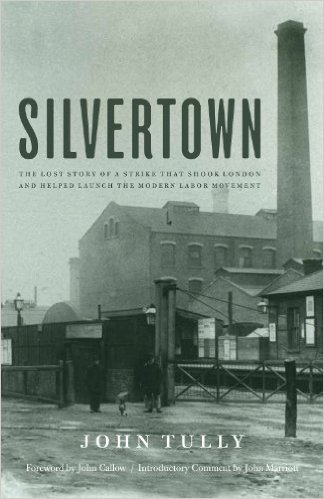
John Tully - Silvertown

In 1889 nearly 3,000 workers at Silver's, an enormous factory in East London, in Silvertown went on strike. The men and women who walked out were inspired by the New Unionism that was sweeping the city. They'd seen mass strikes by dockers in the East End that had won major victories and they wanted improvements too.

Their twelve week strike has almost been forgotten today. Perhaps because it ended in defeat. But John Tully's important book rescues the struggle for readers today, and, perhaps surprisingly, the reader will find that we can learn much from those brave men and women.

Silver's was enormously profitable. Having made a fortune from rubber, the plant was now a central part of a world-web industry. Their products literally stretched across the globe - a key, and very profitable, part of their work was manufacturing the telegraph cables that spanned oceans. Silver's even owned the ships that laid the cables, as well as the plantations that provided some of the raw material. Even after the twelve week strike, with production badly hit, Silver's could still declare "a half yearly dividend of 5 percent, or 10 shillings a share, tax free". Its shareholders, which included some of the most important political figures in the country, could breathe a sigh of relief. Not only were the profits still rolling in, but the company had faced down New Unionism.

For the workers who made these profits possible, life in the East End was appalling. Tully quotes some figures.
In 1906, Silvertown suffered infant mortality rates of 181 deaths per 1,000 live births compared with 141 per 1,000 in West Ham's central ward. Twenty to thirty years earlier, up to one-quarter of all babies in huge swathes of the East End died at birth of shortly afterward. By way of comparison, the UK's rate between 2005 and 2010 was 4.,91 deaths per 1,000 and that of war-devastated Afghanistan during the same recent period was 135.95 per 1,000..... [those for] Rwanda, the Central African Republic, Somalia, and the Democratic Republic of the Congo were respectively, 100,15, 105.37, 106.67 and 115.81 per 1,000.
As Tully comments, behind these figures "was a universe of human pain and sorrow".  Low wages meant poverty and hunger, lack of medical care and appalling living conditions.

The strike was impressive. At the forefront of it were women workers who led the collections, walking mile after mile to collect money for the strike fund. Some of them walked so far they wore out their shoes and new ones were purchased out of funds to enable them to carry on raising solidarity.

Eleanor Marx, who played a central role in the dispute argued explicitly for the equality of women and men in the struggle. Tully quotes one account of her speaking:
"she... appealed strongly to the women. They must form unions and work in harmony with the men's trade unions. As the dock strike had taught them the lesson that skilled and unskilled labour should work together, so the present strike should teach them a further great lesson, that they could only win by men and women working in combination. The capitalist was using women to underwork men and that would be the case until women refused to undersell their brothers and husbands."
Eleanor Marx was tireless in her work in support of the Silvertown strikers. But this was matched by the enthusiastic hard work of the strikers and their families. Regular marches, protest meetings and rallies took place from Hyde Park out to Silvertown itself. Large pickets tried to stop scabs going in, and encourage those workers who remained inside to come out.

For the strikers this was the crucial problem. New Unionism is so called because it represented a break from the old craft unions. By the late 1880s, these unions were still powerful (and sometimes very wealthy). But they represented a small and distinct layer of a growing working class. The power of the union was mostly used to protect the interests of a tiny minority of skilled craftsmen, and their leaders often looked snobbishly down on the new, mass based, trade unions. The failure of a handful of engineers to join the strike meant that Silver's management were able to keep the plant running and provide work for scabs imported from outside London to undermine the strike.

One can speculate about the debates inside the Silvertown strike meetings about how to win. Tully doesn't provide us much information on what took place on a day to day basis - perhaps because none is to be had. We can guess mass pickets by the strikers weren't enough to stop the scabs going in. Perhaps solidarity action by other groups of workers would have helped shut down the plant in the face of such determined management. Certainly the government and the state were doing everything they could to intimidate, imprison and occasionally beat the strikers back to work. In the face of this, only mass solidarity action could have won - though had the engineers walked out it would have made victory much more likely. History can only judge the AES in East London as helping management win in Silvertown.

The defeat of the Silvertown strikers came with a bitterly cold winter as the strikers were starved back to work. Hundreds were victimised for their roles and some never worked again. The defeat helped pave the way for a renewed employers offensive against the workers, which together with an economic down turn helped undermine the gains of New Unionism.

John Tully has done the working class movement and labour history a real service with this detailed book on our forgotten history. Sadly it reads all to familiarly, the story of greedy bosses and shareholders and underpaid, poverty stricken workers desperate for better conditions. But there is much in this book that can teach the modern trade unionist. The Silver's workers were considered unorganisable, and yet they fought a powerful industry nearly to a standstill. From their tragic, and unnecessary defeat, we can learn lessons and be inspired to fight ourselves.

Related Reviews

Marriott - Beyond the Tower: A History of East London
Mayhew - London Labour and the London Poor
Branson - Poplarism 1919-1925
Wise - The Blackest Streets
Fishman - East End Jewish Radicals 1875 - 1914