Tuesday, October 29, 2013

Joseph J. Varga - Hell's Kitchen & the Battle for Urban Space

In the period this book considered, Hell's Kitchen, or "Manhattan's Middle West Side" was considered by many commentators to be an area of poverty, corruption, crime and unsavoury types. In reality of course it was a home to thousands of working class people who carved their own lives out of the limited opportunities that they had. Writing in 1912, a social worker sums this up;

"[Hell's Kitchen] has been known for many years as the scene of disorders, of disregard of property rights and public peace. Certain it is that in the minds of New Yorkers who live outside the district... as well as in the minds of the police... there still lingers a tendency and doubtless a liking to think and speak of the district by the name that disorders, rioting and crime won for it."

Subtitled, Class Struggle and Progressive Reform in New York City, 1894-1914, Joseph J. Varga's new book is a detailed examination of the development of this district in New York, but more importantly, an attempt to understand, using the concept of the "production of space" how that urban space was shaped and, in turn, shaped those who inhabited it.

Varga notes that one "useful approach" is to consider the different vision of land use envisaged by those who live and work in a space and those who wish to exploit it for profit, or "between those 'planning and organizing themselves to make money' though the increase of aggregate rent levels, and those striving for 'affection, community, and sheer physical survival'."

In this, perhaps its simplest form, the books' discussion on the production of space in Hell's Kitchen could be an extreme metaphor for all those urban areas being "developed" and reshaped to produce accommodation for those with money, while the mass of residents are pushed to the fringes of urban areas. However Varga takes this further. In Hell's Kitchen, the production of space

"meant different things to different people. Accounts gathered from residents show how categories such as ethnicity, class, race and gender could bring one to a sense of space, but also fragment those same categories."

So there were numerous factors shaping the space of Hell's Kitchen, and in turn shaping the population. Some of these factors were imposed on the population by changes that had taken place many years previously. For instance steam engines ran to and from the docks on the roads through Hell's Kitchen. Included in the book is a fascinating picture of a steam train running through the middle of a main road while children play on the pavements. This juxtaposition of different spaces helped to earn some of the roads nicknames such as "Abattoir Place" or "Avenue of Death". Local campaigns to change meant battling the powerful dock and railway companies and took decades, and many deaths, to win change. (As an aside it's interesting that William Cronon's excellent history of Chicago mentions similar issues.)

The docks themselves, like all workplaces, were also centres of battles for space. Several excellent chapters look at the working lives of residents, the women working in linen and textile industries, the men on the docks. These tell stories of the battle for dignity, decent wages and improved conditions, as well as standing within the wider community. One quote describing life for casual dockworkers rings earily true as tens of thousands of contemporary British workers are living on "Zero Hours Contracts".

"Daily employment for dock workers was determined by the 'shape-up' in which experienced workers gather to be called to work... based on the arrival of a laden ship... As the telegraph message announcing the imminent arrival of a ship is received, a flag of arrival is raised on the pier, and word spreads among potential workers that 'the flag is up; and a crew needed... the call to shape up beings men together in the open space in front of the pier... The men jostle for position, joke and occasionally scuffle, and await the decision on who will be called to the crew. Stevedore foremen call men based on experience, reputation or on recommendation. In certain circumstances workers pay kickbacks to hiring agents who guarantee them a working day."

Varga looks at one narrow area of a city. But he recognises that what takes place in that space cannot remain isolated from external factors - government policy for instance, or the decisions of the Rockefeller institute. He concludes that "the production of urban space, though often unduly influenced by powerful spatial coalitions, is the product of a variety of factors that often exceed the ability to control it, and is affected by numerous overlapping networks of forces that do not socially construct "reality" but produce sites for often incommensurable actions".

In other words, in a quote from Marx that Vargas is fond of paraphrasing, "Men make history, but not in circumstances of their own choosing". That said, space itself, Varga points out, has a history, that may be independent of human interaction. Wooden piers rot, land changes, rivers alter their courses. The interaction between these internal and external elements is key to understanding how urban areas, indeed human ecology, alters over time and space.

Hell's Kitchen is not an easy read. At times the language is extremely academic and references abound to other academic studies and books that the casual reader is unlikely to have encountered. Those looking for an introduction to the social history of New York, or Hell's Kitchen itself, will have to start elsewhere. Those trying to get to grips with the application of spatial theories to urban areas through the use of historical evidence will find much of interest here.

Related Reviews

Harvey - Rebel Cities
Cronon - Nature's Metropolis
Smith - Uneven Development; Nature, Capital and the Production of Space

Monday, October 28, 2013

Terry Pratchett - The Wee Free Men

File:Nac Mac Feegle.jpgSomehow I had missed reading most of Terry Pratchett's Tiffany Aching novels. So I was pleased to discover this, the first in the series, in a charity shop last week. While set on the Discworld, the stories seem one stage removed - Tiffany lives in Lancre, but on a part far from Pratchett's usual haunts.

Pratchett is one of those authors who does strong female characters very well. Tiffany and her iron saucepan join Susan and her poker as a threat to demons and monsters. Tiffany is just nine, and gifted with the "sight" (and second, third and fourth sights). Spotted by a witch finder (scouting for those who have magical abilities, rather than to burn them) Tiffany must undertake a trip into the magical lands to rescue her brother.

Added into the mix are the Nac Mac Feegles a clan of tiny blue pictsies whose violence is only matched by their appetite. Tiffany gradually learns that the clan have been keeping their eye on her, and on many aspects of the wider sheep ecology. The Nac Mac Feegles adopt Tiffany as their own, temporary leader, and assist her mission with customary violence and humour. This is tight, well written and funny Terry Pratchett novel, my only criticsim is that Tiffany Aching seems old beyond her nine years. Nonetheless this is a must read Discworld story, probably not the best one to start with, but certainly one to read sooner rather than later.

Related Reading

Pratchett - Wintersmith

Thursday, October 24, 2013

Tony Cliff - Trotsky 1927-1940: The Darker the Night the Brighter the Star

The last thirteen years of Leon Trotsky's life, documented in this fourth volume of Tony Cliff's biography, are among some of the hardest of the Russian revolutionary's life. The book starts with Trotsky in internal exile, having been defeated by Stalin's faction. It ends with his murder in near political isolation. Having led millions of revolutionary workers, created and then led the Red Army to defeat the hostile imperialist powers in the Civil War, by the end of his life Trotsky finds himself isolated, with a few hundred followers in the newly formed Fourth International.

There is little in this book that deals with Trotsky's actual life. Cliff does document how Trotsky's family suffered. Children and grandchildren, even those with no interest in politics, are imprisoned, murdered and denied medical treatment by Stalin. In a brief passage dealing with Trotsky's personal feelings, Cliff quotes the anguished statement made by Trotsky and his wife after their son is murdered by Stalin's thugs.

But the vast majority of this book deals with the political activities and writings of Trotsky. Trotsky was a lifelong revolutionary, a committed Marxist. To attempt to write a biography of him that dealt with this period and didn't concentrate on his political activity would be impossible. In fact, in March 1935 Trotsky himself wrote:

"I think that the work in which I am engaged now, despite its extremely insufficient and fragmentary nature, is the most important work of my life - more important than 1917, more important than the period of the Civil War or any other."

What was this work? Much of it involved writing. Trotsky was prolific, producing pamphlet after article, followed by books and an endless stream of letters to his friends and comrades. Cliff argues that some of Trotsky's writings during this period are some of the finest Marxist writings ever produced. From Trotsky's extraordinary work The History of the Russian Revolution which details the transformation of the Russian economy, the growth of the revolutionary movement and the day-to-day struggles of the Bolsheviks during 1917, to his extraordinary analytically clear writings on Germany, Spain and France in the 1930s.

The chapters on France, Germany and Spain in Cliff's book are worthy of particular mention. In order to comprehend the brilliance of Trotsky's analysis, Cliff gives us a detailed overview of the situation in these three crucial countries during the 1930s. In particular Cliff details the rise of Fascism and the struggles to stop it. Trotsky's writings on Germany are among the most useful today. He argued that a United Front between the two mass left wing parties, the Communists and the Social Democrats could provide a strong enough movement to defeat Hitler's Nazis. But he also saw this method as winning masses of workers to revolutionary politics. Unfortunately, as Cliff argues, Trotsky had no forces to put this strategy into effect. The German Communists dutifully followed the Moscow line - Social Democrats were no better than the Fascists and the Communists had to resist both. The left, divided was defeated.

Cliff concludes:

"Neither the Communist Party nor the Social Democratic Party paid any heed. If Trotsky’s analysis and proposals for action had been accepted, the subsequent history of the century would have been completely different. Trotsky’s analysis of German events was particularly impressive in view of the fact that the author was removed from the scene of the events by a considerable distance. Still he managed to follow the day-to-day twists and turns. Reading Trotsky’s writings of the years 1930-33, their concreteness gives the clear impression that the author must have been living in Germany, not far away on the island of Prinkipo in Turkey."

But Trotsky wasn't always right. Tony Cliff argues that Trotsky's analysis of the degeneration of the Russian Revolution, particularly as outlined in his book The Revolution Betrayed, remains the starting point for any Marxist analysis of Stalin's Russia. But Cliff argues that Trotsky failed to understand that the bureaucracy that had arisen was a new class, with a new set of collective interests. Instead of simply being a managerial force in society, they were directing and shaping Russian society in their interests. This analysis of Russia as a degenerated workers' state was further weakened when the Red Army invaded Eastern Europe. These socialist societies were claimed, by some of Trotsky's followers after his death, as degenerated workers' states yet their had been no workers revolution to create them.

Cliff, briefly outlines his own explanation for Soviet society post 1920s, as State Capitalist. This is not, Cliff is quick to point out, to denigrate Trotsky's work, but to build on it. Cliff also critically discusses the Fourth International, the international grouping that Trotsky set up. Cliff had been a member of this, but here he tries to explain why the International didn't take off. Cliff asks if Trotsky had a choice whether he should setup the Fourth International. He rejects the approach of those who thought Trotsky could have entered a "watchtower" simply commenting on events. Instead he insists that

"if in these impossible circumstances Trotsky made some mistakes in the way the Fourth International was built – its over-ambitious structure, mistaken perspectives, including the semi-messianic spirit affecting it, let that be. Without trying to build a revolutionary party Trotsky would not have written his brilliant articles and essays at the time, analysing the situation and putting forward the strategy and tactics necessary for working class advance. Without the effort of building the revolutionary international, Trotsky’s contribution to Marxism, which kept it alive and preserved it from ossification, would not have been achieved."

But Cliff concludes that:

"struggling to build the Fourth International, which Trotsky did from 1933 onwards, was not the same as formally declaring its existence, which he did in 1938. The former was absolutely necessary, whilst the latter was almost certainly a mistake."

Volume four of this brilliant biography ends then at a difficult moment. Trotsky's death leaves a tiny number of isolated and weak revolutionary organisations dedicated to keeping the flame of Bolshevism alive. The Second World War and the Holocaust confirm the barbarity of capitalism and the continuing need for socialist revolution. Yet the revolutionary organisations that can led that struggle seem weaker than ever. Yet the great achievement of Trotsky, when many of his contemporaries gave up in the face of Stalin or were murdered on his orders, was to keep that flame alive. The last few chapters of this biography are particularly sharp, in part because they document Tony Cliffs own initial work developing Trotsky's ideas. That today we have, in however small a way, revolutionary organisations in many different countries is in large part because of the work of Leon Trotsky and those he inspired.

Related Reviews

Cliff - Trotsky 1: Towards October
Cliff - Trotsky 2: Sword of the Revolution
Cliff - Trotsky 3: Fighting the Rising Stalinist Bureaucracy

Monday, October 21, 2013

Chanie Rosenberg - Fighting Fit: A Memoir

Many members of the British Socialist Worker's Party and its sister organisations will be familiar with Chanie Rosenberg. She is one of the group's longest standing members, who helped, alongside her husband Tony Cliff, found the International Socialist tradition. In this short memoir, Chanie says that she hopes "to show that we revolutionaries are people like anyone else.. what happens between the evening meeting and the weekend paper sale?"

It is an excellent reason for writing such a book, but Chanie's life has been far from normal. She grew up in a Jewish family in racist South Africa, moved to Palestine to live on a socialist kibbutz in the 1940s but found her eyes opened to the racist nature of that state, and then began to engage in illegal, underground work agitating as part of a small Trotskyist organisation. Chanie and Tony Cliff lived in extreme poverty during these years. Moving to England things improved as Chanie was able to work as a teacher, and in doing so became central to some of the major struggles in the 1960s as teachers began to organise. Chanie played a central role in the rank and file of the teachers' union, and was blacklisted for her activity. Nonetheless she clearly, and rightly, remains proud of the victories they won.

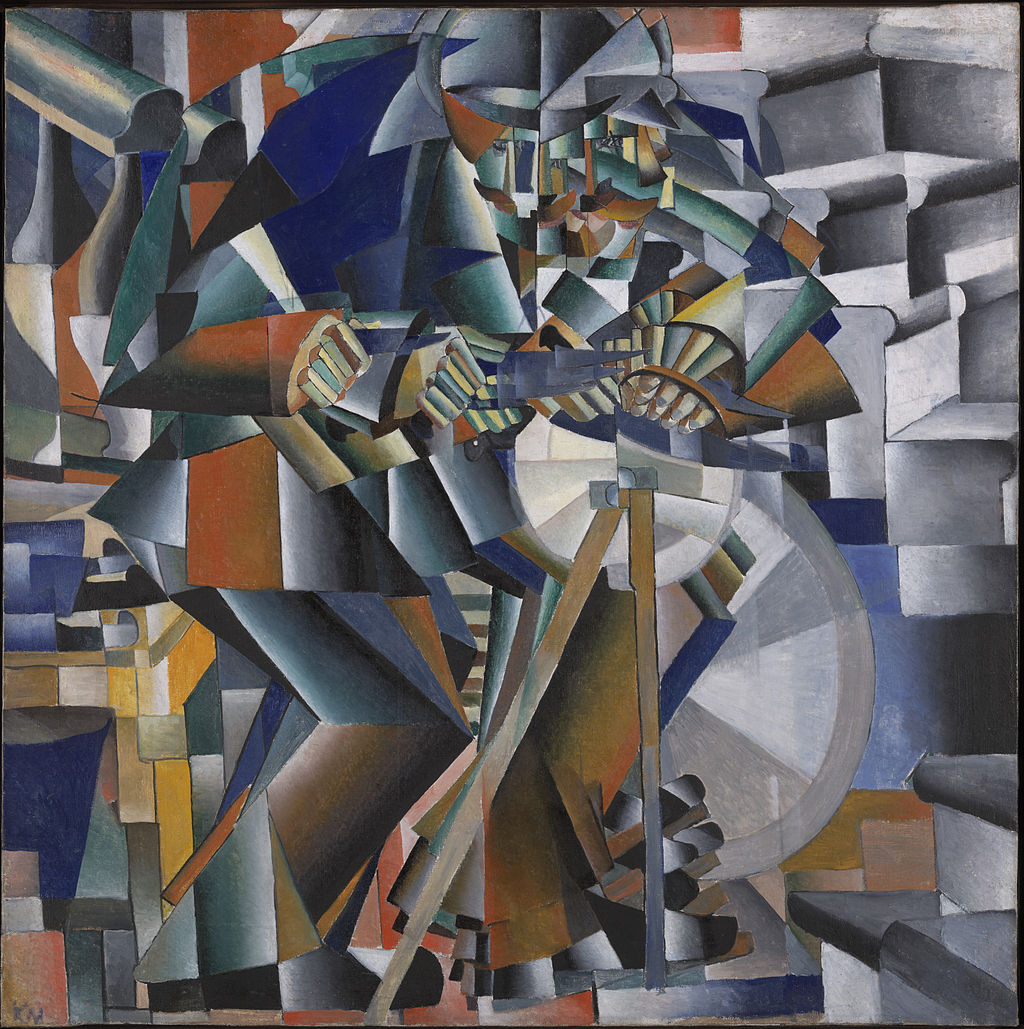
Chanie's second great love is art. When she retired she took up sculpture, and has exhibited in the Royal Academy ("I wish the 'Royal' but could be removed, but that might need to wait for the revolution" she says). But her interest in art and culture is also reflected in her writings and articles. Included in this short volume is an illustrated reprint of Chanie's pamphlet on the Russia artist Kazimir Malevich and his life and times.

Malevich and Revolution examines the evolution of the artists work, and vividly brings home the provocative, challenging nature of these "avant-garde" artists living in pre-revolutionary Russia.
They walked the Moscow streets provocatively in fancy dress, with flowers, algebraic or other motifs pained on cheeks, or masks, and violently coloured shirts.... Malevich [wore] a red wooden spoon, the symbol of Futurism, in his lapel...They tried in this way to drag the established poets and painters our of their ivory towers... into the streets, to reconcile art and society.
Chanie Rosenberg's treatment of Malevich's work is fascinating, comparing him to another "giant" of 20th century art, Picasso, she writes that Malevich "had one important circumstance missing in Picasso's life - the actuality of the Russian Revolutions of 1905 and 1917. Picasso, who was a Communist, had an intellectual's orientation to the new society, but not the reality of the revolution... and this difference influenced the direction of their artistic efforts enormously."

Kazimir Malevich - The Knife Grinder (1912)
While her discussion of Malevich's art is interesting, the way young, fledgling revolutionary society attempts to promote and develop art and artists as part of their transformation of society is equally fascinating. The Bolsheviks were keen to promote art as part of wider society, freeing artists from the need to produce art in order to live, instead living in order to produce art. 

This short volume should be read by anyone with an interest in the history of revolutionary socialism, particularly that of the IS tradition. But Chanie Rosenberg's life will fascinate everyone who has an interest in ordinary people who have tried to change the world. Chanie has fought her whole life for a socialist society that will free ordinary people, economically, politically and culturally. The second half of this book is an inspiring example of how revolution can do that.

Related Reviews

Rosenberg - 1919: Britain on the Brink of Revolution
Birchall - Tony Cliff: A Marxist for his Time
Dewar - The Quiet Revolutionary

Sunday, October 13, 2013

James Jones - The Thin Red Line

There are plenty of novels out there about the experience of the infantry soldier in World War Two. The Thin Red Line however feels very different. James Jones' novel looks at the fighting  on the Pacific island of Guadalcanal as US soldiers fought to destroy entrenched Japanese positions. Jones treats the battles, which are mostly small engagements between handfuls of men, as a highly individual experience. Different characters fight, at the same time as digging through their fears, their nerves, their hatred of their comrades, their feelings of their superiors and their drunkenness.

As a result of this approach there is no real story except the development of the battle. As we follow various individuals we see how the relationships between soldiers grow, develop or collapse. The officers in particular, some talented, many more useless, are the major factors determining how the ordinary soldier feels. As the battle progresses men are sacrificed for ambition, as well as incompetence. The fear of sudden death is matched with hope for a wound that will send the trooper back home. Sometimes the wound is too much; one of the hardest scenes in the book is the injured trooper who repeatedly screams "how will I be able to work?" when his comrades try to reassure him that his wound means he can escape from the war.

This is a classic war novel, but its excellence lies in part in the maturity with which it deals with subjects like sex (in particular a fairly frank attitude to gay sex, that must have been unusual in the early 1960s) and the reality of war. It deserves to be read alongside such classics as The Naked and the Dead.

Tuesday, October 08, 2013

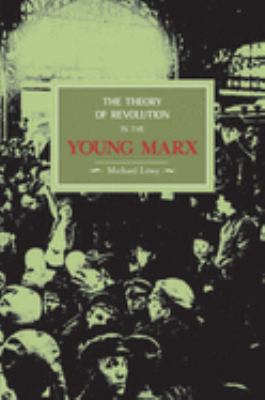
Michael Löwy - The Theory of Revolution in the Young Marx

This is an excellent piece of Marxist writing. First published in France in 1970, this 2005 edition should be on the reading list of everyone trying to understand Karl Marx's ideas and his method.

It also contains useful discussion on revolutionary organisation as envisaged by figures such as Lenin, Trotksy, Luxemburg, Lukacs and Guevara. But the bulk of the book is an attempt to analysis, using Marx's theory of Historical Materialism, the origin and development of Karl Marx's own thought. In particular his path to the idea of communist revolution.

Löwy begins by looking at Marx's ideas. He makes the point that "one must not separate Marx's theoretical work from his practical activity, the 'scientist' from the 'politician'." In particular, he strives to examine Marx's evolving ideas in the context, not just of theoretical debates, but also his experience in the world around him; particularly the arena of class struggle, and most specifically, the struggles of the developing proletariat.

Löwy points out that it is for this reason, that Marx's ideas were of his time. "Marx's doctrine could not have appeared during the peasant wars of the 16th century, not could Müntzer's doctrine have developed after the 1848 revolution." That said, there was nothing automatic about the development of these ideas, the "19th century proletariat offered many 'possibilities' besides Marxism".

Marx was not from the working class. So Löwy's discussion on why, despite this, Marx could become the most important proletarian theoretician is very useful. What matters when discussing such thinkers, Löwy says, is "not to what class he belongs... but what class he represents by his ideas."

From early in his life, Marx engaged with and in attempts to change the world. This took place at first as he tried to analyse and study the various movements taking place as various European countries tried to shake of the old vestiges of the feudal orders. At university Marx identifies with the ideas of Hegel, but he begins to break with this as his ideas clash with his experiences. As the author puts it;

"First, he obviously rejects, along with most of the Left-Hegelians, identification of the existing Prussian state with the realized rational state, and inclines towards a resolutely democratic position.... we find in his articles a virulent and radical criticism which we would look for in vain in Hegel: denunciation of particular interests and private-property owners... and pessimism regarding the possibility of making them harmonize with the general interest of the state."

But the criticism of private property owners did not automatically make Marx a communist. It did however send him down a particular route. As a newspaper editor, confronted by the class struggles of the poor, Marx begins to examine their condition. Initially his articles had as their "actual object", "peasant poverty... and not workers' poverty." But even at this early stage, Marx recognises that the poor are a "species" which "has only numerous arms with which to pluck the fruits of the earth for higher races". They are also "the only serious defender of freedom" when compared to the impotent and cowardly bourgeois.

Throughout the book Löwy demonstrates the way that Marx's ideas are evolving and changing as his study of the world as well as his experience of class struggle shapes him. For example;

"Between his break with the liberal bourgeoisie at the beginning of 1843 and this 'discovery' of the proletariat at the beginning of 1844 there lay, for Marx, a period of 'democratic-humanist' transition, a phase of ideological loss of bearings and of feeling his way which would bring him eventually to communism."

In order to understand this transition, Löwy quotes extensively from Marx's own writings. He also examines the various class struggles that influenced Marx - that of the Silesian Weavers for instance, as well as the various left wing, socialist and workers' organisations that Marx was involved in. Ultimately, Löwy helps us understand the importance of Marx's famous saying, "ThepPhilosopher's have only interpreted the world in various ways: the point is to change it." This represents not just Marx's arrival at revolutionary communism, but his break with passive philosophy and his transition to an understanding of the proletariat, as subject and object of history.

Marx's revolutionary communism then means that he spends the rest of his life engaging, in various ways, in movements to overthrow capitalism and advance the interests of the working class. Key to that, is the building of workers organisation. Löwy's discussion on what that meant for Marx and Engels forms a key part of the remainder of this book, as does his analysis of other revolutionary thinkers who followed Marx.

I found this section of the book less stimulating that the first half. In part because it wasn't in depth enough to fully grasp complexities. But also because the concluding remarks on the importance of Che Guevara's theory of revolutionary organisation felt like a break with Löwy's early chapters. Here Löwy argues that guerrilla organisation can, in certain circumstance, act as a catalyst for wider revolutionary struggles. This seems to me, to go against Löwy's (and Marx's) key point, that the emancipation of the working class must be the act of the working class. Indeed, elsewhere, Löwy is keen to emphasis the way that Lenin and other revolutionaries purposely avoided seeing vanguard organisation in these terms, celebrating the "spontaneous" role of the masses at the same time as understanding that revolutionary organisation must be in a constant, dialectical relationship with those masses. Learning from, shaping and developing the struggle.

This final criticism however shouldn't lead to potential readers avoiding this book. This is an extremely interesting book that will stimulate and provide food for thought for every socialist who reads it, and hopefully improve the understanding of both Marx and Marxism.

Related Reviews

Mehring - Karl Marx: The Story of his Life
Molyneux - The Point is to Change it: An Introduction to Marxist Philosophy

Sunday, October 06, 2013

Matthew Brzezinski - Red Moon Rising: Sputnik and the Rivalries that Ignited the Space Race

This is a very readable, interesting and entertaining introduction to the earliest years of the Space Race. It concentrates on Russia' development of rocket technology and the run up to the launches of the first two man made objects to orbit the Earth in late 1957.

What makes the story interesting is less the technical aspects to this enormous scientific breakthrough, but the political and social contexts of the early years of the Cold War. What is clear from Brzezinski's book is that neither the Soviet Union nor the United States had any particular interest in reaching space. A few scientists and engineers, such as the former German scientist (and Nazi) Werner von Braun, did. But they were a minority within the rocket programmes and certainly did not have much influence on the politicians and political decision makers.

Russia's missile program arose as a result of their inability to compete with the military advancements of the United States. Following on from the doctrine of the Second World War, the US was banking on growing its military might based on air power. Hundreds of massive bombers could threaten the Soviet Union with nuclear annihilation through their long range. Key military and political figures in Washington hyped up the idea of the Soviet Union having a comparable air force and the US engaged in a bomber arms race faced with the threat of nuclear attack.

But this was built on lies. The USSR didn't have the bomber fleets and had no ability to build on a comparable level with the US. They could and did begin to develop nuclear missiles. These they felt would enable them to threaten the US at a much reduced cost. Khrushchev in particular needed the financial leeway to offer some improvements and reforms to Russia's population.

When Sputnik was launched, it terrified the American people and shocked the US government to the core. In hindsight, its clear that President Eisenhower came close to losing his position as the media and people sought a scapegoat for the new threat to the country. Indeed, his handling of the crisis, is a textbook example of how not to deal with the press.

By banking on bombers, the US had starved their missile programmes of cash. This meant their technology was far behind that of the Russians, even through they had the best German scientists and the majority of the Nazi rocket technology. One fascinating aspect to this, is how the US military were desperate to avoid von Braun and his colleagues even thinking about going to space - they tasked someone with the job of checking they didn't fuel the final stages of test rockets so that the scientists couldn't orbit something "accidentally".

Sputnik was laucnhed as a propaganda tool. It almost didn't happen, because as was the case in the US, those holding the purse strings were only interested in the military potential for rockets. The resultant propaganda coup (and the follow up when they launched a dog on the second rocket) stunned the Russian leadership as much as the Americans, though Khrushchev recovered faster.

The book finishes rather abruptly, with the US finally getting a much smaller satellite into space. Brzezinski implies that once the US had got over its shock, it rapidly set about the scientific and civilian conquest of space, while the Russian's languished with the death of their key rocket scientist. I felt this was a little limited, particularly given that once they had reached the moon, the US clearly decided it had won the space race and give up on serious manned space exploration. Because the US was engaged in a Cold War confrontation with Russia, money for its space programme dried up rapidly when that competition was won. The success of the US moon shots must be contrasted with the complete abandonment of the field from the mid 1970s onward. But this is a minor criticism of a very useful and interesting book on the history of the early space race which locates it in the midst of military and economic competition, rather than the desire to understand the universe.

Related Reviews

Scott & Leonov - Two Sides of the Moon

Monday, September 30, 2013

Stephen King - The Dark Tower

I began reading Stephen King's epic Dark Tower series back in 2006. For reasons best known to myself I decided only to buy them when I found them second hand. Hence it's taken longer to finish them than Roland, the last gunslinger and hero of the novels, spent on his quest. It's perhaps this time lag that has helped make reading the series feel like an epic trek, but most of that is to do with King's writing. The scope of this series is truly huge. The characters are numerous, but never shallow. Even relatively minor characters (I'm thinking of Bill the Stuttering Robot in the final book for instance) feel worthy of their own books.

The books themselves vary. Some aren't as good as others, and strangely, the two I enjoyed the most, are the ones least about the quest. Wizard and Glass and The Wastelands both work almost as self contained books, and King's writing befits this well. That said, they are essential to the wider story, and must be read as part of that.

In reviewing the climatic novel of such a long and complex series, it would be wrong to talk about the plot. Mentioning almost any details might ruin other readers taking the same journey. I suspect that most readers are reading toward the end, though the true enjoyment of these books is the trip. King understands this (in fact, in the epilogue to this last volume, he acknowledges this explicitly, and alludes to it in the last chapter) and perhaps the ending is not as satisfying as many would hope. That said, when you have followed characters through some thousands of pages, it is difficult to not feel emotionally linked to them. The ending itself is, at first glance, somewhat flat, but the reader might have to read it again, in detail to understand exactly what is being said.

Back in 2006, I worried that this might be a "long turgid trip" to volume seven. It certainly was long, but it was rarely turgid. While occasionally I felt an editor might have removed some of the words, the imagery and characters will long remain with me.

"Go then, there are other worlds than these."

Related Reviews

King - The Gunslinger
King - The Drawing of the Three
King - Wizard and Glass
King - The Wastelands
King - Wolves of the Calla
King - The Wind Through the Keyhole

Friday, September 27, 2013

Gary Younge - The Speech: The Story Behind Martin Luther King's Dream

Published to mark the fiftieth anniversary of Martin Luther King Jnr's famous "I have a Dream" speech, Gary Younge's new book is more than an examination of those famous words. It is a celebratory and occasionally critical account of the birth and growth of the Civil Rights movement and Martin Luther King's role within it.

The speech, as Younge points out, was not just made at a huge demonstration. It was made in a year that would see immense change. It was "delivered in a year that started with Alabama governor George Wallace... declaring, 'Segregation now, segregation tomorrow, segregation forever,' and ended with President Kennedy's assassination.

Within in a year, Lyndon Johnson had passed the Civil Rights Act, which many of those who heard King's speech would see as a limited step forward. King himself was transformed by the speech, which while it was broadcast live and heard by many, only really received the iconic status it has today with the his assassination. Younge quotes one of King's colleagues as saying "Though he was extremely well known before he stepped up to the lectern, he stepped down on the other side of history."

King was a polished speaker. Younge tells us that in 1963 alone, King made 350 speeches. He takes us through the speech sentence by sentence, showing how King's training as a preacher, his politics and his religion are used at key points, to raise the crowd up, to give power to his rhetoric and to draw the listener in. No wonder that JFK remarked on hearing it, "He's damned good. Damned good."

But the speech was of its time and place. The movement was evolving and growing, but so was King. The march's culmination was King's "dream" but the speakers themselves went on to reception at the Whitehouse. That may well have been a step forward, but the links between sections of the Civil Rights movement and the democratic party helped to dampen down the more radical demands. One of the strengths of this book is that it draws this out - from the secret switch that would have allowed the US state to shut down militant speakers, to plans by the march organisers to drown out more radical action themselves with calming singing by the stewards. Indeed, right until the very last moment, key figures in the coalition that had organised the march were desperately trying to avoid radical rhetoric from their own speakers that might undermine the, essentially passive, message of the march.

King is most famous for his strategy of passive resistance, of non-violent action. Many people at the time, and since criticised this approach for being unrealistic in the face of the powers of the street. There is of course truth in this, but Younge makes the point that for all ones criticisms of King, one cannot discount Martin Luther King. To do that would be "to effectively dismiss the most prominent and popular proponent of civil rights."

King himself stood for far more than civil rights. Younge notes, for instance, that he was a leader that also wanted government intervention to help the poor, who attacked the US government for their violence, and who, towards the end of his life was beginning to look to wider social struggles. Young quotes one current congressman, who knew King arguing that "[King's] speech four years later at the the Riverside Church in New York, in which he condemned the war in Vietnam and talked about the United States as the greatest purveyor of violence in the world, was by far the best speech of his life in terms of sheer tone and substance."

It is fascinating and perhaps futile, to speculate about who King might have become had he not been assassinated. Younge avoids this, and looks instead at King's legacy, or more importantly, the US today. A country still riven by class differences, poverty, war and racism. A country that has twice elected a black President, but a country where in 2004 there were more Black men without the vote than in 1870, the year Black males got a vote. Black male life expectancy in Washington DC is lower than that in the Gaza strip, and years of Obama's leadership have meant worsening conditions for those at the bottom of US society, particularly black people.

Ultimately, King's speech was about a dream. It's power at the time lay in its "nebulous" demands as much as its rhetoric. As such it could be opened to "interpretations that are not only varied but arguable contradictory" says Younge. A veteran civil rights activist quoted points out that the speech was "easily digestible by a white audience and more palatable to them, as opposed to his antiwar speeches and critiques of capitalism". That said, King was part of a movement that began a struggle which did make an enormous difference. Others, often with more radical methods, strategies and ideas, were to follow.

Younge muses on what makes great speeches, and indeed whose speeches are actually heard:

"The speeches we believe to be most decisive can only come from those speeches we have heard about. Those given by a poor woman in Swahili, Kurdish or Quechua are far less likely to make it through the filter of race, sex, class and language than those given by wealthy white men in English, French or Spanish."

Sadly, as this indicates, the struggle that King gave his life for remains to be won. Fifty years after he outlined his "dream", a dream that remains inspiring and powerful, millions of people still have lives blighted by poverty, racism, war and unemployment.

King's struggle, and hence this book, began a discussion of what sort of movement is needed to change things. It's a powerful book, which perhaps leaves too many such questions unanswered. Nonetheless it is an excellent start for further debate.

Related Reviews

Richardson (editor) - Say it Loud! Marxism and the Fight Against Racism

Sunday, September 22, 2013

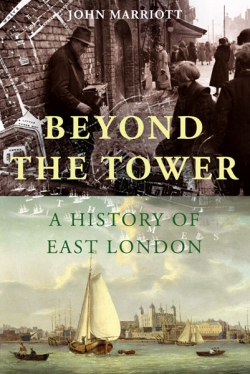
John Marriott - Beyond the Tower: A History of East London

When I lived in East London, I always felt it was one of those urban areas where events of historical importance seemed to have taken place on every street corner. I lived in Poplar, and there were murals, monuments and plaques everywhere. East London was the place of the Match Girls, George Lansbury, Jack the Ripper, Dock Strikes and the battles against the fascists in the 1930s and the 1990s.

John Marriott's new history of the area then is a must read for anyone who lives or works in the area. It is also a must read for anyone trying to understand the wider social development of London, and particular the lives and struggles of the ordinary inhabitants.

The poverty and grim lives of many of East London's inhabitants, led the area to be seen almost as a foreign country. In particular, Jack the Ripper's Whitechapel Murders led the press to paint a picture of "outcast London", but those who lived, worked and organised in the area knew that the reality was very different. Yes there was immense poverty, but the tabloid like descriptions of violence and poverty served to sell newspapers, but not educate readers to realities. Some, like William Booth, the founder of the Salvation Army, saw in East London,a foreign country;

"As there is a darkest Africa is there not also a darkest England? Civilisation, which can breed its own barbarians, does it not also breed its own pygmies?"

But Clara Grant, a teacher in a charity school in Bow, argued:

"novelists and journalists demand vice and squalor when they come down to write us up. The expect evil and seem horribly disappointed if they discover we are not black at all, but only grey... a rich man, wishing to help our work, induced a big daily paper to send down a journalist... He said, 'it won't do. You're not black enough.' I pointed out that I could not very well work up a murder or two, or put every child in rags and bare feet to rouse interest."

Real life in East London was very different to the squalor depicted in the popular press. There was immense unemployment, something that has bedeviled the area since the early days of capitalism and continues today. But alongside the big employers, the Docks, the factories and the like, there have also been numerous smaller trades. The textile industry, in various forms, from the days of Huguenot immigrants to the sweatshops of the 1970s has been a central part of the local economy. One of the great strengths of this book is the way that Marriott demonstrates both continuity with the past, and the change. East London's industry is one part of this.

But at the heart of this book is struggle. The struggle of ordinary people to try and improve their lives. Some of this is criminal. Marriott deals with the criminal gangs of the 40s, 50s and 1960s. But some of it is more collective. Drawing on several books that I've already reviewed on this blog, Marriott looks at the history of the East End's Anarchists, Jewish Radicals and socialist movements. He sees them as mainly peripheral to wider politics, and downplays some of the larger achievements of the struggles in the area. For instance, Marriott argues that the Match Girls strike had far less of an impact than many have argued, "that it inspired the wave of industrial struggle that followed is unconvincing" he writes.

Certainly though, Marriott doesn't ignore these struggles, though he tends to imply that industrial militancy on the Docks or in the gas workers strikes of the late 1800s, had only shortlived impacts. Though he certainly acknowledges their importance in shaping the workers movement of the 20th century. Similarly, Marriott argues that the great anti-fascist mobilisation at Cable Street had little impact in stopping the BUF. That is probably true, but only if you ignore the wider impact of the mass protest, both in terms of the larger population and the people of East London themselves. That tens of thousands took to the streets is of more consequence than the fact that the police stopped the march. The march could not have proceeded, and the decision of the police was one made to prevent a far more bloody outcome.

Those who know more about such individual instances might find Marriott's book frustrating in places. Certainly however, I think it gives an excellent overview of the history of this important centre of the working class. Marriott doesn't give an inch to any criticisms of immigrants, arguing that they have played a central and important role in the areas economy, and the struggles of its people. The book finishes with the looming 2012 Olympics. The author doesn't see much benefit accruing from this international gala of corporate sponsorship for ordinary people. But that's in tone with the history of the area. Working people pushed aside and exploited by larger forces. Those changes, and the resistance, make this an interesting read that will bring to life much forgotten history.

Related Reviews

Fishman - East End Jewish Radicals
Fishman - East End 1888
Piratin - Our Flag Stays Red
Branson - Poplarism 1919 - 1925
Wise - The Blackest Streets

Friday, September 20, 2013

Stephen King - Song of Susannah


Spoiler Alert

With this, volume six of the Dark Tower series, Stephen King's epic series begins to draw to a close. Sadly this novel felt to me very much like a filler. It bridges the gap between the set-piece fun of the previous book, Wolves of the Calla and the finale. That novel was heavily influenced by classic Western themes, right down to a classic, if unusual shoot-out at the end.

Song of Susannah picks up immediately after the end of Wolves. Susannah is trapped in her own body by a former demon and is heavily pregnant with a child that will be the nemisis of Roland. The ka-tet of heroes follow her, but are split up, travelling through time, space and possibly universes to reach modern New York and Maine in 1977. You don't need to be an enormous Stephen King fan to know that Maine is the site of many of his novels, indeed he lives there himself. Rather unusually, King then becomes a key figure in the tale, not particularly as protaganist, but as the driving force of the books. An author influenced by his characters. At first I found this rather annoying and self-indulgent, but as the book reached its end, I quite liked the drawing together of all the threads of King's novels and universes.

Sadly, as a whole, I didn't feel the novel worked as well as the earlier books - it is more of a setup for the series' climax. Certainly King does have the talent to bring it all together, but whether he actually can achieve that rather difficult task remains, for me, to be seen.

King - The Gunslinger
King - The Drawing of the Three
King - Wizard and Glass
King - The Wastelands
King - Wolves of the Calla

Monday, September 16, 2013

David Fernbach (ed) - In the Steps of Rosa Luxemburg: Selected Writings of Paul Levi

In recent years there has been renewed interest in the work of the German revolutionary socialist, Paul Levi. In part this has been inspired by the publication in English of Pierre Broue's classic book on the German Revolution, which emphasised the role that Levi played in the early years of the German Communist Party. Following the murders Rosa Luxemburg and Karl Leibneickt, Paul Levi took on the difficult task of guiding the fledgling party in its early years.

Building mass revolutionary organisation during a revolution is not an easy task. The revolutionary wave that swept Germany at the end of World War One dragged millions of workers into action. Levi's task then, was to try and shape the rapidly growing Communist Party into the type of organisation that could lead a revolution.

The first few articles in this selected works, deal with Levi's writings and speeches in this early period. His address to the founding conference of the Communist Party (KPD) is a polemic designed to win an argument that KPD members needed to involve themselves in the elections to the German Parliament. On this question, and others, Levi was trying to challenge the ultra-left instincts of the new, young communists. Levi lost the argument and the KPD abstained. But millions of workers didn't and the KPD found themselves isolated in the debates around the election.

That said, the KPD grew rapidly, benefiting in part from its links with revolutionary Russia. Nonetheless, the lack of theoretical clarity meant that the KPD's leadership made some serious tactical errors. Paul Levi was the most able of the leaders and his articles are often critical looks at strategy and tactics, trying to learn lessons and teach the party.

Most famously the KPD attempted to force a revolutionary situation in Germany in March of 1921, the so called "March Action". This was a dismal failure and the KPD lost tens of thousands of supporters and many people were killed. Using the unemployed to try and force strikes, KPD members invaded work places, blew up railcars and tried to provoke a revolution that didn't fit with the experience of the majority of German workers.

Paul Levi, who by this point was no longer on the party's central bodies, wrote a long polemical critique of the Action. When published, his pamphlet led to his expulsion for breaking party discipline. It seems fairly clear to me though, that by this point, Levi had decided the KPD was broken beyond repair. His critique is a brilliant defence of the role of revolutionary socialist organisation and roots of the KPD's mistakes. This, and his speech in his defence to the KPD's CC are must reads for anyone trying to understand what took place in Germany in the early 1920s.

Comrades no doubt might argue whether or not he was justified in his actions. But famously Lenin quipped, that while Levi had lost his head, "at least he had a head to lose". But it is clear from these writings that Levi rapidly lost much of what made him such a brilliant leader. In the aftermath of his expulsion and his creation of a new, small left organisation, Levi argued that the KPD was no longer reformable. Part of the blame for this, he argued lay in the decline of the Russian Revolution and the resultant rot in the Communist International. What marks out Levi from others who drew these conclusions, was that Levi was doing this as early as 1921, long before the battles for the future of the Comintern or the Soviet Union had been decided. Levi's intervention in support of (say) Leon Trotsky could have been crucial. Instead he appears to have abandoned them.

Paul Levi
So, contained in these writings are two pieces that Levi writes at this time, one an introduction to a piece by Rosa Luxemburg on Russia, the other a very critical introduction to Trotsky's In Defence of October. Levi critiques the Russian Bolsheviks for their actions post October. But in the latter of these essays, and in other pieces, he clearly fails to see that Trotsky's polemic that is part of an argument about the way forward for the Soviets. Indeed in critiquing Trotsky, Levi ends up siding with those in the Bolshevik leadership who had done most to damage the Germany party.

Having written a brilliant defence of the Democratic Centralist method pioneered by Lenin in 1919, Levi is reduced to criticising the Bolsheviks for a method that meant the "stations of its development... were resolutions and splits on account of resolutions". Levi ignores the decades of brilliant underground work that the Russian Revolutionaries undertook, in order to blur the reasons for the very creation of the Bolshevik party on very specific principles of organisation.

Similarly he attacks Trotsky for writing long polemics on (eg) the Anglo Russian agreements or the revolution in China. Clearly Trotsky does this for fun. Levi seems to miss that both of these arguments went to the heart of Trotsky's battle with Stalin over the direction of Russian policy. Was the Russian party going to look outwards to Revolution, or inwards to Socialism in One Country?

Ultimately I found this a frustrating collection. Some of the articles are very important and will help socialists understand the German revolutionary process and the mistakes of the KPD. However the picture they paint of Levi himself is confused. In the immediate post-war period he comes across as a brilliant revolutionary, striving for revolutionary clarity and a party capable of leading a revolution. His 1919 polemic is a particularly brilliant example of this - it meant the forcing out of a section of the party that was influenced by anarchism and syndicalism. The resultant renewed clarity of ideas meant the KPD recruited thousands of new members within months on a much clearer basis.

But quickly after he leaves the KPD he comes across as a much more liberal socialist (an able one at that) whose polemics against the Russian Revolution seem more about a sectarian assault on the KPD than developing revolutionary clarity.

Sadly this book is also marred by an awful introduction, which, while an excellent outline of the life and times of Paul Levi, has several problems. Not least of these is that the author of the introduction tries to recast Levi as the living embodiment of Rosa Luxemburg's ideas. I think this is unfair on both Levi and Luxemburg, who were both brilliant individuals capable of making judgments based on concrete situations, rather than having some innate set of ideas that remained unchanged over years. Speculation whether Luxemburg would have taken the same decisions as Levi at key points is not particularly useful in clarifying the historical process in my view.

More worryingly, the introduction appears to lay the blame for the failure of the German Revolution and the rise of Fascism on "Leninism". But the KPD of the late 1920s and early 1930s was a long way away from Leninism - it had become, as Broue points out well, a tool of Stalin's foreign policy. It was no longer a revolutionary organisation that was struggling to end capitalism. It's weaknesses flowed from this position, not from a Leninism that was far from its own practise. Indeed in the earlier 1919 article, Levi clearly models his vision of the KPD in part on the Bolsheviks' own practise.

These criticisms aside, few of Paul Levi's writings have been available to the English reader and this book makes some of his key writings (particularly his critique of the March Action) available. This is something that should be welcomed by socialists and historians everywhere. But the book needs to be read in conjunction with a decent history of the German Revolution - Pierre Broue's brilliant work would be ideal, or Chris Harman's Lost Revolution.

Related Reviews

Broue - The German Revolution 1919 - 1923
Reissner - Hamburg at the Barricades

Monday, September 09, 2013

Hilary Mantel - Wolf Hall

Those who follow my reviews regularly might find Wolf Hall an odd choice of novel. After all, what interest could a revolutionary socialist have in a sprawling story about the machinations of the Tudor ruling class?

Apart from Hilary Mantel's wonderful writing, the answer is best summed up by Karl Marx's description of the ruling classes as a "band of warring brothers". In her tale of the rise of Thomas Cromwell, against the backdrop of Henry VIII's infatuation with Anne Boleyn, what Mantel does brilliantly is show the way that those at the top of Tudor society are in a constant fight for power and wealth at the same time as they try to present a united front to the rest of society. The jockeying for position, the way courtiers fall in and out of favour, the fear that they might upset the king, or someone close to him is the meat and drink of this novel. Those who are able to play the game can achieve power and wealth far beyond the dreams of most. Ruling class women, whether Queens or Ladies in Waiting are prized for their ability to produce heirs. Wolf Hall is not some romantic novel, it feels brutally real. There is little marriage for love here, only for alliances and male children.

Mantel's Thomas Cromwell is done brilliantly. He's less the terrifying bully many of us know from the history books, more a thoughtful, intelligent schemer whose photographic memory and intellect is utilised to control and direct from afar. At times he appears to be more an observer on great events. But if his rise to power on the coat tails of Cardinal Worsley, followed by a quick jump of ship might reminds one of a less than average liberal democrat MP it is carefully timed, designed to maximise personal gain.

Mantel's Cromwell is haunted by his own demons - his violent father and his lowly upbringing, as well as the deaths of his beloved wife and children. These are some of the best passages, the ones that make the reader love Cromwell, and side with him even as he rises to the top of the Tudor dunghill.

The Tudor England in Wolf Hall is a grim and dirty place. Descriptions aren't detailed; this is a novel of dialogue and impressions. But Mantel doesn't neglect those at the bottom of society. The majority of the inhabitants of Medieval England aren't a backdrop to the story of the rich, they are a constant presence. A mob that the rulers fear and worry about, who might rebel, or side with the Queen against the King, or stone a bishop.

This 700 page novel never feels overwritten or difficult despite the massive cast of characters and complex plot. Mantel's use of language and humour is beautiful, though her characters seldom are. Her writing deserved the awards and I have no hesitation in recommending it, as well as looking forward to part two.

Related Reviews

Mantel - Bring Up the Bodies
Mantel - A Place of Greater Safety

Monday, September 02, 2013

Felipe Fernández-Armesto - 1492: The Year Our World Began


The arrival of Columbus in the New World in 1492 is often seen as the date which changed history. But had  it been possible to have some sort of global over-view in the later half of the 15th century, few people would have bet that the rather uncouth, unlucky and insignificant admiral would have been the first to discover the Americas. Indeed, few would have put any money on the Spanish state doing it, or even anyone in Europe. Back in the 1490s, as this fascinating history shows, Europe was an economic, technological and scientific backwater compared to some parts of the world.

The years around 1492 had a whole series of "turning points" for world history and this overview of them demonstrates that the world may well have turned out remarkably different. It is also a useful book to demonstrate that European superiority has few historical roots, and violent conquest was the chief mechanism that made sure that Europeans dominated world politics for the next few centuries.

So this book covers some fascinating history. The period marks the expulsion of the Jews from Spain, that helped transform a whole number of countries. The point when Russia stopped being a group of fractious states and headed off down the road of becoming an Empire. A period when a whole series of sub-Saharan countries were at the peak of their prosperity and influence. 

The country that seemed most likely to dominate the future world back in 1492 was China. Her wealth was internationally famed. Travellers and traders did their best to get there and Europe found herself marginalised by local trade in the Indian Ocean. These "seas of milk and butter" linked the world's richest economies but were self contained, forcing European traders to either travel around Africa or find new ports.

China's explorers should have reached America first. Admiral He had made a number of voyages around the Indian ocean, creating Chinese trading sites and bringing embassies. He also brought back giraffes and other strange animals for the Chinese nobility to gawp at. Fernández-Armesto comments that: 

"An age of expansion did begin, but the phenomenon was of an expanding world not, as some historians say, of European expansion. The world did not simply wait for European outreach to transform it as if touched by a magic wand. Other societies were already working magic of their own, turning states into empires and cultures into civilisations. Some of the most dynamic and rapidly expanding societies of the fifteenth century were in the Americas, south-west and northern Asia and sub-Saharan Africa. Indeed, in terms of territorial expansion and military effectiveness... some African and American empires outclassed any state in western Europe."

But Europe did come out on top. Not because of inherent genius or superiority, but because other countries did not turn outwards, or turned in on themselves or succumbed to invasion, war or collapse. China recalled its enormous ships and never found the Americas. But because Europe did;

"The incorporation of the Americas - the resources, the opportunities - would turn Europe from a poor and marginal region into a nursery of potential global hegemonies. It might not have happened that way."

That's one factor. But to do it required guns, germs and steel. Indeed, the author makes the point that it was only the systematic and brutal conquest of the Canary islands by Spain that gave Columbus a launching off point that would allow him to utilise the Atlantic currents and reach America. 

While I don't agree with all of the author's historical analysis (or his historical approach), I found this a very useful introduction to non-European history. To places that have been forgotten or written out of history. A useful book that should prompt further thought and study.

Friday, August 23, 2013

Utsa Patnaik & Sam Moyo - The Agrarian Question in the Neoliberal Era: Primitive Accumulation and the Peasantry

In the early 1970s, Walter Rodney wrote How Europe Underdeveloped Africa. His argument was that Europe had underdeveloped Africa in the interests of their own developing capitalist economies. Patnaik and Moyo's short book is a further development of this thesis. In particular though they argue that neoliberalism continues to make the Global South's agriculture subservient to the interests of the developed world.

The way that neoliberalism has opened up the economies of the developing world to the interests of capital is nothing new. From an agrarian point of view, neoliberalism has two major impacts - the removal of "price support mechanisms" that have helped peasants sell their goods in the face of cheaper commodities from other countries and secondly, a "sustained attack on peasant-owned or occupied land in the name of 'development'."

The case of India will help us understand what happens. After independence, the Indian agrarian economy "was protected for nearly 40 years and output of foodgrains per head slowly climbed back to 183kg per head by the early 1990s." Output per head had peaked at 200kg around 1900 and fallen to 136kg in 1946. But India was opened up to neoliberalism in 1991 and since then, the gain of the last forty years has been "wiped out". Consequences are shocking:

"No mass peasant suicides owing to debt took place before 1991 in India. Since 1996 as global primary prices fell and under the WTO discipline, protection has been virtually removed; indebtedness-driven farmer suicides started from 1998. Total recorded farmer suicides between 1998 and Dec 2008 were 198,000; specifically debt-driven suicides have claimed over 60,000 peasant lives over the last decade.

Neoliberalism has, in the interests of big capital, reconstructed the agrarian economies of countries like India. The authors argue that this is in order to fuel the continued accumulation of capital in the developed world.

"The entire thrust for free trade in agriculture, as promoted by the Bretton Woods institutions and through the WTO has as its primary aim the re-opening of the lands of the global South to meet the increasing demands of the North."

Controversially though, Utsa Patnaik in his opening essay argues that this is not new. Rather than an agricultural revolution in Europe fuelling the birth of capitalism, he says that agriculture proved inadequate to the task. While Enclosure and the Clearances laid the basis for the industrial workforce to enter the factories, it could not feed them.

"In 18th century England there may well have been a revolution in the social relations of production, but the resulting capitalistically organised agriculture showed little success in meeting the challenge of industrialisation from the point of view of raising the productivity of land and labour to the extent required."

Patnaik's detailed figures seem to show that yields in Europe did not grow enough to feed the industrial workforce and that these economies were then dependent on colonies for their cheap foodstuffs as well as markets. Africa, Asia and South America were thus refashioned in the interest of the needs of the developed world. This is part of a wider argument with those, such as Henry Bernstein, whom Paitnaik believes suggest that development of capitalism in poorer countries no longer requires the surpluses from domestic agriculture. On the contrary, Paitnaik suggests that it was never domestic agriculture that brought about capitalist transformation, rather a global exchange that relied on the higher yields obtained in colonial countries to fuel industrialisation, which in turn left the rest of the world underdeveloped.

Today the authors argue, little has changed. The reaction to the 2007/2008 food crisis was a "new scramble for land in Africa" to feed a price bubble in food and biofuels. Neoliberalism and the food crisis has also created a speculative bubble in land prices further impoverising and driving more peasants from the land. A process that Moyo refers to as a resuscitation of the land commodification agenda. Today, as Paitnaik argues,

"corporate subjugation of peasant production is nothing by the imperialist domination of our peasantry for the purpose of export production and it pauperises the peasantry and the labourers."

Contemporary land grabs and the dispossession of peasants from their lands are merely the latest stage in a process that began in England in the 17th century. But the peasantry of the Global South has "nowhere to go". 


What is the alternative? Both authors argue that what is primarily needed is a break from the neoliberal agenda. This much is obvious and their book provides ample evidence for why this is necessary. Less clear is a longer term strategy. The ability of the state to subsidise sections of the economy and offer reforms is a key strategy. For instance, Moyo concludes that what is needed are:


"New regional integration strategies based on holistic agrarian reforms and aimed at collectively reversing the decline of domestic food production and food consumption, including protection from external shocks and dependency are crucial. These have to counter current market based functional regionalism by building a popular regional industrial policy framework that systematically reverses the current opening up of the region."

But this seems only to offer a more friendly version of capitalism on a localised level. While blunting the neoliberal axe may be a good thing, the problem for the people of the Global South as well as their counterparts in the North is an economic system that places them secondary to the pursuit of profit. While food sovereignty is a worthy aim, in and of itself it cannot protect the poorest sections of society against a system geared on the pursuit for profit. Ultimately capitalism, whether the neoliberal system, or more localised is built on exploitation.

State lead intervention to assist and develop the agrarian economy is needed. But what is more urgently needed is a movement from below that can challenge capitalism, in the North and the South and begin to create an agricultural system based on providing for need not profit.

Related Reading

Bernstein - Class Dynamics of Agrarian Change

Larry Niven - Ringworld Engineers


*Spoilers Alert*

While engaging in my own writing tasks I recently decided to re-read Larry Niven's Ringworld series in its entirity. I've reviewed a couple of these previously (back in 2006 for Ringworld and 2007 for the finale here).

The Ringworld Engineers is the second of Larry Niven's book about this enormous alien ring that orbits a far off planet. Readers of the first (and by far the best) of the series will know that when humans Louis Wu and Teela Brown arrive, along with the Kzin Speaker to Animals and the Puppeteer, civilisation on the Ringworld is in decline. Across millions of square miles a previously high tech civilisation has fallen apart. Ringworld Engineers begins the telling the story of how the "fall" happened and who is responsible. In particular, we learn that the Ringworld itself is under threat of destruction as its moving out of its orbit and threatens to brush against the sun.

One of the reasons Ringworld worked so well was precisely because the collapse of civilisation gave the whole novel a sense of mystery. The reader doesn't know who built it or how. The hook that hangs the second novel together is whether Louis Wu and the others can save the Ringworld, while risking the lives of billions of billions.

Niven's writing has matured by the time he penned Engineers. Though in this one, as with the sequels, he begins a somewhat awkward fascination with inter-species sex. This apparently develops as a way that the Ringworld's myriad of different, but linked species, can prove their friendliness. It makes for some odd encounters and slightly eye-brow raising sequences.

On the subject of sex, one of the improvements over the first novel, is that Niven is much better at writing about female characters. The only two women in Ringworld described at any length are basically there to show of Louis Wu's sexual prowess and intelligence. One of them indeed was specifically a prostitute employed on a spaceship (who turns out to be a liar too) the other was the lucky Teela Brown who appears to only be able to survive with a male companion. I never quite knew how tongue in cheek Niven was when he wrote that Teela took up with a walking cliche at the end of the first book. That said, both these novels are of their time. SF these days rarely have quite such obvious sexist limitations as the 1970s. Though sadly things haven't changed rnough.

Engineers is a fast paced novel. Not quite as sharp as the first, it has none of the flabbiness that the remainder of the series has and the ending ties the story into Niven's wider Known Space universe. There are some brilliant set piece scenes too. For instance Chemee's (as Speaker to Animals is renamed) attempt to prove himself as a proper Kzin by capturing an enormous Battleship; Louis Wu's exploration of a city whose families via against each other for limited resources and knowledge. It's an echo of medieval Bologna whose inhabitants erected towers to outgun and impress each other. Wu arrives with the secret to repairing their broken technology and upsets the whole power structure.

The fallen Ringworld civilisation gives a great backdrop to this story, indeed the Big Dumb Object of the title is the best thing about this series.

Related Reviews

Niven - Crashlander
Niven - Ringworld
Niven - Ringworld's Children

Tuesday, August 20, 2013

Mike Davis - Late Victorian Holocausts: El Niño Famines and the Making of the Third World

Ever so often you come across a book which profoundly shakes you. Mike Davis' Late Victorian Holocausts is one of those. On every page there is a fact or figure that makes the reader rage with anger; every chapter is a ringing denouncement of capitalism and colonialism. It should be required reading for all those politicians, journalists and armchair generals who profuse to know what to do about the "Third World".

In the late Victorian era, a period stretching from roughly 1876 to 1900, a series of droughts and famines hit large areas of the world. Various studies, both contemporary and more recent, paint a truly appalling picture of the resultant deaths. A study by the medical journal The Lancet in the immediate aftermath suggested that 19 million Indian people died during the 1896-1902 famine. The totals from all the events, allowing for the variance of scientific debate suggest between 31.7 and 61.3 million died.

Mike Davis argues that these were not merely environmental disasters. Changing weather patterns were caused by the complicated ENSO changes of air-pressure and ocean temperatures. The El Niño effects certainly could be associated with dramatic changes in rainfall, or wind patterns that brought crop failure or flooding to large areas. In late Victorian times politicians and apologists for colonial policies made much of the supposed links between these weather patterns and regular famines. But Mike Davis argues that the economic policies and the particular nature of colonialism (specifically in the British Empire) made, in places as diverse as Brazil, India, the Philippines, Korea, Africa and China, the famines far worse. As Davis suggests, of the victims:
They died in the golden age of Liberal Capitalism; indeed many were murdered... by the theological application of the sacred principles of Smith, Bentham and Mill.
I've written elsewhere about the Irish Potato Famine and the way that British rulers application of the principles of Free Trade condemned thousands to starvation while grain was shipped out to be sold at a profit. What Davis describes is a similar process on an enormous scale:
Although crop failures and water shortages were of epic proportion.. there were almost always surpluses elsewhere in the nation or empire that could have potentially rescued drought victims.
It is worth repeating this simple fact. That (with the possible exception of Ethiopia in 1899) Davis argues that there was almost always enough food or other supplies that could have helped the starving peasants. The people didn't just starve - sometimes they sold their children into slavery in the hope they would survive, or killed strangers and committed cannibalism, or ate tree bark and mud. But their deaths, or many of their deaths, could have been avoided.

Take the official report on the Bombay famine of 1899-1902, which concluded that "supplies of food were at all time sufficient and it cannot be too frequently repeated that severe privation was chiefly due to the dearth of employment in agriculture." In neighbouring Berar, commissioners said that "the famine was one of high prices rather than a scarcity of food."

The problem was that the hungry couldn't afford to eat. It was rarely that there wasn't food. For instance Davis argues that the problem in the case of India was that the British had transformed the old social relations. Under British rule, profit was king, but so was private land. The British destroyed the old economic relations that gave peasants access to communal land and resources like wells. They broke up the old social obligations that meant Chinese rulers stockpiled grain for famine outbreaks. They scrapped the requirements to build or maintain flood defences or dams, because they were considered native, and not valid scientifically. All these facts helped make famine far worse when it arrived. Indeed some of the most shocking descriptions here are when Davis contrasts the way that before colonialism, societies in India, Africa or China dealt far better with drought than under the Imperial era.

Indian Famine Victims 1877
But there was a reason the British behaved like this. Over the 19th century the peasants of South America, Africa, China and the Indian subcontinent became attached to a world market. In a case study from India, Davis describes how the real local power was the Manchester cotton barons who effectively, through their representatives in the Raj, imposed a cotton market on some of the most arable land in India. By changing the local taxes, getting rid of previous local government structures and altering property relations, the British turned the area into a vast cotton factory which produced wealth for the cotton owners of Lancashire, but poverty for the native Indians. When famine came the peasants had no crops to eat, but nor did they have enough money to buy food. The logic of the market was then to abandon them to their fate.

And the vast infrastructure that the Empire builders created, the roads and rail-roads didn't serve to bring food to the hungry, it took it to where the profits were to be made. In the 1870-80 famine, according to official reports, In Bombay and Madras Deccan, "the population decreased more rapidly where the districts were served by railways than where there were no railways." It was easier to take the food away with trains. Davis also writes on how modern industry failed the hungry:
The newly constructed railroads, lauded as institutional safeguards against famine, were instead used by merchants to ship grain inventories from outlying drought-stricken districts to central depots for hoarding (as well as protection from rioters). Likewise the telegraph ensured that price hikes were coordinated in a thousand towns at once, regardless of local supply trends.
This is not a happy book. When Mike Davis describes the vast celebrations for Queen Victoria's Jubilee that involved enormous feasts at a time of vast hunger, most readers will feel sick. I certainly did. But the really sad thing is that nothing has changed. Capitalism's distortion of agriculture through the creation of cash crops and the domination of large multinationals leaves millions still in a precarious place, and as Mike Davis suggests, all the evidence is that global warming will make El Niños worse in the future.

Anyone interested in the confluence of the environment and the economy and the impact upon human beings should read this book. But so should anyone who wants counter-arguments to those who suggest that Empire was a good thing for the majority of people in the world.

Related Reading

Davis - Planet of Slums
Davis - The Monster at Our Door
Woodham-Smith - The Great Hunger; Ireland 1845-9
Bello - The Food Wars
Magdoff & Tokar - Agriculture and Food in Crisis

Sunday, August 11, 2013

Kent Flannery & Joyce Marcus - The Creation of Inequality

Subtitled How Our Prehistoric Ancestors set the Stage for Monarchy, Slavery and Empire this is a very important, and extremely well researched book that traces the development of human society from egalitarian hunter-gatherers to class divided, unequal societies like monarchies.

The authors argue that the first human societies where ones dominated by generosity, sharing and altruism. These societies also hand numerous internal checks to try and protect that egalitarian nature. For instance, both Eskimo and !Kung people have been shown to have used marked hunting arrows to determine who killed an animal. But the !Kung mixed up these arrows so no one really knew who had been the successful hunter. These two societies, and many other hunter-gatherer communities used ridicule and humour to downplay success and prevent anyone gaining a position above others. While successful hunters were cherished, they were expected to downplay their skills and share the fruits of their victories.

Flannery and Marcus have tried not to use studies of contemporary hunter-gatherers. Understanding that almost all of these groups are now changed by their contact with globalised capitalism, the authors instead have looked at records from the earliest encounters with hunter-gatherers. They then attempt to look at historical evidence for similar behaviour in the past. In fact, the greatest strength of this book is its rigorous attempt to find evidence for all aspects of the author's theories at different stages of human history and in different places.

As hunter-gatherers developed technology and skills, their social organisation developed as well. With the development of clan based societies, it was possible for inequality to appear. At first this was simply the difference between someone who had skills or experience over those who didn't. But with the rise of agriculture, the ability to store surplus food meant that "Big Men" could arise who could give others food. In time, some of these people, or even whole lineages could crystallise out into a wider class.

The authors then explore how these early unequal societies might become monarchies or other types of stratified groups, discussing how groups learn from each other, destroy each other, or even revert back to different social organisations.

This is a very important book, and I encourage everyone who has an interest in early human societies to read it. This review deliberately doesn't do the book, or the authors justice as I have written a more detailed and lengthier review for elsewhere.

My extended review of this book for the International Socialism Journal 140 can be read here.

Related Reviews

Lee - The !Kung San: Men, Women & Work in a Foraging Society
Stringer - Homo Britannicus
Leacock - Myths of Male Dominance
Engels - Origin of the Family, Private Property and the State