Wednesday, November 28, 2012

Christian Wolmar - The Subterranean Railway

In his introduction to this history of the London Underground, Christian Wolmar makes the point that few writers on London discuss the enormous rail systems that lie beneath the surface. Indeed, Peter Ackroyd's wonderful biography of the city apparently only has half a dozen references to the Underground. This is a shame because the history of the London Underground parallels the rise of London the city and carries the marks of many of the social events that go with it.

In particular, the Underground bears the marks of the political and economic choices made to build it. Like most great Victorian innovations, the early lines were driven by private finance, raised by railway entrepreneurs who hoped for a swift return on their investments. Few of them, or their shareholders lived to see their money back and as the system got expanded, rival companies swallowed up others, until the 20th century when the whole became partially taken over by the government and part of what is now London Transport.

To the modern traveller this might seem unimportant. But it might be worth contemplating the years of delay caused by such early private finance schemes as when your tube sits waiting in the dark for no apparent reason, it could well be because of decisions made by early industrialists. They may well have chosen to install a rail junction instead of routing tunnels above and below each other. The money saved made the total cost easier for the board of directors, but generations of travellers have cursed their wasted time.

The lines themselves often follow roads, lost rivers and may not take the most direct route. Again this was often about saving money. Early tunnels were made through the "cut and cover" method. Engineers effectively dug an enormous ditch then covered the tunnel over. This was costly and caused enormous disruption, it also meant compensation had to be paid. Railway companies were accused of directing their proposed routes through areas were residents were easier to displace. Wolmar quotes a local vicar, near Smithfield who said against the builders of the early Metropolitan line:

"The special lure of the capitalist is that the line will pass only through inferior property, that is through a densely peopled district, and will destroy the abode of the powerless and the poor, whilst it will avoid the properties of those whose opposition is to be dreaded, the great employers of labour."

The problem wasn't just the capitalists. It was also the government. Victorian laissez-faire capitalism frowned on government involvement in such projects, so the "haphazard" design of the underground was partly due to "being a pioneer" but also "due to the refusal of the government to engage with the planning of the system". As Wolmar comments the "French system of central planning was not the British way."

Of course this doesn't just apply to the London Underground, but also other major transport systems. The lack of a central London overland station of any note, and the multiple lines heading into diverse train stations from around the country, making travellers lives overly complicated. Nonetheless there were many who wanted to make the system more rational, though not all of them had the view of a publicly owned system. Albert Stanley, appointed to oversee their investments by a group of American businessmen began the process of branding the whole tube with iconic signage at the same time as joint tickets for all the lines were coming into play. Stanley, like all good capitalists did his best to ensure that his lines made profits for the shareholders and to do so the largest bus company. Rather than close it down he began to "integrate the services in such a way that direct competition against his own underground lines was reduced, but also ensured he could weaken the remaining three lines outside his control by using buses to run against them."

Anyone who has witnessed the traumatic effects of bus de-regulation will have seen similar tactics employed by travel companies against each other, trying to drive competitors out of business before putting up their own prices.

It is tempting to repeat the many fascinating stories of social history or technical engineering in this review. Wolmar tells the story of the way that in the early days of the Blitz, Communist Party members and others forced London Underground to open up the tube as bomb shelters. He then tells the less well remembered stories of the way that the Underground became almost a permanent home for many Londoners. Authorities put on trains to provide food and water to those sheltering in the stations, and their were enormous problems with sanitation. Underground denizens even elected representatives to negotiate with the authorities. Wolmar also reminds us that the Underground was a shelter during the First World War, something often forgotten by those whose history only goes back to 1939.

After World War Two, the Underground entered a long period of decline which the system has only recently escaped. He blames this on two things:

"The lack of investment for much of the past fifty years, and overcrowding, with record numbers now using the system. The story of the Underground since the Second World War is a sad tale of missed opportunities, displaying a lack of foresight over the need for new lines and based on the mistaken notion that usage of the system would decline as a result of the nearly universal ownership of the motor car."

This lack of investment is partly to blame, in Wolmar's view for the tragic fire that took place at Kings Cross Station, an event which recently had its 25th anniversary. Perhaps more importantly Wolmar argues that successive governments saw the London Underground as a problem rather than something to assist London's economy and indeed he complains as much about "short term political interference" as he does privatisation when listing the ills afflicting London's transport system. Tucked away in a footnote he points out that:

"Even today, London Transport receives around half the level of subsidy in relation to income compared with its counterparts in European cities - typically only 30 per cent of its money comes from subsidy, compared with twice that level in Paris or Berlin."

In addition, he points out that it is almost impossible to measure the importance of the system through the money it can make:

"A financial study of the Victoria line made thirty years after the first section opened in 1968 still suggested that it was only a marginally worthwhile development even when taking into account the social benefits such as savings on car journey times.  Looked at financially, the Victoria line appeared to be a complete non-runner... Yet the line is operating at virtually full capacity for much of the day and is a vital part of London's infrastructure."

I had expected Wolmar's book to be a interesting anecdotal history of a part of London. It is that, but it is much more. It is an argument for a rational public transport policy and that makes this an even more worthwhile read. That said, it is full of fascinating information, the stories of the underground trains powered by steam and filled with smoke, the attempts to move trains with long ropes or compressed air and the experiences of passengers underground with few windows and lights are fascinating and will almost certainly give the modern commuter something to think about while waiting for the Central Line.

Thursday, November 22, 2012

Alastair Reynolds - Blue Remembered Earth

Warning. This review contains enormous spoilers.

Alastair Reynolds specialises in writing large scale science fiction. Often his characters, and indeed story lines can seem dwarfed by the immense scale of the environment he is writing about. His stories cross galaxies, enormous spaces and long periods of time. In this context Blue Remembered Earth is very different. If I was to be someone optioning film rights of Reynolds' works I'd choose this one.

In a very different way from his previous writings, Blue Remembered Earth seems very much character driven. We begin with Geoffrey a scientist studying elephants in an Africa several centuries from today. Humans have survived the chaos of climate change, war and environmental disaster, though Earth has changed. Greenland exports fine Merlot wine and much of what was the industrialised, developed world of today has been overtaken by the powerful economies of Africa, India and China. Reynolds is brilliant at painting this new world, dominated by clean technology, space travel and colonies on the Moon and Mars.

The technology is very much the backdrop though to a personal story of Geoffrey and his Akinya family. The Akinya are fabulously wealthy. Their capitalist fingers in every pie, from space travel to genetics research. Their ageing matriarch has died and leaves behind a series of tantalising clues that takes Geoffrey back and forth across the solar system. Geoffrey, formally a man who wants nothing more than to study the brainwaves of his beloved elephants finds himself exploring our strange future.

Reynolds' future is surprisingly believable, though some of the concepts are a little mind numbing at times. The humans who alter themselves to become sea creatures, mermaids for instance and join the aquatic nations are one example. I also felt the evolving mechanical machines of Mars had a little of the Edgar R. Burroughs to it. These are minor problems though. What Reynolds does well is to link together the different character story lines, often taking place in widely different parts of the solar system to create a novel of humanity on the edge of a new era.

Related Reviews

Reynolds - The Prefect
Reynolds - Zima Blue
Reynolds - Terminal World
Reynolds - Galactic North
Reynolds - Redemption Ark

Tuesday, November 20, 2012

Chris Harman - Zombie Capitalism: Global Crisis & The Relevance of Marx

Chris Harman's last book is breathtaking in its scope and detail. Like his classic work A People's History of the World he condensed a lifetime of reading, analysis and Marxist thought to create a book that is nothing short of an economic history of capitalism, from a Marxist point of view. It is also a deep critique of the inherent problems of the system. Finished as the latest economic crisis began to bite with the failures of banks around the globe, Chris Harman's book has left us valuable ammunition with which to argue against those who believe that capitalism can be either saved, or reformed.

Harman begins this work by looking again at the basic ideas of Marx's economic thought. He takes us through the way that Marx understood that humans interact with the natural world. Our labour being precisely our attempts to shape the world in our own interests. This labour is what makes us human. Most important to this, is the Labour Theory of Value. Human labour is the most important thing about our society, as Harman explains:

"Machines and raw materials do not themselves create value. Only the exercise of human labour has added to the natural wealth that existed in a state of nature and only continued human labour can increase it still further."

Under capitalist production what happens is that this labour is used to fulfil the interests of the capitalists. Goods that are manufactured and sold, are sold at a price that allows the capitalist to "cover not only the cost of providing the labour power of the workers (their wages) and the profit of the company, but also the cost of the wood and the wear and tear [to equipment],"

The "surplus value" - the amount extracted from the workers' labour above and beyond that needed to pay them, is the core issue for a Marxist understanding of economic. But for capitalist production as a whole there is another related factor, which is at the centre of Harman's explanation of what happens to the wider system. This is the "rate of profit". This is, in its simplest terms, "the ratio of surplus value to total investment". All sorts of factors influence the rate of profit - not least the level of wages, and it changes over time and between industries. But, what Marx identifies and Harman explains, is the great tendency for the "rate of profit" to decline over time. It is in this decline, and the attempts of the capitalists to increase their rate of profit, or slow its decline that the problems of the wider system are related to.

By arguing that the falling rate of profit is key to understanding the long term crisis of capitalism, Harman doesn't ignore other factors and issues. For instance, he recognises, with Marx, the problems of declining consumption caused by the reduction of wages, or unemployment and the way that this can feed in to wider economic problems to help create crisis. Harman also explores the role of finance capitalism and the banking industry, a subject that is particularly important when trying to understand the roots of the present crisis. Harman quotes Marx:

"The credit system accelerates the material development of the productive forces and the world market", but does this through developing "the incentive to capitalist production, enrichment through exploitation of the labour of others, to the most pure form of gambling and swindling". Finance drives "the process [of production] beyond its capitalist limits" resulting in "overtrade, overproduction and excessive credit" in ways that rebound on production itself."

The first few chapters of Zombie Capitalism which look at Marx's thought and its application to 21st century capitalism are some of the clearest explanations of the subject I have ever read. Harman's great ability as a writer was to make these concepts accessible. The rest of the book applies this analysis to this history of capitalism, and reasserts some of the ideas which the International Socialist tendency that Harman was part of, developed to explain particular aspects of economic history. Thus Harman explains again the "Permanent Arms Economy" the enormous government spending that enabled the "long boom" of the post-war years to provide so much stability to western economies until the late 1960s.

Harman also surveys the wider economists, both right and left, and both develops their work and criticises it. In particular I found his discussion around the causes of the Great Depression very useful. Of particular interest to current economic debates is Harman's critique of Keynes. Today it is popular to argue that government spending can solve economic crisis, and many mainstream economists are returning to Keynes after rejecting him through the neo-liberal era of the 1980s and 1990s. Yet Harman is critical of Keynes, not least because he argues that such government spending had little to do with rescuing the economies of the 1930s (until the war economies began) or the long boom. He also notes that during the 1970s, governments became convinced that Keynes ideas were infallible, yet when they did fail, quickly switched to more monetarist ideas. Harman locates the end of the long boom, not with particular economic priorities or policies, but rather in the falling rate of profit.

Harman concludes this monumental work by looking at the changes that have taken place in the modern economy. He discusses whether the working class, identified by Marx as the system's "grave digger" can still play that role. He finds that while the class has changed in many ways, workers of different types are still the producers of the profits for the system. He also challenges some of the myths - that manufacturing is dead in the UK, or that call centres are the most important section to developing capitalism in India. In addition, Harman argues that many of the sacred cows of those who believed in globalisation (from both the right and left) have proved false. Capital still tends to associate and rely upon one nation state and few capitalists are actually able to up sticks and move around the globe at will to defy workers fighting for better conditions.

Harman does not ignore the wider implications of capitalism's ongoing existence. He looks in detail for instance at the environmental impact of the system, he uses a classic quote from Marx to point to the way that capitalist interests over-ride the needs and interests of wider society:

"In every stockjobbing swindle everyone knows that some time or other the crash must come, but everyone hopes that it may fall on the head of his neighbour, after he himself has caught the shower of gold and placed it in safety. Apres moi le deluge! is the watchword of every capitalist.... Hence Capital is reckless of the health or length of life of the labourer, unless under compulsion from society."

Harman continues;

"Exactly the same logic as that described by Marx is found in the attitude of capital to the pumping out of climate change gases today. Capitalist politicians make beautiful speeches about the need to do something.... and the bow down before interests which say that this or that measure to deal with climate change will be too costly for the economy to bear."

This analysis has only one conclusion. That if we are to avoid the destructive reality of capitalism, then we need to destroy the beast itself. Harman's book should be a weapon in the hands of every activist who wants to challenge the system. It is a forensic disection of capitalism, whether discussing the falling rate of profit, or the peasantry in the modern world. It also points to the alternative. A system based on need, not greed. The socialist society that Chris Harman devoted his life to fighting for. Zombie Capitalism along with the wealth of books and articles of Harman's are essential ammunition in that ongoing fight.

Related Reviews

Choonara - Unravelling Capitalism
Harman - Revolution in the 21st Century
Harman - Marxism and History

Thursday, November 15, 2012

David Kerr Cameron - The Ballad and the Plough: A Portrait of the Life of the Old Scottish Farmtouns

David Kerr Cameron was the son of a Scottish horseman, a labourer who travelled from farm to farm, working as needed. David himself became a journalist in his twenties and in his fifties produced this book. It documents a now almost forgotten part of Scottish history, the Farmtoun, which formed the basis for the agriculture of the north-east part of Scotland.

The Farmtoun was a near unique arrangement. It is essentially a collection of large farms, making up a small town in its own right. The farmtouns were centred on a house, with a bothy for the single men who made up the workforce. Usually ten, or twenty labourers would live in the bothy, each employed for six or twelve months at a time. They'd be horsemen or ploughmen, or youngsters learning to the trades. The life was hard, and unlike some who write about agricultural life in the past, Cameron does not pretend this was some rural idyll. It was;

"a lifetime of the starker side of farmtoun existence: the poor food, the continuous mud, the constant rheumy pains that came finally from wearing clothes that were damp almost from one year's end to the next; ... the squalor of bothy life and the hardships of domestic service.... Men were mangled by machinery improperly guarded, gored by bulls inadequately tethered; children drowned unseen in mill dams."

The farms themselves were in close knit communities. There was co-operation, but no sharing of crops. Co-operation was needed because of the poverty, few had enough animals or equipment to go it alone. As Cameron writes, "it was common for a joint tenant of a farmtoun to own no more than the half-share of an ox - and eight were needed to pull the plough. The run-rigs were worked by the folk of the community themselves... the farmtoun clusters were co-operatives only in the labour sense; there was no sharing of crops."

Of course the community wouldn't let one of their own starve, but this was agriculture that was frequently close to the wind. The work was tough and some farmtouns didn't survive. Their names often point to the difficulties and failures; Scrapehard, Weariefauld, Stoneyvale and Clayhill.

Working arrangements were also hard. Men were fined for leaving in the evenings without permission, or for other misdemeanours. As one ballad of the time has it;

"The order was to bed at nine,
And never leave the town,
And for every time we left it,
We'd be fined half a crown"

Of course the men did,

"We never heeded Adam
But aye we took the pass,
Sometimes to buy tobacco,
Sometimes to see the lass."

Pay was low and the work long and hard and the author points out that "many of today's farming dynasties were shamefully founded on the wealth that came from squeezing such men into penury."

At the heart of this book are the bothy ballads. Collected as the farmtouns were beginning to fade from agriculture if not from memory. Cameron uses them to great effect, using them to tell the stories of famous ploughmen, the dull, monotonous diet and the love affairs. While concentrating on the farming, Cameron also tells the stories of the women and girls who worked the farms. Getting up before the men to heat water and light a fire, their work was as dull and hard as the men's. It also involved long hours,

"For her seventeen-hour day, the pay was pitifully small a.... Mary Melvin going home to Mains of Corsindae in 1876 got £6 15s (£6.75) for the half-year while Maggie Thom that same year and in the same region, got over £2 less."

 Cameron discusses the affairs and flings that led to many illegitimate children and the way that the church tried to crack down on such behaviour. But in the isolated farmtoun, young men and women made their own rules.

This is a difficult book to read, not least because of the dialect. But Cameron writes assuming his reader has some knowledge of agriculture. He gives a detailed explanation of the importance of the introduction of the 'swing plough' for instance, without explaining what it is. But minor points like this do not really detract from an important work of social history. The poetry, songs and ballads bring to life a forgotten time, one that even as the author wrote was beginning to slip into semi-nostalgic memory, though the pain remained too:


"Have you forgotten it? The dream I mean-
That dream you buried in the ground
Like an early lamb, many winters since?
What else could keep you, knowing all
The odds, but refusing to acknowledge them,
Thinking that victory was in sight?"

The author of this song might have been thinking of a farmtoun driven destitute by the cheap imported grain that came from the US, that helped break Scottish farmtoun agriculture, or perhaps someone driven into the town by old age and unemployment. But there was pride too, pride in work and a job well done, and family and friends and the community.

"Success the ploughmen's wages crown;
Let ploughmen's wages ne'er come down,
And plenty in Scotland aye abound,
By labour of the ploughmen.
For the very King that wears the crown,
The brethren o' the sacred gown,
The Dukes and the Lords of high renown,
Depend upon the ploughmen."

For some, like the women who milked the cows before sunrise, the introduction of machinery was met with a prayer of thanks. For others it meant unemployment or the destruction of old skills. But the rise and fall of the farmtouns is the story of a brief period when Scottish agriculture was transformed. It is also the agriculture that shapes much of the landscape we see today in the north-east of Scotland and its a history that rest of the blood, sweat and tears of thousands of men and women. David Kerr Cameron's book is a fitting tribute to their lives.

Related Reviews

Hutchinson - The Soap Man: Lewis, Harris & Lord Leverhulme
Richards - The Highland Clearances
Whitlock - Peasant's Heritage

Wednesday, November 14, 2012

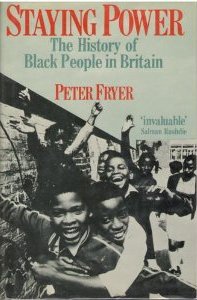
Peter Fryer - Staying Power: The History of Black People in Britain

Peter Fryer was a socialist journalist of enormous reputation. As related in this obituary his experiences in Hungary during the 1956 uprising reporting for the Daily Worker led him to break from the British Communist Party. He remained active on the far left, joining a Trotskyist organisation where his talents as a writer continued to be demonstrated. I've reviewed a couple of his works, including his slightly eccentric Studies of English Prudery on this blog. Staying Power however is Peter Fryer's most important book, the culmination of a lifetimes reading, writing and research. While it covers an immense period, it concentrates on the 16th century onwards for this is when the role of black and asian people becomes most important for British history. In part this is because more and more black people are living in the British Isles, but it is also because it is during the first couple of centuries of this period that slavery becomes absolutely central the accumulation of wealth for British capitalism. It is during this period, to paraphrase Marx, that capital was born into the world, drenched in blood.

Beginning with the presence of black people amongst Roman legionnaires on Hadrian's Wall, Fryer relates much of this history through contemporary accounts, quotes and frequently the voices of black people themselves. These forgotten accounts are often powerful and heart rending - the stories of escaped slaves, people who failed to escape slavery, victims of racism and violence and occasionally those who fought back and escaped persecution or their chains.

As a socialist, Fryer's sympathies are with the oppressed, rather than the oppressor. In one of the two core chapters of the book, that on slavery, he discusses how slavery was ended, first in Britain and then in the colonies. Not for Fryer is this a result of the benevolent gentleman or the sympathetic judge. While both these figures make an appearance (Fryer is too rounded a historian to ignore their contributions) his explanation is rooted much more in the activities of ordinary people, men and women, black and white. Here for instance he describes the way that slavery was ended in Britain:

"if, contrary to popular belief, slavery in Britain was not outlawed by Mansfield in 1772, how in fact was it ended? The short answer is that black slaves in Britain voted with their feet. They had always... resisted by running away from their masters and mistresses. Helped and encouraged, and to some extent protected by the Mansfield decision, they had largely completed this process and freed themselves by the mid-1790s. This gradual self-emancipation is a matter of social rather than legal history..."

Fryer also understands that not all white people had the same attitudes to the small, but growing numbers of black people in Britain. Often those who fought and organised against slavery where the white working class, instinctively understanding that, the ruling class had an interest in dividing them and using racism to undermine their collective strength. Moral revulsion at slavery from ordinary people played its role - Fryer documents a number of accounts of escaped slaves being accepted into white working class communities and protected from their former masters, including a welsh mining community. But it was at periods of "working-class radicalism" that the abolitionist movement grew. This even went to the heart of the parts of Britain which had gained the most from slavery itself:

"The 1792 petition from Manchester, whose population was somewhat under 75,000 carried over 20,0000 signatures. Even Bristol had a petition. It was the spread of radical ideas amongst working people that had brought about this change". 

Anti-slavery was part and parcel of radical activism. It was at the core, for instance, of the ideas coming out of the French Revolution and later of Chartism. This is not surprising, the racial ideas that justified slavery were in part a product of growing fear of rebellion at home, as Fryer points out, "there was an organic connection in nineteenth century Britain between the attitude the ruling class took to the 'natives; in its colonies and the attitude it took to the poor at home."

He continues:

"Though the Chartist movement evaporated after 1848, by the 1860s working people in Britain were once more challenging the political and economic power of those who ruled and employed them. Faced with this challenge, 'the proponents of social inequality slipped all the more readily into racial rhetoric'."

The second core chapter, and perhaps the most important is the one were Fryer shows how racism was consciously created and encouraged on the plantations. This invention of racism was needed to justify what was happening to the slaves and to allow slavery to continue. It was simply too profitable for the slave owners and traders, yet without racial justification for the slave trade, it would have been impossible to continue with it. In part this was pseudo-scientific racism, in part it was simply the extension and development of the myths and prejudices that existed about Africa and the non-white world. Africans were "lazy", "childlike" or "simple" and Fryer details the development of such racist ideas and how they spread through the British Empire. One of the reasons this is so crucial is that it demonstrates that racism (as opposed to prejudice or ignorance about black people) has not always existed. It is not some inherent part of human nature, rather a product of the need to make profit by trading in people from Africa.

As always there were those who argued against this, and Peter Fryer quotes one such man a minister, Morgan Godwyn in 1680, who pointed to the "economic basis and role of plantocracy racism". Godwyn's book argued that in dehumanising black people, slavery was justified. One aspect to this, was the way that slaves were denied religion, which served, as Godwyn points out, to;

"The issue whereof is, that as in the Negroe's all pretence to Religion is cut off, so their Owners are hereby set at Liberty, and freed from those importunate Scruples, which Conscience and better Advice might at any time happen to inject into their unsteadie Minds."

Godwyn believed that the "'public agents' for the West Indies, 'know know other God by Money, nor Religion but Profit'." That the first such blows against slavery were struck in the language of religion is no surprise. They were not to be the last.


Racism did not end with the abolition of slavery. Indeed racism was to prove, as the above quote demonstrates, too useful in dividing the working class. Fryer follows the story of the battles against racism, and the experiences of black people in Britain, through the 20th century. He shows how, despite forming an integral part of the armed forces during World War One, and increasingly being accepted into British life, racism reared its ugly head. As the War finished and black soldiers weren't needed, they were forgotten, deported or ignored. Fryer uncovers the forgotten history of the race riots when groups of white men attacked (often on a huge scale) black people, their homes and clubs. These riots, particularly those in Liverpool and Cardiff in 1919 were terrifying and the authorities looked the other way.

There is much more in Fryers book. He tells the stories of various attempts to build anti-colonial movements in the UK, or to support existing struggles elsewhere. On a lighter note he documents the stories of musicians, boxers and artists who came to Britain from the West Indies and Africa.

The book finishes, abruptly to the contemporary reader, in 1981 in the immediate aftermath of the riots that swept the country. Riots that were both a response to institutionalised racism and the poverty and unemployment that often goes with it. There are many echoes of this past today, not least in the experience of the 2011 riots in Britain. The problems that Fryer identifies in 20th century capitalism for Black people have not disappeared in the early 21st century.

As a social history this book has no equal. Fryer's scholarship is detailed, but his work is immensely readable. It is a book that should be on the shelf of everyone committed to fighting racism, every socialist and every trade unionist. It is a singular history of Britain that demonstrates the way that ordinary people, black and white, have been the victims of the quest for profits, but how they have also organised to improve fight for a better world.

Related Reviews

Fryer - Hungarian Tragedy
Fryer - Mrs Grundy: Studies in English Prudery

Saturday, November 10, 2012

Matthew Cobb - The Resistance: The French Fight Against the Nazis

Given the importance of the French Resistance to the narrative of the Second World War that we hear so often in the UK, it is surprising that so little in English has been written about it. Our image of the Resistance is shaped all to often by the stereotypes in Allo Allo or spy novels. Indeed much of the non-fiction that has been published tends to concentrate on the British contribution, through the work of the secret services during the war.

In the further reading section of his book Matthew Cobb bemoans the lack of English language work on this important period and contrasts this with some 3000 books written in France. Thankfully Cobb's own history is a brilliant summary of the struggle against the Nazi occupation and one that doesn't shy from raising wider political and cultural questions.

It is easy to think of the French Resistance as being a few brave individuals clutching tommy guns and blowing up railway tracks, as well as helping Allied soldiers escape the clutches of the Germans. This did occur of course, but it was far from the only work of the resistance. If this was the only way that French people resisted, then it would have been difficult for the numbers to take part who did. That said, Cobb points out that less then two percent of the total population were involved in the Resistance and that for "most of the war, the vast majority of the French did little or nothing to oppose Vichy and the Occupation". This should not be a surprise. Standing up against the vicious brutality of the fascist occupying force took bravery. Of the half a million or so active résistants 100,000 died in the concentration camps. Cobb also makes the point that many acts of resistance stopped far short of using explosives, though they remained morally and politically important - the wearing of the French colours, listening to the BBC and discussing the news, or helping Jews.

Active resistance work took bravery and enormous commitment. Cobb mentions Andree de Jongh, a Belgian woman who organised an escape route for Allied airmen. She had contacts from Belgium to the south-west of France and accompanied almost all of her "charges" to freedom. Cobb writes that "in the space of 16 months she cross the Pyrenees 35 times, taking 118 evaders to safety". Eventually de Jongh was captured and taken to a concentration camp, though she, unlike many, survived the war.


There are some fascinating accounts of acts of resistance in this book and many of the tales of ordinary people taking up arms are inspiring. However Cobb also takes time to explore some of the other forms of resistance that have rarely been discussed this side of the Channel. For instance Cobb discusses the mass strikes and protests that at times involved thousands of ordinary French workers.

On May Day 1942 a series of demonstrations took place that involved significant numbers of people. The preparation for this again shows how organised the resistance could be - 120,000 newspapers and 250,000 "tracts" were distributed to promote these protests. In Marseilles and Lyons tens of thousands marched, their slogans including "Long Live de Gaulle". At other times during the war, acts of resistance were inseparable from wider economic questions. In June 1941 a mass strike of miners was the first example of large scale opposition to the Occupation. This was driven by the Nazi demands for raw materials from occupied countries to fuel the German war machine as well as demands for better working conditions. A hundred thousand miners, supported by their families refused to obey the Nazis. But they also refused to follow instructions from their management - not all of the French saw the Occupation as against their interests. Several hundred men and women were deported, many never to return. The strike however, despite the vicious reprisals did demonstrate, as one miners' leader said at the time, that "From now on, the Occupier knows that workers who suffer in misery will not always accept the yoke of national oppression."

The miners' spirit indeed the traditions of the French labour movement, would re-emerge on a number of occasions during the war. A number of important factories making components for German industry suffered frequent sabotage and as Cobb shows, quite a few of these required the inside knowledge of workers in the plant. On occasion, management were effectively told by the Resistance to facilitate this or face destruction of equipment on a larger scale. The Normandy Invasion in 1944 was accompanied by large scale acts of sabotage and a further miners' strike. Cobb is careful to point out that it was the Allied armies with their enormous amounts of manpower and equipment that liberated France. But the role of the Resistance at this important moment was crucial to making that a success.

Once again, we might be unaware of the scale of this. So it's worth quoting Cobb here;

"The level of Resistance action was proportionally on the same massive scale as OVERLORD. Within twenty-four hours, the railway network had been paralysed by up to 1,000 acts of sabotage.... Locomotives were destroyed, trains were derailed and bridges were blown up, reducing rail traffic by fifty per cent. Fifty-one trains stuck in a traffic jam  around Lille were easy pickings for Allied aircraft..."

The invasion led to a flood of people getting active. Elsewhere in France a number of cities and areas were liberated by their populations, occasionally too early to avoid being crushed by Nazi forces. The declaration of the Free Republic state of Vercors is a forgotten moment of revolutionary history. The battle that followed required a full scale onslaught of Nazi forces before the résistants were destroyed. SS parachutists and special forces used gliders to assault the liberated area. While a hopelessly one-sided battle that left hundreds of French people dead, these were no doubt forces that had to be diverted from the battles against the Allied forces. Many villages, towns and cities were liberated, not by American tanks but by the people themselves. Cobb says that there were over thirty insurrections that helped kick out the fascist forces, most famously in Paris.

Such acts terrified the Allied leaders. Even some of the right-wing Resistance leaders had recognised early on in the Occupation that the resistance forces could be the beginnings of a "revolutionary army that could transform French society in a socialist direction". Certainly some of the factory occupations that took place following D-Day and during the liberation of France resembled the beginnings of workers power. A terrified de Gualle did everything he could to prevent these sort of actions spreading, while the role of the Communist Party, at the heart of the resistance, both helped inspire such actions and limit them. Towards the end of the war the CP were making it clear they no longer wanted a revolution, but wanted a part of the government that would follow the war.

However some in the Resistance, often those influenced by Trotskyist ideas thought much harder about what sort of struggle would get rid of the Germans and transform society. In some cases Trotskyist and Communists produced literature aimed at the occupying forces, including a German-language paper Soldat im Westen. A Trotskyist in Paris also organised a network of German soldiers around another newspaper and argued that they had a common fight against Fascism. Ultimately these networks were smashed, but showed the potential for the war against fascism to develop in much wider directions.

Much of Cobb's book details the ins and outs of the leadership of the Resistance. Initially the Resistance was looked at with scorn by the Allies. De Gaulle himself had little interest and barely mentions it in his own memoirs of the war. However the actions of men and women on the ground forced him to take it seriously and millions of French people saw De Gaulle as the personification of the struggle against the Occupation. De Gaulle had no interest in turning the struggle against fascism into a wider re-arrangement of French society and when Paris had been liberated he callously dismissed the individuals who had gathered to welcome him on behalf of the Resistance movements.

Cobb includes his book with an examination of the historical importance of the Resistance, particularly its influence on French identity and culture. There can be no doubt that this is significant, but as the years passed there was a reshaping of official memories. French society also had to cope with the fact that many millions of people did not resist and, in thousands of cases, were active collaborators. While there was great sympathy with the suffering of the Jews, such as the solidarity acts of wearing of yellow stars by non-Jews in Paris, only one train was blocked from taking Jews to their deaths in Auschwitz. Cobb tells the story of this dramatic episode, which is worthy of a Hollywood film, but it is an isolated, if inspiring example. The truth is that thousands of French Jews did die, in part as a result of the acts of collaboration by French people, particularly those at the top of society.

In a few short years, the Resistance grew from an amateurish collection of individuals who new little of the basics of security, to a huge armies of armed men and women. Those who took part in this, whatever their own political ideas (though frequently these were shaped by left wing views) demonstrated that people would not collectively give in. The spirit of the Resistance helped shape the ideas of a generation and Matthew Cobb's book is a fine account of those who were prepared to stand up and be counted in the fight against fascism.

Related Reviews

Vinen - The Unfree French: Life under the Occupation
Gildea - Marianne in Chains: Daily Life in the Heart of France During the German Occupation
Gluckstein - A People's History of the Second World War

Wednesday, November 07, 2012

Brian Clegg - Gravity: Why What Goes Up, Must Come Down

Brian Clegg is a fairly prolific writer of popular science books and he has a knack for putting across quite complex concepts in a fairly straight forward way. His decision to write a book on gravity should be welcomed because the topic is one that seems simple but in reality has some enormous complications.

Clegg begins his survey of our understanding of gravity with a examination of the way that we've understood it  historically. The common sense view of gravity is that things fall down. We know today that the rules of gravity are more complex than this - in essence the basic idea is that (following Isaac Newton) objects that have mass attract every other object with mass with a force that is inversely proportionally to the square of the distance between them, multiplied by their masses. (Things with mass attract other things, but less powerfully the further they are away).

For those of us who have had a modern science education or watched film of astronauts this may seem logical. But as Clegg points out, this understanding is very new and if we go back to the earliest ideas of gravity we have to look at some quite "alien" ideas.

The Greek thinker Aristotle had very different ideas about why things fall when you drop them. He believed that things are naturally at rest. In the Aristotilian world view, if you push something it moves until the push is removed. "The place where it stops moving depends on its elementary nature - so Earth, for example, stops moving when it as close as it can get to the centre of the universe". For the Greeks, "earthy objects had a natural heaviness (gravity) that made them want to be at the centre of the universe, while airy objects had natural lightness... that made them move away from the centre".

Such concepts seem odd because the Greeks were limited like by their different view of the universe. For them the Earth was the centre of the universe, the stars and planets fixed in place and a mere four fundamental elements. They were also limited by the stubborn refusal of people like Aristotle to find experimental verification for their theories. Their ideas seemed logical at the time, but wouldn't have often stood the most basic of tests. Famously it took the arrival of Galileo to show that objects of different weights did not accelerate at different rates, a result could have been proved with the technology available to Aristotle and his contemporaries.

The bulk of the book is devoted to more modern ideas about gravity and much of this is based on the development of the ideas of Albert Einstein. Clegg gives us a potted history of Einstein's theories. He covers the special theory of relativity in a few brief pages, concentrating on General Relativity as it is here that gravity plays its most important role. Einstein's innovation in the general theory was, in its most simplest form, to show that space and time are shaped by gravity. There are all sorts of consequences of this and Clegg does a good job of summarising many of the key points (the way that light from distant objects can be "bent" by the presence of mass for instance). He also gives a useful history of attempts to prove the theory, such as expeditions to see the way that the position of stars was distorted by the presence of our sun, something only viewable during solar eclipses.

After looking at General Relativity, Clegg moves further into the exotic. Firstly he discusses attempts to link general relativity together with the science of Quantum Mechanics - the ideas that govern what takes place on very very small scales. Famously this has yet to be achieved, but Clegg gives us some tantalising glimpses of the possibilities. Most intriguingly, Clegg discusses the  work of a Czech physicist, Peter Horava, who has managed to mathematically link general relativity with quantum theory, but only in the special case of the mathematics that might have taken place in the very early stages of the universe.

Finally, after briefly being diverted by discussions on time-travel, Clegg examines the way that gravity works. We are used to thinking of the influence being instantaneous. But gravity only works at the speed of light. Exactly HOW this happens is a matter for enormous debate. Again here mathematics is king. Some of the enormously complex equations suggest that gravity might be like other forces such as electromagnetism, whose influence is governed by the movement of packets of energy called photons. Experimental attempts to spot these packets of gravity (gravitons) have so far been unsuccessful, in part because of the great difficulties in spotting them amongst all the noise caused by masses around us.

Much of this discussion is fascinating, and Clegg's skill as a writer is to get across such ideas. I suspect that most readers will understand 90% of the book and will take the rest on trust. Some of the concepts - such as gravity itself causing further gravity - are hard to get ones head around, but often Clegg does them justice.

However there are some problems with the book. The first of these is editing. In a couple of places the sentences read very badly, and there is at least one nonsensical line ("One pound weight of coffee on the Moon would be 6 times as much coffee 1 pound weight of coffee on the Earth"). At least one of the URLs in the references, supposedly linking to a video demonstrating the properties of gyroscopes doesn't work (chapter 11, reference 3 if the publishers are reading). These are annoying problems that should have been picked up before the book was published.

More problematic is Clegg's way of drowning the reader in ideas and concepts. He mentions the idea of quantum tunnelling on page four for starters - throwing the reader in at the deep end. In the space of a few pages (84-85) Clegg discusses, tidal forces in planets and moons, red giants, extraterrestrial life, followed a few pages on by the life and death of stars. All these things are linked, but it felt like a roller coaster of a read.

These criticisms aside it is a useful book. In the final chapter Clegg quotes the American physicist Richard Feynman saying "the most impressive fact is that gravity is simple". In a way that is true but I fear that Clegg makes too much of this. Gravity might be simple, but understanding it is an incredibly difficult task. This is why many of the scientists discussed in the book devoted their entire lives to trying to solve aspects of the science. Cleggs book is a good attempt at making some difficult science easier.

Related Reviews

Clegg - Infinity: The Quest to think the Unthinkable
Johnson - The Ten Most Beautiful Experiments
Cathcart - The Fly in the Cathedral

Tuesday, October 30, 2012

Naguib Mahfouz - Akhenaten, Dweller in Truth

Novels set in the ancient world often suffer because the author feels obliged to describe the alien surroundings. We end up reading all about the buildings, the food, the sounds to the great detriment of the story.

Naguib Mahfouz's short novel of ancient Egypt is an exception. For Mahfouz, the story is the most important part and there are only the vaguest of descriptions. Ancient Egypt here comes across to us through the voices, ideas and religions of its inhabitants rather than an authors attempt to evoke the world.

But it is not just the style that makes this a unique book. The story is a series of interviews with prominent ancient Egyptians, all of whom are linked - through marriage, servitude, or blood to the Pharaoh Akhenaten. Historical Akhenaten, the father of King Tutankhamen, forcibly changed religious practises, pushing aside the old polytheistic beliefs and encouraging worship of a single god, Aten (or Ra). This caused enormous social and political problems and with Akhenaten's death Egypt only gradually returned to more normal religious practise. Much of the construction projects associated with Akhenaten were dismantled.

The novel centres on the turmoil created by Akhenaten's beliefs, in particular his visions of a single god. As he encourages the worship of this "One God", he preaches love over violence and revenge. But Egypt's bureaucratic and religious structures are too closely linked with the old ways and economic crisis, military invasion and rebellion threaten the whole order.

Akhenaten; Dweller in Truth centres on the series of interviews conducted by the scribe Meriamun with members of Akhenaten's court to attempt to understand what took place. Twenty years after the events, many of those involved find their stories shaped by their own contemporary interests, or a wish to portray themselves in a more favourable light. Conflicting accounts, rumour and propaganda come together to muddy the true story and the reader is left to sort out in their own mind, what really happened. This is a clever novel, its brevity hides a complex and powerful tale. A good book to while away a cold-autumn evening.

Related Reviews

Graves - I, Claudius
Graves - Claudius the God

Sunday, October 28, 2012

Cathy Porter - Alexandra Kollontai: A Biography

Alexandra Kollontai's life matches almost exactly the rise, and then fall of revolutionary Russia. She was born to a well-off, upper middle class Russian family, but her life was shaped by the socialist politics of the early twentieth century. Cathy Porter's detailed and readable biography traces Kollontai's life, from her early engagement in underground revolutionary politics, on to her role as a central committee member of the Bolsheviks. Along the way she traces the development of Marxist parties, the crisis of socialist politics during World War One and the Russian Revolution. Kollontai was an early opponent of Bolshevik politics in the early 1920s, eventually her critical engagement with the building of a revolutionary society was used against her with the rise of Stalin's bureaucracy. In fact it was only Kollontai's fame in Russia and abroad that saved her from the purges. She died in the 1950s, one of the few old-Bolsheviks to have survived so long, having made a decision to remain quiet for the sake of her own life.

Today Kollontai is remembered for her writings about the position of women under capitalism, and the potential for a socialist society to transform this. She was one of the first Marxists to explore how human sexuality might be transformed under a classless, equal society. Her articles and theories were often popular, if sometimes lacking a grounding in what was really happening. Both the right and left wing of the revolutionary movement seem to have on occasion dismissed her as idealistic.

Porter's book traces Kollontai's development as a Marxist as well as her growing concern with the position of women in Russia's backward economy. From early on, Kollontai fought for the Russian revolutionary movement to take work amongst women workers and peasants seriously. In this she was often derided or ignored as this was seen to be a distraction from the more important task of developing revolutionary politics and ideas. Kollontai also faced the sexism of the early socialist movement, and after her exile to Germany, the entrenched ideas of the German socialist parties.

One of the most interesting chapters in this biogrpahy is the section where Porter looks at Kollontai's experiences in Germany. A popular and passionate speaker, she toured the country speaking to crowds of workers, trying to win them to the German SPD. In this she was enormously successful, though the party's bureaucrats where often less sure of her arguments around the emancipation of women.

In early 1911 Kollontai spoke in the industrial town of Grossenhain; describing the aged Party secretary, she recounts:
His tone changed sharply when she enquired about women's activities. When women worked men suffered he said. 'The house becomes a pigsty, the children die... and what does a woman look like when she works in a factory? You expect love to survive when a man's wife looks like a witch?" A crowd of women gathered around her after the meeting and took her to the station. 'Silly old fool,' they said. 'We're stronger than he knows'.
Such attitudes certainly prevailed within the German Party and women like Kollontai fought hard to change them, by creating women's organisations and sections. Inside Russia underground socialist organisation made it even harder for women to organise. In addition the male dominated revolutionary organisation often saw incipient "feminism" within attempts to struggle for women's liberation. Kollontai herself was often accused of feminism, and not keeping to the party line, but in reality she and her comrades were fighting hard against the middle-class women's movement that saw all women, irrespective of class, being part of the same fight for suffrage.

Porter quotes Trotsky's "jaundiced" comments on Kollontai, "During the war she veered sharply to the left.... Her knowledge of foreign languages and her temperament made her a valuable agitator. Her theoretical views have always been somewhat confused however." Nonetheless, as the war lead to revolution, Kollontai became a leading member of Bolshevik organisation in Petrograd.

She was part of the Bolshevik central committee that agreed the insurrection in October 1917. Porter describes 1917 as being happiest of Kollontai's life. In the midst of revolution, Kollontai talents as a speaker and organiser came to the fore. She spoke to mass meetings and, was delegated to the Petrograd soviet to represent a unit of male soldiers. A perfect example of the way that class struggle begins to transform peoples ideas.

Readers who are inspired by the Russian Revolution, will find Porter's accounts of the period and Kollontai's involvement fascinating. Here are some brilliant accounts of mass meetings and debates within the working class. There are detailed accounts from Kollontai's own diaries of the pressures on the leading revolutionaries;
Trotsky had collapsed from fatigue the previous day; that afternoon, after three astounding days charged with an almost electrical tension, and after a particularly fraught argument with a Socialist Revolutionary, Alexandra was overcome by dizziness. She was prevented from falling by a Red Guard, who offered her a rouble for bread. She was grateful, but refused; but he insisted on taking her address, and later that evening crept into her flat, left some bread there for her, and crept out again before she could discover his name to thank him.
After the seizure of power, Kollontai was appointed the head of the Commissariat of Social Welfare. Her work was blocked by a strike of civil servants, but her struggles to attempt to help those in need, impoverished by war and economic chaos are central points to the book. Her attempts to create communal kitchens, orphanages and the like are met with hostility, both from representatives of the old order, such as priests, but also from workers themselves who often believed the Bolsheviks were out to "nationalise the family" and take children from their parents.

The years of economic collapse, famine, disease and civil war that followed the successful insurrection helped undermine the basis of Soviet Power. During this period argument raged about the way forward for the revolution. Always a free thinker, Kollontai was often in opposition to leading Bolsheviks and she was an early member of the Workers Opposition. Her thoughts and writings about the potential for sexual liberation flourished in this period, though again they were often at odds with other leading revolutionaries, who were more concerned with trying to drive forward attempts to stabilise the Russian economy and strengthen the basis for Soviet rule. Kollontai argued that women must be central to a developing economy;
Her chief hope therefore, was that women's continued involvement in production would have a dramatic effect on their consciousness and confidence, and would help to free them from the vestiges of fatalism and ignorance which so tenaciously clung to them from the past. Women's release from the private family was not only an essential precondition of their liberation; of equal importance in her opinion, was the fact that all the labour hours women spent on housework were unproductive and of no value to the revolution. It was only when women contributed these labour hours to social production in the factories that the material conditions for creating socialism could be said to exist.
Despite these confused ideas, which downplay the existing economic role of women, Kollontai was at the heart of Bolshevik attempts to try and dramatically transform the role of women's lives in the early Soviet state. Her speech at the Party congress in 1919 had led to a "flood of complaints" from women that their work was being undermined, leading to the establishment of the Zhenotdel. Much of Kollontai's work over the next few years was associated with this organisation. Zhenotdel took on many tasks, involving women in factory inspections, ensuring that pregnant women were adequately protected and taking up issues such as prostitution, venereal disease, education and child care.
The Zhenotdel delegate, with her red headscarf and shabby clothes was soon a familiar and popular figure in every village and town in Russia, as she trudged from house to house, often taking abandoned children into her own home, and when necessary, picking up a rifle and leaving for the front.
During the Civil War Kollontai travelled the length and breadth of the front on agit-trains, speaking to large and small crowds on station platforms and in cold halls. She rallied women to the revolution and to the war, helping in no small way to enable the Red Army to win.

But the rise of Stalin and the isolation of Russia further undermined Kollontai's ideas. As an old-Bolshevik, who had briefly joined the Menshevik party, she was particularly vulnerable and she was driven out of the Party leadership. Stalin used Kollontai in a diplomatic role, further leading to her isolation. Kollontai herself understood that she was threatened, returning in 1930 to Russia from Stockholm were she was a diplomat, she wrote "How can you oppose the apparatus? How can you fight, or defend yourself against injury? For my part, I've put my fight into a corner of my conscience and carry out as well as I can the policies dictated to me."

She even went so far as to write participles criticising old Bolsheviks Kamenev and Zinoviev who had been put to death by Stalin.

Kollontai's life was dedicated to the emancipation of working people. She was one of the few to try and grapple with what socialist transformation might mean for the relationships between people, freed from economic chains. She was not by any means always correct at particular points, and in places her ideas were often idealistic given the concrete situation. Nonetheless, her life spanned an incredible period of history, and her importance to the genuine revolutionary movement, is demonstrated by the way that her death barely warranted a mention in the pages of Pravda despite her years of work.

Cathy Porter's 1980 biography of Alexandra Kollontai is a must read for anyone trying to understand revolutionary history and the ideas at its heart. Her detailed accounts of life in exile, of the German movement, and the early days of Soviet power are fascinating. The exploration of Kollontai's ideas has rarely been done better and the book is a brilliant tribute to one of the socialist movement's most important figures.

Related Reviews and Reading

Cathy Porter in Socialist Worker on Alexandra Kollontai and International Women's Day
Tony Cliff: Alexandra Kollontai: Russian Marxists and Women Workers

Krupskaya - Memories of Lenin
Smith - Red Petrograd; Revolution in the Factories: 1917 - 1918
Davis - A Rebel's Guide to Alexandra Kollontai

Monday, October 22, 2012

Lynsey Hanley - Estates: An Intimate History

Having seen Lynsey Hanley's book on council estates favourably mentioned in Owen Jones' book Chavs I was looking forward to reading it. Not least because I currently live on a former council estate, and grew up near to the estate on the outskirts of Birmingham that forms some of the centre piece to Hanley's book. I also spent many years living on a council estate in Tower Hamlets, not far from the estate where Hanley now lives and many of the buildings and sites she mentions in London.

Council housing, built by the state and administered by local government forms an important part of British social history. When Margaret Thatcher came to power in 1979 a third of the British population lived on council estates. Today only around 12 percent live in this type of housing. Along with Owen Jones, Hanley argues that Thatchers' changes to the law to allow council tenants to buy their homes, began the process of transforming both the housing stock of the country and the social attitudes of many of the population.

But the story of council housing begins much earlier. Take east London in the late 1800s, here:

"life expectancy of mechanics, servants and labourers in Bethnal Green was sixteen.... Tradesmen, on average reached the age of twenty-six before keeling over, while the outlying professional classes generally made it to forty-five."

The scandal of such poverty meant that Victorian governments recognised the need to clear slums and improve housing. Initially rents were set so that the poorest couldn't afford the new homes, but as World War One finished, there were other reasons to try and alleviate the worst conditions of the poorest in society:

"As Russia... fell to the Bolsheviks, the need to fulfill the basic needs of the working class and thereby dampen their desire for revolt became ever more urgent".

Hanley demonstrates that today, the very notion of council housing has become a by-word for the poorest, most disadvantaged and often the most scapegoated people in society. But it wasn't always so. In the 1930s, she shows how the keys to a council house transformed peoples lives, offering them decent accommodation for the first time in their families history. Standards were also very high. One architect, Raymond Unwin, the designer of Letchworth Garden City, recommended that houses "should not be built more than twelve an acre, with six good-sized rooms and large windows to maximize the penetration of daylight. Minimum floor space was set at 760 square feet, using three standardized types of house design which... should be used to break up the monotony."

After the Second World War and with the destruction of large areas of housing by enemy bombing, the pressure to build more homes was high. The incoming Labour government considered nationalising the entire stock of the countries rented accommodation. This didn't happen but the minister responsible for housing had very high ideals of the type of homes to be built.

Most importantly, he believed that the new housing and estates needed to be designed to offer comfort, decent housing but also specifically to avoid creating new slums. Unfortunately, these high ideals, combined with a lack of raw materials and economic problems meant that homes were not built as quickly as demanded by those in over-crowded, bombed out areas. Hanley argues that the two elections of 1950 & 1951 were fought and won on the question of housing. When Labour eventually lost to the Tories the new housing minister, Macmillian had a very different attitude to Bevan. Speed was now of the essence, reducing costs, standards and quality to throw up homes as rapidly as possible. As Hanley summarises, "Bevan feared building quickly least he built new slums. Macmillan seemed less bothered by this prospect and passed this crucial lack of foresight into the very fabric of the council-housing landscape."

This contributed to the "long decline of the council house". Policy now was "one that saw public housing as providing the nation with a collective legacy to one that saw it as a brief stop towards acquiring an individual legacy."

In this context the actions of Margaret Thatcher is less of a break with the past than might have been thought. The idea that council housing was a stepping stone to something better, rather than the provision of decent homes for large numbers of families has now degenerated into the idea that council homes are for those who can't have anything else. But here to, the roots of this attitude lie years back, when in the 1960s and 1970s, councils started gathering the poor, mentally unwell, unemployed and vulnerable into areas of estates. Rather than trying to create self supporting communities, they created ghettos of the most vulnerable.

Hanley is at her best when describing the degeneration of the council house ideal. She shows how the building of enormous estates was done without thought to peoples' needs (no pubs or buses!). Homes were built to cheaper and cheaper standards. The extraordinary number of tower blocks built (Birmingham had 492 alone) created "slums in the sky". Creating a situation that bears more than a passing resemblance to the Victorian past. As Hanley concludes:

"We've made the class divide worse by allowing the better-off to run off with the profits of their homes, and preventing the worse-off from having new council homes in their place. We've made sure that the poorest people in society are back in the same relative position they were before the first council estates were built."

Estates "are like ghettos, in the sense that the worst-planned and poorest served o f them are so cut off from their surroundings that they may as well have walls built around them..... estates are class ghettos, places were few middle class people aside from those who are paid to do so ever venture."

Hanley clearly believes that there is an alternative, and it requires the rebuilding of decent social housing. How this happens is the big question, and is one that Hanley has no answer to. She recognises that the barriers to such a program are huge. Not least the politics of mainstream British politics which still have all the prejudices and economic principles that lead to the destruction of the council house ideal in the first place.

In her desperation to improve the lot of her particular estate, Hanley was part of an local tenant organisation that oversaw the selling off of a council estate in Tower Hamlets to a new social landlord. She seems positive about the experience, though many of the criticisms of the process of privatising council homes have proved valid elsewhere.

Sadly such schemes are unlikely to be the solution to the problem of council housing in the future. Forcing through a massive program of council home building will not come from arguing that particular areas of existing homes need to be sold off to private landlords. Nonetheless, Hanley is right to argue that tenant participation in the development of new homes and estate is absolutely crucial for creating decent esates in the future.

Sadly I found Hanleys' book quite frustrating. On the one hand, it is a passionate defence of the importance of social housing. On the other it comes across as the last, exasperated gasp of someone who has given up on an ideal. Hanley's solution was individual. She was able to escape "the wall in her head" - the barriers imposed upon someone from her class. She was able to escape her council estate in Birmingham and build a new life, in a former council house elsewhere. That's not a solution for everyone, and as a result, while Estates: An Intimate History has many fine points, at times it feels like she is putting across the same prejudices that she herself escaped.

The fact that in the last decade voters on council estates in large areas of the country have rejected sell offs of council housing implies that thousands of people still recognise the importance of state provided homes. The future of housing policy will have to be written by these people, and others who face high rents, appalling housing conditions, and over-crowding. There needs to be a radical break with existing government policy, which is unlikely to come from the Tory cabinet or from New Labours policy makers. We can only hope that it will come from mass movements of people demanding better, just like their forebears did in the 1930s and 1940s.

Related Reviews

Jones - Chavs
Robbins - There's No Place


See also Owen Hatherley's review of this book in Socialist Review here.

Tuesday, October 16, 2012

Rachel Carson - Silent Spring

The fiftieth anniversary of the first publication of Silent Spring by Rachel Carson has been covered widely in the media (see this rolling coverage by The Guardian for instance). It seemed a good opportunity to read this famous book, often credited as being the trigger for the modern environmental movement and certainly one that continues to provoke wide debate today. Carson's book is a beautiful read, it is eloquent, learned and funny. To take one example; when describing attempts to eradicate the Japanese beetle from croplands, she describes Sheldon in Illinois. Of which she says, that "perhaps no community has suffered more for the sake of a beetleless world." Carson puts across complex ideas well for the layman readership and it is no surprise that it sold hundreds of thousands of copies in the first few months of publication.

The book concentrates on one key environmental issue - the use of chemical pesticides to destroy insects and weeds, particularly for agriculture. Carson rages against the over-use of the chemicals, she describes how the over use of chemicals like DDT to destroy pests (over 200 new pesticides were created between the 1940s and publication) has led even to a "fad of gardening by poisons" in the United States.

The book is most well known for its expose of the use of DDT. Carson is meticulous in her detailing of the problem. She shows how DDT and other pesticides are concentrated as they move up the food chain, meaning that even when the correct amount of poison is used, animals and humans can suffer overdoses because of the food they are eating. There is a powerful section of the book where she explains how earthworms are the "concentrators" of DDT that is used to control Dutch Elm Disease. This then destroys the robins who eat enormous quantities of worms, leading to the loss of birdsong - the silent spring of the title.

She shows how rivers and streams are destroyed by the chemicals, and describes the impact on the wider ecology. Carson even describes the "spontaneous" formation of other weedkillers, when certain chemical compounds combine in the soil and water.

However there is much more to this book than Carson's dramatic denunciation of this culture of poison. The is an intensely ecological book. By that I mean that Carson's analysis is rooted in an understanding of the webs and chains that form nature. In particular she hates the notion that humans are somehow external to the natural world. She writes eloquently;

"As man proceeds towards his announced goal of the conquest of nature, he has written a depressing record of destruction, directed not only against the earth he inhabits but against the life that shares it with him."

But for Carson this "announced goal" is nonsense. Humans aren't separate from nature, they are part of it, and our actions impact upon the natural world and back upon ourselves. This is why she has to spend so much time discussing the illnesses, diseases and cancers that result from the use of chemical pesticides.

But Carson's analysis isn't simply ecological in the sense that she understands the natural world, she also understands the historic and economic reason that pesticides are used in the modern world. She describes the "treadmill" of pesticides, which we might interpret as the logic of the market - that once you begin using vast quantities of chemicals, it is logically to use more and more of them, due to their decreasing impact, rather than switching to more rational alternatives. Carson locates the pesticides use and promotion within an "era dominated by industry... in which the right to make a dollar at whatever cost is seldom challenged". The pesticides that the US used in the 1950s had their roots in the nerve gases and poisons manufactured for military purposes in the First and Second World Wars. The use of Agent Orange as a weapon against the ecology of Vietnam and its people is the logical extension of this.

Carson also appears to see the problem located much more in the structures of modern society. The insect problem she describes, that requires such enormous quantities of pesticides, arose with the intensification of agriculture, in particular the practise of mono-cropping, which she describes as "agriculture as an engineer might conceive it to be".

Carson's environmental critique then, leads directly to a critique of an economic and political system that has profit as its sole goal. Its noteworthy that Carson isn't anti-science or anti-technology. She is not the environmentalist that argues for a return to a more primitive existence. Indeed her well-argued alternatives are often very technological (involving for instance the laboratory sterilisation of insects to undermine populations in the wild). It is dangerous to draw from this that Carson was some sort of Revolutionary Socialist, though her enemies often described her as a Communist. Other writers like John Bellamy Foster have shown the extent to which Carson's world view was influenced by left wing ideas - see this article for instance.

Carson was working and writing in the 1950s and 1960s so it was inevitable that a critique of the priorities of a section of American industry would be highly controversial. Indeed it is noticeable that in many places she draws parallels in her criticism of pesticides with radiation poisoning. At the time the American public was only just coming to terms with the impact of fallout and its links to cancer. So Silent Spring is also a detailed explanation of cancer and how it can result from external environmental influences. Carson clearly believed that an informed public was one that was more prepared to ask questions and protest at what was happening to them.

Carson's work may have helped kick-start the modern environmental movement, but its impact otherwise was limited. DDT and a few other very dangerous chemicals were banned. But pesticides are still used in vast quantities and still suffer from the problems and limitations outlined in Silent Spring. As the world faces even greater environmental problems in the 21st century, Carson's book is important for many reasons, but not least its attempt to locate ecological crises within the framework of a whole system. For that reason alone it deserves a read during the 50th anniversary year.

Related Reviews

Carson - Under the Sea Wind

Thursday, October 11, 2012

Richard J. Evans - Telling Lies About Hitler: The Holocaust, History and the David Irving Trial

When I reviewed Deborah Lipstadt's book Denying the Holocaust I wrote that it was "a service to all those who believe in historical truth and that history is a science that must be based on evidence, facts and documentation."

One person who didn't think this was the "historian" David Irving. In her book Lipstadt had accused him of being "discredited" and having connections to those who denied the Holocaust, as well as other "neo-fascist" organisations.  Irving was, according to Lipstadt (and quoted in Evan's book), "an ardent admirer of the Nazi leader" and had been accused "of distorting evidence and manipulating documents to serve his own purposes".

As a result of these allegations Irving sued Lipstadt and her publishers, Penguin. Despite their being only references to Irving on six of the pages of her book (which had over 300) Irving demanded the retraction of the publication. The case went to court and among those who were asked to work for the defence was Richard J. Evans, an expert on modern German history and the Nazi period in particular.

There are several parts to this book. Evans documents his own analysis of Irving's writings and public statements. As a result of the disclosure ordered by the High Court, Irving gave over to the defence enormous quantities of his writings, as well as video and audio footage of his speeches. From this Evans and his assistants were able to build up a picture of Irving's method of research and his wider ideas.

This book is a description of that process, and includes a fairly forensic demolition of Irving's ideas and books. It also contains a fascinating account of the trial itself, which while centred on Irving suing Penguin, was often portrayed (and interpreted) as a trial of Irving's beliefs. As they discuss the realities of the Holocaust, there are few light hearted moments: Irving referring to the judge as "Mein Fuhrer" is one of these.

The case was the first were a High Court judge made a ruling on points of historical fact. Evans muses on the advisability of this as well as the problems with following such a trial when enormous quantities of paper and evidence (often in archaic German script) made up the evidence. As the Guardian reported, "The judge found Ms Lipstadt was justified in saying that Irving had falsified history to exonerate Hitler, driven by anti-semitism and his own pro-Nazi views."

In conclusion Evans also quotes the Guardian "even a casual reader of the case reports could quickly see how painstaking genuine historical scholarship is; it builds detail upon detail, avoiding casual inference and thin deduction." Evans then continues that the trial "demonstrated triumphantly the ability of historical scholarship to reached reasoned conclusions about the Nazi extermination of the Jews on the basis of a careful examination of the written evidence".

There is much in this book for those who want to understand the Irving trial, as well as wider questions of complex British libel laws. More importantly though, this book is enormously important for those who want to gain a wider historical understanding of the Holocaust as well as the motives behind those who seek to undermine that understanding, or distort it.

Related Reviews

Lipstadt - Denying the Holocaust

Wednesday, October 10, 2012

Richard Morgan - The Cold Commands

Spoiler Alert

This sequel to The Steel Remains is a very different novel, and if I can indulge myself in a slightly unfair metaphor, I'd label it The Two Towers of what I imagine is going to be a trilogy. It is very much a bridging novel, that develops and continues the themes and characters of the first book and gives greater shape and depth of their worlds, but within which not much seems to happen. Actually, that's not quite fair. A lot happens. A lot of fighting, sex, running around and skulking around in corridors happens, as well as palace macinations and strangers flexing muscles in bars. But not much big happens.

In The Steel Remains we met a trilogy of war veterans. Each scarred and near forgotten by the society they served. They came together and fought off a fantastical threat, the Dwenda. In this novel, the threat returns, but is almost un-noticed until the very last pages. In fact Morgan is so concerned with setting up the plot-lines for volume three that the plot-line in this book seems to barely exist.

There are some great set-pieces. The central character, Ringil Eskiath destroys a slave-caravan in a classic piece of revenge. The following scene though, is a very harrowing gang-rape, as Ringil uses his mercenaries as a weapon again the mistriss of the caravan, a character who is also related to him. The scene is fairly awful and almost made me give up on the novel. Richard Morgan presumeably thought so too, as he has Ringil curtail it, though he cuts the victims throat to do so.

I've often wondered whether Morgan is trying to be gruesome out of realism for his fantastical feudal setting, or simply because he likes to shock his readers. Frankly this went a little too far. As with the previous novel, there is a lot of sex. Unusually for the genre, several of the most important characters are gay, and the way that they carry their sexuality in a world that is deeply homophobic is one of the ways that Morgan has rounded out his characters. In one scene, Archeth Indamaninarma, a half alien, half human woman who lives in the service of the Emperor, has sex with a female slave, Morgan came close to using one of the worst cliches of the Fantasy genre. Instead he has Archeth debate endlessly about the rights and wrongs of the act, and question her slave deeply before giving in to her charms. If this is meant to justify sex with a slave as somehow being alright, I'm not sure. Nothing about the power-relations in the relationship appears to change and the slave herself admits she's been instructed to fuck her mistress. Hardly likely to tell her that she doesn't want to.

Morgan is clearly trying to write fantasy novels that are above the usual dross, which is of course a crowded field. His 21st century reworkings of some classic themes, do feel different. If only for the blending of science fiction elements into the mix. Like some of his other novels, I found The Cold Commands overwhelming in places. Characters come and go at a rate of knots. Individuals change location and time, moving between worlds in a bit of a blur. They also change. Somehow, at some point on his travels in this novel, Ringil picks up magical powers. Perhaps I was reading a section superficially, but I really didn't understand where this came from. Maybe one of my readers can help me out?!

Overall, I'd suggest that this is a novel that is worth reading. I don't know when the follow-up (I assume there will be one) is likely to arrive, and I fear that I'll have forgotten important details by then. Nonetheless, worth reading if you like your SF&F a little more gritty than normal.

Related Reviews

Morgan - The Steel Remains
Morgan - Black Man
Morgan - Woken Furies
Morgan - Market Forces