Monday, March 31, 2014

James Heartfield - Unpatriotic History of the Second World War

2014 is the 100th anniversary of the start of the First World War. It is also the 75th anniversary of the start of the Second World War. Unlike the First World War the Second seems to have produced a constant stream of books. Much of this has discussed the war in the context of the "Good Fight" against Fascism, and for Democracy. But in recent years there have been a number of excellent histories that re-examine the war in a more critical light.

James Heartfield's Unpatriotic History is good example of this, and should be read alongside Donny Gluckstein's People's History of the Second World War. Together they comprehensibly demolish the mainstream, "victor's history".

Heartfield begins by noting that the question of labour is central to the war. The winners were those "who best mobilised their domestic workers and so best equipped their armies". The impact on the working class of this "was that more of them worked much harder, and got paid less." Consequently the war transformed the industrial landscape. "Plant created in Detroit and Dagenham, the Urals and Silesia... would lay the basis for the post war boom".

The working class was also transformed. "Between 1942 and 1945 the number of black Americans in work tripled....  One million six hundred thousand, black and white moved north." Similarly, as in the First World War, the position of women was transformed. Two million more British women were put to work. Doing this meant a transformation of the economies. State capitalism became the norm, "the free market was abandoned in order to achieve maximum efficiency in reorganizing trade".

What was the cause of the war though? It certainly wasn't a struggle for democracy, or a fight to end fascism. This was an imperialist conflict, whatever cause the politicians expounded. Churchill and Roosevelt talked of democracy, but their interests were much more base. As an American slogan put it in the pre-war period, "If goods can't cross borders, soldier's will". Indeed, western economic policies helped push Germany into conflict. Heartfield quotes economic historian Adam Tooze, "Given the isolation imposed on the European continent by the Britsh blockade only the Ukraine could provide Western Europe with the millions of tons of grain it needed to sustain its animal population".

This is not to let German Imperialism off the hook. Hitler had come to power with the backing of big business - it needed access to raw materials, markets and the rest of the world. Japan too was heavily dependent on imports and was looking for expansion. It was the British Empire and US interests that this threatened and thus war became increasingly likely. As Heartfield puts it, "the struggle over Empire was the cause of the Second World War. Those countries that tried to enlarge their empires clashed with those who were trying to defend their own."

The economic interests of big business meant that initially, some of Hitler's policies were considered fairly acceptable. As The Economist wrote in 1941;

"The extent...to which the Nazi's have found willing collaborators is not altogether surprising. Industrialists have, of course, been driven into collaboration by the need for raw materials, but there is no doubt that many of them would have been ready for it without this compulsion."

Those who governed in the West of course frequently flirted with Nazis. Churchill for instance, noted the ability of the Fascist regimes to be a bulwark against Communism. Heartfield argues that it was only when his government's imperialist interest was threatened that Churchill was prepared to go to war. The British government was also frequently unmoved by the plight of the Jews


"The whole problem of the Jews in Europe is very difficult and we should move cautiously about offering to take all Jews out of a country like Bulgaria. If we do that then all the Jews of the world will want us to take up similar offers in Poland and Germany. Hitler will take us up on such an offer...", worried Anthony Eden in March 1943 at a meeting of the British Foreign Office discussing the threat of extermination of Bulgarian Jews by the Nazis.

Sometimes I feel Heartfield overstates the case. For instance he suggests that the Second Front in Europe was only launched because Churchill and Roosevelt became worried about the potential for workers uprisings against a crumbling Nazi occupation. I'm not sure this is strictly true. By 1944 I think they were more worried about their position in a post war Europe dominated by the Red Army. Nonetheless, the resistance was significant. But it wasn't always against the Fascists. Heartfield rescues the forgotten histories of those, particularly in South East Asia, who had to fight British and US armies of occupation before, during and after the War.

Some of the most fascinating chapters (as in Gluckstein's book) are those that deal with these forgotten aspects to World War Two. History books focus our minds on Europe and Japan. Less often do we hear about Burma, Indonesia, Malaysia and India. Nor do we hear about the brutalities of the Allies. Victor's justice means we known about the Rape of Nanking, or the Holocaust. We don't get to hear why it was that the US army rarely took Japanese POWs. (They had a no-prisoners policy) or discuss the mass bombing of German civilians.


While the book is very good, it is not without fault. I feel bound to mention that the publishers have failed in their duty to ensure the book was properly proofread... it is littered with typos, and inconsistencies in style. In addition there are a number of glaring errors; B52s were certainly not used to bomb Tokyo - that particular war-crime was committed with B29s. More surprisingly for an author in command of a wide range of sources, the author of The Tin Drum was Gunter Grass, not Heinrich Böll. This is a shame, because the editorial failings detract from an excellent book that challenges many of the most cherished myths of the Second World War.

Related Reviews

Gluckstein - A People's History of the Second World War
Calder - A People's War
Calder - The Myth of the Blitz
Challinor - The Struggle for Hearts and Minds: Essays on the Second World War
Newsinger - Blood Never Dried: A People's History of the British Empire

Thursday, March 27, 2014

Steven Rose - The 21st-Century Brain

How does the peculiar lump of grey matter in our head think? How does it store memories? How does it enable us to breathe and swallow, to hold things, to flinch from pain? Is our brain the same as that of a monkey? Can single celled animals learn?

All these fascinating questions are addressed by Steven Rose's enormously enjoyable 21st Century Brain. Where possible he answers in a style that mixes detailed science with accessible writing. Where we don't know, Rose tells us how close we are to finding out, but most importantly he tells us how science got to where we are today. He also is quick to point out the problems with much of the historical research into the brain, and were problems remain today.

For the dialectical scientist, the brain is not simply an unchanging lump of matter. Rose is keen to emphasize that the brain, and its functionality, is part of an evolving, changing structure that has a history. This history has shaped the physical structure of the brain, but it has also shaped how individual humans think, remember and learn. Key to this is of course evolution, and in some of the most fascinating science writing I have ever read, Rose traces the likely evolutionary development that takes us from the soup of chemicals on the very early earth, through small cellular animals and to today's complex animal brains. Studying human brains "reveals their ancestry. Their basic biochemistry was essentially fixed at the dawn of evolutionary time, with the emergence of cells." Though obviously the has been enormous evolutionary development since then.

But there is a further history, the brain doesn't arrive full-formed in a new-born baby. It develops and grows, and this process is almost as fascinating and the breathtaking story of evolution. Importantly, for Rose, "nothing in biology makes sense except in the lights of its own history." The brain itself is a "marvellous product and process, the result of aeons of evolution and for each human adult decades of development." This idea of the brain as a process is a particularly important one for Rose, who sees its working as ever-changing, developing and growing, rather than a static, fixed set of structures and material.

We might think that the brain is a collection of specialist areas. With a bit that deals with seeing, a part that controls walking, and another for memory. While this is how the brain was often thought of historically, scientific evidence doesn't bear this out. As Rose says,

"One must consider the workings of the brain not merely in terms of three dimensional spatial anatomical connectivity but in the time dimension as well. Cells that fire together bind together. Once again, the message is that brain processes depend on history as well as geography".

The book deals with the development of the brain, but also its ageing process, including disease and death. The final chapters of the book look at attempts to deal with disease or memory lose. But Rose challenges those who simply see these problems as simply ones of chemistry, looking for the perfect drug or fix. Reductionist medicine, as he calls it, that "seek the explanations of many of our troubles in the presence in our brain of such malfunctioning molecules". Such medical procedures also lead to a situation where, US researchers are apparently trying to understand the neural processes involved in choosing between Coke and Pepsi.

This contrasts with Rose's understanding;

"Evolutionary history explains how we got to have the brains we posses today. Developmental history explains how individual persons emerge; social and cultural history provide the context which constrains and shapes that development; and individual life history shaped by culture, society and technology terminates in age and ultimately death."

Rose's book is a fascinating one. He wears his politics clear, raging at those that look for genes or patterns in the brain that suggest individuals are prone to violence, or crime, but don't consider those who drop bombs on Iraq as behaving wrongly.

But it is also Rose's politics that help shape his vision of the dialectic between humans, biology and society. Indeed his book finishes on a hopeful note, precisely because his vision of medical science is not one constrained by finding the correct pill or drug, but sees our biology as part of something much wider.

Related Reviews

Levins & Lewontin - The Dialectical Biologist

Tuesday, March 18, 2014

Robin Blackburn - The American Crucible: Slavery, Emancipation and Human Rights

Robin Blackburn's book The American Crucible is a brilliantly accessible account of the rise and fall of New World slavery. It is engaging, polemical and Blackburn is not afraid of taking on those historians he disagrees with, and who disagree with him. In doing so, the reader will learn much about contemporary debates about the historic role of slavery. Most importantly though, what becomes clear is how slavery was ended.

Blackburn begins by looking at the development of the slave economy. Slavery began with European indentured servants and attempts to enslave the indigenous people of the Americas. But in Barbados for instance, as early as 1650, African slaves outnumbered white-indentured servants. There were differences but also continuity between the slave two systems, separated by what Blackburn calls the plantation revolution. Once established slave plantations rapidly became enormously profitable. As Blackburn notes:

"The British and French slave plantations thrived. The planters of Barbados, Jamaica and Virginia, or of Martinique, Guadeloupe and Saint-Doimingue, began to produce tens of thousands of tons of sugar and millions of pounds of tobacco, responding to the new mass markets for exotic produce in north-west Europe. By 1670 the small island of Barbados was producing as much sugar as Brazil."

From the beginning, slavery was marked by vicious cruelty. Slaves on plantations died from the enormous workloads, but the planters chose to simply replace the slaves, rather than reduce the work. Violence, beatings, executions and rape were common place.

As noted above, slavery began to be enormously profitable in the Americas as the commodities it produced were suddenly in great demand in Europe. This means that a "distinctively capitalist combination of commodity production and free wage-labour in parts of north-western Europe had set the scene for something very different on the other side of the Atlantic."

Associated with the rise of slavery was a new racial order. Blackburn documents the way that racial categories were created to justify the system, as well as enabling the divide and rule that kept it going. In the English colonies, Blackburn describes these racial relations emerging in a "relatively unplanned way". But;

"When planters and their fellow white colonists adopted the rule that the children of slave mothers would themselves be slaves, they were following Iberian practice and Roman Law... The English colonial practice of the 'one drop rule' - anyone with any African ancestry was 'black' - was distinctive. The various colonial assemblies quickly adopted repressive and racialized slave legislation... Charles Mills has written of a 'racial contract' shaping the colonial social order. This was, of course, a contract within the white population. While the leading men had the main say in such regulation, the poorer whites were given a stake in a racial order which reserved the hardest toil for 'blacks'."

While capitalism and the consequent consumer appetities helped create and drive the plantation economy, the slave economy wasn't itself purely capitalist. Blackburn suggests that "Planters were not fully capitalist agents, since they only employed a small number of paid workers. Nevertheless they contributed to an expanded regime of capitalist accumulation."

While the trade was dynamic between (say) Britain and the New World, it also helped lock the slave economy in place, despite its economic limitations. Blackburn concludes that "the colonial authorities created conditions favorable to a supply of slaves, rather than to one with free labourers. This counterfactual was doomed by the lack of imagination and class blinkers of 17th century elites, not... the eternal impossibility of organising sugar cultivation without slave labour."

How did slavery end? Blackburn defends those who argue that the role of slave rebellions was key. In particularly he argues the successful slave revolt in Haiti was instrumental in this process. In part this was because of the slaves' bravery and resolution. More important was the way that revolts like that in Haiti inspired and inflamed anti-slavery movements in Europe and North America. In 1793-4 the "sans-culottes were cheering slave emancipation in Paris, and, at a Sheffield meeting called to support a wider-franchise and the 'total and unqualified abolition of Negro slavery', thousands of metal workers endorsed freedom for the slaves in order to 'avenge peacefully ages of wrongs done to our Negro Brethren.'"

But the Haitian revolution also inspired African Americans to "reach" for freedom, and helped ensure that the new South American republics that achieved independence from Europe, were not based on slavery.

The final ending of New World slavery didn't simply come from slave rebellion, nor did it come because of well meaning abolitionists in Britain and North America. Both of these were important. Blackburn also argues that there was no purely economic reason to abolish slavery, which despite its limitations was still enormously profitable. There were growing outputs per slave as more "scientific" approaches to time management were used on the plantations though slavery was not as productive as other branches of the economy. Blackburn argues instead that "slavery turned out to be vulnerable in an environment dominated by the aspirations, anxities and strife of an advancing capitalism."

Capitalism required a particular idelogy of free-labour and early struggles for rights and democracy didn't sit well with the existence of the slave system. The mass rebellions and abolition movements fueled this as well. Blackburn continues:

"The class struggle of the early industrial epoch focused on the ability of the owners of an enterprise to dictate terms to their workers, as well as on the instability of the accumulation process. This standpoint could put in question the wide-spread idea - always a key prop of the slave system - that private property was sacred. Wage workers knew they were better off than chattel slaves, but they began to challenge the powers and privileges of capitalist employers, and yearned for the independence of owning a small farm or workshop.... In the wake of economic development there were artisans and craftsmen, wage workers and specialists, professionals and technicians who were moved to assert their status as independent citizens. They upheld the rights of labour and of humanity and saw the slave-holder as inimical to them."

This is not to downplay the struggles of the slaves or the work of the abolition movements, both of which Blackburn celebrates. But it is also to put the movements in the context of a changing world order, in which slavery no longer fitted with the ideological framework that was being used to keep workers in chains. This approach helps to illuminate both the way slavery developed and how it ended, whether through the laws passed by the British government, or the American Civil War together with revolution and other radical movements.

This review can only give a partial insight into Robin Blackburn's monumental work. It is a book that will set the standard for writing on the subject of slavery for years to come, and its deserves to be read widely. The author's style, clarity and choice of subject matter make this an excellent and accessible book for the non-specialist and it should be on the shelf of everyone who wants to understand slavery and the historic origins of racism and to be inspired by the fight against them.

Related Reviews

Rediker - The Amistrad Rebellion
Rediker - The Slave Ship
James - The Black Jacobins
Galeano - The Open Veins of Latin America

Interview with Robin Blackburn: What really ended slavery?

Friday, February 28, 2014

Steven Mithen - Thirst: Water & Power in the Ancient World

Steven Mithen is one of today's foremost popularisers of ancient history. Thirst is first and foremost a book about how ancient societies used and controlled water, but it clearly is influenced by wider contemporary questions of water and state power. As Mithen points out, two billion people today have inadequate sanitation, and by 2025 over half the world's nations are expected to face shortages of fresh water. So how can ancient history illuminate contemporary problems?

Firstly there is the obvious point, that access to water can be controlled. Those who control water can thus make others pay tribute in various ways. Indeed some historical studies have linked water very closely to state power. Karl Wittfogel's 1957 book Oriental Despotism argued that irrigation work could only have been done by large amounts of labour, and thus it must have needed a large centralised bureaucratic network.

For some societies this was undoubtably true. Mithen's book looks at the enormous aqueducts and water courses of the Roman Empire, the gigantic water courses and lakes of Angkor and South American civilisations such as the Maya and Inca to see how ancient states often did use water in this way. Water could be a tool to help control populations, but it also had a myriad of symbolic, religious or social uses too.

But Mithen argues very strongly that the existence of a political and bureucratic hierarchy is not a prerequisite for irrigation works. In fact, some of the most fascinating parts of this book, are ones that deal with the extensive water works and irrigation schemes of early farming communities. Frequently these are in places which are extremely arid today. Take for instance the Ubaid and early Uruk "pre-state" communities in the area now known as Iraq. These communities improved on natural features of existing water courses to irrigate their fields.

"Because of the natural braiding of the rivers, short off-shoot canals running for a few kilometres could be dug with minimal alteration of the water regime. The rivers were naturally elevated above the surrounding plain by the levees and hence by simply cutting an outlet through those banks, a sluice gate, water would flow into a channel by gravity. The water could then flow into a network of small channels surrounding the crops... with irrigation, the rich alluvial soils became highly productive and with greater reliability than those from the rain fed farming regions of Northern Mesopotamia."

While such works may not have needed centralised power, they would have required co-operation on a large scale, and archaeologists also suggest that in this case, according to translations of cuneiform texts, individuals that operated as "canal inspectors". Mithen doesn't point this out, but it is not difficult to imagine that such individuals could have ended up becoming the seeds of hieracrchical groups in society as their position in relation to a crucial resource gave them additional power within a community. Later when looking at Iraq's water history, Mithen notes the debates around salinity that may have contributed to the end of Sumerian civilisation. Interestingly he notes that pre-colonial farming was often better at dealing with salt than modern agriculture imposed during colonial times.

With more complex class societies, and more powerful states, water management was on much larger scales. Mithen describes some of the impressive water schemes. One Roman system brings water 551 kilometres to Constantinople. Such schemes led at least one Roman bureaucrat to consider his canals and aqueducts to be far more impressive than the "good for nothing tourist attractions of Greece".

Mithen avoids falling into the trap of arguing that we can simply impose experiences from 1000s of years ago onto contemporary societies. But while the outlook is gloomy, history has shown that we can use technological innovations to bring water to areas that need it.

The kings of Petra may have done this so that visitors experienced the shock of fountains in the middle of the desert, and heard the gurgling of water in underground pipes; today's rulers put golf courses in the centre of deserts to benefit the rich. Mithen notes that in the past, as with today, the wealthy section of the population were more likely to benefit from the technology and engineering solutions.

Steven Mithen's book is not without fault. On occasion I found some of his writing frivolous. To suggest that because the Maya rulers chose the "delicate" water-lily as their symbol it can "excuse the odd bit of rampant environmental degradation and gratuitous violence" is frankly silly. This aside, Mithen's book is an accessible introduction to questions of resource management, government and power in the ancient world that will help the reader to explore the rise of class societies and the nature of hierarchy in the past.

 Related Reviews

Mithen - After the Ice
Mithen - The Singing Neanderthals
Mithen - To the Islands
Fagan - Floods, Famines and Emperors

Tuesday, February 25, 2014

William Gibson & Bruce Sterling - The Difference Engine

Science fiction novels rarely retain their power after nearly a quarter of a century. Yet Gibson and Sterling's The Difference Engine remains a highly readable classic. Back in 1990 it set the standard for the Steampunk genre, and even today, it is hard to beat.

Set in an alternate universe where Babbage's mechanical computer, the Difference Engine, worked, the world has headed down a different trouserleg of time. Britain retains its world power status at the head of a large Empire. America has failed to unify itself, Britain being firm allies with the Confedarcy. North of America, Canada is replaced by a British protectorate. On the continent, France is a firm ally, and Ireland, following a policy of friendship and solidarity from the British government, that avoided the Great Famine, is a firm part of the Union.

Such differences feel real enough to make the novel work. But what really helps is the exciting story line, as London is engulfed in smog during the Great Stink, revolution breaks out. Neo-Luddites and the poor rise up, smashing symbols of government power, destroying machinary and driving out the rich. Sadly, the revolution is defeated by the novel's heroes, yet the uprising itself is vivdly portrayed, the characters carefully drawn with sympathy and solidarity.

Given the depth of its research, readers will be forgive for spending much of the novel trying to find in-jokes and parallels. I particularly liked the idea of Karl Marx leading a Commune in New York, while the richest man in England, Lord Engels, comments sympathetically from his industrial empire in Manchester. But the alternative time-line, with Lord Byron leading a popular revolution against the aristocracy, and Britain's global power centring on her mastery of technology for military and economic domination, is as much of a key part of the books' attraction.

Many people will have already read this classic novel. If you haven't and you are a fan of well written SF, give it a try.

Related Reviews

Harrison - A Transatlantic Tunnel, Hurrah!
Stephenson - Quicksilver

Thursday, February 20, 2014

Lorenzo Fioramonti - How Numbers Rule the World: The Use and Abuse of Statistics in Global Politics

A 2012 report funded by the Irish Department of the Environment made the astonishing claim that earthworms contribute €723 million annually to the Irish agricultural economy. This figure demonstrates a central thesis of Lorenzo Fioramonti's fascinating new book - statistics can both illuminate and confuse. More importantly numbers can serve purposes far beyond their symbolic value.

Fioramonti argues that the tendency to use numbers to quantify, value and understand our wider social and natural environment, has "been used and abused in governance processes to entrench the power of markets and undermine public debate". The use of statistics doesn't simply reflect underlying economic systems, but actually furthers those interests. Fioramonti looks at how this happens in a number of areas. For instance, he discusses the flawed way that we measure economic well being - GDP. GDP reflects market transactions, but ignores whole areas of the economy - housework, pollution or natural resources.

He also shows how the use of statistics by those who want to rubbish global warming science has led in turn, to some scientists, being accused of misrepresenting their own data. Far more problematic though, are the attempts to mitigate climate change, by creating enormous emissions trading schemes that rely on the free market, yet fail to challenge the real causes of rising carbon emissions.

Take approaches to preventing environmental disaster. As I write this, the question of floods has been a major political issue in the UK. Government cuts to environmental defence measures have helped reduce the ability of whole areas to deal with heavy rainfall. Such cuts are irrational, some say, because for every £1 spent on flood defences, £8 will be saved.

This approach is not new. The 1936 US Flood Control Act introduced such cost-benefit analyses "by stating that no flood-control programme would receive federal funding unless it was proved that its benefits would exceed its costs." Such proofs might be hard to achieve and politicians that make their decisions based on such calculations can find themselves in knee-high water.

Nonetheless such sums might have value if they are done in the interest of society in general. But when those totting up the figures are themselves interested in making money, then the outcomes themselves can become distorted. Cost benefit analysis might have started out as a way of trying to make sure that "public infrastructure projects were transformed 'from a collection of local bureaucratic practices into a set of rationalised economic principles'." But it ended up meaning that

"practices of environmental audit, value for money audit, management audit, forensic audit, data audit, intellectual property audit...[etc]... acquired a degree of institutional stability and acceptance."

Nowhere is this clearer than in the behaviour of Credit Ratings Agencies. These are private bodies that make their profits by assigning a value to a company (or country's) credit. These ratings are of enormous importance to organisations, which naturally have a vested interest in improving them. This leads to dodgy dealings and dodgy figures (famously the CRAs considered Lehman Brothers a safe investment until the moment it went belly up).More worryingly it allows CRAs to have enormous power. The downgrading of the US credit rating in 2011, in the words of one CRA analyst

"reflects our view that the effectiveness, stability and predictability of American policy making and political institutions have weakened at a time of ongoing fiscal and economic challenges".

In other words an unaccountable and unelected CRA was able to take a political position which in turn had enormous consequences. The downgrading of countries like Greece, Ireland and Portugal caused misery for millions of people. It has also helped further the agenda of those who stand to gain from privatisation and the opening up of economies to the ravages of neo-liberalism.

It is extremely difficult to choose which parts of this fascinating book to discuss in this review. The chapters that deal with the commodisation of nature, and attempts to deal with pollution through the introduction of market mechanisms are notable in the way they expose the irrationality of these numerical approaches, but also the ineffectual nature of this sort of economic thinking.

Fioramonti says that "numbers do not possess any intrinsic normative value, their power is derived from the capacity to reduce complexity to a few observable facts." But he points out that when "numerical reasoning" is used to try and understand society, it produces all sorts of simplicities and confusions. In particular, "the complexity of social relations is lost through the cracks of mathematical algorithms".

The final section, which discusses how statistical analysis has distorted aid programmes and developmental work, shows this particularly clearly. Those charities, NGOs or philanthropists looking for simple casual situations, where money can be thrown at one thing to solve another, frequently find that the situation is far more complex. It also leads to quite warped thinking. I was particularly saddened by some economic gurus at MIT who asserted that "the stress of living on less than 99 cents per day encourages the poor to make questionable decisions that feed - not fight - poverty." In other words, it is the poor that causes poverty, rather than a system based on the rich getting richer at the expense of the majority.

Fioramonti's book is not an anti-capitalist manifesto, but it is a superb explanation of how the current economic setup uses numbers for its own ends, not as a way to improve things. As Lorezo Fioramonti concludes, "statistics tend to separate complex phenomena in measurable units, they hide the interconnectedness between systemic poverty, economic imbalances and uneven access to resources... the risk is to end up with results that distort reality and mislead policies."

Related Reviews

Böhm and Siddhartha Dabhi - Upsetting the Offset
Burkett - Marxism and Ecological Economics

Sunday, February 16, 2014

Alex Callinicos & Mike Simons - The Great Strike: The Miners' Strike of 1984-5 and its Lessons

2014 marks the 30th anniversary of one of the defining British struggles of the 20th century. The Miner's Strike was to determine the course of the Thatcher government. The defeat of the miner's, one of the most powerful workers movements in the country, meant the defeat of other workers. The trade union movement, the biggest barrier to the unbridled introduction of neo-liberal policies was badly wounded. Yet, as Alex Callinicos and Mike Simons argue, this was not an automatic outcome. Despite what the media said at the time, on occasion, the National Union of Mineworkers was close to victory. Thatcher's Tories were not all powerful. The lessons of the defeat remain essential ones for trade unions and socialists today.

On the surface, the strike stemmed from the decision of the Coal Board to close "uneconomical" pits. But a larger reason was the determination of the Tories to defeat a trade union that had sunk their previous administration with strike action. The question of uneconomical mines was a key political one. In reality it didn't mean that those mines no longer had coal, but that they, in a future privatised existence, would not be able to make sufficient profits.

The strike began in a confused fashion, with individual pits coming out in relation to closure threats. Flying pickets brought out further coal mines, and with the exception of a few areas, the strike was solid. Over the course of a year, initial differences, particularly the decision by sections of mine workers in Nottinghamshire not to join the action, would help determine the final outcome.

The strike received enormous support and sympathy. Over the course of the strike, money, food and solidarity poured into the miner's communities. Soup kitchens and food parcels helped keep the strikers going, and the authors celebrate the role of the miner's wives in being at the fore-front of organising this solidarity. They didn't just sort out the soup kitchens, but they toured the country, raising money, speaking at rallies and joining the pickets. Despite commitments to action from other unions and the TUC, solidarity action however was limited. Few workers took solidarity strikes, despite being tremendously successful when they did. Some of the solidarity however, is astounding.

"Pride of place must go to the railway workers of Coalville in Leicestershire. From 3 April 1984 until the end of the strike, they sealed off the working Leicestershire coalfield. The only time the British Rail management got trains out of the Leicestershire pits was when they imported scabs from out of the area to drive the trains and operate signal boxes. Throughout the strike, there were more railway workers backing the NUM in the Leicestershire coalfield than there were miners. They suffered enormous harassment for sticking to trade union principles."

Yet despite vocal support from the TUC and other unions, they were wary of challenging anti-union laws by committing themselves to strike action. The Tories understood the threat of other simultaneous strikes, and bought off the unions who might join the miners. In May it looked like the rail workers might take national action.

"Suddenly the scene changed. A week before the scheduled industrial disruption, the rail union leaders were called in and offered an improved pay deal - 5.2 per cent on basic rates... worth about 7 per cent."

Union leaders were amazed, but Tory Party chairman John Gummer wrote "It seems to me to be critical at this juncture to avoid the risk of militants being strengthened in their attempts to block the movement of coal by rail, and to make wider common cause with the miners."

The Tories were fighting an open class war, as extensive quotes by the authors from The Financial Times, The Economist and internal government papers make clear. Sadly the union leaders weren't doing the same. The authors conclude:

"Leaders such as Len Murray, David Basnett and Moss Evans did not want confrontation with the government. Their role was essentially that of negotiators, seekers of compromise. They looked back wistfully to the TU bureucracy's heyday in the 1950s, 1960s and 1970s, when they had enjoyed ready access to 10 Downing Street. But the willingness of ruling class  to admit the TUC to corridors of power then was a reflection of the strength of organised labour... Thatcher felt she no longer needed the TUC's active co-operation."

The position of the union leaders as arbitrators between capital and the workers meant they were both unwilling to challenge the power of the Tories and risk losing control of strike action, and wary of encouraging further rank and file action. They wanted a mediated solution that ensured their position, rather than a militant victory that might transform the balance of class forces. This cowardice contrasts with the bravery of the miners' and their communities who withstood police brutality, demonisation in the media, hunger and poverty for a year, sustained only by solidarity from other workers and their own reserves of strength.

Despite the left leadership of the union and Arthur Scargill in particular, the NUM was not without fault. The authors, who both covered the strike for Socialist Worker, lament the way that rank and file action was often not encouraged. All to often they point out, strikers were encouraged to stay at home, rather than joining mass pickets. At crucial junctures this meant that the mass of miners were out of touch with the ins and outs of the dispute, as well as preventing the sort of mass action that might have closed down pits, power stations and coking plants. The authors see the battle of Orgreave, one such confrontation, as a turning point for the strike, lost because there simply wasn't a sustained attempt to deliver mass action.

Writing in the immediate aftermath of the return to work by the defeated miners, the authors have an optimistic outlook on the future. They argue that similar historical defeats had not seen the end of the miner's union, but after the rebuilding of rank and file organisation, the union had returned to its former strength. Sadly this optimism was misplaced. Thatcher continued to ride roughshod over workers and even today the legacy of the defeat means that trade unions have not yet recovered their confidence to fight the Tories.

Neil Kinnock's failure to support the miners and his sitting on the fence throughout the dispute meant Labour failed to give any leadership to the struggle. His failure to beat the hated Tories in the 1992 General Election led, in turn, to John Smith and then Tony Blair. Kinnock's betrayal of the miner's was a disgrace and history should never let him off the hook.

I picked this book up because the 30th anniversary of the strike will be the cause for looking back on behalf of the union movement. Too many will wring their hands and bemoan the defeat of the miners. Few of us will see the opportunity to discuss the sort of union movement that we need today. This book is an excellent introduction to the debates, and activists today who are committed to building up the union movement and defeating the Tories will gain much from reading it.

This book is sadly out of print. But it is available online here.

Related Reviews

Darlington & Lyddon - Glorious Summer: Class Struggle in Britain 1972
Darlington - Radical Unionism
Cliff & Gluckstein - Marxism and Trade Union Struggle

Thursday, February 13, 2014

Robert Harris - Lustrum

*** Spoiler Warning ***

Volume two of Robert Harris' trilogy about ancient Rome's most famous senator, lawyer and orator is a different beast to the first novel. I remember enjoying the first because it evoked a real sense of Rome - the sights, smells, over-crowding and general atmosphere of an ancient city. Instead, volume two, concentrates on the relationships in the senate and between the most important figures


Cicero has grown self-confident and wealthy. The story begins with him helping to finish off the conspiracy of Cataline. His rhetorical skills, and cunning ability to play individuals off against each other, as well as an avowed commitment to the Republic allow Cicero to come out on top. But in doing so, he lays the seeds for his future demise.

As in the first volume the mass of the population rarely make an appearance. Usually they are there to cheer one or other of the main characters. But I did like the way that Harris uses Cicero's greed to demonstrate how ordinary Roman's could still dominate thier rulers. As Cicero glories in his victory, he over-reaches himself, purchasing an elaborate mansion on a hill overlooking the forum. Cicero is glad to be higher up and in a better place than his arch rival, Caesar. But his enemies can use the easily visible mansion as a rhetorical point. Now Cicero is classed as the wannabe dictator, gazing down on the city from on high. The seed is set for future collapse as Cicero's networks unwind.

Sadly volume three is yet to be written in this enjoyable trilogy. The outcome is well known, but Harris has a story-tellers ability to make it all quite new.

Related Reviews

Harris - Imperium
Graves - I, Claudius
Graves - Claudius the God

Sunday, February 09, 2014

Ralph Darlington - Radical Unionism: The Rise and Fall of Revolutionary Syndicalism

This book deals with the ideas of Revolutionary Syndicalism, ideas that were in part responsible for mass movements involving millions of workers in the first few decades of the twentieth century. This was a period when in many different countries, workers and their organisations, were faced with the challenge of world war, conscription, mass unemployment and repression from their governments and bosses. The struggles that Syndicalists took part in, the battles they won and lost, their ideas, innovation and solidarity form a core of this book.

But Ralph Darlington hasn't just written a history of the Syndicalists. He has tried to explore "the different conceptions of capitalism, revolution and socialism held by the syndicalist and communist traditions, and the way in which an entire theoretical and organisational heritage was remade on the road from syndicalism to communism." Coming from a revolutionary Marxist point of view, Darlington has tried to examine the types of workers movements and organisations that are needed to defeat capitalism, drawing on the lessons of Syndicalism and the debates that they took part in after the success of the Russian Revolution of 1917.

The Syndicalists arose from the deep cynicism with which many radicals in the workers movement saw existing workers organisations. At the dawn of the twentieth century, political parties of the left were dominated by reformist tendencies, preaching the language of socialism but in rarely challenging the system. Trade unions, often mass organisations, too were geared less to fighting for even the short term interests of workers, preferring to organise in support of reformists interests. The existence of a bureaucratic layer of officials in the unions created a conservative layer that held back the movement at crucial times.

Syndicalists, in different countries and in various different ways tried to create workers organisations that could break from the existing practice. Revolutionary to the core, these organisations hoped to create mass unions that could, through a enormous general strike, bring down capitalism and introduce socialism. Frequently Syndicalists were prepared to engage in radical, mass action. Action, that could and did win and which led to the growth of such organisations. Frequently Syndicalist unions drew into action workers who were unorganised, or were considered unorganisable. Agricultural workers, those on short contracts, or immigrant labour. The growth might be explosive:

"In America for brief periods the IWW involved many thousands of workers in their organisation. Nonetheless, one year after its 1905 foundation membership was down from 23,000 to 14,500... It was not until 1909 that the Wobblies began to experience rapid growth arising from their free-speech campaigns and increased strike intervention... During 1916-1917 this leapt to 75,000 and it is estimated that by the end of the summer of 1917, at their height, they had between 125-150,000."

But;

"It seems likely some workers may have readily subscribed to the methods of syndicalism (especially 'direct action') rather than necessarily the revolutionary aims of the movement. The immediate demands of the syndicalists, ostensibly a prelude to a revolutionary reconstruction of society may have seemed to individual militants a more sensible strategy for securing reforms in the meantime than the activities of those in the labour movement dedicated to the mere attainment of such reforms."

A further problem was the tendency to reject politics. This meant that frequently syndicalists concentrated on workplace struggles, or looked towards the future control of production, but ducked wider questions of political struggle. The example of World War One is informative here. Many syndicalists were powerfully anti-war, yet few seemed prepared to risk their organisation. The IWW is a case in point. As the IWW discussed calling a general strike against the entry of the US into the war, and the refusal to support workers going to fight for the capitalists, the editor of the IWW's newspaper responded:

"In case of war we want One Big Union... to come out of the conflict stronger and with more industrial control than previously. Why should we sacrifice working class interests of the sake of a few noisy and impotent parades or anti-war demonstrations. Let us rather get on with the job of organising the working class to take over the industries, war or no war, and stop all future capitalist aggression."

Such words sound very revolutionary, yet in practice they are a recipe for inaction.

Part two of Darlington's book looks at the experience of syndicalism following the Russian Revolution and the attempts by the Bolsheviks to engage the mass workers movements into revolutionary struggles. Darlington doesn't simply reject the syndicalists, like the best of the leading Bolsheviks, he understands that their was immense potential for the two groups learning from each other. Indeed many leading syndicalists like Bill Haywood or Alfred Rosmer joined the new Communist Parties.

Haywood said in April 1921, for instance,

"'I feel as I'd always been there... You remember I used to say that all we needed was 50,000 real IWW's and then about a million members to back them up? Well isn't that a similar idea [to the Bolshevik model]? At least I always realised that the essential thing was to have an organisation of those who know.'"

But Darlington also understands that a revolutionary workers movement cannot simply abstain from big political questions, such as the role of the state or the need for revolutionary organisation. Leon Trotsky, in very fraternal exchanges made this point;

"It is quite self-evident that a continued 'denial' of politics and of the state by French syndicalism would constitute a capitulation to bourgeois parties and to the capitalist state. It is not enough to deny the state-it is necessary to conquer the state in order to surmount it. The struggle for the conquest of the state apparatus is - revolutionary politics. To renounce it is to renounce the fundamental tasks of the revolutionary class."

Darlington too writes in this fraternal way. He starts from the same rejection of reformist methods and organisations that so infuriated the syndicalists. But he also draws on the lessons of the various radical movements in the early twentieth century in an attempt to find a strategy that can win. In doing so he celebrates the struggles of the syndicalists, but finds their strategies wanting. As a result, this book is an excellent discussion of the type of trade union struggle we need, but also the revolutionary parties that must be built.

Related Reviews

Darlington and Lyddon - Glorious Summer: Class Struggle in Britain in 1972
Cliff and Gluckstein - Marxism and Trade Union struggle: The General Strike of 1926

Friday, January 31, 2014

N.A.M. Rodger - The Safeguard of the Sea: A Naval History of Britain, 660-1649

The history of the British Isles has been shaped by its island nature. Yet for much of the period covered in this book, there was no formal navy. Indeed, for a large part of this time frame, Rodger's points out that the various monarchs struggled to find the finance to maintain even a few standing ships that might be used in defensive or offensive roles. Rodger is obliged to list the various ways that in times of need, the British, or English state needed to make shipowners and their crews take on a naval role.

This lack of a permanent navy tended to leave monarchs misunderstanding, or downplaying the role of naval forces in their military endeavours. Time and again Rodger's points out that a monarch missed excellent opportunities for military victory simply because they failed to deploy their ships in more than a supporting role.

We know little of the early navy, though the author does an excellent job in telling us what we do know, and summing up the evidence for what may have happened in the past. Ships tend not to survive well, though we can summarise that for much of the first few centuries covered in the book, English monarchs, traders, raiders and fishermen used a variety of ships similar in design to those of Northern Europe. Ships of "viking" design survived in some parts of the British Isles, surprisingly late,

"longest in the West Highlands and parts of Ireland, where the Lords of the Isles and other chiefs maintained large fleets of them throughout the Middle Ages.... The Highland 'galleys'... carried into the sixteenth and even seventeenth centuries that naval traditions of the Viking world. Though adapted to use the stern rudder, these galleys were in other respects unchanged examples of a building tradition which was by then more than a thousand years old."

Maintaining ships is a costly business. Few monarchs before the late Middle Ages could do more than hold together a token force in permanence. Most of those relied on commandeering ships from others in times of need. The biggest problem, was providing food, water and other supplies for the navy when it was required, and Rodger's spends fascinating chapters detailing how this became a major part of operations. Later, the role of individuals in the 16th and 17th centuries in filling their own pockets as part of the victualling process is examined, this wasn't always seen as the corrupt practise that we would think today. Indeed many of those in leading naval positions in the Elizabethan and Stuart era died having pumped large amounts of their own cash into the King's ships.

Other than the technological and political history, Rodger's looks at the lives of the sailors aboard these ships. Rarely did naval sailors earn the wages or have the quality of life of their comrades on merchant or fishing vessels. Life was hard, and few would volunteer, and Rodger's looks at the historic role of the press-gang in making sure there were enough men to man the ships. There is also, the occasional story of rebellion or mutiny as men refused to continue to work (and fight) for short wages.

It might seem that Britain achieved a navy because successive monarchs and states gradually came to understand the importance of this military power. Oddly this doesn't seem to have been the case. The navy rose and fell, in part based on the whim of the monarch, or his finances. It also depended on the threat form overseas, or whether there was opportunity for plunder from Spanish convoys. Henry VIII is often portrayed as the founder of the modern navy, paid in large part from the one-off monies from the abolition of the monasteries. Yet after Henry's death, the navy receded in importance again, rising to new heights with Elizabeth, then declining in the run up to the Civil War era.

At the heart of the book is the story of the Armada, and Rodger's ends a few cherished myths in this excellent chapter. But the real story is how, by the end of the Feudal era, Britain was in no position to have the navy it needed without fundamental change.

"the early Stuart Navy was not merely a decayed and corrupted version of the Elizabethan Navy, but a force attempting to respond to a new threat. Certainly it was under acute strain from human and administrative failings, but it is not sufficient to explain the Navy's weakness simply in moral terms.... the basic problem would have remained, unless the political system had been able to supply an income sufficient to sustain a modern war. Many of the Navy's difficulties were not unique to it, but were symptoms of strains that were falling on government and society in general... The historian's rhetoric of 'corruption' and 'reform' has obscured many developments which might be equally well thought of as growing pains. The question in 1630 was whether the Navy and the English constitution could grow and change fast enough."

Rodgers sets much of the theme for the second volume of his work here. Increasingly placing the navy as both part of the new social and economic order and one that is helping to shape Britain's place in the world. By understanding the navy as having this role in British history, rather than the central feature that explains British dominance of the globe for the next few centuries, Rodger's creates a much more nuanced version of history. One in which British supremacy was not inevitable, indeed almost never occurred.

There are some minor quibbles. I felt that the international role of Britain's ships was neglected, particularly in terms of the establishment of early colonies, and trade. Despite the length I also thought that more detail in some of the key chapters (such as the Armada might have been worthwhile). That said, this together with volume two, is a fine work and readers will be eagerly awaiting the final part.

Related Reviews

Rodgers - The Command of the Ocean

Tuesday, January 21, 2014

Mary Beard & Michael Crawford - Rome in the Late Republic

The end of the Roman Republic and the transition to the Imperial era is a fascinating period of cultural and social change, civil war, and political chaos. As the authors point out, in a "swift and striking transformation, a political system founded upon principles fundamentally opposed to monarchy was replaced by a system monarchical in all but name."

Precisely why this change happened is the subject of enormous debate and Mary Beard and Michael Crawford's book is one of the single best short introductions to the material that I have read. First published in 1985 this 2012 edition has a new introduction and supplementary material where the authors in general stand by their original arguments.

Perhaps the most important part of the authors' approach is the sense of the Roman Republic as a society in constant change and development. This is not a static society that suddenly goes into crisis, but a one were all sorts of individuals and social groups are in constant motion. Take the famous "turning point" of the tribunate of Tiberius Gracchus in 133 BC. Here a radical proposal to redistribute land to the landless poor was made by Tiberius. Unusually he made it to the popular assembly, instead of the Roman senate. Tiberius' method and his ideas brought murder upon him from other members of the governing elite, because

"By his use of the popular assembly, Tiberius gave that body the status of rival to the senate as a source.. of political authority.... the proposal concerning the Asian revenues [to finance redistribution of land] carried with it the implication that the people had some claim on the management of the fruits of the growing empire."

Elsewhere the authors argue that other factors in Roman society were changing, the "development... of moral and political philosophy in the late Republic, bringing with it new ways for the Roman governing class to understand and justify their own conduct." Rules of how Rome was to be governed, and by whom, became more codified, less reliant on custom, more on law.

Similar there was an explosion of culture (which "did not involve the poor or lower classes), though with the reign of Augustus, the authors suggest that this become less dynamic and tended towards a more uniform nature.

Key sections of the book look at social and cultural structures of Roman society. All of these in flux and changing - whether religious practice, or the closely related political process. All these changes were key to understanding what took place with the fall of the Republic. The authors argue hard that there is no single factor. Instead;

"The changes in late Republican society should not be seen just as the causes of the breakdown of the specifically Republican political system; they were also parts of the development of Roman society, which underwent no clean break between the 'fall' of the Republic and the 'advent' of Empire".

The problematic word "revolution" is always used in this context. The authors perhaps clarify this somewhat by pointing out there were two parts to the revolution. The first is the end of the republic, the second is the way that Augustus made himself the single ruler. That story is not part of this book, though it is illuminated by the material here.

This is an excellent short history, marred only by the unfortunate high price. Heavily footnoted and with an excellent summary of the material, it is a must for all students of the period. It is a history based on an attempt to clarify the different, and often competing parts, of Roman society and to understand how they related to each other. It also sees Rome as a evolving culture, whose development brought further, sometimes unexpected changes, that altered the interests and forces within society. Eventually the many internal contradictions broke through, and a new regime was needed, one that could solidify Roman society in its new form.

Related Reviews

Syme - The Roman Revolution
Holland - Rubicon
Everitt - The First Emperor
Suetonius - The Twelve Caesars
Beard - The Roman Triumph
Beard - Pompeii

Sunday, January 19, 2014

Alan D. McMillan & Eldon Yellowhorn - First Peoples in Canada

Perhaps the first thing that strikes readers of this history of the Canadian First Nations peoples, is the sheer variety of ways of life that existed before the arrival of Europeans. From the Arctic peoples who lived in extreme cold, hunted seals, fished and gathered very little food, to those living on the plains, hunting bison or engaging in farming and those living from the vast salmon runs of the West Coast, or hunting and gathering in the extensive forests of the east.

An extremely crude version of Canadian (indeed North American) aboriginal history would simply separate the periods into that pre-European arrival and then post-European time. Some First Nations people have their own version of this, the "Dog Days" versus the "Horse Days", remembering a time when positions were moved with the help of Dogs and then, after European's had introduced horses, a time when travel (as well as hunting) was changed.

But what this book demonstrates is that there is an enormously history of those who arrived in the Americas via the Bering land bridge some 12,000 years ago. They arrived in a "Terra Nullius", a land empty of people, but stocked full of flora and fauna. The authors discuss at length how the first people arrived - contrasting the tradition view of an overland crossing with a suggestion that many people would have travelled along the coast lines. Over the intervening time span, humans spread to every corner of the continent, and adapted to live in a myriad of different ways.

Over time, the aboriginal cultures developed and changed. Some died out, victims of hunger or conflict with other groups. This process accelerated as Europeans arrived, particularly as a result of the diseases that came with them, but also as a result of violence and war. Thus the societies that existing at the point of European contact were not ones that had been fixed for thousands of years. They were the result of the First Nations own history, a history that would have continued on its own path had it not been interrupted by European arrival.

Contact with the global economy transformed aboriginal life. In part the existence of metal tools, guns and horses had an immediate effect on life. But so did the particular nature of the relationship. Many Europeans on the west and east coasts wanted enormous quantities of furs or skins. Purchasing these from the native people, transformed those societies. Now they hunted not for food, or to satisfy needs, but to produce commodities for trade. In one case mentioned in the book, warfare took place that may have annihilated the St. Lawrence Iroquois, as a rival group the Stadaconans tried to monopolise trade with the French.

At the core of this book is a detailed examination of the changing life of different First Nations peoples. This is rooted in archaeology and anthropology, but also the culture and knowledge that we have from encounters with these people since European Contact. Indeed, each section begins with an extensive look at the history of the different groups, then finishes with a history of the time of European contact and finishes by bringing the history up-to-date by discussing the group's experience during the "global era".

I found this later part quite illuminating. The struggles of the First Nations people against the emerging nation state of Canada, were struggles for survival. They were also struggles to protect a heritage. Even in the 20th and 21st centuries, First Nations peoples continue to have to fight for their rights and compensation for how they were treated in the past. Even as late as the 1980s remnants of old Indian Acts several restricted the rights of "Indians" to move, to drink or to work. Much has changed, but much must still change. The First Nations people are not a living museum, they are a people with a rich history which continues to develop. The great strength of this book is to link that history to today, and present a continuity of struggle.

Related Reviews

Fagan - The First North Americans
Leacock - Myths of Male Dominance 
Cronon - Changes in the Land: Indians, Colonists & the Ecology of New EnglandTully - Crooked Deals and Broken Treaties

Friday, January 17, 2014

Neal Stephenson - The System of the World

Finishing Neal Stephenson’s Baroque Cycle feels akin to completing a long voyage. This is not simply because the trilogy weighs in at nearly three thousand pages; it also reflects the enormous scale of the work. Covering some of the most turbulent decades of European history, we see the end of the old feudal order being replaced with a mercantile, capitalist system. The kings and lords are pushed out and replaced, particularly in England, by the coiners, the merchants, the investors and the traders. This is a set of novels about the capitalism becoming entrenched.

Set mostly in England then, System of the World book covers the machinations of those caught up in the whirlpools and eddies of the time. Many of these hang around the court – the post Civil War court – aware of their diminished power, but clinging on to tradition in the hope of wealth, prosperity and promotion.  This final volume brings it all to a head. If the first volume, centred in large part, on the Royal Society dealt with the transformation of culture and science in the new era, volume II examined the impact upon the rest of the world. There we saw South America being stripped bare of precious minerals, slavery and empire.  Our heroes have traveled the globe now and in the final volume they congregate back in England. Some of them attempting, through the introduction of forged coins, to debase England's currency, undermine the economy and open the door to counter-revolutionary foes. Others to stop them, but most of them trying to make a future for themselves by fair means or foul.

The System of the World is the climax to a string of different stories, linked and inseparable, but each with their own characters and subplots. As is the nature of climaxes there is a lot of energy, excitement and drama here. Stephenson ties up lose ends and characters at the same time as taking the story forward. Unusally for the trilogy I found it slightly over long – in the early volumes the philosophical detours that took in science and alchemy, royal intrigues or historical information here seem a distraction. The book could have been a hundred or so pages shorter without losing anything.

Ultimately the book comes down to the fates of the principle characters we met in the early pages of volume one.  Jack Shaftoe, King of the Vagabonds, faces his final and greatest challenge after breaking into the world’s greatest prison. Eliza, the woman he has loved for three decades, is pulling a myriad of strings to ensure her plots and sub-plots work out. Scientists like Newton, Leibniz and the fictional Daniel Waterhouse are on the brink of new discoveries that will open up the universe to human intellect. But their fire and steam machines are also set to open up the world physically to the search for profit. The era of the human slave may be ending in some parts of the world. That of the wage slave and machine is dawning. A new World System as the title, after Newton, indicates.

Stephenson’s trilogy is a masterpiece. Each volume different yet together making an enormously satisfying whole. I marveled at the author's knowledge of the period, his grasp of science and his sense of historical change. Despite the characters frequently being kings, great men, landowners, famous scientists and merchants, the real heroes, drawn in loving detail are the ordinary people of the 17th and 18th century. So I recommend these books to all those who like their fantasy sprinkled with historical change, science, improbable adventure and the dirty streets of London.

Related Reviews

Wednesday, January 08, 2014

Paul Burkett - Marxism and Ecological Economics: Toward a Red and Green Political Economy

Paul Burkett, along with John Bellamy Foster has been at the forefront of both rescuing the ecological core of Karl Marx's work and developing it further. This 2005 book puts the case that Marxism offers both the best critique of existing ecological economics and the best alternative. Burkett argues that "Marxist class analysis can help answer many of the questions raised by ecological economists, at the same time that the substantive agenda of ecological economics can enrich the materialist dimension of Marxism"

Until recently, Burkett argues, ecosocialist (a term I consider slightly problematic in this context) economists have "crowded out any serious Marxist engagement with ecological economics" because of the domination of the "two contradictions' framework".  Behind this lies a critique of Marxism that it doesn't "adequately account for the natural and social conditions of production". Burkett's book is an attempt to seriously grapple with these and other critiques and prove them wrong.

The first part of the book is an excellent attack on the ideas of contingent valuation (CV). Essentially, this boils down to various attempts to quantify natures' contribution to economics by putting a price on different parts of the environment. In some of the cases examined here, this is partly an attempt by various economic theorists to explore ways that the economy can take better account of the natural world. In others, CV is an attempt to mathematically model the resource inputs and waste outputs of the economic process. Should any reader think this is purely an academic experiment, I direct them to those neo-liberal politicians who, at the 2011 UN Environment Conference in Rio de Janiero, attempted to push an agenda where such price tags became the mainstay of international ecological practice. Something I discussed briefly in this article (PDF).

The great strength of Burkett's book is that the way he uses Marx's ideas. In contrast to the academic jargon of the mainstream economists he is analysing, Marx's alternatives shine through with great clarity. Burkett begins by looking at how Marx's debates with the physiocrats (19th century economists who believed land was the source of all wealth) allowed him to develop on their ideas. Burkett writes that "Physiocracy represents an interesting hybrid of the different views held by present-day ecological economists on nature's value." He continues:

"What distinguishes Marx from both the physiocrats and the contemporary nature valuation debate is his definition of 'value' as capitalism's specific form of economic valuation. For Marx, real wealth or use-value is anything that satisfies human needs, whereas value is the specific social representation of use-value under capitalism... Marx thus insists that value relations, including the various tensions between use-value and exchange-value, be analysed in terms of capitalism's specific relations of production."

Here is the crux of Burkett's argument. However brilliant your economic model is mathematically, it cannot account for the destruction of the environment by capitalism, unless it examines the "relations of production". Because Marx begins with the human-nature interaction at the heart of production, but then analyses all aspects of the social relations that result, his method allows a much more nuanced understanding of the degradation of nature. Affixing prices to nature, or parts of the natural world, cannot solve ecological problems because it leaves untouched the need for capitalism to accumulate for the sake of accumulation, whatever the consequences.

Neo-liberal approaches to the environment that begin by giving nature a price, end up with the "introduction of market mechanisms and norms into new spheres of life that previously have been protected from markets." [John O'Neill 1997, quoted by Burkett] The solution then, for the likes of Sir Nicolas Stern, is the introduction of even more market mechanisms, and the commodification of further aspects of nature. Once again, against this approach, Marx's approach begins from the nature of production, not the existence of markets.

"the conditions required by human production and development are in no way, not even partially, external  to the market-orientated sphere where surplus value is produced and realised. They are part of an overall process in which use-value (human need satisfaction and development through the metabolic interaction of labour and nature) is subsumed under, and becomes a means of, the class-exploitative and competitive process of value accumulation. In Marx's dialectical view, the ecological and other social costs of capital accumulation are internal to the general metabolic process of human-natural reproduction (co-evolution) in its specifically capitalist form."

The problem is not that capitalist markets haven't gone far enough, but the nature of capitalist production itself.

I've concentrated on these early aspects of Burket's book here, because I think they are most pertinent to the debates socialists and environmentalists are having at the moment. Burkett's book deals in depth with a number of other related topics. Some of these are very challenging and I feel that readers who, like myself, lack a background in mainstream economics may struggle with some of the chapters. While I was fascinated by those economists who have tried to use an analysis of entropy in ecological economics, I found that even Burkett's clear explantions were not enough. That said, there is still much for the reader to get from these chapters, if he or she is willing to study them.

Later chapters too, will be more accessible if the reader is conversant with the works of various other economists, and I think that many readers who pick up this book hoping for enlightenment may stop before the end. This would be a shame, because in his final chapters Burkett once again takes up the argument that Marxism can offer both a critique of existing ecological economics and an alternative. Unlike many academic Marxists Burkett doesn't simply suggest that Marxism's strength is just its analysis of capitalism, he also argues that the centrality of class struggle is of primary importance. In particular Burkett looks forward to a revolutionary over-throw of capitalism. His final chapters demonstrate the way that, in Marx's words,

"socialised men, the associated producers, govern the human metabolism with nature in a rational way, bringing it under their collective control instead of being dominated by it as a blind power; accomplishing it with the least expenditure of energy and in conditions most worthy and appropriate for their human nature."

Related Reviews

Foster - Marx's Ecology
Foster - The Vulnerable Planet
Smith - Uneven Development: Nature, Capital and the Production of Space

Tuesday, January 07, 2014

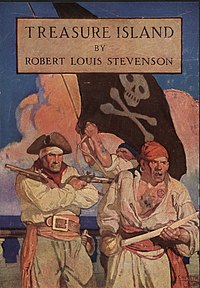
R L Stevenson - Treasure Island

Treasure Island-Scribner's-1911.jpg
While reading recently about real life pirates, I decided to read R.L. Stevenson's classic novel Treasure Island. Reading it was a fascinating experience. I'd never read it before, yet the story was as familiar as if I had read it half a dozen times. No doubt this is because it is one of the most dramatised books ever published, being made repeatedly into a film and play.

So there is little point in detailing more in this review. Though it is worth noting that many of the popular conceptions about pirates had their beginnings here. Wooden legs, parrots on shoulders, Yo Ho Hoing, black spots and treasure islands. The popularity of the book must in part lie in its writing - the story is gripping and exciting, yet the characters are also wonderfully constructed. Blind Pew is terrifying as he taps his way around, the moment he grabs Jim Hawkins genuinely scary... Long John Silver is delightfully ambiguous in his morals and Hawkin's climatic battle with Mr. Hands is as exciting as gunfight ever imagined on the silver screen. The only characters that annoyed me, are the uptight and holier-than-thou Squire and Doctor. Stevenson slotting in some minor English gentry to demonstrate how the plebs ought to behave.

So if you're only experience of Treasure Island is the Muppet version, you really should dig out a free online copy of the original and follow Jim Hawkins into the South Seas.

Friday, January 03, 2014

Karl Marx - Value, Price and Profit

Karl Marx's work is often decried as being difficult or inaccessible. While it is true that some of it requires careful reading, the basic concepts are actually fairly straightforward, and indeed, many books have been written to present these ideas in an accessible way. What is less well known, is that Marx's own writing can be extremely readable, and he was a master at clarifying and presenting complex ideas. Value, Price and Profit is a case in point.

First presented as a paper to a meeting of the International Working Men's Association in 1865, its subtitle, "Addressed to Working Men", betraying its intended use - as a tool to educate and arm workers. In it, Karl Marx presents the basic concepts of what is today usually known as the Labour Theory of Value.

Marx begins by debunking a commonly held belief, that rises in wages cause price rises. At the time he was arguing with a fellow traveller of the IWMA. But more recently the argument that workers cannot have price rises because of inflation has been used by various governments. In opposition to the "dogma" that "prices of commodities are determined or regulated by wages", Marx embarks on showing what actually causes prices to rise. In doing so, he takes the reader through the nature of a commodities value and what gives it that value.

What gives a commodity a value, is its "relations to all other commodities" and the thing that all commodities, whether newspapers, gold or wheat have in common is the human labour required to make them. In a wonderfully clear passage, Marx shows how what is important in giving commodities exchangeable values is the social labour that goes into creating them.

"To produce commodity a certain amount of labour must be bestowed upon it, or worked up in it. And I say not only Labour, but Social Labour. A man who produces an article for his immediate use, to consume it himself, creates a product, but not a commodity. As a self-sustaining producer he has nothing to do with society. But to produce a commodity, a man must not only produce an article satisfying some social want, but his labour itself must form part and parcel of the total sum of labour expended by society. It must be subordinate to the Division of Labour within Society. It is nothing without the other divisions of labour, and on its part is required to integrate them. If we consider commodities as values, we consider them exclusively under the single aspect of realised, fixed, or if you like, crystallised social labour."
Marx then goes on to discuss Price a "peculiar form assumed by value".  Marx goes on to show the origins of the capitalist's profit, lie not in the setting of a commodities' price, but in the difference between the value generated by a worker and that paid to the worker. Because a working men sells is his Labouring Power, there exists the potential to alter both the wages and the profits. But because what the capitalist is doing is paying a wage, but gaining far more from the worker than the wage is worth, Marx repeats that "that normal and average profits are made by selling commodities not above, but at their real values." These real values are determined by the "social labour" utilised in manufacturing the commodity by the worker.

Despite the short length of this work, Marx packs a lot in. He has a brief digression on the origins of the wage labour system being in the separation of the worker from his original means of subsistence and the revolutionary change embodied in the transition to capitalism. Marx also discusses briefly how rent, profit and interest are actually different terms for parts of the surplus value extracted from workers.

But Karl Marx was above all a revolutionary, and the conclusion of the book, after drawing out the nature of work under capitalism, is to point out a revolutionary way forward. The struggle between workers and capitalists has an effect. As Marx points out "if wages fall, profits  will rise; and if wages rise, profits will fall". But for the worker this cannot be enough. Capitalism can only seek to maximise its profits by making workers pay, thus in order to secure for workers the best possible situation, the wages system must be ended. Famously Marx concludes that

"Instead of the conservative motto, 'A fair day's wages for a fair day's work!' they ought to inscribe on their banner the revolutionary watchword, 'Abolition of the wages system!'

In this context, Trade unions are "centres of general resistance" to capital, but the struggle is hampered by their lack of revolutionary struggle, their "guerilla war against the effects of the existing system". What is needed is a revolutionary movement and this short book by the greatest anti-capitalist of them all, is one of the best weapons to educate and clarify workers in understanding the nature of the beast we must destroy.

Related Reviews

Marx - The Civil War in France
Mehring - Karl Marx: The Story of his Life
Choonara - Unravelling Capitalism: A Guide to Marxist Political Economy
Harman - Zombie Capitalism: Global Crisis & the Relevance of Marx

Monday, December 30, 2013

Ian Knight - Zulu Rising

I suspect that most people's knowledge of the Anglo-Zulu wars consists of watching the film Zulu. In that movie, a heroic band of white-British soldiers hold off the Zulu hordes at Rorke's Drift and prove, through their valiant winning of multiple Victoria Crosses, that they were made of British pluck.

Ian Knight's book fills a enormous gap in the literature of military writings on the Victorian era. Unlike many celebration's of British colonialism, he retells the appalling story of the Anglo-Zulu war through the eyes of both sides in the conflict. There are many military histories of the battles of Isandlwana and Rorke's Drift. Few of them are sympathetic with the Zulus. Fewer still locate the root of the enormous defeat the British had at Isandlwana in the personal ambitions of British colonial leaders, isolated from London, who thought they could win a quick victory over a backward people.

Knight begins with a history of the Zulu people. Their origins lie in the Nguni people of eastern Africa and Knight tells us fascinating details of the development of their culture. In this difficult terrain, the Zulu's developed an economy centred on cattle, with a complex network of different tribes that paid homage to a central king.

By the 18th century, these tribes were beginning to encounter white Europeans, often shipwrecked on the dangerous coasts. As the 18th century became the 19th, European interest in East Africa increased, particularly with the discovery of resources such as diamonds.

The Anglo-Zulu war has its origin in colonial incursions into Zulu land. Knight makes it clear that local authorities, desperate to create the basis for a quick war against the Zulu, convinced those back in London to build up their military forces. But not enough. Acting with little more than their own authority, men like Anthony Durnford and Lord Chelmsford invaded the Zulu nation and incurred the wrath of Cetshwayo the Zulu King.

Knight is no romantic. He is completely aware that in the long run, the Zulus stood little chance against the might of the British industrial economy. But this first military campaign suffered from many colonial prejudices. Not for the first time did British red-coats pay with their lives, because General's assumed that the natives would run away in the face of British guns and bayonets.

The actions of the British commander Lord Chelmsford read like a text-book example of how not to invade hostile territory. He split his forces, and badly under-estimated the scale of his opponent. With columns scattered country-wide, few experienced soldiers, long-supply chains over inhospitable terrain, and racist attitudes to the enemy a military defeat of some sort was inevitable. But the scale of the disaster had more to do with the enormous size of Cethswayo's kingdom and the number of Zulu troops prepared to muster to defend their land and people. So skilled were these troops, and so over-confident the British that the Zulus were able to bring 28,000 troops within 8 kilometres of the poorly defended British camp at Isandlwana.

Knight's book is partly social history, hence his emphasis on the history of the Zulu nation and the background of the British troops and officers. Yet it is also military history. Unusually his detailed explanations of, for instance, how a soldier actually fired a Martini-Henri rifle only serve to detail the true horror of the British defeat. Knowing exactly how hot the gun's barrel got after a few shots, and how this could cause the weapon to jam, means that the reader understands how quickly the British got themselves into trouble in the face of such over-whelming odds. Knight has dug out large numbers of eyewitness accounts, from British and Zulu veterans and the stories of the last moments of the massacre, with red-coats fighting with pocket-knives against heavily armed Zulu warriors, are very hard to read.

But Isandlwana was a unique set of circumstances. The entirely different outcome at Rorke's Drift demonstrated that British tactics, in a heavily defended area, with disciplined troops, could defeat enormous odds. The Zulu people just didn't have the weapons to defeat British guns. That said though one does have to wonder at the intelligence of any commander who took rockets out into the plains of Natal to try and defeat a mobile force.

Knight captures the prejudices and mistakes made by the colonial authorities, lays to rest many of the forgotten aspects of the conflicts (the central role played by native forces in the British armies) and demonstrates how British policies (particularly after the defeat) helped lay the basis for many of the problems that came after. This is no sanitised account of military action, but a bloodily realistic description of the front line of Empire.

Sadly the book is slightly over-written, I felt a decent editor could have cut 50 to 100 of the 700 pages. That sad though, the work is immensely readable and recommended.

Related Reviews

Newsinger - The Blood Never Dried; A People's History of the British Empire
Gott - Britain's Empire: Resistance, Repression and Revolt