Thursday, April 28, 2011

Oliver Rackham - The History of the Countryside

Oliver Rackham's history of the countryside is a remarkable book. It is also an unusual and slightly odd book. It's oddity stems not from its content, but its style. In essence it boils down to a very detailed and systematic exploration of every feature of the British landscape - from the woodlands, ancient and modern, to the roads, fields and waterways we see around us. It is odd because what we end up with is really a very complicated and detailed list. Don't let this criticism mean you ignore this. Rackham's book is a great scholarly work, it is by turns fascinating, amusing and enlightening and should instruct the keenest historian of the interaction between humans and the natural world.

What we learn, is that very little of the British landscape is natural. At the end of the last ice age, most of the British Isles were rapidly covered with wild wood - trees that spread from what was then the continent. With the arrival of humans, this was almost immediately under attack as our ancestors reduced the trees for agriculture or cultural reasons. The other changes they made - consciously or unconsciously on the flora and fauna are faithfully recorded - the disappearance of larger mammals like the auroch, the wild boar and so on. The introduction of species from outside, in both ancient and modern times have changed the world we look at from our train windows, and the place would be unrecognisable to an ancient Briton, transported in time to the 21st Century.

In particular, Rackham shows how agriculture and industry have changed the countryside - the fields, with ancient walls and hedges, to the strip fields of the medieval age, and then the heavily enclosed farms of modern times. The hedges are fascinating. They're sometimes natural, sometimes not, they can grow spontaneously along a human-made ditch or line and they can help spread plant species.

Even some of the most impressive areas of the landscape we might take for granted - the Norfolk Broads, or some of the large woodlands are very rarely natural. The Broads are the remains of systematic medieval peat extraction. Many age old forests are the remnants of parks and gardens made a few centuries ago.

The style of the book is lovely. Oliver Rackham comes across as a slightly eccentric expert, passionate about his subject, prepared to delve deep into ancient forestry records and dusty books to prove that a local feature is actually only a few years old. "Much as been written on the history of Irish woodland, but in a vague and general way; except in Killarney there is not one wood whose history over the last 400 years is known" he complains at one point.

My disappointment peaked at the end of the book, which finished abruptly with a brief mention of a fish weir on the River Calder. I had hoped for some interesting concluding remarks on perhaps the conservation of "nature" and what that meant. Nevertheless, there is much here to learn from. Rackham's book is often mentioned and referenced. I've followed it up with a reading of Francis Pryor's latest book on "The Making of the British Landscape". Pryor has referenced Rackham's work in the past and I'll be interested to compare the two. Watch this space, as they say.

Sunday, April 24, 2011

John Newsinger - The Dredd Phenomenon: Comics and Contemporary Society

There is a large part of me that never really got into comics. Partly this was due to a slightly snobbish, middle class attitude that my have existed during my early youth. They were not proper books, so they can't have been anything more than simplistic entertainment. Radio 1 to literature's Radio 3.

Later on, I discovered 2000AD. It's cynical social commentary made it clear that there was something more to comics and graphic novels than those who assumed it was all the Beano might think.

John Newsinger's brief survey of comics is locates them in the the periods when they are being penned. Written in the immediate aftermath of Tony Blair's election in 1997, he firmly roots the popularity of Judge Dredd and 2000AD in the writers' ability to extrapolate from the authoritarian social policies of Thatcher, Major and then Blair.

You can see this most obviously, and perhaps slightly crudely, with the B.L.A.I.R.1 strip which I found immensely enjoyable in 1998. Here Blair is a robotic monster, driving through his plans and wrecking people's lives to make Britain safe for big business. It is only with tongue slightly in cheek that the writers introduced Judge Straw into the mix.

Newsinger argues that the popularity of comics like 2000AD is their ability to hold a lens up to the world. Whether this provokes the readers into further confrontation with the priorities of the politicians and policies that are so elegantly subverted in the stories is another question. Certainly their popularity can only be because most readers spot a little part of the world around them in the panels. I'd forgotten how detailed some of the stories are. In one, Newsinger points out, the Judges, lawmakers, enforcers, judge, jury and executioners, recognise they need to liberalise their policies or risk loosing complete control. They decide to remove the prescription on keeping Goldfish from the list of crimes that can be committed. Though breeding Goldfish still requires a permit, least it gets out of the control of the state.

So the contradiction - that one of Britain's most popular comics has as a hero a semi-fascistic policeman is squared because it is clearly about tackling the excesses of other aspects of 20th and 21st Century capitalism. Other stories, writers and comics mentioned here-in The Preacher, The Invisibles, From Hell and the ABC Warriors also take up other contemporary issues - crime, drugs, religion and violence. They are part, Newsinger argues, of a reaction to those comics that are pure escapism.

Newsinger has a convincing case. Hopefully this book, which has not dated at all since the heady days of 1997, will continue to encourage a critical reading of comics and more of a enjoyment of a wider range of slightly less mainstream graphic novels than your parents might expect.

Related Reviews

Newsinger - The Blood Never Dried: A People's History of the British Empire
Newsinger - Fighting Back: The American Working Class in the 1930s
Newsinger - Them and Us: Fighting the Class War 1910-1939

Thursday, April 21, 2011

Leon Trotsky - Lessons of October

This short volume by Leon Trotsky is an undisguised polemic. Written in 1924, in the aftermath of a series of failed revolutions across Europe, it was clear that the revolutionary movement that had developed following the First World War was at a turning point. Trotsky's volume is in itself a hard restatement of the need for revolutionary organisation to successfully lead a working class revolution.

Trotsky understood that there was a danger that having led a successful revolution in Russia in 1917, the Bolsheviks Party was seen as having a sort of God like status. The idea that revolutionaries elsewhere needed to simply emulate the actions and organisations of the Lenin and the Bolsheviks and that would be enough to seize power. So in part he wrote a "warts and all" history of the Bolsheviks. He documents the way in which following the first revolution of 1917, in February, when the Tsar was deposed, the position of the Bolsheviks was to their right of the position that they took in October. From afar Lenin wrote, begged and urged them to turn further towards the idea of proletarian revolution, instead many, like Stalin tailed the right-wing of the socialist movement.

"Russia is too backward for the workers to take power" they argued, yet a few months later they did just that. At the end of the book, Trotsky explores the idea of insurrection as art. Taking power is not a science. There are a myriad of factors that must be taken into consideration before a successful seizure of power can be made. He documents and explores what happened in Russia - but argues that this shouldn't form a blueprint for anywhere else. He looks at those organs of democratic power in Russia - the Soviets - but explains that there is a danger that other revolutionaries fetishise these as instruments of revolution, rather than noticing other social structures - workers councils, factory committees or even the Trade Unions that might take on this role. I should add though, that I think Trotsky's understanding of the role of the unions here is flawed and based on a peculiarly Russian naivety towards these bodies, as explored in this excellent book here.

Finally Trotsky is launching a weapon in a developing argument in Russia at the time. As the effect of international isolation, civil war and Russian backwardness took their toil on the revolution, Trotsky was fighting against marginalisation from the new bureaucratic cliques developing around Stalin. The Lessons of October are then also a polemical fight in this battle.

The edition I have read comes with very useful notes and an introductory essay by Duncan Hallas. This frames the book very helpfully and can be read online here. I'd recommend it, before dipping into the Trotsky.

Related Reviews

Hallas - Trotsky's Marxism
Choonara - A Rebel's Guide to Trotsky
Trotsky - An Appeal to the Toiling, Oppressed and Exhausted Peoples of Europe

Tuesday, April 19, 2011

J.G. Farrell - Troubles

I thoroughly enjoyed reading Farrell's book The Siege of Krishnapur and this earlier book of his does not disappoint either. Apparently this is really the first in a trilogy of which Krishnapur is the second, but there are limited links between the stories, so the order doesn't matter.

Together with the third in the series, the theme is the end of Empire. Krishnapur appeared to deal with the highpoint of British rule in India, but was centred on the mutiny that marked the beginning of the end. Troubles is set in Ireland, in the immediate aftermath of the First World War and the Easter Uprising of 1916.

Arriving in Ireland, Major Archer thinks he is going to be married to his fiancee. A young woman with whom he has engaged in a love-affair by letter, following a short meeting. That doesn't happen and instead he gets drawn in to the daily life of the Majestic Hotel that is owned by her family. The Hotel was once a splendid and famous resort. Now, it is a shade of its former glory. Decay permeates every corner - the masonry is crumbling, the gardens getting overrun. This decay is also infecting the people there. The servants don't care - The Major is not met on his arrival, and the first comic chapters of the novel are when he tries to adjust to the idea that no-one will make his bed and no one will run his bath.

The decay of the hotel is a metaphor for the decay of British rule in Ireland, or indeed the beginning of the end of Empire. As the Civil War gathers pace, the guests at the hotel remain blissfully above it all. Sure that the Empire will continue, and unbelieving of the growing tidal wave of change they face. As in Krishnapur the natives are distinct, indistinct figures. Starving on the periphery of the story. This is how they must have appeared to the British, enclosed in their ivory towers.

As events hot up, the Major becomes unable or unwilling to leave. He falls in love again, and his heart is broken once more. Here, in addition to the dark gloom of the crumbling hotel, Farrell adds the  claustrophobic life of a Englishman unable to cope with his sexuality, desperate for relief as he sweats at night thinking of the woman he loves. But there is a counter-point. Two young girls who mature into woman as the novel progresses, taunt, flirt and tease the visiting British soldiers and the Major himself. They surely represent a more confident sexuality of the coming twenties.

The end of the novel, is, like the end of Empire, brutal. There is little happiness here, and I was left feeling that there should have been something more. But this is the end of Empire from the occupiers point of view - they deserved no happy ending. It is up to those who freed themselves to write the next chapter of the story.


Related Reviews
 
J.G. Farrell - The Siege of Krishnapur

Saturday, April 16, 2011

Rosemary Hill - Stonehenge

It is rare that I express disappointment with a book. Usually I am aware enough of the contents to feel that I know what I am about to read, so it is unusual to find myself criticising one.

However, it may be that my own criticisms of this book are misplaced. The Wonders of the World series has been extremely enjoyable and I would encourage others to read these short books. There are links to previous reviews below.

Rosemary Hill's book though suffers from not really being about it's subject matter. Now this is true of all the series to a lesser extent. You can't really discuss the Temple of Jerusalem or the Colosseum without mentioning their impact on society and cultures that have come along after they were built, or destroyed.

But this book on Stonehenge suffers from seeming to barely mention any detail about Stonehenge at all. Apart from the very first chapter, and some of the later chapters which deal with modern archaeology. We learn very little about the monument itself. Hill is correct of course to point out that there are many unknowns about Stonehenge. Any book about the place could and indeed should point to the controversies that still exist. Instead we're treated to large chunks about the influence of Stonehenge on various different cultural stages of British history - the Antiquarians, The Romantics and so on. Stonehenge as an idea, has had a big impact - its influence extended to the architects who put together major bits of Bath and Covent Garden for instance.

Hill tells this story particularly well, but I for one found myself not really caring much. The various different suggestions about the origins of the monument that have been put forward by various scientists, amateurs and crackpots over the years are also interesting, but they reflect more of contemporary history, than illuminate the past.

However, I do think Hill does her story of Stonehenge well. I can't fault that, and I did enjoy her account of the more recent history of the monument - the changing social attitudes to conservation of ancient places, access rights and so on. Her final chapter has plenty of ammunition that can be used against recent governments (including I think the Coalition that is in place while I write this) for their attitudes to places like Stonehenge.

But I did feel disappointed. There should have been more about Stonehenge itself and the people who built it, as well as the epic monumental landscape that it is a central part of. Readers who might like more of that, are encouraged to search out Francis Pryor's excellent book Britain BC, which delves into some of this.

Related Reviews in the Wonders of the World series


Watkin - The Roman Forum
Fenlon - Piazza San Marco
Tillotson – Taj Mahal
Goldhill - The Temple of Jerusalem
Gere - The Tomb of Agamemnon
Ray - The Rosetta Stone
Hopkins & Beard - The Colosseum

Tuesday, April 12, 2011

E.P. Thompson - The Making of the English Working Class

E. P. Thompson's monumental work of history of the development and shaping of the English working class almost defies review. After all, in almost 1000 pages he covers so much ground, in such great detail, that it feels inappropriate to even attempt to mention an section for fear of glossing over something equally important elsewhere. Hundreds of words could also be written about Thompson's methodology. His approach is more than history from below, it is about analysing cause and effect in history, imposition and resistance, the dialectical interaction between social forces that shapes the present and the future.

Thompson wrote as an avowed Marxist. Marx wrote that "being shapes consciousness" and this little quote perhaps explains the core idea of Thompson's work. The making of the English working class, is not a conscious activity by any one group, least of all the working classes themselves. Rather Thompson describes a world changing as new interests and forces come to the fore - in this case the growth and expansion of industrial capitalism. This changing circumstances changed the interests of the ruling class (indeed, to a great extent it changed the very personnel of the ruling classes as aristocrat was replaced by industrialist) as they needed to increasingly exploit workers to extract profits.

But this process didn't automatically create a working class, other than in the simplest of senses that it produced workers in factories, workplaces and elsewhere. What Thompson is trying to understand is the growth of workers and their self-conscious identity as such, compared to the other classes and interests in society. To do this Thompson documents the struggles of people to resist changes to their lives. To pick a random example, Thompson looks extensively at the Luddite movement.

The Luddites are often picked as representing some group of anti-technological, backward looking rebels. They'd rather wreck-machines than be part of a forward moving society. Yet the Luddities held the sympathies of the majority of people in the villages and towns that they came from - the organisation, Thompson tells us, was in "Nottingham and Yorkshire... so opaque that it resisted all penetration". The Luddities, rather than looking backward were resisting the imposition of machinery that would  destroy their lives. In many cases they were happy to accept new technology, so long as those who lost out were compensated and looked after, rather than being left to starve.

Thompson says "Luddism must be seen as arising at the crisis-point in the abrogation of paternalist legislation, and in the imposition of the political economy of laissez faire upon, and against the will and conscience of, the working people."

It is this sense of the imposition of new forms of capitalist organisation upon a people that dominates the book. What also repeatadly comes through is the resistance. In particular the methods of organisation used over decades by those at the bottom of society to try and fight for their own interests, or retain existing rights. Thompson shows how the ruling class was in fear of insurrection and terrified of working class organisation. Whether its the Corresponding societies or debating clubs, or nascent trade unions, the establishment tried to penetrate, destroy, murder and lock-up those who organised. Some of the most interesting parts of the book are those were Thompson describes the extent to which the government introduced spies to seek out insurrection and how those spies helped create an atmosphere of imminent revolution in order to justify their own existence.

The brutality of repression is here too. The massacre at Peterloo, the hanging of those who organised, the transportation of those who dared to speak out, or sell radical literature, or called for the vote. But a system that uses violence in this way cannot continue forever and reform did come eventually, but in a way that helped inspire further revolt.

Thompson finishes the book on the eve of great industrial revolts. By the 1830s the working class had, through the struggles, defeats, betrayals and victories become a class "for itself", increasingly understanding it's position in society and that of its rulers and beginning to grasp towards an alternative way of organising. This is the time of the Utopian socialists, men like Robert Owen  who had not yet come to a full understanding of the need to replace capitalism, but who had created the basis for a set of ideas that could do so.

The Making of the English Working Class will continue to be debated by historians. Even for those who disagree, it's scholarship and clarity should be a marker for other history writing. But with this work, perhaps more than any other in British social-history, Thompson laid the basis for an understanding of were those who struggle for freedom and justice today come from.

The men and women in these pages, from Colonel Despard and Tom Paine, to the unnamed pamphleteers and bill-posters, to those who drilled with pretend pikes high on the moors, believing that their day was coming, should never be forgotten. Their dream of a better world, is also ours.

Related Reviews

Thompson - Customs in Common

Sunday, April 03, 2011

Richard Overy - 1939 Countdown to War

The processes that led to the start of the Second World War are ones that have been examined and debated enormously. The battle lines in this debate were set out even before the war ended - Richard Overy points out that the historian Sir Llewellyn Woodward was asked to write an "official survey of British foreign policy before the outbreak of war" later on in the conflict. Woodward seems to have been keen that the British version of events won through.

But what exactly was the British version of events was has been open to question. The Prime Minister of the time, Neville Chamberlain has gone down in recent interpretation as a weak willed politician. Desperate to avoid peace and unwilling to confront Hitler.

In this short, accessible work, Richard Overy argues that Chamberlain and a wider layer of people around him had a much clearer and more subtle analysis of the situation. Chamberlain he argues may have wanted to avoid war, but was in the end committed to a position that meant that Germany's attack on Poland would inevitably trigger war. Chamberlain didn't enter this situation blindfold, but he and those around him clearly thought Hitler would avoid conflict in the face of Britain and France's determined support for Poland.

In turn, Hitler clearly did not believe that Britain and France would honour their commitment. Overy quotes Hitler's chief press officer noting that it was "plain to see how stunned he [Hitler] was". He supports the view that Hitler really had no idea of the scale of what was being unleashed. Certainly elements of the German high-command were surprised by the declaration of war. But they also clearly thought that it meant practically nothing, and that full scale war would be avoided after a short period.

So what was the motivating force for Hitler's decision to attack Poland. This was no whim. Plans were laid in detail and a strategy involving the destruction of the Polish leadership, it's Jewish population and those forces opposed to Fascism were organised well in advance. The basis for the Race War in Eastern Europe was begun with the first shots. Overy argues that Hitler wanted a short "local" war, that would cement his position as a military leader, and "open the way for the eventual confrontation with Stalin's Soviet Union".

Overy argues against those who portray Hitler as always having a desire for world domination. His position is more plausible. It stems from some of the central ideological tenets of Nazism - the need to eradicate the "sub-human" peoples of the East, to challenge "Bolshevism" and to create "living-space" for the German people. War with the western countries would not have been on Hitler's mind. His surprise is understandable.

But this book lacks some of this analysis. In fact Overy almost has a mechanical explanation of events. So in the opening chapter he writes;

"Above all it was Poland's intransigent refusal to make any concessions to its powerful German neighbour that made war almost certain".

What concessions could Poland have realistically made that would have contained or prevented the basis for Hitler's rise to power? Events in Czechoslovakia had already shown that giving into small demands from the Nazis had only resulted in greater ones. And would it be right for Poland to given into the Imperialistic ambitions of their more "powerful German neighbour", couched in the language of racism as they were?

The author himself argues this later when he explains that Hitler's planned war "would destroy the Polish state" and had "an agenda drawn not from diplomacy or military strategy, but from the racial priorities of the regime". Giving into this sort of bully would hardly lead to peace.

Despite the major irritation I feel at the blame being laid for war and the feet of Poland, this is a useful and interesting book that clarifies a fast moving and complicated moment of history. Neville Chamberlain comes across as having a more rounded and complex analysis of events than he is usually portrayed with, and this in itself is more useful to understanding the beginnings of the war.

Related Reviews

Overy - Russia's War

Friday, April 01, 2011

Iain M. Banks - Surface Detail

Iain M Banks' latest culture novels is somewhat of a return to form, though it still suffers somewhat from the bloated feel of his more recent SF novels.

At the heart of this novel is the concept of virtual hells. Sufficiently advanced civilisations, Banks postulates, could create virtual environments for minds to be introduced to. If you wanted to, you could introduce them to a horrific environment, that would, for the person subjected to the horrors of hell, be indistinguishable from reality. Whether or not this is an acceptable activity for civilisations to do is something that divides the galaxy. The Culture, Banks' is enormous, anarcho-communist civilisation is opposed to such hells, and is fighting a simulated war. The outcome of this war will determine whether or not virtual hells can continue.

Now Banks adds into this mix his usual complitcated (and slightly bloated) list of characters. Some of them are inside hell. Some of them are fighting wars to stop or keep hells. Some of them are bloated industrialists living from the fat of their exploitation of people, and the existing system.

There is much here for Banks to play with, and he does so well. One character escapes from a virtual hell and then uses his knowledge to identify and expose what is going on, quite literarily under the surface of society. He is hailed a hero by some but encounters bribery (and worse) from those politicians who owe a certain amount of their political and financial security to the existence of torture and suffering.

The virtual battle against Hell threatens to break out into reality and this combines with powerful interests amongst some of those civilisations who have not yet become part of the Culture, but want a piece of the economic action.

This is not the easiest book to start the culture series from - it has many references and potential links to earlier novels. While it is also long and complicated, it is much slicker than some of Banks' more recent Science Fiction. If you have enjoyed all or part of the earlier Culture novels, than this is worth reading, particularly if you like the spaceship Minds.

Thursday, March 17, 2011

Donny Gluckstein - The Tragedy of Bukharin

I first developed an interest in the Russian revolutionary Nikolai Bukharin after I read an account of his show trial by Fitzroy Maclean in his autobiography Eastern Approaches. There, Maclean describes how Bukharin runs rings around his prosecutors, who have tried to portray him as an enemy of the revolution, who plotted to assassinate Lenin and Stalin.

These accusations were based on nothing. Bukharin was a loyal revolutionary. Someone who had spent time in the prisons of Europe as he attempted to build the organisations that could overthrow capitalism. Lenin thought Bukharin "Bolshevism's biggest theoretician". He was a leading figure, popular for his speeches and ideas. Some of Bukharin's early writings were particularly important. His work on Imperialism for instance, is still of great use today, and was recently republished.

But following the isolation and defeat of the revolution, the growth of the internal bureaucracy meant that the Soviet Union travelled increasingly further from the workers state that Lenin, Bukharin and the other Bolshevik's fought for.

Donny Gluckstein's political biography then looks at Bukharin's life in the context of this changing role. In particular he examines key debates in the years following 1917, and how Bukharin's ideas and arguments shaped those debates. Bukharin comes across very much as someone who is constantly fighting for the revolution and for a socialist society. However he often seems to lack the ability to know when to retreat or step back, or to put it more crudely, he sometimes "can't see the wood for the trees".

For example the disappearance of money is something that would happen, it was argued, as socialism developed. But that doesn't mean that when money goes, socialism has been created. Economic collapse, the hoarding of wealth, the lack of availability of things to buy can also cause this. Bukharin was too busy arguing that this was a good thing, to be able to provide a coherent way out of the mess.

The problem was, that the isolation of the revolution had created an almost impossible situation. At best, what could be hoped for was survival for a time when revolutions elsewhere would rescue Russia. This had been a real hope in the years immediately after World War One, when revolutions swept Europe. By the mid-1920s this was no longer on the cards. With the death of Lenin and the degeneration of the revolution, Bukharin lost the best influences upon him. All revolutionaries make mistakes, but their collective organisation helps correct and challenge this. Left to his own devices, Bukharin increasingly comes to represent the growing influence of other forces in society - in particular the rising bureaucracy and the richer peasants.

In the great battle between Trotsky and Stalin, Bukharin becomes the best weapon Stalin has. His ability to articulate an argument, and his position as an old-bureaucracy, makes him a formidable weapon. Gluckstein traces the contradictions of Bukharin's position and shows how, as his use as the "hammer of Trotskyism" disappears, then he is next in the firing line.

This is not an easy book. It assumes a good deal of knowledge of the inner dynamics of the Russian Revolution as well as the debates and discussions. Some sections of it are very dated. Bukharin is no longer lauded by many as the "third way" between Stalin and Trotsky, because of his perceived pro-market ideas. This was, it seems the case as an aging Soviet Union's internal contradictions started to come out.

But Gluckstein does argue that Bukharin wasn't the enemy of the revolution that Stalin was. Bukharin's lack of theoretical clarity and, as Lenin argued, his lack of dialectical thinking meant that his mistakes could appear accurate but did not stand up to the test of events. But for all this, Gluckstein rescues Bukharin the revolutionary - a flawed revolutionary, but a man committed to fighting for a better world.

Wednesday, March 09, 2011

Marcel Mazoyer & Laurence Roudart - A History of World Agriculture from the Neolithic Age to the Current Crisis

Depsite how we in the modern world might view agriculture, it is
more than simply another branch of industry. For those of us living in the developed world, the vast majority of us have little or nothing to do with the production of food, or indeed other crops. Today, those doing the farming work that feeds us all, comprise, in the developed world at least, somewhere around 5% of the populations.

However, for the vast majority of human history and indeed for most of the undeveloped world, this is not the case. Most people were involved in the production of food, and in most historical societies, almost all of the work that took place within a community was related to food production.

Mazoyer and Roudart's work is an examination of the history of agriculture - from the earliest hunter-gatherers who would have nurtured and protected plants, to the slash and burn cultivation that replaced them, through the various permanent "post-forest agrarian" cultures that saw the growth and strengthen of class society, to feudal and eventually capitalist agriculture. It is a monumental book, both readable and interesting as well as in depth and well researched.

There is a temptation to see agricultural history as a linear path. Indeed my summary of the book in the previous paragraph makes that very mistake. But development of agriculture wasn't linear, though it did develop along definite paths and through particular stages. The reasons for moving from one form to a more developed form are complex and varied. Sometimes people didn't move on - which is why today there are still hunter-gatherer communities or people practising slash and burn cultivation. More developed agriculture is not necessarily easier work - though it will invariably provide a greater surplus. Nor is there necessarily a straight dividing line. Hunter-gatherers will have planted and harvested grains. Slash and Burn cultivators would have gathered nuts and hunted game.

Often though, population pressures and growth were a key factor - in particular with the switch from slash and burn to more permanent agriculture. The authors document these processes, along with all the other factors to show just why the world of farming changed when it did. There is a wealth of technical detail - some of it obscure to those of us who've never seen a field of corn harvested. But what is fascinating is the way there is often repetition of tools and practises across many different continents. What is also amazing is the way some primitive methods still dominate - the simple scratch plough (the ard) still being used by hundreds of thousands today, even though it was replaced hundreds of years ago elsewhere.

But this book is also part polemic. The authors are trying to explain why it is, despite technical innovation and cheaper materials, the "difference in productivity between the least efficient agriculture in the world, practiced exclusively with manual implements ... and the best-equipped and most efficient agriculture has increased dramatically. The gap has widened from 1 to 10 in the interwar period to 1 to 2000 at the end of the twentieth century".

They continue by pointing out that "One third of the world's peasants, or more than 400 million of the working population, work not only with strictly manual tools but without fertilizer, feed for livestock, pesticides, and specially selected varieties of plants and breeds of animals". One billion people get their food from peasants farming like this.

The root of this is of course wealth. The poorest farmers simply cannot afford to lift themselves out of the situation they are in, to obtain the most advanced equipment, fertilizers and seeds. They cannot compete against the cheaper priced crops from the developed world, and face sinking back into poverty and starvation.

So the last chapters of the book look at alternate economic strategies to solve this problem. This is, I would argue the weakest section. The authors aren't naive enough to believe that simple controls on the import of cheap foodstuffs are enough to raise prices in the home market. But they have no other option. The problem is, that they aren't discussing agriculture in the context of capitalism - and the inherent power that the richest nations have over the poorest. Whatever rules may be created by a United Nations body, the rules of colonialism and imperialism will make the poorest pay.

But these are minor criticisms of a tremendously important book. This solid investigation into the basis for human societies throughout the last 20,000 years is ammunition for those of us who believe a genuine materialist history of humans is possible. By examining in such detail different cultures and societies, we can put together an understanding of human development, and failure which will help us understand the enormous challenges for the future.

Sunday, March 06, 2011

Siegfried Sassoon - Memoirs of an Infantry Officer

Part two of Sassoon's fictionalised autobiographical account of his early life reads much more lifelike than his earlier account of hunting and riding in the English countryside. At the end of his fox hunting memoirs, we left him in the early years of trench warfare on the Western Front. Several of his friends and acquaintances had already died.

Volume two begins slightly after the end of the first book. We find the author in the Army School, learning or relearning the art of open warfare that the military top brass keep expecting will appear soon, after the infantry in the trenches have broken through the German lines and more conventional war returns. Time and again we find this theme returns, as the soldiers prepare for a "big push" we learn how the cavalry is in reserve, ready to exploit the gaps that never open up.

Most of the book though, is the tale of Sassoon's gradual awakening to the "wrongness" of the war and his growing desire to "do something about it". Sassoon is an officer, from a relatively privileged background. He believes, perhaps rightly, that if he speaks out, it'll count for more than the complaints of the ordinary infantry. What's fascinating though, is the way Sassoon is motivated by the apparent lack of understanding from ordinary citizens back home. Like many accounts of soldiers returning from home on leave, he finds himself unable to describe his experiences, or find comprehension amongst even military veterans.

On the other hand, he cannot bring himself to talk about the reality of war. Even amongst other veterans or wounded in the hospital, there seems to be little discussion about the grim realities of the conflict, just long lists of the dead and wounded.

Sassoon describes how he gradually decides to speak out. In part he can do this because, as an officer, when wounded his convalescence is far superior to that of ordinary soldiers. Staying in good hospitals and then country houses, he has time to read an think. He certainly feels little pressure to return, and when he overstays his sick-leave he is simply asked by telegram where he is.

His eventual letter, speaking out against the war, is written by someone convinced he is speaking on "behalf of soldiers" everywhere. If this had been from an ordinary infantryman, I suspect that court martial would rapidly follow. Instead, with his rank and class background, Sassoon is argued with by friendly senior officers to withdraw, then he is offered a trip to a medical enquiry to check he is of sound mind. Eventually he agrees to this, as he finds that no one really wants to risk the embarrassment of a court martial.

Sassoon's rebellion is influenced in a minor way by some anti-war activists and thinkers. But what really convinces him is the reality of conflict and the tremendous waste of the pointless conflict. It is clear that he is the tip of a much larger iceberg - around him it is common to complain about those sitting out the war, or profiteering from it, or enjoying it from afar.

In other countries, notably Russia and Germany, these sentiments combined with growing lack of food and supplies to create a situation of mass rebellion and revolution. This didn't happen in Britain, though there were some major struggles. But its clear from Sassoon's account that the feelings of those at the bottom of the army were not differing greatly from those of the troops in the trenches a few yeards away.

Related Reviews

Sassoon - Memoirs of a Fox Hunting Man

Saturday, March 05, 2011

Greg Bear - Eon

Eon - Classic SF "Big Dumb Object"
Greg Bear's classic science fiction novel Eon, is seen as one of the all time great novels of that genre. Part of its reputation must rest on the imaginative idea at the heart of the story. Just before the book begins, a large asteroid (which turns out to be an exact copy of Juno which is still orbiting around the sun) appears and enters orbit around Earth. Travels to the planet discover it has been artificially hollowed out and inside there are various enormous chambers, filled with relics of a civilisation. The beings who inhabited this civilisation turn out to be human and one of the chambers turns out to be infinite in size.

So we have the setting for science fiction of the grandest order. Perhaps what also helped turn Eon into one of the great novels was the political backdrop to the tale. Written in the mid 1980s, Earth is still very much separated into two camps - East and West. The US dominated side gets to the asteroid first and gives the Warsaw Pact limited access. As time progresses, we learn that the planetoid comes from an alternate universe, or rather an alternate future, and it is in part the coming war between East and West that has led to its arrival in our own universe.

This allows Greg Bear to play around with some interesting concepts - for instance how does knowing what you might do in the future impact upon what you actually do. Forearmed with this knowledge, can you change the timeline you are in.

Its these sort of ideas that make the novel very readable. Sadly the characterisations of the people within the novel let it down - particular as Bear has some quite clunky dialogue between humans in places. As with so many of his fellow science fiction authors, Bear seems better at describing spaceships docking with each other than two humans making love.

Eon is also limited by the time it is set. The Warsaw Pact countries didn't last much beyond a few years after the book was first published and this makes some of his future history particularly unbelievable. Sadly, once again, being a scientific visionary doesn't necessarily mean you can see even a few years into the real future. Oddly enough some science fiction written many years ago, dates less than some novels set during specific periods of human history. The cold war seems to date novels (and not just SF) far more than other events.

But Eon is an interesting book. I particularly liked that Bear didn't simply go for a happy ending. It would be too tempting, when your key characters know the future, to allow humanity to escape their fate. I did notice, what I thought was one large plot hole, but that's probably because I spend too much time worrying about alternate universes. Having said that, a look at the plot descriptions for the various sequels doesn't inspire me. Perhaps some of my readers might want to suggest whether the follow-up novels are worth the effort.

Tuesday, March 01, 2011

Siegfried Sassoon - Memoirs of a Fox-hunting Man

This is a book that really shouldn't work for me. My only experience of horse-riding was one of abject terror followed by a vow to never to get in close proximity to a mule again. I despise the very notion of fox-hunting, mostly because it is a classic case of the ruling class in society thinking they should be allowed to ride rough-shod (literarily in the case) over everyone else and kill out of pleasure.

So Siegfried Sassoon's fictionalised biography of his early life in the countryside should not really have much in it for me. Its a detailed account of his time learning to ride, to enjoy the company of other riders and ultimately to take part in long fox hunts and country races. But I found myself enjoying every page, even the ones with the complex discussions about horses.
Sassoon's brilliant writing is the first pleasure. He's not above the odd joke at his own expense, but his descriptions and his passion shine through. He manages to capture a society on the wane - rural communities that were remote enough to be effectively independent from the rest of the world. The rich of course make the occasional trips to the capital or other places (mostly to take part in hunts) but most people never leave their place of birth. You get a sense of this when Sassoon talks about the distances travelled during some hunts - 15 miles was considered a long long way.

But of course the reader in one sense, knows what happens. For Sassoon the coming war is barely noticeable. He lives a life of leisure - his income of £600 a year is enough for a gentleman's life, though he needs more to full enjoy his hobbies. Few of his friends seem to work. Certainly there doesn't seem to be much debate and discussion about the war clouds that gather. Then Sassoon simply joins up, apparently on a whim, but you get a sense of his boredom and desire for excitement. Eventually he's at the Western Front, though his fox-hunting career and his prowess with a horse ensure that he's welcomed by the right people all along the way.

You start to get a sense at the end of this volume of the coming horror. He loses friends early in the war and the growing clash of the classes behind the lines is very apparent. Sassoon is on the wrong side of this (who on earth brings smoked salmon back from home leave), though to his credit, he seems to know it. Volume two of this book deals with later stages of the war, but the scene is set for a major crisis in Sassoon's thoughts. In a very real way, he reflects the major shocks that the entire political and social system would start to feel as the war went on.

Related Reviews

Sassoon - Memoirs of an Infantry Officer

Wednesday, February 23, 2011

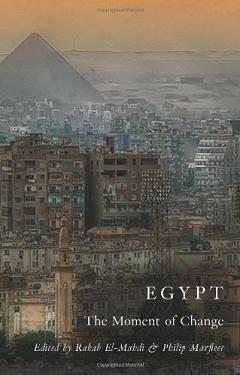
Rabab El-Mahdi & Philip Marfleet - Egypt: The Moment of Change

Revolutions these days seem two a penny. Mass strikes and protests did for Tunisia's dictator Ben Ali in what seemed like a few days. Egypt's Mubarak held on for longer, but as the mass of people in Cairo's Tahrir Square refused to give up in the face of the state's repressive force and strikes broke out across the country, even he couldn't remain in power. As I write this, Libya's Colonel Gadaffi appears to only have the most brutal of methods left to secure his position.

The authors of this collection of essay's published in 2009 are all political activists, if not revolutionary socialists. But they cannot have foreseen the events that have shaken the Middle East. The book though, is not dated by recent events. If anything it is even more relevant and I would argue, it is a crucial read for all those trying to understand the Egypt Revolution. Revolution is a process - and what happens is dependent on what has gone before. Egypt: the Moment of Change is about what has gone before.

Each chapter of the book looks at a particular aspect of Egypt's history and political/economic situation. All of them come together to give a unique picture of why the revolution broke out and who the major forces are. Egypt as a society is dominated by one key economic factor - the continued attempts to open up the economy to the free market. Pushed, over the past two decades by a variety of "economic advisers", who mostly hailed from Washington, the Egyptian state has been quick to sell off assets - state companies, land and so on, to outside investors. Such profiteers have helped drive up the cost of living for ordinary people, making the very richer even richer, and the majority of the people poorer.

Here is the contradiction that is so visible to the visitor - high security compounds and shopping malls - which allow in the rich, but deny access to the poor. It's why Egypt has experienced a variety of strikes and protests over the years. The corruption, the rising price of food, lack of access to jobs and drinking water combine to create a society bubbling over with indignation.

Various forces have sought to push this process forward and hold it back. The Trade Union movement up until 2011 was very much one of state unions. These existed to close down workers action, prevent strikes and form deals with the bosses. Union officials were little more than hired functionaries of the state, and many did very well out of this relationship. Various democracy organisations have exploded onto the streets over the years. The  Kifaya movement (meaning Enough) in 2004 did a lot to prove the state was not all powerful. Many brave men and women suffered indignation, brutality, torture and sexual assault because they dared to call for change. The chapter on these movements by Rabab El-Mahdi is particularly interesting because it shows how much the global movement against the Iraq War and in support of the Palestinian people helped to encourage things.

But economic factors aren't the only reason for this uprising. This repressive state, with its allegiance to the US and it's failure to stand up against oppression in the wider Middle East, in particular the question of the Palestinians and the US War on Terror, has been part of generating wider discontent and radical ideas.

The repression that Mubarak's state forces imposed on those prepared to stand up for something different is horrific. But it certainly wasn't the result of a few rotten apples. Aida Seif El-Dawla's chapter on state repression puts torture as an endemic and central part of the repressive process - on that exists and is supported at every level. Combined with the huge amounts of corruption amongst state functionaries and this leads to enormous brutality, often with little or no evidence.

But this state force effectively melted away in Tahrir Square. The police proved ineffectual at stopping a real mass movement. The army, itself a bloated and influential body, swollen on US "aid" dollars, were also unable to make a difference. But this must in part be due to the close links between a mass conscript army and the ordinary people of Egypt.

The struggles for land, against repressive taxation and corrupt landlords, the mass strikes that have shaken Egypt over the last five years have a common root. Those who argue today that Mubarak's fall was simply to do with the use of twitter or facebook, misunderstand the social processes that developed over years, involving many different actors, which culminated in the overthrow of the dictator. Mubarak's downfall is not the end of the story. The Egyptian Revolution has a longer road to travel. The struggle for justice and democracy, or access to water and decent food, for proper wages and the right to organise at work, will not be won by dispensation from a benevolent army council - it will have to be fought for. The Egyptian people have shown over the years that they are up to this task. We can wish them well and be inspired for our own struggles for justice.

This short book is an invaluable resource for all those wanting to get to the bottom of the process. It comes highly recommended and should be required reading. I hope they write a follow-up which details the revolutionary year of 2011.

Further Reading

A more detailed review from Socialist Review is here.

Socialist Worker (UK) continues to have unrivalled coverage and analysis from Egypt and the wider Middle Eastern struggles. Editor Judith Orr's eyewitness accounts were inspirational. Further analysis pieces will no doubt follow, though this article by Alex Callinicos on whether the revolution was a coup or not, is particularly useful.

For more on the mass strike movement prior to 2011 this article from the IS Journal by one of the contributors to Egypt: The Moment of Change, is very useful. An interview with an Egyptian socialist one the strike movement from 2007 is also interesting, in particular because it looks briefly at the relationship between socialists and the Muslim Brotherhood in various struggles.

Tuesday, February 22, 2011

Terry Pratchett - Unseen Academicals

Capitalism is very adept at taking old traditions, remoulding and repackaging (and occasionally reinventing) them in its own interests. These interests are usual those of short term profit, but they can also be in the interest of propaganda, or the creation of ideas of nation or racial superiority. One of the things that has been adapted and distorted by modern society are the games that communities have played. From traditional games played in working class communities or on village greens, multi-billion pound international sports have been created.

This is perhaps most obvious with football and in his latest Discworld novel, Terry Pratchett satirises the process extremely well, adding in his usual comic mix of magic and chaos. Pratchett has the eye for a good opportunity for satire. In my opinion football is worthy of this, not least because of the way that it is already fairly funny. It's million pound players, who seem to have little of worth to say, the entourage of glamorous wives who follow these players around and gather such bizarre press attention. The strange customs of the fans and the odd little traditions. All of these are stretched and distorted by Pratchett.

In the novel, football is a mass participatory sport, enjoyed mostly for the opportunities for fighting between the groups of fans. Huge crowds swell the streets, there are limited rules to the actual game and the state (via the medium of Ankh-Morpork's Watchmen) have little or no control on match-days. Games are the occasion for much anarchy and revelry. Much like the original football "matches" here in Britain.

Such anarchy needs to be brought under control and the city's leader Lord Vetinari does what rulers have done through the ages. He brings the game under his wing, offers it reward and respectability and fashions order from chaos. No matter that the games has lost its real roots, it is now a method of control and profit.

Pratchett does all this well. By setting up the comic figures of the city's Wizards as a new football team the story has some roots. This unlikely idea is designed to attract those readers who already have pictured the new players as over-weight, lazy academics. But this need to be in the know may well confuse newer readers.

Here again is a criticism I've previously made of Pratchett's more recent novels - because they come across as formulaic, they aren't as amusing as they used to be. There are fewer laugh out loud moments in Unseen Academicals. The characters all have their predetermined parts to play, and us regular readers will come to expect them to have their walk on parts sooner or later. There are a host of new individuals, but they seem to flit onto the stage and leave without leaving us with much.

Pratchett is a brilliant writer. We'll all continue to read his books even though they are now weaker than they were, not simply out of loyalty but also out of genuine love. But there does seem to be something increasingly missing from them.

Related Reviews

Pratchett - Wintersmith
Pratchett - Thud
Pratchett - Going Postal
Pratchett - Colour Of Magic

Monday, February 14, 2011

Antony Beevor - D-Day; The Battle For Normandy

Antony Beevor's latest book is an excellent addition to his earlier works, particular those on the battles for Stalingrad and Berlin. In some ways for this reader, coming from Britain, it's a book that is closer to home. After all this was a battle fought by Allied soldiers who were either British or invading the continent from Britain.

The battles themselves are described in gruesome detail, as is the nature with Beevor's writing. He doesn't shirk from the horrors of battle, nor does he fall into the trap of describing a generic "bad" enemy and "good" allies. So we hear about the killing of POWs by the Germans and by the British, Canadian, American and other allied forces. Of course, Beevor is quick to point out that there was a particular brutal response from some of the German forces - the massacres of entire villages in response to resistance fighters for instance - by the SS in particular.

At the top of the story is the relationships between the various allied leaders. Here the differing styles and emphasises has the most impact. It's clear that there were real personal clashes between say the Americans and British had a lasting impact. The British General Montgomery comes across as a real barrier to the further development of the front in the crucial weeks after the invasion. Beevor does point out that Montgomery took on the hardest and most entrenched enemy forces, and the contribution of the British certainly helped the Americans elsewhere. But there is no doubt that there is a lasting anti-Montgomery prejudice from the official American military histories.

The liberation of Paris and the particular role of the insurrectionary resistance fighters in the capital forms the end of the chapter. The story of the particular factions involved in this is fascinating, as is the clear fear from the allied leaders of a Communist inspired revolutionary take over. Here Beevor is astute enough to also argue that this was a fear for Stalin, who had now moved so far from the politics of international revolution that he had no interest in such an outcome on the Western Front.

Beevor's conclusion is the invasion of Normandy was a crucial point in World War Two. Not particularly because it changed the outcome of the conflict - that had already been decided outside Stalingrad, but because it allowed the United States in particular, and to a much lesser extent Britain and France a voice in the post-war carve up of Europe. This is an important argument, challenging the more common idea that it was the West that won the war. It is because he makes such realistic appraisals, despite their likely unpopularity amongst sections of his readership, which makes Antony Beevor such an excellent military historian.

Tuesday, February 08, 2011

Eleanor Burke Leacock - Myths of Male Dominance

Eleanor Burke Leacock's collection of essays, Myths of Male Dominance (Collected Articles on Women Cross-Culturally) is one of the most important works for those who argue that the way we live our lives today is not the natural order of things. Leacock's articles are a powerful defence of the Marxist notion of "Primitive Communism" - the idea that in humanity's past, our societies were egalitarian, private property was unknown in a general sense and class differences nonexistent. Most interestingly, this means that there were also differences in the way that men and women related - monogamy has not always been the natural way of doing things, men have not always been dominant in relationships or society, and different attitudes to sexuality have been far more common that most commentators would have us believe.

Leacock's own research was centred on a Canadian tribe called the Montagnais-Naskapi. These were people who, in their hunter-gather past had lived in a "primitive communist" society. What is almost unique about them, is that this lifestyle had been extremely well documented by the Europeans who encountered them. The Montagnais had lived by collected the fruit and berries of their local area, as well as hunting the plentiful game at different times of the year. European traders arrived in the 1600s and began to trade goods, with the Montagnais in exchange for vast quantities of furs - beaver and the like.

This caused a fundamental transformation of Montagnais life. From a society were private property was almost unknown, were decision making was a collective process and status in society was not based on property or any form of economic power, the Montagnais were transformed into a people were private property (in this case the animal traps and the associated areas of rivers / land) formed part of their lives. This introduction of private property changed all the other relationships in their society, as did the cynical and regular interference of Jesuit missionaries. The Jesuits who documented the lives of the indigenous people, also attempted to introduce more European things - like leaders, monogamy, physical beating of children and so on. Prompting one Montagnais to say "You Jesuit's love only your own children, we love all of them".

By the time Leacock was able to live with the Montagnais, a surprising amount of their earlier social relations still existed. She describes how hard she found it to understand the collective decision making process as someone who has only lived in a society with leaders and social hierarchies.

These experiences and the documentary evidence of a people with a completely different set of relations of productions to those we see in the vast majority of the world today shape most essays in this book. Leacock looks at the role of women in Montagnais society - and similar societies around the world, family relations and so on. She also look critically at the ideas of two of the thinkers who have most often dominated this form of discussion for the left - Lewis Morgan and Friedrich Engels.

Collected here is her introduction to Lewis Morgan's classic book of anthropology - Ancient Society. The book itself informed Engels' own work (as well as Marx) in particular, The Origin of the Family, Private Property and the State. Leacock wrote a classic introduction to this as well, of which sadly only part is in here.

Rather impressively, Leacock also includes articles and critical responses from other anthropologists - together with her reactions. This is of great interest, in part because she is a born polemicist, but also because it is fascinating to see her ideas tested, and passing the test.

For anyone with an interest in ancient cultures, this is a fascinating book. However it should also be required reading for everyone who wants to argue, or dares to believe that the "natural" relationships that we experience under capitalism are anything but natural.

Related Reviews

Wednesday, February 02, 2011

Edward Vallance - A Radical History of Britain

Before anything else is said about this book, the author should be congratulated at the very least, for attempting this monumental task. Anyone trying to get to grips with almost 800 or so years of radical history has set themselves an enormous job. To cover everything, even in 551 pages would be almost impossible, to do what is covered justice would take a historian of some note.

What is good about this book then, is the sense of rescuing a hidden history. The moments in Britain's past when men and women took it on themselves to attempt to change their world. Sometimes this was in small ways - local protests and uprisings. Sometimes they tried to overturn the whole world order. And we should learn this history - the story of the Peasant Revolt of 1381 has its lessons for today (don't trust the ruling class when they are forced to negotiate) for instance. To bring the stories of the English Revolution, the Levellers and the Diggers, the struggle for the vote, the battles for rights and justices is an important task. I hope that many people learn about these struggles from Vallance's book and take the time to delve deeper.

That said, the book itself is an immense disappointment. In part this is because the book is so large in its scope. Important points of history often receive only the briefest of mentions (more on that later) and sometimes Vallance (as with his discussion on the English Revolution) sticks to a very mainstream retelling of the history.

Another problem is the author's focus. All too often this radical history is a history of key figures or big names. I rarely felt I was hearing the voices of the ordinary people most affected by what was going on. That's not to say that people like Tom Paine, the Pankhurst's or the leading names of the Revolution aren't important. But moments of great radical change come because there are social forces moving, and they move because of other factors.

Why did women want the vote? What made people join Cromwell's forces? How come people marched to Trafalgar Square to demand the right to assemble in the 1890s, but not 10 years before hand?

To be fair, Vallance might say he wasn't writing a "People's History". That's a point, but by definition a radical history has as it's focus, changes to the system that are in the interests of the ordinary people at the bottom of society, rather than those at the top. But even so Vallance is selective in his choice of important radicals. William Morris gets a few pages, the Pankhurst's get whole chapters. King Alfred, rather bizarrely gets a good chunk. But there are strange omissions - George Lansbury gets a couple of oblique mentions, despite putting himself at the head of one of the largest radical revolts in recent history.  John McLean gets a passing mention (Scotland is barely discussed) and Communist MPs like Phil Piratin or William Gallacher, who lead real mass movements, aren't discussed.

Perhaps these references reflect my own orientation on the history of Britain as seen through the eyes of a Trotskyist. But what about such figures as Owain Glyndŵr or William Wallace who must surely fit into the broadest definition of radical. Even Gordon Brown is referrenced more times than William Wilberforce (a figure that most liberal historians would consider fairly radical - Wilberforce that is, not Brown). Actually it's a great crime that the entire struggle against Slavery is missing.

Then there is the detail. It shold be said that the book gets worse the closer we get to contemporary times. The earliest chapters, particular those on the Peasants Revolt and the periods around the French Revolution are well written, though the chronic lack of references makes it difficult to learn more. The chapter on the English Revolution is very complex and difficult. If you don't know anything about this particular period, it is not a good place to start at all, painted as it is as a battle dominated by religious arguments.

But because Vallance doesn't start from what's happening in wider society, but begins with the individuals at the head of movements he comes unstuck. The struggle for Women's liberation for him, is dominated by the arguments between the militants and the rest of the movement. He concludes that militant action fails to deliver and becomes a hindrance and ends up with a position that implicitly argues that the Suffragettes had to wait for a more friendly government to arrive. No to a point this is true, but what Vallance misses is that the radical militancy stemmed from a movement that had failed to mobilise the mass of working people into it's orbit.

Had the working class movement used its powers to force change, then the battle would have been shorter. The tragedy of the Suffragette movement was that much of it was dominated by a Middle Class leadership who, while brave enough to go to jail and risk their lives, were terrified of wider social unrest that could have forced the governments to listen. Breaking windows gets media coverage, but it doesn't frighten the forces of the state and the descent by sections of the movement into even more radical acts reflects the frustration of this.

Vallance also fails to grasp the wider situation. For him, the involvement of women in the workforce during the First World War was something that came and went, with little lasting impact. He argues that most of the jobs they did were ones that they had before the war, which I don't think stands up to scrutiny (munitions work?) Yet he also misses the way that this changed perceptions of women's roles and their perceptions of themselves - once lots of people had seen women driving buses then they weren't easily going to be able to put them back in their pre-war boxes.

If this wasn't the case, why did so much effort have to be put into forcing women back into their pre-war roles. The creation of women's Trade Unions and involvement of women in the wider union movement on an unprecedented scale certainly changed the working class movement. So by looking superficially, Vallance fails to grasp the real changes in society that were happening.

After the Suffragettes, Vallance has a chapter on the fight against Fascism (which devotes barely 2 pages to the question of Cable Street and the battles against the British Union of Fascists). He doesn't explain why fascism failed in Britain, but was successful elsewhere. Even if you don't believe (as he doesn't) that Cable Street was particularly important, surely the debate deserves more than he offers here. There is nothing here about the Second World War, or even the post-war battles against fascists and the later NF.

But radical history apparently stops for Vallance with World War Two, but even his post 1900 history is severely wanting. The 1926 General Strike gets less than one page. The Great Unrest is by-passed, as is Red Clydeside and the 1919 strikes ("Britain on the Brink of Revolution"). The Russian Revolution apparently had no impact here - the Communist Party being irrelevant. Other missing moments are New Unionism (the Match girls get a couple of paragraphs) and George Lansbury's 1921 refusal to impose Tory economic policies on the poorest sections of British society. I could go on. In fact I will, because students of more recent radical history will be amazed that the mass movements against Apartheid, Racism and Fascism in the 1970s are missing, the union militancy that did for Edward Heath, the Miners Strike, CND, Wapping, the Poll Tax and finally the Stop the War movement of the last decade.

Actually to be fair, Vallance salutes the anti-Iraq war movement in his last paragraph, though he doesn't name it. But he ignores the fact that it also opposed war in Afghanistan. Now I might not expect Vallance to write a work of history that keen readers of Socialist Worker would appreciate, but to miss out the Miner's Strike and CND in a work on the radical history of Britain, is a bizarre error. This is a problem, because arguably the struggles of the 20th Century have shaped our culture, politics and social structures far more than those of much earlier times.

The problem is of course, the one that has beset liberals for decades - the question of the Labour Party. Ultimately this is a history that is about the struggle to get the Labour Party to office, through the enfranchisement of the poorest in society. This means of course, that criticism of Labour is frowned upon and more recent radicalism is brushed under the carpet because it might show Labour in a worse light. Thus the culmination of radical history for Vallance is the building up of the Labour party into a party fit to govern. Towards the end of his book he explicitly says this, arguing that few in Britain's radical history wanted to level out things. In other words, British radicalism is a different beast to that of France or Russia - it is not about building a new world, but creating a nice capitalism, overseen by a friendly government.

By concentrating more on the earliest period of radical history (important though they are) you end up with a book that will be appreciated by Gordon Brown and Ed Miliband. You can look left wing and radical by informing the masses about Wat Tyler and Tom Paine. But don't let on about how Labour failed the miners, or how the TUC has failed the organised working classes time and again. To do that, might have ramifications today, and we can't risk the next General Election can we?

Tuesday, January 25, 2011

Frederick Engels - The Origin of the Family, Private Property and the State

Frederick Engels' book, The Origin of the Family, Private Property and the State was an incredible achievement. It shows Engels' and Marx's fascination by every aspect of human life and history. Engels shows a deep knowledge of his subject, which while dated by today's understanding, must have meant he was at the forefront of contemporary anthropological work.

Origin is an attempt to demonstrate that the way in which human society is organised has radically changed through the years. Human's haven't always lived in a society that is based on competition, earlier societies, particularly those we would now call hunter-gathering communities, were Engels argued based on primitive communism. In these there was no private property of land or materials and this meant that human relationships were based on eglatarian principles.

Engels' starting point for much of his work are the writings of Lewis Morgan, who was the first person to propose a stagiest history for humans, arguing, based on his understanding of langugages around the world, that people tended to follow a particular set of social organisations through the centuries. These three stages, savagery, barbarism and civilisation had with them a particular set of social organisations, particular those to do with the family and marriage.

Engels is particularly keen to show that the subjagated position of women under capitalism, was not something that was always true. He writes "That woman was the slave of man at the commencement of society is one of the most absurd notions that have come down to us from the Enlightenment".

Engels, following Morgan, writes that the modern family arises as part and parcel of the development of private property relations. Because in the first instance, material objects (such as tools) and the produce of agriculture end up in the hands of males in society (due to the division of labour that takes place as women take on the primary role of bringing up children) this leads to the male lineage becoming important for the inheritance of wealth. This then, for Engels is the world historic defeat of the female sex. It is also a defeat for males to, as it creates a situation were no one can be happy. Engels is at his best when he demonstrates, that we live in a world were monogamy is held up to be the ideal, but is not the reality (particularly for men) and this situation will continue until the means of production are once again held in common - and the individual family ceases to be the basic economic unit in society.

Much of the central arguments of Engels work, on the social relationships between people in ancient societies and their languages can be shown to be flawed. But this doesn't invalidate the central themes of his book, that the rise of class societies and the associated move towards private property leads to radically different family relations.

The section on the state is the most useful here. Engels shows how the state machinary develops as classes arise, with the needs of one group (the ruling class) to protect its interests and its wealth. Engels contrasts the complex machinary of the state, with its police and judges and so on, with the "child like simplicity" of earlier societies that needed no such armed bodies of men. This state, Engels argues needs to be smashed and placed in a musuem alongside the "spinning wheel and the bronze axe". This will require a revolution in property relations, and the creation of a world which holds the means of production in common.

This new world would bring with it the emancipation of women. Only when women are able to take a full part in production within society will they truely hold an equal position in society - in other words, when women are free to do what they want, because of socialised childcare, because of full access to abortion and contraception and because they are not held back by artificial social constructs like the family under capitalism.

Engels work is still inspirational, if a little complex at times. It's worth perservering with, because it is the first real attempt by a Marxist to grapple with some of the complex questions thrown up by human history. If you get a copy, it's worth finding an edition that has an introduction that takes up some of the anthropological questions and develops these. The Marxist anthropologist Eleanor Burke Leacock wrote an introduction that did this, though I am not aware that it is in print. Part of it was reprinted in her collection Myths of Male Dominance, which I will review shortly. It is also mostly available here at Google Books.

Related Reviews

Engels - Socialism: Utopian and Scientific
Marx and Engels on the Population Bomb
Engels - The Condition of the Working Class in England
Dee - The Red in the Rainbow - Sexuality, Socialism & LGBT Liberation

Friday, January 21, 2011

Keith Miller - St Peter's

The church of St Peter's is surely one of the most awe inspiring pieces of architecture in the world. Whether or not you find it beautiful, or whether you yourself inspired into religious excitement by it is a different question. It's a powerful statement of strength by the Catholic Church, perhaps summed up by one visitor, Florence Nightingale who wrote that:

"No event in my life except my death can ever be greater than that first entrance into St Peter's, the concenrtated spirit of the Christianity of so many years, the great image of our faith which is the worship of grief."

Keith Miller explores the buildings history and its links with the growing power of the Popes and the Church. The building itself is a strange amalgam, being built on the site (and incorporating some of the walls of a much older St. Peters). Miller points out that this may in part be deliberate - by re-using ancient materials, we get a sort of concrete (excuse the pun) statement about the triumph of the Christian church over paganism. Its architects seem inumerable and its inspirations are many. Fashion comes and goes in the world of bricks and mortar as much as in that of fashion, and the changes of style and design over the centuries are well documented here.

For the non architectural expert, some of the book is daunting. Like all experts there is a private language which, even in books that are attempting to be accessible can only serve to mask what is being said. What are pilasters for instance, and how do windows "snarl" as Michelangelos are supposed to? The book is perhaps also a little incomprehensible to those who haven't visited St Peters, unlike some of the others in this series, you really have to have been there. And perhaps this is the real aim of the book - it is a trawl through the history that frames St Peters - the stories of the ruling classes who have used the building, or sought to use its image to strengthen their own social position, rather than a blow by blow account of the building itself.

St Peter's continues to inspire - many buildings have borrowed its dome in particular - the Bank of England and St Paul's for instance. Though I was interested to learn that while a recent church in the Ivory Coast has done the same, their dome is bigger!

So if you're going to Rome, and plan to visit St Peter's this is a great guide book. It is fascinating and amusing and doesn't simply fall into the trap of listing sculpture after sculpture with some meaningless dates.

Related Reviews in the Wonders of the World series
Watkin - The Roman Forum
Fenlon - Piazza San Marco
Tillotson – Taj Mahal
Goldhill - The Temple of Jerusalem
Gere - The Tomb of Agamemnon
Ray - The Rosetta Stone
Hopkins & Beard - The Colosseum